Question
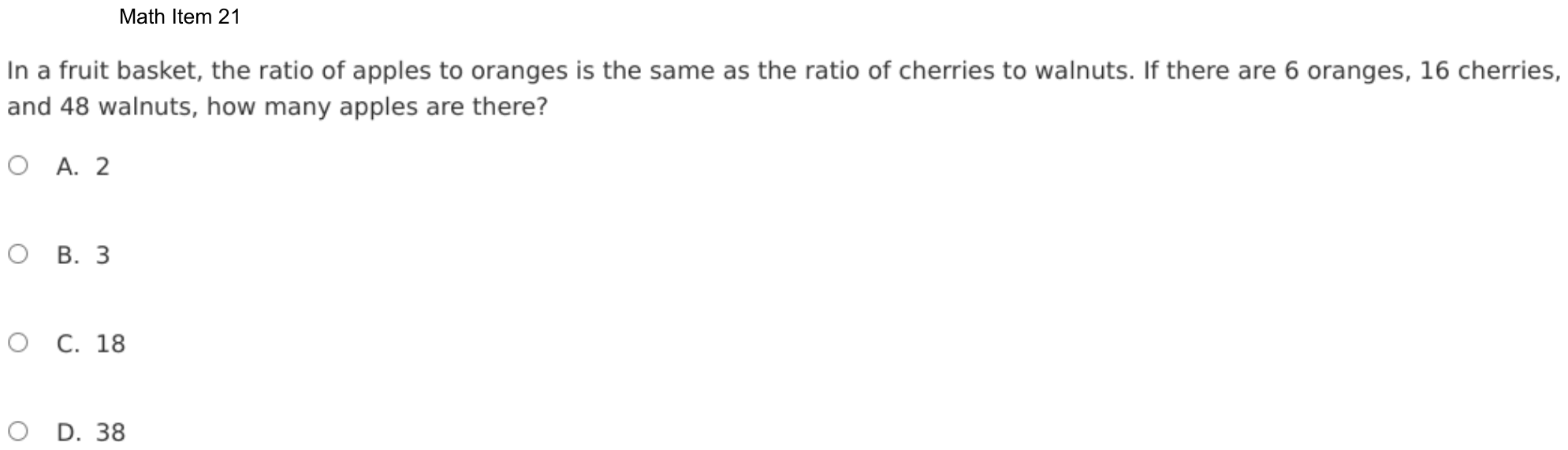
In a fruit basket, the ratio of apples to oranges is the same as the ratio of cherries to walnuts. If there are 6 oranges, 16 cherries, and 48 walnuts, how many apples are there?
- A2
- B3
- C18
- D38
Show the answer
Correct answer: A
The ratios of the items are equal, so they can be expressed using a proportion.
Let a represent the number of apples, o the number of oranges, c the number of cherries, and w the number of walnuts. Write a proportion showing apples:oranges is equal to cherries:walnuts:
Substitute the given values for oranges (6), cherries (16), and walnuts (48):
Cross multiply to form an equation to solve for the number of apples (a):
Solve for the value of a:
Question analysis
In a fruit basket, the ratio of apples to oranges equals the ratio of cherries to walnuts, and students find the number of apples from the counts of oranges, cherries and walnuts. It tests setting up and solving a proportion. Matching each quantity to its place in the ratio matters, since the wrong order gives a very different count.
- Grade level
- Grade 6 content, by NYS standard
- Compared with grade 7
- Below grade 7 Equal ratios with whole numbers are grade 6 work, and the numbers divide evenly. Grade 7 proportion problems are usually longer; here the only care is keeping apples with oranges in the same order as cherries with walnuts.
- Estimated difficulty
- Straightforward: two steps or one careful reading.
- Thinking it demands
- Depth of knowledge 2, skills and concepts · mainly apply
- What makes it hard
- Turning words into math minor
- Much to keep track of minor
- Solution
- 2 steps
- Reading level
- Question and choices: about grade 7, 32 words.
- Students, last 30 days
- Not enough answers yet to show (it takes 10).
Why it is hard, traps and wrong answers (shows the answer)
Why it is hard
The numbers divide evenly, since 16/48 is 1/3, so the work is in the setup. Writing the two ratios in the order the sentence gives them makes the apples a third of the oranges; writing either one upside down makes them three times the oranges. A quick sense check helps: cherries are fewer than walnuts, so apples must be fewer than oranges.
Turning words into math minor Understanding the question
The sentence pairs apples with oranges and cherries with walnuts in the same order, so a/6 = 16/48; reading either pair the other way turns one ratio upside down. (Hegarty, Mayer & Monk, 1995; Koedinger & Nathan, 2004)
Much to keep track of minor Working it out
Four kinds of fruit are named and three counts given, and the unknown apples must be matched with the smaller count, the cherries, not the larger, the walnuts. (Sweller, 1988; Carpenter, Just & Shell, 1990)
Strategy: Write apples over oranges equal to cherries over walnuts, simplify the known ratio, and scale it to match the 6 oranges.
Traps
- Wrong operation: Adds instead of multiplying, divides the wrong way round, turns a ratio or rate upside down, or undoes a step in the wrong direction (subtracts what should be added back).
- Stops one step early: A choice is a number from partway through the solution.
- Misunderstands the concept: A wrong belief about a concept: that percents can be added, that area grows like length, that averages can be averaged, that a bigger denominator means a bigger fraction.
The wrong answers, classified
B Stops one step early (King et al., 2004; Gierl et al., 2017)
Divides the 48 walnuts by the 16 cherries to get the factor 3 and stops before using it to divide the 6 oranges.
C Wrong operation (Hegarty, Mayer & Monk, 1995; King et al., 2004)
Turns one ratio upside down, setting apples over oranges equal to 48 over 16, so the apples come out as 3 × 6 = 18.
D Misunderstands the concept (Smith, diSessa & Roschelle, 1993; De Bock et al., 1998; Ni & Zhou, 2005)
Reasons with differences instead of ratios, taking the gap of 32 between walnuts and cherries and adding it to the 6 oranges.
Worked solution, step by step
Formulas used
- Equal ratios
- A ratio compares two amounts. Writing it as a fraction puts the first thing named on top. The question says the two ratios are the same, so the two fractions are equal. Keep the same order in both.
Sort out the question
A ratio compares two amounts. The ratio of apples to oranges equals the ratio of cherries to walnuts. You know there are 6 oranges, 16 cherries and 48 walnuts. You need the number of apples.
Write the proportion
Put the first thing of each pair on top. Apples go with oranges, and cherries go with walnuts. Let a be the number of apples:
Watch out: keep the order the same. Writing 48 over 16 flips the second ratio. That gives 18, choice C.
Simplify the known ratio
16 goes into both 16 and 48. Divide the top and the bottom by 16:
So there is 1 cherry for every 3 walnuts. There must also be 1 apple for every 3 oranges.
Find the apples
Now the proportion is:
The bottom 6 is 3 × 2, so the top is 1 × 2. That makes .
Watch out: is choice B, but that is not the number of apples. And 38 comes from using differences instead of ratios.
So the answer is A, 2.
Check your answer
Compare the ratios. Apples to oranges is 2 to 6. Cherries to walnuts is 16 to 48. In both, the second number is 3 times the first: and . So the ratios are equal.
More questions like this
The original DOE question