Question
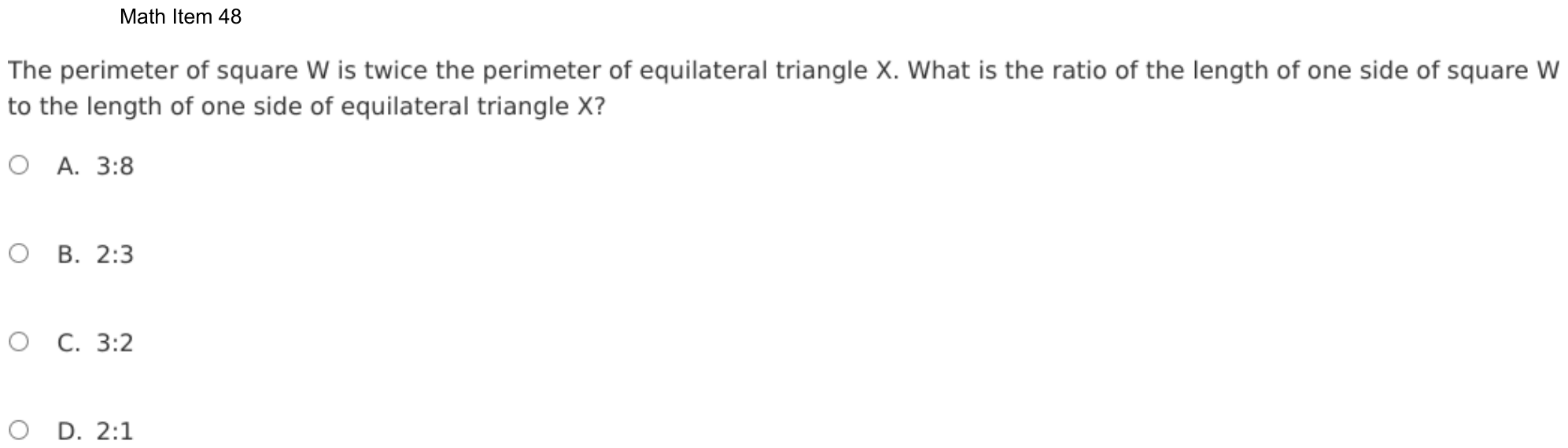
The perimeter of square W is twice the perimeter of equilateral triangle X. What is the ratio of the length of one side of square W to the length of one side of equilateral triangle X?
- A3:8
- B2:3
- C3:2
- D2:1
Show the answer
Correct answer: C
First, set up the ratio of the perimeter of the square to the triangle as 2:1 because the question states that the perimeter of the square is twice the perimeter of the triangle.
Recognizing that the square has 4 equal sides and that an equilateral triangle has 3 sides, use division to find the ratio of the sides.
Perimeter:
Sides:
Question analysis
The perimeter of square W is twice the perimeter of equilateral triangle X, and students find the ratio of a side of the square to a side of the triangle. This ratio question uses perimeters of regular shapes with no lengths given. Turning a comparison of perimeters into one of sides, and keeping the ratio in the order asked, are the tricky parts.
- NYS standards
- Grade level
- Grade 7 content, by NYS standard
- Compared with grade 7
- Above grade 7 Grade 7 ratio problems usually supply numbers to work with. This one gives only a relationship between two perimeters, so students must bring in the number of sides of each shape themselves and keep the ratio in the order asked.
- Estimated difficulty
- Hard: combines ideas, needs a plan, and has more than one tempting wrong answer.
- Thinking it demands
- Depth of knowledge 2, skills and concepts · mainly apply
- What makes it hard
- Turning words into math moderate
- Variables instead of numbers moderate
- A very close wrong answer minor
- Solution
- 3 steps
- Reading level
- Question and choices: about grade 9, 36 words.
- Students, last 30 days
- Not enough answers yet to show (it takes 10).
Why it is hard, traps and wrong answers (shows the answer)
Why it is hard
The question turns a statement about perimeters into a ratio of sides, and the natural guess, that the sides keep the perimeters’ 2 to 1, ignores that the square shares its perimeter among 4 sides and the triangle among 3. Choosing a triangle perimeter such as 12 makes the comparison concrete. The order of the ratio still has to be checked at the end, because its reverse is listed too.
Turning words into math moderate Understanding the question
“The perimeter of square W is twice the perimeter of equilateral triangle X” must become 4s = 2 × 3t, with the 2 on the triangle’s side; written backward, it gives the triangle the larger perimeter. (Hegarty, Mayer & Monk, 1995; Koedinger & Nathan, 2004)
Variables instead of numbers moderate Understanding the question
No side length is given, so students must either work with letters for the two sides or choose a convenient perimeter themselves, such as 12 for the triangle. (Koedinger & Nathan, 2004; Enright, Morley & Sheehan, 2002)
A very close wrong answer minor Choosing the answer
The ratios 3:2 and 2:3 use the same two numbers, so only keeping the square’s side first, as the question orders it, separates the answer from its reverse. (Embretson & Wetzel, 1987; Gorin & Embretson, 2006; Ascalon et al., 2007)
Strategy: Pick an easy side length for the triangle, find its perimeter, double that for the square, divide by the square's number of sides, and write square to triangle.
Traps
- Misunderstands the concept: A wrong belief about a concept: that percents can be added, that area grows like length, that averages can be averaged, that a bigger denominator means a bigger fraction.
- Wrong operation: Adds instead of multiplying, divides the wrong way round, turns a ratio or rate upside down, or undoes a step in the wrong direction (subtracts what should be added back).
- Equation written backwards: Writes a comparison the wrong way round, word for word: "six times as many students as professors" as 6S = P. The bigger quantity gets the bigger number.
The wrong answers, classified
A Equation written backwards (Clement, Lochhead & Monk, 1981)
Writes the comparison backward, 2 × 4s = 3t, giving the triangle the larger perimeter, so the ratio of the sides comes out 3:8.
B Wrong operation (Hegarty, Mayer & Monk, 1995; King et al., 2004)
Finds the right relationship but turns the ratio upside down, giving the triangle’s side to the square’s instead of the square’s side first.
D Misunderstands the concept (Smith, diSessa & Roschelle, 1993; De Bock et al., 1998; Ni & Zhou, 2005)
Assumes the sides are in the same ratio as the perimeters, 2:1, ignoring that the square has 4 sides and the triangle only 3.
Worked solution, step by step
Formulas used
- Perimeter of a square
- P is the perimeter, the distance around the shape. s is the length of one side. A square has 4 equal sides, so its perimeter is 4 times one side.
- Perimeter of an equilateral triangle
- An equilateral triangle has 3 equal sides. t is the length of one side. So its perimeter is 3 times one side.
- Ratio
- A ratio compares two amounts in order. a : b means a compared with b. The order matters, so write the amounts in the order the question names them.
Sort out the question
Square W has a perimeter twice as long as the perimeter of triangle X. Equilateral means all 3 sides of X are equal.
You need the ratio of one side of the square to one side of the triangle, in that order. No lengths are given, so you can pick a size to try.
Pick a size for the triangle
Choose an easy side length for the triangle, such as 2 units. All 3 sides are 2, so its perimeter is:
Find the square’s side
The square’s perimeter is twice the triangle’s:
The square has 4 equal sides, so divide by 4:
Each side of the square is 3 units.
Write the ratio in order
The square comes first, then the triangle. Their sides are 3 and 2, so the ratio is 3 : 2.
Watch out: 2 : 1, choice D, compares the perimeters, not the sides. The square splits its perimeter into 4 sides, the triangle into only 3. Choice B, 2 : 3, puts the triangle first. Choice A, 3 : 8, comes from giving the triangle the bigger perimeter.
So the answer is C, 3:2.
Check your answer
Try a different size. Give the triangle sides of 4. Its perimeter is 12, so the square’s is 24. Each side of the square is . The ratio 6 : 4 simplifies to 3 : 2. The size does not change the ratio.
More questions like this
The original DOE question