Question
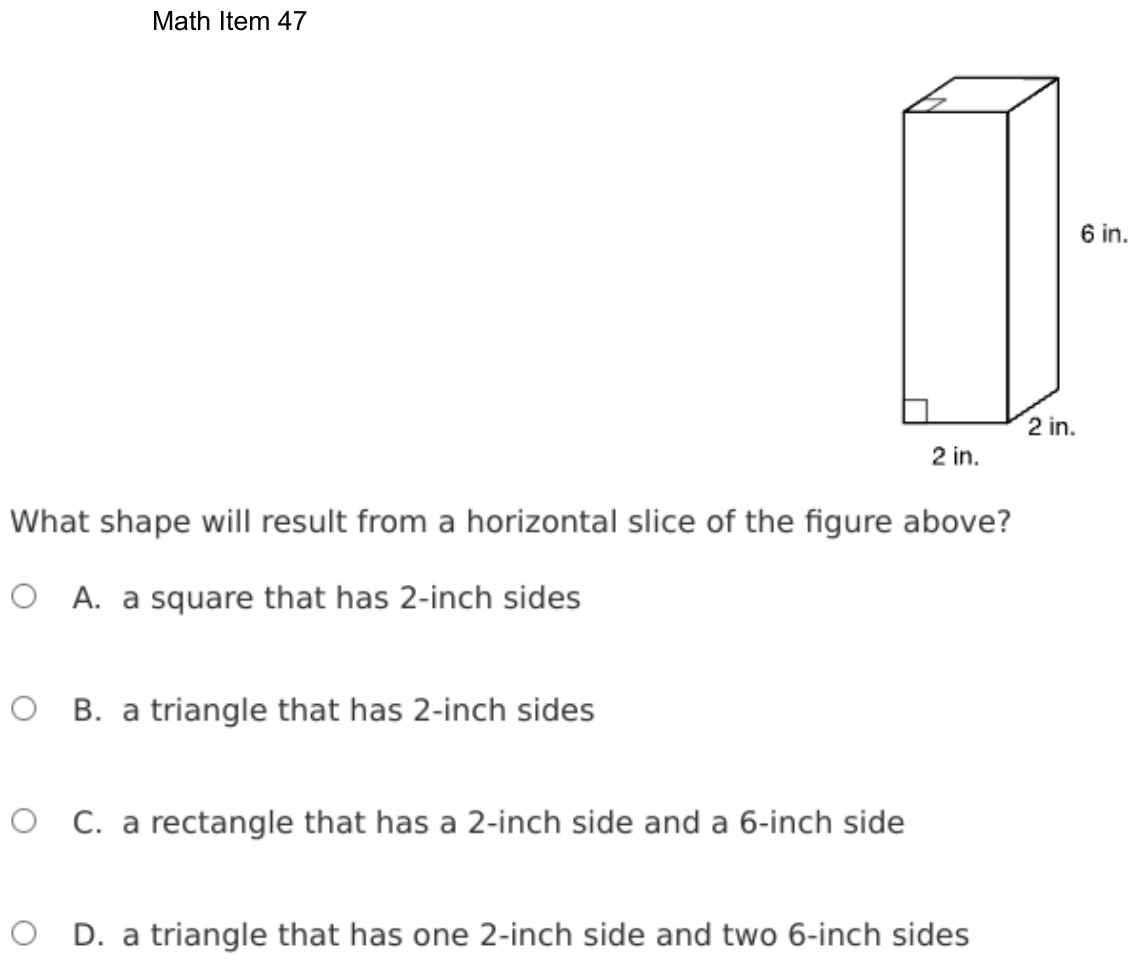
What shape will result from a horizontal slice of the figure above?
- Aa square that has 2-inch sides
- Ba triangle that has 2-inch sides
- Ca rectangle that has a 2-inch side and a 6-inch side
- Da triangle that has one 2-inch side and two 6-inch sides
Show the answer
Correct answer: A
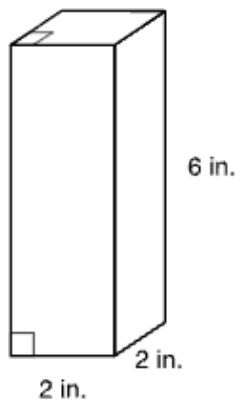
Based on the diagram, the figure shown is a right rectangular prism with a square base. A horizontal slice of the figure will be a plane parallel to the square base, as in this example.
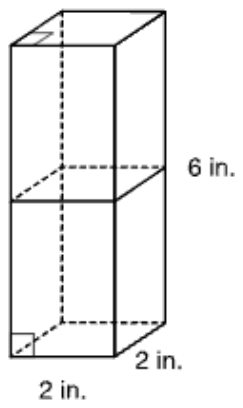
Since the horizontal slice is parallel to the base, it will be congruent to the base, which is a square with 2-inch sides.
Question analysis
A figure shows a right rectangular prism measuring 2 inches by 2 inches by 6 inches, standing on end. This geometry question asks what two-dimensional shape a horizontal slice of the prism makes. It tests visualizing cross-sections of solids, using the labeled lengths to name both the shape and its size.
- NYS standards
- 7.G.3 slicing three-dimensional solids
- Grade level
- Grade 7 content, by NYS standard
- Compared with grade 7
- At grade 7 Describing the shape made by slicing a prism parallel to its base is exactly the grade 7 standard. This is its simplest case, a single slice of a labeled right prism, typical of a classroom example.
- Estimated difficulty
- Routine: one familiar step, little to misread.
- Thinking it demands
- Depth of knowledge 1, recall and reproduction · mainly understand
- What makes it hard
- Solution
- 1 step
- Reading level
- Question and choices: about grade 2, 46 words.
- Students, last 30 days
- Not enough answers yet to show (it takes 10).
Why it is hard, traps and wrong answers (shows the answer)
Why it is hard
A horizontal cut runs parallel to the ground, and this prism stands on a square base, so the slice copies the base. The main danger is picturing the cut along the tall front face, which gives a 2-by-6 rectangle, the shape a vertical slice makes. The two triangles need a slanted cut through a corner and catch only students guessing.
Reading a figure, table or graph minor Understanding the question
The prism is drawn standing on end, 6 inches tall on a 2-by-2 base, so the cut has to be pictured in a flat drawing where the tall front face is the most visible shape. (Lesh, Post & Behr, 1987; Kirsch & Mosenthal, 1990)
Something you must already know minor Working it out
Students must know that a slice parallel to the base of a prism has the same shape and size as the base, which here is the square at the bottom. (Anderson & Krathwohl, 2001)
Strategy: Picture a flat cut across the prism parallel to the ground, ask which face of the prism that cut runs parallel to, and read that face's edge lengths from the labels.
Traps
- Misreads the question: Misses or misreads a condition or a word in the question: "at least", "each", "remaining", "not".
- Misunderstands the concept: A wrong belief about a concept: that percents can be added, that area grows like length, that averages can be averaged, that a bigger denominator means a bigger fraction.
The wrong answers, classified
B Misunderstands the concept (Smith, diSessa & Roschelle, 1993; De Bock et al., 1998; Ni & Zhou, 2005)
Expects a slice to cut off a corner and make a triangle, as a cut through a pyramid might, not a cut parallel to this square base.
C Misreads the question (Hegarty, Mayer & Monk, 1995)
Describes a vertical slice, which runs down the 6-inch height and makes a 2-by-6 rectangle, mixing up horizontal and vertical.
D Numbers taken from the question (Hegarty, Mayer & Monk, 1995)
Builds a triangle from the labels in the figure, one 2-inch and two 6-inch sides, a shape no horizontal cut of this prism can make.
Worked solution, step by step
Formulas used
- A slice parallel to the base
- The sign ≅ means congruent: the same shape and the same size. A prism has the same shape all the way up, like a stack of matching cards. So a cut parallel to its base, at any height, is a copy of the base.
Sort out the question
The figure is a right rectangular prism, a box shape whose faces are all rectangles. It stands on end. The two edges along the bottom are labeled 2 in. The tall edge is labeled 6 in.
You need the shape you get from a horizontal slice. Horizontal means flat, like the floor or a tabletop.
Find the base
The base is the face the prism stands on. The two bottom edges you can see are both labeled 2 in. The right-angle mark on the top face shows its corners are square. The top and the bottom match. So the base is a square with 2-inch sides.
Picture the slice
A horizontal slice cuts straight across the prism, parallel to the base. The walls of the prism go straight up, so the slice is a copy of the base. It is a square with 2-inch sides, at whatever height you cut.
The 6-inch height does not matter. It only tells how tall the stack of squares is.
Rule out the other shapes
Watch out: a 2-inch by 6-inch rectangle, choice C, comes from a vertical slice. That cut goes straight down, through the 6-inch height. A triangle, choice B or D, needs a slanted cut through a corner.
So the answer is A, a square that has 2-inch sides.
Check your answer
Picture the slice sliding up and down. At the bottom, it matches the base, 2 in. by 2 in. At the top, it matches the top face, the same square. In between, the walls are straight, so its size never changes.
More questions like this
The original DOE question