Question
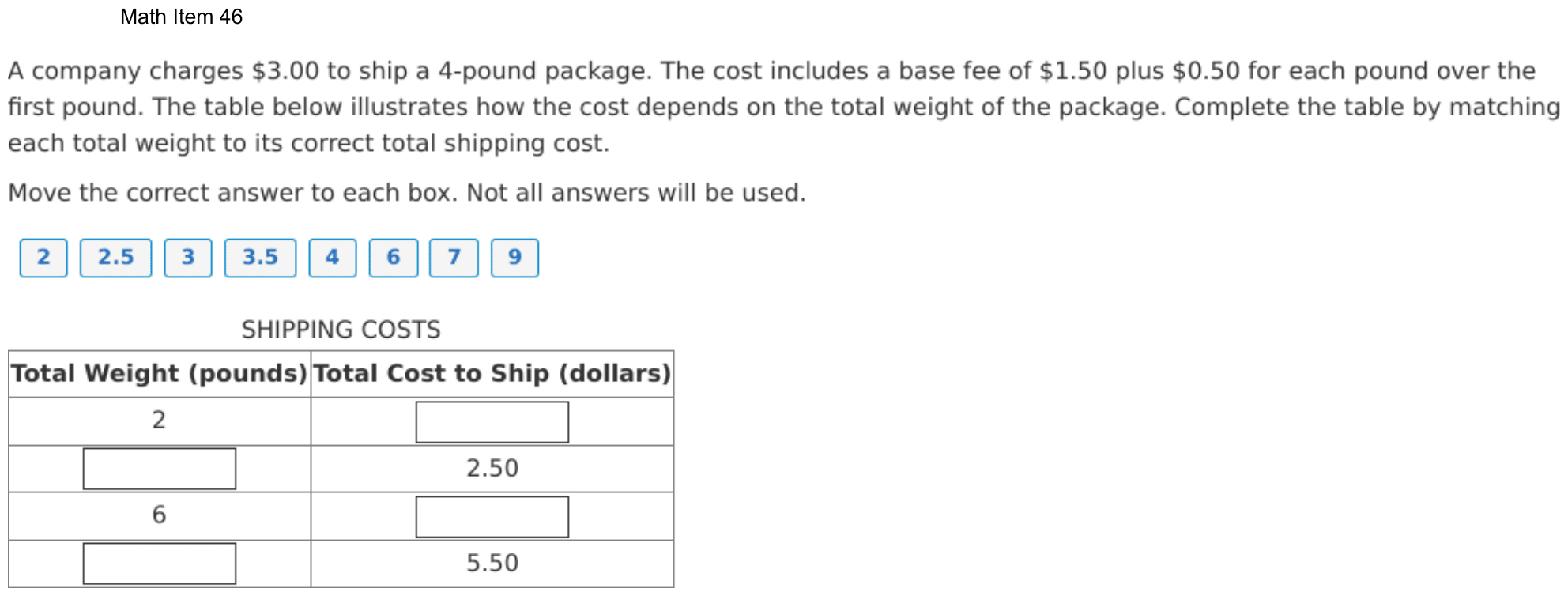
A company charges $3.00 to ship a 4-pound package. The cost includes a base fee of $1.50 plus $0.50 for each pound over the first pound. The table below illustrates how the cost depends on the total weight of the package. Complete the table by matching each total weight to its correct total shipping cost.
Move the correct answer to each box. Not all answers will be used.
SHIPPING COSTS
| Total Weight (pounds) | Total Cost to Ship (dollars) |
|---|---|
| 2 | |
| 2.50 | |
| 6 | |
| 5.50 |
On the test you drag tiles into the boxes; here, choose each box’s tile from its menu. Each tile can be used once. The DOE has not published how answers with several parts are scored; this site counts one right only when every part is right.
Show the answer
Correct answer: blank 1: 2; blank 2: 3; blank 3: 4; blank 4: 9
| Total Weight (pounds) | Total Cost to Ship (dollars) |
|---|---|
| 2 | 2 |
| 3 | 2.50 |
| 6 | 4 |
| 9 | 5.50 |
Let x represent the weight of the package in pounds. The first pound is included in the base fee of $1.50, so represents the number of pounds that cost $0.50 each.
The cost equation can be written as
- The cost for a 2-pound package is
- The cost for a 6-pound package is
-
The weight of a package that costs $2.50 to ship can be found by solving
-
The weight of a package that costs $5.50 to ship can be found by solving
To check:
Given that the total cost is $3.00 for the initial package
pounds fits the linear pattern of the table
Question analysis
A shipping company charges a base fee plus 50 cents for each pound over the first, and a 4-pound package costs $3.00. Students drag number tiles into a table to complete two costs and two weights, with some tiles left unused. It tests building and using a linear rule, and the wording about the first pound must be applied in every row.
- Grade level
- Grade 7 content, by NYS standard
- Compared with grade 7
- At grade 7 Grade 7 students solve word problems with equations like p(x + q) = r. This table needs that rule four times, twice run backward from a cost to a weight, and the phrase about the first pound must be applied every time.
- Estimated difficulty
- Moderate: several steps, or a close reading with one strong distractor.
- Thinking it demands
- Depth of knowledge 2, skills and concepts · mainly apply
- What makes it hard
- Turning words into math moderate
- Many steps minor
- Solution
- 4 steps
- Reading level
- Question and choices: about grade 4, 75 words.
- Students, last 30 days
- Not enough answers yet to show (it takes 10).
Why it is hard, traps and wrong answers (shows the answer)
Why it is hard
The rule is stated in words and confirmed by the 4-pound example, so the work is applying it consistently in both directions. Charging every pound breaks the $3.00 example at once, since 4 pounds would cost $3.50, and models that ignore the wording leave costs or weights with no matching tile. A shortcut helps: each extra pound adds $0.50 to the $3.00, so the table can be filled by counting up or down from 4 pounds.
Turning words into math moderate Understanding the question
The phrase “$0.50 for each pound over the first pound” means the first pound is covered by the $1.50 fee, so a package of x pounds pays for only x − 1 of them. (Hegarty, Mayer & Monk, 1995; Koedinger & Nathan, 2004)
Many steps minor Working it out
Four boxes must all be right, two found forward from a weight and two backward from a cost, and the backward rows need the first pound added back. (Daniel & Embretson, 2010; Enright, Morley & Sheehan, 2002)
Strategy: Write the rule as the base fee plus $0.50 times the pounds after the first, check it against the 4-pound example, then use it forward for the costs and backward for the weights.
Traps
- Misreads the question: Misses or misreads a condition or a word in the question: "at least", "each", "remaining", "not".
- Misunderstands the concept: A wrong belief about a concept: that percents can be added, that area grows like length, that averages can be averaged, that a bigger denominator means a bigger fraction.
- Stops one step early: A choice is a number from partway through the solution.
The wrong answers, classified
BAEH Misreads the question (Hegarty, Mayer & Monk, 1995)
Charges $0.50 for every pound, first included, so 2 pounds cost $2.50 and $2.50 ships 2 pounds; no tile fits its $4.50 or 8, so it settles for 4 and 9.
ACFH Misunderstands the concept (Smith, diSessa & Roschelle, 1993; De Bock et al., 1998; Ni & Zhou, 2005)
Triples the 2-pound cost for the 6-pound package, $2 × 3 = $6, treating the cost as proportional to weight though the base fee is paid only once.
ACBH Stops one step early (King et al., 2004; Gierl et al., 2017)
Charges $0.50 for each of the 5 pounds over the first for the 6-pound package but stops there, leaving out the $1.50 base fee and entering 2.5.
Worked solution, step by step
Formulas used
- Shipping cost
- C is the total cost in dollars, and w is the weight in pounds. The $1.50 base fee is paid once, and it covers the first pound. Each pound after the first costs $0.50. There are w − 1 of those pounds.
Sort out the question
The base fee of $1.50 covers the first pound. Each pound over the first adds $0.50. A 4-pound package costs $3.00.
You fill four boxes: the costs for 2 and 6 pounds, and the weights that cost $2.50 and $5.50. Each tile is used once at most, and four tiles are not used.
Test the rule on 4 pounds
Check the rule with the example. A 4-pound package has 3 pounds over the first:
That is $3.00, so the rule fits.
Watch out: charging $0.50 for every pound, the first one too, gives $3.50 for 4 pounds. That does not match.
Find the two costs
For 2 pounds, 1 pound is over the first:
For 6 pounds, 5 pounds are over the first:
The costs are the tiles 2 and 4.
Watch out: 6 pounds is 3 times 2 pounds, but the cost is not 3 times $2. The base fee is paid once. Tripling gives the tile 6. Leaving out the base fee gives the tile 2.5.
Work back to the two weights
For $2.50, take off the base fee: . At $0.50 a pound, $1.00 pays for 2 extra pounds. Add the first pound: pounds.
For $5.50: . $4.00 pays for 8 extra pounds. Add the first pound: pounds.
Watch out: forgetting to add back the first pound gives 2 and 8.
Fill in the four boxes
From top to bottom, the boxes get 2, 3, 4 and 9. The tiles 2.5, 3.5, 6 and 7 are not used. On the test, you drag each tile into its box. On this site, you choose it from the box’s menu.
Check your answer
Each extra pound adds $0.50, so count from 4 pounds at $3.00. Going down: 3 pounds cost $2.50 and 2 pounds cost $2.00. Going up: 5 pounds $3.50, 6 pounds $4.00, 7 pounds $4.50, 8 pounds $5.00 and 9 pounds $5.50. All four boxes match.
More questions like this
The original DOE question