Passage Martial Arts for the Mind and Body
Martial Arts for the Mind and Body
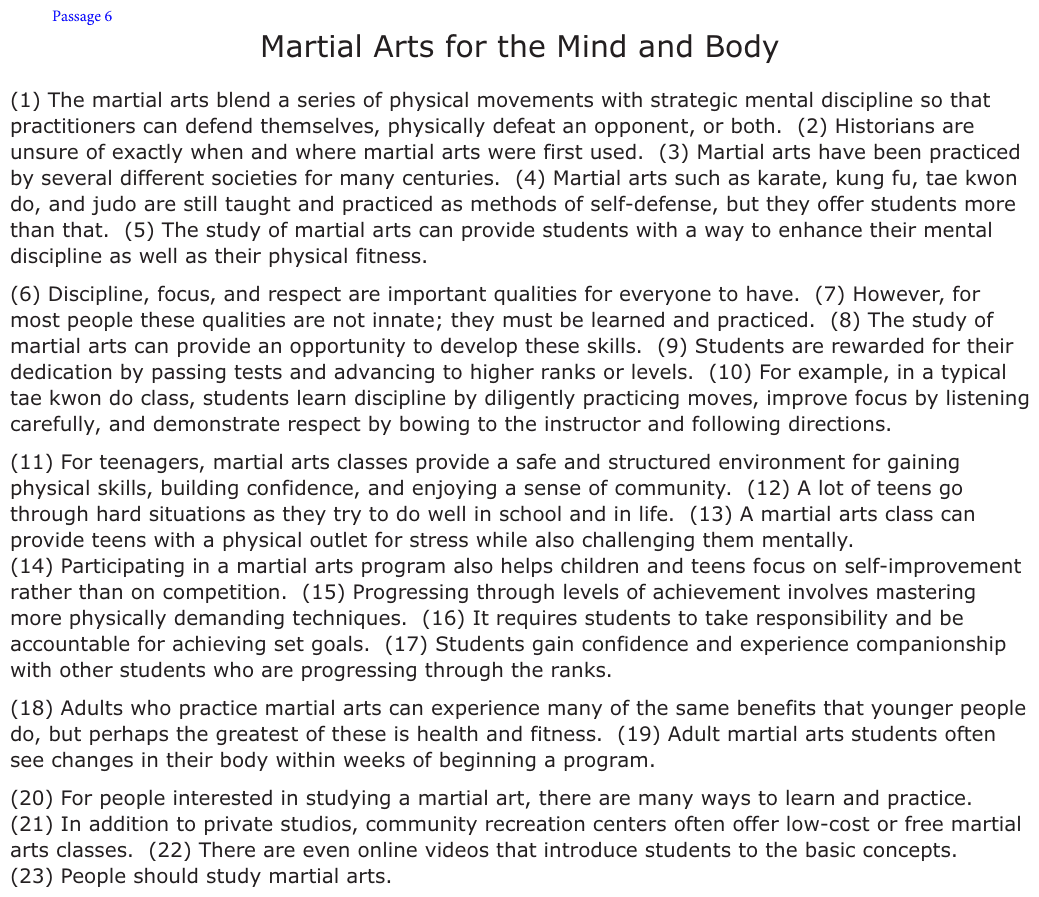
(1) The martial arts blend a series of physical movements with strategic mental discipline so that practitioners can defend themselves, physically defeat an opponent, or both. (2) Historians are unsure of exactly when and where martial arts were first used. (3) Martial arts have been practiced by several different societies for many centuries. (4) Martial arts such as karate, kung fu, tae kwon do, and judo are still taught and practiced as methods of self-defense, but they offer students more than that. (5) The study of martial arts can provide students with a way to enhance their mental discipline as well as their physical fitness.
(6) Discipline, focus, and respect are important qualities for everyone to have. (7) However, for most people these qualities are not innate; they must be learned and practiced. (8) The study of martial arts can provide an opportunity to develop these skills. (9) Students are rewarded for their dedication by passing tests and advancing to higher ranks or levels. (10) For example, in a typical tae kwon do class, students learn discipline by diligently practicing moves, improve focus by listening carefully, and demonstrate respect by bowing to the instructor and following directions.
(11) For teenagers, martial arts classes provide a safe and structured environment for gaining physical skills, building confidence, and enjoying a sense of community. (12) A lot of teens go through hard situations as they try to do well in school and in life. (13) A martial arts class can provide teens with a physical outlet for stress while also challenging them mentally. (14) Participating in a martial arts program also helps children and teens focus on self-improvement rather than on competition. (15) Progressing through levels of achievement involves mastering more physically demanding techniques. (16) It requires students to take responsibility and be accountable for achieving set goals. (17) Students gain confidence and experience companionship with other students who are progressing through the ranks.
(18) Adults who practice martial arts can experience many of the same benefits that younger people do, but perhaps the greatest of these is health and fitness. (19) Adult martial arts students often see changes in their body within weeks of beginning a program.
(20) For people interested in studying a martial art, there are many ways to learn and practice. (21) In addition to private studios, community recreation centers often offer low-cost or free martial arts classes. (22) There are even online videos that introduce students to the basic concepts. (23) People should study martial arts.
Question
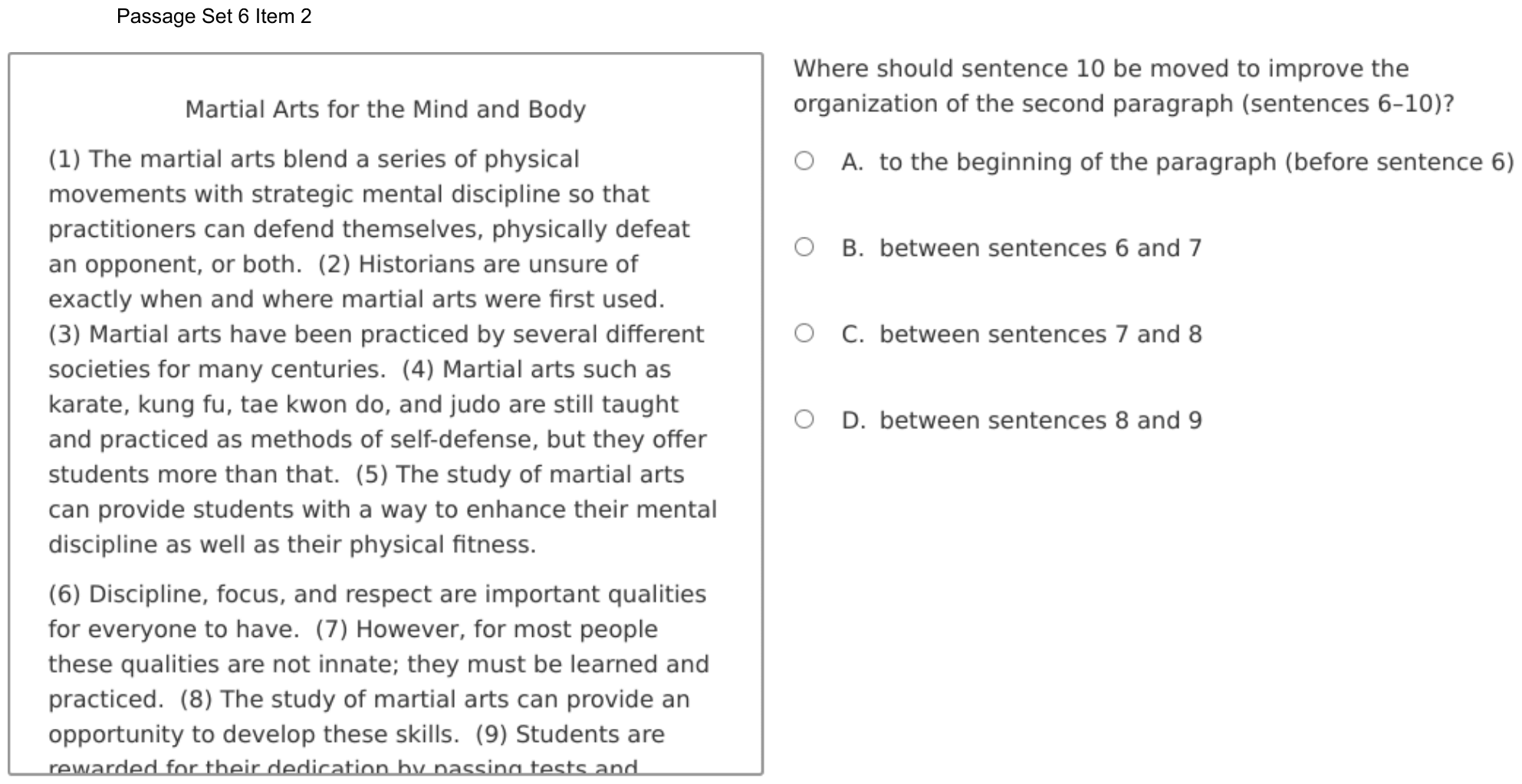
Where should sentence 10 be moved to improve the organization of the second paragraph (sentences 6–10)?
- Ato the beginning of the paragraph (before sentence 6)
- Bbetween sentences 6 and 7
- Cbetween sentences 7 and 8
- Dbetween sentences 8 and 9
Show the answer
Correct answer: D
The question asks where sentence 10 should be moved to improve the organization of the second paragraph.
A. Incorrect. Starting this paragraph with sentence 10 would weaken the paragraph’s organization because it would place a supporting detail sentence (sentence 10) before the topic sentence (sentence 6). Sentence 6 belongs at the beginning of the paragraph because it introduces the topic—the qualities of discipline, focus, and respect. Sentence 10 supports the key idea of the paragraph, that these qualities can be developed through the study of martial arts. If sentence 10 preceded sentence 6, the transitional phrase “for example” would refer to an unspecified topic and idea.
B. Incorrect. Sentence 6 presents the idea that “discipline, focus, and respect are important qualities for everyone to have,” but the example in sentence 10 does not directly relate to this idea. Sentence 10 explains how martial arts develop these qualities, not why they are important qualities to have. Because sentence 10 is not directly related to the idea in sentence 6 (the qualities are important), it should not follow sentence 6.
C. Incorrect. Sentences 7 and 8 should not be separated, because the idea presented in sentence 8—that “the study of martial arts can provide an opportunity to develop these skills”—is directly related to the idea from sentence 7—that the skills of discipline, focus, and respect “are not innate; they must be learned and practiced.” Sentence 10 supports the idea from sentence 8 by describing an example from a typical martial arts class, so sentence 10 should not precede sentence 8.
D. CORRECT. This option is correct because sentence 10 logically follows and supports the idea in sentence 8 that “the study of martial arts can provide an opportunity to develop” the qualities of discipline, focus, and respect. Sentence 10 explains this idea with examples, describing three specific ways that students in a typical tae kwon do class develop discipline, focus, and respect—by “diligently practicing,” “listening carefully,” and “bowing to the instructor and following directions.”
Question analysis
This organization question asks where sentence 10, a “For example” sentence describing a typical tae kwon do class, should be moved within the second paragraph of the martial arts passage. Students must work out what idea the example illustrates and read the paragraph with the sentence in each position, since several spots sound acceptable.
- Grade level
- Grade 7 reading and task
- Compared with grade 7
- At grade 7 Placing a sentence where it supports the right idea is regular grade 7 revision work. The paragraph is five plain sentences and the opening “For example” is a strong clue, which keeps the demand typical of grade 7.
- Estimated difficulty
- Moderate: several steps, or a close reading with one strong distractor.
- Thinking it demands
- Depth of knowledge 2, skills and concepts · mainly analyze
- What makes it hard
- How sentences fit together moderate
- A very close wrong answer minor
- Much to keep track of minor
- Evidence
- Answered from one paragraph or stanza
- Reading level
- Passage: about grade 11, 402 words; question and choices: about grade 7, 31 words.
- Students, last 30 days
- Not enough answers yet to show (it takes 10).
Why it is hard, traps and wrong answers (shows the answer)
Why it is hard
The example sentence fits loosely almost anywhere in a paragraph about discipline, focus and respect, so students have to ask what exactly it is an example of. The slot just before sentence 8 is the trap: the class’s practicing seems to illustrate sentence 7’s claim that the qualities “must be learned and practiced,” but the paragraph has not yet brought in martial arts. Those who match the example to sentence 8’s claim about martial arts place it correctly.
How sentences fit together moderate Working it out
Sentence 10 opens with “For example,” so it must follow the claim it illustrates, sentence 8’s point that studying martial arts can “develop these skills,” before sentence 9 turns to rewards. (Halliday & Hasan, 1976)
A very close wrong answer minor Choosing the answer
The slots before and after sentence 8 are neighbors, and the tae kwon do class could seem to illustrate sentence 7 as well as sentence 8, so only rereading tells them apart. (Embretson & Wetzel, 1987; Gorin & Embretson, 2006; Ascalon et al., 2007)
Much to keep track of minor Working it out
Each of the four positions means rereading a five-sentence paragraph in a new order in your head while keeping track of what “these qualities” and “these skills” refer to. (Sweller, 1988; Carpenter, Just & Shell, 1990)
Strategy: Ask which sentence the tae kwon do class is an example of, then reread the paragraph with sentence 10 placed right after it and check that every sentence still follows the one before.
Traps
- Sentence in the wrong place: Puts a sentence where it breaks the order of ideas or separates it from what it refers to.
The wrong answers, classified
A Sentence in the wrong place (Halliday & Hasan, 1976)
Moves the example to the front, where “For example” would point back to nothing and the topic sentence would come after its own illustration.
B Sentence in the wrong place (Halliday & Hasan, 1976)
Places the example after sentence 6, but the class shows how the qualities are built, not why everyone needs them, and it would cut sentence 7’s “However” off from sentence 6.
C Sentence in the wrong place (Halliday & Hasan, 1976)
Hears sentence 7’s “learned and practiced” echoed in “learn” and “practicing,” but the example must come after sentence 8, which first connects the qualities to martial arts.
Working it out, step by step
Figure out what the question asks
This asks where to move sentence 10 so paragraph 2 reads in a better order. Sentence 10 starts with “For example.” So it must come right after the idea it is an example of.
Name the rule
An example goes right after the claim it shows. “For example” points back to the sentence before it. For instance: Reading builds your word power. For example, you meet new words in every book. If the example came first, it would point back to nothing.
Find what sentence 10 shows
Sentence 10 says students “learn discipline by diligently practicing moves, improve focus by listening carefully, and demonstrate respect by bowing to the instructor and following directions.” Diligently means with steady, careful effort. This shows how martial arts build those three qualities. Sentence 8 makes that claim: “The study of martial arts can provide an opportunity to develop these skills.” So sentence 10 belongs right after sentence 8.
Read the new order
Now the paragraph runs 6, 7, 8, 10, 9. Sentence 6 names the qualities. Sentence 7 says they “must be learned and practiced.” Sentence 8 says martial arts can build them. Sentence 10 gives the tae kwon do example. Then sentence 9 tells how students are rewarded. Each sentence leads to the next.
Check each choice
- A is wrong. “For example” would point back to nothing.
- B is wrong. Sentence 6 says why the qualities matter, but the class shows how they are built. It would also cut sentence 7’s “However” off from sentence 6.
- C is wrong. Sentence 7 never mentions martial arts. Sentence 8 is the first to link the qualities to martial arts.
- D is right. The example follows the claim it shows.
Watch out: Sentence 7 says “learned and practiced,” and sentence 10 uses “learn” and “practicing.” That echo pulls you toward C.
Choose the answer
Sentence 10 gives an example of sentence 8’s claim. It belongs right after it. So the answer is D, “between sentences 8 and 9.”
Why this answer and not the closest wrong one
C is the closest wrong answer, because sentence 7 talks about learning and practice too. But sentence 7 does not mention martial arts. Sentence 8 claims that martial arts can build these skills, and the tae kwon do class is an example of exactly that. So the example belongs right after sentence 8.
More questions like this
The original DOE question
The passage “Martial Arts for the Mind and Body” as printed (page 52)