Passage Martial Arts for the Mind and Body
Martial Arts for the Mind and Body
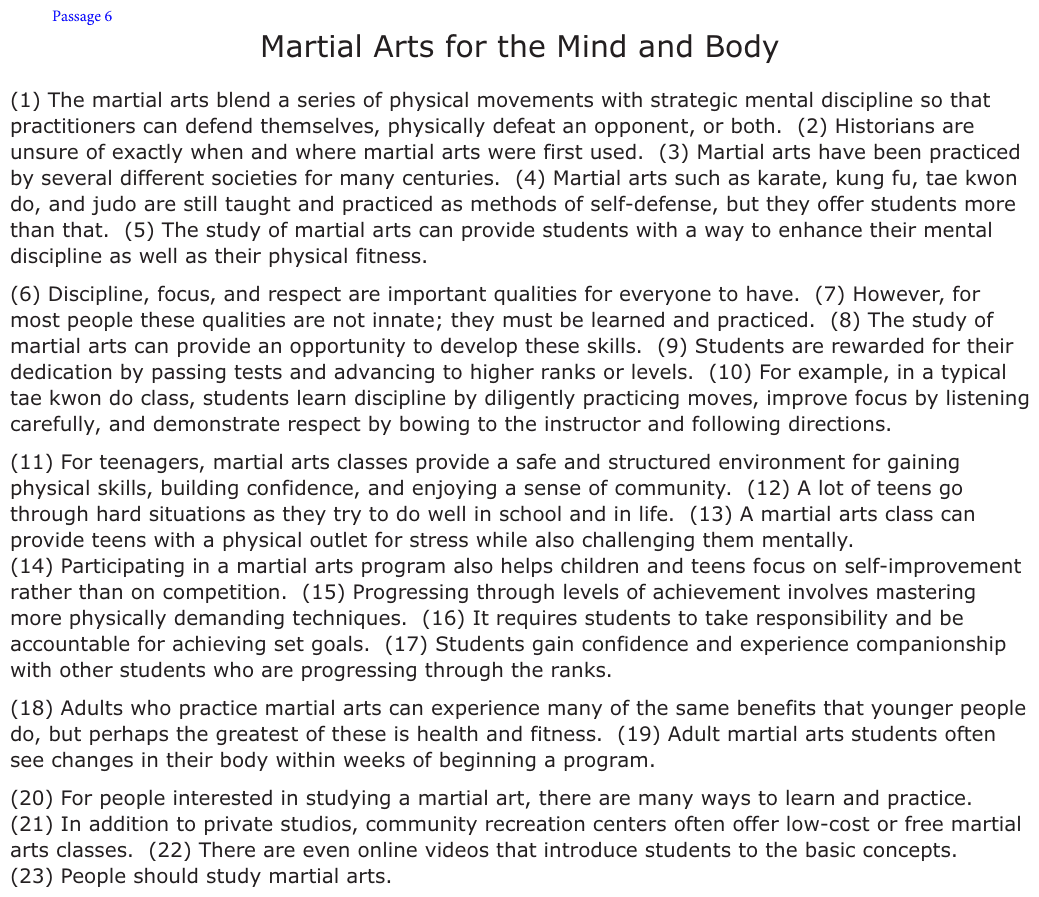
(1) The martial arts blend a series of physical movements with strategic mental discipline so that practitioners can defend themselves, physically defeat an opponent, or both. (2) Historians are unsure of exactly when and where martial arts were first used. (3) Martial arts have been practiced by several different societies for many centuries. (4) Martial arts such as karate, kung fu, tae kwon do, and judo are still taught and practiced as methods of self-defense, but they offer students more than that. (5) The study of martial arts can provide students with a way to enhance their mental discipline as well as their physical fitness.
(6) Discipline, focus, and respect are important qualities for everyone to have. (7) However, for most people these qualities are not innate; they must be learned and practiced. (8) The study of martial arts can provide an opportunity to develop these skills. (9) Students are rewarded for their dedication by passing tests and advancing to higher ranks or levels. (10) For example, in a typical tae kwon do class, students learn discipline by diligently practicing moves, improve focus by listening carefully, and demonstrate respect by bowing to the instructor and following directions.
(11) For teenagers, martial arts classes provide a safe and structured environment for gaining physical skills, building confidence, and enjoying a sense of community. (12) A lot of teens go through hard situations as they try to do well in school and in life. (13) A martial arts class can provide teens with a physical outlet for stress while also challenging them mentally. (14) Participating in a martial arts program also helps children and teens focus on self-improvement rather than on competition. (15) Progressing through levels of achievement involves mastering more physically demanding techniques. (16) It requires students to take responsibility and be accountable for achieving set goals. (17) Students gain confidence and experience companionship with other students who are progressing through the ranks.
(18) Adults who practice martial arts can experience many of the same benefits that younger people do, but perhaps the greatest of these is health and fitness. (19) Adult martial arts students often see changes in their body within weeks of beginning a program.
(20) For people interested in studying a martial art, there are many ways to learn and practice. (21) In addition to private studios, community recreation centers often offer low-cost or free martial arts classes. (22) There are even online videos that introduce students to the basic concepts. (23) People should study martial arts.
Question
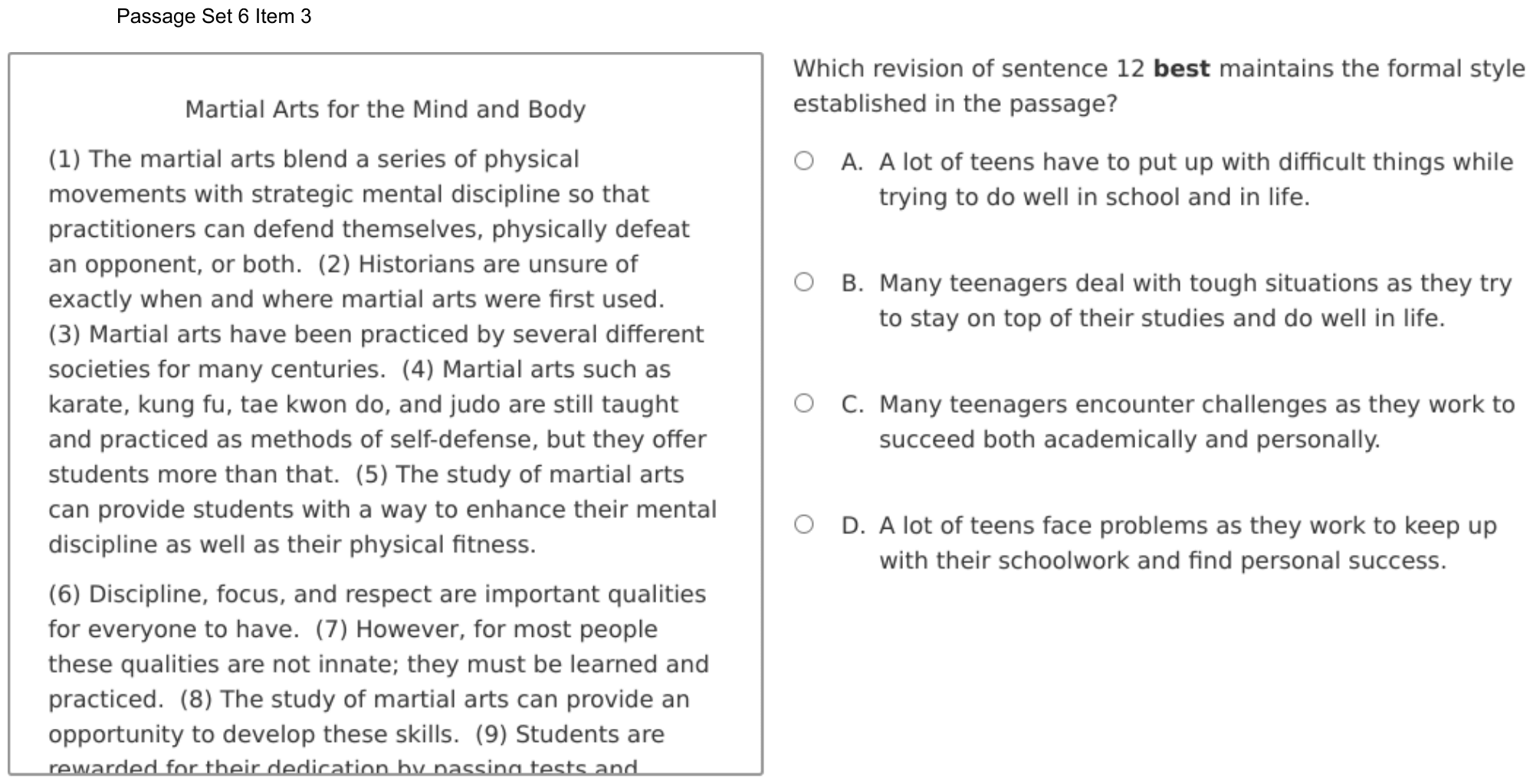
Which revision of sentence 12 best maintains the formal style established in the passage?
- AA lot of teens have to put up with difficult things while trying to do well in school and in life.
- BMany teenagers deal with tough situations as they try to stay on top of their studies and do well in life.
- CMany teenagers encounter challenges as they work to succeed both academically and personally.
- DA lot of teens face problems as they work to keep up with their schoolwork and find personal success.
Show the answer
Correct answer: C
The question asks for the revision of sentence 12 that best maintains the formal style established in the passage.
A. Incorrect. The phrases “A lot,” “put up with,” “difficult things,” and “do well in school” are worded informally; therefore, this sentence does not consistently maintain the formal style established in the passage.
B. Incorrect. The phrases “deal with,” “tough situations,” “stay on top of,” and “do well in life” are worded informally; therefore, this sentence does not consistently maintain the formal style established in the passage.
C. CORRECT. This option is correct because it uses clear and scholarly wording throughout the whole sentence. The phrases “many teenagers,” “encounter challenges,” and “succeed both academically and personally” make the sentence’s style more consistently formal than the other options.
D. Incorrect. The phrases “A lot,” “face problems,” and “keep up with” are worded informally; therefore, this sentence does not consistently maintain the formal style established in the passage.
Question analysis
This style question asks which revision of sentence 12, “A lot of teens go through hard situations as they try to do well in school and in life,” best keeps the formal style of the martial arts passage. Students compare four rewrites phrase by phrase, listening for casual expressions in each one.
- Grade level
- Grade 6 reading and task
- Compared with grade 7
- Below grade 7 Keeping a formal style is practiced from grade 6, and here it is tested in one sentence with familiar casual phrases. Typical grade 7 style work asks for subtler choices of precise, content-specific words across a passage.
- Estimated difficulty
- Routine: one familiar step, little to misread.
- Thinking it demands
- Depth of knowledge 1, recall and reproduction · mainly evaluate
- What makes it hard
- Evidence
- Answered from one sentence or line
- Reading level
- Passage: about grade 11, 402 words; question and choices: about grade 8, 87 words.
- Students, last 30 days
- Not enough answers yet to show (it takes 10).
Why it is hard, traps and wrong answers (shows the answer)
Why it is hard
Most students hear the casual phrases at once, and only one version avoids all of them, so this is one of the easier revising questions. The risk is stopping at a formal start: one version opens with “Many teenagers” and then slides into “tough situations,” and another sounds serious with “face problems” but begins with “A lot of teens.” Checking every phrase, not the first few words, is all the question asks.
Every choice must be checked minor Choosing the answer
Each rewrite mixes formal and casual wording, “Many teenagers” beside “deal with” and “stay on top of,” so every phrase of every version has to be checked, not just the opening words. (Embretson & Wetzel, 1987)
Something you must already know minor Working it out
Students must recognize idioms such as “put up with” and “keep up with” as spoken English, a sense of register that the question expects them to bring. (Anderson & Krathwohl, 2001)
Strategy: Underline every casual phrase in each rewrite, such as everyday idioms or vague words, and keep only the version with none; one formal phrase is not enough.
Traps
- Wordy, vague or informal: A revision is grammatical but wordy, imprecise or too casual for the passage.
The wrong answers, classified
A Wordy, vague or informal (Connors & Lunsford, 1988)
Trades “go through hard situations” for “put up with difficult things” and keeps “A lot of teens,” swapping one set of casual phrases for another.
B Wordy, vague or informal (Connors & Lunsford, 1988)
Is reassured by the formal opening “Many teenagers,” but the rest, “deal with,” “tough situations” and “stay on top of,” is everyday speech.
D Wordy, vague or informal (Connors & Lunsford, 1988)
Likes the more serious “face problems” and “personal success,” but keeps the casual “A lot of teens” and “keep up with their schoolwork.”
Working it out, step by step
Figure out what the question asks
This asks which rewrite of sentence 12 matches the passage’s formal style. Formal style is the careful, serious way of writing you use in a school report. It skips the casual words you might use with friends.
Spot the casual words
Sentence 12 says, “A lot of teens go through hard situations as they try to do well in school and in life.” “A lot of,” “teens” and “go through” sound like talking with a friend. Compare sentence 11, which speaks of “a safe and structured environment.” The rest of the passage uses careful words like those.
Name the rule
Formal writing uses exact, serious words and skips everyday sayings. For example, Kids have a ton of homework is casual. Students have a large amount of homework is formal. Check every phrase in each choice, not just the first few words.
Check each choice
- A is wrong. “A lot of teens,” “put up with” and “difficult things” are casual.
- B is wrong. It starts well with “Many teenagers.” But “deal with,” “tough situations” and “stay on top of” are casual.
- C is right. Every phrase is formal. To encounter challenges is to meet hard problems. Academically means in school. Personally means in your own life.
- D is wrong. “Face problems” sounds serious. But “A lot of teens” and “keep up with” are casual.
Watch out: B and D each have a formal phrase or two. One formal phrase is not enough.
Choose the answer
Only C is formal from start to finish. So the answer is C, “Many teenagers encounter challenges as they work to succeed both academically and personally.”
Why this answer and not the closest wrong one
B is the closest wrong answer, because it opens with the formal “Many teenagers.” But it then slides into everyday phrases like “deal with” and “stay on top of.” C keeps the same meaning and stays formal from start to end. Words like “encounter challenges” and “academically” match the careful style of the passage.
More questions like this
The original DOE question
The passage “Martial Arts for the Mind and Body” as printed (page 52)