Passage Looking for the Smallest Spark of Everything
Looking for the Smallest Spark of Everything
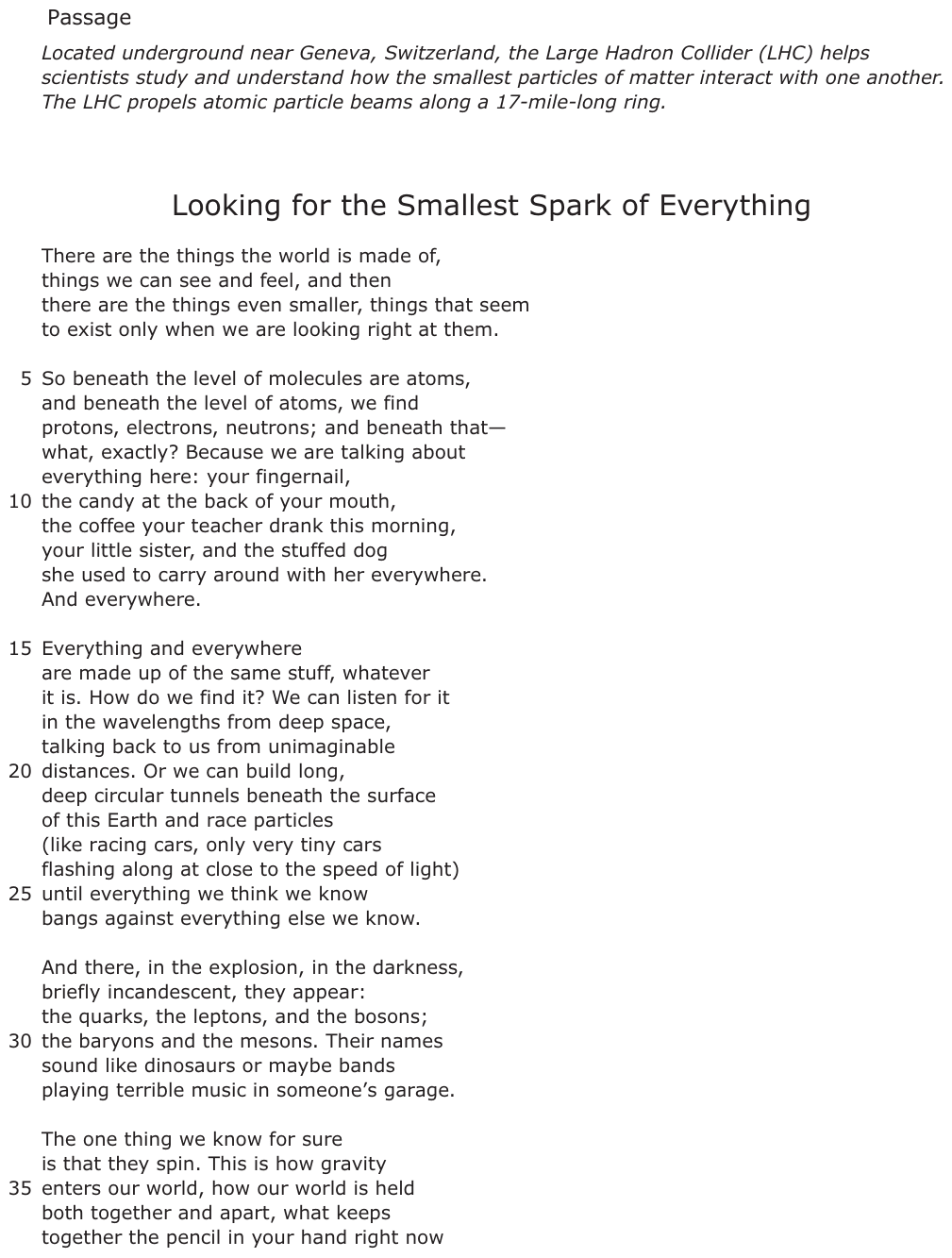
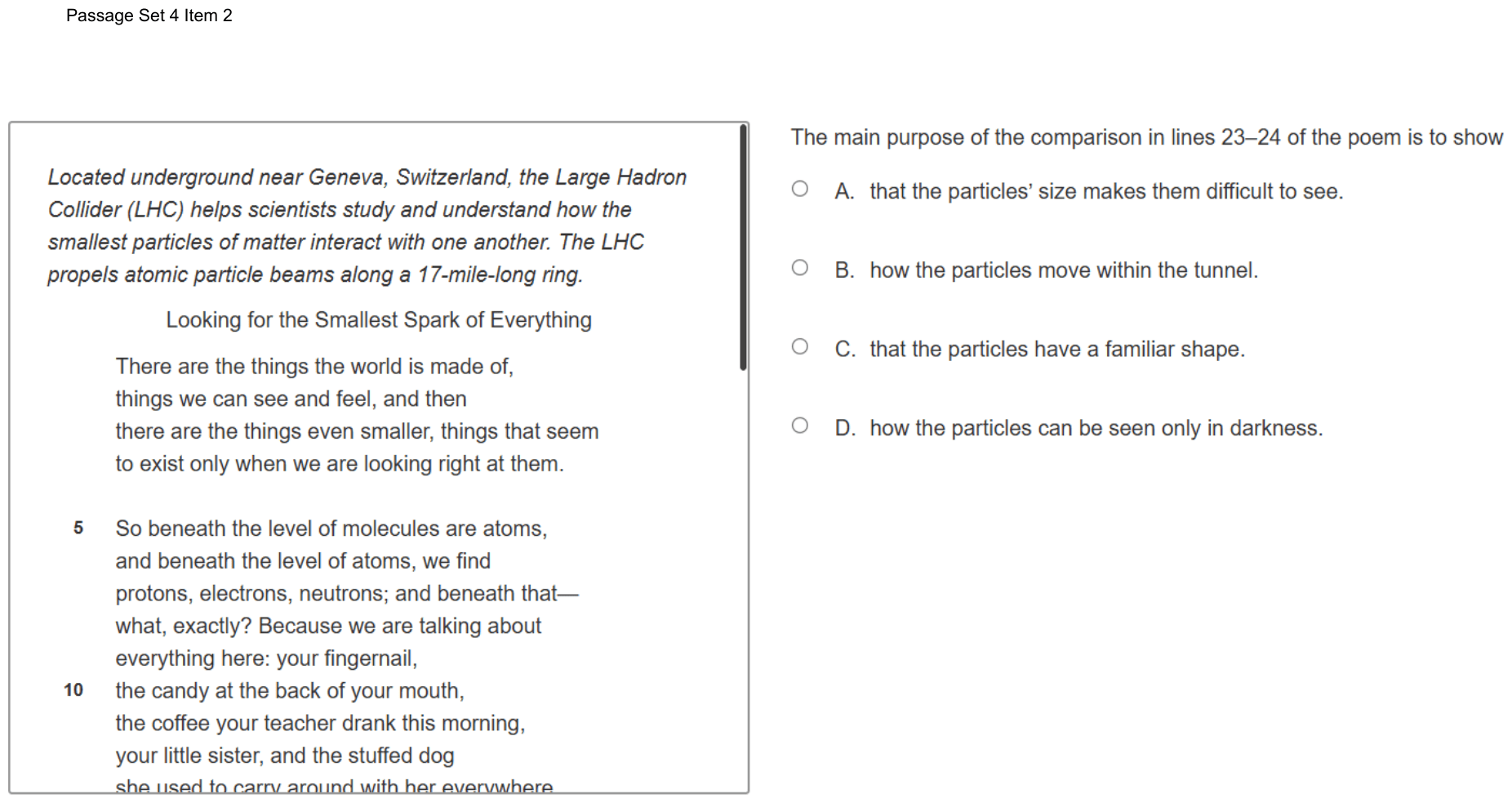
Located underground near Geneva, Switzerland, the Large Hadron Collider (LHC) helps scientists study and understand how the smallest particles of matter interact with one another. The LHC propels atomic particle beams along a 17-mile-long ring.
There are the things the world is made of,
things we can see and feel, and then
there are the things even smaller, things that seem
to exist only when we are looking right at them.
So beneath the level of molecules are atoms,
and beneath the level of atoms, we find
protons, electrons, neutrons; and beneath that—
what, exactly? Because we are talking about
everything here: your fingernail,
the candy at the back of your mouth,
the coffee your teacher drank this morning,
your little sister, and the stuffed dog
she used to carry around with her everywhere.
And everywhere.
Everything and everywhere
are made up of the same stuff, whatever
it is. How do we find it? We can listen for it
in the wavelengths from deep space,
talking back to us from unimaginable
distances. Or we can build long,
deep circular tunnels beneath the surface
of this Earth and race particles
(like racing cars, only very tiny cars
flashing along at close to the speed of light)
until everything we think we know
bangs against everything else we know.
And there, in the explosion, in the darkness,
briefly incandescent, they appear:
the quarks, the leptons, and the bosons;
the baryons and the mesons. Their names
sound like dinosaurs or maybe bands
playing terrible music in someone’s garage.
The one thing we know for sure
is that they spin. This is how gravity
enters our world, how our world is held
both together and apart, what keeps
together the pencil in your hand right now
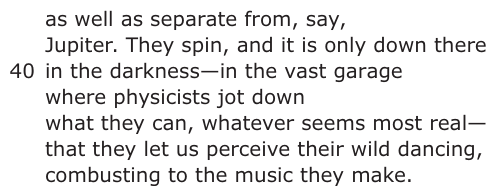
as well as separate from, say,
Jupiter. They spin, and it is only down there
in the darkness—in the vast garage
where physicists jot down
what they can, whatever seems most real—
that they let us perceive their wild dancing,
combusting to the music they make.
Question
The main purpose of the comparison in lines 23–24 of the poem is to show
- Athat the particles’ size makes them difficult to see.
- Bhow the particles move within the tunnel.
- Cthat the particles have a familiar shape.
- Dhow the particles can be seen only in darkness.
Show the answer
Correct answer: B
The question asks what the comparison in lines 23–24 of the poem is mainly meant to show.
A. Incorrect. While the particles are moving “close to the speed of light” (line 24), which would make them difficult to see, the comparison in lines 23–24 focuses on the movement of the particles, not how visible they are.
B. CORRECT. Lines 23–24 describe “tiny cars / flashing along at close to the speed of light,” which describes how the particles move.
C. Incorrect. Lines 23–24 do not describe the shape of the particles but rather their movement, which is “flashing along at close to the speed of light” (line 24).
D. Incorrect. The word “flashing” in line 24 does not refer to light in darkness but rather to speed, and the word “light” is used to reference a measurement of speed, not brightness in darkness.
Question analysis
This figurative language question asks for the main purpose of a comparison in lines 23–24 of the poem “Looking for the Smallest Spark of Everything,” where particles in an underground tunnel are likened to tiny racing cars. Students must work out what the image is mainly meant to show about the particles, judging the comparison as a whole rather than word by word.
- Grade level
- Grade 6 reading and task
- Compared with grade 7
- Below grade 7 Explaining what a simple comparison shows is grade 6 work, and this one likens particles to racing cars in two short lines of familiar words, so a single step of interpretation is enough.
- Estimated difficulty
- Routine: one familiar step, little to misread.
- Thinking it demands
- Depth of knowledge 2, skills and concepts · mainly understand
- What makes it hard
- Evidence
- Answered from one sentence or line
- Reading level
- Passage: 346 words (a poem; reading level not measured); question and choices: about grade 5, 46 words.
- Students, last 30 days
- Not enough answers yet to show (it takes 10).
Why it is hard, traps and wrong answers (shows the answer)
Why it is hard
The image is built from words about motion, racing cars “flashing along at close to the speed of light,” so most students see its purpose quickly. Each wrong choice seizes one piece of the picture, the cars’ tininess, their shape or the word “light,” and makes it the point. Students who ask what the whole comparison makes them picture, rather than what one word suggests, avoid all three.
Figurative or literary language minor Understanding the question
The comparison sits in parentheses, “like racing cars, only very tiny cars / flashing along at close to the speed of light,” and students must see that racing cars stand for speed. (Graesser, Singer & Trabasso, 1994; Kintsch, 1998)
Strategy: Name the two things being compared in lines 23–24 and ask what a reader is meant to picture, then choose the purpose that the comparison’s own words support.
Traps
- Taking figurative language literally: A choice reads a figure of speech or image at face value.
- Word match: Repeats striking words or phrases from the text, so it looks supported, but its meaning does not fit the question.
- Dictionary meaning, not meaning here: A common meaning of the word that does not fit its use in this text.
The wrong answers, classified
A Word match (Freedle & Kostin, 1993)
Fixes on “very tiny cars” and decides the point is that the particles are too small to see, though racing cars are chosen for their speed, not their size.
C Taking figurative language literally (Graesser, Singer & Trabasso, 1994)
Takes the comparison at face value, as if particles looked like little cars, when the speaker uses racing to picture how they move, not what shape they have.
D Dictionary meaning, not meaning here (Perfetti, 2007)
Reads “flashing” and “light” as a glow, like the one in the darkness of lines 27–28, but “the speed of light” measures how fast the particles travel.
Working it out, step by step
Figure out what the question asks
This asks why the poet makes a comparison in lines 23–24. A comparison shows how two different things are alike. First find the two things. Then ask what the reader is meant to picture.
Read the lines around it
Lines 20–22 describe building “deep circular tunnels beneath the surface / of this Earth” to race particles. Then lines 23–24 add “(like racing cars, only very tiny cars / flashing along at close to the speed of light)”. The speed of light is the fastest speed there is.
Work out the comparison
The particles are compared to racing cars. Racing cars zoom around a track, lap after lap, very fast. The particles zoom around the round tunnel the same way. “Flashing along” means moving so fast they are a blur. So the comparison helps you picture how the particles move.
Check each choice
- A does not fit. The cars are “very tiny,” but the point is racing, not being hard to see.
- B fits. Like racing cars, the particles speed around the tunnel.
- C does not fit. The particles do not look like cars. The comparison is about motion, not shape.
- D does not fit. “Light” here measures speed. It is not about glowing in the dark.
Watch out: A is tempting because of the word “tiny.” But a poet picks racing cars to show speed, not size.
Choose the answer
The racing cars help you picture particles speeding around the tunnel. So the answer is B, “how the particles move within the tunnel.”
Why this answer and not the closest wrong one
A is the closest wrong choice, since the poem does call them “very tiny cars.” But the comparison is to racing cars “flashing along at close to the speed of light.” Every word there is about speed and motion. So B, how the particles move, fits better.
More questions like this
The original DOE question
The passage “Looking for the Smallest Spark of Everything” as printed (pages 32–33)