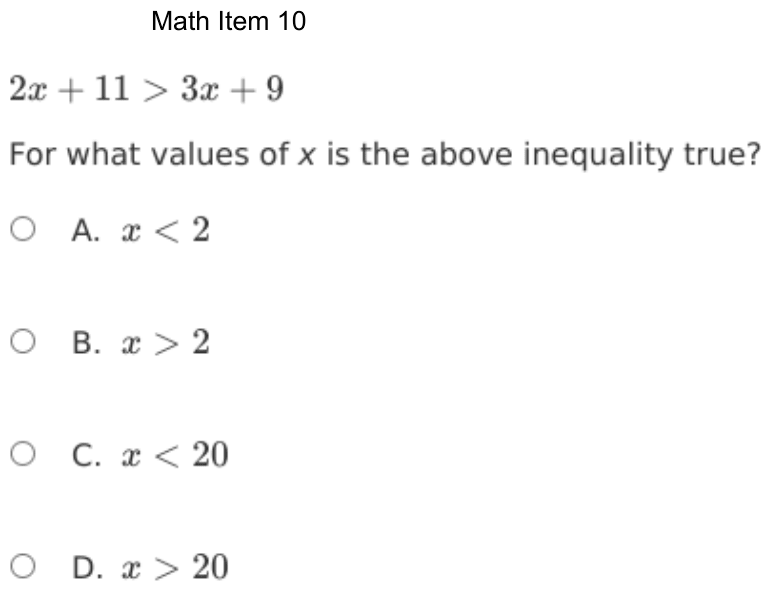
Question
For what values of x is the above inequality true?
- A
- B
- C
- D
Show the answer
Correct answer: A
Use inverse operations to isolate the variable x by first getting the x variable on one side.
Now, when dividing by , the direction of the inequality sign changes.
Another way to solve is to keep the coefficient of x positive and then recognize that is the same as .
Question analysis
This algebra question asks which values of x make the inequality 2x + 11 > 3x + 9 true, choosing from four solution sets. It tests solving a linear inequality with the variable on both sides. Collecting the x terms can leave a negative coefficient, and handling the inequality sign at that point is where most mistakes happen.
- Grade level
- Grade 8 content, by NYS standard
- Compared with grade 7
- At grade 7 Two-step inequalities are grade 7 work, and having x on both sides, a grade 8 idea, takes only one extra subtraction here. The demand matches a careful grade 7 problem, with one sign decision that is easy to get wrong.
- Estimated difficulty
- Moderate: several steps, or a close reading with one strong distractor.
- Thinking it demands
- Depth of knowledge 1, recall and reproduction · mainly apply
- What makes it hard
- Error-prone arithmetic moderate
- A very close wrong answer moderate
- Solution
- 2 steps
- Reading level
- Question and choices: about grade 10, 15 words.
- Corrected from the DOE handbook
- A grammatical error in the explanation was corrected.
- Students, last 30 days
- Not enough answers yet to show (it takes 10).
Why it is hard, traps and wrong answers (shows the answer)
Why it is hard
The boundary 2 comes out of two routine moves; the direction is where points are lost. Whichever side the x terms are collected on, the last step either divides by a negative or leaves x on the right, and both moments invite a reversed answer. A second risk is moving the 9 without changing its sign, which yields 20. Substituting x = 0, which makes 11 > 9 true, confirms the direction.
Error-prone arithmetic moderate Working it out
Subtracting 3x from both sides leaves −x > −2, and dividing by −1 must reverse the sign; subtracting 2x instead leaves 2 > x, which still has to be read from the x side. (Brown & Burton, 1978; Junker & Sijtsma, 2001)
A very close wrong answer moderate Choosing the answer
x < 2 and x > 2 share the boundary and differ only in direction, so finding the 2 settles nothing; only the sign rule or a test value such as x = 0 decides. (Embretson & Wetzel, 1987; Gorin & Embretson, 2006; Ascalon et al., 2007)
Strategy: Subtract 2x from both sides so the x term stays positive, undo the + 9, then rewrite the result with x first; testing a value in the original inequality checks the direction.
Traps
- Negatives and direction: Arithmetic with negative numbers, the order of a subtraction, or direction on a number line. (Moving a term across the equals sign without changing its sign is a faulty procedure.)
- A faulty procedure: A systematic but wrong procedure: adding fractions straight across, applying an exponent to each term of a sum, dropping a sign when moving a term.
The wrong answers, classified
B Negatives and direction (Brown & Burton, 1978)
Reaches −x > −2 but divides by −1 without reversing the inequality, or reads 2 > x as x > 2, so the direction comes out backwards.
C A faulty procedure (Brown & Burton, 1978; Tatsuoka, 1983)
Moves the 9 across the inequality without changing its sign, 11 + 9 = 20 instead of 11 − 9 = 2, and keeps the direction right.
D A faulty procedure (Brown & Burton, 1978; Tatsuoka, 1983)
Moves the 9 without changing its sign to get 20 > x, then also rewrites that statement backwards as x > 20, two errors at once.
What was corrected from the DOE handbook, and why
- Explanation: The DOE’s explanation says “Another way to solve is to keep the coefficient of x positive and then recognizing that 2 > x is the same as x < 2.” The two verbs joined by “and then” should have the same form, so the site now says “and then recognize that”.
Worked solution, step by step
Formulas used
- Doing the same to both sides of an inequality
- a and b are the two sides, and c is any number or term. Subtracting (or adding) the same amount on both sides keeps the inequality true and its sign the same. That is how you move terms from one side to the other.
- Dividing by a negative number
- a and b are any numbers. Multiplying or dividing both sides by a negative number flips the sign, so > becomes <. For example, 3 > 2, but −3 < −2. Use it whenever you divide by a negative number.
Sort out the question
The sign > means is greater than. You need every value of x that makes 2x + 11 greater than 3x + 9. The answer is a range of values, not one number. Solve it like an equation, but keep an eye on the direction of the sign.
Gather the x terms on one side
The right side has more x’s, 3x, than the left side, 2x. So subtract 2x from both sides. That keeps the x term positive:
Get x by itself
Subtract 9 from both sides:
Watch out: to move the 9, subtract it from both sides. Adding it instead gives 20 > x, which leads to choice C or D.
Read it from the x side
says 2 is greater than x. That is the same as saying x is less than 2:
Watch out: when you swap the sides, the sign must point the other way. Writing gives choice B. If you subtract 3x instead, you get . Dividing by −1 then flips the sign, and you get again.
So the answer is A, .
Check your answer
Test x = 0, which is less than 2. The left side is 11 and the right side is 9, and 11 > 9 is true. Test x = 5, which is more than 2. The left side is 21 and the right side is 24, and 21 > 24 is false. So only values below 2 work.
More questions like this
The original DOE question