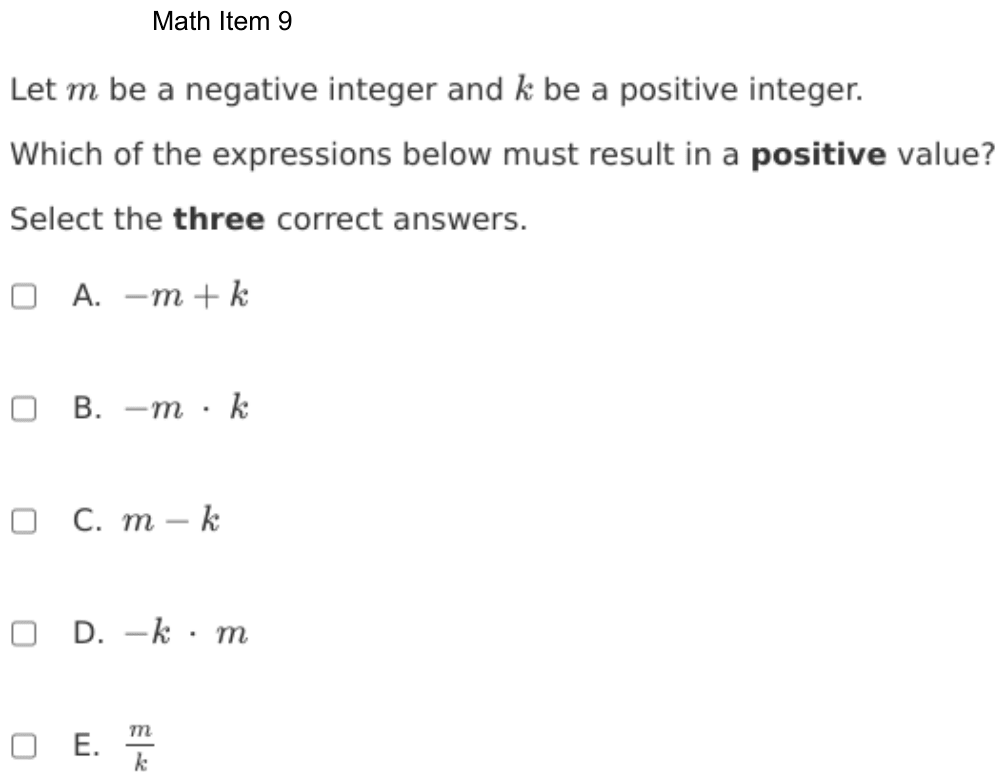
Question
Let m be a negative integer and k be a positive integer.
Which of the expressions below must result in a positive value?
Select the three correct answers.
Choose every answer that is correct, then check. The DOE has not published how answers with several parts are scored; this site counts one right only when every part is right.
- A
- B
- C
- D
- E
Show the answer
Correct answer: A, B, and D
Each of the expressions must be considered:
, where m is a negative integer and k is a positive integer: Correct
The “−” in front of m acts like a multiplier that flips the sign of m, so is positive when m is negative and k is positive.
, where m is a negative integer and k is a positive integer: Correct
The “−” in front of m acts like a multiplier that flips the sign of m, so is positive when m is negative and k is positive.
, where m is a negative integer and k is a positive integer:
A negative number minus a positive number gives a negative number.
, where m is a negative integer and k is a positive integer: Correct
A positive times a negative is a negative. Then, taking the opposite of that makes it positive.
, where m is a negative integer and k is a positive integer:
A negative divided by a positive remains negative.
Therefore, , , and must all result in a positive number.
Question analysis
Given that m is a negative integer and k a positive integer, students select the three expressions, out of five, that must have a positive value. It tests the sign rules for adding, subtracting, multiplying and dividing integers. Minus signs in front of letters, and letters in place of numbers, make each sign easy to misjudge, and all three must be found.
- NYS standards
- Grade level
- Grade 7 content, by NYS standard
- Compared with grade 7
- At grade 7 Sign rules for adding, subtracting, multiplying and dividing integers are core grade 7 content. Here they are applied to letters with known signs instead of numbers, across five expressions, and all three right ones must be chosen with no wrong one.
- Estimated difficulty
- Moderate: several steps, or a close reading with one strong distractor.
- Thinking it demands
- Depth of knowledge 2, skills and concepts · mainly analyze
- What makes it hard
- Variables instead of numbers moderate
- Every choice must be checked moderate
- Much to keep track of minor
- Solution
- 3 steps
- Reading level
- Question and choices: about grade 8, 33 words.
- Students, last 30 days
- Not enough answers yet to show (it takes 10).
Why it is hard, traps and wrong answers (shows the answer)
Why it is hard
Each expression needs only one sign rule, but the minus signs are placed to mislead. In −k · m the leading minus seems to make the result negative until the sign of m is counted, and in m − k two negatives seem to cancel, though subtracting makes the result more negative. Substituting one negative and one positive value into all five gives three positive results and two negative ones, the count the item asks for.
Variables instead of numbers moderate Understanding the question
Only the signs of m and k are known, so the sign of each expression must be reasoned from the rules or tested with values such as m = −2 and k = 3. (Koedinger & Nathan, 2004; Enright, Morley & Sheehan, 2002)
Every choice must be checked moderate Choosing the answer
All five expressions mix the same two letters with minus signs, so none can be dismissed at a glance; each is judged on its own and exactly three must be picked. (Embretson & Wetzel, 1987)
Much to keep track of minor Working it out
The item scores only when all three positive expressions are chosen and both negative ones left out, so five separate verdicts must be kept and combined. (Sweller, 1988; Carpenter, Just & Shell, 1990)
Strategy: Substitute sample values, such as m = −2 and k = 3, into all five expressions and note each sign, then confirm with the sign rules that no other values could change it.
Traps
- Negatives and direction: Arithmetic with negative numbers, the order of a subtraction, or direction on a number line. (Moving a term across the equals sign without changing its sign is a faulty procedure.)
- Misunderstands the concept: A wrong belief about a concept: that percents can be added, that area grows like length, that averages can be averaged, that a bigger denominator means a bigger fraction.
The wrong answers, classified
C Misunderstands the concept (Smith, diSessa & Roschelle, 1993; De Bock et al., 1998; Ni & Zhou, 2005)
Sees two negatives, m and the minus before k, and applies “two negatives make a positive” to subtraction, though a negative minus a positive moves further below zero.
D Negatives and direction (Brown & Burton, 1978)
Left out by students who read the leading minus in −k · m as making the product negative, missing that m is negative too, so the product is positive.
E Negatives and direction (Brown & Burton, 1978)
Sees no minus sign in m/k and takes it as positive, forgetting that m itself is negative, so the quotient of a negative and a positive is negative.
Worked solution, step by step
Formulas used
- The opposite of a number
- a is any positive number, so −a is negative. A minus sign in front of a number or letter means its opposite: the same distance from 0, on the other side. The opposite of a negative number is positive. So if m is negative, −m is positive.
- Signs when you multiply or divide
- a and b are positive numbers, so −a and −b are negative. Two negatives multiply to a positive. A negative and a positive multiply or divide to a negative. These rules tell you the sign of an answer without knowing the numbers.
Sort out the question
m is a negative integer, a whole number below 0, such as −2. k is a positive integer, such as 3. You must pick the three expressions that are always positive. Check all five, and test m = −2 and k = 3 as you go.
Understand the minus in front
A minus sign in front of a letter means the opposite of that number. Since m is negative, −m is positive. Since k is positive, −k is negative. With the test values, −m = 2 and −k = −3.
Check choices A and B
A: is a positive plus a positive, so it is always positive. Test: 2 + 3 = 5.
B: is a positive times a positive, so it is always positive. The dot · means times. Test: 2 × 3 = 6.
Check choices C and E
C: starts below 0 and moves further down, so it is always negative. Test: −2 − 3 = −5.
E: is a negative divided by a positive, so it is always negative. Test: −2 ÷ 3 = −2/3.
Watch out: two negatives make a positive only when you multiply or divide them. Choice C subtracts, so it stays negative. Choice E shows no minus sign, but m itself is negative.
Check choice D
D: is a negative times a negative, so it is always positive. Test: −3 × (−2) = 6.
Watch out: the minus sign in front makes D look negative. But m is negative too, and the two negatives make a positive. Skipping D leaves you one answer short.
Choose the three answers
Choices C and E are always negative, so leave them out. The three positive ones are A, B and D. On the test, you check the box next to each one.
So the answers are A, B and D.
Check your answer
Try different values, such as m = −10 and k = 1. A: 10 + 1 = 11. B: 10 × 1 = 10. D: −1 × (−10) = 10. All three are positive again. C gives −11 and E gives −10, both negative.
More questions like this
The original DOE question