Question
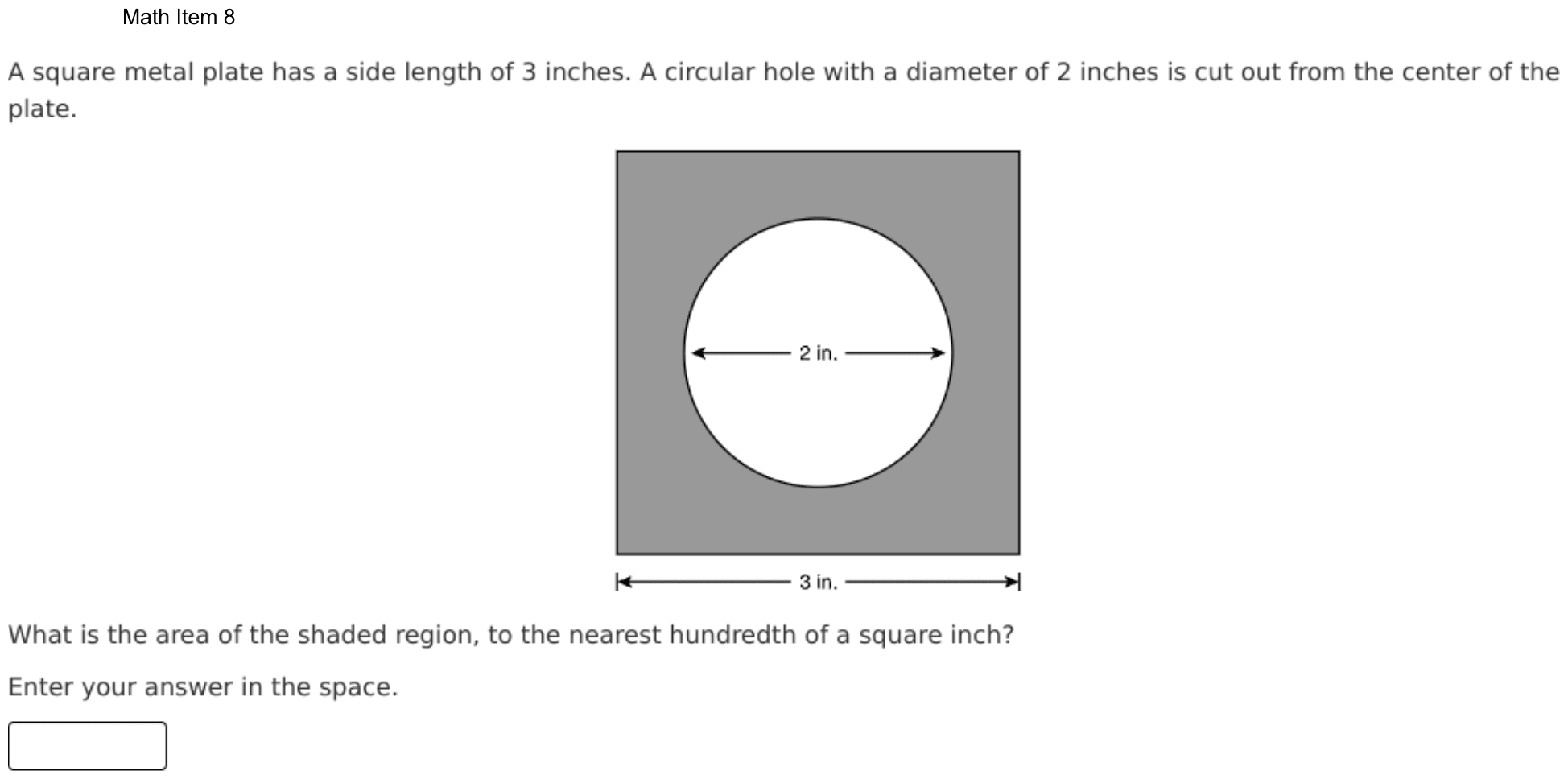
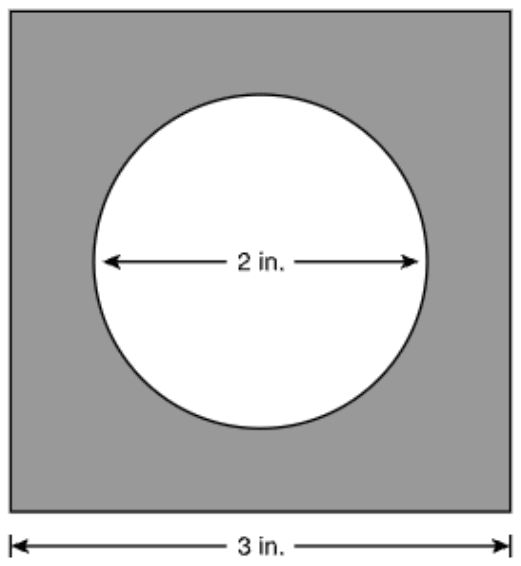
A square metal plate has a side length of 3 inches. A circular hole with a diameter of 2 inches is cut out from the center of the plate.
What is the area of the shaded region, to the nearest hundredth of a square inch?
Enter your answer in the space.
Fill-in question: work out the answer and type it as a number.
Show the answer
Correct answer: 5.86
To determine the area of a square, use .
Begin by finding the length of the side of the square, which is 3 inches. The area of the square is .
To determine the area of the circle, use .
The radius of the circle (the hole) is one-half the diameter or , so the area of the entire circle is
To determine the area of the shaded region, subtract the area of the hole in the square from the area of the square:
The shaded area to the nearest hundredth of a square inch sq in.
Question analysis
A 3-inch square metal plate has a circular hole 2 inches across cut from its center, and students find the area of the metal that is left, to the nearest hundredth of a square inch. It tests the areas of a circle and a square. Using the radius, not the diameter, and subtracting the right areas are the keys.
- NYS standards
- 7.G.4 circle area and circumference
- Grade level
- Grade 7 content, by NYS standard
- Compared with grade 7
- At grade 7 Finding a circle's area is a grade 7 standard, and subtracting a hole from a shape is common grade 7 practice. The radius must come from the diameter and the result must be rounded, but the steps are routine.
- Estimated difficulty
- Straightforward: two steps or one careful reading.
- Thinking it demands
- Depth of knowledge 2, skills and concepts · mainly apply
- What makes it hard
- Something you must already know moderate
- Combines ideas minor
- An answer in an unexpected form minor
- Solution
- 3 steps
- Reading level
- Question and choices: about grade 4, 49 words.
- Corrected from the DOE handbook
- A wrong symbol in the explanation was corrected.
- Students, last 30 days
- Not enough answers yet to show (it takes 10).
Why it is hard, traps and wrong answers (shows the answer)
Why it is hard
Every number is small, so the work is choosing the right pieces: the area of the square, the area of the hole, and the difference. A radius of 1 makes the circle's area simply π, which is easy to confuse with the circumference, 2π, when the formulas are half remembered. The region asked for is the gray metal, not the hole, and the final rounding goes up, since the third decimal place is 8.
Something you must already know moderate Working it out
Neither area formula is given, and the hole is labeled by its 2-inch diameter, so students must recall A = πr² and halve the diameter to get the radius 1 first. (Anderson & Krathwohl, 2001)
Combines ideas minor Working it out
The shaded metal is a square with a circle removed, so two area formulas are combined by subtraction rather than either one used alone. (Embretson, 1998; Daniel & Embretson, 2010)
An answer in an unexpected form minor Choosing the answer
The result is typed to the nearest hundredth with no choices to compare, so the long decimal 5.858… must be rounded up, not cut off after two places. (Enright, Morley & Sheehan, 2002)
Strategy: Halve the diameter to get the radius, find the area of the square and of the circle, subtract the circle from the square, and round only at the end.
Traps
- Answers a different question: A choice is right for another quantity: the other unknown, the rest instead of the part, the part instead of the whole.
- Wrong formula: Uses a related but wrong formula: perimeter for area, diameter for radius, area for volume, or a misremembered one.
- A formula you must know: Needs a formula the test does not give: area, circumference, volume, probability rules.
The wrong answers, classified
2.72 Wrong formula (King et al., 2004)
Uses the circumference, 2π × 1 ≈ 6.28, in place of the circle's area and subtracts it from the square's 9 square inches, getting about 2.72.
3.14 Answers a different question (King et al., 2004; Hegarty, Mayer & Monk, 1995)
Finds the area of the circular hole, π × 1² ≈ 3.14 square inches, and enters it instead of the area of the shaded metal left around it.
5.85 Rounds too early (King et al., 2004)
Works the area out correctly as about 5.858 but cuts off the extra digits instead of rounding up to the nearest hundredth.
What was corrected from the DOE handbook, and why
- Explanation: The DOE’s explanation gives the area of the hole as “π(1 in.)² ≅ 3.14 sq in.” The symbol ≅ means “is congruent to”, which an area and a number cannot be; the line means “is approximately equal to”, written ≈. The site now says “π(1 in.)² ≈ 3.14 sq in.”
Worked solution, step by step
Formulas used
- Area of a square
- A is the area, the amount of flat space inside. s is the length of one side. s² means s × s. It works because a square with side s holds s rows of s little unit squares.
- Area of a circle
- A is the area. r is the radius, the distance from the center to the edge. It is half the diameter, the distance straight across through the center. π (pi) is a number a little more than 3, about 3.14. r² means r × r.
Sort out the question
The plate is a square with 3-inch sides. A circle with a 2-inch diameter is cut out of the middle. The diameter is the distance straight across the circle through its center. The shaded region is the metal that is left. You need its area to the nearest hundredth of a square inch.
Find the area of the square
Use the formula for the area of a square, with s = 3 inches:
The whole plate, before the hole is cut, is 9 square inches.
Find the radius of the hole
The circle formula needs the radius, not the diameter. The figure labels the 2 in. distance across the hole. The radius is half of it:
The radius is 1 inch.
Find the area of the hole
Use the formula for the area of a circle, with r = 1 inch:
The sign ≈ means is about equal to. The hole is about 3.14 square inches.
Watch out: 2πr is the circumference, the distance around the circle, not its area. Using it gives 9 − 6.28 = 2.72. And 3.14 is the hole, not the metal, so do not stop there.
Subtract the hole from the square
The shaded metal is the square with the circle taken away:
The shaded region is about 5.86 square inches.
Round and enter the answer
With more digits of π, 3.1416, you get 9 − 3.1416 = 5.8584. The digit after the hundredths place is 8, which is 5 or more, so round up to 5.86. Chopping it to 5.85 is wrong. Type only the number, with no units.
So you would enter 5.86.
Check your answer
The hole is a bit more than a third of the plate, since 3.14 is a bit more than 9 ÷ 3 = 3. So the metal left should be a bit less than two thirds of 9, which is 6. The answer 5.86 is just under 6, so it makes sense.
More questions like this
The original DOE question