Question
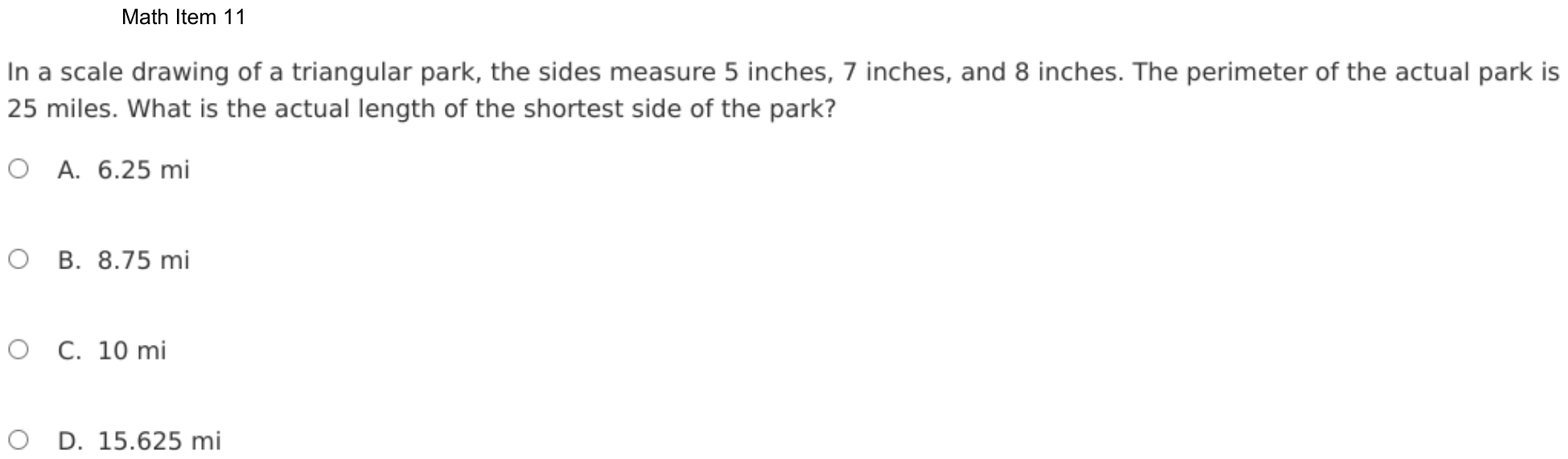
In a scale drawing of a triangular park, the sides measure 5 inches, 7 inches, and 8 inches. The perimeter of the actual park is 25 miles. What is the actual length of the shortest side of the park?
- A6.25 mi
- B8.75 mi
- C10 mi
- D15.625 mi
Show the answer
Correct answer: A
To find the perimeter of a triangle, add the measures of the three sides. The perimeter of the scale drawing is inches.
Now, use the perimeters to find the scale factor for the scale drawing to the actual perimeter.
The scale factor is 20 inches to 25 miles, which reduces to a scale factor of 4 inches to 5 miles. Note that the scale for the perimeter is the same as the scale for the side lengths.
Since the smallest side on the scale drawing is 5 inches, use the scale factor to find the actual side length of the smallest side:
Question analysis
A scale drawing of a triangular park has sides of 5, 7 and 8 inches, and the real park's perimeter is 25 miles. Students find the actual length of the park's shortest side. It tests scale drawings and proportional reasoning; the scale is not given directly, so it must be worked out from the two perimeters first.
- Grade level
- Grade 7 content, by NYS standard
- Compared with grade 7
- At grade 7 Scale drawings are a grade 7 topic, and this is a standard scale problem. The one twist is that the scale is not stated: it must come from comparing the two perimeters before any side can be converted.
- Estimated difficulty
- Straightforward: two steps or one careful reading.
- Thinking it demands
- Depth of knowledge 2, skills and concepts · mainly apply
- What makes it hard
- Turning words into math minor
- Many steps minor
- Solution
- 3 steps
- Reading level
- Question and choices: about grade 2, 39 words.
- Students, last 30 days
- Not enough answers yet to show (it takes 10).
Why it is hard, traps and wrong answers (shows the answer)
Why it is hard
A scale drawing multiplies every length by one factor, and the perimeter shares that factor, so the work is short once the two perimeters are paired. The common loss is reasoning with differences: the perimeter grows by 5, so a side seems to grow by 5 as well. Converting to miles per inch first, then checking that the three real sides add back to 25 miles, guards against that error and against scaling the wrong side.
Turning words into math minor Understanding the question
The 25 miles is the park's perimeter, not a side, so it must be matched with the drawing's perimeter, 5 + 7 + 8 = 20 inches, before any side can be scaled. (Hegarty, Mayer & Monk, 1995; Koedinger & Nathan, 2004)
Many steps minor Working it out
Three operations in a row, adding the sides, dividing 25 by 20 for 1.25 miles per inch, and multiplying the 5-inch side, each produce a number the next step needs. (Daniel & Embretson, 2010; Enright, Morley & Sheehan, 2002)
Strategy: Add the three drawn sides to get the drawing's perimeter, divide the real perimeter by it to find the miles per inch, then multiply the shortest drawn side by that scale.
Traps
- Answers a different question: A choice is right for another quantity: the other unknown, the rest instead of the part, the part instead of the whole.
- Misreads the question: Misses or misreads a condition or a word in the question: "at least", "each", "remaining", "not".
The wrong answers, classified
B Answers a different question (King et al., 2004; Hegarty, Mayer & Monk, 1995)
Finds the scale of 1.25 miles per inch but applies it to the 7-inch side, the middle one, giving 8.75 miles instead of the shortest side.
C Misunderstands the concept (Smith, diSessa & Roschelle, 1993; De Bock et al., 1998; Ni & Zhou, 2005)
Keeps a constant difference instead of a constant ratio: the perimeter grows by 5, from 20 to 25, so it adds 5 to the 5-inch side.
D Misreads the question (Hegarty, Mayer & Monk, 1995)
Pairs the 25 miles with the longest side, 8 inches, instead of the 20-inch perimeter, so each inch seems to be 3.125 miles and 5 inches 15.625.
Worked solution, step by step
Formulas used
- Perimeter of a triangle
- P is the perimeter, the distance all the way around. a, b and c are the lengths of the three sides. You add them because going once around the triangle covers each side once.
- Using a scale
- The drawing length is measured on the drawing, in inches. Miles per inch is how many real miles each inch stands for. In a scale drawing, every length is multiplied by the same number, so the perimeter and each side use the same scale.
Sort out the question
A scale drawing is a smaller copy, with every length shrunk by the same amount. The drawing’s sides are 5, 7 and 8 inches. The real park’s perimeter, the distance all the way around, is 25 miles. You need the real length of the shortest side.
Find the drawing’s perimeter
Add the three sides of the drawing:
The drawing’s perimeter is 20 inches. It stands for the real perimeter of 25 miles.
Watch out: 25 miles is the whole way around, not one side. Matching it with the 8-inch side gives 15.625 miles, choice D.
Find the scale
20 inches stand for 25 miles. Divide to find how many miles 1 inch stands for:
So each inch on the drawing is 1.25 miles in the park.
Scale the shortest side
The shortest side on the drawing is 5 inches. Multiply it by the scale:
The real shortest side is 6.25 miles.
Watch out: the perimeter grew by 5, from 20 to 25, but you cannot just add 5 to a side. That gives 10 miles, choice C. Scaling multiplies. Also use the 5-inch side, not the 7-inch side, which gives 8.75 miles, choice B.
So the answer is A, 6.25 mi.
Check your answer
Scale all three sides: 5 × 1.25 = 6.25, 7 × 1.25 = 8.75 and 8 × 1.25 = 10. Add them: 6.25 + 8.75 + 10 = 25 miles. That is the park’s perimeter, so the scale is right.
More questions like this
The original DOE question