Question
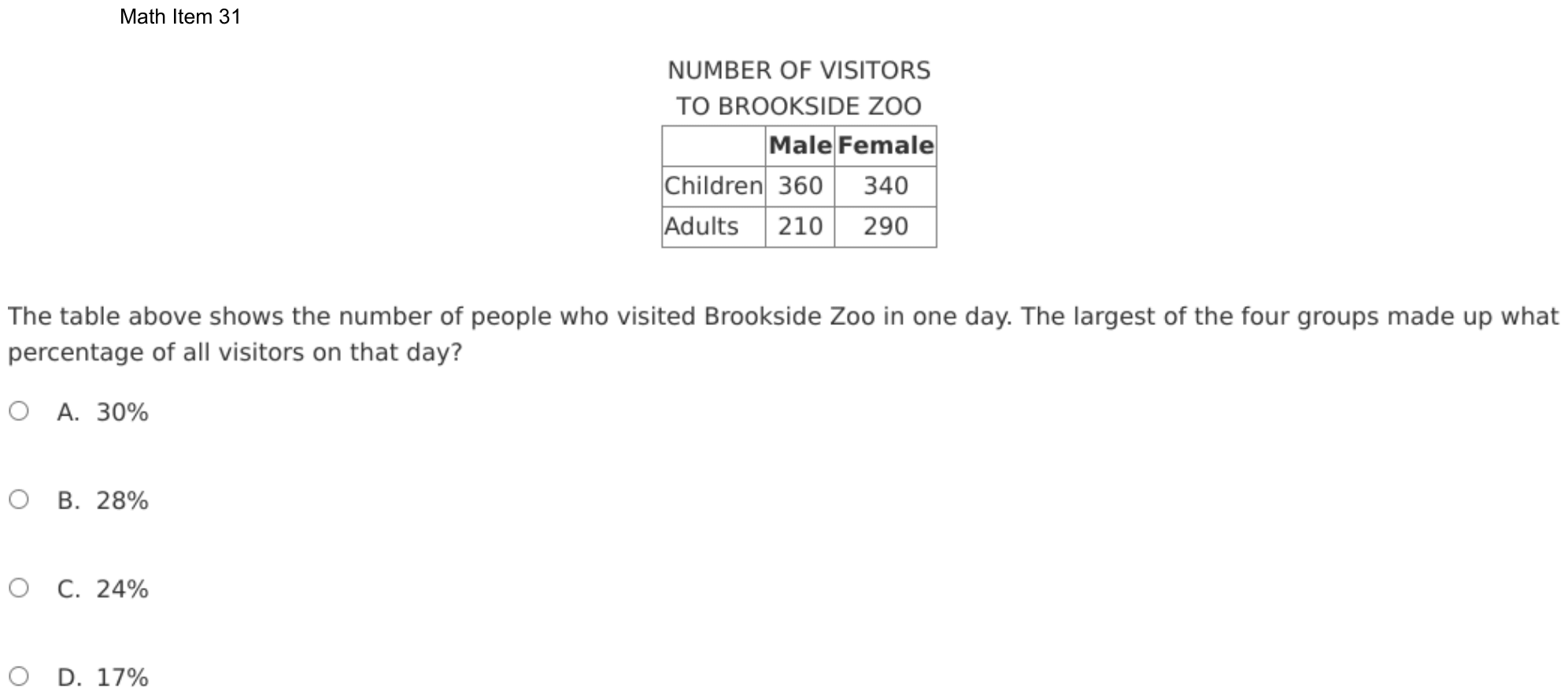
NUMBER OF VISITORS
TO BROOKSIDE ZOO
| Male | Female | |
|---|---|---|
| Children | 360 | 340 |
| Adults | 210 | 290 |
The table above shows the number of people who visited Brookside Zoo in one day. The largest of the four groups made up what percentage of all visitors on that day?
- A30%
- B28%
- C24%
- D17%
Show the answer
Correct answer: A
First, determine the total number of visitors.
The largest group is 360 (Male Children).
Find the percent that represents .
Question analysis
A two-way table counts one day's visitors to Brookside Zoo by age, children or adults, and by male or female. Students find what percent of all visitors the largest of the four groups made up. They must total every cell first, then make sure the count they divide is really the largest one.
- NYS standards
- 6.RP.3c percent as a rate per 100
- Grade level
- Grade 6 content, by NYS standard
- Compared with grade 7
- Below grade 7 Finding what percent one count is of a total is grade 6 work. A two-way table adds two quick steps, totaling the four groups and spotting the largest, but the numbers divide evenly, so it stays below grade 7 demand.
- Estimated difficulty
- Straightforward: two steps or one careful reading.
- Thinking it demands
- Depth of knowledge 1, recall and reproduction · mainly apply
- What makes it hard
- Reading a figure, table or graph minor
- Many steps minor
- Solution
- 3 steps
- Reading level
- Question and choices: about grade 5, 39 words.
- Students, last 30 days
- Not enough answers yet to show (it takes 10).
Why it is hard, traps and wrong answers (shows the answer)
Why it is hard
The arithmetic is friendly, since 360 over 1,200 reduces to 3 over 10, so the work is in reading the table. Two of its cells are close, 340 just below 360, and every wrong choice is the share of one of the other groups. Adding all four counts first, and circling the largest before dividing, keeps the right cell in play.
Reading a figure, table or graph minor Understanding the question
The two-way table gives four separate counts and no totals, so the 1,200 visitors must be added up from the cells and the largest group picked out of a grid. (Lesh, Post & Behr, 1987; Kirsch & Mosenthal, 1990)
Many steps minor Working it out
Three short steps run in order: total the four cells, pick the largest, and divide; using the wrong cell in the last step still gives a believable percent. (Daniel & Embretson, 2010; Enright, Morley & Sheehan, 2002)
Strategy: Add all four cells for the day's total, pick the biggest single cell, and divide it by the total; simplifying the fraction before dividing keeps the arithmetic short.
Traps
- Misreads the question: Misses or misreads a condition or a word in the question: "at least", "each", "remaining", "not".
- Answers a different question: A choice is right for another quantity: the other unknown, the rest instead of the part, the part instead of the whole.
- Misreads the figure: Reads a value, label or tick spacing in a figure, table or graph wrongly.
The wrong answers, classified
B Misreads the figure (Lesh, Post & Behr, 1987; Kirsch & Mosenthal, 1990)
Takes 340, the female children, as the largest cell, misjudging it against the 360 male children beside it, so 340 ÷ 1,200 ≈ 28%.
C Answers a different question (King et al., 2004; Hegarty, Mayer & Monk, 1995)
Answers for the larger adult group, the 290 female adults, as if the question were about adults, so 290 ÷ 1,200 ≈ 24%.
D Misreads the question (Hegarty, Mayer & Monk, 1995)
Reads largest as smallest and uses the 210 male adults, so 210 ÷ 1,200 = 17.5%, and takes the nearest choice.
Worked solution, step by step
Formulas used
- Percent of a whole
- The part is the one group you care about. The whole is everyone. The fraction tells what share of everyone the group is. Multiplying by 100 turns that share into a percent, which means out of 100.
Sort out the question
The table splits one day’s visitors into four groups:
Male Female Children 360 340 Adults 210 290 You need the largest group as a percent of all the visitors. The table gives no total, so you must find it.
Add up all the visitors
Add all four groups to get the whole:
So 1,200 people visited the zoo that day.
Find the largest group
Compare the four numbers. The biggest is 360, the male children.
Watch out: 340 is close to 360, but it is smaller. Using 340 gives about 28%, choice B. Using the 290 female adults gives about 24%, choice C. And 210 is the smallest group, which gives 17.5%, near choice D.
Find the percent
Put the part over the whole. Then simplify by dividing the top and bottom by 120:
Now multiply by 100 to get a percent:
So the male children made up 30% of the visitors.
Give the answer
The largest group, 360 male children, is 30% of all 1,200 visitors.
So the answer is A, 30%.
Check your answer
Work backward. 30% of 1,200 is , the male children. Also, with four groups an even split would be 25% each. The largest group should be a bit more than 25%, and 30% is.
More questions like this
The original DOE question