Also in 2026 Practice Test C English, question 19.
Passage Excerpt from “Impressions of an Indian Childhood”
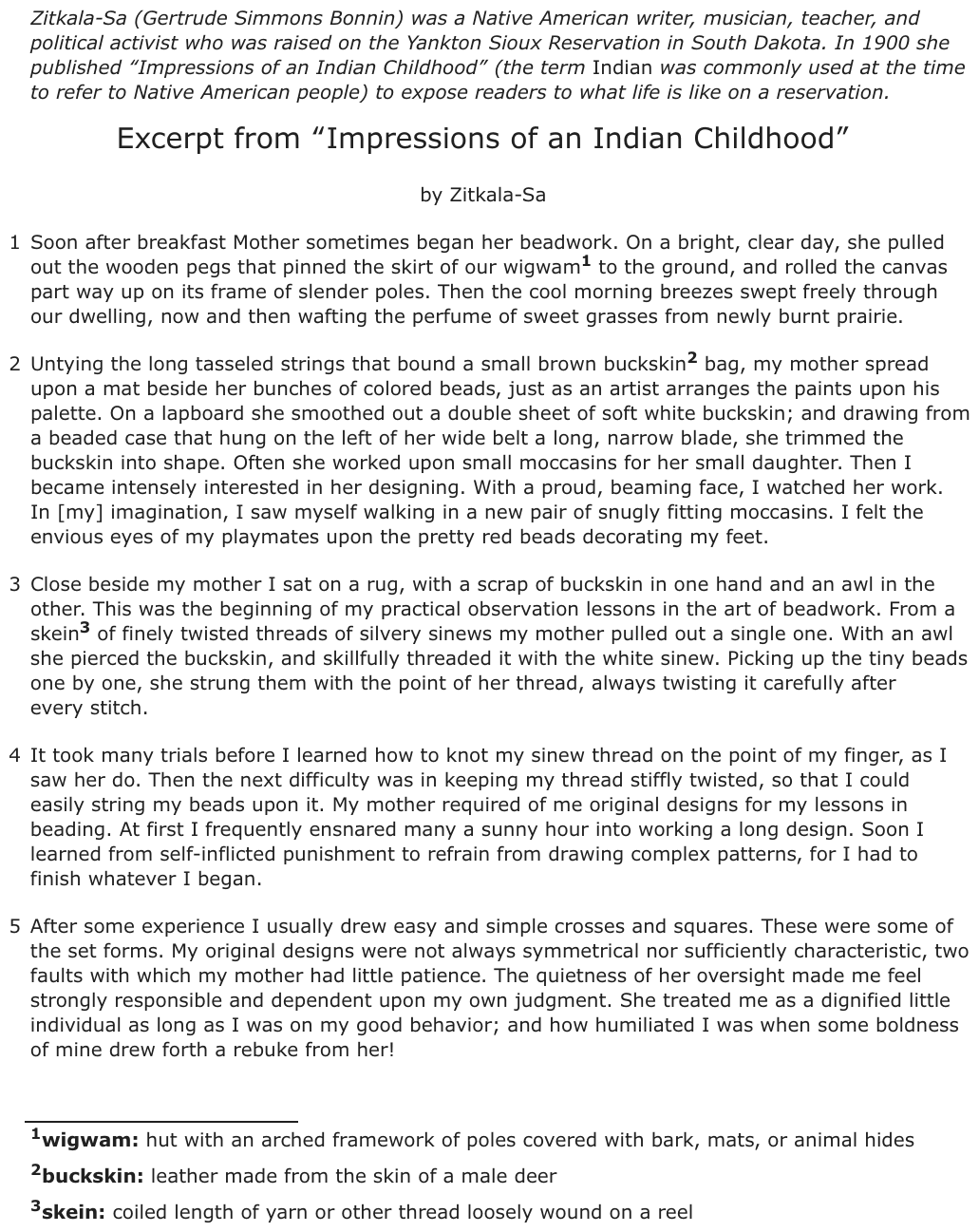
Excerpt from “Impressions of an Indian Childhood”
by Zitkala-Sa
Zitkala-Sa (Gertrude Simmons Bonnin) was a Native American writer, musician, teacher, and political activist who was raised on the Yankton Sioux Reservation in South Dakota. In 1900 she published “Impressions of an Indian Childhood” (the term Indian was commonly used at the time to refer to Native American people) to expose readers to what life is like on a reservation.
Soon after breakfast Mother sometimes began her beadwork. On a bright, clear day, she pulled out the wooden pegs that pinned the skirt of our wigwam1 to the ground, and rolled the canvas part way up on its frame of slender poles. Then the cool morning breezes swept freely through our dwelling, now and then wafting the perfume of sweet grasses from newly burnt prairie.
Untying the long tasseled strings that bound a small brown buckskin2 bag, my mother spread upon a mat beside her bunches of colored beads, just as an artist arranges the paints upon his palette. On a lapboard she smoothed out a double sheet of soft white buckskin; and drawing from a beaded case that hung on the left of her wide belt a long, narrow blade, she trimmed the buckskin into shape. Often she worked upon small moccasins for her small daughter. Then I became intensely interested in her designing. With a proud, beaming face, I watched her work. In [my] imagination, I saw myself walking in a new pair of snugly fitting moccasins. I felt the envious eyes of my playmates upon the pretty red beads decorating my feet.
Close beside my mother I sat on a rug, with a scrap of buckskin in one hand and an awl in the other. This was the beginning of my practical observation lessons in the art of beadwork. From a skein3 of finely twisted threads of silvery sinews my mother pulled out a single one. With an awl she pierced the buckskin, and skillfully threaded it with the white sinew. Picking up the tiny beads one by one, she strung them with the point of her thread, always twisting it carefully after every stitch.
It took many trials before I learned how to knot my sinew thread on the point of my finger, as I saw her do. Then the next difficulty was in keeping my thread stiffly twisted, so that I could easily string my beads upon it. My mother required of me original designs for my lessons in beading. At first I frequently ensnared many a sunny hour into working a long design. Soon I learned from self-inflicted punishment to refrain from drawing complex patterns, for I had to finish whatever I began.
After some experience I usually drew easy and simple crosses and squares. These were some of the set forms. My original designs were not always symmetrical nor sufficiently characteristic, two faults with which my mother had little patience. The quietness of her oversight made me feel strongly responsible and dependent upon my own judgment. She treated me as a dignified little individual as long as I was on my good behavior; and how humiliated I was when some boldness of mine drew forth a rebuke from her!
In the choice of colors she left me to my own taste. I was pleased with an outline of yellow upon a background of dark blue, or a combination of red and myrtle-green. There was another of red with a bluish-gray that was more conventionally used. When I became a little familiar with designing and the various pleasing combinations of color, a harder lesson was given me. It was the sewing on, instead of beads, some tinted porcupine quills, moistened and flattened between the nails of the thumb and forefinger. My mother cut off the prickly ends and burned them at once in the centre fire. These sharp points were poisonous, and worked into the flesh wherever they lodged. For this reason, my mother said, I should not do much alone in quills until I was as tall as my cousin Warca-Ziwin.
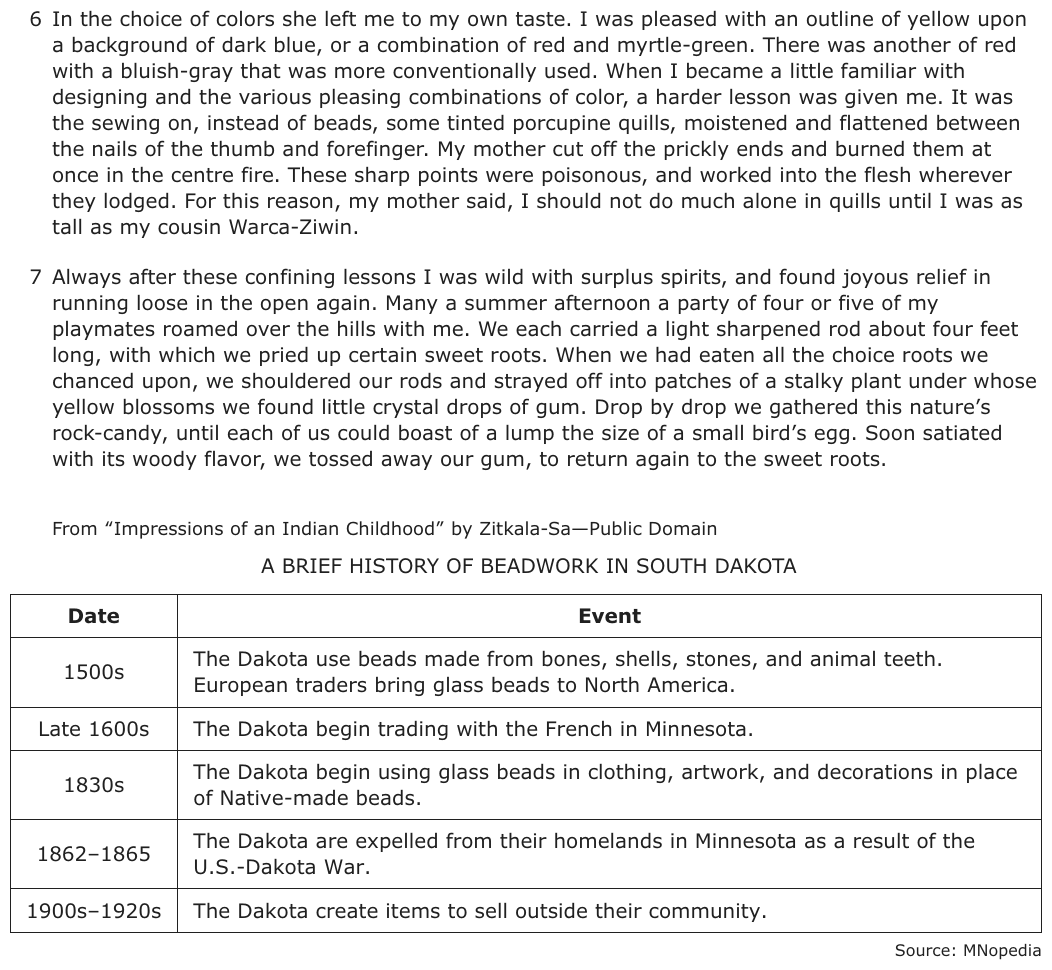
Always after these confining lessons I was wild with surplus spirits, and found joyous relief in running loose in the open again. Many a summer afternoon a party of four or five of my playmates roamed over the hills with me. We each carried a light sharpened rod about four feet long, with which we pried up certain sweet roots. When we had eaten all the choice roots we chanced upon, we shouldered our rods and strayed off into patches of a stalky plant under whose yellow blossoms we found little crystal drops of gum. Drop by drop we gathered this nature’s rock-candy, until each of us could boast of a lump the size of a small bird’s egg. Soon satiated with its woody flavor, we tossed away our gum, to return again to the sweet roots.
From “Impressions of an Indian Childhood” by Zitkala-Sa—Public Domain
A BRIEF HISTORY OF BEADWORK IN SOUTH DAKOTA
| Date | Event |
|---|---|
| 1500s | The Dakota use beads made from bones, shells, stones, and animal teeth. European traders bring glass beads to North America. |
| Late 1600s | The Dakota begin trading with the French in Minnesota. |
| 1830s | The Dakota begin using glass beads in clothing, artwork, and decorations in place of Native-made beads. |
| 1862–1865 | The Dakota are expelled from their homelands in Minnesota as a result of the U.S.-Dakota War. |
| 1900s–1920s | The Dakota create items to sell outside their community. |
Source: MNopedia
1wigwam: hut with an arched framework of poles covered with bark, mats, or animal hides
2buckskin: leather made from the skin of a male deer
3skein: coiled length of yarn or other thread loosely wound on a reel
Question
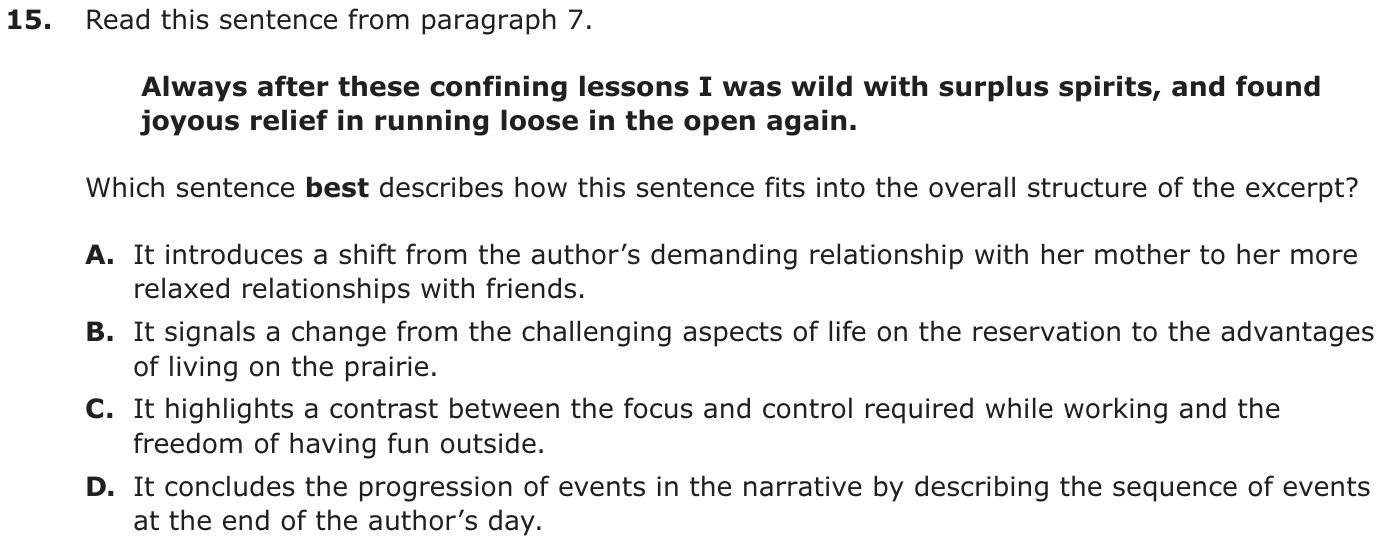
Read this sentence from paragraph 7.
Always after these confining lessons I was wild with surplus spirits, and found joyous relief in running loose in the open again.
Which sentence best describes how this sentence fits into the overall structure of the excerpt?
- AIt introduces a shift from the author’s demanding relationship with her mother to her more relaxed relationships with friends.
- BIt signals a change from the challenging aspects of life on the reservation to the advantages of living on the prairie.
- CIt highlights a contrast between the focus and control required while working and the freedom of having fun outside.
- DIt concludes the progression of events in the narrative by describing the sequence of events at the end of the author’s day.
Show the answer
Correct answer: C
The question asks which sentence best describes how the sentence from paragraph 7 fits into the overall structure of the excerpt.
A. Incorrect. Though the author feels humiliated “when some boldness of mine drew forth a rebuke from” her mother (paragraph 5) and characterizes her lessons with her mother as “confining” (paragraph 7), the overall passage does not portray a demanding relationship between the author and the mother. The shift introduced in the sentence from paragraph 7 is not from one of the author’s relationships to another; it is from work to play.
B. Incorrect. In paragraph 6, the author explains how working with porcupine quills is difficult because the “sharp points were poisonous, and worked into the flesh wherever they lodged.” Although this sentence suggests that working with porcupine quills was challenging, the sentence from paragraph 7 does not signal a change from the challenging aspects of life on the reservation to the advantages of living on the prairie. Most of paragraph 6 describes the author’s pleasure in creating designs in different colors.
C. CORRECT. In the sentence from paragraph 7, the author refers to her beadwork lessons as “confining” and states that after the lessons, she “was wild with surplus spirits” and “found joyous relief” in being outside and running around. The phrases “surplus spirits” and “joyous relief” highlight a sense of freedom that stands in strong contrast to the “confining” nature of the author’s beadwork lessons, which required intense focus and control.
D. Incorrect. In paragraph 7, the author describes how “many a summer afternoon” after her beadwork lessons, she and her friends used “a light sharpened rod” to gather “sweet roots” and “little crystal drops of gum.” She then explains that they later “tossed away our gum, to return again to the sweet roots.” However, the sentence from paragraph 7 does not conclude the progression of events in the narrative by describing the sequence of events at the end of the author’s day; the sentence appears at the beginning of paragraph 7 and provides a contrast with events from the previous paragraph.
Question analysis
This reading question quotes the sentence that opens the last paragraph of Zitkala-Sa's excerpt, where she tells how she felt after her beadwork lessons, and asks how it fits the overall structure. Several choices describe a turn or a contrast, so students must pin down exactly what is being set against what.
- Grade level
- Grade 7 reading and task
- Compared with grade 7
- At grade 7 Explaining how one sentence fits a text's structure is grade 7 reading. The sentence is quoted and its wording is vivid, but the student must connect it to the paragraphs on both sides of it, a typical grade 7 demand.
- Estimated difficulty
- Moderate: several steps, or a close reading with one strong distractor.
- Thinking it demands
- Depth of knowledge 2, skills and concepts · mainly analyze
- What makes it hard
- How, not what moderate
- A very close wrong answer moderate
- Hard words minor
- Evidence
- Answered from several paragraphs or stanzas
- Reading level
- Passage: about grade 8, 946 words; question and choices: about grade 10, 123 words.
- Students, last 30 days
- Not enough answers yet to show (it takes 10).
Why it is hard, traps and wrong answers (shows the answer)
Why it is hard
The sentence clearly marks a change, and every choice names some change, so the work lies in saying exactly what is set against what. The excerpt contrasts careful, controlled work with free play, and the word “confining” carries that contrast. Students lose the point by making the turn about people, reading one rebuke as a hard relationship, or about the day's timeline, when the sentence describes what always happened after lessons.
How, not what moderate Working it out
The stem asks how the sentence works in the excerpt's structure, so students must name the turn it marks, from the “confining” lessons of paragraphs 3–6 to running loose outdoors. (Anderson & Krathwohl, 2001)
A very close wrong answer moderate Choosing the answer
The relationships choice also describes a move from lessons with her mother to play with friends, and differs from the right one only in calling the bond with her mother demanding. (Embretson & Wetzel, 1987; Gorin & Embretson, 2006; Ascalon et al., 2007)
Hard words minor Understanding the question
Old-fashioned phrasing such as “wild with surplus spirits” and “joyous relief” has to be decoded as a burst of energy after hours of holding still. (Perfetti, 2007; Freedle & Kostin, 1993)
Strategy: Compare paragraph 6 with paragraph 7 and name what changes between them in a few words, then pick the choice whose two halves match both sides of that change.
Traps
- Half right: One half of a two-part choice is right and the other is not.
- Twists what the text says: Uses the text's topic and ideas but changes what it says: who did it, how much, when, or why.
- Wrong purpose or structure: Names a purpose, structure or effect that the part does not serve, or describes what a part says when the question asks what it does.
The wrong answers, classified
A Half right (King et al., 2004; Thissen, Steinberg & Fitzpatrick, 1989)
Notices the move from lessons with her mother to play with friends, but the excerpt shows a quiet, respectful teacher, not a demanding relationship; the turn is from work to play.
B Twists what the text says (King et al., 2004)
Inflates the move outdoors into a contrast between hardships of reservation life and the prairie's advantages, a far broader claim than one sentence about lessons supports.
D Wrong purpose or structure (Anderson & Krathwohl, 2001)
Takes the sentence as closing a day's events, since the excerpt begins after breakfast and paragraph 7 turns to afternoons, though it opens its paragraph with a contrast.
Working it out, step by step
Figure out what the question asks
This asks how one sentence fits the structure of the excerpt. Structure means how the parts are put together. You need to know what change this sentence marks.
Read the sentence closely
The sentence opens paragraph 7: “Always after these confining lessons I was wild with surplus spirits, and found joyous relief in running loose in the open again.” Confining means keeping you shut in or held still. “Surplus spirits” means extra energy. “Joyous relief” is a happy feeling of being free at last.
Compare what comes before and after
Paragraphs 3 to 6 show the lessons. The girl sits still and works with care. She learns to knot thread, plan designs and handle sharp quills. The rest of paragraph 7 shows her roaming the hills with friends. So this sentence turns from careful work to free play.
Check each choice
- A is wrong. The mother is a quiet, respectful teacher, not a demanding one. The shift is from work to play.
- B is wrong. The sentence sets lessons against play. It says nothing about reservation life being hard or the prairie being better.
- C is right. “Confining” lessons are set against “running loose in the open.”
- D is wrong. The sentence starts paragraph 7 and tells what always happened after lessons. It doesn’t end the story.
Watch out: A is tempting because the girl goes from her mother to her friends. But the sentence contrasts how she felt during lessons and after them.
Choose the answer
The sentence contrasts the focus that work needs with the freedom of playing outside. So the answer is C.
Why this answer and not the closest wrong one
A is the closest wrong answer. It also sees a move from lessons with her mother to play with friends. But A calls the relationship demanding. The mother teaches quietly and treats her daughter “as a dignified little individual” (paragraph 5). The real contrast is in the word “confining,” which sets held-still work against free play. That is C.
More questions like this
The original DOE question
The passage “Excerpt from “Impressions of an Indian Childhood”” as printed (pages 42–43)