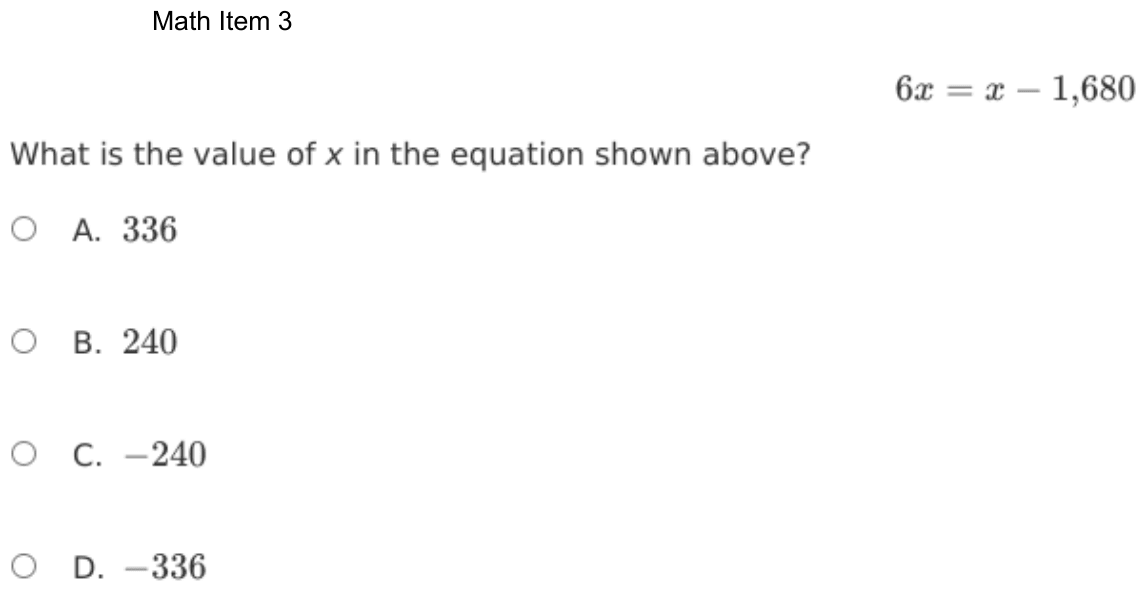
Question
What is the value of x in the equation shown above?
- A336
- B240
- C−240
- D−336
Show the answer
Correct answer: D
Simplify . First, subtract x from both sides of the equation. Then, divide both sides by 5.
Question analysis
This algebra question gives the equation 6x = x − 1,680, with x on both sides, and asks for the value of x. Students collect the x terms on one side and divide by the coefficient that remains. The choices pair two sizes with both signs, so every move across the equals sign has to keep its sign right.
- Grade level
- Grade 8 content, by NYS standard
- Compared with grade 7
- At grade 7 An unknown on both sides of the equals sign is a grade 8 topic, yet gathering the x terms here takes one subtraction and one division, the same work as a two-step grade 7 equation.
- Estimated difficulty
- Straightforward: two steps or one careful reading.
- Thinking it demands
- Depth of knowledge 1, recall and reproduction · mainly apply
- What makes it hard
- Error-prone arithmetic moderate
- A very close wrong answer moderate
- Solution
- 2 steps
- Reading level
- Question and choices: about grade 5, 12 words.
- Corrected from the DOE handbook
- A line of the explanation’s working, printed without its fraction bars and equals sign, was restored.
- Students, last 30 days
- Not enough answers yet to show (it takes 10).
Why it is hard, traps and wrong answers (shows the answer)
Why it is hard
Collecting the x terms takes one subtraction, and the only way the method goes wrong is moving x across the equals sign, which turns the 5 into a 7. The sign is the bigger hazard: 6x equals x minus a large number, so x must be negative, yet the division 1,680 ÷ 5 is done on positive numbers. Substituting −336 back gives −2,016 on each side, which confirms both the size and the sign.
Error-prone arithmetic moderate Working it out
Subtracting x from both sides leaves 5x = −1,680, and 1,680 ÷ 5 = 336 has to be worked out by hand while the negative sign is carried through to the result. (Brown & Burton, 1978; Junker & Sijtsma, 2001)
A very close wrong answer moderate Choosing the answer
The choices are two sizes, 336 and 240, each offered with both signs, so 336 and −336 are written the same except for the minus; only tracking the sign of 1,680 separates them. (Embretson & Wetzel, 1987; Gorin & Embretson, 2006; Ascalon et al., 2007)
Strategy: Subtract x from both sides so the unknown appears once, divide by the coefficient that is left, and substitute the result into both sides to check that they match.
Traps
- Negatives and direction: Arithmetic with negative numbers, the order of a subtraction, or direction on a number line. (Moving a term across the equals sign without changing its sign is a faulty procedure.)
- A faulty procedure: A systematic but wrong procedure: adding fractions straight across, applying an exponent to each term of a sum, dropping a sign when moving a term.
The wrong answers, classified
A Negatives and direction (Brown & Burton, 1978)
Reaches 5x = −1,680 correctly but drops the negative sign when dividing by 5, giving a positive 336 of the right size.
B A faulty procedure (Brown & Burton, 1978; Tatsuoka, 1983)
Moves x to the left without changing its sign, getting 7x, and also loses the minus on 1,680, so 1,680 ÷ 7 = 240.
C A faulty procedure (Brown & Burton, 1978; Tatsuoka, 1983)
Moves x to the left side without changing its sign, writing 6x + x = −1,680, so divides by 7 and gets −240.
What was corrected from the DOE handbook, and why
- Explanation: The DOE’s explanation page for this question is one of the pages replaced in the appendix, and on it the step between 5x = −1,680 and x = −336 shows only 5x over 5 and −1,680 over 5: the two fraction bars and the equals sign between them are missing, so the line is not an equation. The sentence above it says to divide both sides by 5, and the 2022–23 guide, which first printed this explanation, prints the step as 5x/5 = −1,680/5. The site shows 5x/5 = −1,680/5.
Worked solution, step by step
Formulas used
- Keeping an equation balanced
- a and b are the two sides of an equation, and c is any number (not 0 when you divide). An equation is like a balanced scale. Subtract the same thing from both sides, or divide both sides by the same number, and it stays balanced.
- Dividing a negative by a positive
- a and b are positive numbers, so −a is negative. Divide the sizes as usual. Then give the answer a minus sign, because a negative divided by a positive is negative.
Sort out the question
The equation is . You need the value of x. Here 6x means 6 times x. The unknown x is on both sides. So first gather it on one side.
Subtract x from both sides
Take x away from both sides. On the right, x − x is 0, so only −1,680 is left:
Six x’s take away one x leaves five x’s.
Watch out: moving x to the left without changing its sign gives 7x. Dividing by 7 then leads to choice C, −240, or B, 240.
Divide both sides by 5
5x means 5 times x. Divide both sides by 5 to undo it:
Find the size first. Split 1,680 into 1,500 + 180:
A negative divided by a positive is negative:
Choose the answer
Watch out: the minus sign is easy to drop. Positive 336 is choice A. Carry the sign of −1,680 all the way to the end.
So the answer is D, −336.
Check your answer
Put −336 into both sides. The left side is . The right side is . The two sides match, so x = −336 is right.
More questions like this
The original DOE question