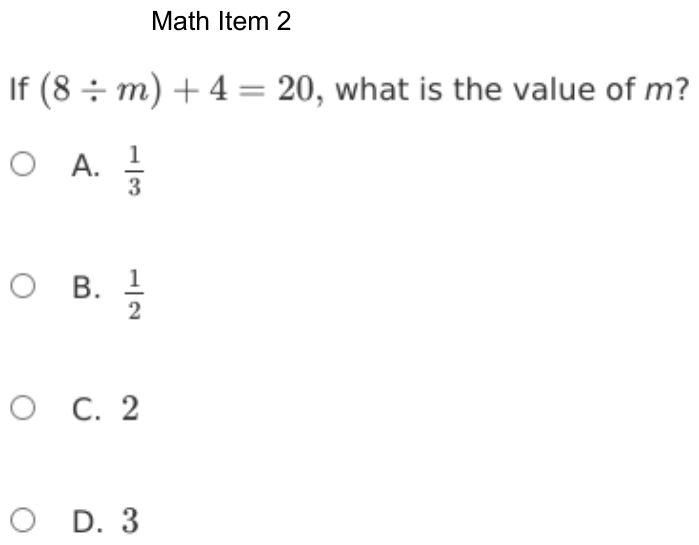
Question
If , what is the value of m?
- A
- B
- C2
- D3
Show the answer
Correct answer: B
The quantity means the same as , so the equation can be rewritten:
Subtract 4 from both sides:
Multiply both sides of the equation by m:
Solve for m:
Simplify:
Question analysis
This equation question asks for the value of m when 8 divided by m, plus 4, equals 20. Students undo the addition, then work out what m must be for 8 divided by it to give the value left. Because m is the divisor rather than the number being divided, the last step needs care.
- Grade level
- Grade 7 content, by NYS standard
- Compared with grade 7
- At grade 7 Undoing an addition and then a division is typical two-step grade 7 equation work. The unknown sitting in a denominator is less common than px + q = r, which makes the last step easier to get backward.
- Estimated difficulty
- Straightforward: two steps or one careful reading.
- Thinking it demands
- Depth of knowledge 1, recall and reproduction · mainly apply
- What makes it hard
- Error-prone arithmetic moderate
- Something you must already know minor
- Solution
- 3 steps
- Reading level
- Question and choices: about grade 6, 10 words.
- Students, last 30 days
- Not enough answers yet to show (it takes 10).
Why it is hard, traps and wrong answers (shows the answer)
Why it is hard
Undoing the + 4 is routine, so nearly all the risk sits in the last step, where m divides 8 rather than being divided by it. Students who read 8 ÷ m = 16 as asking how many 8s make 16 answer 2, and substituting it back, 8 ÷ 2 + 4 = 8, shows at once that it fails. The right value makes 8 ÷ 1/2 = 16, a division that gives a larger number, which feels wrong but is correct.
Error-prone arithmetic moderate Working it out
The unknown is the divisor, so 8 ÷ m = 16 ends in m = 8 ÷ 16, a quotient less than 1; the familiar order, 16 ÷ 8, gives a whole number instead. (Brown & Burton, 1978; Junker & Sijtsma, 2001)
Something you must already know minor Working it out
Students must see that (8 ÷ m) is the fraction 8/m and that freeing m from a denominator means multiplying both sides by it, a move grade 7 equations rarely need. (Anderson & Krathwohl, 2001)
Strategy: Subtract 4 from both sides, multiply both sides by m so the unknown is no longer in a denominator, then divide; check by substituting your value back into the equation.
Traps
- Wrong operation: Adds instead of multiplying, divides the wrong way round, turns a ratio or rate upside down, or undoes a step in the wrong direction (subtracts what should be added back).
The wrong answers, classified
A Wrong operation (Hegarty, Mayer & Monk, 1995; King et al., 2004)
Adds 4 to 20 instead of subtracting it, so 8 ÷ m = 24 and m = 8/24, which simplifies to 1/3.
C Wrong operation (Hegarty, Mayer & Monk, 1995; King et al., 2004)
Gets 8 ÷ m = 16 correctly but then divides 16 by 8, putting the divisor and the dividend the wrong way round, so m comes out as 2.
D Wrong operation (Hegarty, Mayer & Monk, 1995; King et al., 2004)
Makes both mistakes, adding 4 to get 8 ÷ m = 24 and then dividing 24 by 8 instead of 8 by 24.
Worked solution, step by step
Formulas used
- Keeping an equation balanced
- a and b are the two sides of an equation, and c is any number. An equation is like a balanced scale. Subtract the same number from both sides, or multiply both sides by the same number, and it stays balanced. That is how you get the unknown by itself.
Sort out the question
The equation is . You need the value of m. Here m is the number you divide 8 by. In words: 8 divided by some number, plus 4, makes 20.
Undo the plus 4
A fraction bar means divide, so is the same as . Subtract 4 from both sides to undo the plus 4:
Now 8 divided by m equals 16.
Watch out: adding 4 instead gives 24 on the right. That leads to choice A, 1/3, or to D, 3.
Get m out of the bottom
m is on the bottom of the fraction. Multiply both sides by m to free it:
Now divide both sides by 16:
8 goes into both 8 and 16, so 8/16 simplifies to 1/2.
Choose the answer
Watch out: it is tempting to divide 16 by 8 and get 2, choice C. But ask yourself: 8 divided by what number makes 16? To get an answer bigger than 8, you must divide by a number less than 1.
So the answer is B, 1/2.
Check your answer
Put 1/2 back into the equation. How many halves are in 8? There are 16, so . Then . That matches the equation, so m = 1/2 is right.
More questions like this
The original DOE question