Question
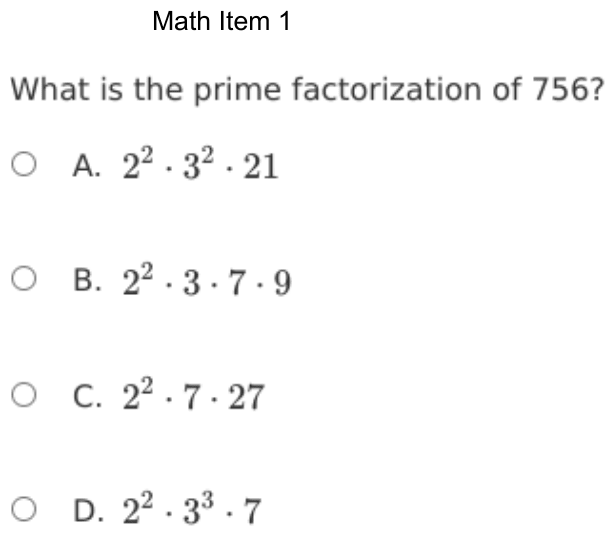
What is the prime factorization of 756?
- A
- B
- C
- D
Show the answer
Correct answer: D
Determine the prime factors of 756 using a factor tree:
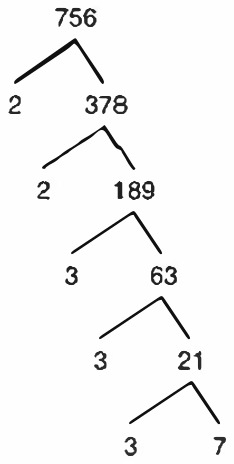
The prime factors are 2, 2, 3, 3, 3, and 7, or , which can be expressed using exponents as .
Question analysis
This number question asks for the prime factorization of 756, written with exponents. Students break the number into prime factors, with a factor tree or repeated division, and match the result to one of four products. Every choice multiplies back to 756, so the real test is whether each factor shown is actually prime.
- Grade level
- Grade 6 content, by NYS standard
- Compared with grade 7
- Below grade 7 Factor trees and exponent notation are grade 6 skills, and 756 splits quickly by small divisors. What adds a little is that every choice multiplies out to 756, so checking the product alone settles nothing.
- Estimated difficulty
- Straightforward: two steps or one careful reading.
- Thinking it demands
- Depth of knowledge 1, recall and reproduction · mainly apply
- What makes it hard
- A very close wrong answer moderate
- Something you must already know minor
- Solution
- 3 steps
- Reading level
- Question and choices: about grade 11, 10 words.
- Students, last 30 days
- Not enough answers yet to show (it takes 10).
Why it is hard, traps and wrong answers (shows the answer)
Why it is hard
The factoring itself is quick: halving twice and dividing by 3 three times leaves 7. The question is built so that multiplying back proves nothing, since every choice equals 756, and three of them simply stop the factor tree at a composite number. Students who check only the product, or who take an odd factor such as 21 or 27 for a prime, pick a factorization that is unfinished.
A very close wrong answer moderate Choosing the answer
2² · 3² · 21 shares the right answer's 2² and differs only in 3² · 21 against 3³ · 7, and both equal 756, so neither an estimate nor a product check separates them. (Embretson & Wetzel, 1987; Gorin & Embretson, 2006; Ascalon et al., 2007)
Something you must already know minor Working it out
Students must know that a prime factorization may hold only primes, and must spot that 21, 9 and 27 are composite even though none of them is even. (Anderson & Krathwohl, 2001)
Strategy: Divide 756 by 2 while the result is even, then by 3 while it divides evenly, and keep going until every factor left is prime; then compare factor by factor, not by product.
Traps
- Stops one step early: A choice is a number from partway through the solution.
- Misunderstands the concept: A wrong belief about a concept: that percents can be added, that area grows like length, that averages can be averaged, that a bigger denominator means a bigger fraction.
The wrong answers, classified
A Stops one step early (King et al., 2004; Gierl et al., 2017)
Divides out 2 twice and 3 twice, then stops at 21, which is 3 × 7, so one composite factor remains in a product that still equals 756.
B Misunderstands the concept (Smith, diSessa & Roschelle, 1993; De Bock et al., 1998; Ni & Zhou, 2005)
Splits off a 3 and a 7 but keeps 9 as if it were prime, perhaps because it is odd, though 9 = 3 × 3.
C Stops one step early (King et al., 2004; Gierl et al., 2017)
Splits 756 into 4 × 189 and 189 into 7 × 27, then stops, not seeing that 27 is 3 × 3 × 3.
Worked solution, step by step
Formulas used
- Writing a repeated factor with an exponent
- a is the number being multiplied, called the base. n is the exponent, the small raised number. It tells how many times a appears in the product. So 2² means 2 × 2, and 3³ means 3 × 3 × 3. Exponents are a short way to write a factor that repeats.
Sort out the question
You need the prime factorization of 756. That means writing 756 as a product of prime numbers only. A product is the answer to a multiplication. A prime number has exactly two factors, 1 and itself. Examples are 2, 3, 5 and 7.
All four choices multiply to 756. So multiplying a choice back does not pick the answer. You must check that every factor is prime.
Divide by 2 while you can
A factor tree splits a number into two factors, again and again. Start with the smallest prime, 2. 756 is even, so 2 goes into it:
378 is even too:
189 is odd, so 2 does not go into it. You have pulled out two 2s.
Divide by 3 while you can
Add the digits of 189: . A number can be divided by 3 when its digits add up to a number that 3 goes into. 3 goes into 18, so it goes into 189:
7 is prime, so the tree stops. You have pulled out three 3s and one 7.
Write the factors with exponents
Collect every prime you pulled out:
Use the exponent rule. Two 2s make , and three 3s make . The choices use a raised dot, ·, for times. So 756 is .
Choose the answer
Watch out: each wrong choice is a factor tree that stopped too soon. A ends in 21, which is 3 × 7. B has 9, which is 3 × 3. C has 27, which is 3 × 3 × 3. Being odd does not make a number prime.
Only D uses primes alone. So the answer is D, .
Check your answer
Multiply your answer back: , and . Then look at each factor. 2, 3 and 7 are all prime. D passes both tests.
More questions like this
The original DOE question