Question
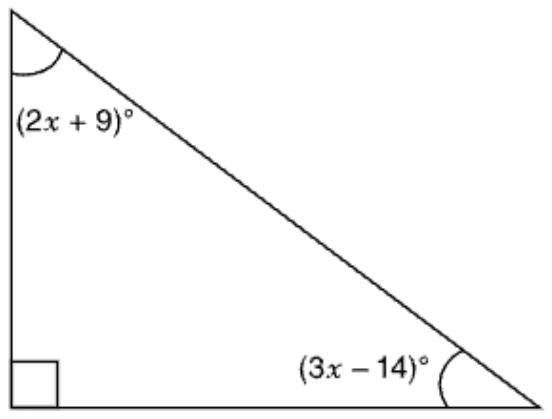
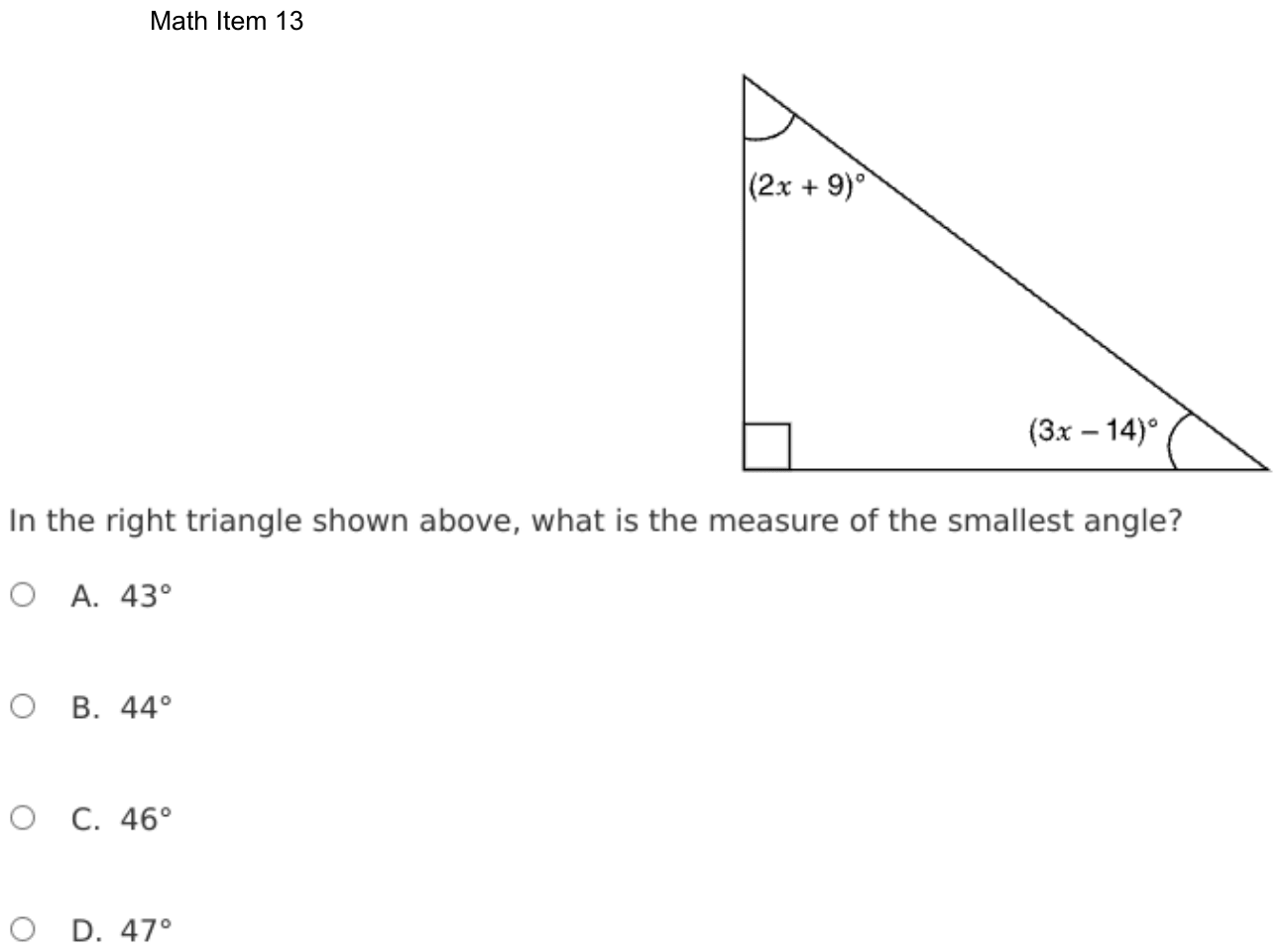
In the right triangle shown above, what is the measure of the smallest angle?
- A43°
- B44°
- C46°
- D47°
Show the answer
Correct answer: A
Since the three angles of a triangle have a sum of 180°, and since one angle is a right angle, the other two angles have a sum of 90°. By writing an equation and using inverse operations, the value of x can be found.
Now, use substitution to find the measure of the two angles to determine the smallest angle of the triangle.
The smallest angle is 43°.
Question analysis
A right triangle has its two other angles labeled (2x + 9)° and (3x − 14)°, and students find the measure of the smallest angle. It tests the angle sum of a triangle and solving a linear equation. Finding x is not the end: both angles must be worked out and compared to see which one is smallest.
- NYS standards
- Grade level
- Grade 8 content, by NYS standard
- Compared with grade 7
- Above grade 7 Grade 7 students write equations for unknown angles using complementary and supplementary angles. This also needs the angle sum of a triangle, which New York places in grade 8, plus substituting back and comparing, though each step is short.
- Estimated difficulty
- Moderate: several steps, or a close reading with one strong distractor.
- Thinking it demands
- Depth of knowledge 2, skills and concepts · mainly apply
- What makes it hard
- Combines ideas moderate
- Many steps minor
- Something you must already know minor
- Solution
- 4 steps
- Reading level
- Question and choices: about grade 6, 14 words.
- Students, last 30 days
- Not enough answers yet to show (it takes 10).
Why it is hard, traps and wrong answers (shows the answer)
Why it is hard
Setting the sum of the two labeled angles to 90° is the decision; the algebra after it is routine. The trap waits at the end: x = 19 is not an angle, and the expression at the top vertex, 2x + 9, gives the larger acute angle, 47°. Evaluating both expressions and checking that they add to 90° takes seconds and shows which one is smaller.
Combines ideas moderate Working it out
The angle facts and the algebra meet in one equation: the right angle means the two labeled angles add to 90°, and only that sum makes (2x + 9) + (3x − 14) solvable. (Embretson, 1998; Daniel & Embretson, 2010)
Many steps minor Working it out
After solving 5x − 5 = 90, both angle expressions must be evaluated and compared, because the question wants an angle, not x, and not the first angle found. (Daniel & Embretson, 2010; Enright, Morley & Sheehan, 2002)
Something you must already know minor Working it out
The 180° angle sum of a triangle is not printed, and only the small square at the bottom left shows that one angle is 90°. (Anderson & Krathwohl, 2001)
Strategy: Use the right angle to see that the other two angles add to 90°, solve that equation for x, then substitute into both expressions and compare them.
Traps
- Answers a different question: A choice is right for another quantity: the other unknown, the rest instead of the part, the part instead of the whole.
- A formula you must know: Needs a formula the test does not give: area, circumference, volume, probability rules.
The wrong answers, classified
B Little reason to choose it (Haladyna & Downing, 1993; Rodriguez, 2005)
No common working gives 44°; it sits one degree from the right measure and fits no consistent value of x, so it mostly draws estimates and guesses.
C Little reason to choose it (Haladyna & Downing, 1993; Rodriguez, 2005)
No common working gives 46°, which would need x = 20 and two angles adding to 95°, so it mostly catches guesses near 45°.
D Answers a different question (King et al., 2004; Hegarty, Mayer & Monk, 1995)
Solves x = 19 correctly but answers with 2x + 9 = 47°, the larger acute angle, instead of evaluating both expressions to find the smaller.
Worked solution, step by step
Formulas used
- Angles in a triangle
- a, b and c are the three angles of any triangle, in degrees. They always add up to 180 degrees. If you tear off the three corners and set them side by side, they make a straight line.
- The two other angles of a right triangle
- a and b are the two angles that are not the right angle. A right angle is 90 degrees, so the other two share what is left of the 180: 180 − 90 = 90.
Sort out the question
The small square at the bottom left corner marks a right angle, which is 90°. The top angle is (2x + 9)°, and the bottom right angle is (3x − 14)°. You need the smallest of the three angles. First find x, then find each angle.
Write an equation
The three angles add to 180°. The right angle uses 90° of that, so the other two angles add to 90°:
Solve for x
Combine the x terms, 2x + 3x = 5x. Combine the numbers, 9 − 14 = −5:
Add 5 to both sides, then divide both sides by 5:
Find both angles
Put x = 19 into each expression:
The three angles are 47°, 43° and 90°.
Watch out: x = 19 is not an angle. And the first angle you find, 47°, is not the smallest one. Stopping there gives choice D.
Pick the smallest angle
Compare 47°, 43° and 90°. The smallest is 43°. The figure is not drawn to scale, so do not judge the angles by how they look. Use the numbers.
So the answer is A, 43°.
Check your answer
Add the three angles: 47 + 43 + 90 = 180. That is the right total for a triangle. Also, 47 + 43 = 90, so the two smaller angles fill exactly what the right angle leaves.
More questions like this
The original DOE question