Passage Bird Talk
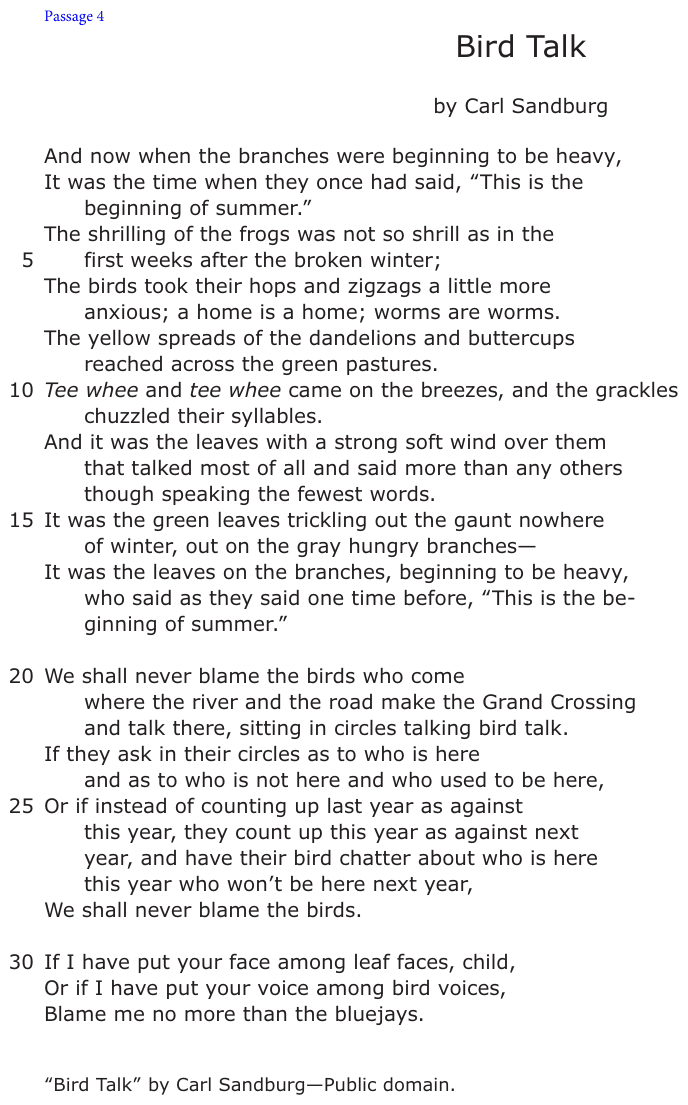
Bird Talk
by Carl Sandburg
And now when the branches were beginning to be heavy,
It was the time when they once had said, “This is the
beginning of summer.”
The shrilling of the frogs was not so shrill as in the
first weeks after the broken winter;
The birds took their hops and zigzags a little more
anxious; a home is a home; worms are worms.
The yellow spreads of the dandelions and buttercups
reached across the green pastures.
Tee whee and tee whee came on the breezes, and the grackles
chuzzled their syllables.
And it was the leaves with a strong soft wind over them
that talked most of all and said more than any others
though speaking the fewest words.
It was the green leaves trickling out the gaunt nowhere
of winter, out on the gray hungry branches—
It was the leaves on the branches, beginning to be heavy,
who said as they said one time before, “This is the be-
ginning of summer.”
We shall never blame the birds who come
where the river and the road make the Grand Crossing
and talk there, sitting in circles talking bird talk.
If they ask in their circles as to who is here
and as to who is not here and who used to be here,
Or if instead of counting up last year as against
this year, they count up this year as against next
year, and have their bird chatter about who is here
this year who won’t be here next year,
We shall never blame the birds.
If I have put your face among leaf faces, child,
Or if I have put your voice among bird voices,
Blame me no more than the bluejays.
“Bird Talk” by Carl Sandburg—Public domain.
Question
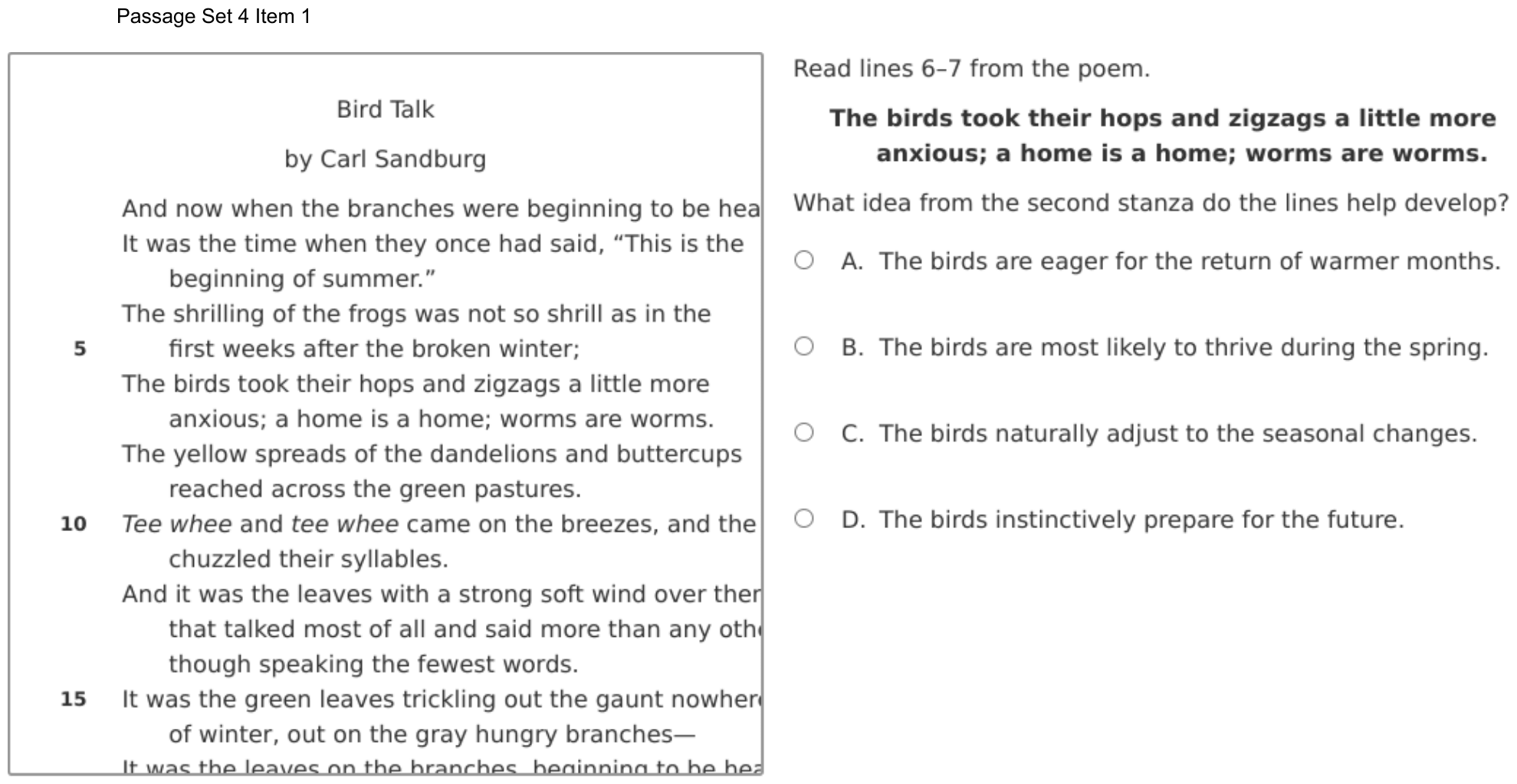
Read lines 6–7 from the poem.
The birds took their hops and zigzags a little more
anxious; a home is a home; worms are worms.
What idea from the second stanza do the lines help develop?
- AThe birds are eager for the return of warmer months.
- BThe birds are most likely to thrive during the spring.
- CThe birds naturally adjust to the seasonal changes.
- DThe birds instinctively prepare for the future.
Show the answer
Correct answer: C
The question asks how lines 6–7 from the poem develop an idea from the second stanza.
A. Incorrect. In lines 2–3, the tree branches exclaim that “ ‘This is the / beginning of summer,’ ” and the birds respond by taking “their hops and zigzags a little more / anxious” (lines 6–7); however, the birds’ eager reaction to the return of warmer weather is not referenced in the second stanza of the poem, which is more about the nature of birds generally than the changing of the seasons.
B. Incorrect. Birds are more likely to thrive in warmer weather as evidenced by some birds’ migration to a warmer climate during winter, and the creatures in the first stanza are responding to the “ ‘beginning of summer’ ” (line 3) in their own way, such as the birds who are taking “their hops and zigzags a little more / anxious” (lines 6–7). However, the thriving of birds during a particular season is not the focus of the second stanza; rather, it is focused on the general nature of birds.
C. CORRECT. The birds are taking “their hops and zigzags a little more / anxious” (lines 6–7) in light of warmer weather, but they are not making a big to-do of the change because “a home is a home; worms are worms” (line 7) any time of the year. Such a natural adjustment to seasonal changes is reflected in the second stanza, where the birds “count up this year as against next / year” (lines 26–27) because they are well accustomed to the cyclical nature of things.
D. Incorrect. Although the birds’ actions of “hops and zigzags” (line 6) may indicate some sort of preparation, these actions are not preparation but rather the internalized cognizance of the change that has occurred with little conscious thought. As revealed in the second stanza, birds do not ponder much about past or future but rather adapt naturally as things change.
Question analysis
This question on Carl Sandburg’s poem “Bird Talk” quotes lines 6–7, where the birds hop and zigzag “a little more anxious,” and asks which idea from the second stanza they help develop. Students must link two compressed lines in the first stanza to a later stanza about birds gathered at the Grand Crossing, and every choice sounds like a fair claim about birds.
- Grade level
- Grade 8 reading and task
- Compared with grade 7
- Above grade 7 Typical grade 7 poetry questions ask what one line or stanza shows on its own. Here two compressed lines from the first stanza must be tied to an idea the second stanza never states, in Sandburg’s loose, unusual phrasing.
- Estimated difficulty
- Among the hardest on the SHSAT: a non-obvious approach, heavy reading, or a well-hidden trap.
- Thinking it demands
- Depth of knowledge 3, strategic thinking · mainly analyze
- What makes it hard
- Reading between the lines major
- A very close wrong answer moderate
- Evidence in several places moderate
- Figurative or literary language moderate
- Evidence
- Answered from several paragraphs or stanzas
- Reading level
- Passage: 296 words (a poem; reading level not measured); question and choices: about grade 5, 70 words.
- Students, last 30 days
- Not enough answers yet to show (it takes 10).
Why it is hard, traps and wrong answers (shows the answer)
Why it is hard
The stem runs in an unusual direction: two lines from the first stanza must help develop an idea that only the second stanza holds, and the poem never states it. Students who read “next year” as planning are drawn to preparation, a choice built on the key’s own frame, while others answer from the first stanza’s summer or from what they know about birds. The question rewards hearing the birds’ roll call of who is gone as the same matter-of-fact acceptance as “worms are worms.”
Reading between the lines major Working it out
Neither stanza states the shared idea: students must hear calm acceptance in “a home is a home; worms are worms” and in birds tallying “who won’t be here next year,” then call it adjusting to change. (Graesser, Singer & Trabasso, 1994; Kintsch, 1998)
A very close wrong answer moderate Choosing the answer
The choice about instinctive preparation shares the key’s shape, birds acting by nature as time passes; it differs only in what the birds do, prepare for the future rather than adjust to the seasons. (Embretson & Wetzel, 1987; Gorin & Embretson, 2006; Ascalon et al., 2007)
Evidence in several places moderate Working it out
Lines 6–7 sit in the first stanza and the idea lives in the second, lines 20–29, so students must carry two lines across the poem and match them to the gathering at the Grand Crossing. (Kirsch & Mosenthal, 1990; Gorin & Embretson, 2006)
Figurative or literary language moderate Understanding the question
“A home is a home; worms are worms” says nothing on its surface; its meaning, a shrug that life goes on as it always has, has to be read from the repetition. (Graesser, Singer & Trabasso, 1994; Kintsch, 1998)
Strategy: Paraphrase the second stanza first: what are the birds doing and saying at the Grand Crossing? Then reread lines 6–7 and ask which idea about birds both passages share.
Traps
- Reads too much in: A reasonable-sounding conclusion that goes further than the text allows.
- Wrong part of the text: A choice is true of another paragraph, stanza or speaker than the one asked about.
- Outside knowledge: A choice is plausible in the real world but not supported by this text.
The wrong answers, classified
A Wrong part of the text (Kirsch & Mosenthal, 1990)
Hears “a little more anxious” as eagerness for the summer announced in lines 2–3, an idea of the first stanza, while the second stanza never mentions weather or warmth.
B Outside knowledge (King et al., 2004; Recht & Leslie, 1988)
Brings in the real fact that birds do well in warm weather, which neither lines 6–7 nor the birds’ talk of who is gone says, and the poem’s season is summer, not spring.
D Reads too much in (Graesser, Singer & Trabasso, 1994)
Sees nest-building in “a home is a home” and planning in counting “this year as against next / year,” but the birds only note who will be missing and make no preparations.
Working it out, step by step
Figure out what the question asks
This question points in an unusual direction. Lines 6–7 are in the first stanza. A stanza is a group of lines set apart by a blank line. But the idea you need is in the second stanza, lines 20–29. The question asks which idea in stanza 2 these earlier lines also help build. So find the idea in stanza 2 first. Then see how lines 6–7 support it.
Find the idea in stanza 2
In stanza 2, birds sit “in circles talking bird talk.” They ask “who is here / and as to who is not here and who used to be here.” They also talk about “who is here / this year who won’t be here next year.” The birds simply count the changes. They are not upset by them. The speaker says, “We shall never blame the birds.” The idea: birds take the changes that time brings as a normal part of life.
Read lines 6–7 closely
Lines 6–7 say “The birds took their hops and zigzags a little more / anxious; a home is a home; worms are worms.” As summer comes, the birds hop about a little more nervously and busily. That is a small change. Then the speaker shrugs: “a home is a home; worms are worms.” Life goes on as it always does. The birds change a little and carry on, with no fuss.
See what the two parts share
Both parts show birds meeting change calmly. In lines 6–7, the season turns, and the birds adjust a little. To adjust is to change a little to fit something new. In stanza 2, the birds note who has come and gone, and life goes on. So lines 6–7 help build stanza 2’s idea: birds naturally adjust to the changing seasons.
Check each choice
- A does not fit. Stanza 2 never mentions warm weather or being eager for it.
- B does not fit. Nothing in the poem says birds do best in spring. The poem’s season is the start of summer.
- C fits. Both parts show birds taking seasonal change calmly, as a matter of course.
- D does not fit. The birds talk about next year, but they make no plans for it.
Watch out: D is tempting because “a home is a home” can sound like nest building. But the birds only count who will be missing. They do not get ready for anything.
Choose the answer
Lines 6–7 and stanza 2 both show birds accepting change as natural. So the answer is C, “The birds naturally adjust to the seasonal changes.”
Why this answer and not the closest wrong one
D is the closest wrong choice. Like C, it says birds act by nature as time passes. But D says they prepare, or get ready. In stanza 2, the birds talk about next year only to count who “won’t be here next year.” In lines 6–7, they hop about and carry on. They adjust to change. They do not plan for it.
More questions like this
The original DOE question
The passage “Bird Talk” as printed (page 32)