Question
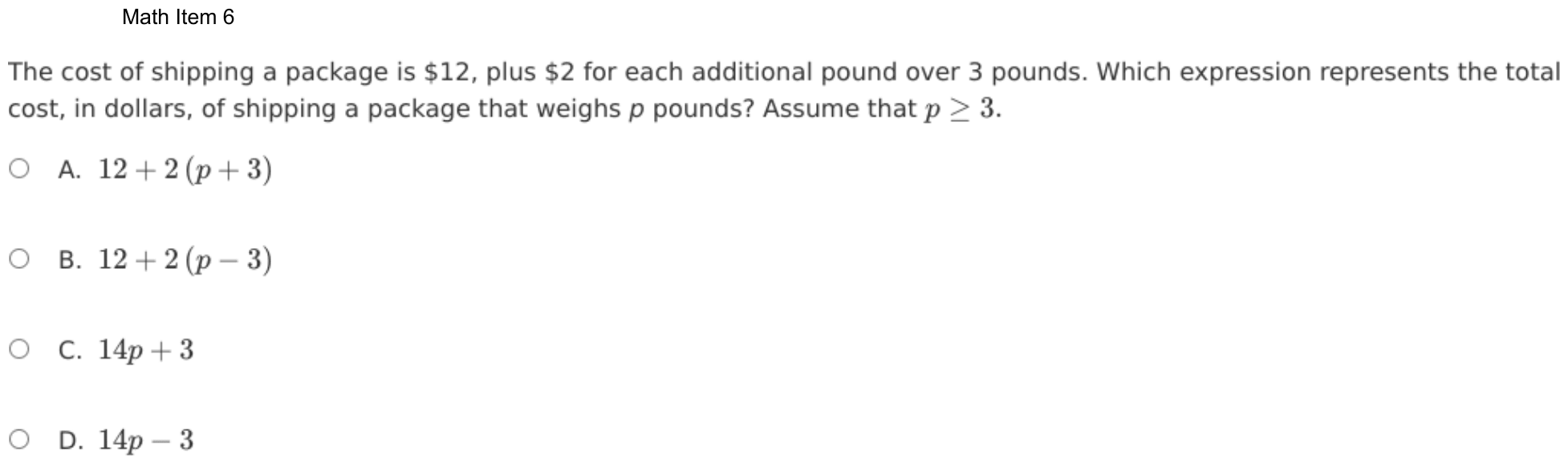
The cost of shipping a package is $12, plus $2 for each additional pound over 3 pounds. Which expression represents the total cost, in dollars, of shipping a package that weighs p pounds? Assume that .
- A
- B
- C
- D
Show the answer
Correct answer: B
Since the additional cost per pound is not added until the package weighs more than 3 pounds, the total cost for 1, 2, or 3 pounds is $12.
- 1 pound is $12
- 2 pounds is $12
- 3 pounds is $12
Since p is greater than or equal to 3 pounds, the total cost for:
- 4 pounds is
- 5 pounds is
- p pounds is
You may try to write the expression without generating the pattern by recognizing that subtracting 3 from the number of pounds for the package before multiplying by $2 and then adding $12 results in the total cost.
Question analysis
Shipping a package costs $12, plus $2 for each additional pound over 3 pounds, and students choose the expression for the total cost of a package that weighs p pounds. It tests writing an algebraic expression from a word problem. The per-pound charge starts only after the first 3 pounds, and turning that phrase into algebra is the tricky part.
- Grade level
- Grade 6 content, by NYS standard
- Compared with grade 7
- At grade 7 Writing an expression from a cost description is grade 6 algebra. Because the per-pound charge starts only after the first 3 pounds, it is less routine than a fee plus a simple rate, in line with typical grade 7 demand.
- Estimated difficulty
- Moderate: several steps, or a close reading with one strong distractor.
- Thinking it demands
- Depth of knowledge 2, skills and concepts · mainly apply
- What makes it hard
- Turning words into math moderate
- A very close wrong answer moderate
- Variables instead of numbers minor
- Solution
- 2 steps
- Reading level
- Question and choices: about grade 6, 37 words.
- Students, last 30 days
- Not enough answers yet to show (it takes 10).
Why it is hard, traps and wrong answers (shows the answer)
Why it is hard
The question rewards modeling the fee in two parts: a flat $12 that covers the first 3 pounds, and $2 for each pound beyond them. The two choices that start with 12 look equally reasonable until a weight is tried, and the two that begin with 14p come from merging the fee with the per-pound charge. Testing p = 3, which must cost exactly $12, rules out three choices in one step.
Turning words into math moderate Understanding the question
“$2 for each additional pound over 3 pounds” must become 2(p − 3), a charge on the pounds beyond the first 3, and the word “over” invites writing p + 3 instead. (Hegarty, Mayer & Monk, 1995; Koedinger & Nathan, 2004)
A very close wrong answer moderate Choosing the answer
12 + 2(p + 3) and 12 + 2(p − 3) differ only in the sign inside the parentheses, so their shape cannot separate them; only a test weight or a careful reading can. (Embretson & Wetzel, 1987; Gorin & Embretson, 2006; Ascalon et al., 2007)
Variables instead of numbers minor Understanding the question
The weight is the letter p, so there is no cost to work out and compare; choosing a weight such as 5 pounds, which costs $16, turns every choice into a number. (Koedinger & Nathan, 2004; Enright, Morley & Sheehan, 2002)
Strategy: Test a weight such as 5 pounds: work out its cost from the description, then substitute 5 for p in each choice and keep the one that gives the same cost.
Traps
- Follows a key word: Picks the operation from a single word rather than the situation: "removed" so subtract, "of" so multiply, "more" so add, when the situation needs something else.
- Numbers taken from the question: Combines the numbers in the question without a model of the situation, or is simply a number that appears in the question.
The wrong answers, classified
A Follows a key word (Hegarty, Mayer & Monk, 1995)
Reads “over 3 pounds” as adding 3, so the $2 charge applies to p + 3 pounds instead of only the pounds above the first 3.
C Numbers taken from the question (Hegarty, Mayer & Monk, 1995)
Merges the $12 and the $2 into $14 for every pound and tacks on the 3 from the stem, building an expression from its numbers without a model.
D Numbers taken from the question (Hegarty, Mayer & Monk, 1995)
Charges $14 for every pound by merging the fee with the $2 rate, then subtracts 3 for the first 3 pounds, mixing dollars with pounds.
Worked solution, step by step
Formulas used
- Cost with a base fee and a rate
- The base fee is the set price, $12, which covers the first 3 pounds. The rate is the price for each pound after that, $2. The extra pounds are the pounds over 3, which is p − 3. Use it when a price has a fixed part plus a part per unit.
Sort out the question
Shipping costs $12 to start. Each pound over 3 pounds adds $2. The package weighs p pounds, and p is at least 3. You need an expression for the total cost in dollars.
Count the extra pounds
Only the pounds above 3 cost extra. To find them, take 3 away from the weight:
For example, a 5-pound package has 5 − 3 = 2 extra pounds.
Watch out: over 3 pounds means more than 3. It does not tell you to add 3. Writing p + 3 leads to choice A.
Build the expression
Each extra pound costs $2, so the extra pounds cost 2(p − 3) dollars. Add the $12 base fee:
Watch out: the $12 is paid once, not for every pound. Choices C and D charge $14 for every pound, which mixes up the fee and the rate.
Test each choice with 5 pounds
A 5-pound package costs $12 plus two $2 charges, which is $16. Put p = 5 into each choice:
Choice Value when p = 5 A 12 + 2(8) = 28 B 12 + 2(2) = 16 C 14(5) + 3 = 73 D 14(5) − 3 = 67 Only B gives $16. So the answer is B, .
Check your answer
Try p = 3, the smallest weight allowed. There are no extra pounds, so it should cost just $12. Choice B gives 12 + 2(0) = 12. Try p = 4: 12 + 2(1) = 14, which is $12 plus one $2 charge.
More questions like this
The original DOE question