Question
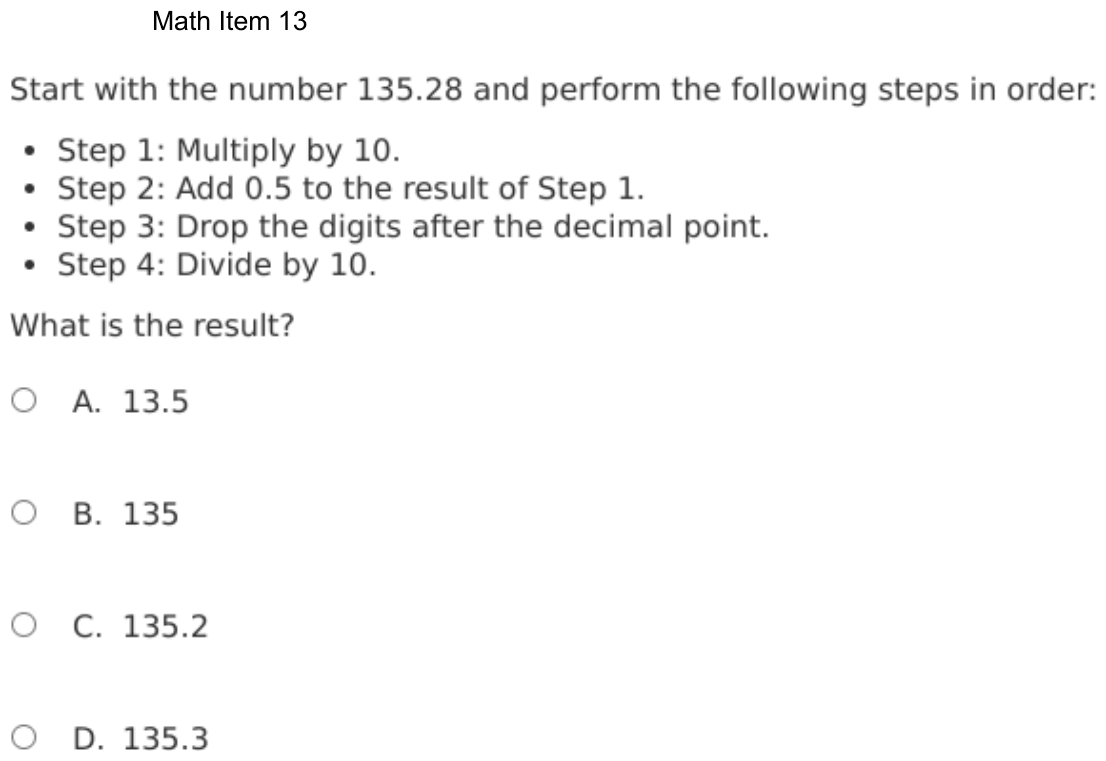
Start with the number 135.28 and perform the following steps in order:
- Step 1: Multiply by 10.
- Step 2: Add 0.5 to the result of Step 1.
- Step 3: Drop the digits after the decimal point.
- Step 4: Divide by 10.
What is the result?
- A13.5
- B135
- C135.2
- D135.3
Show the answer
Correct answer: D
Begin by multiplying 135.28 by 10:
Add 0.5:
Drop the digits after the decimal point, so becomes .
Divide by 10:
Question analysis
Students start with 135.28 and carry out four listed steps: multiply by 10, add 0.5, drop the digits after the decimal point, and divide by 10. It tests place value and operations with decimals. Skipping a step, or doing two of them in the wrong order, changes the result, and the choices are built from those slips.
- NYS standards
- 6.NS.3 multi-digit decimal operations
- Grade level
- Grade 6 content, by NYS standard
- Compared with grade 7
- Below grade 7 Multiplying and dividing a decimal by 10 and adding 0.5 are grade 5 and 6 skills. The four steps are spelled out, so the demand is following them exactly and in order, not choosing a method.
- Estimated difficulty
- Straightforward: two steps or one careful reading.
- Thinking it demands
- Depth of knowledge 1, recall and reproduction · mainly apply
- What makes it hard
- A very close wrong answer moderate
- Many steps minor
- Error-prone arithmetic minor
- Solution
- 4 steps
- Reading level
- Question and choices: about grade 3, 36 words.
- Students, last 30 days
- Not enough answers yet to show (it takes 10).
Why it is hard, traps and wrong answers (shows the answer)
Why it is hard
The steps spell out how to round 135.28 to the nearest tenth, but nothing says so, and they have to be followed exactly. The decisive moment is step 2, where adding 0.5 pushes 1,352.8 past 1,353; skip it and the digits are simply cut, not rounded. Students who recognize the routine can check the result directly, since 135.28 lies closer to 135.3 than to 135.2.
A very close wrong answer moderate Choosing the answer
135.3 and 135.2 differ only in the tenths digit, and 135 shares their whole-number part, so a rough sense of the result's size rules out nothing. (Embretson & Wetzel, 1987; Gorin & Embretson, 2006; Ascalon et al., 2007)
Many steps minor Working it out
Four listed steps move the decimal point twice, and doing them in another order, or skipping one, still produces a believable number near 135. (Daniel & Embretson, 2010; Enright, Morley & Sheehan, 2002)
Error-prone arithmetic minor Working it out
Adding 0.5 to 1,352.8 carries into the ones place, since 8 tenths and 5 tenths make 1.3, which turns 1,352 into 1,353 before the decimals are dropped. (Brown & Burton, 1978; Junker & Sijtsma, 2001)
Strategy: Write down the number after each step instead of doing them in your head, and carry out the steps exactly in the order listed.
Traps
- Misreads the question: Misses or misreads a condition or a word in the question: "at least", "each", "remaining", "not".
- Rounds too early: Rounds a value partway through, or rounds the wrong way, so the final answer drifts from the exact one.
The wrong answers, classified
A Misreads the question (Hegarty, Mayer & Monk, 1995)
Skips step 1, so adds 0.5 to 135.28, drops the decimals to get 135, and then divides by 10 to reach 13.5.
B Misreads the question (Hegarty, Mayer & Monk, 1995)
Divides by 10 before dropping the digits after the decimal point, so 1,353.3 becomes 135.33 and then 135, doing steps 3 and 4 in reverse order.
C Rounds too early (King et al., 2004)
Leaves out step 2, or adds 0.5 without carrying, so 1,352 is kept and 135.2 results: 135.28 cut down instead of rounded up.
Worked solution, step by step
Formulas used
- Multiplying and dividing by 10
- a is any decimal number. Multiplying by 10 moves its decimal point one place to the right, so each digit is worth ten times as much. Dividing by 10 moves the point one place to the left. The two steps undo each other.
Sort out the question
You start with 135.28 and do four steps, in order. Write down the number after each step. Doing them in your head, or in another order, leads to a wrong choice. You need the number at the end.
Multiply by 10
Step 1. Multiplying by 10 moves the decimal point one place to the right:
The digits stay the same. Only the decimal point moves.
Add 0.5
Step 2. Line up the decimal points. 8 tenths plus 5 tenths is 13 tenths. That is 1 whole and 3 tenths, so carry the 1 into the ones place:
Watch out: skipping this step, or forgetting to carry, keeps 1,352. That leads to choice C, 135.2.
Drop the digits after the point
Step 3. Cut off the digits after the decimal point. Do not round. So 1,353.3 becomes 1,353.
Watch out: do step 3 before step 4. Dividing first gives 135.33. Dropping its decimals then gives 135, choice B.
Divide by 10
Step 4. Dividing by 10 moves the decimal point one place to the left:
Skipping step 1 gives 13.5, choice A. So the answer is D, 135.3.
Check your answer
These four steps are a recipe for rounding to the nearest tenth. 135.28 is between 135.2 and 135.3. Its hundredths digit is 8, which is 5 or more, so it rounds up to 135.3. The recipe and the rounding agree.
More questions like this
The original DOE question