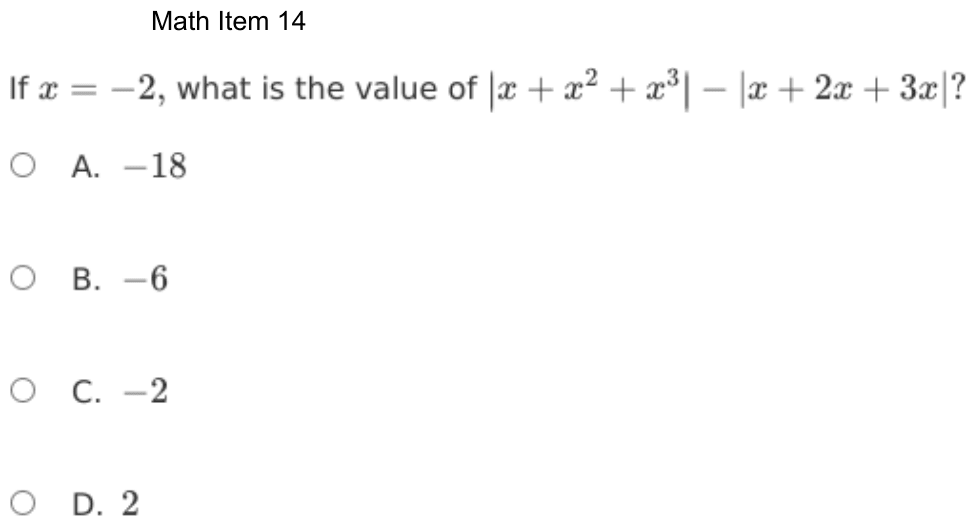
Question
If , what is the value of ?
- A−18
- B−6
- C−2
- D2
Show the answer
Correct answer: B
Substitute for each value of x in the expression:
minus
Evaluate the terms involving exponents:
minus
Evaluate the terms involving multiplication:
minus
Simplify the expression:
The absolute value of is 6, and the absolute value of is 12, so is the equivalent of subtracting 12 from 6:
Question analysis
This substitution question sets x = −2 in an expression that subtracts one absolute value from another: the first holds x, x squared and x cubed, the second x, 2x and 3x. Students evaluate the expression. It tests powers of negative numbers, absolute value and integer subtraction, and the signs of the square and the cube are where answers go wrong.
- NYS standards
- Grade level
- Grade 7 content, by NYS standard
- Compared with grade 7
- At grade 7 Substituting a negative number and taking absolute values is typical grade 7 sign practice. This expression puts a square and a cube of a negative inside one pair of bars and then subtracts two absolute values, so there are several places to slip.
- Estimated difficulty
- Moderate: several steps, or a close reading with one strong distractor.
- Thinking it demands
- Depth of knowledge 1, recall and reproduction · mainly apply
- What makes it hard
- Error-prone arithmetic moderate
- Many steps minor
- Solution
- 4 steps
- Reading level
- Question and choices: about grade 7, 8 words.
- Students, last 30 days
- Not enough answers yet to show (it takes 10).
Why it is hard, traps and wrong answers (shows the answer)
Why it is hard
Every step is routine, but the expression stacks sign decisions, and each wrong choice records a different one going wrong. The powers of −2 alternate in sign, which students who treat every power as positive, or the square as negative, miss. The last step catches students who know the rules: both absolute values are positive, yet 6 − 12 is still negative, so the answer keeps its minus sign.
Error-prone arithmetic moderate Working it out
With x = −2 the square is 4 but the cube is −8, so the first bars hold −2 + 4 − 8 = −6, and the sign changes from each term to the next. (Brown & Burton, 1978; Junker & Sijtsma, 2001)
Many steps minor Working it out
Six terms are substituted, two pairs of bars are simplified and made positive, and only then is 12 subtracted from 6, four stages that must come in a fixed order. (Daniel & Embretson, 2010; Enright, Morley & Sheehan, 2002)
Strategy: Work out each power of −2 separately, keeping its sign, add the terms inside each pair of bars, take both absolute values, and subtract only at the end.
Traps
- Negatives and direction: Arithmetic with negative numbers, the order of a subtraction, or direction on a number line. (Moving a term across the equals sign without changing its sign is a faulty procedure.)
- A faulty procedure: A systematic but wrong procedure: adding fractions straight across, applying an exponent to each term of a sum, dropping a sign when moving a term.
The wrong answers, classified
A A faulty procedure (Brown & Burton, 1978; Tatsuoka, 1983)
Simplifies both insides correctly but treats the first bars like parentheses, keeping −6, so −6 − 12 = −18.
C Negatives and direction (Brown & Burton, 1978)
Takes (−2)³ as positive 8, as if every power of a negative were positive, so the first bars hold −2 + 4 + 8 = 10, and 10 − 12 = −2.
D Negatives and direction (Brown & Burton, 1978)
Takes (−2)² as −4, so the first bars hold −2 − 4 − 8 = −14, and 14 − 12 = 2; dropping the minus from x throughout also gives 2.
Worked solution, step by step
Formulas used
- Absolute value
- a is any number. The bars mean absolute value: how far a is from 0 on the number line. A distance is never negative, so |−6| = 6 and |6| = 6. Work out what is inside the bars first, then take the absolute value.
- Powers of a negative number
- The small raised number is the exponent. It tells how many times −2 is multiplied by itself. Two negatives multiply to a positive. So an even number of negative factors gives a positive answer, and an odd number gives a negative one.
Sort out the question
You need the value of when x = −2. The bars | | mean absolute value. Work out each pair of bars on its own. Subtract only at the end.
Find the powers of −2
Put −2 in for x. Keep each negative sign:
The square is positive, but the cube is negative.
Watch out: taking as +8 makes the first bars hold 10. That leads to choice C, −2.
Work out the first bars
Add the three terms inside the first pair of bars:
−2 + 4 is 2, and 2 + (−8) is −6. The distance from −6 to 0 is 6.
Work out the second bars
Here 2x means 2 times x, so it is −4. And 3x is −6:
All three terms are negative, so they add to −12. Its absolute value is 12.
Subtract the second value
Now subtract the second value from the first:
Watch out: the bars make each part positive, but the difference can still be negative. Keeping −6 inside the first bars gives −6 − 12 = −18, choice A.
So the answer is B, −6.
Check your answer
Check the second bars a faster way. , and . That matches. Also, the second value, 12, is bigger than the first, 6. So the difference must be negative, as −6 is.
More questions like this
The original DOE question