Passage Excerpt from “Scribe Like an Egyptian”
Excerpt from “Scribe Like an Egyptian”
by Hilary Wilson
In ancient Egypt, literacy was the key to success. However, contrary to popular belief, not all Egyptian scribes understood hieroglyphs. Many relied instead on the simpler hieratic script for the multitude of everyday documents generated by the Egyptian bureaucracy.
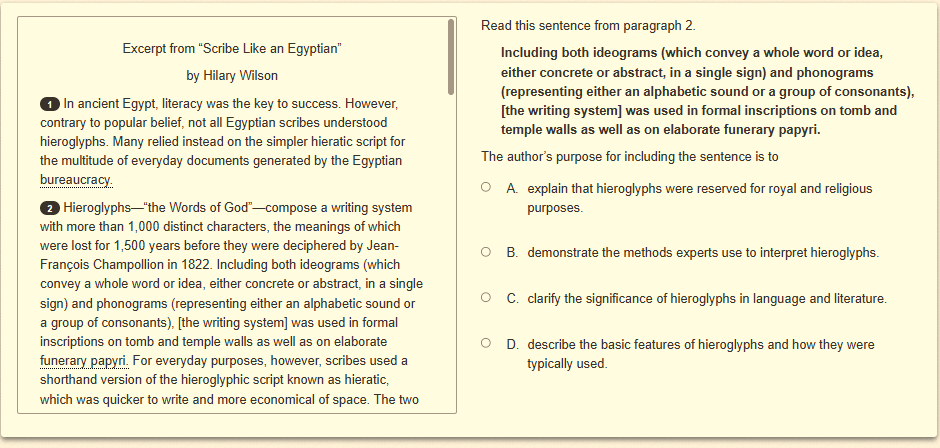
Hieroglyphs—“the Words of God”—compose a writing system with more than 1,000 distinct characters, the meanings of which were lost for 1,500 years before they were deciphered by Jean-François Champollion in 1822. Including both ideograms (which convey a whole word or idea, either concrete or abstract, in a single sign) and phonograms (representing either an alphabetic sound or a group of consonants), [the writing system] was used in formal inscriptions on tomb and temple walls as well as on elaborate funerary papyri. For everyday purposes, however, scribes used a shorthand version of the hieroglyphic script known as hieratic, which was quicker to write and more economical of space. The two writings existed side by side for at least 2,500 years.
Scraps of ancient hieratic writing, mostly penned by student scribes on limestone flakes called ostraca, suggest that no matter how humble his origins, an educated Egyptian could achieve almost anything. Horemheb (d.1292 B.C.) is a good example. Born of middle-ranking parents, his scribal training led to an army career. From Scribe of Recruits, during the reign of Akhenaten (1353–1336 B.C.), Horemheb rose through the military ranks and, by the rule of Tutankhamun (1332–1323 B.C.), he was commander in chief of the Egyptian forces. As a close adviser of the young Pharaoh, Horemheb was appointed “Deputy of the King throughout the Two Lands,” and might have expected to succeed to the throne should the king die childless. He had to wait a few years, but eventually Horemheb achieved the pinnacle of his career by becoming the last king of the 18th Dynasty, making his mark by instituting dramatic reforms to the organisation of the army, the judiciary and administration in general. The lasting success of these changes owed much to his scribal background. . . .
But education was not available to all. Government departments and major temples supported schools, where boys commenced their training at six or seven, sometimes earlier. To these boarding establishments . . . family or household servants delivered the students’ food and drink rations daily for several years, during which time the student was not contributing to the family’s income. Boys from poorer families could only hope to be educated with support from a wealthier relative or patron, or through apprenticeship to an older scribe, perhaps the local clerk or land agent, who would teach them the basics of the scribe’s craft. This limited the scope for employment but such “on the job” training allowed apprentices to help out at home while learning. . . .
Scribal education began with the elementary principles of the hieratic script. The lowliest scribes, who trained for just five or six years, probably learned only the rudiments of the hieroglyphic script. Students were set exemplar documents and extracts from popular texts to copy, to practice their hieratic handwriting on basic-format letters, reports and contracts, while absorbing the good advice contained in the texts. Surviving examples of copy-work sometimes include tutors’ corrections added in red. Some significant Egyptian literary works survive almost exclusively from student copies.
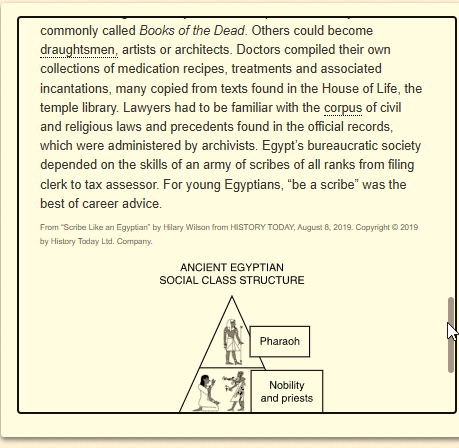
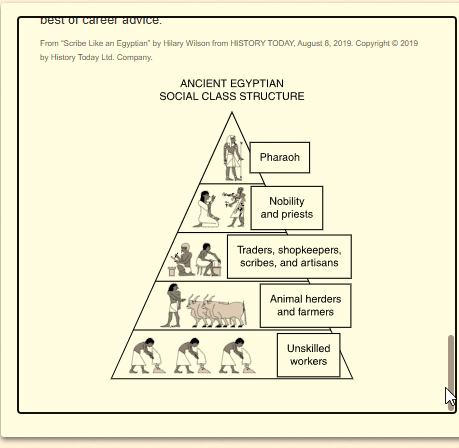
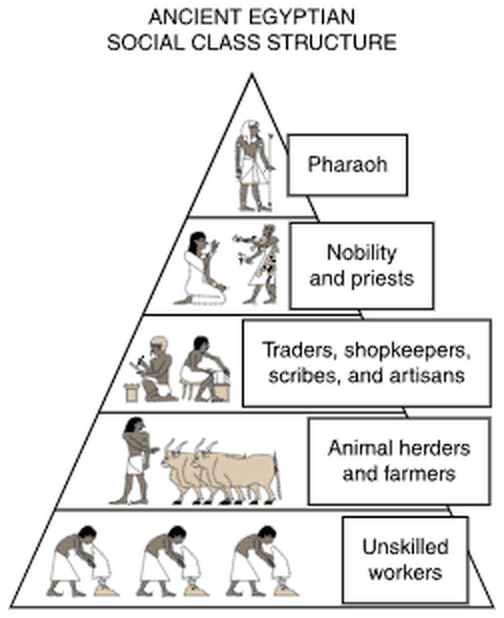
A schoolboy “dictionary” of hieroglyphs with their hieratic equivalents shows that a knowledge of more than 450 signs was required for everyday writing purposes. Lessons in record-keeping and filing and labelling enabled any half-competent scribe to perform that most essential of all scribal functions: the making and updating of lists. For professions such as those of government official, priest or lawyer, a scribe would train for several more years, increasing his vocabulary to perhaps a thousand or more signs. Those with the best handwriting or drawing skills might follow the craft of creating beautifully illustrated copies of funerary texts, commonly called Books of the Dead. Others could become draughtsmen, artists or architects. Doctors compiled their own collections of medication recipes, treatments and associated incantations, many copied from texts found in the House of Life, the temple library. Lawyers had to be familiar with the corpus of civil and religious laws and precedents found in the official records, which were administered by archivists. Egypt’s bureaucratic society depended on the skills of an army of scribes of all ranks from filing clerk to tax assessor. For young Egyptians, “be a scribe” was the best of career advice.
From “Scribe Like an Egyptian” by Hilary Wilson from HISTORY TODAY, August 8, 2019. Copyright © 2019 by History Today Ltd. Company.
Question
Read this sentence from paragraph 2.
Including both ideograms (which convey a whole word or idea, either concrete or abstract, in a single sign) and phonograms (representing either an alphabetic sound or a group of consonants), [the writing system] was used in formal inscriptions on tomb and temple walls as well as on elaborate funerary papyri.
The author’s purpose for including the sentence is to
- Aexplain that hieroglyphs were reserved for royal and religious purposes.
- Bdemonstrate the methods experts use to interpret hieroglyphs.
- Cclarify the significance of hieroglyphs in language and literature.
- Ddescribe the basic features of hieroglyphs and how they were typically used.
Show the answer
Correct answer: D
The question asks for an explanation of the author’s purpose for including a sentence in paragraph 2 that describes the two types of hieroglyphs and the main uses of this particular writing system.
A. Incorrect. The sentence explains that hieroglyphs were used for formal inscriptions, but it does not suggest that these inscriptions were limited to royal and religious contexts.
B. Incorrect. The sentence describes the two basic types of hieroglyphs, ideograms and phonograms, but it does not address how experts interpret the ancient writing system. A sentence earlier in the paragraph explains that the hieroglyphs were deciphered by Champollion, but it does not explain how he deciphered them.
C. Incorrect. Although the sentence explains that the hieroglyphs were typically used for formal inscriptions, it does not provide an explanation of the significance or importance of hieroglyphs in the Egyptian language.
D. CORRECT. The sentence explains that hieroglyphs included both phonograms and ideograms that were used in formal inscriptions and funeral papyri; therefore, this sentence achieves the purpose of describing the basic features of hieroglyphs as conveying either words and ideas or sounds, in addition to explaining the common uses for the writing system.
Question analysis
This author’s-purpose question quotes a long, technical sentence from paragraph 2 of “Scribe Like an Egyptian” about the ancient Egyptian hieroglyphic writing system, and asks why the author includes it. Students must make sense of its specialist vocabulary before they can say what the sentence contributes to the paragraph and to the article.
- Grade level
- Grade 8 reading and task
- Compared with grade 7
- At grade 7 Explaining why an author includes a sentence is regular grade 7 work. This one is long, with definitions in parentheses and a bracketed insert, but it is quoted in full, so the task stays within one sentence.
- Estimated difficulty
- Straightforward: two steps or one careful reading.
- Thinking it demands
- Depth of knowledge 2, skills and concepts · mainly analyze
- What makes it hard
- Complex sentences moderate
- Hard words minor
- How, not what minor
- Evidence
- Answered from one sentence or line
- Reading level
- Passage: about grade 12, 755 words; question and choices: about grade 11, 103 words.
- Students, last 30 days
- Not enough answers yet to show (it takes 10).
Why it is hard, traps and wrong answers (shows the answer)
Why it is hard
Once the parentheses are set aside, the sentence says two simple things: what kinds of signs hieroglyphs were, and where they appeared. The wrong purposes each go one step beyond that, turning tombs and temples into an exclusive royal and religious use, borrowing Champollion’s deciphering from the sentence before, or claiming a significance the sentence never weighs. Students who untangle the syntax first find the matching purpose quickly.
Complex sentences moderate Understanding the question
The quoted sentence runs fifty words, two parenthetical definitions come before the verb, and its subject, the bracketed “[the writing system],” appears only after thirty words of description. (Abedi & Lord, 2001; Freedle & Kostin, 1993; Messick, 1989)
Hard words minor Understanding the question
“Ideograms,” “phonograms” and “funerary papyri” are specialist terms; the parentheses define the first two, but students who stall on them may not reach the sentence’s plain point about where the signs were used. (Perfetti, 2007; Freedle & Kostin, 1993)
How, not what minor Working it out
The stem asks why the author includes the sentence, so students must match the job it does in paragraph 2 to a purpose, and only one purpose stays within what the sentence actually covers. (Anderson & Krathwohl, 2001)
Strategy: Restate the quoted sentence in plain words, setting the parentheses aside at first, then choose the purpose that fits everything the sentence says and nothing more.
Traps
- Reads too much in: A reasonable-sounding conclusion that goes further than the text allows.
- Wrong part of the text: A choice is true of another paragraph, stanza or speaker than the one asked about.
- Wrong purpose or structure: Names a purpose, structure or effect that the part does not serve, or describes what a part says when the question asks what it does.
The wrong answers, classified
A Reads too much in (Graesser, Singer & Trabasso, 1994)
Reads “formal inscriptions on tomb and temple walls” and “funerary papyri” as royal and religious only, though the sentence names where hieroglyphs usually appeared, not a rule reserving them.
B Wrong part of the text (Kirsch & Mosenthal, 1990)
Remembers that Champollion deciphered the signs, which the sentence before reports, and takes this sentence for an account of how experts read them, though it never mentions interpreting.
C Wrong purpose or structure (Anderson & Krathwohl, 2001)
Chooses an important-sounding purpose, the significance of hieroglyphs in language and literature, though the sentence never says why the script mattered or mentions any literature.
Working it out, step by step
Figure out what the question asks
This asks why the author put this sentence in paragraph 2. In other words, what job does the sentence do? First work out what the sentence says. Then pick the purpose that matches all of it and adds nothing extra.
Untangle the long sentence
The sentence is long, so set the parentheses aside at first. The main part says the writing system “was used in formal inscriptions on tomb and temple walls as well as on elaborate funerary papyri.” An inscription is writing carved or painted on something. Funerary means having to do with burials. Papyri are scrolls made from papyrus, a kind of early paper.
Read the parentheses
Now add back the two kinds of signs. Ideograms “convey a whole word or idea” in one sign. Phonograms stand for “either an alphabetic sound or a group of consonants.” Consonants are letter sounds like b, t and m. So one kind of hieroglyph shows a meaning, and the other shows a sound.
Sum up the sentence’s job
Put the two parts together. The sentence tells what hieroglyphs were made of: signs for ideas and signs for sounds. It also tells where people usually used them: on tombs, temples and burial scrolls. So its job is to describe what hieroglyphs were like and how they were used.
Check each choice
- A does not fit. The sentence says where hieroglyphs usually appeared. It never says they were reserved, or kept only, for kings and religion.
- B does not fit. The sentence before it says Champollion figured out the signs. This sentence never says how experts read them.
- C does not fit. The sentence never says why hieroglyphs mattered, and it never mentions literature.
- D fits. It names both parts: the basic features and the usual uses.
Watch out: Tombs and temples sound royal and religious, so A tempts. But “used in” is not the same as “reserved for.”
Choose the answer
The sentence describes the two kinds of signs and where they were usually used. So the answer is D.
Why this answer and not the closest wrong one
A is the closest wrong choice. Tombs and temples do suggest kings and religion. But the sentence only lists where hieroglyphs were used. It never says they were kept for those uses alone. D matches everything the sentence says and adds nothing it doesn’t.
More questions like this
The original DOE question
The passage “Excerpt from “Scribe Like an Egyptian”” as shown on the test