Passage Excerpt from “Scribe Like an Egyptian”
Excerpt from “Scribe Like an Egyptian”
by Hilary Wilson
In ancient Egypt, literacy was the key to success. However, contrary to popular belief, not all Egyptian scribes understood hieroglyphs. Many relied instead on the simpler hieratic script for the multitude of everyday documents generated by the Egyptian bureaucracy.
Hieroglyphs—“the Words of God”—compose a writing system with more than 1,000 distinct characters, the meanings of which were lost for 1,500 years before they were deciphered by Jean-François Champollion in 1822. Including both ideograms (which convey a whole word or idea, either concrete or abstract, in a single sign) and phonograms (representing either an alphabetic sound or a group of consonants), [the writing system] was used in formal inscriptions on tomb and temple walls as well as on elaborate funerary papyri. For everyday purposes, however, scribes used a shorthand version of the hieroglyphic script known as hieratic, which was quicker to write and more economical of space. The two writings existed side by side for at least 2,500 years.
Scraps of ancient hieratic writing, mostly penned by student scribes on limestone flakes called ostraca, suggest that no matter how humble his origins, an educated Egyptian could achieve almost anything. Horemheb (d.1292 B.C.) is a good example. Born of middle-ranking parents, his scribal training led to an army career. From Scribe of Recruits, during the reign of Akhenaten (1353–1336 B.C.), Horemheb rose through the military ranks and, by the rule of Tutankhamun (1332–1323 B.C.), he was commander in chief of the Egyptian forces. As a close adviser of the young Pharaoh, Horemheb was appointed “Deputy of the King throughout the Two Lands,” and might have expected to succeed to the throne should the king die childless. He had to wait a few years, but eventually Horemheb achieved the pinnacle of his career by becoming the last king of the 18th Dynasty, making his mark by instituting dramatic reforms to the organisation of the army, the judiciary and administration in general. The lasting success of these changes owed much to his scribal background. . . .
But education was not available to all. Government departments and major temples supported schools, where boys commenced their training at six or seven, sometimes earlier. To these boarding establishments . . . family or household servants delivered the students’ food and drink rations daily for several years, during which time the student was not contributing to the family’s income. Boys from poorer families could only hope to be educated with support from a wealthier relative or patron, or through apprenticeship to an older scribe, perhaps the local clerk or land agent, who would teach them the basics of the scribe’s craft. This limited the scope for employment but such “on the job” training allowed apprentices to help out at home while learning. . . .
Scribal education began with the elementary principles of the hieratic script. The lowliest scribes, who trained for just five or six years, probably learned only the rudiments of the hieroglyphic script. Students were set exemplar documents and extracts from popular texts to copy, to practice their hieratic handwriting on basic-format letters, reports and contracts, while absorbing the good advice contained in the texts. Surviving examples of copy-work sometimes include tutors’ corrections added in red. Some significant Egyptian literary works survive almost exclusively from student copies.
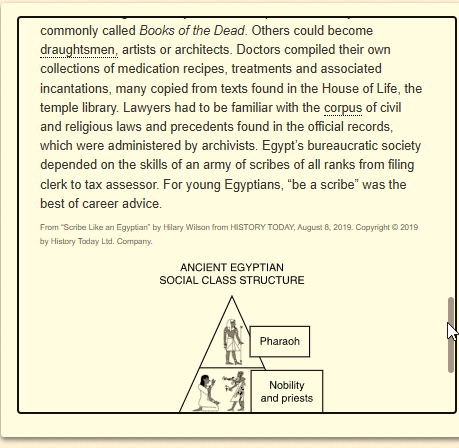
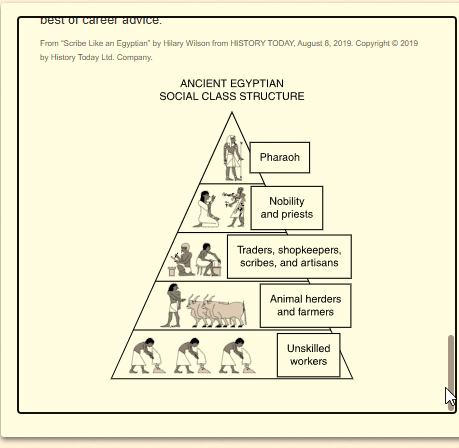
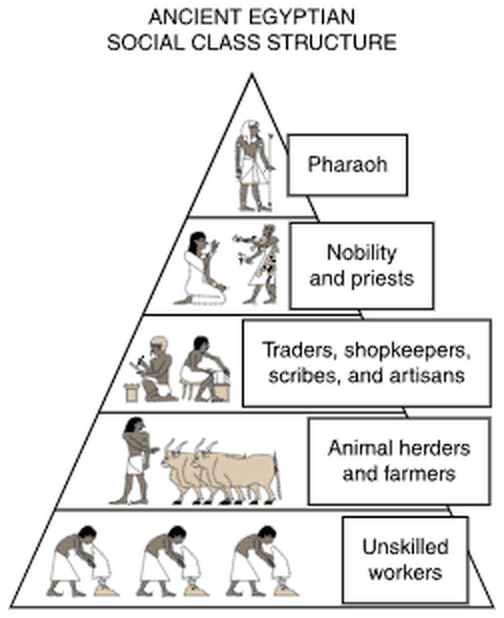
A schoolboy “dictionary” of hieroglyphs with their hieratic equivalents shows that a knowledge of more than 450 signs was required for everyday writing purposes. Lessons in record-keeping and filing and labelling enabled any half-competent scribe to perform that most essential of all scribal functions: the making and updating of lists. For professions such as those of government official, priest or lawyer, a scribe would train for several more years, increasing his vocabulary to perhaps a thousand or more signs. Those with the best handwriting or drawing skills might follow the craft of creating beautifully illustrated copies of funerary texts, commonly called Books of the Dead. Others could become draughtsmen, artists or architects. Doctors compiled their own collections of medication recipes, treatments and associated incantations, many copied from texts found in the House of Life, the temple library. Lawyers had to be familiar with the corpus of civil and religious laws and precedents found in the official records, which were administered by archivists. Egypt’s bureaucratic society depended on the skills of an army of scribes of all ranks from filing clerk to tax assessor. For young Egyptians, “be a scribe” was the best of career advice.
From “Scribe Like an Egyptian” by Hilary Wilson from HISTORY TODAY, August 8, 2019. Copyright © 2019 by History Today Ltd. Company.
Question
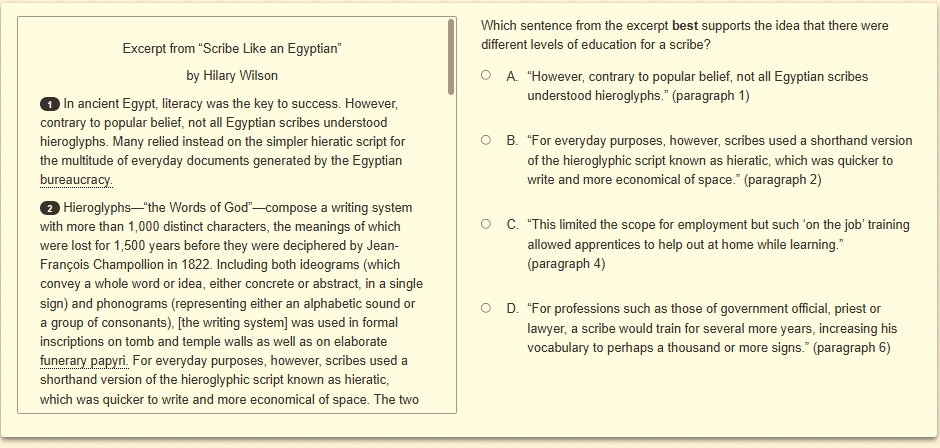
Which sentence from the excerpt best supports the idea that there were different levels of education for a scribe?
- A“However, contrary to popular belief, not all Egyptian scribes understood hieroglyphs.” (paragraph 1)
- B“For everyday purposes, however, scribes used a shorthand version of the hieroglyphic script known as hieratic, which was quicker to write and more economical of space.” (paragraph 2)
- C“This limited the scope for employment but such ‘on the job’ training allowed apprentices to help out at home while learning.” (paragraph 4)
- D“For professions such as those of government official, priest or lawyer, a scribe would train for several more years, increasing his vocabulary to perhaps a thousand or more signs.” (paragraph 6)
Show the answer
Correct answer: D
The question asks for a sentence from the excerpt that best supports the idea that different levels of education were available to scribes.
A. Incorrect. The sentence from paragraph 1 provides evidence that Egyptian scribes used two different forms of writing, but it does not address the topic of education or the different levels of education that were available to scribes.
B. Incorrect. The advantages and purposes of hieratic script are described in this sentence from paragraph 2, but this explanation of the advantages and purposes does not suggest that there were different levels of education for scribes.
C. Incorrect. The fact that scribes could learn their trade through apprenticeships as discussed in this sentence from paragraph 4 does provide evidence that another method of learning to be a scribe was possible, but this process was for a limited entry into becoming a scribe, not the continued education scribes would need in order to work in specific areas.
D. CORRECT. By explaining that certain professions required additional years of training, this sentence from paragraph 6 supports the idea that different levels of education existed for scribes.
Question analysis
This evidence question on Hilary Wilson’s “Scribe Like an Egyptian,” a magazine article about how ancient Egyptian scribes learned their trade, asks which quoted sentence best supports the idea that scribes received different levels of education. The four sentences come from paragraphs 1, 2, 4 and 6, and more than one seems to touch on the idea, so close reading of each decides it.
- Grade level
- Grade 8 reading and task
- Compared with grade 7
- Above grade 7 Choosing the sentence that best supports an idea is routine grade 7 evidence work. Here several quotations touch on ways scribes differed, and the article’s dense, technical wording makes those differences harder to sort than usual.
- Estimated difficulty
- Hard: combines ideas, needs a plan, and has more than one tempting wrong answer.
- Thinking it demands
- Depth of knowledge 3, strategic thinking · mainly evaluate
- What makes it hard
- Reading between the lines moderate
- Every choice must be checked moderate
- Hard words minor
- Evidence
- Answered from several paragraphs or stanzas
- Reading level
- Passage: about grade 12, 755 words; question and choices: about grade 13, 110 words.
- Students, last 30 days
- Not enough answers yet to show (it takes 10).
Why it is hard, traps and wrong answers (shows the answer)
Why it is hard
Two of the wrong sentences are not off topic: one says not all scribes understood hieroglyphs, the other that apprenticeship narrowed a scribe’s job prospects, and both imply that scribes differed. The question rewards asking what the idea actually claims, that schooling itself came in stages, and only the sentence about professions that required more years of training says so outright. Students who stop at the first sentence suggesting a difference lose the point.
Reading between the lines moderate Working it out
The right sentence never says “levels”; students must see that training “for several more years” for official, priest or lawyer posts means a higher tier of schooling than the basic course. (Graesser, Singer & Trabasso, 1994; Kintsch, 1998)
Every choice must be checked moderate Choosing the answer
Two other quotations also hint at differences among scribes, paragraph 1’s “not all Egyptian scribes understood hieroglyphs” and paragraph 4’s “limited the scope for employment,” so each must be weighed, not just scanned. (Embretson & Wetzel, 1987)
Hard words minor Understanding the question
Terms such as “hieratic,” “economical of space” and “scope for employment” slow the reading of the quotations, and the shorthand sentence is hard to dismiss until hieratic is understood as a script. (Perfetti, 2007; Freedle & Kostin, 1993)
Strategy: Ask what a sentence would have to say to prove that scribal education came in levels, then test each quotation against that and prefer a direct statement over a hint.
Traps
- Supports only part of the claim: In a question about evidence: a line that backs one half of the claim but not the other, or a related point rather than the claim itself.
- True but not the answer: A choice says something accurate about the text that does not answer this question.
The wrong answers, classified
A Supports only part of the claim (King et al., 2004; Thissen, Steinberg & Fitzpatrick, 1989)
Reads “not all Egyptian scribes understood hieroglyphs” as proof of different levels of schooling, but it reports a difference in knowledge without saying anything about how scribes were taught.
B True but not the answer (King et al., 2004; Embretson & Wetzel, 1987)
Picks the sentence on hieratic as a faster everyday shorthand, which describes how scribes wrote, not how long or how far any of them studied.
C Supports only part of the claim (King et al., 2004; Thissen, Steinberg & Fitzpatrick, 1989)
Sees that on-the-job training “limited the scope for employment” and takes it for a lower level of education, though the sentence contrasts two routes into the trade, not stages of study.
Working it out, step by step
Figure out what the question asks
This asks for the sentence that best supports one idea: scribes could get “different levels of education.” A level is a stage. Some scribes studied for a short time, and others went on to study more. You need a sentence that shows a difference in schooling, not just any difference between scribes.
Find what each level looked like
Paragraphs 5 and 6 describe the training. Paragraph 5 says the lowest scribes studied for only five or six years. They learned just the basics of hieroglyphs. Paragraph 6 says that more than 450 signs were needed for everyday writing. Then choice D adds a higher level: “For professions such as those of government official, priest or lawyer, a scribe would train for several more years, increasing his vocabulary to perhaps a thousand or more signs.”
Work out what choice D means
A profession is a job that needs special training. Choice D says some jobs needed more years of study and more signs, perhaps over a thousand. A basic scribe stopped sooner and knew fewer signs. So schooling came in stages: a basic course, and then more years for the top jobs. That is what the question means by levels of education.
Check each choice
- A does not fit. It says not all scribes understood hieroglyphs. That is a difference in what scribes knew. It says nothing about how they were taught.
- B does not fit. It explains hieratic, a faster shorthand way of writing. That is about writing, not schooling.
- C does not fit. It is about apprentices, who learned on the job from an older scribe. That is a different way into the work, not a higher or lower stage of study.
- D fits. Some jobs needed several more years of training.
Watch out: A is tempting because it shows that scribes were not all alike. But it never mentions school.
Choose the answer
Only one sentence shows some scribes studying for years after the basic course. So the answer is D.
Why this answer and not the closest wrong one
A is the closest wrong choice. It shows that some scribes knew hieroglyphs and others did not. But it doesn’t say why, or how long anyone studied. D says plainly that some jobs needed several more years of training. That is a level of education above the basic one.
More questions like this
The original DOE question
The passage “Excerpt from “Scribe Like an Egyptian”” as shown on the test