Also in 2025 Practice Test A English, question 8.
Passage Snowy Mountains
Snowy Mountains
by John Gould Fletcher
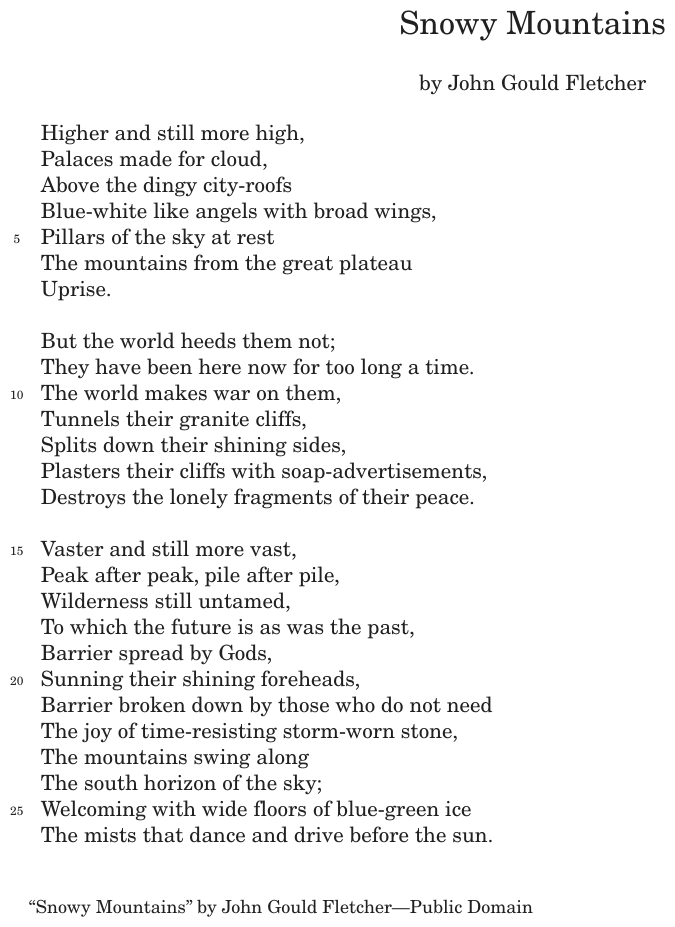
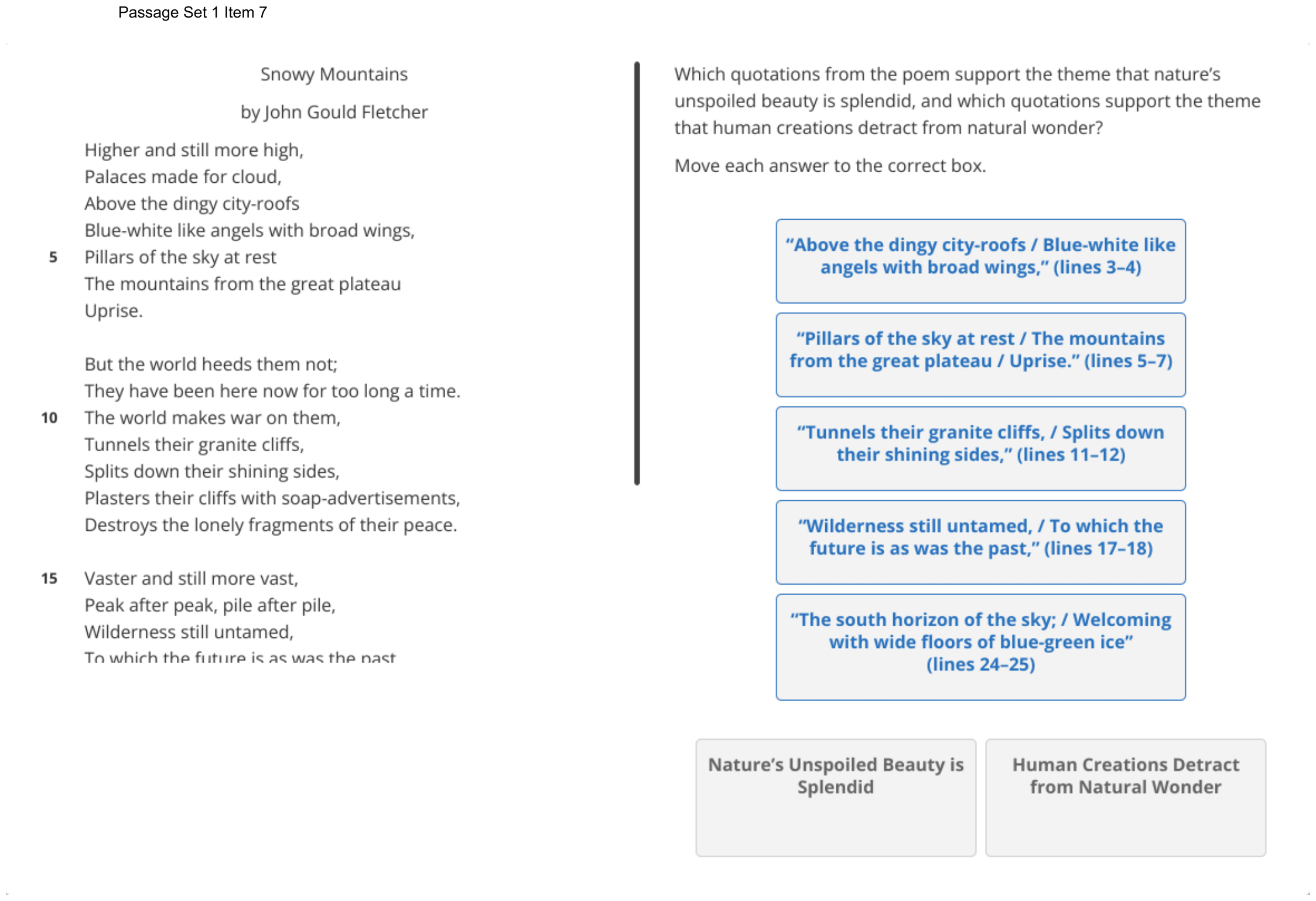
Higher and still more high,
Palaces made for cloud,
Above the dingy city-roofs
Blue-white like angels with broad wings,
Pillars of the sky at rest
The mountains from the great plateau
Uprise.
But the world heeds them not;
They have been here now for too long a time.
The world makes war on them,
Tunnels their granite cliffs,
Splits down their shining sides,
Plasters their cliffs with soap-advertisements,
Destroys the lonely fragments of their peace.
Vaster and still more vast,
Peak after peak, pile after pile,
Wilderness still untamed,
To which the future is as was the past,
Barrier spread by Gods,
Sunning their shining foreheads,
Barrier broken down by those who do not need
The joy of time-resisting storm-worn stone,
The mountains swing along
The south horizon of the sky;
Welcoming with wide floors of blue-green ice
The mists that dance and drive before the sun.
“Snowy Mountains” by John Gould Fletcher—Public Domain
Question
Which quotations from the poem support the theme that nature’s unspoiled beauty is splendid, and which quotations support the theme that human creations detract from natural wonder?
Move each answer to the correct box.
Choose one answer in each row, then check. The DOE has not published how answers with several parts are scored; this site counts one right only when every part is right.
| Nature’s Unspoiled Beauty is Splendid | Human Creations Detract from Natural Wonder | |
|---|---|---|
| “Above the dingy city-roofs / Blue-white like angels with broad wings,” (lines 3–4) | ||
| “Pillars of the sky at rest / The mountains from the great plateau / Uprise.” (lines 5–7) | ||
| “Tunnels their granite cliffs, / Splits down their shining sides,” (lines 11–12) | ||
| “Wilderness still untamed, / To which the future is as was the past,” (lines 17–18) | ||
| “The south horizon of the sky; / Welcoming with wide floors of blue-green ice” (lines 24–25) |
Show the answer
Correct answer: “Above the dingy city-roofs / Blue-white like angels with broad wings,” (lines 3–4): Human Creations Detract from Natural Wonder; “Pillars of the sky at rest / The mountains from the great plateau / Uprise.” (lines 5–7): Nature’s Unspoiled Beauty is Splendid; “Tunnels their granite cliffs, / Splits down their shining sides,” (lines 11–12): Human Creations Detract from Natural Wonder; “Wilderness still untamed, / To which the future is as was the past,” (lines 17–18): Nature’s Unspoiled Beauty is Splendid; “The south horizon of the sky; / Welcoming with wide floors of blue-green ice” (lines 24–25): Nature’s Unspoiled Beauty is Splendid
The question identifies two themes and asks which quotations from the poem support each theme. Each quotation should be moved to one of the two boxes: “Nature’s Unspoiled Beauty is Splendid” or “Human Creations Detract from Natural Wonder.”
“Above the dingy city-roofs / Blue-white like angels with broad wings,” (lines 3–4)
This quotation supports the theme that human creations detract from natural wonder. The lines describe the city-roofs as “dingy,” suggesting that they mar the lovely background of the blue-white mountains, which are compared to angels, a simile that vividly conveys the wonder of nature. The description in the lines primarily serves to create a contrast between the city’s unsightly appearance and the beauty of the mountains, thereby providing support for the theme that human creations (i.e. the city) detract from natural wonder.
“Pillars of the sky at rest / The mountains from the great plateau / Uprise.” (lines 5–7)
This quotation supports the theme that nature’s unspoiled beauty is splendid. By describing the mountains as “pillars of the sky” that “uprise” dramatically from a large plateau, the lines primarily convey a sense of the mountains’ dramatic and impressive size. The description suggests that the mountains are holding up the sky, a powerful image of an unspoiled, natural landscape.
“Tunnels their granite cliffs, / Splits down their shining sides,” (lines 11–12)
The quotation supports the theme that human creations detract from natural wonder. The words “tunnels” and “splits” emphasize that human intervention in nature is destructive, breaking apart the “shining sides” of the mountain. These lines suggest that human creations—such as building a tunnel through a mountain—detract from natural wonder, diminishing its beauty and serenity.
“Wilderness still untamed, / To which the future is as was the past,” (lines 17–18)
The quotation supports the theme that nature’s unspoiled beauty is splendid by indicating that the natural mountainous landscape is both splendid and unspoiled (“wilderness still untamed”). The phrase “to which the future is as was the past” suggests that nature in its unspoiled state is timeless or eternal, further supporting the theme.
“The south horizon of the sky; / Welcoming with wide floors of blue-green ice” (lines 24–25)
The quotation supports the theme that nature’s unspoiled beauty is splendid. The reference to the “wide floors of blue-green ice” emphasizes that the landscape is beautiful, and the description in the lines conveys the grandiose splendor of nature, conveying an image of the “south horizon of the sky” majestically “welcoming” one’s eye, inviting appreciation of its unspoiled beauty.
Question analysis
This sorting question on the poem “Snowy Mountains” gives two themes, the splendor of unspoiled nature and the way human creations detract from natural wonder, and asks students to place five quotations under them. The quotations come from all three stanzas. Students make five separate judgments, and a line’s most vivid image is not always the best guide to where it belongs.
- Grade level
- Grade 7 reading and task
- Compared with grade 7
- At grade 7 Matching quotations to a stated theme is routine grade 7 evidence work, and both themes are given. The added demand is volume: five separate judgments on lines from all three stanzas of old-fashioned verse, each of which must land in the right box.
- Estimated difficulty
- Moderate: several steps, or a close reading with one strong distractor.
- Thinking it demands
- Depth of knowledge 2, skills and concepts · mainly analyze
- What makes it hard
- Much to keep track of moderate
- Reading between the lines moderate
- Figurative or literary language minor
- Evidence
- Answered from several paragraphs or stanzas
- Reading level
- Passage: 161 words (a poem; reading level not measured); question and choices: about grade 9, 34 words.
- Students, last 30 days
- Not enough answers yet to show (it takes 10).
Why it is hard, traps and wrong answers (shows the answer)
Why it is hard
Most tiles sort quickly once a student asks whether people appear in the lines. The first tile is the hard one: its angel simile is pure splendor, yet the “dingy city-roofs” beneath it set the city against the peaks, and only that contrast fits the second theme. The tunneling lines hide their human actor outside the tile. With five placements that must all be right, one hasty tile loses the question.
Much to keep track of moderate Working it out
Five tiles from all three stanzas go into two boxes and every placement must be right, so a student holds both themes in mind while judging each quotation on its own. (Sweller, 1988; Carpenter, Just & Shell, 1990)
Reading between the lines moderate Working it out
Two tiles name no person: in lines 3–4 the human presence is only the “dingy city-roofs,” and in lines 11–12 the subject, “The world,” sits back in line 10, outside the tile. (Graesser, Singer & Trabasso, 1994; Kintsch, 1998)
Figurative or literary language minor Understanding the question
The splendor is carried by images rather than statements, the mountains as “angels,” “Pillars of the sky” and “wide floors of blue-green ice,” which students must read as praise of untouched nature. (Graesser, Singer & Trabasso, 1994; Kintsch, 1998)
Strategy: Read each quotation to the end and ask whether it shows something people have made or done; then sort it by what the lines as a whole are about, not by one word.
Traps
- Supports only part of the claim: In a question about evidence: a line that backs one half of the claim but not the other, or a related point rather than the claim itself.
- Taking figurative language literally: A choice reads a figure of speech or image at face value.
- Word match: Repeats striking words or phrases from the text, so it looks supported, but its meaning does not fit the question.
The wrong answers, classified
1:A Supports only part of the claim (King et al., 2004; Thissen, Steinberg & Fitzpatrick, 1989)
Files the lines under splendor for the angel simile, which shows beauty but not beauty unspoiled; the “dingy city-roofs” put a human creation right beneath it.
2:B Taking figurative language literally (Graesser, Singer & Trabasso, 1994)
Takes “Pillars” as something people build, a human structure, when the metaphor makes the mountains themselves the columns that hold up the sky.
3:A Word match (Freedle & Kostin, 1993)
Is drawn by “granite cliffs” and “shining sides,” words of admiration, and misses that “Tunnels” and “Splits” are what “The world” of line 10 does to the mountains.
4:B Reads too much in (Graesser, Singer & Trabasso, 1994)
Reads “still untamed” as a sign that people are trying to tame the land, though the lines praise a wilderness that people have not changed and that time leaves as it was.
5:B Wrong part of the text (Kirsch & Mosenthal, 1990)
Remembers that the last stanza blames those who broke down the “Barrier” in lines 21–22 and carries that charge to lines 24–25, which only picture ice and sky.
Working it out, step by step
Figure out what the question asks
This is a sorting question. You get two themes. A theme is a big idea a poem keeps coming back to. The first theme says nature that people have not spoiled is splendid, which means grand and beautiful. The second says things people make detract from nature, which means they take away from its wonder. For each quotation, ask: does it show something people made or did?
Sort the lines about the city
Lines 3 and 4 say “Above the dingy city-roofs / Blue-white like angels with broad wings.” The angel picture is beautiful. But right under the mountains are “dingy city-roofs.” Dingy means dirty and dull. City roofs are something people built. The lines set the dirty city against the shining mountains. So this quotation shows a human creation taking away from nature’s wonder.
Sort the lines about the pillars
Lines 5 to 7 say “Pillars of the sky at rest / The mountains from the great plateau / Uprise.” Pillars are tall posts that hold something up. A plateau is a high, flat stretch of land. The mountains rise up like giant posts holding up the sky. No people appear here. This quotation shows how splendid untouched nature is.
Sort the lines about tunnels
Lines 11 and 12 say “Tunnels their granite cliffs, / Splits down their shining sides.” These lines do not say who does this. Look back at line 10: “The world makes war on them.” So “the world,” meaning people, cuts tunnels and splits the mountains. The cliffs shine, but people are breaking them. This quotation shows human creations hurting nature.
Sort the last two quotations
Lines 17 and 18 say “Wilderness still untamed, / To which the future is as was the past.” Untamed means not controlled or changed by people. The second line means the mountains will stay as they always were. Lines 24 and 25 say “The south horizon of the sky; / Welcoming with wide floors of blue-green ice.” That is a picture of sky and ice, with no people in it. Both praise unspoiled nature.
Place each quotation in its box
- Lines 3–4 (the city roofs): Human Creations Detract from Natural Wonder
- Lines 5–7 (the pillars): Nature’s Unspoiled Beauty is Splendid
- Lines 11–12 (the tunnels): Human Creations Detract from Natural Wonder
- Lines 17–18 (the wilderness): Nature’s Unspoiled Beauty is Splendid
- Lines 24–25 (the ice): Nature’s Unspoiled Beauty is Splendid
Drag each tile into its box. All five must be right to get the point.
Why this answer and not the closest wrong one
Lines 3 and 4 are the hardest tile. The angel image alone would fit the first box. But that box is about beauty that is unspoiled. These lines put the dingy city right under the shining peaks. The dirty roofs spoil the view, so the tile belongs in the second box.
More questions like this
The original DOE question
The passage “Snowy Mountains” as printed (page 142)