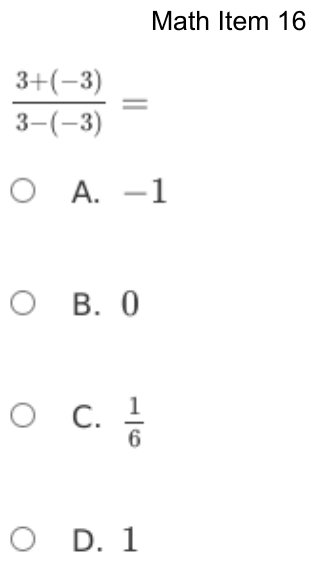
Question
- A−1
- B0
- C
- D1
Show the answer
Correct answer: B
Simplify the expression.
is the equivalent of subtracting 3 from 3, and is the equivalent of adding 3 to 3:
The zero property of division states that zero divided by any nonzero number equals zero, so .
Question analysis
This fraction has 3 plus negative 3 on top and 3 minus negative 3 on the bottom, and students find its value. It tests adding and subtracting negative numbers and dividing integers. The top and the bottom look almost alike, so each sign has to be read carefully before anything is divided.
- Grade level
- Grade 7 content, by NYS standard
- Compared with grade 7
- Below grade 7 Adding and subtracting a negative integer and dividing are grade 7 basics, and here the numbers are small. It is a short routine calculation, easier than typical grade 7 work, though the two signs invite a quick misreading.
- Estimated difficulty
- Routine: one familiar step, little to misread.
- Thinking it demands
- Depth of knowledge 1, recall and reproduction · mainly apply
- What makes it hard
- Error-prone arithmetic minor
- Solution
- 2 steps
- Reading level
- Question and choices: about grade 16+, 2 words.
- Corrected from the DOE handbook
- A grammatical error in the explanation was corrected.
- A rule stated too broadly in the explanation was corrected.
- Students, last 30 days
- Not enough answers yet to show (it takes 10).
Why it is hard, traps and wrong answers (shows the answer)
Why it is hard
The arithmetic is two one-step sign calculations and a division by 6. The danger is reading the top and the bottom as alike: they differ in a single sign, and treating them the same way gives 1 or −1. Students who rewrite 3 − (−3) as 3 + 3 and 3 + (−3) as 3 − 3 see 0 over 6 at once, and zero divided by a nonzero number is zero.
Error-prone arithmetic minor Working it out
The top adds −3 and the bottom subtracts −3, signs that look nearly the same but give 0 and 6, so each has to be rewritten before anything is divided. (Brown & Burton, 1978; Junker & Sijtsma, 2001)
Strategy: Simplify the top and the bottom separately, rewriting the subtraction of a negative as an addition, and only then divide the top by the bottom.
Traps
- Negatives and direction: Arithmetic with negative numbers, the order of a subtraction, or direction on a number line. (Moving a term across the equals sign without changing its sign is a faulty procedure.)
The wrong answers, classified
A Negatives and direction (Brown & Burton, 1978)
Adds the sizes on top and keeps the minus, taking 3 + (−3) as −6, so the fraction becomes −6/6 = −1.
C Little reason to choose it (Haladyna & Downing, 1993; Rodriguez, 2005)
No sign rule gives a top of 1, so 1/6 mostly draws students who find the bottom, 6, and are unsure what a top of 0 means.
D Negatives and direction (Brown & Burton, 1978)
Treats the top like the bottom, adding 3 and 3 in both places, so the fraction becomes 6/6 = 1.
What was corrected from the DOE handbook, and why
- Explanation: The DOE’s explanation says “3 − (−3) is equivalent of adding 3 to 3”, without the article that the same sentence uses in “3 + (−3) is the equivalent of subtracting 3 from 3”. The site now says “is the equivalent of adding 3 to 3”.
- Explanation: The DOE’s explanation says “The zero property of division states that zero divided by any number equals zero.” Zero divided by zero is undefined, not zero, so the rule holds only when the divisor is not zero. The site now says “zero divided by any nonzero number equals zero”. Here the divisor is 6, so 0/6 = 0, as before.
Worked solution, step by step
Formulas used
- Adding a negative
- a and b are numbers. Adding a negative is the same as subtracting. On a number line, adding −3 moves you 3 steps left, just like subtracting 3.
- Subtracting a negative
- a and b are numbers. Subtracting a negative is the same as adding. Taking away a debt of 3 dollars leaves you 3 dollars better off. On a number line, you move right.
- Zero divided by a number
- b is any number except 0. Zero split into b equal parts leaves 0 in each part. The rule needs b not to be 0, because dividing by 0 has no answer.
Sort out the question
The top of the fraction is , and the bottom is . A fraction bar means divide. Work out the top and the bottom separately first. Then divide the top by the bottom.
Work out the top
Adding −3 is the same as subtracting 3:
A number plus its opposite is always 0.
Watch out: do not add the 3s and keep the minus sign. That makes the top −6 and leads to choice A, −1.
Work out the bottom
Subtracting −3 is the same as adding 3:
Watch out: the top and bottom look alike, but they are not. Making both of them 6 gives 6/6 = 1, choice D.
Divide the top by the bottom
Now the fraction is 0 over 6. Zero divided by any number other than zero is zero:
A top of 0 does not make the fraction 1/6, choice C. So the answer is B, 0.
Check your answer
Check by multiplying. A division is right when the answer times the bottom gives the top. Here , which is the top. So 0/6 really is 0.
More questions like this
The original DOE question