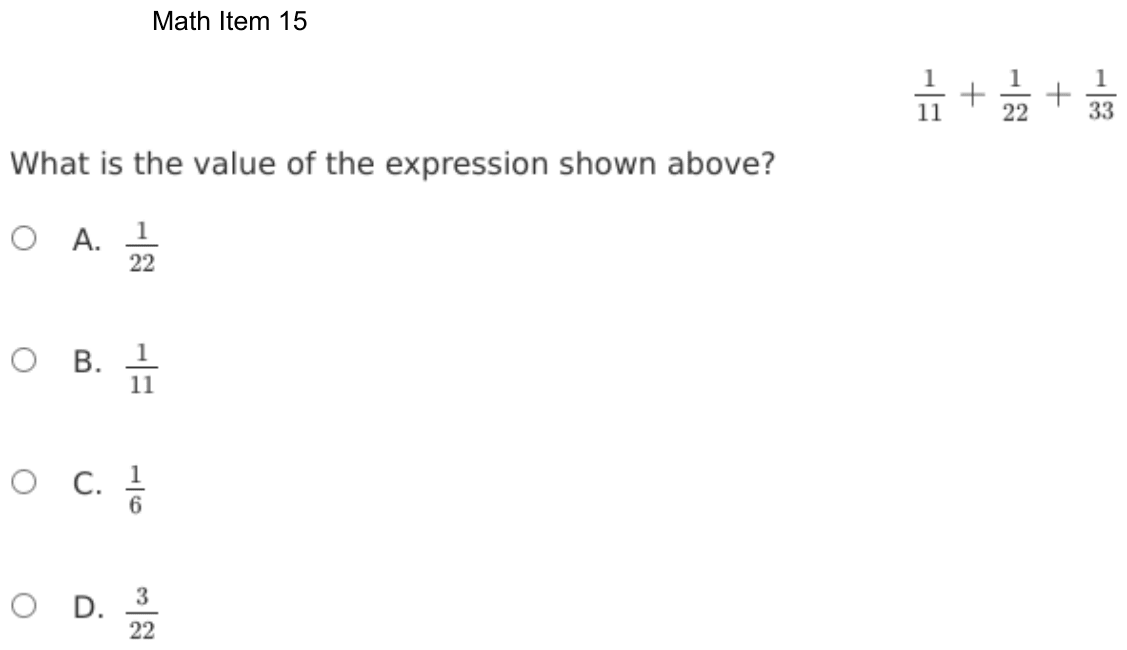
Question
What is the value of the expression shown above?
- A
- B
- C
- D
Show the answer
Correct answer: C
To add fractions, find a common denominator and rename the fractions using the common denominator. The least common denominator for 11, 22, and 33 is 66. After adding the fractions, the final fraction can be reduced to lowest terms.
Question analysis
This fractions question asks for the value of 1/11 + 1/22 + 1/33. Students find a common denominator for three fractions, rename each one, add and simplify. The denominators are all multiples of 11, and adding the tops and bottoms straight across, or forgetting to rename a numerator, leads to tempting wrong choices.
- Grade level
- Grade 7 content, by NYS standard
- Compared with grade 7
- Below grade 7 Adding fractions with unlike denominators is taught before grade 7. Finding a common denominator for three related numbers and simplifying is short, routine work, lighter than typical grade 7 problems with signed rational numbers.
- Estimated difficulty
- Straightforward: two steps or one careful reading.
- Thinking it demands
- Depth of knowledge 1, recall and reproduction · mainly apply
- What makes it hard
- Error-prone arithmetic moderate
- An answer in an unexpected form minor
- Solution
- 3 steps
- Reading level
- Question and choices: about grade 9, 14 words.
- Students, last 30 days
- Not enough answers yet to show (it takes 10).
Why it is hard, traps and wrong answers (shows the answer)
Why it is hard
The question checks whether students rename fractions before adding, and each wrong choice comes from a shortcut that skips that step or stops early. Seeing that 22 and 33 are multiples of 11 points to 66 as the common denominator. A size check helps too: the sum must be more than 1/11, its largest term, which rules out two of the wrong choices at once.
Error-prone arithmetic moderate Working it out
Three unlike denominators must be renamed over 66, not over the product of all three, and the numerators 6, 3 and 2 have to be found one by one before adding. (Brown & Burton, 1978; Junker & Sijtsma, 2001)
An answer in an unexpected form minor Choosing the answer
The sum comes out as 11/66, which must be reduced to match a choice; its simplest form has a denominator, 6, unlike any in the expression. (Enright, Morley & Sheehan, 2002)
Strategy: Notice that 22 and 33 are multiples of 11, rename all three fractions over their least common multiple, add the numerators, and simplify the result.
Traps
- A faulty procedure: A systematic but wrong procedure: adding fractions straight across, applying an exponent to each term of a sum, dropping a sign when moving a term.
- Stops one step early: A choice is a number from partway through the solution.
The wrong answers, classified
A A faulty procedure (Brown & Burton, 1978; Tatsuoka, 1983)
Adds the numerators and the denominators straight across, 3 over 11 + 22 + 33 = 66, and simplifies 3/66 to 1/22.
B A faulty procedure (Brown & Burton, 1978; Tatsuoka, 1983)
Puts the three 1s over the largest denominator, 33, without renaming the other two fractions, so 3/33 simplifies to 1/11.
D Stops one step early (King et al., 2004; Gierl et al., 2017)
Adds the first two fractions correctly, 2/22 + 1/22 = 3/22, and stops before adding the third fraction, 1/33.
Worked solution, step by step
Formulas used
- Equivalent fractions
- a/b is a fraction, and n is any number except 0. Multiplying the top and the bottom by the same n gives an equal fraction. It works because n/n is 1, and multiplying by 1 changes nothing. Use it to give fractions the same bottom.
- Adding fractions with the same denominator
- d is the denominator, the bottom number, which tells the size of each piece. a, b and c are the numerators, the top numbers, which count the pieces. When the pieces are the same size, add the tops and keep the bottom.
Sort out the question
You need to add three fractions: 1/11, 1/22 and 1/33. Their denominators (bottom numbers) are all different. You can only add fractions when the pieces are the same size. So first give all three the same denominator.
Find a common denominator
A common denominator is a number that 11, 22 and 33 all divide into. Notice that 22 = 2 × 11 and 33 = 3 × 11. So the smallest number that all three divide into is:
Rename each fraction
Multiply the top and bottom of each fraction by the number that makes the bottom 66:
Add the tops
Now every piece is a sixty-sixth. Add the tops and keep the bottom:
Watch out: never add the bottoms. Adding straight across gives 3/66 = 1/22, choice A. Putting the three 1s over 33 gives 3/33 = 1/11, choice B.
Simplify the fraction
To simplify, divide the top and bottom by a number that goes into both. Here 11 goes into 11 and into 66:
Watch out: add all three fractions. Stopping after the first two gives 3/22, choice D.
So the answer is C, .
Check your answer
Estimate with decimals. 1/11 is about 0.091, 1/22 is about 0.045 and 1/33 is about 0.030. They add to about 0.166. And 1/6 is 0.1666…, a match. The other choices are all 0.136 or less.
More questions like this
The original DOE question