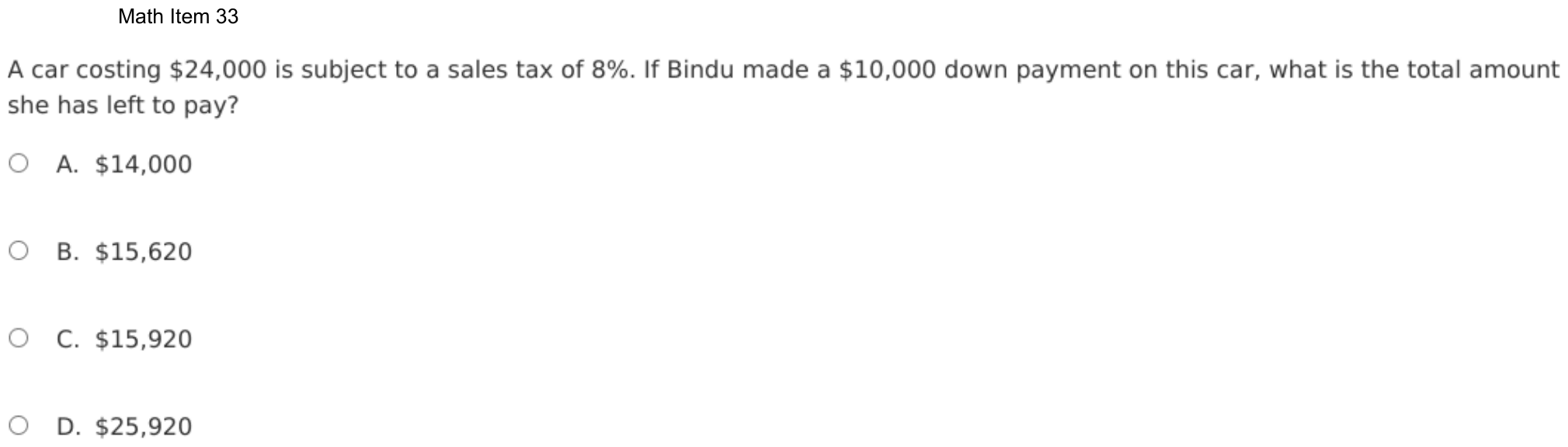
Question
A car costing $24,000 is subject to a sales tax of 8%. If Bindu made a $10,000 down payment on this car, what is the total amount she has left to pay?
- A$14,000
- B$15,620
- C$15,920
- D$25,920
Show the answer
Correct answer: C
First, find the sales tax. Then, add the sales tax to the cost of the car. Finally, subtract the down payment to find out how much she has left to pay.
Question analysis
Bindu buys a $24,000 car with an 8% sales tax and makes a $10,000 down payment, and students find how much she still has to pay. This percent word problem combines finding a tax, adding it to the price and subtracting a payment. Every step must be done in order, since leaving one out gives an amount that looks just as reasonable.
- NYS standards
- Grade level
- Grade 7 content, by NYS standard
- Compared with grade 7
- At grade 7 Adding sales tax to a price is a standard grade 7 percent task. This one also subtracts a down payment at the end, three routine steps with round numbers, much like a typical classroom problem.
- Estimated difficulty
- Straightforward: two steps or one careful reading.
- Thinking it demands
- Depth of knowledge 2, skills and concepts · mainly apply
- What makes it hard
- Many steps minor
- Error-prone arithmetic minor
- Solution
- 3 steps
- Reading level
- Question and choices: about grade 5, 29 words.
- Students, last 30 days
- Not enough answers yet to show (it takes 10).
Why it is hard, traps and wrong answers (shows the answer)
Why it is hard
The method is the standard one for tax on a purchase, so the question checks order and completeness. Forgetting the tax or forgetting the down payment each produces an amount as reasonable-looking as the answer, and a careless 8 × 24 produces one just $300 below it. Multiplying the price by 1.08 in one step, which gives $25,920, is a second route that catches a slip in the tax.
Many steps minor Working it out
Three operations come in a fixed order, 8% of $24,000, then adding the tax, then subtracting the $10,000, and leaving out the first or the last gives a listed choice. (Daniel & Embretson, 2010; Enright, Morley & Sheehan, 2002)
Error-prone arithmetic minor Working it out
Finding 8% of $24,000 comes down to 8 × 24 = 192 with two zeros added, and a lost carry in that product turns $1,920 into $1,620. (Brown & Burton, 1978; Junker & Sijtsma, 2001)
Strategy: Find 8% of the price and add it, or multiply the price by 1.08, to get the full cost with tax, then subtract what Bindu has already paid.
Traps
- Stops one step early: A choice is a number from partway through the solution.
- Misreads the question: Misses or misreads a condition or a word in the question: "at least", "each", "remaining", "not".
The wrong answers, classified
A Misreads the question (Hegarty, Mayer & Monk, 1995)
Subtracts the $10,000 down payment from the $24,000 price and never adds the 8% sales tax, so the tax is simply left out.
B An arithmetic slip (Junker & Sijtsma, 2001)
Drops the carried 3 when multiplying 8 × 24, so the tax comes out $1,620 instead of $1,920 and the balance $300 too low.
D Stops one step early (King et al., 2004; Gierl et al., 2017)
Adds the $1,920 tax to the price correctly but stops at $25,920, the full cost, forgetting to subtract the $10,000 Bindu already paid.
Worked solution, step by step
Formulas used
- Percent of a number
- Percent means out of 100. So 8% is 8/100, or 0.08. To find a percent of a number, change the percent to a decimal and multiply it by the whole.
- Amount left to pay
- The price plus the tax is the full cost. A down payment is money paid at the start. Subtract it, because that part is already paid.
Sort out the question
You know:
- The car costs $24,000.
- The sales tax is 8%. Sales tax is extra money added to a price.
- Bindu paid $10,000 at the start. That is the down payment.
You need the amount Bindu still has to pay. Work in order: tax, then full cost, then subtract.
Find the sales tax
Change 8% to the decimal 0.08. Multiply it by the price:
A quick way: 1% of 24,000 is 240, so 8% is . The tax is $1,920.
Watch out: in 8 × 24 you carry a 3 from 8 × 4 = 32. Dropping it gives 162, so the tax looks like $1,620. That leads to $15,620, choice B.
Find the full cost
Add the tax to the price:
The car costs $25,920 with tax.
Watch out: this is not the answer yet. Stopping here gives $25,920, choice D. Bindu already paid part of it.
Subtract the down payment
Bindu already paid $10,000. Take it away:
She has $15,920 left to pay.
Watch out: leaving out the tax gives , choice A.
So the answer is C, $15,920.
Check your answer
Use a shortcut for the full cost. The price plus 8% more is 108% of the price, or 1.08 times it: . Then . Same answer.
More questions like this
The original DOE question