Question
In the figure above, . Straight line m intersects both line n and line p. What is the value of r?
- A17
- B117
- C163
- D173
Show the answer
Correct answer: C
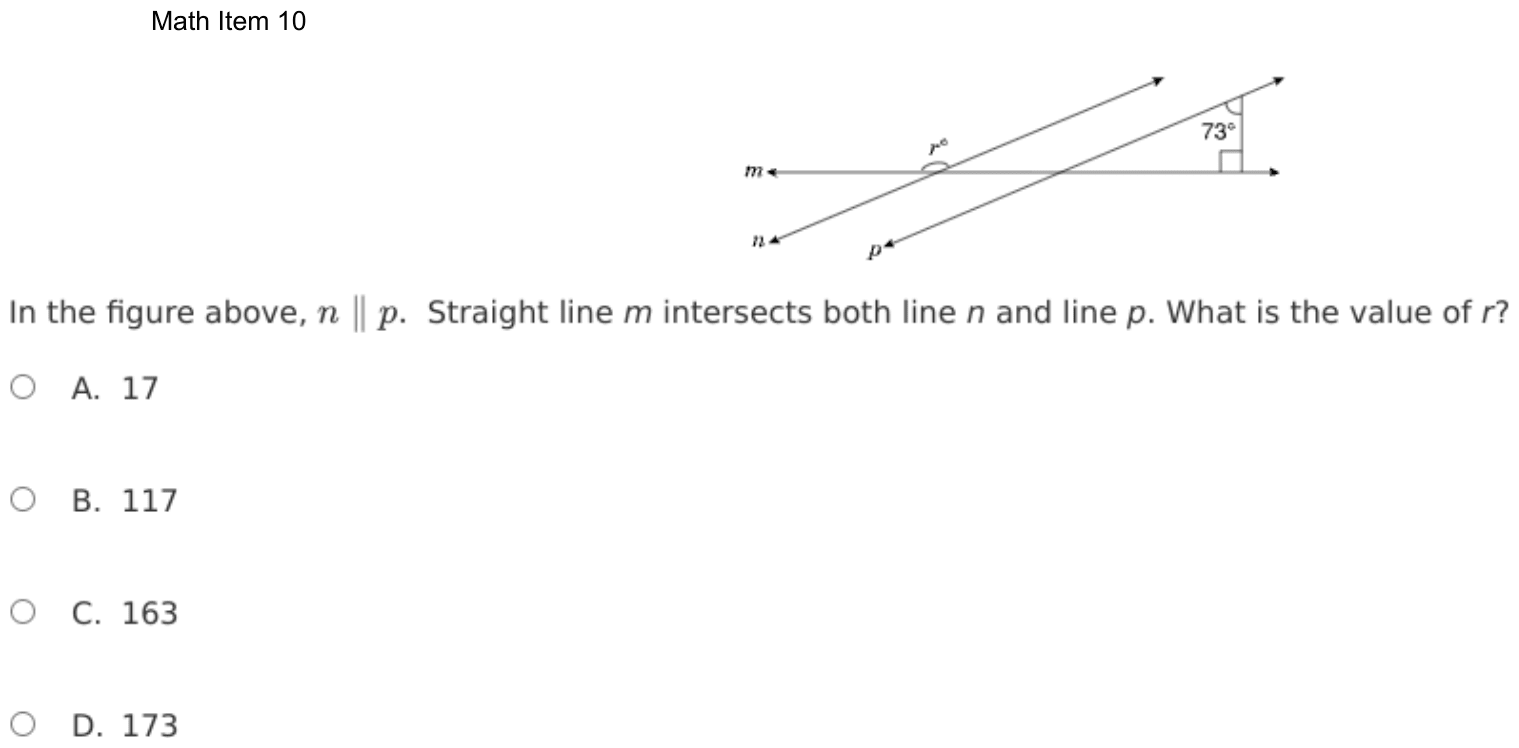
The triangle formed by line p, line m, and the line segment connecting the two contains a 73° angle, a right angle (90°), and a missing angle measuring x°. The sum of the interior angles of a triangle is 180°, so begin by finding the value of x:
Line m is a straight line, so it has a measure of 180°. The 17° angle from the triangle and the adjacent angle outside the triangle are supplementary, so they have a sum of 180°. Let s represent the measure of the adjacent angle outside the triangle. The value of s can be determined by subtracting:
Given that n and p are parallel lines and that they have been cut by a transversal, line m, then corresponding angles are congruent. Angles r and s are corresponding angles, so the value of r is congruent to the value of s, which is 163°.
Question analysis
Two parallel lines, n and p, cross a straight line m, and a segment drawn at a right angle to m forms a small triangle with lines m and p, where a 73° angle is marked. Students find the angle r at line n. It combines a triangle's angle sum, a straight angle and parallel lines, and the angle wanted sits away from the marked ones.
- NYS standards
- Grade level
- Grade 8 content, by NYS standard
- Compared with grade 7
- Above grade 7 Grade 7 angle problems use supplementary, vertical and adjacent angles. This one also needs the angle sum of a triangle and the angles formed by parallel lines and a transversal, grade 8 facts, chained across a busy figure.
- Estimated difficulty
- Hard: combines ideas, needs a plan, and has more than one tempting wrong answer.
- Thinking it demands
- Depth of knowledge 2, skills and concepts · mainly apply
- What makes it hard
- Reading a figure, table or graph moderate
- Combines ideas moderate
- Something you must already know minor
- Solution
- 3 steps
- Reading level
- Question and choices: about grade 3, 21 words.
- Students, last 30 days
- Not enough answers yet to show (it takes 10).
Why it is hard, traps and wrong answers (shows the answer)
Why it is hard
Each fact needs only a subtraction, but the student has to plan a route from the 73° angle at line p over to r at line n. The first number the route gives, the triangle's 17° angle, is listed, and it is the acute partner of r rather than r itself. The figure helps here: r is drawn plainly obtuse, and 163 is also 90 + 73, the triangle's exterior angle, which confirms it.
Reading a figure, table or graph moderate Understanding the question
The 73° sits between line p and the vertical segment, not between p and m, and r is the obtuse angle above m on the left of line n, far from every marked angle. (Lesh, Post & Behr, 1987; Kirsch & Mosenthal, 1990)
Combines ideas moderate Working it out
Three facts chain together: the triangle's angles sum to 180°, the angles along straight line m sum to 180°, and corresponding angles at the parallel lines n and p are equal. (Embretson, 1998; Daniel & Embretson, 2010)
Something you must already know minor Working it out
The angle pairs formed by a line crossing two parallel lines are a grade 8 topic, and the question uses them without naming them. (Anderson & Krathwohl, 2001)
Strategy: Find the third angle of the right triangle, use the straight line m to get the angle beside it, then carry that angle over to line n using the parallel lines.
Traps
- Stops one step early: A choice is a number from partway through the solution.
- An arithmetic slip: The right method with a plausible arithmetic error: a digit, a place value or a times-table fact.
The wrong answers, classified
A Stops one step early (King et al., 2004; Gierl et al., 2017)
Finds the triangle's third angle, 180 − 90 − 73 = 17, and stops, though r is the obtuse angle next to the 17° angle, not that angle itself.
B Little reason to choose it (Haladyna & Downing, 1993; Rodriguez, 2005)
No angle fact in the figure gives 117; even 180 − 73 is 107, so this choice mostly catches guesses at an obtuse angle.
D An arithmetic slip (Junker & Sijtsma, 2001)
Finds the 17° angle and subtracts it from 180 but borrows without reducing the 8, so 180 − 17 comes out as 173.
Worked solution, step by step
Formulas used
- Angles of a triangle
- a, b and c are the three angles inside any triangle. They always add up to 180°. If you know two of them, subtract their sum from 180° to find the third.
- Angles on a straight line
- a and b are two angles side by side on a straight line. Together they make a half turn, which is 180°. Use it to find the angle next to one you already know.
- Corresponding angles
- The symbol ∥ means is parallel to. When line m crosses two parallel lines, it makes the same angles at each crossing. Angles in the same position at the two crossings are called corresponding angles. They are equal.
Sort out the question
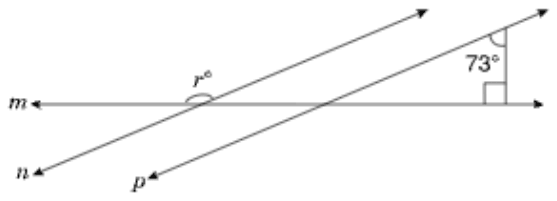
Lines n and p are parallel, and line m crosses both. Near line p, a straight-up segment meets line m. The small square shows a right angle, 90°. Line p, line m and that segment make a small triangle. Its top angle is 73°.
You need r, the wide angle where line n crosses line m.
Find the triangle’s third angle
The third angle is where line p crosses line m. Call it x. Use the triangle rule:
So that angle is 17°.
Watch out: this is not r. Stopping here gives choice A, 17.
Use the straight line m
The 17° angle sits above line m, on the right of line p. Beside it, on the left of line p, is a wide angle. Call it s. The two angles fill the straight line m, so they add to 180°:
So s is 163°.
Watch out: borrow carefully. 180 − 17 is 163, not 173, choice D.
Carry the angle to line n
Angle s is above line m and to the left of line p. Angle r is above line m and to the left of line n. They are in the same position, so they are corresponding angles. Since n and p are parallel:
So the answer is C, 163.
Check your answer
Look at the figure. Angle r is wider than a right angle, so it must be more than 90°. That rules out 17. Also, the narrow angle beside r, on the right of line n, matches the 17° angle at line p. And , as it should on a straight line.
More questions like this
The original DOE question