Passage Martial Arts for the Mind and Body
Martial Arts for the Mind and Body
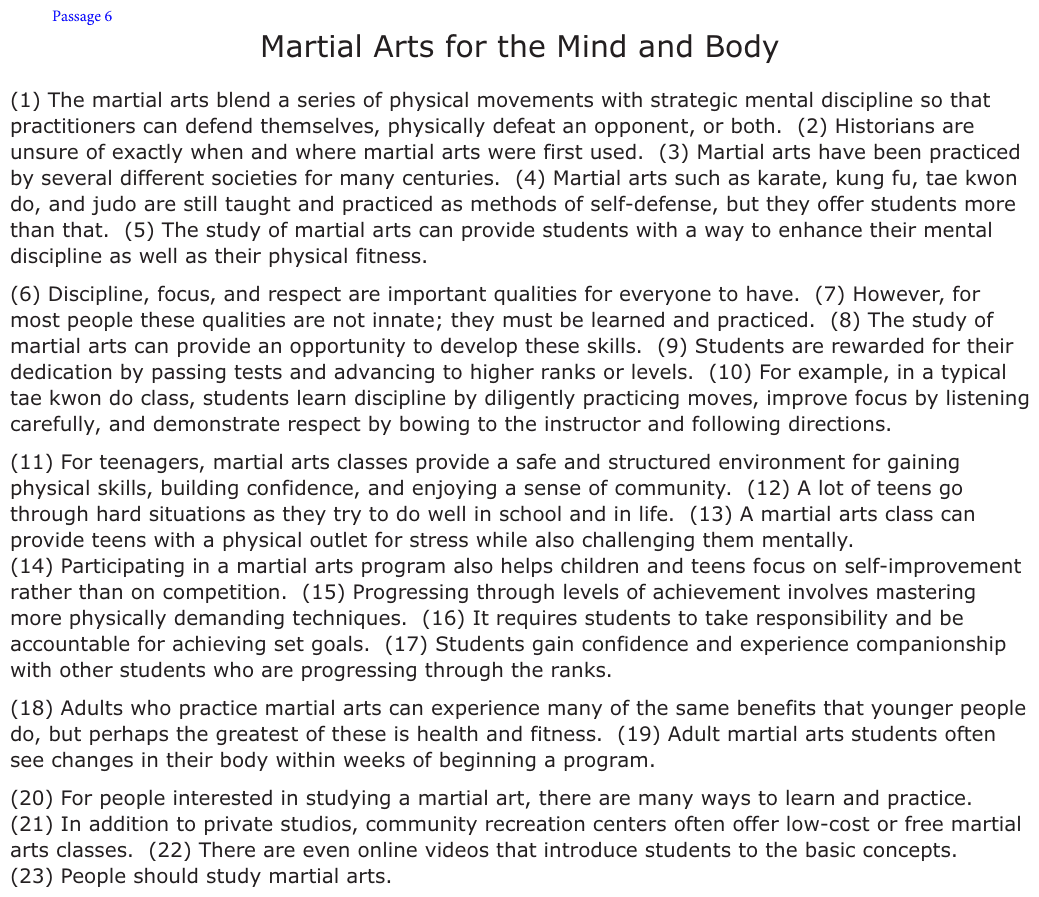
(1) The martial arts blend a series of physical movements with strategic mental discipline so that practitioners can defend themselves, physically defeat an opponent, or both. (2) Historians are unsure of exactly when and where martial arts were first used. (3) Martial arts have been practiced by several different societies for many centuries. (4) Martial arts such as karate, kung fu, tae kwon do, and judo are still taught and practiced as methods of self-defense, but they offer students more than that. (5) The study of martial arts can provide students with a way to enhance their mental discipline as well as their physical fitness.
(6) Discipline, focus, and respect are important qualities for everyone to have. (7) However, for most people these qualities are not innate; they must be learned and practiced. (8) The study of martial arts can provide an opportunity to develop these skills. (9) Students are rewarded for their dedication by passing tests and advancing to higher ranks or levels. (10) For example, in a typical tae kwon do class, students learn discipline by diligently practicing moves, improve focus by listening carefully, and demonstrate respect by bowing to the instructor and following directions.
(11) For teenagers, martial arts classes provide a safe and structured environment for gaining physical skills, building confidence, and enjoying a sense of community. (12) A lot of teens go through hard situations as they try to do well in school and in life. (13) A martial arts class can provide teens with a physical outlet for stress while also challenging them mentally. (14) Participating in a martial arts program also helps children and teens focus on self-improvement rather than on competition. (15) Progressing through levels of achievement involves mastering more physically demanding techniques. (16) It requires students to take responsibility and be accountable for achieving set goals. (17) Students gain confidence and experience companionship with other students who are progressing through the ranks.
(18) Adults who practice martial arts can experience many of the same benefits that younger people do, but perhaps the greatest of these is health and fitness. (19) Adult martial arts students often see changes in their body within weeks of beginning a program.
(20) For people interested in studying a martial art, there are many ways to learn and practice. (21) In addition to private studios, community recreation centers often offer low-cost or free martial arts classes. (22) There are even online videos that introduce students to the basic concepts. (23) People should study martial arts.
Question
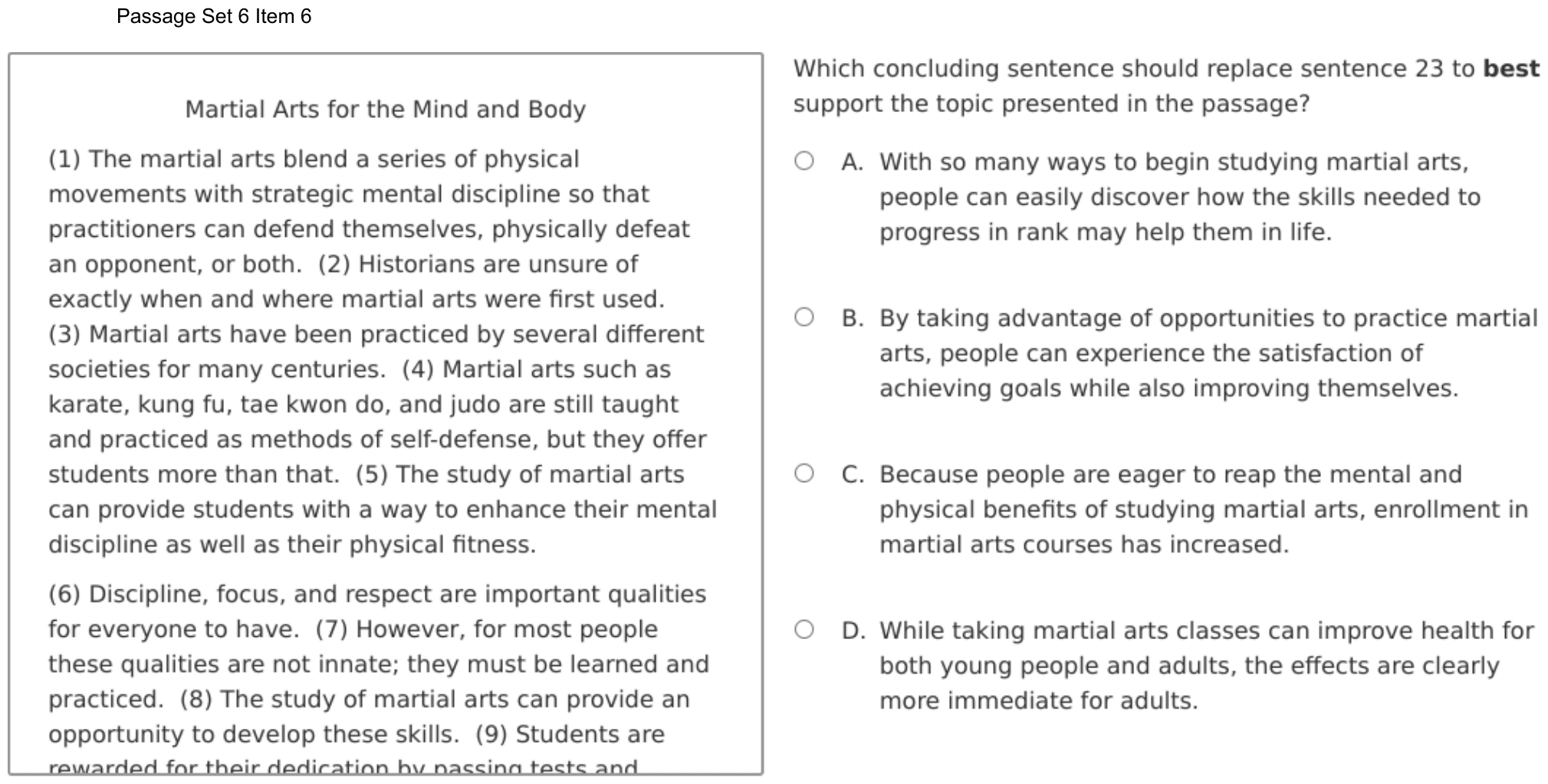
Which concluding sentence should replace sentence 23 to best support the topic presented in the passage?
- AWith so many ways to begin studying martial arts, people can easily discover how the skills needed to progress in rank may help them in life.
- BBy taking advantage of opportunities to practice martial arts, people can experience the satisfaction of achieving goals while also improving themselves.
- CBecause people are eager to reap the mental and physical benefits of studying martial arts, enrollment in martial arts courses has increased.
- DWhile taking martial arts classes can improve health for both young people and adults, the effects are clearly more immediate for adults.
Show the answer
Correct answer: B
The question asks for the concluding sentence that best replaces sentence 23 and supports the topic presented in the passage.
A. Incorrect. The phrase “the skills needed to progress in rank” is vague, and progressing in rank is not related to the overall topic of the passage, which is the benefits of studying martial arts. The topic of the passage is not the “many ways to begin studying martial arts” or how “people can easily discover” the benefits of martial arts.
B. CORRECT. This option is correct because it best supports the topic of the passage—the benefits of studying martial arts—by stating two reasons why people should study martial arts: to “experience the satisfaction of achieving goals while also improving themselves.”
C. Incorrect. Some readers may choose this option because it refers to the benefits of martial arts, but the word “because” and the detail that “enrollment in martial arts courses has increased” make this sentence unrelated to the overall topic of the passage, which is about the benefits of studying martial arts, not the number of people who participate.
D. Incorrect. Although the benefits of studying martial arts are described for both teens (in the third paragraph) and adults (in the fourth paragraph), the topic of the passage is the overall benefits of studying martial arts, which include mental discipline (discussed in the first, second, and third paragraphs) in addition to health benefits. Furthermore, the passage does not compare the health effects of studying martial arts across age groups.
Question analysis
This conclusion question asks which sentence should replace sentence 23, the bare closing line “People should study martial arts,” to best support the topic of the passage. Students must keep all five paragraphs in view, from mental discipline to fitness to ways of getting started, because every choice sounds like a reasonable final line when read on its own.
- NYS standards
- 7W2e concluding informative writing
- Grade level
- Grade 8 reading and task
- Compared with grade 7
- Above grade 7 Grade 7 writers choose conclusions that follow from a passage’s topic. This passage covers mental and physical benefits for different ages, and each long choice picks up a real thread, so judging the best fit takes more than typical grade 7 work.
- Estimated difficulty
- Hard: combines ideas, needs a plan, and has more than one tempting wrong answer.
- Thinking it demands
- Depth of knowledge 2, skills and concepts · mainly evaluate
- What makes it hard
- A very close wrong answer moderate
- Evidence in several places moderate
- A lot to read minor
- Evidence
- Answered from the whole text
- Reading level
- Passage: about grade 11, 402 words; question and choices: about grade 12, 106 words.
- Corrected from the DOE handbook
- The DOE printed this question’s explanation after a different question; the site matches the question with its own explanation.
- Students, last 30 days
- Not enough answers yet to show (it takes 10).
Why it is hard, traps and wrong answers (shows the answer)
Why it is hard
Every ending borrows something real from the passage: ways to begin, ranks, mental and physical benefits, or adults’ quick results. The work is deciding what the whole passage is about, the benefits of martial arts for mind and body, and then noticing which ending adds a new claim or shrinks the topic. The rank-based ending is hardest to reject because it is shaped like the key and promises help “in life,” but its focus is how easily people discover rank skills.
A very close wrong answer moderate Choosing the answer
The rank choice is built like the key, a phrase about ways or chances to train followed by what people gain; it differs in resting on the vague “skills needed to progress in rank.” (Embretson & Wetzel, 1987; Gorin & Embretson, 2006; Ascalon et al., 2007)
Evidence in several places moderate Working it out
The topic is pieced together from all five paragraphs, from the opening’s mind-and-body claim through teens, adults’ fitness and ways to learn, so a fitting ending must cover both kinds of benefit. (Kirsch & Mosenthal, 1990; Gorin & Embretson, 2006)
A lot to read minor Understanding the question
Each choice is a two-part sentence of 21 to 26 words, and each picks up a real thread of the passage, so all four must be held against the topic. (Kintsch, 1998; Gorin & Embretson, 2006; Freedle & Kostin, 1993)
Strategy: State the passage’s topic in a few words using all five paragraphs, then test each ending: does it sum up that topic, or does it narrow it or add a new claim?
Traps
- Off the point: Adds or keeps something that does not support the paragraph's or the passage's focus, or an introduction or conclusion that misses the main point.
- Too narrow: A single detail offered as the central idea or a summary, or a summary that keeps minor details and leaves out an essential part.
The wrong answers, classified
A Too narrow (King et al., 2004)
Follows on from the last paragraph’s many ways to start, but rests the ending on vague “skills needed to progress in rank,” one thread of paragraphs 2 and 3, not the benefits overall.
C Off the point (Halliday & Hasan, 1976)
Names the passage’s “mental and physical benefits,” which fits, but ends on rising enrollment, a claim about numbers of students that the passage never discusses.
D Half right (King et al., 2004; Thissen, Steinberg & Fitzpatrick, 1989)
Rightly says training can improve health for young people and adults, but adds that adults clearly benefit sooner, a comparison the passage never makes, and drops the mental benefits.
What was corrected from the DOE handbook, and why
- Explanation: In the DOE’s explanations appendix, the explanation printed after this question belongs to question 39 (“the sentence that would best follow and support sentence 18”) and marks C correct, and this question’s explanation (“the concluding sentence that best replaces sentence 23 and supports the topic presented in the passage”) is printed after question 39, marking B correct. Read page by page, the appendix gives this question the answer C. The site gives the question the explanation that restates it, and the answer follows that explanation: B, because it sums up the passage’s topic, the benefits of studying martial arts.
Working it out, step by step
Figure out what the question asks
This asks for a better last sentence. A good concluding sentence sums up the topic of the whole passage. Sentence 23, “People should study martial arts,” is short and plain. It doesn’t remind the reader why.
Find the passage’s topic
Sentence 5 states the topic. Martial arts can help students “enhance their mental discipline as well as their physical fitness.” Enhance means improve. Paragraph 2 covers discipline, focus and respect. Paragraph 3 covers teens and goals. Paragraph 4 covers adults and fitness. Paragraph 5 lists ways to start. So the topic is how martial arts help both mind and body.
Name the rule
A conclusion should sum up the main point. It should not shrink the point or add a brand-new claim. For example, after a report on why sleep matters, a good ending is Getting enough sleep helps both your body and your mind. A poor one is More people buy pillows now.
Check each choice
- A is wrong. It rests on vague “skills needed to progress in rank,” one small part of the passage.
- B is right. “Opportunities to practice” follows paragraph 5. “Achieving goals” and “improving themselves” sum up the benefits.
- C is wrong. Enrollment is the number of people who sign up. The passage never says it has gone up.
- D is wrong. The passage never says adults see results sooner than young people. D also leaves out the benefits to the mind.
Watch out: A is built like B and promises help “in life.” But it shrinks the topic to rank skills.
Choose the answer
B sums up what the whole passage says martial arts offer. So the answer is B, “By taking advantage of opportunities to practice martial arts, people can experience the satisfaction of achieving goals while also improving themselves.”
Why this answer and not the closest wrong one
A is the closest wrong answer. Like B, it starts with ways to begin and ends with what people gain. But its gain is vague “skills needed to progress in rank.” That is only one thread of the passage. B sums up the whole topic: reaching goals and improving yourself.
More questions like this
The original DOE question
The passage “Martial Arts for the Mind and Body” as printed (page 52)