Question
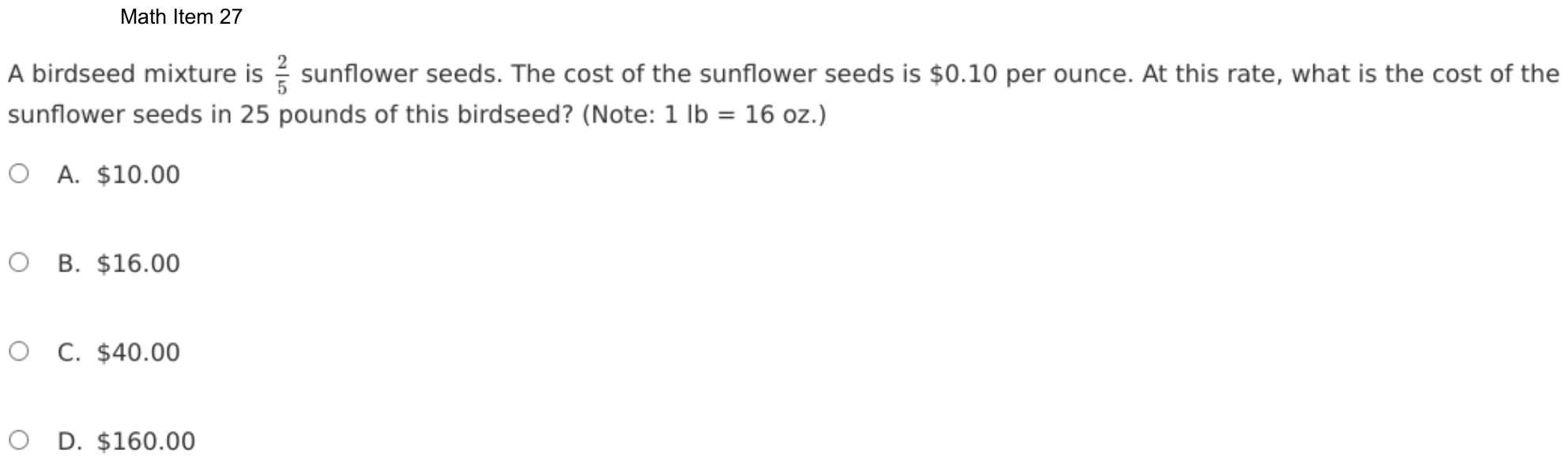
A birdseed mixture is sunflower seeds. The cost of the sunflower seeds is $0.10 per ounce. At this rate, what is the cost of the sunflower seeds in 25 pounds of this birdseed? (Note: 1 lb = 16 oz.)
- A$10.00
- B$16.00
- C$40.00
- D$160.00
Show the answer
Correct answer: B
First, calculate the amount of sunflower seeds in 25 pounds of this birdseed by using ratio reasoning to find that there are 10 pounds of sunflower seeds in the birdseed.
Then, use ratio reasoning to find the cost of the sunflower seeds per pound.
The cost of the sunflower seeds is $1.60 per pound.
Finally, find the total cost using ratios by multiplying the unit cost per pound by 10 pounds.
The first two steps above could be done in the other order; that is, find $1.60 per pound first and 10 pounds of sunflower seeds second.
Question analysis
A birdseed mixture is two-fifths sunflower seeds, which cost 10 cents an ounce, and students find the cost of the sunflower seeds in 25 pounds of the mix. It combines a fraction of a whole, a pounds-to-ounces conversion and a unit price. Each step's result looks like a possible answer, so keeping track of which quantity is in hand matters.
- Grade level
- Grade 7 content, by NYS standard
- Compared with grade 7
- At grade 7 Multistep ratio problems with a unit conversion are typical grade 7 work. This one chains three short steps, a fraction of the mixture, pounds to ounces and a price per ounce, and the numbers are chosen to come out evenly.
- Estimated difficulty
- Moderate: several steps, or a close reading with one strong distractor.
- Thinking it demands
- Depth of knowledge 2, skills and concepts · mainly apply
- What makes it hard
- Many steps moderate
- Combines ideas minor
- Solution
- 3 steps
- Reading level
- Question and choices: about grade 3, 35 words.
- Students, last 30 days
- Not enough answers yet to show (it takes 10).
Why it is hard, traps and wrong answers (shows the answer)
Why it is hard
Each step is routine, but the steps can be done in more than one order, and every partial result looks like a price once a dollar sign is put in front of it. Each wrong choice leaves something out: the 2/5, the price per ounce, or the conversion and the price together. Labelling each number with its unit, pounds, ounces or dollars, as it is found keeps the chain straight and shows when it is finished.
Many steps moderate Working it out
Three operations are chained: 2/5 of 25 pounds gives 10 pounds of sunflower seeds, the note turns them into 160 ounces, and $0.10 an ounce prices them; stopping at 10 pounds or 160 ounces, or skipping the 2/5, gives a listed choice. (Daniel & Embretson, 2010; Enright, Morley & Sheehan, 2002)
Combines ideas minor Working it out
A fraction of a mixture, a pounds-to-ounces conversion and a price per ounce meet in one question, and the price is per ounce while the amount is given in pounds. (Embretson, 1998; Daniel & Embretson, 2010)
Strategy: Find the weight of the sunflower seeds first, change it to ounces with the note, then multiply by the price per ounce; or turn the price into dollars per pound first.
Traps
- Stops one step early: A choice is a number from partway through the solution.
- Answers a different question: A choice is right for another quantity: the other unknown, the rest instead of the part, the part instead of the whole.
The wrong answers, classified
A Stops one step early (King et al., 2004; Gierl et al., 2017)
Finds that 10 of the 25 pounds are sunflower seeds and stops, giving that weight as $10.00 without converting it to ounces or pricing it.
C Answers a different question (King et al., 2004; Hegarty, Mayer & Monk, 1995)
Prices all 25 pounds of birdseed, 400 ounces at $0.10 an ounce, never taking the 2/5 of the mixture that is sunflower seeds.
D Stops one step early (King et al., 2004; Gierl et al., 2017)
Converts the 10 pounds of sunflower seeds to 160 ounces and stops, reading the number of ounces as the cost without multiplying by $0.10.
Worked solution, step by step
Formulas used
- A fraction of an amount
- The whole is the full amount, here 25 pounds of birdseed. The fraction tells how much of it you want. To find 2/5 of something, split it into 5 equal parts and take 2 of them. Multiplying does both at once.
- Changing pounds to ounces
- The note says 1 pound is 16 ounces. So each pound turns into 16 ounces. An ounce is smaller than a pound, so you get a bigger number.
- Total cost
- The units here are ounces. The price of one unit is $0.10 for one ounce. Every ounce costs the same, so you multiply the number of ounces by the price of one.
Sort out the question
You know:
- The birdseed is sunflower seeds.
- There are 25 pounds of birdseed.
- Sunflower seeds cost $0.10 per ounce.
- 1 pound = 16 ounces.
You need the cost, in dollars, of just the sunflower seeds. The price is per ounce, but the weight is in pounds. So you will need to change pounds to ounces.
Find the weight of sunflower seeds
Only 2/5 of the birdseed is sunflower seeds. Find 2/5 of 25 pounds:
Another way: 25 ÷ 5 = 5, and 2 fifths is 2 × 5 = 10. So there are 10 pounds of sunflower seeds.
Watch out: 10 is a number of pounds, not dollars. Stopping here and calling it $10.00 leads to choice A.
Change pounds to ounces
The price is per ounce, so turn the 10 pounds into ounces. Each pound is 16 ounces:
There are 160 ounces of sunflower seeds.
Watch out: 160 is a number of ounces, not dollars. Calling it $160.00 leads to choice D.
Find the cost
Each ounce costs $0.10. Multiply:
The sunflower seeds cost $16.00.
Watch out: skipping the 2/5 prices all 25 pounds. That is 400 ounces, and , choice C.
So the answer is B, $16.00.
Check your answer
Do it in another order. One pound of sunflower seeds costs dollars. Ten pounds cost dollars. You get $16.00 again.
More questions like this
The original DOE question