Passage Bird Talk
Bird Talk
by Carl Sandburg
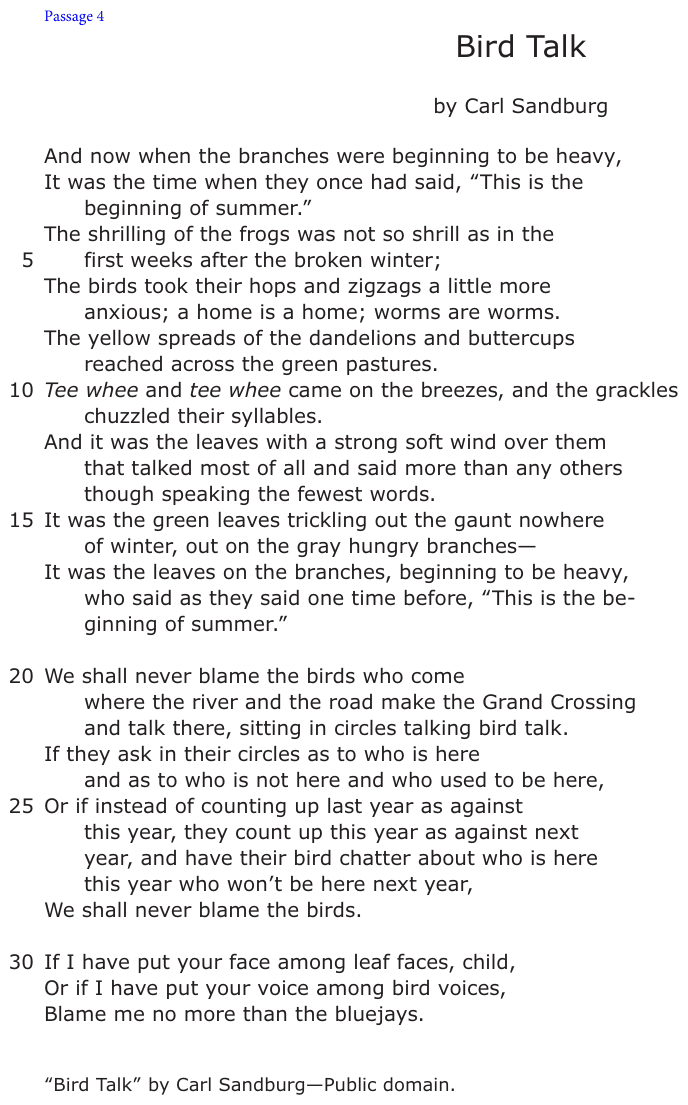
And now when the branches were beginning to be heavy,
It was the time when they once had said, “This is the
beginning of summer.”
The shrilling of the frogs was not so shrill as in the
first weeks after the broken winter;
The birds took their hops and zigzags a little more
anxious; a home is a home; worms are worms.
The yellow spreads of the dandelions and buttercups
reached across the green pastures.
Tee whee and tee whee came on the breezes, and the grackles
chuzzled their syllables.
And it was the leaves with a strong soft wind over them
that talked most of all and said more than any others
though speaking the fewest words.
It was the green leaves trickling out the gaunt nowhere
of winter, out on the gray hungry branches—
It was the leaves on the branches, beginning to be heavy,
who said as they said one time before, “This is the be-
ginning of summer.”
We shall never blame the birds who come
where the river and the road make the Grand Crossing
and talk there, sitting in circles talking bird talk.
If they ask in their circles as to who is here
and as to who is not here and who used to be here,
Or if instead of counting up last year as against
this year, they count up this year as against next
year, and have their bird chatter about who is here
this year who won’t be here next year,
We shall never blame the birds.
If I have put your face among leaf faces, child,
Or if I have put your voice among bird voices,
Blame me no more than the bluejays.
“Bird Talk” by Carl Sandburg—Public domain.
Question
Over the course of the poem, a central idea is developed mainly through the speaker’s
- Asense of eager anticipation as winter ends.
- Bdescription of the changes in nature as the seasons transition.
- Cobservation of the birds’ behavior as summer begins.
- Dprediction of future alterations in the physical landscape.
Show the answer
Correct answer: B
The question asks how the central idea about the natural acceptance of change by nature is developed by the speaker of the poem.
A. Incorrect. The speaker is an observer of the changes in nature as propelled by the seasons and shows no personal eagerness for the end of winter. Further, even though nature rejoices at the end of winter as exemplified by “the shrilling of the frogs” (line 4), the speaker merely records this and does not share in this display.
B. CORRECT. The response of nature to the “beginning of summer” (line 3) is the primary focus of the poem as revealed by the speaker through vivid descriptions of the sights, sounds, movements, and attitudes of the natural world.
C. Incorrect. The second stanza of the poem begins a reflection on birds “sitting in circles talking bird talk” (line 22) and taking a sort of attendance of who is present, but this behavioral description is largely figurative and meant to illustrate a point about the way the birds adapt quickly to change, not to develop a central idea of the poem in terms of how nature responds generally.
D. Incorrect. Seasonal changes are inevitable and cyclical per the speaker, but the speaker does not predict future changes to the landscape as a method of developing the central idea. Rather, the speaker describes nature’s response to changes that have already occurred.
Question analysis
Students decide how the speaker of Carl Sandburg’s “Bird Talk” mainly develops a central idea of the poem. The question does not name the idea, so students must work it out across the poem’s three stanzas and then weigh four accounts of what the speaker does, each tied to a different part or feature of the poem.
- Grade level
- Grade 7 reading and task
- Compared with grade 7
- At grade 7 Tracing how a central idea develops is core grade 7 work. Here the idea is never stated, so students must first infer it from 32 lines of free verse and then judge what the speaker mainly does to build it.
- Estimated difficulty
- Moderate: several steps, or a close reading with one strong distractor.
- Thinking it demands
- Depth of knowledge 3, strategic thinking · mainly analyze
- What makes it hard
- A very close wrong answer moderate
- Reading between the lines moderate
- Evidence in several places minor
- Evidence
- Answered from the whole text
- Reading level
- Passage: 296 words (a poem; reading level not measured); question and choices: about grade 9, 48 words.
- Students, last 30 days
- Not enough answers yet to show (it takes 10).
Why it is hard, traps and wrong answers (shows the answer)
Why it is hard
The title “Bird Talk” and the whole second stanza push students toward the birds, and the key differs from that choice only in taking in all of nature. Two other choices credit the speaker with something the poem gives elsewhere: the eagerness belongs to the frogs and birds, and the only look ahead is the birds’ talk of next year. Weighing what the speaker does across all 32 lines points to the description of nature changing.
A very close wrong answer moderate Choosing the answer
The choice about the birds’ behavior as summer begins matches the key’s frame, the speaker watching nature at the turn of the season; it differs only in narrowing nature to birds. (Embretson & Wetzel, 1987; Gorin & Embretson, 2006; Ascalon et al., 2007)
Reading between the lines moderate Working it out
The central idea is never stated, so students must first work out that the poem is about nature meeting the year’s turn calmly, then judge which of the speaker’s acts builds it most. (Graesser, Singer & Trabasso, 1994; Kintsch, 1998)
Evidence in several places minor Working it out
Birds appear in lines 6–7, 10–11, 20–29 and 31–32, so the title and the second stanza make them look central until the branches, frogs, flowers and leaves are counted too. (Kirsch & Mosenthal, 1990; Gorin & Embretson, 2006)
Strategy: Put the poem’s central idea into a sentence of your own, then ask which choice describes something the speaker really does and does the most to build that idea.
Traps
- Too narrow: A single detail offered as the central idea or a summary, or a summary that keeps minor details and leaves out an essential part.
- Wrong tone or attitude: Misjudges the tone, attitude or point of view, such as reading admiration as criticism, or taking a character's or subject's feelings for the author's.
- Reads too much in: A reasonable-sounding conclusion that goes further than the text allows.
The wrong answers, classified
A Wrong tone or attitude (Graesser, Singer & Trabasso, 1994)
Gives the speaker the stir of the shrilling frogs and anxious birds, but the speaker records it calmly, and the poem opens after winter, at “the beginning of summer.”
C Too narrow (King et al., 2004)
Follows the title and the birds’ circles at the Grand Crossing, but birds are one thread in a poem that also tracks branches, frogs, dandelions and leaves into summer.
D Reads too much in (Graesser, Singer & Trabasso, 1994)
Builds a forecast from the birds counting “this year as against next / year,” but that talk concerns who will be gone, not the land, and the speaker predicts nothing.
Working it out, step by step
Figure out what the question asks
This asks how a central idea is mainly built. A central idea is a big point the whole poem makes. First, put that idea in your own words. Then ask what the speaker does most, across the whole poem, to build it.
Find the central idea
The poem shows nature at “the beginning of summer.” The branches grow heavy, the frogs quiet down, the flowers spread and the leaves come out. In stanza 2, the birds calmly count who has come and gone. A central idea is that nature moves through the seasons, and living things accept the change as natural.
See how the speaker builds it
Most of the poem is description. Stanza 1 fills 19 of the 32 lines with changes in nature. It shows “The yellow spreads of the dandelions and buttercups” and “the green leaves trickling out the gaunt nowhere / of winter.” Trickling out means coming out slowly, a little at a time. Gaunt means thin and bare. Detail by detail, the speaker shows the season turning. That description is the main way the idea is built.
Check each choice
- A does not fit. The frogs and birds are stirred up, but the speaker describes them calmly. The poem also starts after winter is over.
- B fits. The speaker describes nature changing as the seasons turn.
- C does not fit. Birds are only one part. The poem also covers branches, frogs, flowers and leaves.
- D does not fit. The speaker predicts nothing about the land. The birds’ talk of next year is about who will be gone.
Watch out: C is tempting because the poem is called “Bird Talk” and stanza 2 is all about birds. But the central idea is about all of nature.
Choose the answer
The speaker builds the idea mostly through details of nature changing as summer begins. So the answer is B, “description of the changes in nature as the seasons transition.”
Why this answer and not the closest wrong one
C is the closest wrong choice. It also has the speaker watching nature as summer begins. But it narrows nature to birds. The poem’s changes come from many living things: branches, frogs, dandelions, buttercups and leaves. Only B takes in all of them, so only B describes how the whole poem builds its idea.
More questions like this
The original DOE question
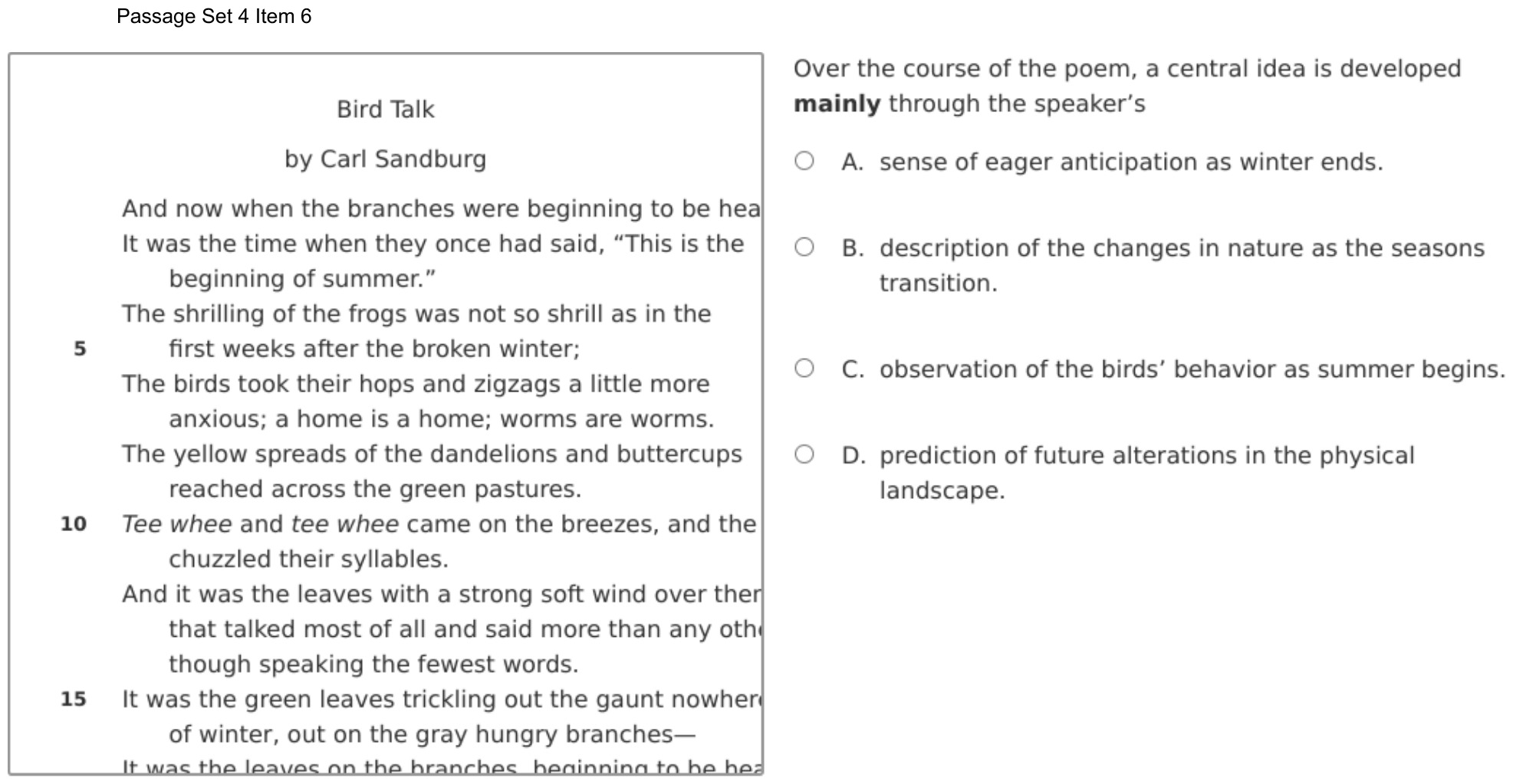
The passage “Bird Talk” as printed (page 32)