Passage Serpent Mound
Serpent Mound
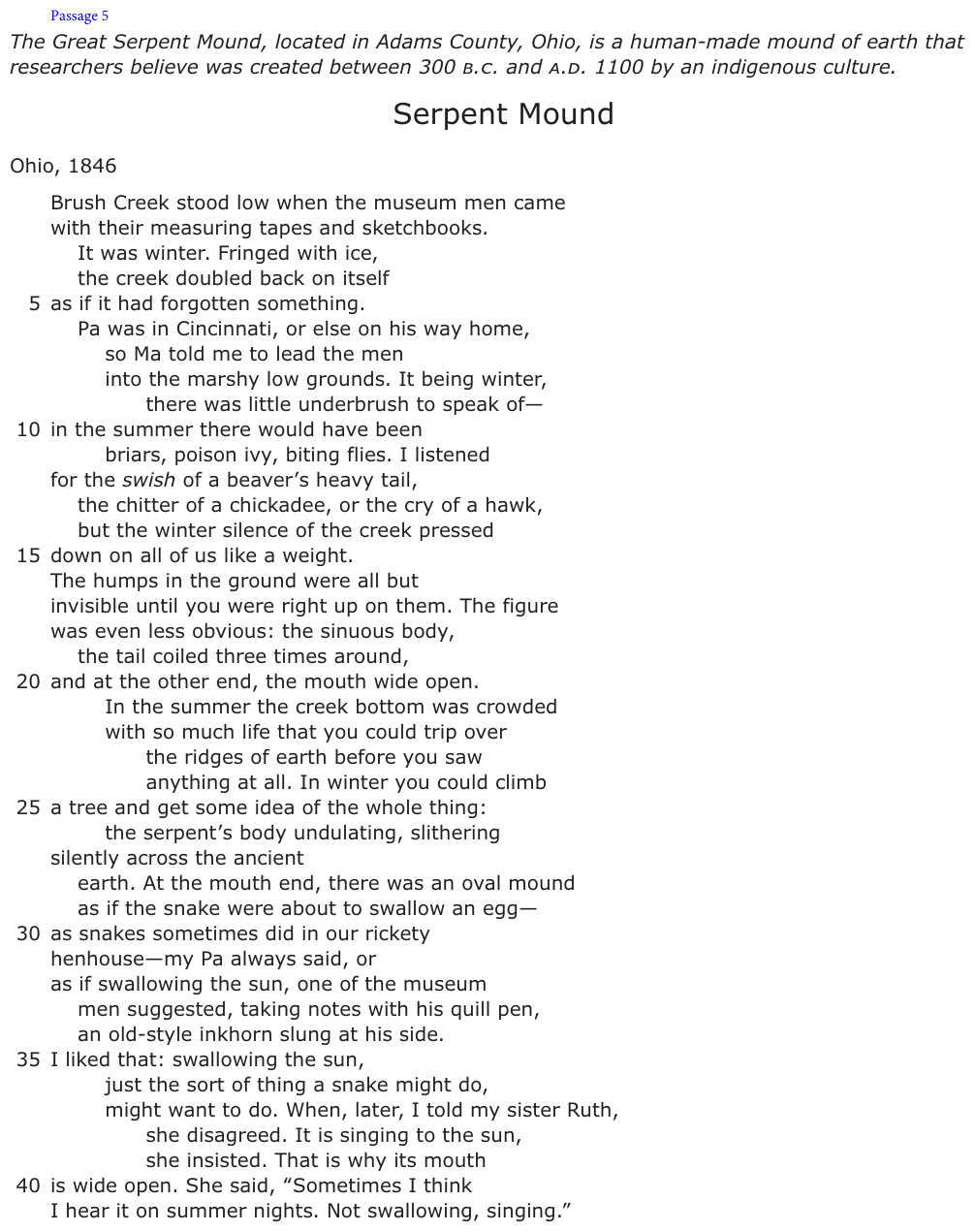
The Great Serpent Mound, located in Adams County, Ohio, is a human-made mound of earth that researchers believe was created between 300 B.C. and A.D. 1100 by an indigenous culture.
Ohio, 1846
Brush Creek stood low when the museum men came
with their measuring tapes and sketchbooks.
It was winter. Fringed with ice,
the creek doubled back on itself
as if it had forgotten something.
Pa was in Cincinnati, or else on his way home,
so Ma told me to lead the men
into the marshy low grounds. It being winter,
there was little underbrush to speak of—
in the summer there would have been
briars, poison ivy, biting flies. I listened
for the swish of a beaver’s heavy tail,
the chitter of a chickadee, or the cry of a hawk,
but the winter silence of the creek pressed
down on all of us like a weight.
The humps in the ground were all but
invisible until you were right up on them. The figure
was even less obvious: the sinuous body,
the tail coiled three times around,
and at the other end, the mouth wide open.
In the summer the creek bottom was crowded
with so much life that you could trip over
the ridges of earth before you saw
anything at all. In winter you could climb
a tree and get some idea of the whole thing:
the serpent’s body undulating, slithering
silently across the ancient
earth. At the mouth end, there was an oval mound
as if the snake were about to swallow an egg—
as snakes sometimes did in our rickety
henhouse—my Pa always said, or
as if swallowing the sun, one of the museum
men suggested, taking notes with his quill pen,
an old-style inkhorn slung at his side.
I liked that: swallowing the sun,
just the sort of thing a snake might do,
might want to do. When, later, I told my sister Ruth,
she disagreed. It is singing to the sun,
she insisted. That is why its mouth
is wide open. She said, “Sometimes I think
I hear it on summer nights. Not swallowing, singing.”
Question
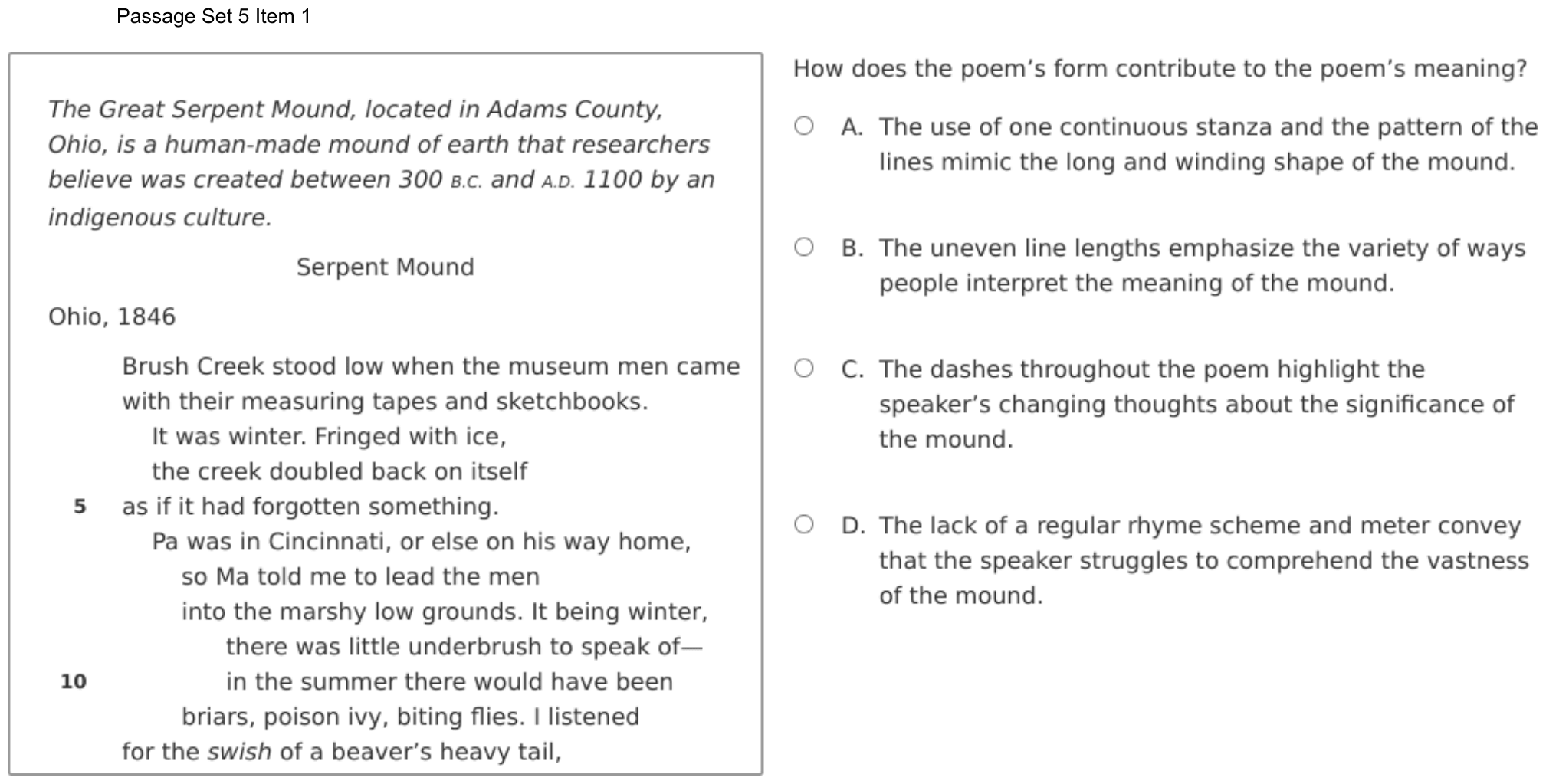
How does the poem’s form contribute to the poem’s meaning?
- AThe use of one continuous stanza and the pattern of the lines mimic the long and winding shape of the mound.
- BThe uneven line lengths emphasize the variety of ways people interpret the meaning of the mound.
- CThe dashes throughout the poem highlight the speaker’s changing thoughts about the significance of the mound.
- DThe lack of a regular rhyme scheme and meter convey that the speaker struggles to comprehend the vastness of the mound.
Show the answer
Correct answer: A
The question asks how the poem’s form contributes to the poem’s meaning.
A. CORRECT. The poem is structured as one long stanza. The line lengths throughout the poem and the line indents (such as those in lines 7–10) create a visual effect so that the poem itself mimics the shape of the Serpent Mound.
B. Incorrect. The uneven line lengths in the poem do not indicate the different interpretations of the mound; separate stanzas or other stopping points would more effectively point to contrasting ideas.
C. Incorrect. The dashes in the poem lead to further explanation of a thought, not a change of thought.
D. Incorrect. The lack of regular rhyme and meter is intended to create a conversational tone rather than show the speaker’s struggle to grasp how large the mound is.
Question analysis
This question about poetic form asks how the form of “Serpent Mound,” a poem set in 1846 at the ancient earthwork in Adams County, Ohio, contributes to its meaning. Students must consider features such as the single stanza, the uneven lines, the dashes and the lack of rhyme, and decide which feature the poem actually puts to work, and how.
- NYS standards
- 7R5 structure and genre features
- Grade level
- Grade 7 reading and task
- Compared with grade 7
- At grade 7 Asking how a poem’s form adds to its meaning is a grade 7 standard. Each choice names a feature that is easy to check on the page and pairs it with a meaning that must also be tested, a typical demand.
- Estimated difficulty
- Hard: combines ideas, needs a plan, and has more than one tempting wrong answer.
- Thinking it demands
- Depth of knowledge 3, strategic thinking · mainly analyze
- What makes it hard
- How, not what major
- A very close wrong answer moderate
- Something you must already know minor
- Evidence
- Answered from the whole text
- Reading level
- Passage: 354 words (a poem; reading level not measured); question and choices: about grade 8, 84 words.
- Students, last 30 days
- Not enough answers yet to show (it takes 10).
Why it is hard, traps and wrong answers (shows the answer)
Why it is hard
Every choice names something really on the page, so the work is in the meaning each attaches. The strongest pull pairs the uneven lines with the poem’s real ending, three readings of the oval mound, and the free-verse choice can lean on line 25’s “some idea of the whole thing.” Seeing the key takes a step back from the words to the poem’s outline, which on the test means scrolling through all 41 lines.
How, not what major Working it out
This is a form question: students must see that the single stanza and the indents stepping right and back, as in lines 6–12, draw a winding body on the page, an effect of layout, not of words. (Anderson & Krathwohl, 2001)
A very close wrong answer moderate Choosing the answer
The choice about uneven line lengths names nearly the same feature as the key, the shape of the lines, but gives it another meaning: the mound’s many interpretations instead of its long, winding form. (Embretson & Wetzel, 1987; Gorin & Embretson, 2006; Ascalon et al., 2007)
Something you must already know minor Working it out
The choices assume “stanza,” “rhyme scheme” and “meter,” and the idea that a poem’s outline can picture its subject, which the poem never explains. (Anderson & Krathwohl, 2001)
Strategy: Test each choice in two steps: confirm that the feature it names is really in the poem, then ask whether the poem supports the meaning the choice attaches to it.
Traps
- Wrong purpose or structure: Names a purpose, structure or effect that the part does not serve, or describes what a part says when the question asks what it does.
- Reads too much in: A reasonable-sounding conclusion that goes further than the text allows.
The wrong answers, classified
B Wrong purpose or structure (Anderson & Krathwohl, 2001)
Pairs two real things, the uneven lines and the different readings of the mound at the end, but nothing ties the line lengths to those readings, which come only in lines 29–41.
C Wrong purpose or structure (Anderson & Krathwohl, 2001)
Spots the dashes in lines 9, 29 and 31, but each one leads into more detail on the thought before it, not into a change in what the speaker thinks of the mound.
D Reads too much in (Graesser, Singer & Trabasso, 1994)
Links free verse to line 25, where a climbed tree gives only “some idea of the whole thing,” but that is about seeing the shape, and the speaker never seems overwhelmed by it.
Working it out, step by step
Figure out what the question asks
This asks about form. Form is how a poem is built and how it looks on the page. It includes stanzas, which are groups of lines set apart by blank lines. It also includes line lengths, indents, rhyme and rhythm. An indent is space at the start of a line that pushes it to the right. You need the choice that ties a real feature of form to the poem’s meaning.
Look at the shape on the page
Don’t read the words yet. Just look. The poem is one long block of 41 lines with no blank lines. So it is one continuous stanza. Its lines do not all start at the left edge. Some are pushed in one step, some two, and some three. The steps go in and come back out, again and again.
Follow the lines in and out
Take lines 6–12. Line 6 starts one step in. Lines 7 and 8 start two steps in. Lines 9 and 10 start three steps in. Line 11 comes back to two steps, and line 12 is back at the left edge. The same swing out and back happens again in lines 19–27 and in lines 33–41. Look down the whole poem. Its left edge curves out and back like a snake winding down the page.
Connect the shape to the mound
The poem is about a giant earth mound shaped like a snake. Line 18 calls it “the sinuous body.” Sinuous means full of curves. Line 26 shows “the serpent’s body undulating, slithering.” Undulating means moving in waves. The one long stanza is like the snake’s long body. The lines curving in and out are like its winding shape. The poem looks like what it describes.
Check each choice
- A fits. The single stanza and the winding lines copy the mound’s long, curving shape.
- B does not fit. The lines are uneven. But the different ideas about the mound come only at the end, in lines 29–41. The line lengths are not tied to them.
- C does not fit. The dashes in lines 9, 29 and 31 lead into more detail. They do not show the speaker’s thoughts changing.
- D does not fit. The poem has no rhyme scheme, or pattern of rhymes, and no meter, or steady beat. But the speaker never struggles to grasp how big the mound is.
Watch out: B is tempting because both of its parts are true. But nothing links the line lengths to the different ideas about the mound.
Choose the answer
The poem’s one long stanza and its in-and-out lines draw a winding snake on the page. So the answer is A, “The use of one continuous stanza and the pattern of the lines mimic the long and winding shape of the mound.”
Why this answer and not the closest wrong one
B is the closest wrong choice. It also points to how the lines look, and the poem does give different ideas about the mound. But the uneven lines run through the whole poem, while those ideas come only at the end. The in-and-out pattern draws a shape, not a set of opinions. That shape is the mound’s long, winding body.
More questions like this
The original DOE question
The passage “Serpent Mound” as printed (page 40)