Something you must already know
This test has the first 120 of the 154 questions that match.
Question 1 of 120
2026 Practice Test A English, question 48Question
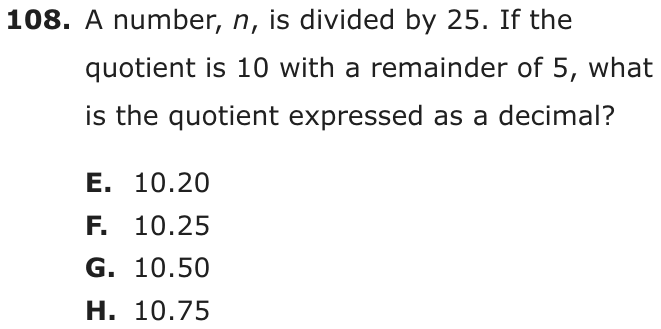
Which sentence of the paragraph should be revised to correct a vague pronoun?
(1) Eliza and Brianna have been singing in their school chorus since they were in fourth grade. (2) The girls always sing a duet at the school talent show, and they take turns singing the national anthem before school sporting events. (3) Outside of school, she also sings in a choir made up of young and old members of her community. (4) Both girls hope that they will be able to continue singing for many more years.
- Asentence 1
- Bsentence 2
- Csentence 3
- Dsentence 4
Show the answer
Correct answer: C
The question asks for identification of the sentence with a vague pronoun.
A. Incorrect. There is no vague pronoun in sentence 1, which correctly uses the plural pronouns “their”/“they” to refer to both Eliza and Brianna.
B. Incorrect. There is no vague pronoun in sentence 2, which uses the pronoun “they” to correctly refer to both girls again.
C. CORRECT. Sentence 3 is the only sentence where the pronoun is vague. The sentence uses the pronoun “she” near the beginning, but whether “she” refers to Eliza or Brianna is unclear.
D. Incorrect. There is no vague pronoun in sentence 4, which uses the pronoun “they” to correctly refer to “both girls.”
Question analysis
This editing question gives a short paragraph about Eliza and Brianna, two girls who have sung in their school chorus since fourth grade, and asks which sentence should be revised to fix a vague pronoun. Students must trace each pronoun back to the person or people it stands for and ask whether a reader could tell who is meant.
- NYS standards
- 7L1 grammar and usage conventions
- Grade level
- Grade 6 reading and task
- Compared with grade 7
- Below grade 7 Recognizing and fixing vague pronouns is taught in grade 6. This paragraph is four short sentences in everyday language with one rule to apply, lighter than the multi-error paragraphs typical of grade 7 editing.
- Estimated difficulty
- Routine: one familiar step, little to misread.
- Thinking it demands
- Depth of knowledge 1, recall and reproduction · mainly apply
- What makes it hard
- Evidence
- Answered from one paragraph or stanza
- Reading level
- Question and choices: about grade 5, 90 words.
- Students, last 30 days
- Not enough answers yet to show (it takes 10).
Why it is hard, traps and wrong answers (shows the answer)
Why it is hard
The paragraph is short, plainly worded and about two named girls, so the one singular pronoun stands out once students look for the person each pronoun stands for. Points are lost mainly by students unsure what “vague” means, who suspect a sentence with several pronouns or a plural “they” instead. Tracing each pronoun back to its noun settles the question in seconds.
Something you must already know minor Working it out
Students must know what makes a pronoun vague: “she” in sentence 3 could mean either Eliza or Brianna, while each plural “they” clearly means both girls. (Anderson & Krathwohl, 2001)
Strategy: Circle every pronoun, draw a line from each to the noun it replaces, and look for one where the line could go to more than one person.
Traps
- Fixes what isn't broken: Changes a part of the sentence that was already correct, while the real error stays; or, where the question asks which sentence has an error or should go, picks one that is correct and belongs.
The wrong answers, classified
A Fixes what isn't broken (Connors & Lunsford, 1988)
Sees two pronouns, “their” and “they,” in the first sentence and suspects confusion, though both are plural and plainly refer to Eliza and Brianna together.
B Fixes what isn't broken (Connors & Lunsford, 1988)
Thinks “The girls” and “they” are too general and wants the names repeated, though both point clearly back to the two girls just named.
D Fixes what isn't broken (Connors & Lunsford, 1988)
Wonders whether “they” could include the choir members of the sentence before, though “Both girls” at the start of sentence 4 fixes who “they” are.
Working it out, step by step
Learn the rule for pronouns
A pronoun is a short word that stands in for a noun, like she, he, they or it. A pronoun is vague when the reader can’t tell who it means. For example: Ana and Lily went to the park, and she fell. Who fell, Ana or Lily? You can’t tell.
Trace each pronoun to its noun
- Sentence 1: “their” and “they” mean both girls, Eliza and Brianna.
- Sentence 2: “they” means “The girls,” both of them.
- Sentence 3: “she” and “her” mean one girl. But which one?
- Sentence 4: “they” means “Both girls.”
Find the vague one
Sentence 3 says, “Outside of school, she also sings in a choir made up of young and old members of her community.” Two girls were just named. “She” could be Eliza or Brianna. The reader can’t tell who sings in the choir.
Show the fix
Replace the pronoun with a name: Outside of school, Brianna also sings in a choir made up of young and old members of her community. It could just as well be Eliza. The point is to name one girl. Now the reader knows who sings in the choir.
Check each choice
- A is wrong. “Their” and “they” are plural, meaning more than one. Both clearly mean the two girls.
- B is wrong. “They” points back to “The girls,” just named.
- C is right. “She” could mean either girl.
- D is wrong. “Both girls” at the start makes “they” clear.
Watch out: Having many pronouns doesn’t make a sentence vague. Sentence 1 has two, but each one is clear.
Choose the answer
Only sentence 3 has a pronoun that could point to two different people. So the answer is C, sentence 3.
Why this answer and not the closest wrong one
Sentence 1 is the closest wrong answer, because it has two pronouns, “their” and “they.” But both are plural, and both mean Eliza and Brianna together. In sentence 3, the singular “she” could mean either girl. So only sentence 3 needs a fix.
More questions like this
The original DOE question
Question 2 of 120
2026 Practice Test A Math, question 50Question
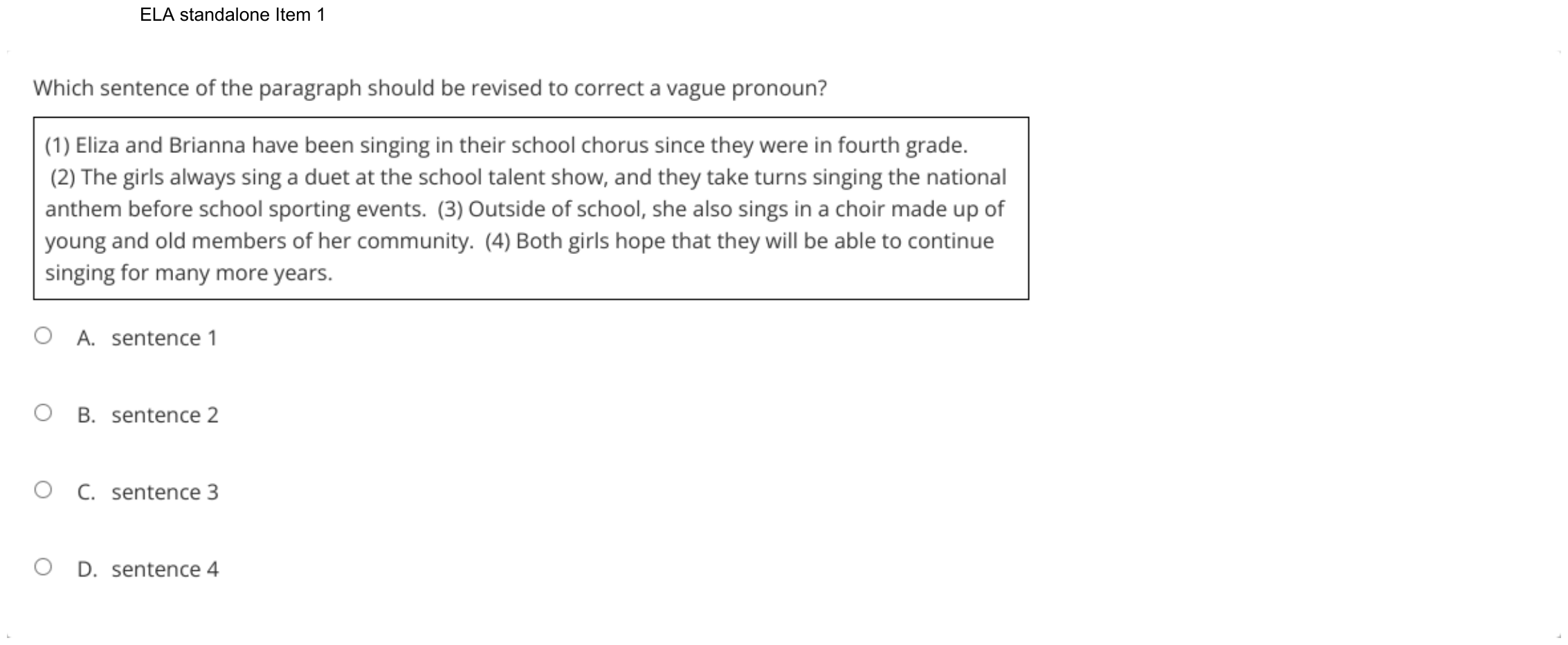
Let , , and . Determine the value of .
Enter your fractional answer in the space provided. Enter only your fraction.
On the test you build the answer on an on-screen keypad; here, type it. Use ^ for a power, sqrt( ) or √ for a root, pi for π, and <= or >= for ≤ and ≥.
Show the answer
Correct answer: 7/5
Solution:
Substitute , , and in : .
Then simplify the complex fraction by multiplying the complex fraction by a form of 1, : .
Simplify after multiplying by a form of 1: .
Then simplify again and add the two fractions: .
Question analysis
This substitution question gives values for b, c and d and asks for the value of an expression made of a fraction divided by a fraction, plus another fraction. Students substitute, simplify the complex fraction and add, then type the result. Dividing fractions in the stacked form is the main hurdle, and the item wants a fraction, not a decimal.
- NYS standards
- Grade level
- Grade 7 content, by NYS standard
- Compared with grade 7
- At grade 7 Grade 7 students evaluate expressions and divide and add fractions. A fraction stacked over another fraction looks unfamiliar and there are no choices to check, but with these values the work is three short steps.
- Estimated difficulty
- Moderate: several steps, or a close reading with one strong distractor.
- Thinking it demands
- Depth of knowledge 1, recall and reproduction · mainly apply
- What makes it hard
- Error-prone arithmetic moderate
- Something you must already know minor
- An answer in an unexpected form minor
- Solution
- 3 steps
- Reading level
- Question and choices: about grade 9, 22 words.
- Students, last 30 days
- Not enough answers yet to show (it takes 10).
Why it is hard, traps and wrong answers (shows the answer)
Why it is hard
Once the values are in, the work is one fraction division and one addition, but the division is printed as a fraction over a fraction, in small type. Multiplying the two fractions, or flipping the top one, gives a sum in fifteenths that looks as finished as the right one. Noticing that the 4s cancel, so the stacked part is simply 3/5, turns the last step into adding fifths.
Error-prone arithmetic moderate Working it out
Dividing 4/5 by 4/3 means multiplying by 3/4, giving 3/5, which is then added to 4/5; multiplying straight across or flipping the top fraction instead both lead to fifteenths. (Brown & Burton, 1978; Junker & Sijtsma, 2001)
Something you must already know minor Working it out
Nothing on the page says that a fraction over a fraction is a division, or that dividing by 4/3 means multiplying by its reciprocal, and the stacked form is rare in grade 7 work. (Anderson & Krathwohl, 2001)
An answer in an unexpected form minor Choosing the answer
The value is typed into a fraction box with no choices to check against, and the item asks for a fraction, so the equal decimal 1.4 is not accepted. (Enright, Morley & Sheehan, 2002)
Strategy: Substitute the values, rewrite the stacked fraction as the top fraction times the reciprocal of the bottom one, where the 4s cancel, then add the last fraction and leave the result as a fraction.
Traps
- Wrong operation: Adds instead of multiplying, divides the wrong way round, turns a ratio or rate upside down, or undoes a step in the wrong direction (subtracts what should be added back).
- A faulty procedure: A systematic but wrong procedure: adding fractions straight across, applying an exponent to each term of a sum, dropping a sign when moving a term.
- Misreads the question: Misses or misreads a condition or a word in the question: "at least", "each", "remaining", "not".
The wrong answers, classified
28/15 Wrong operation (Hegarty, Mayer & Monk, 1995; King et al., 2004)
Multiplies 4/5 by 4/3 instead of dividing, getting 16/15, then adds 4/5, or 12/15, to reach 28/15.
37/15 A faulty procedure (Brown & Burton, 1978; Tatsuoka, 1983)
Flips the top fraction instead of the bottom one, so the stacked part becomes 5/4 × 4/3 = 5/3, and 5/3 + 4/5 = 37/15.
1.4 Misreads the question (Hegarty, Mayer & Monk, 1995)
Finds the right value but works in decimals, 0.6 + 0.8 = 1.4, and enters that, though the item asks for a fraction.
Worked solution, step by step
Formulas used
- Dividing fractions
- a, b, c and d are numbers that are not zero. To divide by a fraction, multiply by its reciprocal, the fraction flipped upside down. Flip only the fraction you divide by. It works because a fraction times its reciprocal is 1, so the reciprocal undoes the fraction, just as dividing does.
- Adding fractions with the same bottom
- d is the denominator, the bottom number, which tells the size of each piece. a and b are the numerators, the top numbers, which count the pieces. When the pieces are the same size, add the tops and keep the bottom.
Sort out the question
You know , and . You need the value of:
The first part is a fraction on top of a fraction. A fraction bar means divide, so this part is . The answer must be typed as a fraction.
Put in the numbers
Replace each letter with its value. Look closely: the bottom fraction has b under the c, not d.
So the expression becomes:
Divide the two fractions
Use the rule for dividing fractions. The reciprocal of 4/3 is 3/4. To multiply fractions, multiply the tops and multiply the bottoms:
To simplify 12/20, divide its top and bottom by 4.
Watch out: flip only the bottom fraction. Multiplying without flipping gives 16/15 and a total of 28/15. Flipping the top one gives 5/3 and a total of 37/15.
Add the last fraction
Both fractions are now fifths, so add the tops and keep the bottom:
The value is 7/5.
Enter it as a fraction
The item asks for a fraction. 7/5 equals the decimal 1.4, but 1.4 is not accepted. On the test, the answer box already holds a fraction template, a small box over a small box. Type 7 in the top box. Then click the bottom box and type 5. On this site, type 7/5.
So you would enter 7/5.
Check your answer
Check with decimals. , and 4/3 is about 1.33. Then is about 0.6, which is 3/5. Last, , and 1.4 is the same as 7/5.
More questions like this
The original DOE question
Question 3 of 120
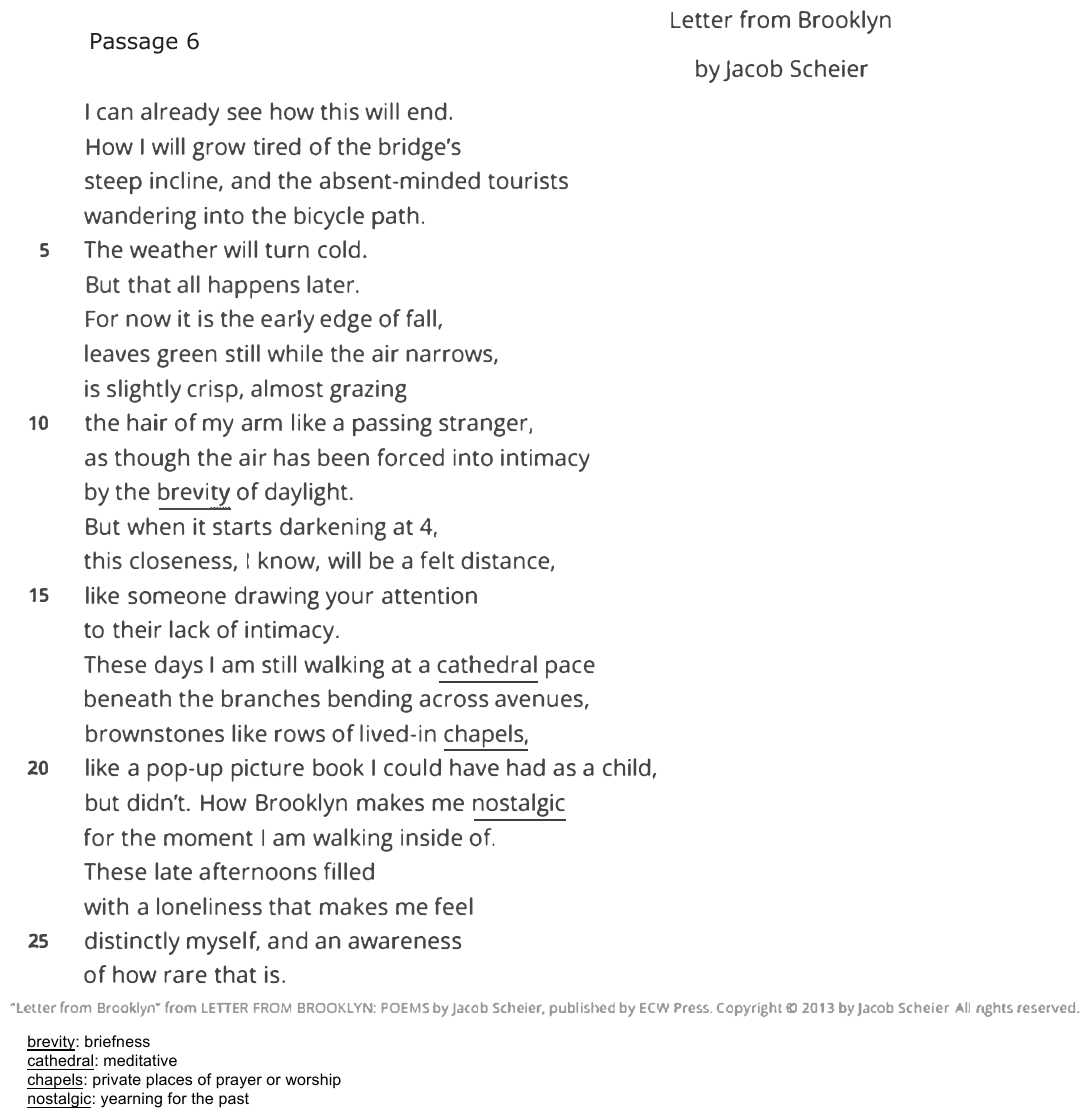
2026 Practice Test B English, question 36Passage Letter from Brooklyn
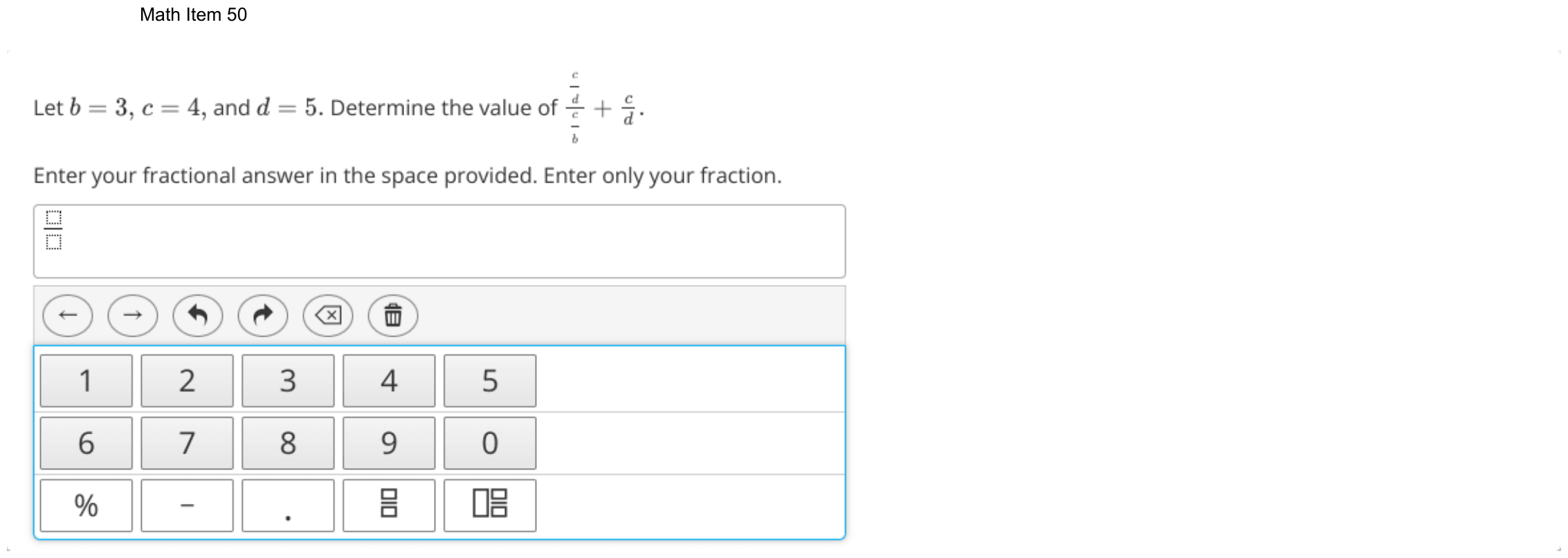
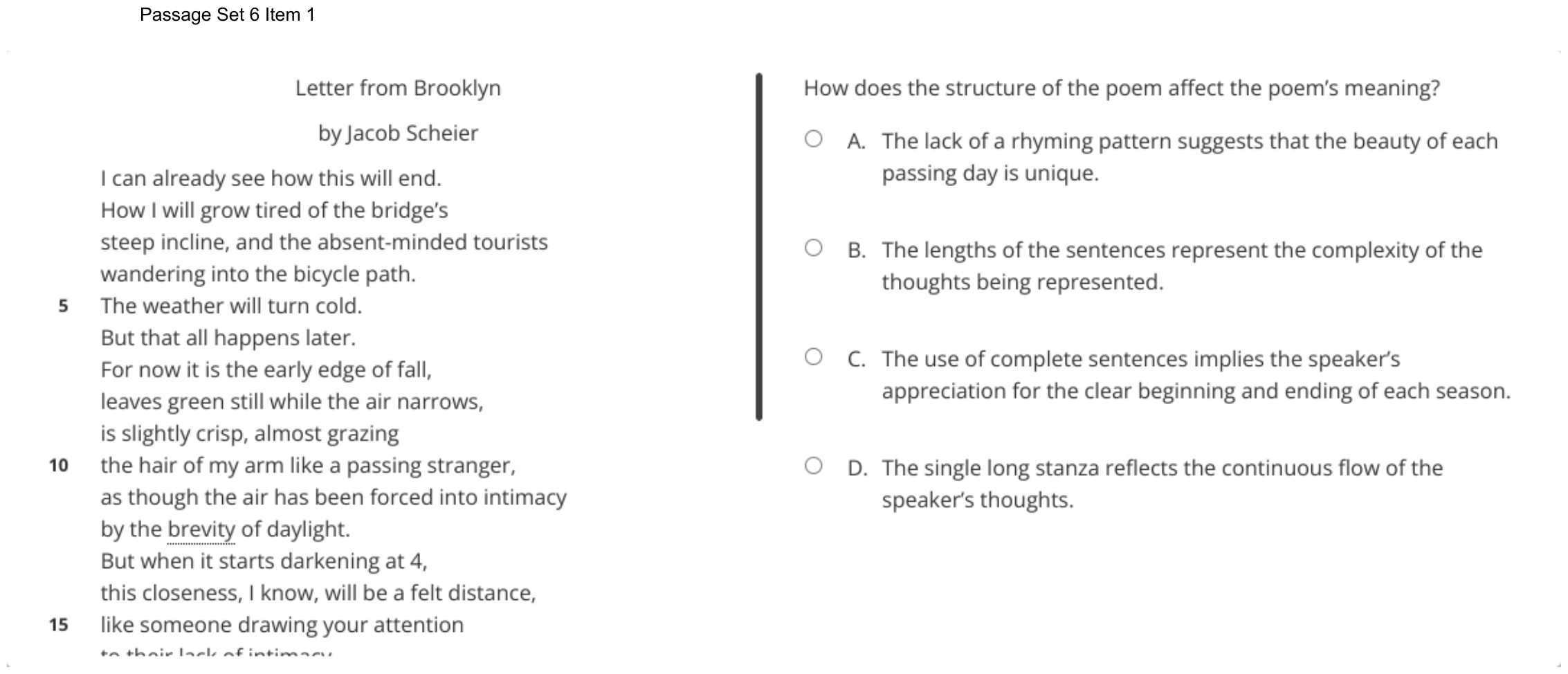
Letter from Brooklyn
by Jacob Scheier
I can already see how this will end.
How I will grow tired of the bridge’s
steep incline, and the absent-minded tourists
wandering into the bicycle path.
The weather will turn cold.
But that all happens later.
For now it is the early edge of fall,
leaves green still while the air narrows,
is slightly crisp, almost grazing
the hair of my arm like a passing stranger,
as though the air has been forced into intimacy
by the brevity of daylight.
But when it starts darkening at 4,
this closeness, I know, will be a felt distance,
like someone drawing your attention
to their lack of intimacy.
These days I am still walking at a cathedral pace
beneath the branches bending across avenues,
brownstones like rows of lived-in chapels,
like a pop-up picture book I could have had as a child,
but didn’t. How Brooklyn makes me nostalgic
for the moment I am walking inside of.
These late afternoons filled
with a loneliness that makes me feel
distinctly myself, and an awareness
of how rare that is.
“Letter from Brooklyn” from LETTER FROM BROOKLYN: POEMS by Jacob Scheier, published by ECW Press. Copyright © 2013 by Jacob Scheier All rights reserved.
brevity: briefness
cathedral: meditative
chapels: private places of prayer or worship
nostalgic: yearning for the past
Question
How does the structure of the poem affect the poem’s meaning?
- AThe lack of a rhyming pattern suggests that the beauty of each passing day is unique.
- BThe lengths of the sentences represent the complexity of the thoughts being represented.
- CThe use of complete sentences implies the speaker’s appreciation for the clear beginning and ending of each season.
- DThe single long stanza reflects the continuous flow of the speaker’s thoughts.
Show the answer
Correct answer: D
The question asks how the structure of the poem affects its meaning.
A. Incorrect. Though the poem lacks a rhyming pattern, such a structure is not related to the uniqueness of the passing days. The speaker is savoring “the early edge of fall” (line 7) and describes walks taken on “these days” (line 17), but the beauty the speaker appreciates is attributed to the fall season rather than to a unique day. Further, the poem is primarily concerned with broad seasonal shifts, not the passing of each day, and the absence of rhyme does not suggest that each day is unique in its beauty.
B. Incorrect. The poem includes both long sentences (such as the one in lines 7–12) and short sentences (such as those in lines 5 and 6). However, the sentence lengths are not connected with the complexity of the ideas expressed.
C. Incorrect. A complete sentence serves to present the beginning and the end of a single thought, but the poem is not primarily concerned with the speaker’s thoughts on the “clear beginning and ending of each season.” Though it contrasts the speaker’s feelings and experiences during different seasons, the poem does not present descriptions focused specifically on the beginnings or ends of these seasons.
D. CORRECT. Unlike poems that are broken into stanzas reflecting unified groups of thoughts, this poem is one long stanza. This structure serves to emphasize the uninterrupted flow of the speaker’s thoughts from time to time and experience to experience without a clear break between any specific thoughts.
Question analysis
This poetry question asks how the structure of Jacob Scheier's “Letter from Brooklyn,” a poem about walking through the city in early fall, affects its meaning. Students must look at how the poem is built, its sentences, line breaks, stanzas and lack of rhyme, and decide which feature really shapes what the poem says.
- NYS standards
- 7R5 structure and genre features
- Grade level
- Grade 7 reading and task
- Compared with grade 7
- At grade 7 Grade 7 standards ask how a poem's form shapes its meaning. Here each choice names a feature of form that students must first confirm in the poem and then link to its meaning, a typical grade 7 poetry task on a short poem.
- Estimated difficulty
- Moderate: several steps, or a close reading with one strong distractor.
- Thinking it demands
- Depth of knowledge 2, skills and concepts · mainly analyze
- What makes it hard
- How, not what moderate
- Every choice must be checked moderate
- Something you must already know minor
- Evidence
- Answered from the whole text
- Reading level
- Passage: 217 words (a poem; reading level not measured); question and choices: about grade 8, 70 words.
- Students, last 30 days
- Not enough answers yet to show (it takes 10).
Why it is hard, traps and wrong answers (shows the answer)
Why it is hard
Checking whether a feature exists rules out little here, since the poem is unrhymed, its sentences vary widely and it has one stanza. The decision rests on which feature matches what the speaker does: thoughts move from future to present to memory without a break. The strongest pull ties the lack of rhyme to the uniqueness of each day, which sounds like the poem’s theme of rare moments but is not something rhyme or its absence can show.
How, not what moderate Working it out
The question is about form, so students must ask what the single unbroken stanza does: it carries the speaker from the coming cold back to the present walk without a pause. (Anderson & Krathwohl, 2001)
Every choice must be checked moderate Choosing the answer
Three choices name features the poem really has, no rhyme, sentences from five words to six lines, and one stanza, so the meaning each feature is given is what separates them. (Embretson & Wetzel, 1987)
Something you must already know minor Working it out
Students must know what a stanza and a rhyming pattern are, and that a poem without stanza breaks has no white space marking separate groups of thought. (Anderson & Krathwohl, 2001)
Strategy: For each choice, first check that the poem really has the feature named, then ask whether that feature fits what the speaker is doing throughout the poem, not just in one line.
Traps
- Wrong purpose or structure: Names a purpose, structure or effect that the part does not serve, or describes what a part says when the question asks what it does.
- Reads too much in: A reasonable-sounding conclusion that goes further than the text allows.
The wrong answers, classified
A Reads too much in (Graesser, Singer & Trabasso, 1994)
Applies the habit of finding meaning in free verse, linking the missing rhyme to each day’s unique beauty, which echoes “how rare that is” but follows from nothing in the form.
B Wrong purpose or structure (Anderson & Krathwohl, 2001)
Rightly sees sentences ranging from five words to six lines, but gives their length a job, matching complex thoughts, that the poem never connects to it.
C Wrong purpose or structure (Anderson & Krathwohl, 2001)
Assumes complete sentences marking each season’s clear start and end, though the last four lines are a fragment and the poem follows fall’s gradual early turn.
Working it out, step by step
Figure out what the question asks
This question asks how the poem’s structure shapes its meaning. Structure means how the poem is built: its stanzas, its sentences and its rhyme. A stanza is a group of lines set apart by a blank line. It is like a paragraph in a poem.
Look at how the poem is built
The poem has 26 lines and no blank lines, so it is one long stanza. The lines don’t rhyme. The sentences have many lengths. Line 5, “The weather will turn cold,” is short. The sentence in lines 7–12 runs six lines.
Follow the speaker’s thoughts
The speaker is the voice talking in the poem. Line 1 jumps ahead: “I can already see how this will end.” Line 6 comes back: “But that all happens later.” Then the speaker describes the fall air, then the walk, then a lonely feeling. One thought slides into the next with no stop. One unbroken stanza matches that steady flow.
Check each choice
- A is wrong. The poem has no rhyme. But missing rhyme can’t show that each day’s beauty is unique, or one of a kind.
- B is wrong. The sentences do vary in length. But the poem doesn’t link long sentences to hard thoughts.
- C is wrong. The poem isn’t about each season’s clear start and end. It describes fall just starting to turn.
- D is right. The single stanza matches thoughts that flow on with no breaks.
Watch out: Three choices name real features of the poem. So don’t stop at Is this true? Ask whether that feature really creates the meaning the choice gives it.
Choose the answer
Continuous means going on without stopping. So the answer is D: “The single long stanza reflects the continuous flow of the speaker’s thoughts.”
Why this answer and not the closest wrong one
A is the closest wrong answer, because the poem does praise a rare moment. But rhyme, or no rhyme, can’t show that each day is unique. One long stanza can show thoughts flowing without a stop. That is how the speaker thinks, from line 1 to line 26.
More questions like this
The original DOE question
The passage “Letter from Brooklyn” as printed (page 50)
Question 4 of 120
2026 Practice Test B English, question 45Passage The End of an Era
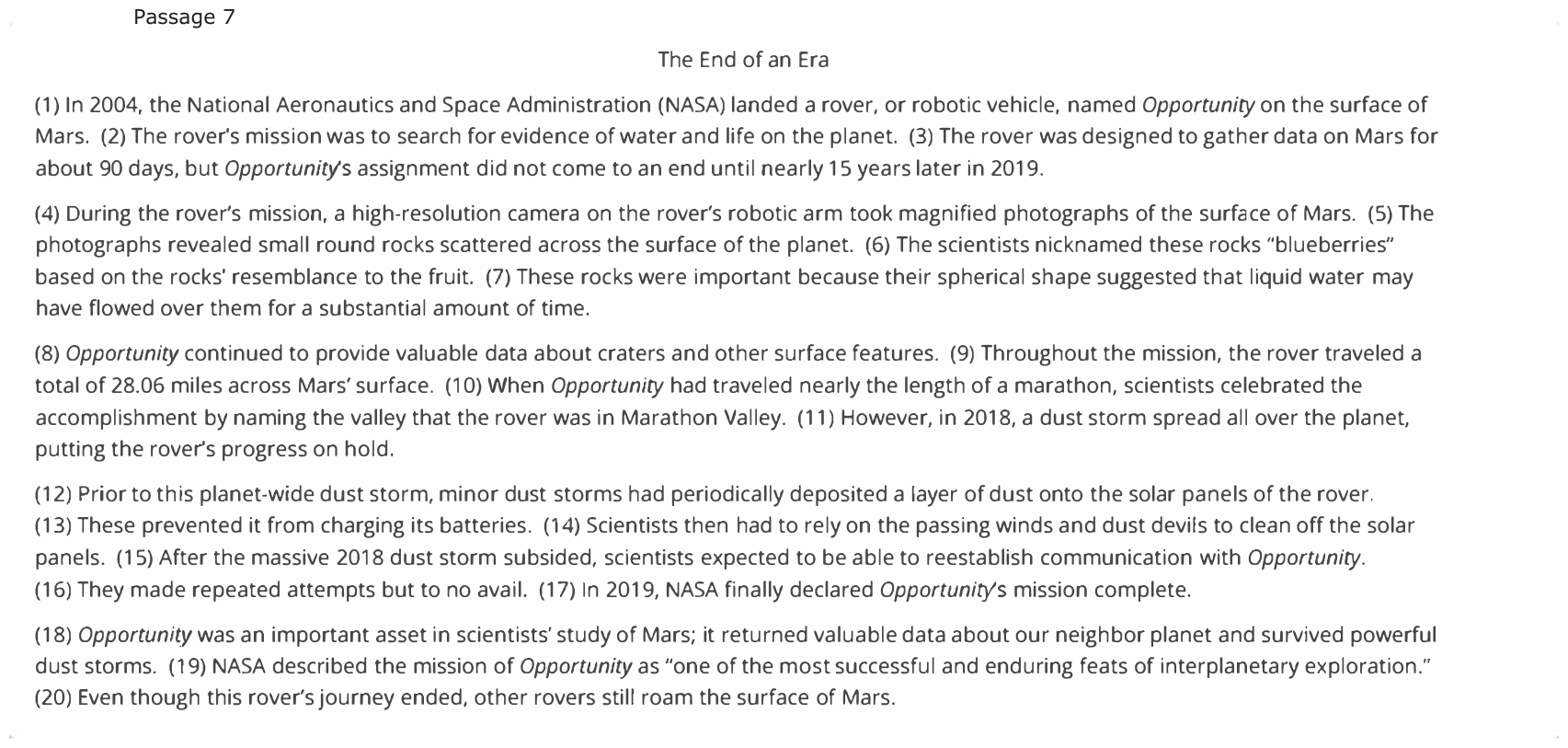
The End of an Era
(1) In 2004, the National Aeronautics and Space Administration (NASA) landed a rover, or robotic vehicle, named Opportunity on the surface of Mars. (2) The rover’s mission was to search for evidence of water and life on the planet. (3) The rover was designed to gather data on Mars for about 90 days, but Opportunity’s assignment did not come to an end until nearly 15 years later in 2019.
(4) During the rover’s mission, a high-resolution camera on the rover’s robotic arm took magnified photographs of the surface of Mars. (5) The photographs revealed small round rocks scattered across the surface of the planet. (6) The scientists nicknamed these rocks “blueberries” based on the rocks’ resemblance to the fruit. (7) These rocks were important because their spherical shape suggested that liquid water may have flowed over them for a substantial amount of time.
(8) Opportunity continued to provide valuable data about craters and other surface features. (9) Throughout the mission, the rover traveled a total of 28.06 miles across Mars’ surface. (10) When Opportunity had traveled nearly the length of a marathon, scientists celebrated the accomplishment by naming the valley that the rover was in Marathon Valley. (11) However, in 2018, a dust storm spread all over the planet, putting the rover’s progress on hold.
(12) Prior to this planet-wide dust storm, minor dust storms had periodically deposited a layer of dust onto the solar panels of the rover. (13) These prevented it from charging its batteries. (14) Scientists then had to rely on the passing winds and dust devils to clean off the solar panels. (15) After the massive 2018 dust storm subsided, scientists expected to be able to reestablish communication with Opportunity. (16) They made repeated attempts but to no avail. (17) In 2019, NASA finally declared Opportunity’s mission complete.
(18) Opportunity was an important asset in scientists’ study of Mars; it returned valuable data about our neighbor planet and survived powerful dust storms. (19) NASA described the mission of Opportunity as “one of the most successful and enduring feats of interplanetary exploration.” (20) Even though this rover’s journey ended, other rovers still roam the surface of Mars.
Question
Which revision of sentence 11 best maintains the formal style established in the passage?
- AHowever, in 2018, a dust storm covered the planet, bringing the rover’s progress to a standstill.
- BHowever, in 2018, a dust storm shrouded the planet, impermanently halting the rover’s progress.
- CHowever, in 2018, a dust storm enveloped the whole of the planet, arresting the rover’s progress for a time.
- DHowever, in 2018, a dust storm covered up the whole planet, which quickly brought a stop to the progress of the rover.
Show the answer
Correct answer: A
The question asks for the revision of sentence 11 that best maintains the formal style established in the passage.
A. CORRECT. This sentence uses clear and formal writing throughout. The phrase “covered the planet” is accurate and formal without being overly poetic, and “standstill” is a precise word for putting something “on hold,” as expressed by the original sentence, while maintaining the formal style of the passage.
B. Incorrect. Although the sentence is formal in style, the word “shrouded” is overly poetic, and the phrase “impermanently halting” is too stilted and formal for the style and tone of the passage.
C. Incorrect. Although the sentence is formal in style, the words “enveloped” and “arresting” are overly poetic, especially when used in the same sentence, and the phrases “the whole of the planet” and “for a time” are needlessly wordy and imprecise, compared with the formal scientific language of the passage.
D. Incorrect. The phrases “covered up the whole planet” and “quickly brought a stop to the progress of the rover” are less formal and unnecessarily wordy, compared with the formal style established by the rest of the passage.
Question analysis
This style question asks which revision of sentence 11, about the 2018 dust storm that covered Mars and stopped the Opportunity rover, best maintains the formal style of the passage. All four versions say the same thing, so students must compare word choice and wordiness and decide which one reads like the rest of the passage.
- Grade level
- Grade 8 reading and task
- Compared with grade 7
- Above grade 7 Keeping a formal style is grade 7 writing work, usually tested by spotting slang or casual wording. Here all four revisions keep the meaning and differ in register by degrees, so students must judge the passage's own style closely, more than typical.
- Estimated difficulty
- Hard: combines ideas, needs a plan, and has more than one tempting wrong answer.
- Thinking it demands
- Depth of knowledge 2, skills and concepts · mainly evaluate
- What makes it hard
- Something you must already know moderate
- Every choice must be checked moderate
- Hard words minor
- Evidence
- Answered from one sentence or line
- Reading level
- Passage: about grade 11, 337 words; question and choices: about grade 9, 80 words.
- Students, last 30 days
- Not enough answers yet to show (it takes 10).
Why it is hard, traps and wrong answers (shows the answer)
Why it is hard
The question turns on what “formal” means. Many students equate it with impressive words and choose the revision with “enveloped” and “arresting,” or the one with “shrouded,” missing that both are more poetic than a passage that reports dates and distances. The casual revision is easy to reject, so the real test is preferring the plainest formal sentence to the grandest one.
Something you must already know moderate Working it out
Students must know that a formal informational style is plain and precise, so words such as “shrouded,” “enveloped” and “arresting” are too ornate for a passage that reports miles and dates. (Anderson & Krathwohl, 2001)
Every choice must be checked moderate Choosing the answer
All four revisions keep the meaning of sentence 11 and differ only in register and length, so each must be heard against the passage’s voice rather than checked for errors. (Embretson & Wetzel, 1987)
Hard words minor Understanding the question
“Impermanently,” “shrouded” and “arresting,” in its sense of stopping, are uncommon words, and students must judge how they sound in the passage, not only what they mean. (Perfetti, 2007; Freedle & Kostin, 1993)
Strategy: Reread a few sentences around sentence 11 to hear the passage's voice, then check each revision for casual phrasing, needless words and words that would sound out of place in that voice.
Traps
- Wordy, vague or informal: A revision is grammatical but wordy, imprecise or too casual for the passage.
The wrong answers, classified
B Wordy, vague or informal (Connors & Lunsford, 1988)
Equates formal with elevated, so “shrouded” and “impermanently halting” seem best, though both are stilted and poetic beside the passage’s plain reporting of facts.
C Wordy, vague or informal (Connors & Lunsford, 1988)
Avoids casual words, but “enveloped” and “arresting” are poetic, and “the whole of the planet” and “for a time” add words the plain version does without.
D Wordy, vague or informal (Connors & Lunsford, 1988)
Keeps the meaning, but the casual “covered up” and the roundabout “brought a stop to the progress of the rover” make it wordier and less formal.
Working it out, step by step
Figure out what the question asks
This question asks which version of sentence 11 keeps the passage’s formal style. Formal writing is serious and clear, like a textbook. It avoids slang and casual words. But formal doesn’t mean fancy. Formal writing about science uses plain, exact words. For example, The game got called off is casual. The contest was halted indefinitely is too fancy. The game was canceled is formal and plain.
Hear the passage’s voice
Sentence 9 says “the rover traveled a total of 28.06 miles across Mars’ surface.” Sentence 12 says minor storms “deposited a layer of dust onto the solar panels.” The words are exact and plain. The passage gives dates and numbers. It doesn’t paint poetic pictures.
Check each revision
- A is right. “Covered the planet” is plain and exact. A standstill is a complete stop, a clear way to say “on hold.”
- B is wrong. “Shrouded” is poetic. A shroud is a cloth wrapped around a body. “Impermanently halting” sounds stiff and odd.
- C is wrong. “Enveloped” and “arresting” are fancy words. Here arresting means stopping. “The whole of the planet” and “for a time” add extra words.
- D is wrong. “Covered up” is casual. “Brought a stop to the progress of the rover” is wordy, or longer than it needs to be.
Watch out: Many students think formal means big words, so they choose C. But a passage of dates and miles calls for plain words.
Choose the answer
Only A is both formal and plain, like the rest of the passage. So the answer is A: “However, in 2018, a dust storm covered the planet, bringing the rover’s progress to a standstill.”
Why this answer and not the closest wrong one
C is the closest wrong answer, because it has no slang and sounds serious. But “enveloped” and “arresting” are poetic, and “the whole of the planet” is wordy. The passage reports facts in plain words. A says the same thing in the plainest formal way.
More questions like this
The original DOE question
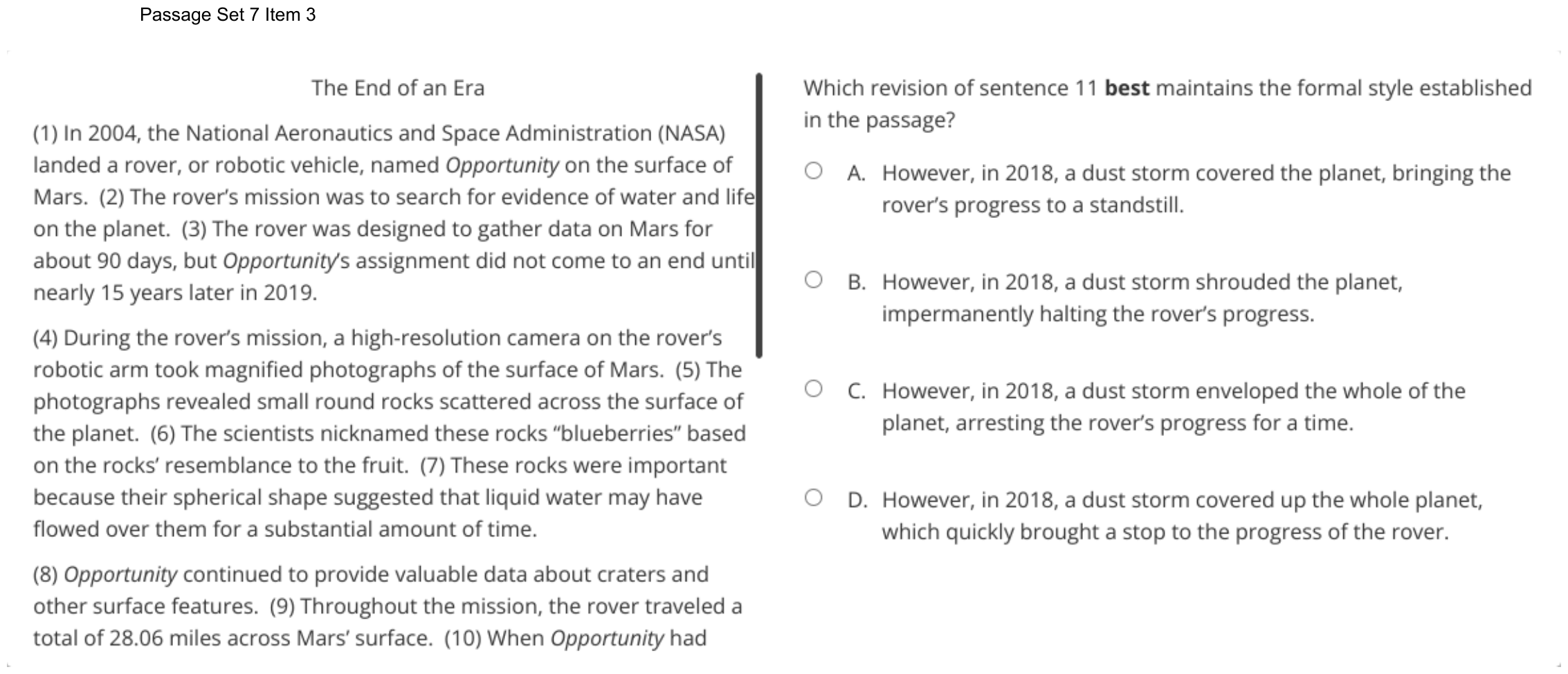
The passage “The End of an Era” as printed (page 60)
Question 5 of 120
2026 Practice Test B Math, question 13Question
A basket contains 3 apples, 4 oranges, 5 bananas, and 8 pears.
If one piece of fruit is randomly pulled from the basket, what is the probability that it will be a pear?
Select the place on the number line to plot the point.
On the test you click a point on the number line; here, choose it from the menu.
Show the answer
Correct answer: the point 0.4
The total number of fruits is:
The probability of picking a pear is:
Question analysis
A basket holds apples, oranges, bananas and pears, and students find the probability that a piece of fruit pulled at random is a pear, then plot it as a point on a number line from 0 to 1. It tests simple probability as a part of a whole. With no choices to pick from, the fraction has to be turned into tenths to find its place.
- Grade level
- Grade 6 content, by NYS standard
- Compared with grade 7
- Below grade 7 Finding the probability of a simple event from counts is grade 6 work in New York. This one adds four whole numbers, forms one fraction and plots it among marked tenths, a shorter and more routine task than grade 7 probability.
- Estimated difficulty
- Routine: one familiar step, little to misread.
- Thinking it demands
- Depth of knowledge 1, recall and reproduction · mainly apply
- What makes it hard
- Solution
- 3 steps
- Reading level
- Question and choices: about grade 6, 40 words.
- Students, last 30 days
- Not enough answers yet to show (it takes 10).
Why it is hard, traps and wrong answers (shows the answer)
Why it is hard
Adding the four counts to 20 and writing 8 over 20 is routine, so most students succeed. The losses come from the number line: its decimal labels make it easy to read the 8 pears as 0.8, and a part-to-part fraction such as 8/12 falls between marks and has to be rounded, which should prompt a second look. Simplifying 8/20 to 2/5 and then to 4/10 makes the mark plain.
Something you must already know minor Working it out
The question does not say that a probability is the favorable count over the whole count, here the 8 pears over all 20 pieces of fruit rather than over the other 12. (Anderson & Krathwohl, 2001)
An answer in an unexpected form minor Choosing the answer
The number line is labeled only in tenths from 0 to 1, so 8/20 has to be rewritten as a decimal before the right mark can be chosen. (Enright, Morley & Sheehan, 2002)
Strategy: Add up all the fruit for the total, write the number of pears over that total, rewrite the fraction in tenths, and select that mark on the line.
Traps
- Answers a different question: A choice is right for another quantity: the other unknown, the rest instead of the part, the part instead of the whole.
- Misunderstands the concept: A wrong belief about a concept: that percents can be added, that area grows like length, that averages can be averaged, that a bigger denominator means a bigger fraction.
The wrong answers, classified
0.8 Numbers taken from the question (Hegarty, Mayer & Monk, 1995)
Takes the 8 pears straight to the mark labeled 0.8, never dividing by the 20 pieces of fruit in the basket.
0.7 Misunderstands the concept (Smith, diSessa & Roschelle, 1993; De Bock et al., 1998; Ni & Zhou, 2005)
Compares the 8 pears with the 12 other pieces of fruit, 8/12 or about 0.67, a part-to-part ratio, and plots the nearest tenth.
0.6 Answers a different question (King et al., 2004; Hegarty, Mayer & Monk, 1995)
Puts the 12 apples, oranges and bananas over the 20 pieces of fruit, plotting the chance of not getting a pear instead of getting one.
Worked solution, step by step
Formulas used
- Probability of an event
- P is the probability, the chance that something happens. It goes from 0 (never) to 1 (always). The top counts the results you want, here pears. The bottom counts every possible result, here every piece of fruit. It works when each result is equally likely, like grabbing fruit without looking.
- Equal fractions
- a is the top of a fraction, and b is the bottom. n is any number except 0. Dividing the top and the bottom by the same number gives an equal fraction. Use it to get 10 on the bottom, which is easy to write as a decimal.
Sort out the question
The basket has 3 apples, 4 oranges, 5 bananas and 8 pears. You pull out one piece without looking. You need the probability that it is a pear. Then you plot that number as a point. The number line runs from 0 to 1, with a mark at every tenth.
Count all the fruit
The bottom of the fraction is every piece of fruit you could pull out. Add all four kinds:
There are 20 pieces of fruit in all.
Write the probability as a fraction
Use the probability formula. There are 8 pears out of 20 pieces of fruit:
Watch out: the bottom is all the fruit, not just the other fruit. compares the pears with the 12 fruits that are not pears. It is about 0.67, and it leads you to the mark at 0.7. And 12 over 20 is the chance of not getting a pear.
Change it to tenths
The number line is marked in tenths. So rewrite the fraction with 10 on the bottom. Divide the top and the bottom by 2:
Four tenths is written 0.4.
Watch out: the 8 pears do not make 0.8. That skips dividing by the 20 pieces of fruit.
Plot the point
Start at 0 and count four marks to the right: 0.1, 0.2, 0.3, 0.4. On the test, you click the mark labeled 0.4. On this site, you choose 0.4 from the menu.
So the answer is the point at 0.4.
Check your answer
The chance of not getting a pear is . A pear and not a pear cover every result, so the two must add to 1: . Also, pears are less than half of the fruit, so the point should be left of 0.5. It is.
More questions like this
The original DOE question

Question 6 of 120
2026 Practice Test B Math, question 16Question
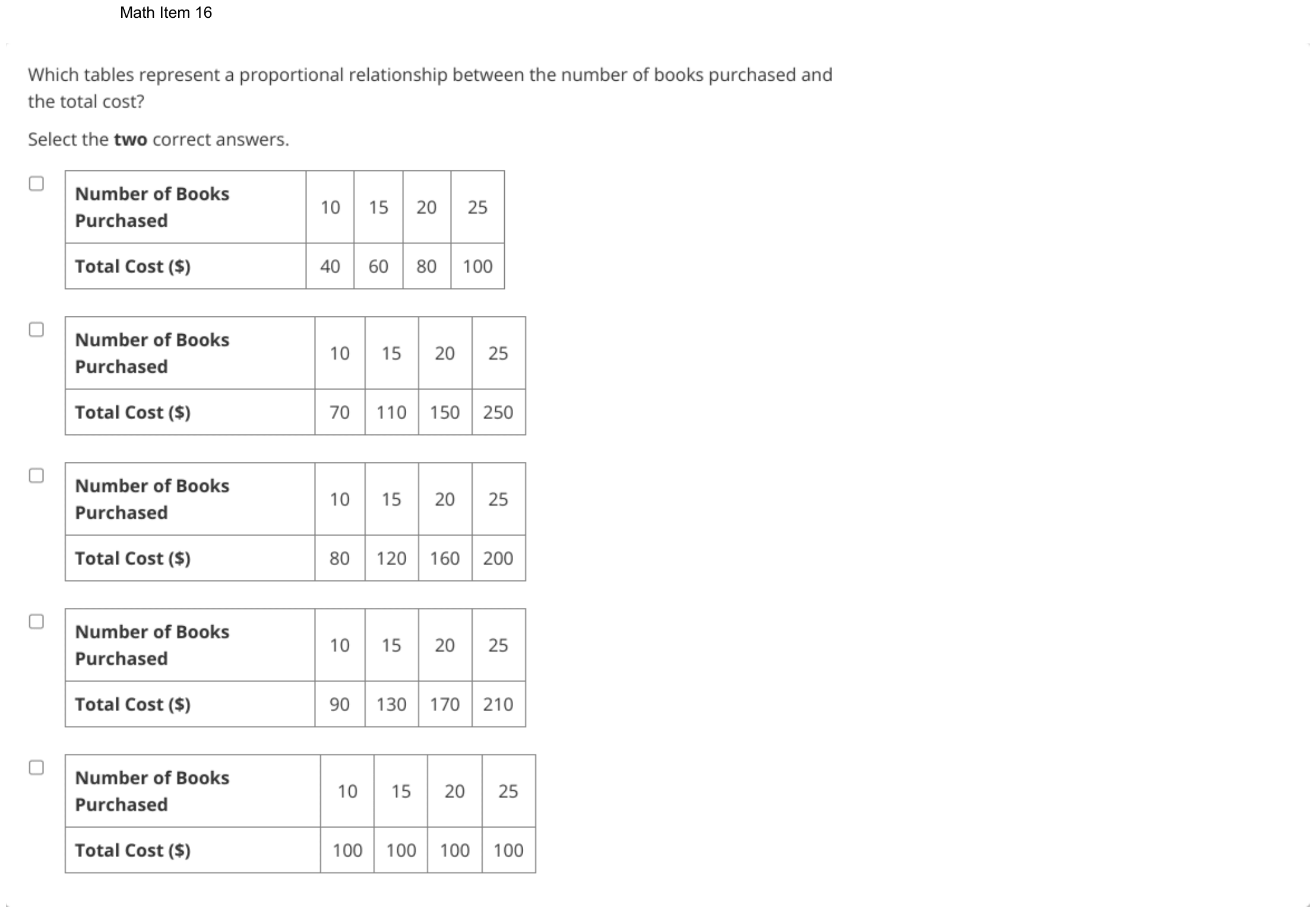
Which tables represent a proportional relationship between the number of books purchased and the total cost?
Select the two correct answers.
Choose every answer that is correct, then check. The DOE has not published how answers with several parts are scored; this site counts one right only when every part is right.
- A
Number of Books Purchased 10 15 20 25 Total Cost ($) 40 60 80 100 - B
Number of Books Purchased 10 15 20 25 Total Cost ($) 70 110 150 250 - C
Number of Books Purchased 10 15 20 25 Total Cost ($) 80 120 160 200 - D
Number of Books Purchased 10 15 20 25 Total Cost ($) 90 130 170 210 - E
Number of Books Purchased 10 15 20 25 Total Cost ($) 100 100 100 100
Show the answer
Correct answer: A and C
The two tables that represent a proportional relationship are tables A and C.
In table A, the total costs divided by the numbers of books for each set of quantities are:
These ratios are equivalent; therefore, these quantities are in a proportional relationship.
In table C, the total costs divided by the numbers of books for each set of quantities are:
These ratios are equivalent; therefore, these quantities are in a proportional relationship.
Question analysis
Five tables list the total cost of buying 10, 15, 20 and 25 books, and students select the two tables that show a proportional relationship between books and cost. It tests recognizing proportional relationships from a constant unit rate. A steady rise in cost is not enough on its own, so each pair of values has to be checked.
- Grade level
- Grade 7 content, by NYS standard
- Compared with grade 7
- At grade 7 Deciding from a table whether two quantities are proportional is a core grade 7 skill, and the divisions here are easy. The demand lies in checking every column of five tables rather than judging by how the costs change.
- Estimated difficulty
- Straightforward: two steps or one careful reading.
- Thinking it demands
- Depth of knowledge 2, skills and concepts · mainly apply
- What makes it hard
- A very close wrong answer moderate
- Every choice must be checked minor
- Something you must already know minor
- Solution
- 2 steps
- Reading level
- Question and choices: about grade 5, 51 words.
- Students, last 30 days
- Not enough answers yet to show (it takes 10).
Why it is hard, traps and wrong answers (shows the answer)
Why it is hard
The divisions are easy, so the question tests what proportional means. Three tables grow by the same amount for every 5 books, and the one with a $10 head start looks just as regular as the right one it copies; only its cost per book, drifting from $9 down to $8.40, gives it away. The flat $100 table and the one that jumps to $250 catch fewer students, and dividing the first and last column of each table is a quick, reliable check.
A very close wrong answer moderate Choosing the answer
The table running $90, $130, $170, $210 is the $80-to-$200 table with $10 added to every cost; both climb $40 for each 5 books, and only the cost per book separates them. (Embretson & Wetzel, 1987; Gorin & Embretson, 2006; Ascalon et al., 2007)
Every choice must be checked minor Choosing the answer
Five tables of four columns each have to be tested by dividing cost by books, and both right tables must be picked to score, so no table can be judged from one column. (Embretson & Wetzel, 1987)
Something you must already know minor Working it out
Students must know that proportional means the same cost per book in every column, a line through zero, not merely a cost that grows by the same amount each time. (Anderson & Krathwohl, 2001)
Strategy: Divide the total cost by the number of books in every column of each table; a table is proportional only when that cost per book stays the same all the way across.
Traps
- Misunderstands the concept: A wrong belief about a concept: that percents can be added, that area grows like length, that averages can be averaged, that a bigger denominator means a bigger fraction.
The wrong answers, classified
B Misunderstands the concept (Smith, diSessa & Roschelle, 1993; De Bock et al., 1998; Ni & Zhou, 2005)
Sees the cost climb $40 for each 5 books across the first three columns and stops checking, though the cost per book goes $7, about $7.33, $7.50, then $10.
D Misunderstands the concept (Smith, diSessa & Roschelle, 1993; De Bock et al., 1998; Ni & Zhou, 2005)
Takes the steady rise of $40 for every 5 books as proportional, but 90 ÷ 10 = 9 while 210 ÷ 25 = 8.4, so the cost per book is not constant.
E Misunderstands the concept (Smith, diSessa & Roschelle, 1993; De Bock et al., 1998; Ni & Zhou, 2005)
Mistakes a cost that never changes for a constant ratio, though $100 for 10 books is $10 a book and $100 for 25 books is $4 a book.
Worked solution, step by step
Formulas used
- Cost per book
- This is the unit rate, the price of one book. Divide the total cost in dollars by the number of books bought. If every book has the same price, this number comes out the same in every column.
- A proportional relationship
- x is the number of books, and y is the total cost in dollars. k is the cost per book, a number that never changes. In a proportional relationship, y is always k times x. So 0 books cost $0, and twice as many books cost twice as much.
Sort out the question
Each table shows the total cost of 10, 15, 20 and 25 books. Proportional means the cost per book is the same in every column. In other words, each book has one fixed price. You must pick the two tables where that is true.
Test the first table
Divide each total cost by its number of books. For table A:
Every column gives $4 per book. So table A is proportional.
Test the other four tables
Do the same division for every table. The numbers are dollars per book:
Table 10 books 15 books 20 books 25 books Same? A 4 4 4 4 Yes B 7 about 7.33 7.50 10 No C 8 8 8 8 Yes D 9 about 8.67 8.50 8.40 No E 10 about 6.67 5 4 No Only tables A and C keep the same price all the way across.
Watch for steady growth
Watch out: table D climbs $40 for every 5 more books, just like table C. That steady climb looks proportional, but it is not enough. D starts $10 higher than C, so its price per book slides from $9 down to $8.40.
Watch out: table E never changes. But $100 for 10 books is $10 each, and $100 for 25 books is $4 each. A total that stays the same is not a price that stays the same.
Name the two answers
Table A charges $4 per book and table C charges $8 per book, in every column. On the test, you check the box next to each of those tables. So the answers are A and C.
Check your answer
In a proportional table, twice the books cost twice as much. In table A, 10 books cost $40 and 20 books cost $80, which is double. In table C, $80 doubles to $160. In table D, $90 would have to double to $180, but the table shows $170. So D fails.
More questions like this
The original DOE question
Question 7 of 120
2026 Practice Test B Math, question 28Question
A circle has a radius of 5 inches. What is the area of the circle in terms of ?
Use to express your answer.
Enter your answer in the space provided. Enter only your answer.
On the test you build the answer on an on-screen keypad; here, type it. Use ^ for a power, sqrt( ) or √ for a root, pi for π, and <= or >= for ≤ and ≥.
Show the answer
Correct answer: 25π
Solution:
The area of a circle is its radius squared times .
Question analysis
This circle question gives a radius of 5 inches and asks for the area in terms of π, typed into a box rather than chosen. Students recall and apply the formula for the area of a circle. The formula is not printed on the test, and the area and circumference formulas are easy to mix up.
- NYS standards
- 7.G.4 circle area and circumference
- Grade level
- Grade 7 content, by NYS standard
- Compared with grade 7
- At grade 7 Finding the area of a circle from its radius is the grade 7 circle standard applied directly, in one routine calculation. Typing the answer in terms of π, with no choices to compare, adds a little risk.
- Estimated difficulty
- Straightforward: two steps or one careful reading.
- Thinking it demands
- Depth of knowledge 1, recall and reproduction · mainly apply
- What makes it hard
- Solution
- 2 steps
- Reading level
- Question and choices: about grade 4, 35 words.
- Students, last 30 days
- Not enough answers yet to show (it takes 10).
Why it is hard, traps and wrong answers (shows the answer)
Why it is hard
This is one formula and one square, so the question comes down to recall and to the form of the answer. The area and circumference formulas both pair π with the radius, and 2πr gives a tidy value with π in it that looks just as right. The other losses are about form: replacing π with 3.14, which the instructions rule out twice, or dropping π after squaring 5.
Something you must already know moderate Working it out
The formula A = πr² is not printed with the question, and the circumference formula 2πr uses the same r and π, so recalling the wrong one gives a value that looks just as finished. (Anderson & Krathwohl, 2001)
An answer in an unexpected form minor Choosing the answer
The answer is built on a keypad with a π key and must keep π as a symbol; a decimal worked out with 3.14 is not accepted, and no choices show the expected form. (Enright, Morley & Sheehan, 2002)
Strategy: Recall the area formula rather than the circumference formula, square the radius before multiplying, and leave π as a symbol instead of replacing it with 3.14.
Traps
- Wrong formula: Uses a related but wrong formula: perimeter for area, diameter for radius, area for volume, or a misremembered one.
- A formula you must know: Needs a formula the test does not give: area, circumference, volume, probability rules.
- Misreads the question: Misses or misreads a condition or a word in the question: "at least", "each", "remaining", "not".
The wrong answers, classified
10π Wrong formula (King et al., 2004)
Uses the circumference formula 2πr, or doubles the radius instead of squaring it, so 2 × 5 gives 10π, the distance around the circle.
78.5 Misreads the question (Hegarty, Mayer & Monk, 1995)
Finds the area correctly but replaces π with 3.14, 25 × 3.14 = 78.5, though the question asks for the area in terms of π.
25 Stops one step early (King et al., 2004; Gierl et al., 2017)
Squares the radius, 5 × 5 = 25, and stops before multiplying by π, so the entry leaves out the π the instructions ask for.
Worked solution, step by step
Formulas used
- Area of a circle
- A is the area, the space inside the circle. r is the radius, the distance from the center to the edge. π (pi) is a fixed number, a little more than 3. r² means r times r. Square the radius first, then multiply by π. The area is in square units.
- Circumference of a circle
- C is the circumference, the distance around the circle. r is the radius, and π is the same number as above. This formula measures a length, not the space inside. It is here so you can tell the two formulas apart.
Sort out the question
The circle has a radius of 5 inches. The radius is the distance from the center to the edge. You need the area, the space inside the circle. In terms of π means π stays in the answer as a symbol. Do not change it to 3.14.
Choose the area formula
The area formula is . It uses the radius squared.
Watch out: the circumference formula, , also uses π and the radius. It gives , the distance around the circle in inches. That is not the area.
Square the radius
Squaring a number means multiplying it by itself:
Watch out: squaring is not doubling. would lead to 10π again.
Multiply by π
Put 25 into the formula in place of r²:
The area is 25π square inches. Write the number first and then π, the way you write 3x for 3 times x.
Watch out: leave π as π. Using 3.14 gives 78.5, which is not accepted. Dropping π leaves 25, which is not the area.
Enter it with the π key
On the test, the keypad has a π key in its bottom left corner. Press 2, then 5, then the π key. You do not need a times sign. Enter only the answer, with no A = and no units. On this site, type 25π or 25pi.
So you would enter 25π.
Check your answer
Estimate. π is a little more than 3, so 25π is a little more than 75 square inches. A square drawn around the circle is 10 inches on each side, so its area is 100 square inches. The circle fits inside that square, so its area must be less than 100. It is.
More questions like this
The original DOE question
Question 8 of 120
2026 Practice Test B Math, question 31Question
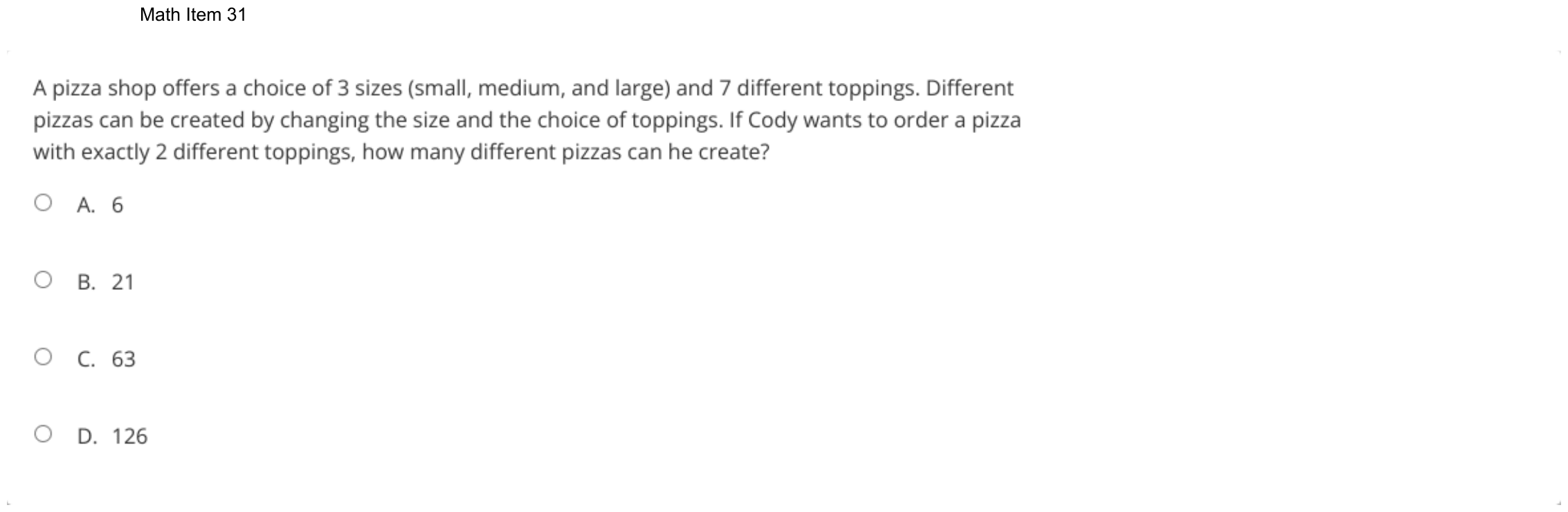
A pizza shop offers a choice of 3 sizes (small, medium, and large) and 7 different toppings. Different pizzas can be created by changing the size and the choice of toppings. If Cody wants to order a pizza with exactly 2 different toppings, how many different pizzas can he create?
- A6
- B21
- C63
- D126
Show the answer
Correct answer: C
Figure out how many different topping pairs are possible. Use 1, 2, 3, 4, 5, 6, 7 to represent the toppings, and create a list of possible pairs:
1,2; 1,3; 1,4; 1,5; 1,6; 1,7
2,3; 2,4; 2,5; 2,6; 2,7
3,4; 3,5; 3,6; 3,7
4,5; 4,6; 4,7
5,6; 5,7
6,7
So there are 21 different topping combinations for one pizza.
Since there are 3 pizza sizes, multiply the total number of combinations by 3 to get the total number of different pizzas Cody can create: .
Question analysis
Cody orders a pizza with exactly 2 of 7 toppings in one of 3 sizes, and students count how many different pizzas he could create. It tests counting combinations, where the order of the toppings does not matter, combined with a second choice. The challenge is to count every possible pizza exactly once.
- NYS standards
- 7.SP.8b sample spaces for compound events
- Grade level
- Grade 7 content, by NYS standard
- Compared with grade 7
- Above grade 7 In grade 7, compound events are usually ordered pairs, such as a coin with a number cube. Here an unordered pair of toppings is chosen from seven and then matched with three sizes, a combination count beyond typical grade 7 work.
- Estimated difficulty
- Hard: combines ideas, needs a plan, and has more than one tempting wrong answer.
- Thinking it demands
- Depth of knowledge 2, skills and concepts · mainly apply
- What makes it hard
- Combines ideas moderate
- Something you must already know minor
- Solution
- 3 steps
- Reading level
- Question and choices: about grade 8, 47 words.
- Students, last 30 days
- Not enough answers yet to show (it takes 10).
Why it is hard, traps and wrong answers (shows the answer)
Why it is hard
The question packs two counts into one sentence, each with its own trap. Order does not matter among the toppings, while the size multiplies every pair, and students tend to remember one of these and forget the other. Listing pairs systematically, each topping matched only with later ones, keeps the first count honest, and the stem’s “changing the size and the choice of toppings” is the reminder that size counts too.
Combines ideas moderate Working it out
Two counts are joined: the unordered pairs of toppings from 7, then the 3 sizes each pair can come in, and a mistake in either count changes the total. (Embretson, 1998; Daniel & Embretson, 2010)
Something you must already know minor Working it out
Students must know that a pizza with mushroom and onion is the same as one with onion and mushroom, so the ordered count 7 × 6 has to be halved. (Anderson & Krathwohl, 2001)
Strategy: Number the toppings 1 to 7, list each pair once by matching every topping only with higher-numbered ones, count the list, then bring in the choice of size.
Traps
- Stops one step early: A choice is a number from partway through the solution.
- Overlapping groups: Things in two groups at once are counted twice, or not subtracted.
The wrong answers, classified
A Numbers taken from the question (Hegarty, Mayer & Monk, 1995)
Multiplies the 3 sizes by the 2 toppings Cody wants, using the number of toppings on the pizza instead of the number of possible pairs.
B Stops one step early (King et al., 2004; Gierl et al., 2017)
Lists or counts the 21 pairs of toppings correctly, then stops without giving each pair its 3 possible sizes.
D Overlapping groups (King et al., 2004)
Counts ordered pairs, 7 × 6 = 42, so each pair of toppings appears twice, and then multiplies by the 3 sizes to reach 126.
Worked solution, step by step
Formulas used
- The counting principle
- m is the number of ways to make one choice, and n is the number of ways to make a second choice. Every first choice can go with every second choice, so you multiply. Here, every pair of toppings can come in every size.
- Pairs when order does not matter
- n is the number of items to choose from. There are n ways to pick a first item and n − 1 ways to pick a different second one. That counts each pair twice, once in each order. Dividing by 2 counts each pair once.
Sort out the question
Each of Cody’s pizzas has one size and exactly 2 different toppings. There are 3 sizes and 7 toppings. Pizzas differ by “changing the size and the choice of toppings.” So a small and a large with the same toppings are two different pizzas. You need to count every pizza once.
List the topping pairs
Order does not matter: onion with peppers is the same pizza as peppers with onion. So number the toppings 1 to 7, and pair each one only with bigger numbers. Then no pair shows up twice.
Topping Pairs with Pairs 1 2, 3, 4, 5, 6, 7 6 2 3, 4, 5, 6, 7 5 3 4, 5, 6, 7 4 4 5, 6, 7 3 5 6, 7 2 6 7 1 There are 21 different pairs of toppings.
Check the pairs with the formula
Use the pairs formula with 7 toppings:
Watch out: 7 × 6 = 42 counts every pair twice, once as 1 then 2 and once as 2 then 1. Keeping 42 leads to , choice D.
Bring in the sizes
Each of the 21 topping pairs can come in any of the 3 sizes. Use the counting principle:
Watch out: stopping at 21 leaves out the sizes, which gives choice B. Choice A, 6, multiplies the 3 sizes by the 2 toppings on one pizza. That does not count pizzas.
Give the answer
There are 21 topping pairs, and each one comes in 3 sizes. Cody can create 63 different pizzas. So the answer is C, 63.
Check your answer
Count one size at a time. A small pizza can have any of the 21 pairs, so there are 21 small pizzas. There are also 21 medium and 21 large ones: . That is more than the 21 pairs but fewer than 126, so it is reasonable.
More questions like this
The original DOE question
Question 9 of 120
2026 Practice Test C English, question 26Passage Serpent Mound
Serpent Mound
The Great Serpent Mound, located in Adams County, Ohio, is a human-made mound of earth that researchers believe was created between 300 B.C. and A.D. 1100 by an indigenous culture.
Ohio, 1846
Brush Creek stood low when the museum men came
with their measuring tapes and sketchbooks.
It was winter. Fringed with ice,
the creek doubled back on itself
as if it had forgotten something.
Pa was in Cincinnati, or else on his way home,
so Ma told me to lead the men
into the marshy low grounds. It being winter,
there was little underbrush to speak of—
in the summer there would have been
briars, poison ivy, biting flies. I listened
for the swish of a beaver’s heavy tail,
the chitter of a chickadee, or the cry of a hawk,
but the winter silence of the creek pressed
down on all of us like a weight.
The humps in the ground were all but
invisible until you were right up on them. The figure
was even less obvious: the sinuous body,
the tail coiled three times around,
and at the other end, the mouth wide open.
In the summer the creek bottom was crowded
with so much life that you could trip over
the ridges of earth before you saw
anything at all. In winter you could climb
a tree and get some idea of the whole thing:
the serpent’s body undulating, slithering
silently across the ancient
earth. At the mouth end, there was an oval mound
as if the snake were about to swallow an egg—
as snakes sometimes did in our rickety
henhouse—my Pa always said, or
as if swallowing the sun, one of the museum
men suggested, taking notes with his quill pen,
an old-style inkhorn slung at his side.
I liked that: swallowing the sun,
just the sort of thing a snake might do,
might want to do. When, later, I told my sister Ruth,
she disagreed. It is singing to the sun,
she insisted. That is why its mouth
is wide open. She said, “Sometimes I think
I hear it on summer nights. Not swallowing, singing.”
Question
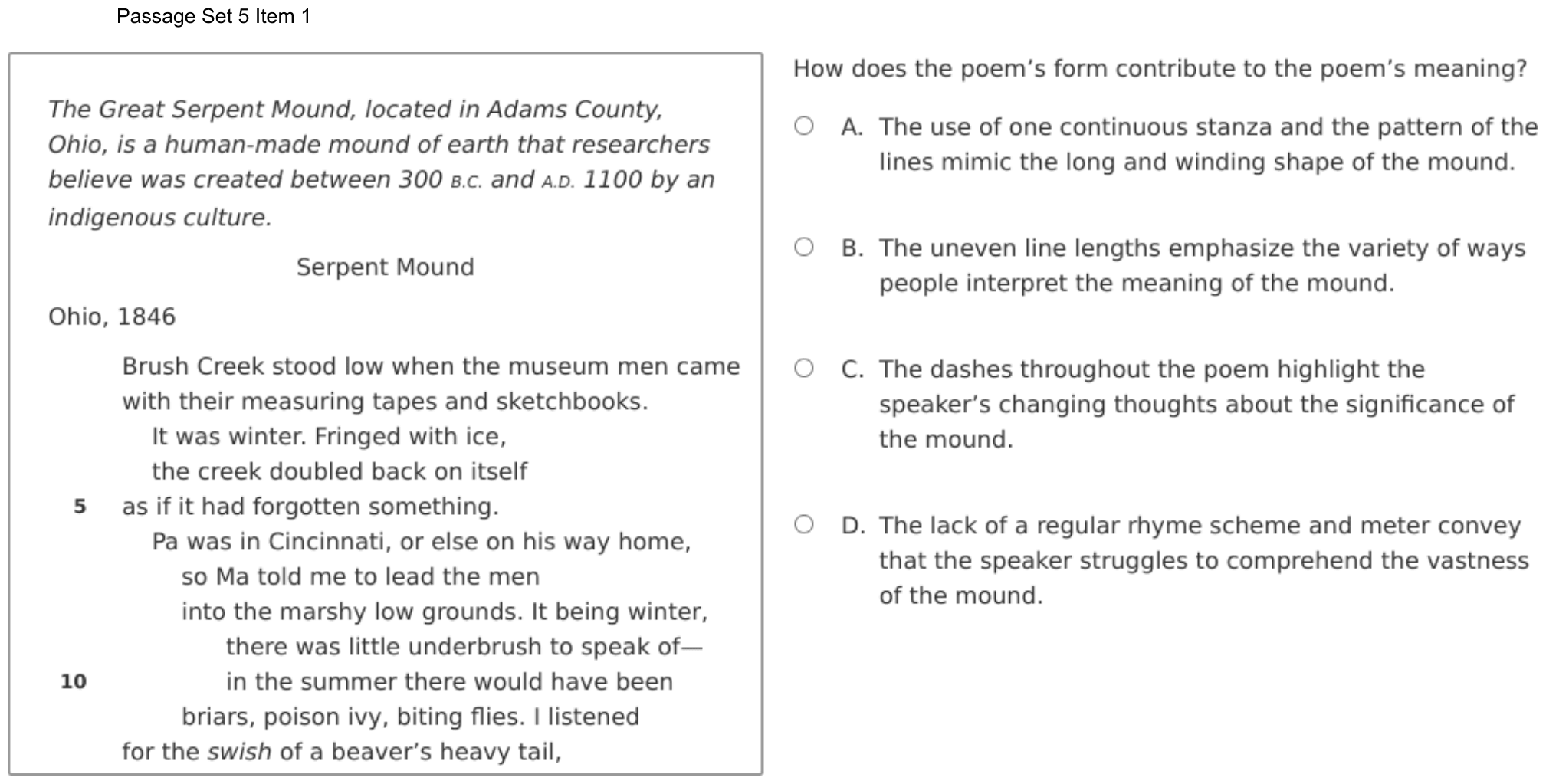
How does the poem’s form contribute to the poem’s meaning?
- AThe use of one continuous stanza and the pattern of the lines mimic the long and winding shape of the mound.
- BThe uneven line lengths emphasize the variety of ways people interpret the meaning of the mound.
- CThe dashes throughout the poem highlight the speaker’s changing thoughts about the significance of the mound.
- DThe lack of a regular rhyme scheme and meter convey that the speaker struggles to comprehend the vastness of the mound.
Show the answer
Correct answer: A
The question asks how the poem’s form contributes to the poem’s meaning.
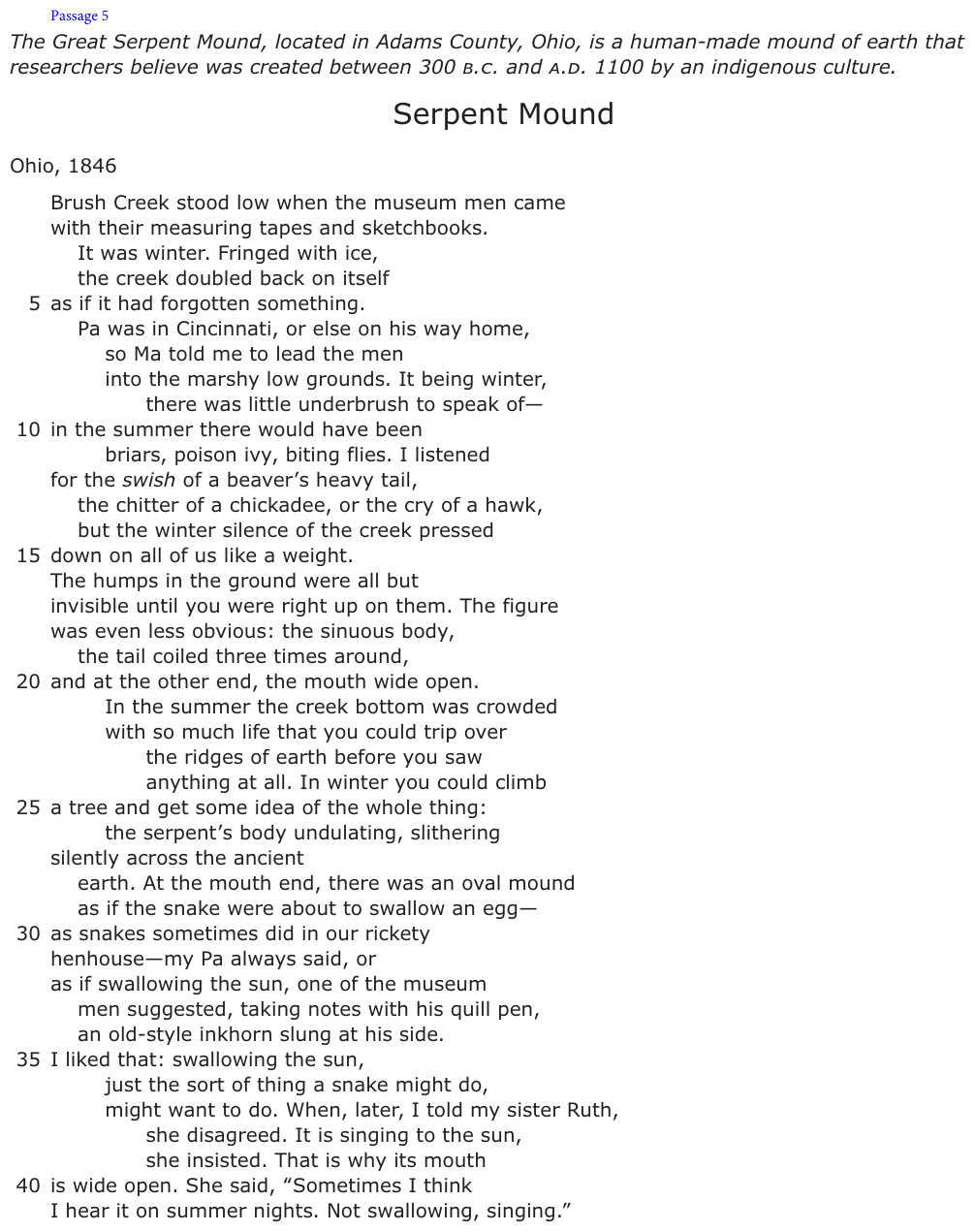
A. CORRECT. The poem is structured as one long stanza. The line lengths throughout the poem and the line indents (such as those in lines 7–10) create a visual effect so that the poem itself mimics the shape of the Serpent Mound.
B. Incorrect. The uneven line lengths in the poem do not indicate the different interpretations of the mound; separate stanzas or other stopping points would more effectively point to contrasting ideas.
C. Incorrect. The dashes in the poem lead to further explanation of a thought, not a change of thought.
D. Incorrect. The lack of regular rhyme and meter is intended to create a conversational tone rather than show the speaker’s struggle to grasp how large the mound is.
Question analysis
This question about poetic form asks how the form of “Serpent Mound,” a poem set in 1846 at the ancient earthwork in Adams County, Ohio, contributes to its meaning. Students must consider features such as the single stanza, the uneven lines, the dashes and the lack of rhyme, and decide which feature the poem actually puts to work, and how.
- NYS standards
- 7R5 structure and genre features
- Grade level
- Grade 7 reading and task
- Compared with grade 7
- At grade 7 Asking how a poem’s form adds to its meaning is a grade 7 standard. Each choice names a feature that is easy to check on the page and pairs it with a meaning that must also be tested, a typical demand.
- Estimated difficulty
- Hard: combines ideas, needs a plan, and has more than one tempting wrong answer.
- Thinking it demands
- Depth of knowledge 3, strategic thinking · mainly analyze
- What makes it hard
- How, not what major
- A very close wrong answer moderate
- Something you must already know minor
- Evidence
- Answered from the whole text
- Reading level
- Passage: 354 words (a poem; reading level not measured); question and choices: about grade 8, 84 words.
- Students, last 30 days
- Not enough answers yet to show (it takes 10).
Why it is hard, traps and wrong answers (shows the answer)
Why it is hard
Every choice names something really on the page, so the work is in the meaning each attaches. The strongest pull pairs the uneven lines with the poem’s real ending, three readings of the oval mound, and the free-verse choice can lean on line 25’s “some idea of the whole thing.” Seeing the key takes a step back from the words to the poem’s outline, which on the test means scrolling through all 41 lines.
How, not what major Working it out
This is a form question: students must see that the single stanza and the indents stepping right and back, as in lines 6–12, draw a winding body on the page, an effect of layout, not of words. (Anderson & Krathwohl, 2001)
A very close wrong answer moderate Choosing the answer
The choice about uneven line lengths names nearly the same feature as the key, the shape of the lines, but gives it another meaning: the mound’s many interpretations instead of its long, winding form. (Embretson & Wetzel, 1987; Gorin & Embretson, 2006; Ascalon et al., 2007)
Something you must already know minor Working it out
The choices assume “stanza,” “rhyme scheme” and “meter,” and the idea that a poem’s outline can picture its subject, which the poem never explains. (Anderson & Krathwohl, 2001)
Strategy: Test each choice in two steps: confirm that the feature it names is really in the poem, then ask whether the poem supports the meaning the choice attaches to it.
Traps
- Wrong purpose or structure: Names a purpose, structure or effect that the part does not serve, or describes what a part says when the question asks what it does.
- Reads too much in: A reasonable-sounding conclusion that goes further than the text allows.
The wrong answers, classified
B Wrong purpose or structure (Anderson & Krathwohl, 2001)
Pairs two real things, the uneven lines and the different readings of the mound at the end, but nothing ties the line lengths to those readings, which come only in lines 29–41.
C Wrong purpose or structure (Anderson & Krathwohl, 2001)
Spots the dashes in lines 9, 29 and 31, but each one leads into more detail on the thought before it, not into a change in what the speaker thinks of the mound.
D Reads too much in (Graesser, Singer & Trabasso, 1994)
Links free verse to line 25, where a climbed tree gives only “some idea of the whole thing,” but that is about seeing the shape, and the speaker never seems overwhelmed by it.
Working it out, step by step
Figure out what the question asks
This asks about form. Form is how a poem is built and how it looks on the page. It includes stanzas, which are groups of lines set apart by blank lines. It also includes line lengths, indents, rhyme and rhythm. An indent is space at the start of a line that pushes it to the right. You need the choice that ties a real feature of form to the poem’s meaning.
Look at the shape on the page
Don’t read the words yet. Just look. The poem is one long block of 41 lines with no blank lines. So it is one continuous stanza. Its lines do not all start at the left edge. Some are pushed in one step, some two, and some three. The steps go in and come back out, again and again.
Follow the lines in and out
Take lines 6–12. Line 6 starts one step in. Lines 7 and 8 start two steps in. Lines 9 and 10 start three steps in. Line 11 comes back to two steps, and line 12 is back at the left edge. The same swing out and back happens again in lines 19–27 and in lines 33–41. Look down the whole poem. Its left edge curves out and back like a snake winding down the page.
Connect the shape to the mound
The poem is about a giant earth mound shaped like a snake. Line 18 calls it “the sinuous body.” Sinuous means full of curves. Line 26 shows “the serpent’s body undulating, slithering.” Undulating means moving in waves. The one long stanza is like the snake’s long body. The lines curving in and out are like its winding shape. The poem looks like what it describes.
Check each choice
- A fits. The single stanza and the winding lines copy the mound’s long, curving shape.
- B does not fit. The lines are uneven. But the different ideas about the mound come only at the end, in lines 29–41. The line lengths are not tied to them.
- C does not fit. The dashes in lines 9, 29 and 31 lead into more detail. They do not show the speaker’s thoughts changing.
- D does not fit. The poem has no rhyme scheme, or pattern of rhymes, and no meter, or steady beat. But the speaker never struggles to grasp how big the mound is.
Watch out: B is tempting because both of its parts are true. But nothing links the line lengths to the different ideas about the mound.
Choose the answer
The poem’s one long stanza and its in-and-out lines draw a winding snake on the page. So the answer is A, “The use of one continuous stanza and the pattern of the lines mimic the long and winding shape of the mound.”
Why this answer and not the closest wrong one
B is the closest wrong choice. It also points to how the lines look, and the poem does give different ideas about the mound. But the uneven lines run through the whole poem, while those ideas come only at the end. The in-and-out pattern draws a shape, not a set of opinions. That shape is the mound’s long, winding body.
More questions like this
The original DOE question
The passage “Serpent Mound” as printed (page 40)
Question 10 of 120
2026 Practice Test C English, question 44Passage New York City and the Hudson Valley Brickmaking Industry
New York City and the Hudson Valley Brickmaking Industry
(1) Residents of New York City cannot help but notice that the buildings they are surrounded by are predominantly made of brick. (2) Indeed, one author described the bricks that make up some of New York City’s most recognizable landmarks, including the Empire State Building and the arches of the Brooklyn Bridge, as “an inescapable presence.” (3) Nearly 65 million people visit New York City every year to see these and other attractions. (4) Why was so much brick used in buildings constructed during the century before World War II? (5) The answer involves an explosion in New York City’s population that caused an increase in demand for bricks starting in the mid-1800s and lasting into the 1940s that affected the area more than 100 miles up the Hudson River Valley toward Albany. (6) When demand later declined, the industry would entirely disappear.
(7) New York City’s appetite for brick was fueled by surging population and demand for safer building materials. (8) The city’s population ballooned from about 313,000 people in 1840 to more than 7 million a century later. (9) Following large, destructive fires in the 1830s, the city had enacted laws requiring the use of fire-resistant materials. (10) Bricks turned out to be an inexpensive way for builders to quickly throw together a lot of structures while keeping building owners and safety inspectors happy.
(11) The brickmaking industry in the Hudson Valley skyrocketed. (12) At the industry’s peak, approximately 130 brick factories crammed themselves into a 120-mile stretch along the Hudson River. (13) These factories employed much of the region’s population. (14) Population growth in the Hudson River Valley after the mid-1800s was substantial, though percentage increases were smaller than those in New York City. (15) Even though the factories operated only during the summers, their production was immense. (16) Hudson Valley factories shipped over a billion bricks on barges down the river to New York City annually. (17) In fact, The New York Times declared, “It’s fairly safe to assume that any brick building constructed between 1800 and 1950 includes some form of sediment from the banks of the Hudson River.”
(18) History has proven, however, that boom times eventually end. (19) Shifting architectural trends halted not only the Hudson Valley’s brickmaking boom, but its entire industry. (20) Starting early in the twentieth century, architects and builders increasingly favored steel, glass, and concrete instead of brick. (21) By 1979, reduced demand for brick had driven every Hudson Valley brick factory out of business.
(22) The Hudson Valley’s brickmaking legacy lives on in the architecture of New York City. (23) Throughout the city, famous and ordinary buildings stand as evidence of the remarkable productivity achieved by the Valley’s brickmakers. (24) The brick buildings surrounding New Yorkers today serve as a reminder that, as one amateur brick historian put it, “The skyline of New York City used to be the landscape of the Hudson River Valley.”
Question
Which revision of sentence 10 would best maintain the style established in the passage?
- ABuilders turned to brick, which was an affordable material that met safety standards while satisfying the city’s large demand for buildings.
- BFiguring out that bricks were inexpensive, builders used tons of them to satisfy inspectors and the city’s desperate construction needs.
- CBuilders favored brick as a pleasingly economical way to meet significant construction demand while following municipal regulations.
- DOnce builders realized that low-cost brick was a law-abiding way to meet the city’s building needs, they hardly ever used any other materials.
Show the answer
Correct answer: A
The question asks for the revision of sentence 10 that would best maintain the style established in the passage.
A. CORRECT. This sentence maintains the style established in the passage because it uses clear, precise, and formal language. The phrases “affordable material” and “met safety standards” are accurate and appropriate to the historical and technical context. The word “satisfying” is a precise replacement for “keeping building owners . . . happy” from the original sentence, preserving both the meaning and the formal tone of the passage.
B. Incorrect. Although the sentence conveys the same basic ideas as the passage, the phrases “Figuring out” and “tons of them” are informal and inconsistent with the passage’s formal style. In addition, the word “desperate” introduces a subjective and emotional tone, whereas the passage maintains an objective, fact-based style.
C. Incorrect. Although this sentence incorporates some formal vocabulary, the phrase “pleasingly economical” introduces an opinion that is inconsistent with formal historical writing. The passage’s style avoids subjective language and focuses on precise, factual descriptions of events and conditions. The phrase “municipal regulations” is also more technical and at the same time less clear and precise than the style established in the passage.
D. Incorrect. This sentence does not maintain the passage’s formal style because the phrase “law-abiding way” is awkward and informal for a historical description, and the expression “hardly ever” is conversational. The passage uses precise, objective language when describing building practices and material choices, avoiding casual or conversational phrasing.
Question analysis
This style question asks which revision of sentence 10 of the passage “New York City and the Hudson Valley Brickmaking Industry” best keeps the passage’s style. The original says bricks let builders “quickly throw together a lot of structures” while keeping owners and inspectors “happy.” Students compare four rewrites for wording that sounds casual, emotional or out of place.
- Grade level
- Grade 7 reading and task
- Compared with grade 7
- At grade 7 Choosing wording that fits a passage’s formal style is regular grade 7 writing work. The four rewrites are single sentences on a familiar subject, but they differ in small word choices that must each be weighed, a typical grade 7 demand.
- Estimated difficulty
- Moderate: several steps, or a close reading with one strong distractor.
- Thinking it demands
- Depth of knowledge 2, skills and concepts · mainly evaluate
- What makes it hard
- A very close wrong answer moderate
- Every choice must be checked minor
- Something you must already know minor
- Evidence
- Answered from one sentence or line
- Reading level
- Passage: about grade 12, 465 words; question and choices: about grade 13, 94 words.
- Corrected from the DOE handbook
- A misquotation of the passage in the explanation was corrected.
- Students, last 30 days
- Not enough answers yet to show (it takes 10).
Why it is hard, traps and wrong answers (shows the answer)
Why it is hard
Sentence 10 is the passage’s most casual sentence, so the task is to raise its register without overshooting. Students who equate formality with long words fall for the rewrite with “pleasingly economical” and “municipal regulations,” which sounds official but adds an opinion. Others overlook the chatty “tons of them,” or miss that “hardly ever used any other materials” claims more than the original does. The plain, accurate key can look too ordinary to be best.
A very close wrong answer moderate Choosing the answer
The “pleasingly economical” rewrite carries the same three ideas as the key, low cost, heavy demand and the rules, in grander words; only its opinion word and the stiffer “municipal regulations” set it apart. (Embretson & Wetzel, 1987; Gorin & Embretson, 2006; Ascalon et al., 2007)
Every choice must be checked minor Choosing the answer
Each rewrite hides its off-key words among neutral ones, “tons of them” and “desperate,” “pleasingly,” “hardly ever,” so every phrase must be checked, not the overall sound. (Embretson & Wetzel, 1987)
Something you must already know minor Working it out
Students must already know what counts as formal written English, and the passage’s own lively verbs, “ballooned,” “skyrocketed” and “crammed themselves,” make its style harder to pin down. (Anderson & Krathwohl, 2001)
Strategy: Spot what makes sentence 10 sound casual, then check every phrase of each rewrite, not just its overall sound, for chatty, emotional or opinionated wording, and make sure the facts stay the same.
Traps
- Wordy, vague or informal: A revision is grammatical but wordy, imprecise or too casual for the passage.
- Changes the meaning: A revision is correct English but no longer says what the writer meant.
The wrong answers, classified
B Wordy, vague or informal (Connors & Lunsford, 1988)
Keeps the meaning but slips into casual talk, “Figuring out” and “tons of them,” and adds the emotional “desperate,” none of which fits the passage’s factual voice.
C Wordy, vague or informal (Connors & Lunsford, 1988)
Mistakes elevated words for good style: “municipal regulations” sounds official, but “pleasingly economical” injects an opinion and the wording is less clear than the passage’s plain statements.
D Changes the meaning (Connors & Lunsford, 1988)
Overlooks the conversational “hardly ever” and claims builders almost never used other materials, far more than sentence 10, which says only that brick was cheap, quick and acceptable to inspectors.
What was corrected from the DOE handbook, and why
- Explanation: The handbook’s explanation of Option A calls “satisfying” a replacement for “keeping owners happy” from the original sentence. Sentence 10 ends “while keeping building owners and safety inspectors happy,” so the site now quotes “keeping building owners . . . happy.”
Working it out, step by step
Figure out what the question asks
This question is about style, the way a passage sounds. You need a new version of sentence 10 that sounds like the rest of the passage. The passage is an informational article. It uses clear, serious, factual language. It has no slang or chatty phrases, and the writer doesn’t share feelings.
Spot the casual words in sentence 10
Sentence 10 says: “Bricks turned out to be an inexpensive way for builders to quickly throw together a lot of structures while keeping building owners and safety inspectors happy.” Three phrases sound like everyday talk: “throw together,” “a lot of,” and “keeping … happy.” Here is the rule with a made-up example. Casual: The kids threw together a ton of posters. Formal: The students quickly made many posters.
See how A keeps the meaning
Choice A says the same things in formal words. “Inexpensive” becomes “affordable material.” Keeping the safety inspectors happy becomes “met safety standards.” The word “satisfying” takes the place of keeping the building owners happy. And the many buildings become the city’s “large demand for buildings.” Nothing is added, and no feelings slip in.
Check each choice
- A is right. It is clear, exact and serious, like the rest of the passage.
- B is wrong. “Figuring out” and “tons of them” are chatty. “Desperate” adds strong feeling.
- C is wrong. “Pleasingly” gives the writer’s opinion. “Municipal regulations” is stiff and less clear than plain words like city rules.
- D is wrong. “Hardly ever” is chatty, and “law-abiding way” is awkward. It also claims builders almost never used other materials. Sentence 10 never says that.
Watch out: C uses long, official-sounding words, so it can seem the most formal. But formal writing still avoids opinions.
Choose the answer
Only one version sounds like the rest of the passage and keeps the meaning. So the answer is A, “Builders turned to brick, which was an affordable material that met safety standards while satisfying the city’s large demand for buildings.”
Why this answer and not the closest wrong one
C is the closest wrong answer. It carries the same three ideas as A: low cost, high demand and the rules. But “pleasingly economical” tells you how the writer feels about brick. The passage reports facts and doesn’t judge. A says the same things plainly and without an opinion.
More questions like this
The original DOE question
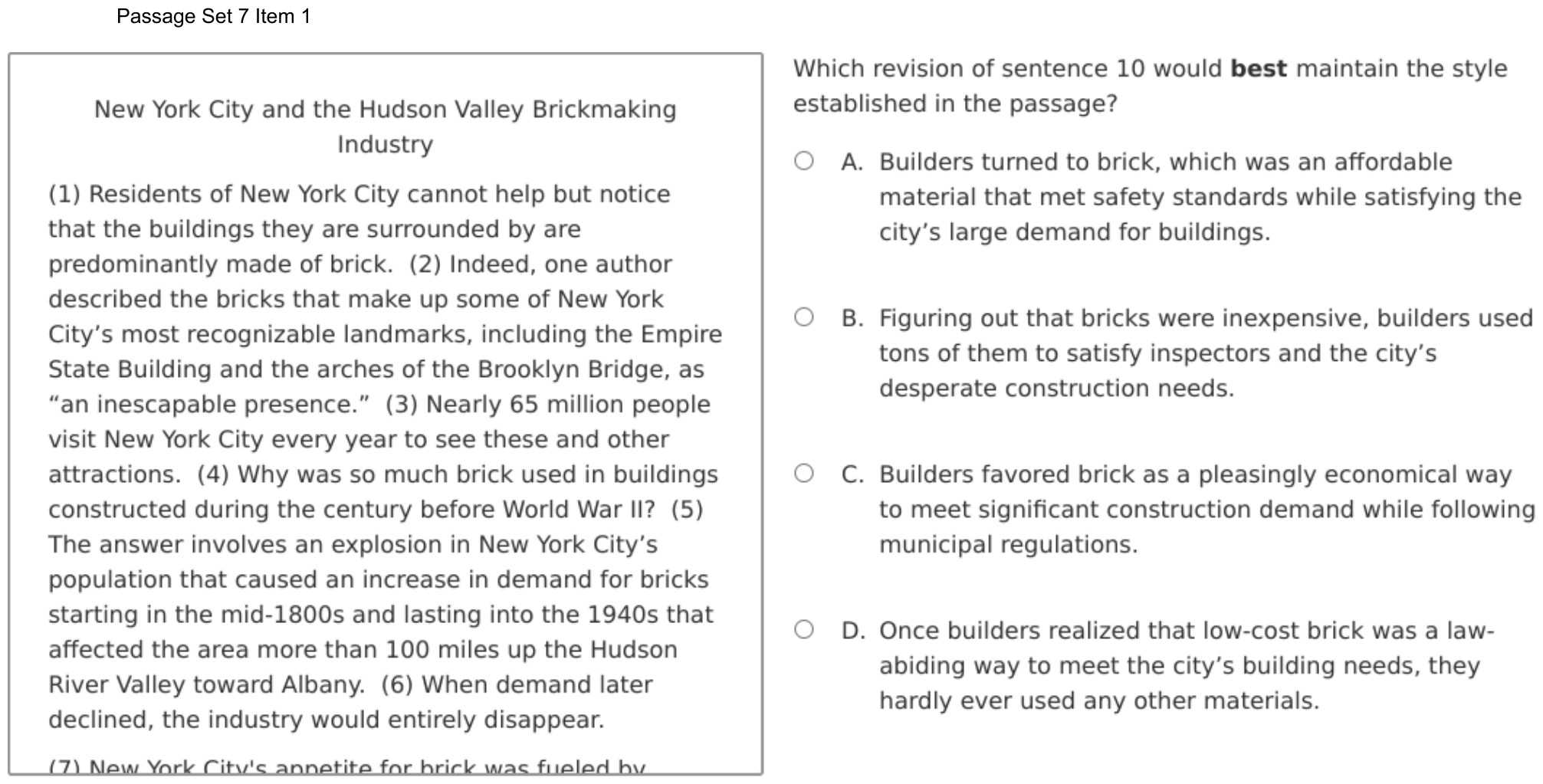
The passage “New York City and the Hudson Valley Brickmaking Industry” as printed (page 64)
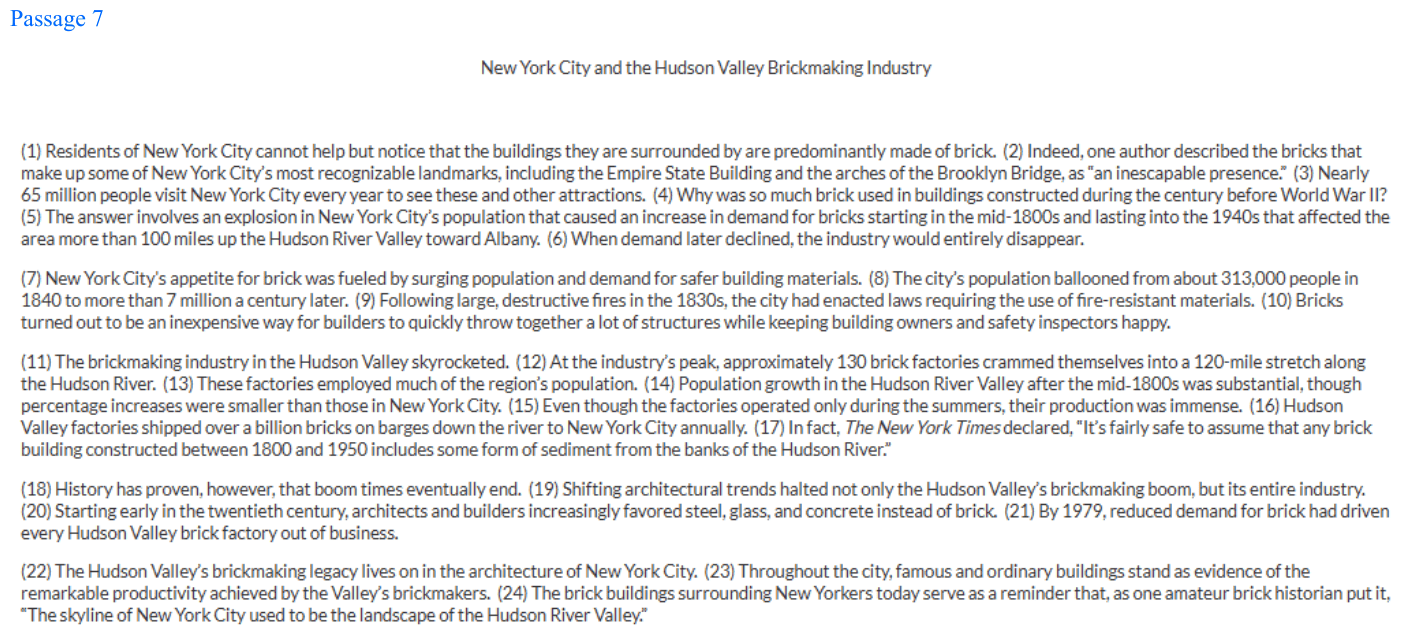
Question 11 of 120
2026 Practice Test C Math, question 1Question
What is the prime factorization of 756?
- A
- B
- C
- D
Show the answer
Correct answer: D
Determine the prime factors of 756 using a factor tree:
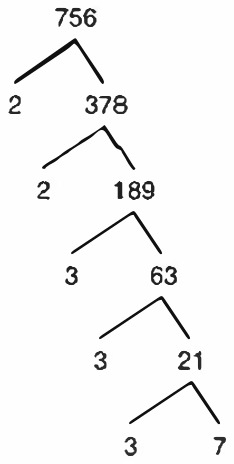
The prime factors are 2, 2, 3, 3, 3, and 7, or , which can be expressed using exponents as .
Question analysis
This number question asks for the prime factorization of 756, written with exponents. Students break the number into prime factors, with a factor tree or repeated division, and match the result to one of four products. Every choice multiplies back to 756, so the real test is whether each factor shown is actually prime.
- Grade level
- Grade 6 content, by NYS standard
- Compared with grade 7
- Below grade 7 Factor trees and exponent notation are grade 6 skills, and 756 splits quickly by small divisors. What adds a little is that every choice multiplies out to 756, so checking the product alone settles nothing.
- Estimated difficulty
- Straightforward: two steps or one careful reading.
- Thinking it demands
- Depth of knowledge 1, recall and reproduction · mainly apply
- What makes it hard
- A very close wrong answer moderate
- Something you must already know minor
- Solution
- 3 steps
- Reading level
- Question and choices: about grade 11, 10 words.
- Students, last 30 days
- Not enough answers yet to show (it takes 10).
Why it is hard, traps and wrong answers (shows the answer)
Why it is hard
The factoring itself is quick: halving twice and dividing by 3 three times leaves 7. The question is built so that multiplying back proves nothing, since every choice equals 756, and three of them simply stop the factor tree at a composite number. Students who check only the product, or who take an odd factor such as 21 or 27 for a prime, pick a factorization that is unfinished.
A very close wrong answer moderate Choosing the answer
2² · 3² · 21 shares the right answer's 2² and differs only in 3² · 21 against 3³ · 7, and both equal 756, so neither an estimate nor a product check separates them. (Embretson & Wetzel, 1987; Gorin & Embretson, 2006; Ascalon et al., 2007)
Something you must already know minor Working it out
Students must know that a prime factorization may hold only primes, and must spot that 21, 9 and 27 are composite even though none of them is even. (Anderson & Krathwohl, 2001)
Strategy: Divide 756 by 2 while the result is even, then by 3 while it divides evenly, and keep going until every factor left is prime; then compare factor by factor, not by product.
Traps
- Stops one step early: A choice is a number from partway through the solution.
- Misunderstands the concept: A wrong belief about a concept: that percents can be added, that area grows like length, that averages can be averaged, that a bigger denominator means a bigger fraction.
The wrong answers, classified
A Stops one step early (King et al., 2004; Gierl et al., 2017)
Divides out 2 twice and 3 twice, then stops at 21, which is 3 × 7, so one composite factor remains in a product that still equals 756.
B Misunderstands the concept (Smith, diSessa & Roschelle, 1993; De Bock et al., 1998; Ni & Zhou, 2005)
Splits off a 3 and a 7 but keeps 9 as if it were prime, perhaps because it is odd, though 9 = 3 × 3.
C Stops one step early (King et al., 2004; Gierl et al., 2017)
Splits 756 into 4 × 189 and 189 into 7 × 27, then stops, not seeing that 27 is 3 × 3 × 3.
Worked solution, step by step
Formulas used
- Writing a repeated factor with an exponent
- a is the number being multiplied, called the base. n is the exponent, the small raised number. It tells how many times a appears in the product. So 2² means 2 × 2, and 3³ means 3 × 3 × 3. Exponents are a short way to write a factor that repeats.
Sort out the question
You need the prime factorization of 756. That means writing 756 as a product of prime numbers only. A product is the answer to a multiplication. A prime number has exactly two factors, 1 and itself. Examples are 2, 3, 5 and 7.
All four choices multiply to 756. So multiplying a choice back does not pick the answer. You must check that every factor is prime.
Divide by 2 while you can
A factor tree splits a number into two factors, again and again. Start with the smallest prime, 2. 756 is even, so 2 goes into it:
378 is even too:
189 is odd, so 2 does not go into it. You have pulled out two 2s.
Divide by 3 while you can
Add the digits of 189: . A number can be divided by 3 when its digits add up to a number that 3 goes into. 3 goes into 18, so it goes into 189:
7 is prime, so the tree stops. You have pulled out three 3s and one 7.
Write the factors with exponents
Collect every prime you pulled out:
Use the exponent rule. Two 2s make , and three 3s make . The choices use a raised dot, ·, for times. So 756 is .
Choose the answer
Watch out: each wrong choice is a factor tree that stopped too soon. A ends in 21, which is 3 × 7. B has 9, which is 3 × 3. C has 27, which is 3 × 3 × 3. Being odd does not make a number prime.
Only D uses primes alone. So the answer is D, .
Check your answer
Multiply your answer back: , and . Then look at each factor. 2, 3 and 7 are all prime. D passes both tests.
More questions like this
The original DOE question
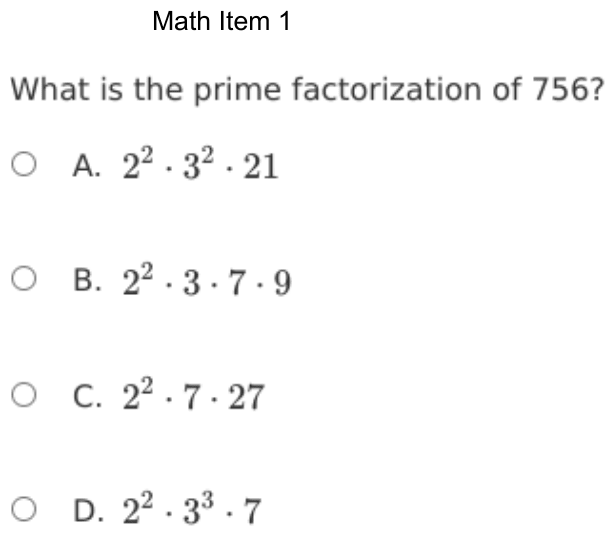
Question 12 of 120
2026 Practice Test C Math, question 2Question
If , what is the value of m?
- A
- B
- C2
- D3
Show the answer
Correct answer: B
The quantity means the same as , so the equation can be rewritten:
Subtract 4 from both sides:
Multiply both sides of the equation by m:
Solve for m:
Simplify:
Question analysis
This equation question asks for the value of m when 8 divided by m, plus 4, equals 20. Students undo the addition, then work out what m must be for 8 divided by it to give the value left. Because m is the divisor rather than the number being divided, the last step needs care.
- Grade level
- Grade 7 content, by NYS standard
- Compared with grade 7
- At grade 7 Undoing an addition and then a division is typical two-step grade 7 equation work. The unknown sitting in a denominator is less common than px + q = r, which makes the last step easier to get backward.
- Estimated difficulty
- Straightforward: two steps or one careful reading.
- Thinking it demands
- Depth of knowledge 1, recall and reproduction · mainly apply
- What makes it hard
- Error-prone arithmetic moderate
- Something you must already know minor
- Solution
- 3 steps
- Reading level
- Question and choices: about grade 6, 10 words.
- Students, last 30 days
- Not enough answers yet to show (it takes 10).
Why it is hard, traps and wrong answers (shows the answer)
Why it is hard
Undoing the + 4 is routine, so nearly all the risk sits in the last step, where m divides 8 rather than being divided by it. Students who read 8 ÷ m = 16 as asking how many 8s make 16 answer 2, and substituting it back, 8 ÷ 2 + 4 = 8, shows at once that it fails. The right value makes 8 ÷ 1/2 = 16, a division that gives a larger number, which feels wrong but is correct.
Error-prone arithmetic moderate Working it out
The unknown is the divisor, so 8 ÷ m = 16 ends in m = 8 ÷ 16, a quotient less than 1; the familiar order, 16 ÷ 8, gives a whole number instead. (Brown & Burton, 1978; Junker & Sijtsma, 2001)
Something you must already know minor Working it out
Students must see that (8 ÷ m) is the fraction 8/m and that freeing m from a denominator means multiplying both sides by it, a move grade 7 equations rarely need. (Anderson & Krathwohl, 2001)
Strategy: Subtract 4 from both sides, multiply both sides by m so the unknown is no longer in a denominator, then divide; check by substituting your value back into the equation.
Traps
- Wrong operation: Adds instead of multiplying, divides the wrong way round, turns a ratio or rate upside down, or undoes a step in the wrong direction (subtracts what should be added back).
The wrong answers, classified
A Wrong operation (Hegarty, Mayer & Monk, 1995; King et al., 2004)
Adds 4 to 20 instead of subtracting it, so 8 ÷ m = 24 and m = 8/24, which simplifies to 1/3.
C Wrong operation (Hegarty, Mayer & Monk, 1995; King et al., 2004)
Gets 8 ÷ m = 16 correctly but then divides 16 by 8, putting the divisor and the dividend the wrong way round, so m comes out as 2.
D Wrong operation (Hegarty, Mayer & Monk, 1995; King et al., 2004)
Makes both mistakes, adding 4 to get 8 ÷ m = 24 and then dividing 24 by 8 instead of 8 by 24.
Worked solution, step by step
Formulas used
- Keeping an equation balanced
- a and b are the two sides of an equation, and c is any number. An equation is like a balanced scale. Subtract the same number from both sides, or multiply both sides by the same number, and it stays balanced. That is how you get the unknown by itself.
Sort out the question
The equation is . You need the value of m. Here m is the number you divide 8 by. In words: 8 divided by some number, plus 4, makes 20.
Undo the plus 4
A fraction bar means divide, so is the same as . Subtract 4 from both sides to undo the plus 4:
Now 8 divided by m equals 16.
Watch out: adding 4 instead gives 24 on the right. That leads to choice A, 1/3, or to D, 3.
Get m out of the bottom
m is on the bottom of the fraction. Multiply both sides by m to free it:
Now divide both sides by 16:
8 goes into both 8 and 16, so 8/16 simplifies to 1/2.
Choose the answer
Watch out: it is tempting to divide 16 by 8 and get 2, choice C. But ask yourself: 8 divided by what number makes 16? To get an answer bigger than 8, you must divide by a number less than 1.
So the answer is B, 1/2.
Check your answer
Put 1/2 back into the equation. How many halves are in 8? There are 16, so . Then . That matches the equation, so m = 1/2 is right.
More questions like this
The original DOE question
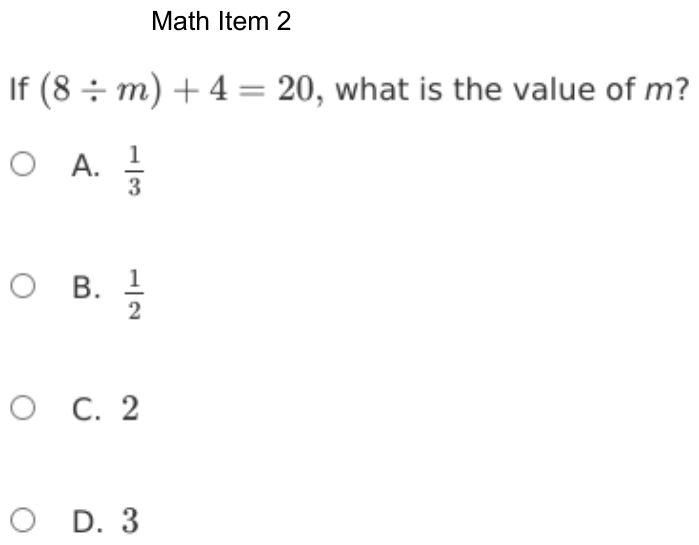
Question 13 of 120
2026 Practice Test C Math, question 6Question
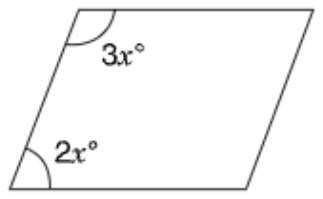
In the parallelogram above, what is the value of x?
- A36
- B18
- C6
- D5
Show the answer
Correct answer: A
In a parallelogram, any two adjacent angles are supplementary, so the sum of the two given angles is equal to 180°.
Write an equation showing that the sum of and is equal to 180°:
Solve for x:
Question analysis
A parallelogram is drawn with the two angles at the ends of its left side labeled 3x° and 2x°, and students find the value of x. It tests the angle facts of a parallelogram and solving a simple equation. Knowing what the two angles must add up to is the key fact, since the figure gives no other number.
- NYS standards
- Grade level
- Grade 8 content, by NYS standard
- Compared with grade 7
- At grade 7 The angle fact needed, about consecutive angles of a parallelogram, rests on grade 8 parallel-line reasoning. Once it is known, the work is one short equation, like a typical grade 7 problem about angle sums.
- Estimated difficulty
- Straightforward: two steps or one careful reading.
- Thinking it demands
- Depth of knowledge 2, skills and concepts · mainly apply
- What makes it hard
- Solution
- 2 steps
- Reading level
- Question and choices: about grade 7, 10 words.
- Students, last 30 days
- Not enough answers yet to show (it takes 10).
Why it is hard, traps and wrong answers (shows the answer)
Why it is hard
Once the angle fact is in place, 5x = 180 is a one-line equation, so the question tests recall more than computation. Students who use 90° for the pair land on half the right value, and the two smallest choices come only from combining the labels' 3 and 2. A sense check helps: x = 36 makes the angles 108° and 72°, one obtuse and one acute, just as the drawing shows.
Something you must already know moderate Working it out
The figure gives no number of degrees, only 3x° and 2x°, so everything rests on recalling that the two angles at the ends of one side of a parallelogram add to 180°. (Anderson & Krathwohl, 2001)
Reading a figure, table or graph minor Understanding the question
The marked angles sit at the upper and lower ends of the left side, consecutive rather than opposite, which is what makes them supplementary instead of equal. (Lesh, Post & Behr, 1987; Kirsch & Mosenthal, 1990)
Strategy: Decide what two angles that share a side of a parallelogram add up to, set 3x + 2x equal to that total, solve for x, and check that the two angles fit the figure.
Traps
- Wrong formula: Uses a related but wrong formula: perimeter for area, diameter for radius, area for volume, or a misremembered one.
- Stops one step early: A choice is a number from partway through the solution.
- Numbers taken from the question: Combines the numbers in the question without a model of the situation, or is simply a number that appears in the question.
The wrong answers, classified
B Wrong formula (King et al., 2004)
Uses 90° as the total of the two angles, the complementary total, so 5x = 90 gives 18, though consecutive angles of a parallelogram add to 180°.
C Numbers taken from the question (Hegarty, Mayer & Monk, 1995)
Multiplies the two coefficients from the labels, 3 × 2 = 6, without using any angle fact or writing an equation.
D Stops one step early (King et al., 2004; Gierl et al., 2017)
Combines 3x + 2x into 5x and gives the coefficient 5, stopping before dividing the 180° total by it.
Worked solution, step by step
Formulas used
- Neighboring angles of a parallelogram
- a and b are two angles of a parallelogram that share a side, like the top left and bottom left angles. They always add to 180°. Here is why. The four angles add to 360°, and opposite angles are equal. So each pair of neighbors is half of 360°.
Sort out the question
The figure is a parallelogram. That is a four-sided shape whose opposite sides are parallel, so they never meet. Two angles are marked: 3x° at the upper left and 2x° at the lower left. You need the value of x.
Write an equation for the angles
The two marked angles are at the two ends of the left side. So they are neighbors, not opposite angles. Use the rule that neighbors add to 180°:
Watch out: the total is 180°, not 90°. Using 90 gives 5x = 90 and x = 18, choice B.
Solve for x
Three x’s plus two x’s make five x’s:
Divide both sides by 5 to get x alone:
Watch out: stopping at 5, the number in front of x, gives choice D. Multiplying 3 × 2 = 6 gives choice C, but that uses no angle fact.
Choose the answer
The value of x is 36. It is a number, not the size of an angle. The angles themselves are 3 × 36 and 2 × 36 degrees.
So the answer is A, 36.
Check your answer
Find the two angles. The top one is degrees. The bottom one is degrees. They add to 180°. In the figure, the top angle is wide, more than 90°. The bottom one is narrow, less than 90°. That matches.
More questions like this
The original DOE question
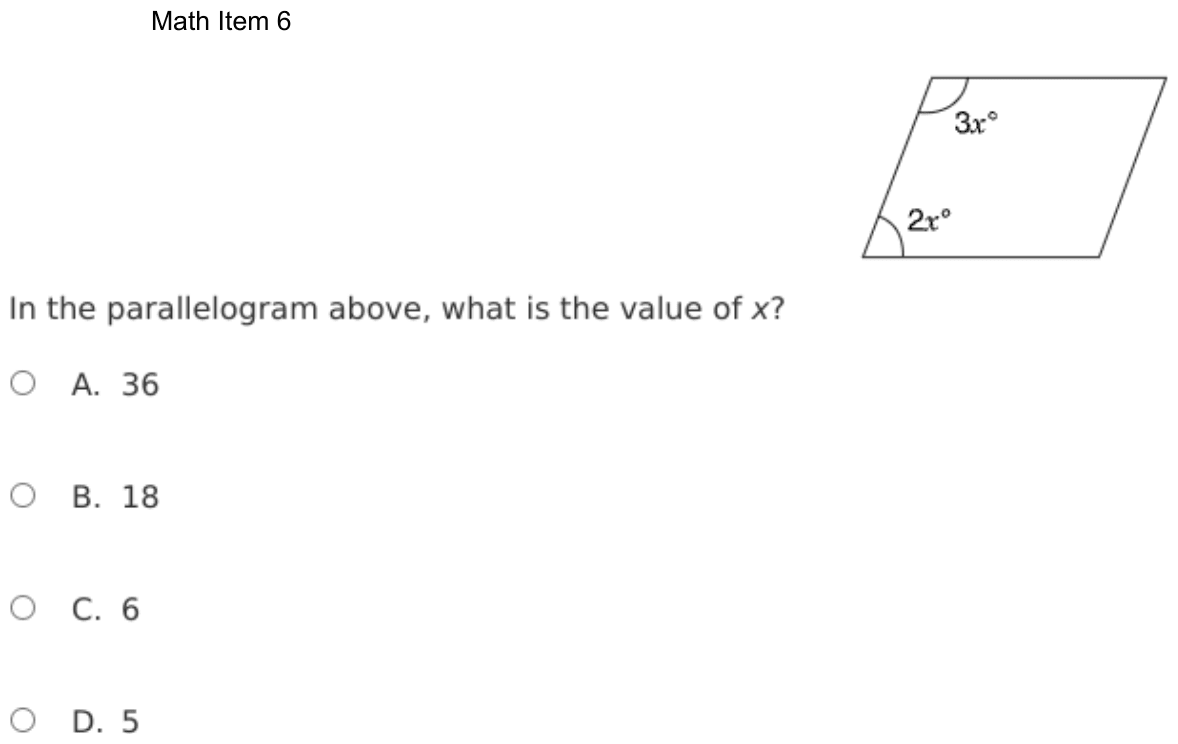
Question 14 of 120
2026 Practice Test C Math, question 7Question
For what values of x is the above inequality true?
- A
- B
- C
- D
Show the answer
Correct answer: C
Divide to solve for x:
Rewriting with the x term first requires reversing the inequality symbol in order to keep the meaning “x is less than ”.
Question analysis
This inequality question asks which values of x make −12 > 6x true. Students solve a one-step inequality by dividing and then state the solution with x written first. A negative number on one side and the variable on the other make the direction of the symbol the main thing to get right.
- Grade level
- Grade 7 content, by NYS standard
- Compared with grade 7
- Below grade 7 Grade 7 inequalities usually take two steps, such as 3x + 4 > 19. This one needs a single division, and the care goes into reading the result correctly when the variable ends up on the right of the symbol.
- Estimated difficulty
- Straightforward: two steps or one careful reading.
- Thinking it demands
- Depth of knowledge 1, recall and reproduction · mainly apply
- What makes it hard
- A very close wrong answer moderate
- Something you must already know minor
- Solution
- 2 steps
- Reading level
- Question and choices: about grade 10, 15 words.
- Students, last 30 days
- Not enough answers yet to show (it takes 10).
Why it is hard, traps and wrong answers (shows the answer)
Why it is hard
One division finds the boundary, so the question is really about direction. Two things pull students the wrong way: the −12 on the left makes the inequality look like one that must be flipped, and the result −2 > x has x on the right, where it is easy to read backward. Testing x = −3, which gives −12 > −18, shows that values below −2 work.
A very close wrong answer moderate Choosing the answer
x < −2 and x > −2 share the boundary −2 and differ only in direction, so finding the right number settles nothing until the direction is read correctly. (Embretson & Wetzel, 1987; Gorin & Embretson, 2006; Ascalon et al., 2007)
Something you must already know minor Working it out
Students must know that the symbol flips only when both sides are multiplied or divided by a negative number, and that −2 > x says the same as x < −2. (Anderson & Krathwohl, 2001)
Strategy: Divide both sides by 6, asking whether you divided by a negative number, then rewrite the result with x on the left so that the symbol still opens toward the larger side.
Traps
- Negatives and direction: Arithmetic with negative numbers, the order of a subtraction, or direction on a number line. (Moving a term across the equals sign without changing its sign is a faulty procedure.)
- Wrong operation: Adds instead of multiplying, divides the wrong way round, turns a ratio or rate upside down, or undoes a step in the wrong direction (subtracts what should be added back).
The wrong answers, classified
A Wrong operation (Hegarty, Mayer & Monk, 1995; King et al., 2004)
Adds 6 to −12 instead of dividing by 6, getting −6, and also reverses the direction, so both the boundary and the symbol are wrong.
B Wrong operation (Hegarty, Mayer & Monk, 1995; King et al., 2004)
Undoes the 6 by adding it to −12 rather than dividing, as if 6x meant x − 6, getting −6 > x and so x < −6.
D Negatives and direction (Brown & Burton, 1978)
Finds −2 > x but flips the symbol because −12 is negative, or reads −2 > x as x > −2, though dividing by a positive 6 keeps the direction.
Worked solution, step by step
Formulas used
- Dividing both sides of an inequality
- a and b are the two sides of an inequality, and c is the number you divide by. If c is positive, the symbol stays the same. It flips only when you multiply or divide both sides by a negative number. Here c is 6, which is positive.
- Reading an inequality the other way
- a and b are any two numbers. Saying a is greater than b is the same as saying b is less than a. When you swap the two sides, turn the symbol around. Its point still aims at the smaller number.
Sort out the question
The inequality is . The symbol > means is greater than. So it says −12 is greater than 6 times x. You need every value of x that makes this true.
Divide both sides by 6
To get x alone, divide both sides by 6:
You divided by 6, which is positive. So the symbol does not flip.
Watch out: −12 is negative, but that does not matter. Only dividing by a negative number flips the symbol.
Put x first
says −2 is greater than x. That means x is less than −2. Swap the sides and turn the symbol around:
Watch out: keeping > when you swap the sides gives choice D, . That is the opposite meaning.
Choose the answer
Choices A and B use −6. That comes from adding 6 to −12 instead of dividing by 6. The right boundary is −2, and x is below it.
So the answer is C, .
Check your answer
Test a number below −2, such as −3. Then , and is true. Now test 0, which is above −2. Then , and is false. So only numbers below −2 work.
More questions like this
The original DOE question
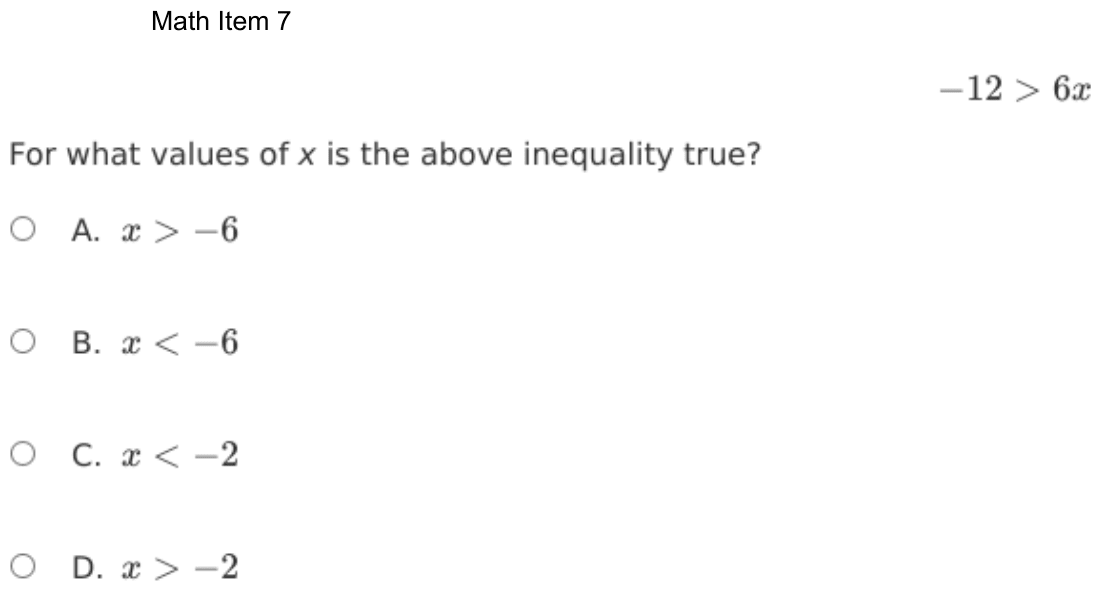
Question 15 of 120
2026 Practice Test C Math, question 9Question
Maria rides her bicycle to school at a constant speed of 15 miles per hour. If the distance to school is 6 miles, how many minutes will it take Maria to get to school?
- A10
- B15
- C24
- D30
Show the answer
Correct answer: C
Maria’s rate of speed is given as 15 miles per hour. Since 1 hour is equivalent to 60 minutes, her rate of speed, in miles per minute, can be determined.
, or mile per minute.
Therefore, it takes Maria 4 minutes to ride 1 mile.
The distance to school is 6 miles, so it will take minutes to ride to school.
Question analysis
Maria bikes 6 miles to school at a constant 15 miles per hour, and students find how many minutes the ride takes. It tests using a rate to find a time and converting hours to minutes. With the speed given per hour and the question asking, in bold, for minutes, keeping track of units is the main hurdle.
- Grade level
- Grade 6 content, by NYS standard
- Compared with grade 7
- Below grade 7 Distance, speed and time with whole numbers is grade 6 rate work. The only extra demand is an answer in minutes when the speed is per hour, a conversion grade 7 students make routinely.
- Estimated difficulty
- Straightforward: two steps or one careful reading.
- Thinking it demands
- Depth of knowledge 2, skills and concepts · mainly apply
- What makes it hard
- Solution
- 2 steps
- Reading level
- Question and choices: about grade 6, 32 words.
- Students, last 30 days
- Not enough answers yet to show (it takes 10).
Why it is hard, traps and wrong answers (shows the answer)
Why it is hard
The numbers are small, but the speed is per hour and the answer is wanted in minutes, so students have to choose a route through the units. Finding the minutes per mile first, 4 at 15 miles an hour, turns the rest into a single multiplication. The wrong choices come from using a number in the stem as the answer, from mixing the 60 minutes with the 6 miles, or from rounding 0.4 hour to a half hour.
Something you must already know minor Working it out
Nothing on the page says that time is distance divided by speed or that an hour has 60 minutes, and the bold word minutes requires both. (Anderson & Krathwohl, 2001)
Error-prone arithmetic minor Working it out
6 ÷ 15 is less than 1, 0.4 hour, and turning it into minutes means 0.4 × 60; the cleaner route, 60 ÷ 15 = 4 minutes a mile, avoids decimals. (Brown & Burton, 1978; Junker & Sijtsma, 2001)
Strategy: Find how many minutes Maria needs to ride one mile at 15 miles per hour, then multiply by the number of miles to school.
Traps
- Numbers taken from the question: Combines the numbers in the question without a model of the situation, or is simply a number that appears in the question.
- Rounds too early: Rounds a value partway through, or rounds the wrong way, so the final answer drifts from the exact one.
The wrong answers, classified
A Numbers taken from the question (Hegarty, Mayer & Monk, 1995)
Divides the 60 minutes in an hour by the 6 miles, 60 ÷ 6 = 10, as if the ride took a full hour, and ignores the 15 mph speed.
B Numbers taken from the question (Hegarty, Mayer & Monk, 1995)
Takes the 15 in 15 miles per hour as the number of minutes, a number copied from the question without any calculation.
D Rounds too early (King et al., 2004)
Sees that 6 miles is a little under half of 15, rounds the time of 0.4 hour up to half an hour, and gives 30 minutes.
Worked solution, step by step
Formulas used
- Minutes for each mile
- Miles per hour tells how many miles you ride in one hour, which is 60 minutes. Sharing the 60 minutes evenly among those miles gives the minutes for each mile. This works when the speed stays the same the whole time.
- Distance, speed and time
- Distance is how far you go, here in miles. Speed is how far you go in one hour. Dividing the distance by the speed gives the time in hours.
Sort out the question
Maria rides at a constant speed of 15 miles per hour. Constant means it never changes. School is 6 miles away. You need the time in minutes, not hours. You must know that one hour has 60 minutes.
Find the minutes for one mile
15 miles per hour means Maria rides 15 miles in 60 minutes. Use the minutes-per-mile formula:
So each mile takes Maria 4 minutes.
Find the minutes for 6 miles
Each of the 6 miles takes 4 minutes:
So the ride takes 24 minutes.
Watch out: 15 is the speed, not a time, so choice B is a trap. And , choice A, ignores the speed.
Choose the answer
Another way is the time formula. , so the ride takes 0.4 of an hour. In minutes, that is .
Watch out: rounding 0.4 hour up to half an hour gives choice D, 30.
So the answer is C, 24.
Check your answer
Check with the speed. 24 minutes is of an hour. In a full hour Maria rides 15 miles. So in 2/5 of an hour she rides miles. That is exactly the distance to school.
More questions like this
The original DOE question
Question 16 of 120
2026 Practice Test C Math, question 10Question
In the figure above, . Straight line m intersects both line n and line p. What is the value of r?
- A17
- B117
- C163
- D173
Show the answer
Correct answer: C
The triangle formed by line p, line m, and the line segment connecting the two contains a 73° angle, a right angle (90°), and a missing angle measuring x°. The sum of the interior angles of a triangle is 180°, so begin by finding the value of x:
Line m is a straight line, so it has a measure of 180°. The 17° angle from the triangle and the adjacent angle outside the triangle are supplementary, so they have a sum of 180°. Let s represent the measure of the adjacent angle outside the triangle. The value of s can be determined by subtracting:
Given that n and p are parallel lines and that they have been cut by a transversal, line m, then corresponding angles are congruent. Angles r and s are corresponding angles, so the value of r is congruent to the value of s, which is 163°.
Question analysis
Two parallel lines, n and p, cross a straight line m, and a segment drawn at a right angle to m forms a small triangle with lines m and p, where a 73° angle is marked. Students find the angle r at line n. It combines a triangle's angle sum, a straight angle and parallel lines, and the angle wanted sits away from the marked ones.
- NYS standards
- Grade level
- Grade 8 content, by NYS standard
- Compared with grade 7
- Above grade 7 Grade 7 angle problems use supplementary, vertical and adjacent angles. This one also needs the angle sum of a triangle and the angles formed by parallel lines and a transversal, grade 8 facts, chained across a busy figure.
- Estimated difficulty
- Hard: combines ideas, needs a plan, and has more than one tempting wrong answer.
- Thinking it demands
- Depth of knowledge 2, skills and concepts · mainly apply
- What makes it hard
- Reading a figure, table or graph moderate
- Combines ideas moderate
- Something you must already know minor
- Solution
- 3 steps
- Reading level
- Question and choices: about grade 3, 21 words.
- Students, last 30 days
- Not enough answers yet to show (it takes 10).
Why it is hard, traps and wrong answers (shows the answer)
Why it is hard
Each fact needs only a subtraction, but the student has to plan a route from the 73° angle at line p over to r at line n. The first number the route gives, the triangle's 17° angle, is listed, and it is the acute partner of r rather than r itself. The figure helps here: r is drawn plainly obtuse, and 163 is also 90 + 73, the triangle's exterior angle, which confirms it.
Reading a figure, table or graph moderate Understanding the question
The 73° sits between line p and the vertical segment, not between p and m, and r is the obtuse angle above m on the left of line n, far from every marked angle. (Lesh, Post & Behr, 1987; Kirsch & Mosenthal, 1990)
Combines ideas moderate Working it out
Three facts chain together: the triangle's angles sum to 180°, the angles along straight line m sum to 180°, and corresponding angles at the parallel lines n and p are equal. (Embretson, 1998; Daniel & Embretson, 2010)
Something you must already know minor Working it out
The angle pairs formed by a line crossing two parallel lines are a grade 8 topic, and the question uses them without naming them. (Anderson & Krathwohl, 2001)
Strategy: Find the third angle of the right triangle, use the straight line m to get the angle beside it, then carry that angle over to line n using the parallel lines.
Traps
- Stops one step early: A choice is a number from partway through the solution.
- An arithmetic slip: The right method with a plausible arithmetic error: a digit, a place value or a times-table fact.
The wrong answers, classified
A Stops one step early (King et al., 2004; Gierl et al., 2017)
Finds the triangle's third angle, 180 − 90 − 73 = 17, and stops, though r is the obtuse angle next to the 17° angle, not that angle itself.
B Little reason to choose it (Haladyna & Downing, 1993; Rodriguez, 2005)
No angle fact in the figure gives 117; even 180 − 73 is 107, so this choice mostly catches guesses at an obtuse angle.
D An arithmetic slip (Junker & Sijtsma, 2001)
Finds the 17° angle and subtracts it from 180 but borrows without reducing the 8, so 180 − 17 comes out as 173.
Worked solution, step by step
Formulas used
- Angles of a triangle
- a, b and c are the three angles inside any triangle. They always add up to 180°. If you know two of them, subtract their sum from 180° to find the third.
- Angles on a straight line
- a and b are two angles side by side on a straight line. Together they make a half turn, which is 180°. Use it to find the angle next to one you already know.
- Corresponding angles
- The symbol ∥ means is parallel to. When line m crosses two parallel lines, it makes the same angles at each crossing. Angles in the same position at the two crossings are called corresponding angles. They are equal.
Sort out the question
Lines n and p are parallel, and line m crosses both. Near line p, a straight-up segment meets line m. The small square shows a right angle, 90°. Line p, line m and that segment make a small triangle. Its top angle is 73°.
You need r, the wide angle where line n crosses line m.
Find the triangle’s third angle
The third angle is where line p crosses line m. Call it x. Use the triangle rule:
So that angle is 17°.
Watch out: this is not r. Stopping here gives choice A, 17.
Use the straight line m
The 17° angle sits above line m, on the right of line p. Beside it, on the left of line p, is a wide angle. Call it s. The two angles fill the straight line m, so they add to 180°:
So s is 163°.
Watch out: borrow carefully. 180 − 17 is 163, not 173, choice D.
Carry the angle to line n
Angle s is above line m and to the left of line p. Angle r is above line m and to the left of line n. They are in the same position, so they are corresponding angles. Since n and p are parallel:
So the answer is C, 163.
Check your answer
Look at the figure. Angle r is wider than a right angle, so it must be more than 90°. That rules out 17. Also, the narrow angle beside r, on the right of line n, matches the 17° angle at line p. And , as it should on a straight line.
More questions like this
The original DOE question
Question 17 of 120
2026 Practice Test C Math, question 12Question
A spinner has 5 congruent sections labeled as shown. One side of a fair coin is heads, and the other side is tails.
The spinner is spun one time, and the coin is flipped. What is the probability that the spinner lands on 1 and the coin lands on tails?
Select the place on the number line that represents the probability.
On the test you click a point on the number line; here, choose it from the menu.
Show the answer
Correct answer: the point 0.2
The spinner has five equal-sized sections. Two of the sections are labeled with a 1. So, the probability of landing on a 1 is two out of five, or 2/5.
A coin has two sides, one heads and one tails. So, the probability of landing on tails is one out of two, or 1/2.
The compound probability of the spinner landing on a 1 and the coin landing on tails can be calculated by multiplying 2/5 and 1/2 as shown:
Question analysis
A spinner with five equal sections is spun once and a fair coin is flipped. Students find the probability that the spinner lands on 1 and the coin shows tails, then select that point on a number line from 0 to 1. Counting the right sections and combining the two events correctly are the tricky parts.
- Grade level
- Grade 7 content, by NYS standard
- Compared with grade 7
- At grade 7 Finding the chance of two independent events together is grade 7 compound probability, here with one spinner and one coin. Counting sections from the picture and placing the result on a number line add two small steps.
- Estimated difficulty
- Moderate: several steps, or a close reading with one strong distractor.
- Thinking it demands
- Depth of knowledge 2, skills and concepts · mainly apply
- What makes it hard
- Solution
- 3 steps
- Reading level
- Question and choices: about grade 5, 59 words.
- Students, last 30 days
- Not enough answers yet to show (it takes 10).
Why it is hard, traps and wrong answers (shows the answer)
Why it is hard
The probability itself takes one multiplication of two simple fractions; the losses come before and after it. Before, the spinner has to be searched for every section labeled 1, and the coin's chance brought in as well. After, 1/5 has to be rewritten as 2/10 to find its point, since only 0, 1/2 and 1 are labeled. Checking that the result is smaller than both separate chances catches an addition.
Reading a figure, table or graph moderate Understanding the question
The two sections labeled 1, upper left and right, are not side by side, and the number line labels only 0, 1/2 and 1, so its nine points must be read as tenths. (Lesh, Post & Behr, 1987; Kirsch & Mosenthal, 1990)
Something you must already know minor Working it out
Nothing says that the chance of two independent events both happening is the product of their chances, 2/5 × 1/2, rather than their sum. (Anderson & Krathwohl, 2001)
Strategy: Count the sections labeled 1 to get the spinner's chance, take the coin's chance of tails, multiply the two because both must happen, and write the result in tenths.
Traps
- Stops one step early: A choice is a number from partway through the solution.
- Wrong operation: Adds instead of multiplying, divides the wrong way round, turns a ratio or rate upside down, or undoes a step in the wrong direction (subtracts what should be added back).
- Misreads the figure: Reads a value, label or tick spacing in a figure, table or graph wrongly.
The wrong answers, classified
0.4 Stops one step early (King et al., 2004; Gierl et al., 2017)
Finds the spinner's chance of landing on 1, two sections out of five, and plots 2/5 without multiplying by the coin's chance of tails.
0.9 Wrong operation (Hegarty, Mayer & Monk, 1995; King et al., 2004)
Adds the two chances, 2/5 + 1/2 = 9/10, instead of multiplying them, though both events must happen together.
0.1 Misreads the figure (Lesh, Post & Behr, 1987; Kirsch & Mosenthal, 1990)
Counts only one section labeled 1, so multiplies 1/5 by 1/2 and plots 1/10, missing the second 1 on the spinner.
Worked solution, step by step
Formulas used
- Probability of an event
- P is the probability, the chance that something happens. It goes from 0 (never) to 1 (always). The top counts the results you want. The bottom counts all possible results. It works when every result is equally likely, like equal sections of a spinner.
- Probability that two things both happen
- A and B are two events that do not affect each other, like a spin and a coin flip. P(A) and P(B) are their chances. Multiply them to get the chance that both happen. Needing both makes the chance smaller, never bigger.
Sort out the question
The spinner has 5 congruent sections. Congruent means the same size and shape, so each is equally likely. The coin has a heads side and a tails side. You need the chance that the spinner lands on 1 and the coin lands on tails.
Find the spinner’s chance
Two sections show 1: the upper left one and the one on the right. So 2 of the 5 equal sections give a 1:
Watch out: the two 1s are not next to each other. Counting only one gives 1/5 here, and 0.1 at the end.
Find the coin’s chance
A fair coin is equally likely to land on either side. Tails is 1 of its 2 sides:
Multiply the two chances
The spin and the flip do not affect each other, and both must happen. So multiply:
Watch out: stopping at 2/5 gives 0.4. Adding gives , or 0.9. Both are wrong.
Select the point
On the test, the number line labels only 0, 1/2 and 1. Between 0 and 1 are 9 targets, one at each tenth. 0.2 is the second target to the right of 0. On this site, choose 0.2 from the Point menu.
So the answer is the point at 0.2.
Check your answer
List every result. The spinner has 5 sections and the coin has 2 sides, so there are results, all equally likely. Just 2 of them are a 1 with tails, one for each section labeled 1. That is 2 out of 10, or 0.2.
More questions like this
The original DOE question
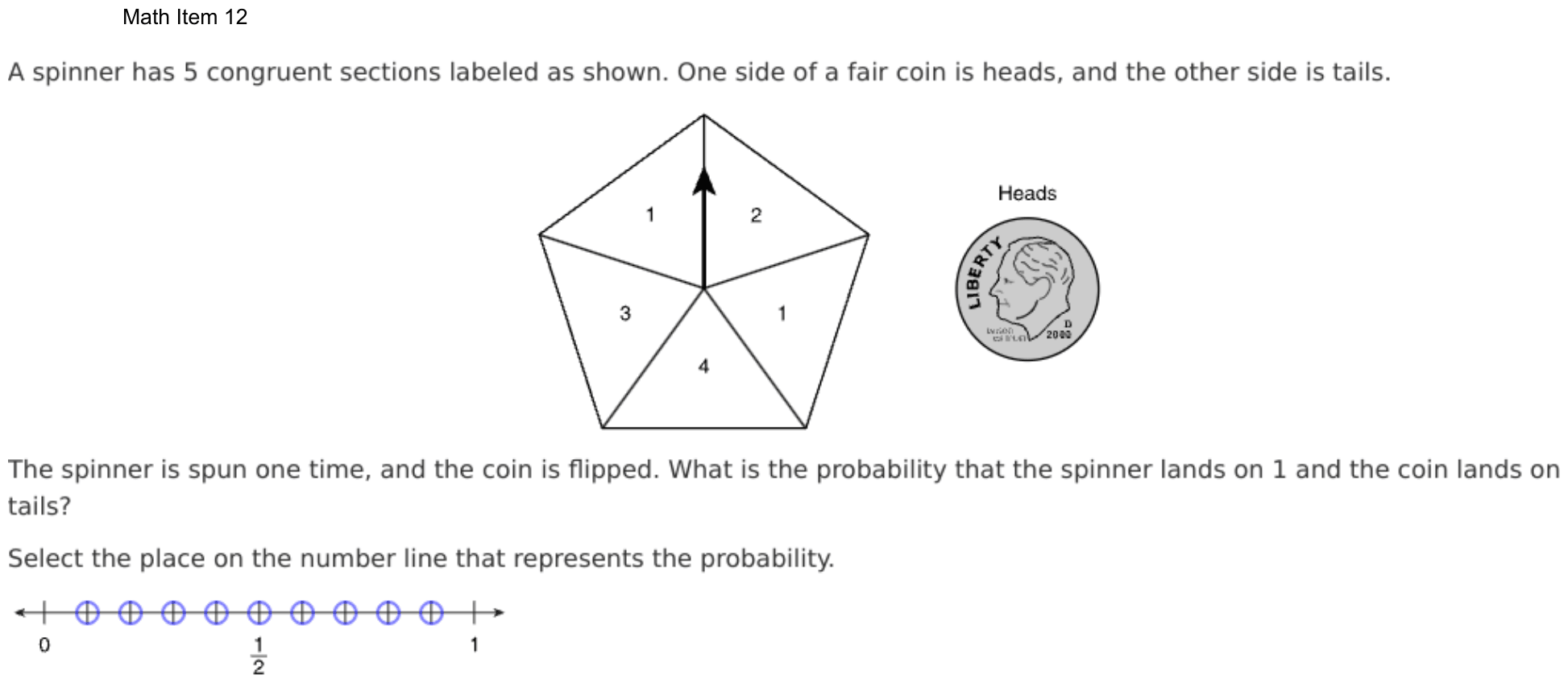
Question 18 of 120
2026 Practice Test C Math, question 15Question
A grocery store sells 1-gallon containers of milk for $3.99. The store also sells orange juice in a 6-pack of 5.5-fluid-ounce bottles for $1.79. Suppose the store wants to sell its orange juice in gallon containers instead. To the nearest dollar, how much more would a gallon of orange juice cost than a gallon of milk?
Enter your answer in the space.
Fill-in question: work out the answer and type it as a number.
Show the answer
Correct answer: 3
To determine the cost of a gallon of orange juice, begin by finding the total number of ounces in the 6-pack of bottles:
So, 33 oz of orange juice costs $1.79.
There are 128 oz in 1 gallon. Set up a proportion using the $1.79 cost per 33 oz of orange juice and the unknown cost (x) per 1 gallon of orange juice:
Cross multiply to solve for x in the proportion:
So, the orange juice costs $6.94 per gallon, and the milk costs $3.99 per gallon.
Subtract the cost per gallon of milk from the cost per gallon of orange juice.
Round the difference to the nearest dollar.
$2.95 rounds to $3.
Question analysis
A store sells milk by the gallon for $3.99 and orange juice in six-packs of 5.5-fluid-ounce bottles for $1.79. Students work out what a gallon of the juice would cost at the same price per ounce and how much more that is than the milk, to the nearest dollar. The ounces in a gallon must be known, and several steps involve decimals.
- Grade level
- Grade 7 content, by NYS standard
- Compared with grade 7
- Above grade 7 Unit prices are grade 6 and 7 work, but this chains five steps with decimals and needs a fact the question does not give, the number of fluid ounces in a gallon. Typing a rounded difference, with no choices, adds risk.
- Estimated difficulty
- Hard: combines ideas, needs a plan, and has more than one tempting wrong answer.
- Thinking it demands
- Depth of knowledge 2, skills and concepts · mainly apply
- What makes it hard
- Something you must already know moderate
- Many steps moderate
- Error-prone arithmetic minor
- An answer in an unexpected form minor
- Solution
- 5 steps
- Reading level
- Question and choices: about grade 5, 60 words.
- Corrected from the DOE handbook
- A rounded value in the explanation is now marked as approximate (≈ instead of =).
- Students, last 30 days
- Not enough answers yet to show (it takes 10).
Why it is hard, traps and wrong answers (shows the answer)
Why it is hard
The calculation is long, and its key fact is missing from the page. Students who know the 128 fluid ounces still face a division by 33 that does not come out evenly, which tempts them to round the price per ounce to 5 cents and lose about 50 cents a gallon. Keeping the exact quotient to the end, or scaling 33 ounces up by about 3.9, keeps the difference near $2.95, which rounds to 3.
Something you must already know moderate Working it out
The question never says that a gallon holds 128 fluid ounces, yet the whole comparison depends on it; the 6-pack holds only 6 × 5.5 = 33 ounces. (Anderson & Krathwohl, 2001)
Many steps moderate Working it out
Five moves follow one another: the ounces in a pack, the scale-up to 128 ounces, the division by 33, the subtraction of $3.99 and the rounding to a whole dollar. (Daniel & Embretson, 2010; Enright, Morley & Sheehan, 2002)
Error-prone arithmetic minor Working it out
1.79 × 128 = 229.12 and 229.12 ÷ 33 are long decimal calculations without a calculator, and a slip in either moves the price of a gallon. (Brown & Burton, 1978; Junker & Sijtsma, 2001)
An answer in an unexpected form minor Choosing the answer
The rounded difference is typed with no choices, so an unrounded $2.95, or a figure rounded too soon, looks just as finished as the whole-dollar answer. (Enright, Morley & Sheehan, 2002)
Strategy: Find the ounces in one six-pack, scale its price up to the 128 fluid ounces in a gallon, subtract the milk's price, and round only at the end.
Traps
- Stops one step early: A choice is a number from partway through the solution.
- Rounds too early: Rounds a value partway through, or rounds the wrong way, so the final answer drifts from the exact one.
- Misreads the question: Misses or misreads a condition or a word in the question: "at least", "each", "remaining", "not".
The wrong answers, classified
7 Stops one step early (King et al., 2004; Gierl et al., 2017)
Finds the juice's cost per gallon, about $6.94, rounds it to $7, and enters that without subtracting the $3.99 price of the milk.
2 Rounds too early (King et al., 2004)
Rounds the price per ounce, 1.79 ÷ 33 ≈ 0.054, to $0.05, so a gallon costs $6.40 and the difference, $2.41, rounds to 2.
2.95 Misreads the question (Hegarty, Mayer & Monk, 1995)
Works out the difference of $2.95 correctly but enters it as it stands, though the question asks for it to the nearest dollar.
What was corrected from the DOE handbook, and why
- Explanation: The DOE’s explanation goes from 33x = $229.12 to “x = $6.94”. But 229.12 ÷ 33 = 6.9430…, so $6.94 is the cost per gallon rounded to the cent. The site writes x ≈ $6.94. Nothing else changes: $6.94 − $3.99 = $2.95, which rounds to $3, and the unrounded cost gives the same answer.
Worked solution, step by step
Formulas used
- Fluid ounces in a gallon
- A gallon holds 128 fluid ounces. This is a fact you must know, because the question does not give it. A fluid ounce measures an amount of liquid. Multiply gallons by 128 to change them into fluid ounces.
- Cross-multiplying a proportion
- A proportion says two ratios are equal. Here each ratio is ounces over dollars. a and c are the tops, and b and d are the bottoms. Multiply each top by the other bottom, and the two products are equal. That turns the proportion into an equation.
Sort out the question
Milk costs $3.99 for 1 gallon. Orange juice comes in a 6-pack of 5.5-fluid-ounce bottles for $1.79. You need how much more a gallon of juice would cost than a gallon of milk. Round to the nearest dollar.
The question doesn’t say how big a gallon is. You must know this fact: 1 gallon is 128 fluid ounces.
Find the ounces in a 6-pack
Each of the 6 bottles holds 5.5 fluid ounces:
So $1.79 buys 33 fluid ounces of juice.
Set up a proportion
Let x be the cost in dollars of a gallon, 128 fluid ounces, of juice. The price per ounce stays the same. So ounces over dollars is the same for the pack and the gallon:
Cross-multiply:
Find the cost of a gallon
Divide both sides by 33:
The sign ≈ means about equal. The exact value is 6.943…, so a gallon of juice costs about $6.94.
Watch out: don’t round too early. One ounce costs about $0.054. Rounding that to $0.05 makes a gallon $6.40, and your answer becomes 2.
Subtract the milk’s price
Find how much more the juice costs:
A gallon of juice costs $2.95 more than a gallon of milk.
Watch out: entering 7, the juice’s price, forgets to subtract the milk.
Round and enter it
The question asks for the nearest dollar. $2.95 is between $2 and $3. Its cents, 95, are 50 or more, so it rounds up to $3. Do not enter 2.95.
Type only the number in the box. So you would enter 3.
Check your answer
Estimate. 128 ounces is almost 4 packs, since . Four packs cost dollars, so a gallon costs a bit less than that. Milk costs about $4. About $7 minus $4 is $3, which matches.
More questions like this
The original DOE question

Question 19 of 120
2026 Practice Test C Math, question 18Question
I.
II.
III.
If s is a positive integer and t is a negative integer, which of the above expressions must be a positive number?
- AII only
- BI and II only
- CII and III only
- DI, II, and III
Show the answer
Correct answer: D
Each of the three expressions must be considered:
Expression I: , where s is a positive integer and t is a negative integer:
Subtracting a negative integer is the equivalent of adding a positive integer, so is equivalent to finding the value of , which must result in a positive number.
Expression II: , where s is a positive integer and t is a negative integer:
Squaring a negative integer results in a positive integer, so is equivalent to finding the value of , which must result in a positive number.
Expression III: , where s is a positive integer and t is a negative integer:
A negative exponent results in the reciprocal of the same exponential expression, so is equivalent to finding the value of , which must result in a positive number.
Therefore, Expressions I, II, and III must all result in a positive number.
Question analysis
Three expressions, s − t, s times t squared, and s to the power t, are listed, and students decide which must be positive when s is a positive integer and t is a negative integer. It tests sign rules for subtraction and multiplication and the meaning of a negative exponent. Each expression has to be judged for every possible pair, not just one example.
- NYS standards
- Grade level
- Grade 8 content, by NYS standard
- Compared with grade 7
- Above grade 7 Grade 7 students learn sign rules for subtracting and multiplying signed numbers. Here they reason about letters rather than numbers, decide what must always hold, and handle a negative exponent, a grade 8 idea.
- Estimated difficulty
- Hard: combines ideas, needs a plan, and has more than one tempting wrong answer.
- Thinking it demands
- Depth of knowledge 2, skills and concepts · mainly analyze
- What makes it hard
- Variables instead of numbers moderate
- Something you must already know moderate
- Every choice must be checked minor
- Solution
- 3 steps
- Reading level
- Question and choices: about grade 5, 42 words.
- Corrected from the DOE handbook
- Two steps of the explanation that treated t as a positive number were corrected.
- A punctuation error in the explanation was corrected.
- Students, last 30 days
- Not enough answers yet to show (it takes 10).
Why it is hard, traps and wrong answers (shows the answer)
Why it is hard
The three expressions test three different sign facts: subtracting a negative, squaring a negative, and raising to a negative power. The last is the trap, since a negative exponent seems to promise a negative result when it really gives a fraction, and that belief alone leads to a listed choice. Trying s = 2 and t = −3 gives 5, 18 and 1/8, all positive, and the rules show why no other pair can change that.
Variables instead of numbers moderate Understanding the question
No values are given for s and t, only their signs, and must means each expression has to be positive for every such pair, not just for one example. (Koedinger & Nathan, 2004; Enright, Morley & Sheehan, 2002)
Something you must already know moderate Working it out
Expression III needs the meaning of a negative exponent, s to the power t equals 1 over s to the power −t, a grade 8 rule the question does not state. (Anderson & Krathwohl, 2001)
Every choice must be checked minor Choosing the answer
Each of the three expressions is judged on its own and the choices combine the verdicts, so one wrong judgment anywhere points to a wrong combination. (Embretson & Wetzel, 1987)
Strategy: Try a pair such as s = 2 and t = −3 in each expression, then explain why its sign could or could not change for any other positive s and negative t.
Traps
- Misunderstands the concept: A wrong belief about a concept: that percents can be added, that area grows like length, that averages can be averaged, that a bigger denominator means a bigger fraction.
- Negatives and direction: Arithmetic with negative numbers, the order of a subtraction, or direction on a number line. (Moving a term across the equals sign without changing its sign is a faulty procedure.)
The wrong answers, classified
A Misunderstands the concept (Smith, diSessa & Roschelle, 1993; De Bock et al., 1998; Ni & Zhou, 2005)
Trusts only the squared expression, believing that subtracting t must make s smaller and that a negative exponent makes a negative number.
B Misunderstands the concept (Smith, diSessa & Roschelle, 1993; De Bock et al., 1998; Ni & Zhou, 2005)
Handles the subtraction and the square correctly but believes a negative exponent makes the result negative, though s to the power t is a positive fraction such as 1/8.
C Negatives and direction (Brown & Burton, 1978)
Reads s − t as taking a number away from s, so thinks it could be negative, missing that subtracting the negative t adds to s.
What was corrected from the DOE handbook, and why
- Explanation: The question makes t the negative integer, but two steps of the DOE’s explanation write the negative integer as −t, as if t were positive. For Expression I it says “s − (−t) is equivalent to finding the value of s + t, which must result in a positive number”: s − (−t) is not Expression I, and with the question’s t, s + t need not be positive (s = 1 and t = −2 give −1). For Expression III it says “s^(−t) is equivalent to finding the value of 1/s^t”, about s^(−t) rather than Expression III. The site now says that s − t is equivalent to s + (−t), and that s^t is equivalent to 1/s^(−t). Since t is negative, −t is a positive integer, so s + (−t) is the sum of two positive integers and 1/s^(−t) is the reciprocal of a positive integer: both positive, and the answer, I, II and III, is unchanged. The step for Expression II, s(−t)² = st², is true for any t and is unchanged.
- Explanation: The DOE’s explanation introduces Expression III as “s^t. where s is a positive integer and t is a negative integer”, with a period where Expressions I and II (and the 2022–23 guide, which first printed this explanation) have a comma. The site has the comma.
Worked solution, step by step
Formulas used
- Subtracting a number
- s and t are integers, and −t is the opposite of t. Subtracting a number is the same as adding its opposite. When t is negative, −t is positive. So subtracting t adds a positive amount.
- A negative exponent
- s is the base and t is the exponent. When t is negative, −t is positive. So a negative exponent means 1 over the base to a positive exponent. For example, 2 to the power −3 is 1 over 2³, which is 1/8.
Sort out the question
An integer is a whole number or its opposite, such as −2, 0 or 5. Here s is a positive integer, like 1, 2 or 3. And t is a negative integer, like −1, −2 or −3. Must means always. An expression counts only if it is positive for every such pair.
Try one pair of numbers
Try s = 2 and t = −3 in each expression:
- I:
- II:
- III:
All three are positive this time. Now see why that always happens.
Explain expression I
Use the rule for subtracting:
t is negative, so its opposite, −t, is positive. So s − t is a positive plus a positive. That is always positive.
Watch out: subtracting does not always make a number smaller. Subtracting a negative makes it bigger. Missing this leads to choice C.
Explain expression II
means t × t. A negative times a negative is positive, so is always positive. Then is a positive times a positive. That is always positive too.
Explain expression III
Use the rule for a negative exponent:
−t is a positive integer, so is a positive integer. So is 1 over a positive number. That is a positive fraction.
Watch out: a negative exponent does not make the answer negative. It makes a fraction. Thinking it does leads to choice B, I and II only.
Choose the answer
Each of the three expressions is positive for every positive s and negative t. None of them can ever be zero or negative.
So the answer is D, I, II, and III.
Check your answer
Try the values closest to 0: s = 1 and t = −1. I gives . II gives . III gives . All three are still positive.
More questions like this
The original DOE question
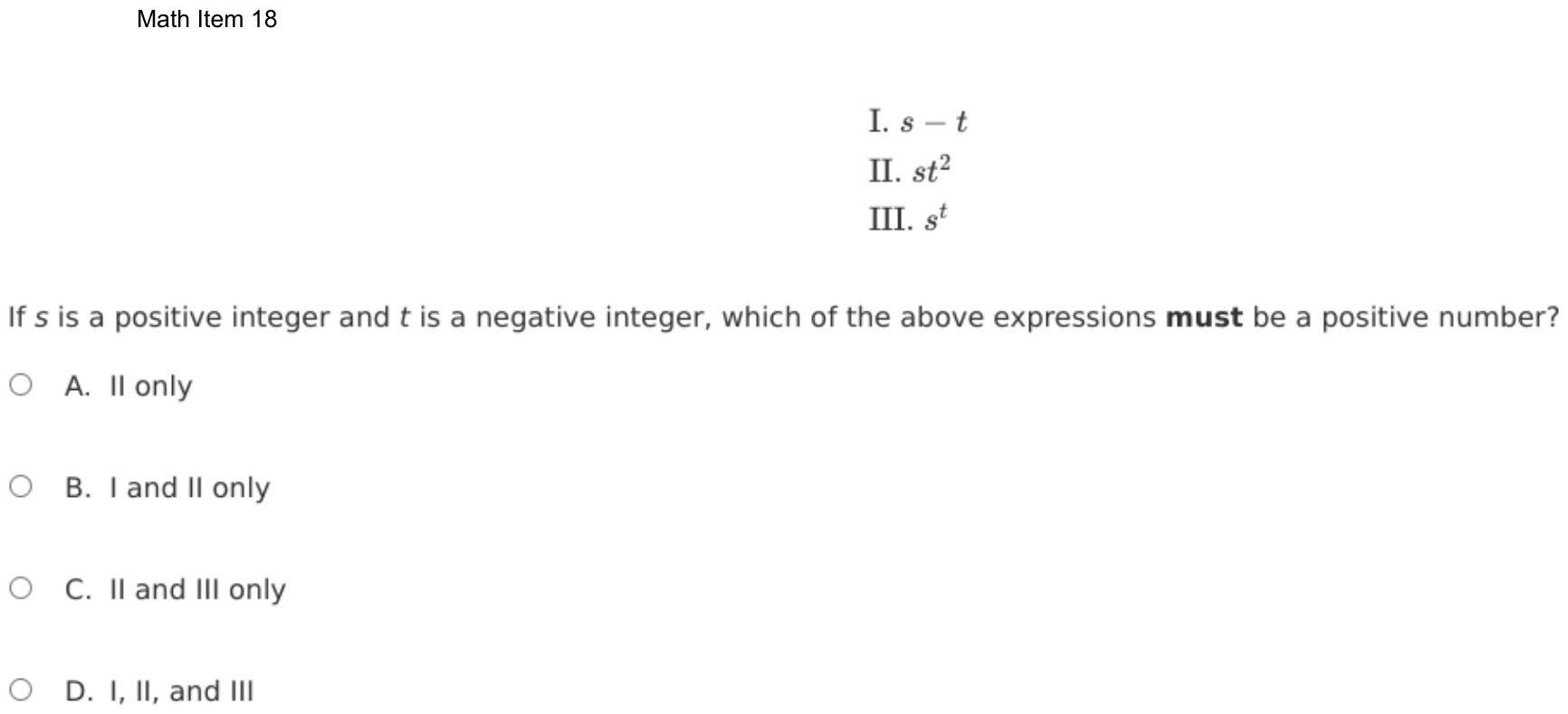
Question 20 of 120
2026 Practice Test C Math, question 20Question
Two circles, with centers at A and C, are shown. Line segment AB is congruent to line segment DE.
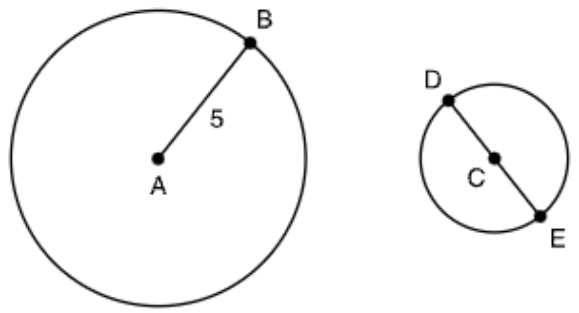
Determine the area, A, and the circumference, C, of each circle to complete the table.
Select one answer in each row.
Choose one answer in each row, then check. The DOE has not published how answers with several parts are scored; this site counts one right only when every part is right.
| Circle A | Circle C | Neither | |
|---|---|---|---|
Show the answer
Correct answer: A = 25π: Circle A; C = 5π: Circle C
: Circle A
: Circle C
As shown in the illustration, AB (the radius of Circle A) is 5 units in length. Since DE (the diameter of Circle C) is congruent to AB, we know it is also 5 units in length.
Circle A:
We know the radius of Circle A is 5 so the answer to row 1 is A.
Circle C:
We have to look for the circle with a diameter of 5. That is circle C.
Question analysis
Two circles centered at A and C are shown: radius AB of Circle A is labeled 5, and segment DE, drawn through C, is congruent to AB. Students decide whether an area of 25π and a circumference of 5π each belong to Circle A, Circle C or neither. Keeping radius and diameter apart, and area and circumference, is the challenge.
- NYS standards
- 7.G.4 circle area and circumference
- Grade level
- Grade 7 content, by NYS standard
- Compared with grade 7
- At grade 7 Applying the area and circumference formulas is the grade 7 circle standard. This gives a radius for one circle and, for the other, a segment known only through congruence, and both rows of the table must be right.
- Estimated difficulty
- Moderate: several steps, or a close reading with one strong distractor.
- Thinking it demands
- Depth of knowledge 2, skills and concepts · mainly apply
- What makes it hard
- Reading a figure, table or graph moderate
- Something you must already know moderate
- Much to keep track of minor
- Solution
- 4 steps
- Reading level
- Question and choices: about grade 5, 40 words.
- Students, last 30 days
- Not enough answers yet to show (it takes 10).
Why it is hard, traps and wrong answers (shows the answer)
Why it is hard
Circle A is direct: its labeled radius of 5 gives an area of 25π. Circle C is where points are lost, since its size comes from a sentence rather than a label, and the segment through its center is a diameter, so its circumference is 5π while its area is only 6.25π. The row labels favor guessers, because the A and C in A = 25π and C = 5π match the circles' names, though they stand for area and circumference.
Reading a figure, table or graph moderate Understanding the question
Circle C's size is shown only by segment DE, drawn through center C with no label, and only the stem's sentence that DE is congruent to AB makes it a diameter of 5. (Lesh, Post & Behr, 1987; Kirsch & Mosenthal, 1990)
Something you must already know moderate Working it out
Neither A = πr² nor C = πd is given, and one circle is measured by a radius and the other by a diameter, so each formula needs the right length. (Anderson & Krathwohl, 2001)
Much to keep track of minor Working it out
Four values are in play, areas of 25π and 6.25π and circumferences of 10π and 5π, and both rows must be matched correctly for the item to count. (Sweller, 1988; Carpenter, Just & Shell, 1990)
Strategy: Write down the radius and the diameter of each circle, compute both circles' areas and circumferences in terms of π, then match each value in the table.
Traps
- Wrong formula: Uses a related but wrong formula: perimeter for area, diameter for radius, area for volume, or a misremembered one.
- Misreads the question: Misses or misreads a condition or a word in the question: "at least", "each", "remaining", "not".
- A formula you must know: Needs a formula the test does not give: area, circumference, volume, probability rules.
The wrong answers, classified
1:B Wrong formula (King et al., 2004)
Squares the diameter instead of the radius, so Circle C's area seems to be π × 5² = 25π while Circle A's becomes 100π.
1:C Wrong formula (King et al., 2004)
Uses 2πr for the area, so Circle A seems to have an area of 10π and Circle C one of 5π, and no circle seems to have 25π.
2:A Wrong formula (King et al., 2004)
Uses π times the radius for the circumference, so Circle A's radius of 5 seems to give a circumference of 5π.
2:C Misreads the question (Hegarty, Mayer & Monk, 1995)
Overlooks that DE is congruent to AB, so Circle C has no known size, and with Circle A's circumference at 10π picks Neither.
Worked solution, step by step
Formulas used
- Area of a circle
- A is the area, the space inside the circle. r is the radius, the distance from the center to the edge. π (pi) is a fixed number, a little more than 3. Square the radius, then multiply by π.
- Circumference of a circle
- C is the circumference, the distance around the circle. d is the diameter, the distance across the circle through its center. A diameter is twice as long as a radius. Multiply the diameter by π.
Sort out the question
Circle A has its center at A. Its radius, AB, is 5. Circle C has its center at C. Segment DE goes through C, so it is a diameter. Congruent means the same length, so DE is 5 too.
Careful: in the table, A means area and C means circumference. Circle A and Circle C are just names.
Find each radius and diameter
Circle A: the radius is 5, so the diameter is .
Circle C: the diameter is 5, so the radius is .
Watch out: without the sentence about DE, Circle C seems to have no size. Then you might pick Neither for the second row.
Check the area row
Use the area formula for each circle. For Circle A:
For Circle C:
Only Circle A has an area of 25π.
Watch out: squaring Circle C’s diameter instead of its radius gives 25π by mistake.
Check the circumference row
Use the circumference formula for each circle. For Circle A:
For Circle C:
Only Circle C has a circumference of 5π.
Watch out: π times the radius is not the circumference. It would give Circle A 5π.
Fill in the table
Choose one button in each row. In the row for A = 25π, choose the Circle A column. In the row for C = 5π, choose the Circle C column. Neither stays empty.
So the answers are A = 25π: Circle A and C = 5π: Circle C.
Check your answer
Compare sizes. Circle A’s radius, 5, is twice Circle C’s radius, 2.5. So the distance around Circle C should be half of Circle A’s 10π. Half of 10π is 5π, which matches. And the bigger circle has the bigger area, 25π.
More questions like this
The original DOE question
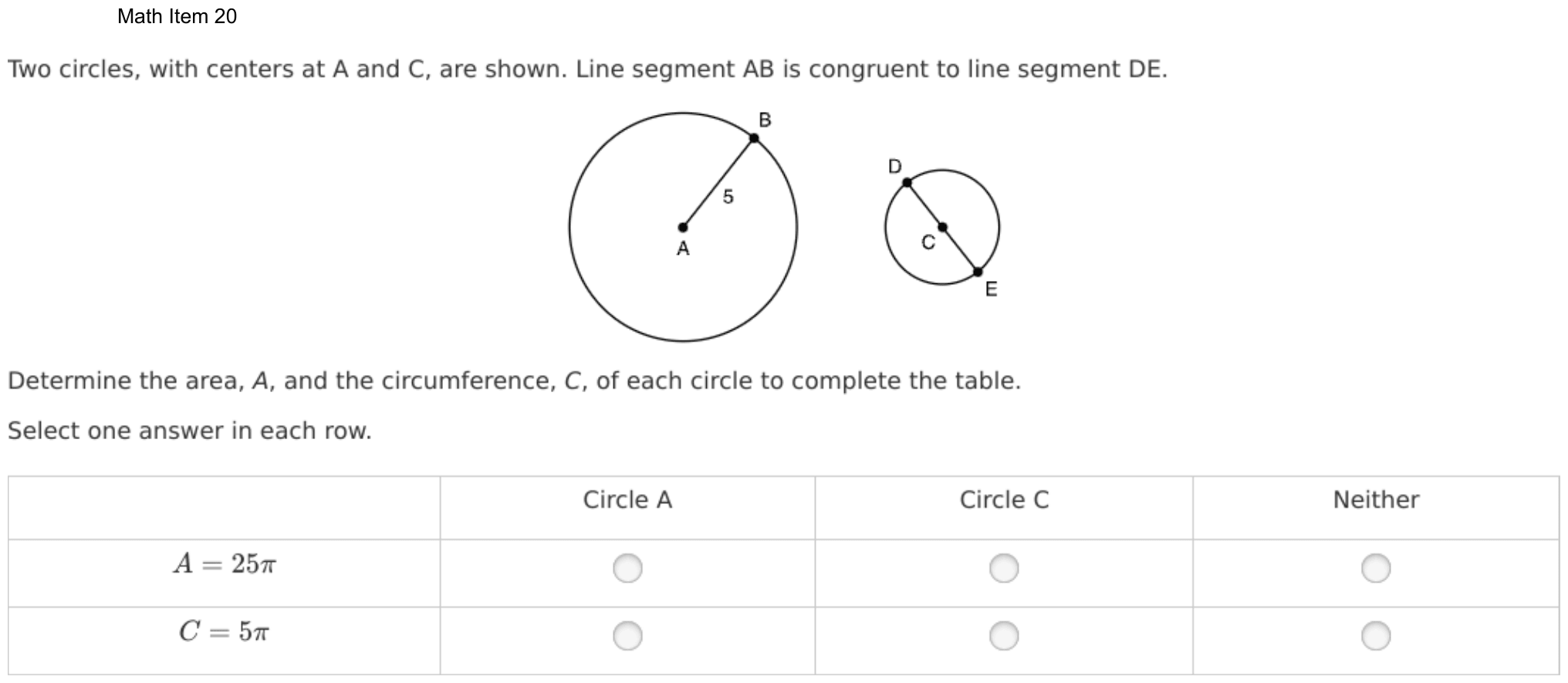
Question 21 of 120
2026 Practice Test C Math, question 23Question
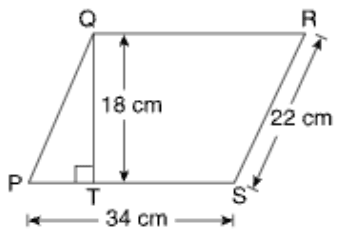
On parallelogram PQRS above, the length of is 18 centimeters. What is the area of the parallelogram?
- A112 sq cm
- B396 sq cm
- C612 sq cm
- D748 sq cm
Show the answer
Correct answer: C
PQRS is a parallelogram in which PS is a base and QT is an altitude. The base is 34 cm in length, and the height is the length of the altitude, so the height is 18 cm.
To determine the area of a parallelogram, multiply the base × the height:
Question analysis
Parallelogram PQRS is drawn with a 34 cm base PS, a 22 cm slanted side and an 18 cm segment QT at a right angle to the base, and students find its area. It tests the area formula for a parallelogram. One labeled length is not needed, so the base and height that go together have to be chosen.
- NYS standards
- 6.G.1 area of polygons
- Grade level
- Grade 6 content, by NYS standard
- Compared with grade 7
- Below grade 7 The area of a parallelogram is grade 6 content, used here once with the height already drawn and labeled. Grade 7 area tasks usually involve circles, composite shapes or scale drawings, so this is easier.
- Estimated difficulty
- Routine: one familiar step, little to misread.
- Thinking it demands
- Depth of knowledge 1, recall and reproduction · mainly apply
- What makes it hard
- Solution
- 1 step
- Reading level
- Question and choices: about grade 5, 25 words.
- Students, last 30 days
- Not enough answers yet to show (it takes 10).
Why it is hard, traps and wrong answers (shows the answer)
Why it is hard
One multiplication answers the question once the right pair of lengths is chosen. Each wrong choice pairs or combines the labeled lengths in another way: the two sides as for a rectangle, the height with the slanted side, or all four sides as a perimeter. Following the right-angle mark at T from QT down to PS identifies the base and height that belong together.
Reading a figure, table or graph minor Understanding the question
Three lengths are labeled, 34 cm, 18 cm and 22 cm, but only the base PS and the height QT meet at the right-angle mark; the slanted side RS is not needed. (Lesh, Post & Behr, 1987; Kirsch & Mosenthal, 1990)
Something you must already know minor Working it out
The formula, base times height, is not given, and the height must be the perpendicular distance between two sides, not the length of a slanted side. (Anderson & Krathwohl, 2001)
Strategy: Multiply the base by the height measured at a right angle to it, and check that the length you use as the height meets that base at a right-angle mark.
Traps
- Wrong formula: Uses a related but wrong formula: perimeter for area, diameter for radius, area for volume, or a misremembered one.
- Information you don't need: The question gives numbers or facts that play no part in the answer.
The wrong answers, classified
A Wrong formula (King et al., 2004)
Adds all four sides, 2 × (34 + 22) = 112, finding the perimeter of the parallelogram instead of its area.
B Misreads the figure (Lesh, Post & Behr, 1987; Kirsch & Mosenthal, 1990)
Multiplies the 18 cm height by the 22 cm slanted side, a pair that does not meet at a right angle, getting 396.
D Wrong formula (King et al., 2004)
Multiplies the two side lengths, 34 × 22 = 748, as if a parallelogram's area were side times side like a rectangle's.
Worked solution, step by step
Formulas used
- Area of a parallelogram
- A is the area. b is the base, the side the shape sits on. h is the height, the straight-up distance from the base to the opposite side, at a right angle to the base. It works because you can cut a triangle off one end, move it to the other end, and make a rectangle.
Sort out the question
PQRS is a parallelogram, a four-sided shape whose opposite sides are parallel. The figure shows three lengths. Side PS, the bottom, is 34 cm. Segment QT goes straight down from Q to PS and is 18 cm. Side RS is slanted and is 22 cm. You need the area, in square centimeters.
Pick the base and the height
The base is PS, 34 cm. The height must meet the base at a right angle. The small square at T shows that QT does. So the height is QT, 18 cm.
Watch out: the 22 cm side is slanted, so it is not the height. Multiplying 22 × 18 gives 396, choice B.
Multiply the base by the height
Use the area formula:
Break it up to multiply:
The area is 612 square centimeters.
Choose the answer
Watch out: 34 × 22 = 748, choice D, treats the shape like a rectangle. Adding all four sides gives 112, choice A. That is the perimeter, the distance around.
So the answer is C, 612 sq cm.
Check your answer
Estimate: 34 is about 30 and 18 is about 20, and . 612 is close. Also, the area must be less than , because the height is shorter than the slanted side.
More questions like this
The original DOE question
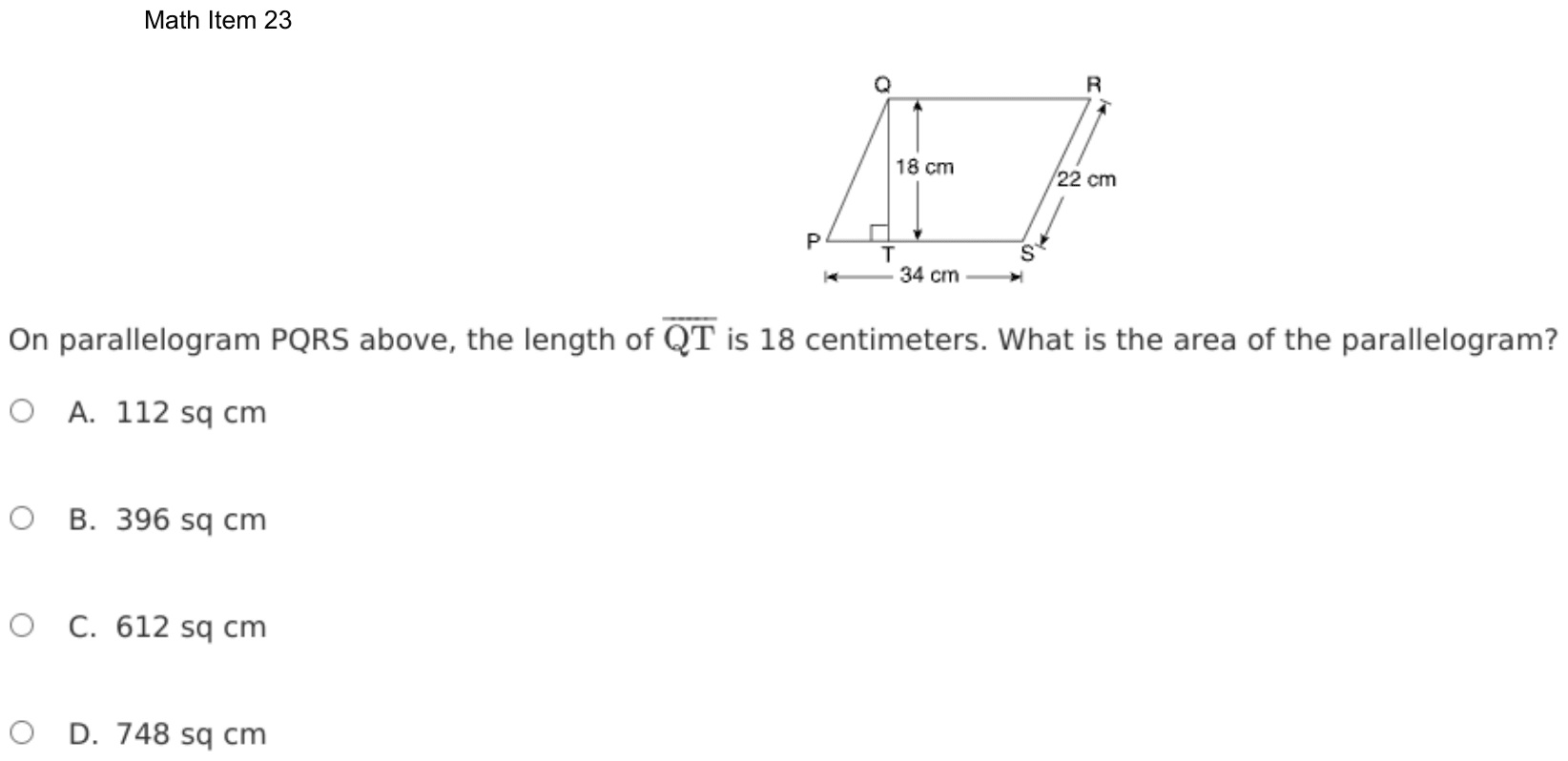
Question 22 of 120
2026 Practice Test C Math, question 26Question
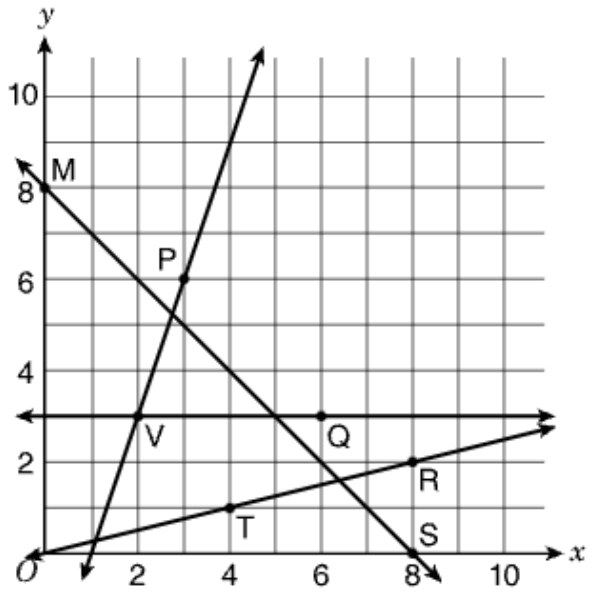
Which straight line is the graph of a proportional relationship?
- A
- B
- C
- D
Show the answer
Correct answer: D
The graph of any proportional line must intersect the origin, .
The only line on the coordinate plane that contains is .
Both point and point have a y-value that is of the x-value, and every point on the line fits the proportional equation .
When . So the line contains the origin, .
Question analysis
A coordinate grid shows four straight lines, each named by two labeled points such as M and S or V and Q, and students choose the one that is the graph of a proportional relationship. It tests recognizing proportional relationships on a graph. Every line is straight, so being straight is not enough, and the lines must be told apart by what defines proportionality.
- NYS standards
- 7.RP.2a testing for proportionality
- Grade level
- Grade 7 content, by NYS standard
- Compared with grade 7
- At grade 7 Deciding from a graph whether a relationship is proportional is a named grade 7 skill, and this is a typical case: four lines on a clean grid, each checked against the same rule, with no calculation needed.
- Estimated difficulty
- Routine: one familiar step, little to misread.
- Thinking it demands
- Depth of knowledge 1, recall and reproduction · mainly understand
- What makes it hard
- Solution
- 1 step
- Reading level
- Question and choices: about grade 9, 14 words.
- Corrected from the DOE handbook
- Coordinates and an equation in the explanation were corrected to match the graph.
- Students, last 30 days
- Not enough answers yet to show (it takes 10).
Why it is hard, traps and wrong answers (shows the answer)
Why it is hard
Once the origin rule is recalled, the graph answers the question at a glance: only the line from O through T and R starts at (0, 0). Students who think of proportional as any steady pattern have three other candidates, from the falling line through M and S to the flat line at height 3. The steep line through V and P is the closest call, because its lower end disappears near the corner where the axes meet.
Something you must already know minor Working it out
The rule that a proportional graph is a straight line through the origin is not printed, and all four lines are straight, so straightness alone rules none of them out. (Anderson & Krathwohl, 2001)
Reading a figure, table or graph minor Understanding the question
Line VP runs off the grid just right of O, crossing the x-axis at (1, 0), so whether it passes through the origin has to be read from the gridlines, not from its general direction. (Lesh, Post & Behr, 1987; Kirsch & Mosenthal, 1990)
Strategy: Recall what every proportional graph must look like, then test each line: see where it would be when x is 0, and whether y divided by x stays the same at both labeled points.
Traps
- Misunderstands the concept: A wrong belief about a concept: that percents can be added, that area grows like length, that averages can be averaged, that a bigger denominator means a bigger fraction.
- Misreads the figure: Reads a value, label or tick spacing in a figure, table or graph wrongly.
The wrong answers, classified
A Misunderstands the concept (Smith, diSessa & Roschelle, 1993; De Bock et al., 1998; Ni & Zhou, 2005)
Takes MS as proportional because it is straight and meets both axes, though it starts at (0, 8) and its y-values fall as x rises.
B Misreads the figure (Lesh, Post & Behr, 1987; Kirsch & Mosenthal, 1990)
Sees the steep line’s lower end vanish near O and assumes it passes through the origin, though VP crosses the x-axis at (1, 0).
C Misunderstands the concept (Smith, diSessa & Roschelle, 1993; De Bock et al., 1998; Ni & Zhou, 2005)
Mistakes the steady y-value of 3 along VQ for a constant of proportionality, though y ÷ x falls from 3/2 at V to 1/2 at Q.
What was corrected from the DOE handbook, and why
- Explanation: The DOE’s explanation says “Both point T (1, 4) and point R (2, 8) have a y-value that is 4 times the x-value, and every point on the line fits the proportional equation y = 4x”, and then “When x = 0, y = 4(0).” On the graph, T is at (4, 1) and R at (8, 2): each y-value is 1/4 of its x-value, and the line through the origin, T and R is y = (1/4)x. (The line y = 4x would pass through (1, 4) and (2, 8), which are not marked.) The 2022–23 guide, which first printed this question with the same graph, has the same slip. The site now gives T (4, 1) and R (8, 2), “a y-value that is 1/4 of the x-value”, y = (1/4)x, and y = (1/4)(0) at x = 0. The answer is unchanged: TR is still the only line through the origin.
Worked solution, step by step
Formulas used
- Proportional relationship
- y and x are two amounts that change together. k is the constant of proportionality: the number you always multiply x by to get y. When x is 0, y is k times 0, which is 0. So the graph is a straight line through the origin, the point (0, 0) where the axes meet.
Sort out the question
The grid shows four straight lines. Each one is named by two labeled points on it: line MS, line VP, line VQ and line TR.
You need the line that shows a proportional relationship. In that kind of relationship, y is always the same number times x. For example, y might always be 3 times x.
Recall what a proportional graph looks like
Use the rule . Put in 0 for x:
So every proportional graph goes through the origin. That is the corner point (0, 0), labeled O, where the two axes meet. The graph must also be a straight line.
All four lines here are straight. So being straight does not settle it. Look for the line through O.
Check where each line starts
- Line MS meets the y-axis at M (0, 8). When x is 0, y is 8, not 0.
- Line VP is steep. Its lower end crosses the x-axis at (1, 0), one unit to the right of O.
- Line VQ is flat at a height of 3. It never comes down to 0.
- Line TR starts at O and runs up through T and R.
Watch out: the lower end of line VP looks close to O. Follow it along the grid lines. It misses O by one unit, so choice B is wrong.
Test the ratio on line TR
In a proportional relationship, the ratio y ÷ x is the same at every point. T is at (4, 1) and R is at (8, 2):
Both give . So each y-value is of its x-value, and the line is .
Watch out: line VQ keeps the same y-value, 3, but not the same ratio. At V it is , and at Q it is . So choice C is wrong.
Give the answer
Line MS starts at 8 on the y-axis, so choice A is out too. Only line TR goes through the origin and keeps y ÷ x the same.
So the answer is D, line TR.
Check your answer
Put the origin into the rule for line TR: . So (0, 0) is on the line. Then test R: , which matches R (8, 2). The rule fits every labeled point on the line.
More questions like this
The original DOE question
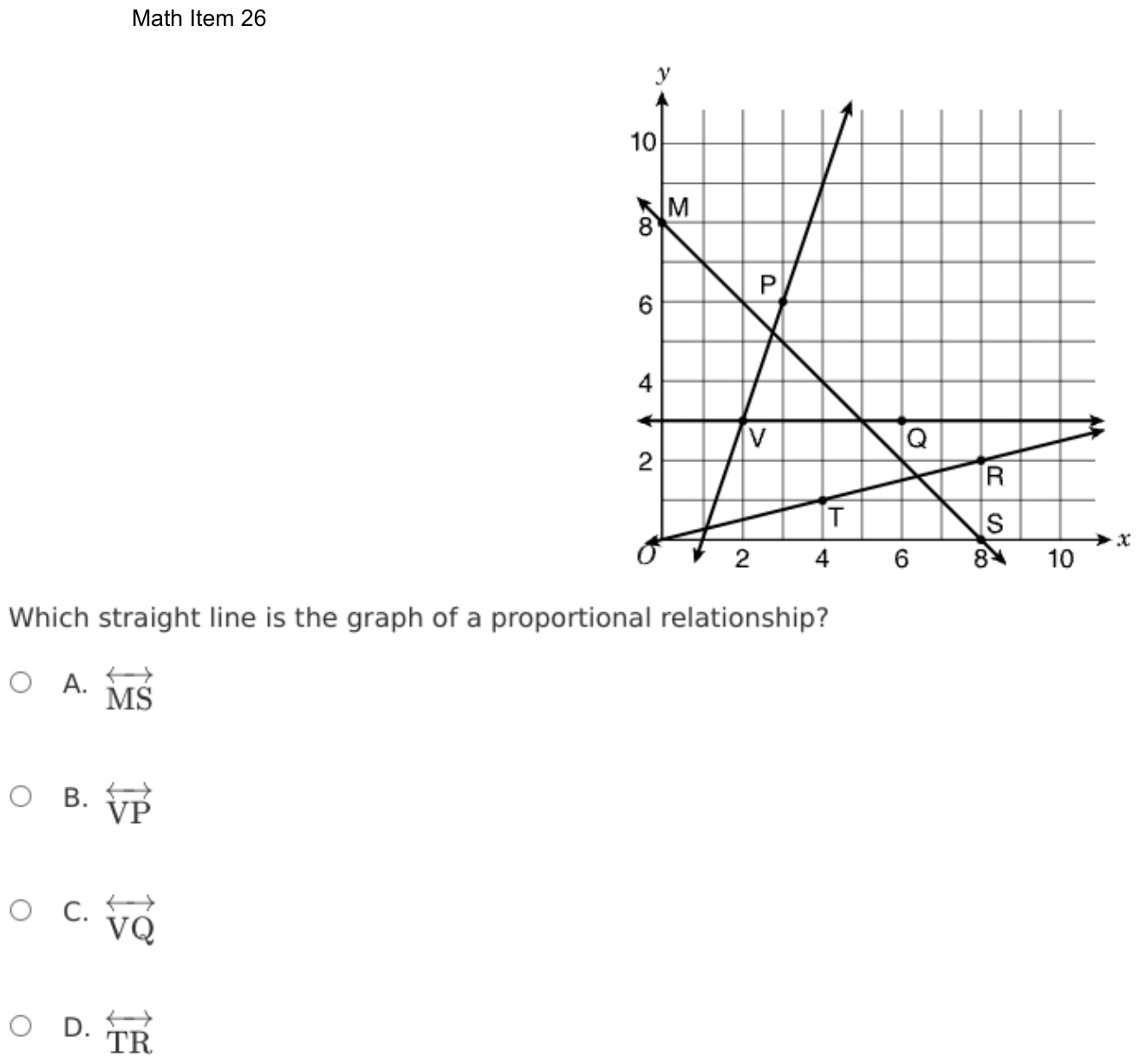
Question 23 of 120
2026 Practice Test C Math, question 32Question
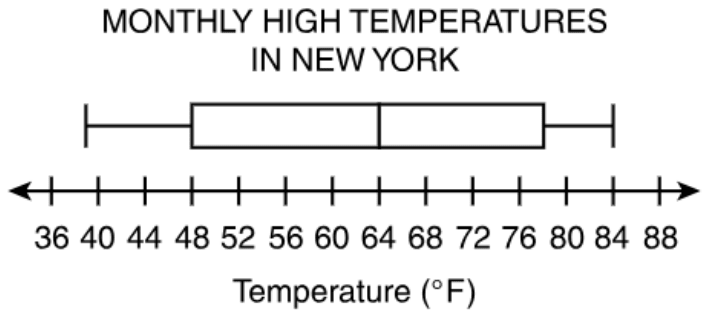
The box plot shows the average monthly high temperatures in New York City for 12 months. What is the difference between the range and the interquartile range of the temperature data?
Enter your answer in the space.
Fill-in question: work out the answer and type it as a number.
Show the answer
Correct answer: 15
Determine the range by subtracting the minimum value on the box plot from the maximum value on the box plot:
Maximum value , Minimum value
Determine the interquartile range by subtracting the lower quartile value on the box plot from the upper quartile value on the box plot:
Upper Quartile Value , Lower Quartile Value
Determine the difference between the range (45° F) and the interquartile range (30° F):
Question analysis
A box plot of New York City's average monthly high temperatures for 12 months sits above a number line labeled every 4 degrees. Students type the difference between the range and the interquartile range of the data. Two of the plot's values fall between labeled ticks, so careful reading of the scale decides the answer.
- Grade level
- Grade 7 content, by NYS standard
- Compared with grade 7
- Above grade 7 Reading a box plot and finding its interquartile range are grade 7 skills. Here two of the five values fall between ticks spaced 4 apart, and the range, the IQR and their difference must all be found and typed with no choices.
- Estimated difficulty
- Hard: combines ideas, needs a plan, and has more than one tempting wrong answer.
- Thinking it demands
- Depth of knowledge 2, skills and concepts · mainly apply
- What makes it hard
- Solution
- 3 steps
- Reading level
- Question and choices: about grade 7, 36 words.
- Students, last 30 days
- Not enough answers yet to show (it takes 10).
Why it is hard, traps and wrong answers (shows the answer)
Why it is hard
The method is standard, but the key rests on reading the scale between its labels. The axis is ticked only every 4 degrees, and the minimum and the upper quartile land off the ticks, so rounding either one to the nearest label moves the result by a degree or two with nothing to flag it. Students who find the range correctly can also stop there, entering 45, the larger of the two spreads, instead of the difference the question asks for.
Reading a figure, table or graph major Understanding the question
Two of the five values fall between ticks spaced 4 degrees apart: the left whisker ends just short of the 40 tick, at 39, and the box’s right edge sits midway between 76 and 80, at 78. (Lesh, Post & Behr, 1987; Kirsch & Mosenthal, 1990)
Many steps minor Working it out
Four values are read and combined in three subtractions, the range, the interquartile range and then their difference, so one misread value changes the final entry. (Daniel & Embretson, 2010; Enright, Morley & Sheehan, 2002)
Something you must already know minor Working it out
Neither measure is defined on the page: the range spans the whiskers, and the interquartile range is the width of the box, the upper quartile minus the lower. (Anderson & Krathwohl, 2001)
An answer in an unexpected form minor Choosing the answer
The result is typed with no choices to compare, so an entry one or two degrees off, from rounding a value to the nearest tick, looks just as finished as the right one. (Enright, Morley & Sheehan, 2002)
Strategy: Read the minimum, both quartiles and the maximum, judging where each mark falls between the ticks, then subtract for the range and for the IQR, and subtract those two results.
Traps
- Misreads the figure: Reads a value, label or tick spacing in a figure, table or graph wrongly.
- Stops one step early: A choice is a number from partway through the solution.
The wrong answers, classified
14 Misreads the figure (Lesh, Post & Behr, 1987; Kirsch & Mosenthal, 1990)
Reads the left whisker’s end as 40, the nearest labeled tick, instead of 39, so the range becomes 84 − 40 = 44 and 44 − 30 = 14.
45 Stops one step early (King et al., 2004; Gierl et al., 2017)
Finds the range, 84 − 39 = 45 degrees, and enters it, stopping before the interquartile range of 30 is subtracted from it.
17 Misreads the figure (Lesh, Post & Behr, 1987; Kirsch & Mosenthal, 1990)
Reads the box’s right edge as 76, the tick just left of it, instead of 78, so the IQR becomes 76 − 48 = 28 and 45 − 28 = 17.
Worked solution, step by step
Formulas used
- Range
- The maximum is the greatest value, at the right end of the right whisker. The minimum is the least value, at the left end of the left whisker. The range tells how far the whole set of data spreads.
- Interquartile range (IQR)
- Q3 is the upper quartile, the right edge of the box. Q1 is the lower quartile, the left edge of the box. The IQR is the width of the box. It tells how far the middle half of the data spreads.
Sort out the question
A box plot shows data with five numbers. The two whiskers are the lines on each side of the box. Their ends are the minimum, the least value, and the maximum, the greatest. The box runs from the lower quartile to the upper quartile. These are the middles of the lower half and the upper half of the data. The line inside the box is the median, the middle value.
You need the range minus the interquartile range (IQR), in degrees.
Read the values between the ticks
The ticks on the number line are 4 degrees apart. So each degree is one quarter of the space between two ticks. Three values sit right on ticks: the box’s left edge at 48, the median at 64, and the right whisker’s end at 84.
- The left whisker starts just left of the 40 tick. It sits about one quarter of the way back toward 36. So the minimum is degrees.
- The box’s right edge is halfway between 76 and 80. Halfway is 78 degrees.
Find the range
Use the range formula:
The data spread over 45 degrees.
Watch out: rounding the minimum to the 40 tick gives a range of 44. Then the final answer comes out 14, which is wrong.
Find the IQR
Use the IQR formula with the two edges of the box:
The middle half of the data spreads over 30 degrees.
Watch out: reading the box’s right edge as 76 gives an IQR of 28. Then the final answer comes out 17.
Subtract the IQR from the range
The question asks for the difference between the two:
Watch out: 45 is only the range. Do not stop there. Type only the number, with no degree sign.
So you would enter 15.
Check your answer
The range covers the whole plot, and the IQR covers only the box. So their difference is the two whiskers added together. The left whisker is degrees long. The right whisker is degrees long. , which matches.
More questions like this
The original DOE question
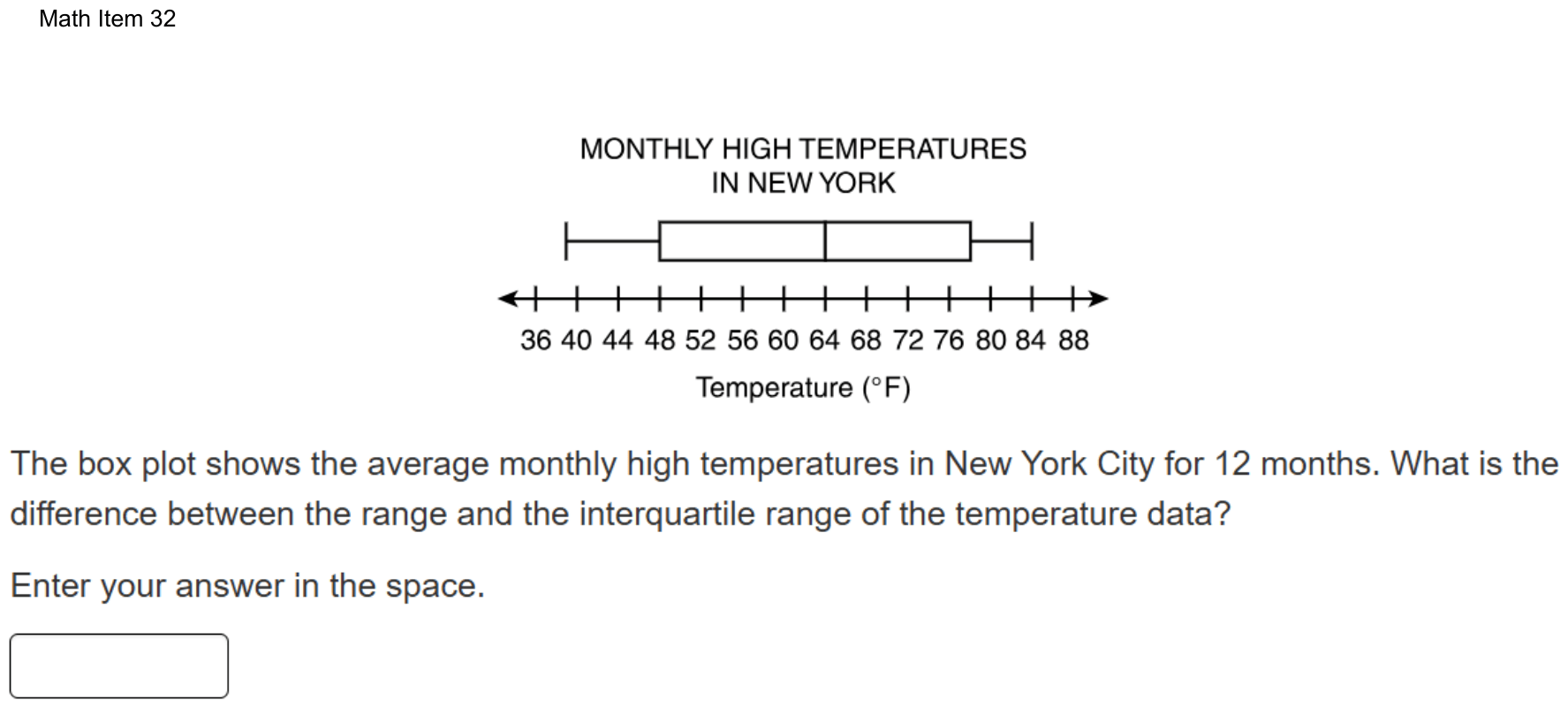
Question 24 of 120
2026 Practice Test C Math, question 33Question
A bag contains 40 tiles that are either red, green, or blue. A tile is selected at random, the color is recorded, and the tile is put back in the bag. This process is carried out 120 times, and 18 of those times a red tile is selected. Based on the information, what is the most likely number of red tiles in the bag?
- A6
- B15
- C18
- D30
Show the answer
Correct answer: A
First, determine what fraction of the sample were red tiles, given 18 of the 120 tiles drawn were red.
To predict how many of the actual 40 tiles in the bag are red, multiply 40 by the fraction of red tiles in the sample.
Question analysis
A bag holds 40 red, green and blue tiles, and a tile is drawn and put back 120 times, with red coming up 18 times. Students predict the most likely number of red tiles in the bag. It tests using experimental results to estimate what is in the bag, and the draws outnumber the tiles, which can confuse the scaling.
- Grade level
- Grade 6 content, by NYS standard
- Compared with grade 7
- At grade 7 Predicting from repeated trials is grade 6 probability, and grade 7 students make similar estimates from samples. The twist is scaling down, from 120 draws to a bag of 40 tiles, rather than up to a larger group.
- Estimated difficulty
- Straightforward: two steps or one careful reading.
- Thinking it demands
- Depth of knowledge 2, skills and concepts · mainly apply
- What makes it hard
- Solution
- 2 steps
- Reading level
- Question and choices: about grade 6, 61 words.
- Students, last 30 days
- Not enough answers yet to show (it takes 10).
Why it is hard, traps and wrong answers (shows the answer)
Why it is hard
There are more draws than tiles, which is what makes this unusual: the 120 draws must be scaled down to a bag of 40, not up to a bigger group. Red came up 18 times because each tile went back in the bag, so 18 is not a count of red tiles. Since there are three draws for every tile, dividing the 18 red draws by 3 gives the same estimate as taking 3/20 of 40.
Turning words into math minor Understanding the question
The 18 red draws come from 120 draws with the tile put back each time, so they give a share, 3/20, to take of the 40 tiles, not a count of red tiles. (Hegarty, Mayer & Monk, 1995; Koedinger & Nathan, 2004)
Something you must already know minor Working it out
Students must know that the share of red in repeated draws estimates the share of red tiles in the bag; the stem never says to multiply 40 by that share. (Anderson & Krathwohl, 2001)
Strategy: Write the red draws as a fraction of all 120 draws, simplify it, and take that same fraction of the 40 tiles in the bag.
Traps
- Stops one step early: A choice is a number from partway through the solution.
- Numbers taken from the question: Combines the numbers in the question without a model of the situation, or is simply a number that appears in the question.
The wrong answers, classified
B Stops one step early (King et al., 2004; Gierl et al., 2017)
Finds that red came up in 18 of 120 draws, or 15%, and gives 15 as the count, stopping before taking that share of the 40 tiles.
C Numbers taken from the question (Hegarty, Mayer & Monk, 1995)
Gives 18, the number of times red was drawn, as the number of red tiles, though each tile went back and could be drawn many times.
D Little reason to choose it (Haladyna & Downing, 1993; Rodriguez, 2005)
No working from 18 red draws in 120 gives 30 red tiles, three quarters of the bag, when red came up in fewer than one draw in six.
Worked solution, step by step
Formulas used
- Predicting from repeated draws
- The fraction is the share of draws that came up red. That share is your best guess for the share of tiles that are red. Multiply it by the number of tiles in the bag to predict the red tiles. The sign ≈ means about equal.
Sort out the question
The bag has 40 tiles, each red, green or blue. A tile is drawn, its color is written down, and it goes back in the bag. This happens 120 times, and red comes up 18 times.
You need the most likely number of red tiles in the bag.
See why 18 is not the answer
Each tile goes back in the bag after it is drawn. So the same red tile can be drawn again and again. That means 18 counts draws, not tiles.
Watch out: choice C, 18, mixes up the number of red draws with the number of red tiles.
Find the share of red draws
Red came up 18 times out of 120. Simplify by dividing the top and bottom by 6:
As a decimal, that is 0.15, or 15%.
Watch out: 15 is a percent here, not a number of tiles. Stopping now gives choice B.
Take that share of the bag
Use the same share of the 40 tiles in the bag:
So about 6 of the 40 tiles are red.
Give the answer
The best prediction is 6 red tiles. The other 34 tiles are probably green or blue.
So the answer is A, 6.
Check your answer
There were 120 draws for 40 tiles. That is 3 draws for every tile. So divide the red draws by 3: . Same answer. Choice D, 30 red tiles, would be three quarters of the bag. Then red would come up far more than 18 times.
More questions like this
The original DOE question
Question 25 of 120
2026 Practice Test C Math, question 42Question
Tariq is making a clay block in the shape of a cube with a side length of . He hollows out the center by removing clay to form a rectangular prism-shaped hole with a base of and a height of .
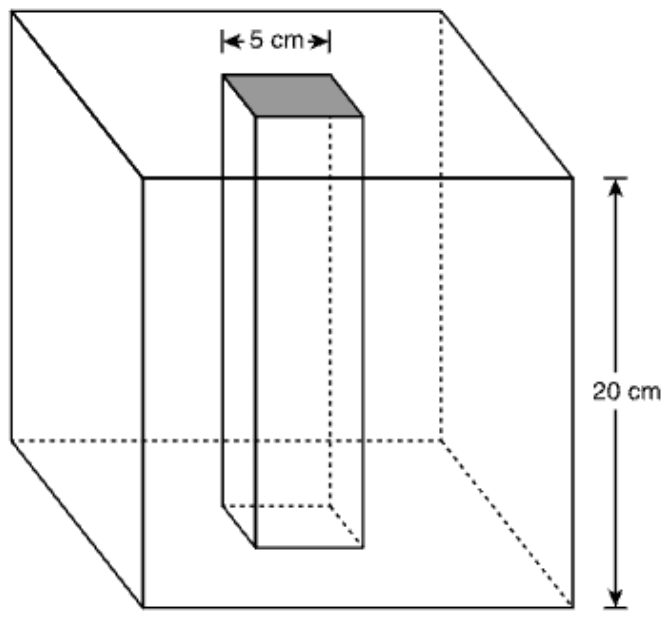
What is the volume, in cubic centimeters, of the block after the clay is removed from the center?
Enter your answer in the space.
Fill-in question: work out the answer and type it as a number.
Show the answer
Correct answer: 7,500
First, find the volume of the cube using the formula .
The length, width, and height of the cube are each equal to 20 cm.
Next, find the volume of the cut-out square prism, with equal length and width of 5 cm and height of 20 cm.
Finally, subtract the volume of the prism from the volume of the cube.
Question analysis
Tariq makes a clay cube 20 centimeters on each side and removes a rectangular prism from its center, with a 5 cm by 5 cm base and a height of 20 cm. Students type the volume of the block that is left, in cubic centimeters. It tests the volume of rectangular prisms, and the hole's size must be read carefully from the words and figure.
- Grade level
- Grade 7 content, by NYS standard
- Compared with grade 7
- At grade 7 Finding the volume of a solid made from rectangular prisms, here by taking one away, is named in the grade 7 standards. This is a direct case with whole numbers, two volumes and one subtraction.
- Estimated difficulty
- Straightforward: two steps or one careful reading.
- Thinking it demands
- Depth of knowledge 1, recall and reproduction · mainly apply
- What makes it hard
- Solution
- 3 steps
- Reading level
- Question and choices: about grade 8, 66 words.
- Students, last 30 days
- Not enough answers yet to show (it takes 10).
Why it is hard, traps and wrong answers (shows the answer)
Why it is hard
This is a direct composite-volume problem with whole numbers: one cube, one hole, one subtraction. What it checks is that both volumes are real volumes, the hole as tall as the cube, and that the subtraction is done at the end. Students who stop at the hole’s volume, or who subtract only the square face, give amounts that are easy to type and hard to doubt without choices.
Something you must already know minor Working it out
The volume of a rectangular prism, length times width times height, is not given, and it is needed twice, once for the 20 cm cube and once for the hole. (Anderson & Krathwohl, 2001)
Reading a figure, table or graph minor Understanding the question
The figure labels only the 5 cm opening and the cube’s 20 cm edge; the hole’s 20 cm height comes from the words, while the drawing shows it reaching from top to bottom. (Lesh, Post & Behr, 1987; Kirsch & Mosenthal, 1990)
An answer in an unexpected form minor Choosing the answer
The volume is typed with no choices to compare, so the hole’s 500 cubic centimeters or the cube’s 8,000 can be entered without any warning. (Enright, Morley & Sheehan, 2002)
Strategy: Find the volume of the full cube, then the volume of the square hole that runs from the top face to the bottom, and subtract the hole from the cube.
Traps
- Answers a different question: A choice is right for another quantity: the other unknown, the rest instead of the part, the part instead of the whole.
- Misreads the figure: Reads a value, label or tick spacing in a figure, table or graph wrongly.
- Wrong formula: Uses a related but wrong formula: perimeter for area, diameter for radius, area for volume, or a misremembered one.
The wrong answers, classified
500 Answers a different question (King et al., 2004; Hegarty, Mayer & Monk, 1995)
Finds the volume of the hole, 5 × 5 × 20 = 500 cubic centimeters, and gives the clay removed instead of the clay that is left.
7,875 Misreads the figure (Lesh, Post & Behr, 1987; Kirsch & Mosenthal, 1990)
Treats the hole as a 5 cm cube, 5 × 5 × 5 = 125, though it runs the full 20 cm height, so 8,000 − 125 = 7,875.
7,975 Wrong formula (King et al., 2004)
Subtracts only the area of the square opening, 5 × 5 = 25, from the cube’s 8,000, mixing a face’s area with the hole’s volume.
Worked solution, step by step
Formulas used
- Volume of a rectangular prism
- V is the volume, the space inside a solid. l is the length, w is the width and h is the height. A cube is a prism with all three the same. Volume is measured in cubic centimeters, tiny cubes 1 cm on each side.
Sort out the question
Tariq’s block starts as a cube 20 cm on each side. He removes a hole shaped like a rectangular prism, a box shape with flat rectangle sides. Its base is 5 cm by 5 cm, and its height is 20 cm. The figure shows it running from the top face to the bottom face.
You need the volume of the clay that is left, in cubic centimeters.
Find the volume of the cube
Use the volume formula. The length, width and height are all 20 cm:
The full cube holds 8,000 cubic cm of clay.
Find the volume of the hole
The hole is a prism too. Its length and width are 5 cm, and its height is 20 cm:
So 500 cubic cm of clay are removed.
Watch out: the hole is 20 cm tall, not 5 cm. Treating it as a small 5 cm cube gives 125 and the wrong answer 7,875. And 5 × 5 = 25 is only the area of the opening, not a volume. Subtracting it gives 7,975, also wrong.
Subtract the hole from the cube
The clay left is the cube minus the hole:
The block has 7,500 cubic cm of clay left.
Watch out: 500 is the clay taken out, not the clay that is left.
Enter the number
Type only the number, with no units. You can type 7500 or 7,500.
So you would enter 7,500.
Check your answer
Think of the cube as 20 flat layers, each 1 cm thick. Each layer is a 20 by 20 square, 400 square cm, with a 5 by 5 hole, 25 square cm. So each layer holds cubic cm of clay. Then . It matches.
More questions like this
The original DOE question
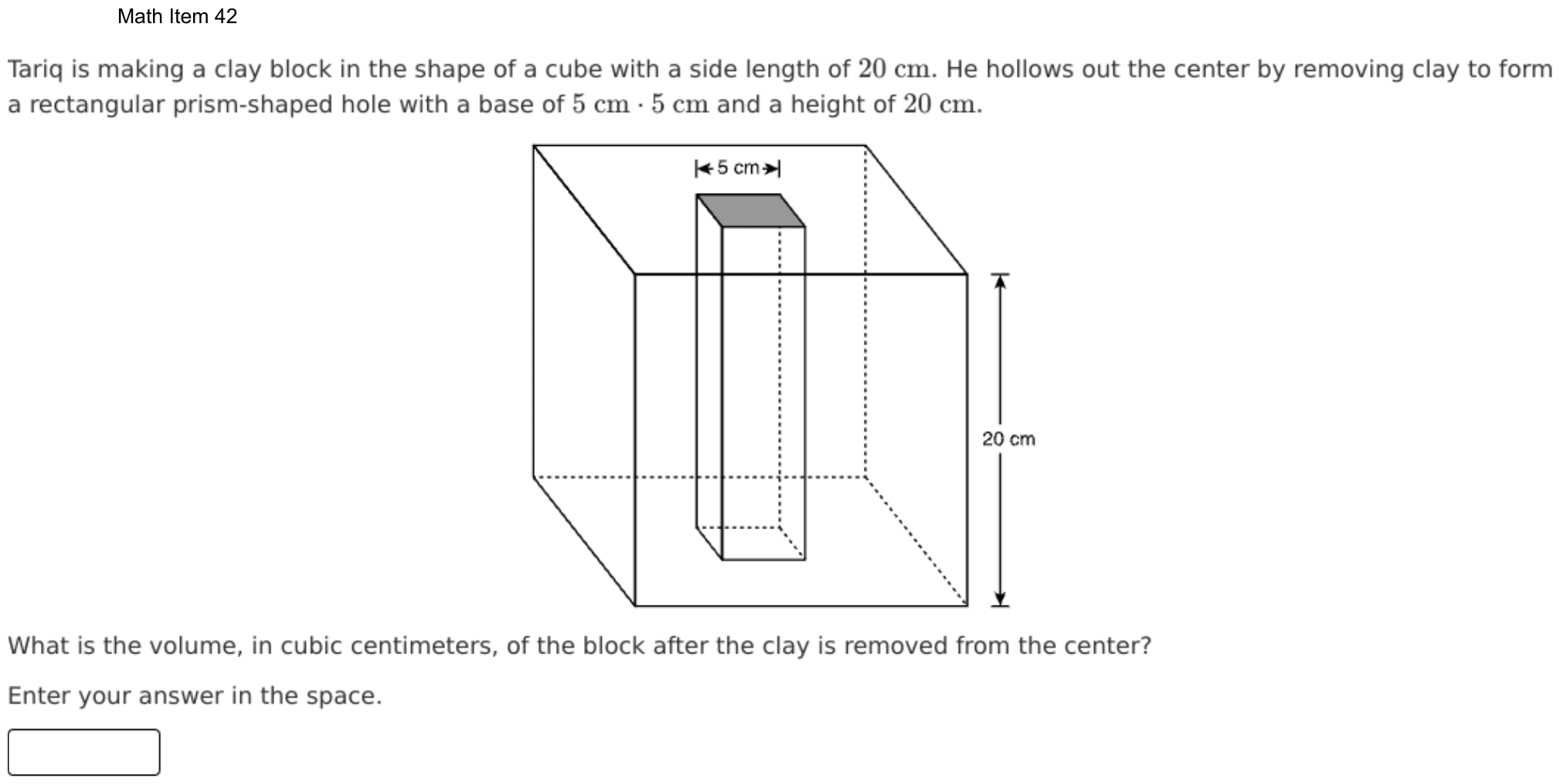
Question 26 of 120
2026 Practice Test C Math, question 43Question
A softball player bought bottles of water for her team to have at practice. The total number of bottles she bought, b, is proportional to n, the number of players at practice. Which equation represents the relationship between b and n? The constant of proportionality is p.
- A
- B
- C
- D
Show the answer
Correct answer: A
In this context, the constant of proportionality, p, represents the relationship between b, the number of bottles of water, and n, the number of players on the team.
The number of bottles of water is the product of the constant of proportionality and the number of players.
The equation that represents this relationship is .
Question analysis
A softball player buys bottles of water for practice, and the number of bottles, b, is proportional to the number of players, n, with constant of proportionality p. Students choose the equation that represents the relationship. It tests writing an equation for a proportional relationship using letters only, so the meaning of proportional has to be clear.
- NYS standards
- 7.RP.2c proportional relationship equations
- Grade level
- Grade 7 content, by NYS standard
- Compared with grade 7
- Below grade 7 Grade 7 students write equations for proportional relationships from tables, graphs and descriptions, usually with a number to find. Here the constant is already given as a letter, so only the general form must be recalled, a short task.
- Estimated difficulty
- Routine: one familiar step, little to misread.
- Thinking it demands
- Depth of knowledge 1, recall and reproduction · mainly remember
- What makes it hard
- Solution
- 1 step
- Reading level
- Question and choices: about grade 7, 51 words.
- Students, last 30 days
- Not enough answers yet to show (it takes 10).
Why it is hard, traps and wrong answers (shows the answer)
Why it is hard
This is a recall question dressed in a short story: the softball team adds nothing but names for the letters. The one idea needed is that proportional means multiplied by a constant, so doubling the players doubles the bottles. Students who think of a constant as something added, or as a fixed total, are drawn to the two sums that use the same letters.
Something you must already know minor Working it out
The general form of a proportional relationship, one amount equal to the constant times the other, has to be recalled; the stem names p but never says it multiplies. (Anderson & Krathwohl, 2001)
Variables instead of numbers minor Understanding the question
No numbers are given, only b, n and p, so a choice cannot be checked by computing unless students make up a case, such as 2 bottles per player for 10 players. (Koedinger & Nathan, 2004; Enright, Morley & Sheehan, 2002)
Strategy: Recall how two proportional quantities are linked through the constant of proportionality, then test each choice with sample numbers: if the players double, the bottles should double too.
Traps
- Misunderstands the concept: A wrong belief about a concept: that percents can be added, that area grows like length, that averages can be averaged, that a bigger denominator means a bigger fraction.
The wrong answers, classified
B Misunderstands the concept (Smith, diSessa & Roschelle, 1993; De Bock et al., 1998; Ni & Zhou, 2005)
Treats proportional as adding a fixed amount, so the bottles would be the players plus p, rather than the players multiplied by a constant.
C Misunderstands the concept (Smith, diSessa & Roschelle, 1993; De Bock et al., 1998; Ni & Zhou, 2005)
Takes the constant of proportionality as the total of bottles and players, confusing a constant sum with a constant ratio.
D Little reason to choose it (Haladyna & Downing, 1993; Rodriguez, 2005)
Puts all three letters into one sum equal to 1, an equation that uses the right letters but matches no idea of proportion, so it mostly draws guesses.
Worked solution, step by step
Formulas used
- Proportional relationship
- y and x are two amounts that change together. k is the constant of proportionality, the number you always multiply x by to get y. Because it is a multiplication, doubling x doubles y.
Sort out the question
The letter b is the number of bottles, and n is the number of players. The bottles are proportional to the players. The constant of proportionality is p.
You need the equation that links b and n. There are no numbers, only letters.
Recall what proportional means
Proportional means one amount is always a fixed number times the other. For example, say there are 2 bottles for each player. Then 10 players need 20 bottles, and 20 players need 40 bottles. Doubling the players doubles the bottles.
The fixed number, here 2, is the constant of proportionality.
Write it with these letters
Start with the rule . The bottles take the place of y, the players take the place of x, and p is the constant:
Here pn means p times n.
Check the other choices
Watch out: choice B, , adds instead of multiplying. With p = 2, 10 players give 12 bottles. Then 20 players give 22, which is not double.
Choice C makes p a total of bottles and players, not a multiplier. Choice D makes all three letters add up to 1, which does not fit at all.
Give the answer
Only multiplies the players by a constant. So it is the only choice where doubling the players doubles the bottles.
So the answer is A, .
Check your answer
Try p = 3 bottles per player. With 5 players, . With 10 players, . Twice the players, twice the bottles. Also, , so b ÷ n gives back the constant.
More questions like this
The original DOE question
Question 27 of 120
2026 Practice Test C Math, question 45Question
Malik earns $10 per hour at his job. He wants to change to a job that will pay $12 per hour. What will be the percent increase in Malik’s hourly pay if he makes this job change?
- A2%
- B20%
- C83%
- D120%
Show the answer
Correct answer: B
Subtract to determine the amount of increase in Malik’s hourly pay if he changes jobs.
Divide the increase amount by the original hourly pay rate.
Multiply the quotient by 100 to express the decimal amount as a percentage.
Question analysis
Malik earns $10 an hour and wants to switch to a job that pays $12 an hour. Students find the percent increase in his hourly pay. It tests finding a percent change. The numbers are easy, so the challenge is knowing which amounts to compare and how to turn that comparison into a percent.
- NYS standards
- 7.RP.3 multistep ratio and percent problems
- Grade level
- Grade 7 content, by NYS standard
- Compared with grade 7
- At grade 7 Percent increase is grade 7 content, and this case uses whole-dollar wages that make the arithmetic easy. The demand is comparing the change with the right amount rather than reporting the change itself or a ratio of the wages.
- Estimated difficulty
- Straightforward: two steps or one careful reading.
- Thinking it demands
- Depth of knowledge 2, skills and concepts · mainly apply
- What makes it hard
- Solution
- 2 steps
- Reading level
- Question and choices: about grade 2, 35 words.
- Students, last 30 days
- Not enough answers yet to show (it takes 10).
Why it is hard, traps and wrong answers (shows the answer)
Why it is hard
The numbers could hardly be friendlier, a $2 raise on $10, so the question checks what to divide by what. Dividing $12 by $10 gives 1.2, the new pay as a percent of the old, and stopping there is tempting because the division feels like the whole job. Reading the $2 itself as 2% is the other quick error, since dollars of change are not percent of change.
Something you must already know minor Working it out
The rule for percent change, the change divided by the starting amount, is not given, and each wrong choice comes from a different comparison of the $10 and the $12. (Anderson & Krathwohl, 2001)
Turning words into math minor Understanding the question
“Percent increase in Malik’s hourly pay” has to be read as the $2 rise measured against the $10 he earns now, not as the new wage compared with the old. (Hegarty, Mayer & Monk, 1995; Koedinger & Nathan, 2004)
Strategy: Find how many dollars the hourly pay goes up, then divide that change by the pay Malik earns now and write the result as a percent.
Traps
- Answers a different question: A choice is right for another quantity: the other unknown, the rest instead of the part, the part instead of the whole.
- Misunderstands the concept: A wrong belief about a concept: that percents can be added, that area grows like length, that averages can be averaged, that a bigger denominator means a bigger fraction.
- Wrong operation: Adds instead of multiplying, divides the wrong way round, turns a ratio or rate upside down, or undoes a step in the wrong direction (subtracts what should be added back).
The wrong answers, classified
A Misunderstands the concept (Smith, diSessa & Roschelle, 1993; De Bock et al., 1998; Ni & Zhou, 2005)
Finds the $2 increase and reads it as 2%, as if a change in dollars were a percent, without dividing it by the original $10.
C Wrong operation (Hegarty, Mayer & Monk, 1995; King et al., 2004)
Divides the old pay by the new, 10 ÷ 12 ≈ 0.83, turning the ratio of the wages upside down and reporting 83%.
D Answers a different question (King et al., 2004; Hegarty, Mayer & Monk, 1995)
Divides the new pay by the old, 12 ÷ 10 = 1.2, which gives the new wage as a percent of the old, not the increase.
Worked solution, step by step
Formulas used
- Percent increase
- The original is the amount before the change. The new amount is the amount after it. The top is how much it went up. Dividing by the original compares the change with where you started. Multiplying by 100 makes it a percent.
Sort out the question
Malik earns $10 an hour now. The new job pays $12 an hour. You need the percent increase.
That means: how much does his pay go up, compared with what he earns now? So $10 is the original amount, and $12 is the new amount.
Find the increase in dollars
Subtract the old pay from the new pay:
His pay goes up by $2 an hour.
Watch out: $2 is an amount of money, not a percent. Calling it 2% gives choice A.
Compare the increase with the original
Use the percent increase formula. Divide the $2 by the original $10, then multiply by 100:
So the pay goes up by 20%.
Watch out: is 120%, choice D. That is the new pay as a percent of the old, not the increase. And is about 83%, choice C, which is upside down.
Give the answer
The $2 raise is 20% of Malik’s current pay.
So the answer is B, 20%.
Check your answer
Work forward. 20% of $10 is dollars. Add that to $10, and you get $12, the new pay. It works. Note that 120% is the new pay compared with the old pay, which is the same as a 20% increase.
More questions like this
The original DOE question
Question 28 of 120
2026 Practice Test C Math, question 47Question
The height of a plant, in millimeters, is proportional to the number of days the plant has grown. The plant has grown 20 millimeters in 8 days. What is the constant of proportionality, in millimeters per day?
- A0.4
- B2.5
- C12
- D20
Show the answer
Correct answer: B
The constant of proportionality is determined by dividing the number of millimeters by the number of days:
Question analysis
A plant's height in millimeters is proportional to the number of days it has grown, and it grew 20 millimeters in 8 days. Students find the constant of proportionality in millimeters per day. It tests finding a unit rate, and the order of the division decides whether the rate comes out in the units asked for.
- Grade level
- Grade 7 content, by NYS standard
- Compared with grade 7
- Below grade 7 Finding a constant of proportionality from one pair of values is a basic grade 7 skill. With one division and the units named in the question, it asks less than most grade 7 problems.
- Estimated difficulty
- Routine: one familiar step, little to misread.
- Thinking it demands
- Depth of knowledge 1, recall and reproduction · mainly apply
- What makes it hard
- Solution
- 1 step
- Reading level
- Question and choices: about grade 7, 35 words.
- Students, last 30 days
- Not enough answers yet to show (it takes 10).
Why it is hard, traps and wrong answers (shows the answer)
Why it is hard
One division gives the constant, and the question itself names the order by asking for millimeters per day. The tempting slip is dividing the smaller number by the larger, 8 by 20, out of habit, which gives a rate in days per millimeter. A plant that grows 20 millimeters in 8 days grows more than 2 millimeters a day, a quick sense check on any result.
Something you must already know minor Working it out
Students must know that the constant is the height divided by the days; the units in the question, millimeters per day, name the order of the division. (Anderson & Krathwohl, 2001)
Strategy: Use the units in the question, millimeters per day, as the instruction: divide the millimeters grown by the number of days.
Traps
- Wrong operation: Adds instead of multiplying, divides the wrong way round, turns a ratio or rate upside down, or undoes a step in the wrong direction (subtracts what should be added back).
- Numbers taken from the question: Combines the numbers in the question without a model of the situation, or is simply a number that appears in the question.
The wrong answers, classified
A Wrong operation (Hegarty, Mayer & Monk, 1995; King et al., 2004)
Divides the days by the millimeters, 8 ÷ 20 = 0.4, which gives days per millimeter, the rate turned upside down.
C Numbers taken from the question (Hegarty, Mayer & Monk, 1995)
Subtracts the days from the millimeters, 20 − 8 = 12, combining the two numbers without thinking about a rate.
D Numbers taken from the question (Hegarty, Mayer & Monk, 1995)
Gives the 20 millimeters the plant grew over all 8 days, the total growth, rather than the growth for each single day.
Worked solution, step by step
Formulas used
- Constant of proportionality
- Here y is the height in millimeters, and x is the number of days. k is the growth in one day, in millimeters per day. In a proportional relationship, y = kx, so dividing y by x gives k.
Sort out the question
The plant’s height is proportional to the number of days it grows. It grew 20 millimeters (mm) in 8 days.
You need the constant of proportionality in millimeters per day. Per day means for each day. So you need how much the plant grows in one day.
Divide millimeters by days
The units tell you the order: millimeters per day means millimeters divided by days. Use the formula:
So the plant grows 2.5 mm each day.
Avoid the tempting slips
Watch out: , choice A, is days per millimeter. That is the rate upside down.
Choice C, 12, comes from . Subtracting does not make a rate. Choice D, 20, is the growth over all 8 days, not one day.
Give the answer
The constant of proportionality is 2.5 mm per day.
So the answer is B, 2.5.
Check your answer
Multiply back. At 2.5 mm a day for 8 days, the plant grows mm. That matches. Also, 2 mm a day would give only 16 mm, and 3 mm a day would give 24 mm. So the rate must be between 2 and 3.
More questions like this
The original DOE question
Question 29 of 120
2026 Practice Test C Math, question 49Question
The box plot illustrates the number of hours eighth-grade students spend on screens during a typical week. What is the difference between the range and the interquartile range (IQR) of the screen time data?
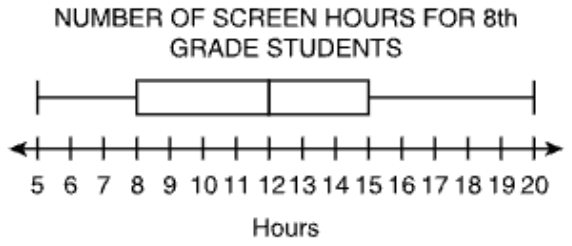
Move the correct answer to each box. Not all answers will be used.
The range of screen time hours is hours.
The IQR is hours.
The difference between the range and the IQR is hours.
On the test you drag tiles into the boxes; here, choose each box’s tile from its menu. Each tile can be used once. The DOE has not published how answers with several parts are scored; this site counts one right only when every part is right.
Show the answer
Correct answer: blank 1: 15; blank 2: 7; blank 3: 8
Determine the range by subtracting the minimum value on the box plot from the maximum value on the box plot:
Maximum value , Minimum value
Determine the interquartile range by subtracting the lower quartile value on the box plot from the upper quartile value on the box plot:
Upper Quartile Value , Lower Quartile Value
Determine the difference between the range (15 hr) and the interquartile range (7 hr):
Question analysis
A box plot shows how many hours a week eighth-grade students spend on screens, on a number line marked every hour. Students move number tiles to complete three sentences: the range, the interquartile range, and the difference between them. Each tile can be used only once, and keeping the range and the interquartile range apart is the tricky part.
- Grade level
- Grade 7 content, by NYS standard
- Compared with grade 7
- At grade 7 Reading a box plot and finding its range and interquartile range are grade 7 statistics skills. The values sit on labeled whole-number ticks and the three sentences lead through the steps, a typical grade 7 task.
- Estimated difficulty
- Straightforward: two steps or one careful reading.
- Thinking it demands
- Depth of knowledge 2, skills and concepts · mainly apply
- What makes it hard
- Something you must already know minor
- Many steps minor
- Solution
- 3 steps
- Reading level
- Question and choices: about grade 4, 69 words.
- Corrected from the DOE handbook
- A missing comma in the explanation was restored.
- Students, last 30 days
- Not enough answers yet to show (it takes 10).
Why it is hard, traps and wrong answers (shows the answer)
Why it is hard
The plot is drawn on whole-hour ticks, and the three sentences lay out the steps, so this is a direct check of two definitions. The main risk is taking a value off the plot, such as the lower quartile of 8, for a spread between two values. Because the four tiles allow only one use each, a student who confuses the measures can still fill every box, which hides the error.
Something you must already know minor Working it out
The sentences name the range and the IQR but never define them; students must know the range spans the whiskers and the IQR spans only the box. (Anderson & Krathwohl, 2001)
Many steps minor Working it out
Three boxes must all be right, the third depends on the first two, and each tile can be used once, so one mix-up spreads to a second box. (Daniel & Embretson, 2010; Enright, Morley & Sheehan, 2002)
Strategy: Read the five key values off the plot, subtract the least from the greatest for the range, subtract the lower quartile from the upper for the IQR, then subtract those results.
Traps
- Misunderstands the concept: A wrong belief about a concept: that percents can be added, that area grows like length, that averages can be averaged, that a bigger denominator means a bigger fraction.
- Wrong formula: Uses a related but wrong formula: perimeter for area, diameter for radius, area for volume, or a misremembered one.
The wrong answers, classified
DCB Misunderstands the concept (Smith, diSessa & Roschelle, 1993; De Bock et al., 1998; Ni & Zhou, 2005)
Takes the lower quartile, 8, as the interquartile range, reading a value off the box instead of its width, so the difference becomes 15 − 8 = 7.
BDC Wrong formula (King et al., 2004)
Swaps the two measures, giving the box’s width, 7, as the range and the whiskers’ spread, 15, as the IQR, while the difference stays 8.
What was corrected from the DOE handbook, and why
- Explanation: The DOE’s explanation runs two values together: “Maximum value = 20 hr Minimum value = 5 hr”. Its next line is “Upper Quartile Value = 15 hr, Lower Quartile Value = 8 hr”, and Question 32’s explanation has “Maximum value = 84° F, Minimum value = 39° F”. The site adds the comma.
Worked solution, step by step
Formulas used
- Range
- The maximum is the greatest value, at the right end of the right whisker. The minimum is the least value, at the left end of the left whisker. The range tells how far the whole set of data spreads.
- Interquartile range (IQR)
- Q3 is the upper quartile, the right edge of the box. Q1 is the lower quartile, the left edge of the box. The IQR is the width of the box. It tells how far the middle half of the data spreads.
Sort out the question
The box plot shows the hours of screen time for eighth graders in a week. You need three numbers: the range, the IQR, and the difference between them.
There are four tiles: 5, 7, 8 and 15. Each tile is used at most once, and one tile is left over.
Read the five values
The number line has a tick at every hour, and every value sits on a tick:
- The left whisker starts at 5. This is the minimum.
- The box starts at 8. This is the lower quartile, the middle of the lower half of the data.
- The line inside the box is at 12. This is the median, the middle value.
- The box ends at 15. This is the upper quartile, the middle of the upper half.
- The right whisker ends at 20. This is the maximum.
Find the range
Use the range formula with the two ends of the whiskers:
The screen times spread over 15 hours, from the least to the most.
Find the IQR
Use the IQR formula with the two edges of the box:
The middle half of the students spend between 8 and 15 hours, a spread of 7 hours.
Watch out: the IQR is a width, not a point on the plot. The tile 8 is the lower quartile. Putting it in the IQR box also makes the last box 7, which is wrong.
Find the difference
Subtract the IQR from the range:
Watch out: do not swap the two measures. The range uses the whiskers’ ends, and the IQR uses only the box.
Fill in the three boxes
On the test, you drag a tile into each box. On this site, you choose each tile from its box’s menu. The range box gets 15, the IQR box gets 7, and the difference box gets 8. The tile 5 is not used.
So the boxes get 15, 7 and 8.
Check your answer
The difference is just the two whiskers added together. The left whisker is hours long. The right whisker is hours long. , which matches the third box.
More questions like this
The original DOE question
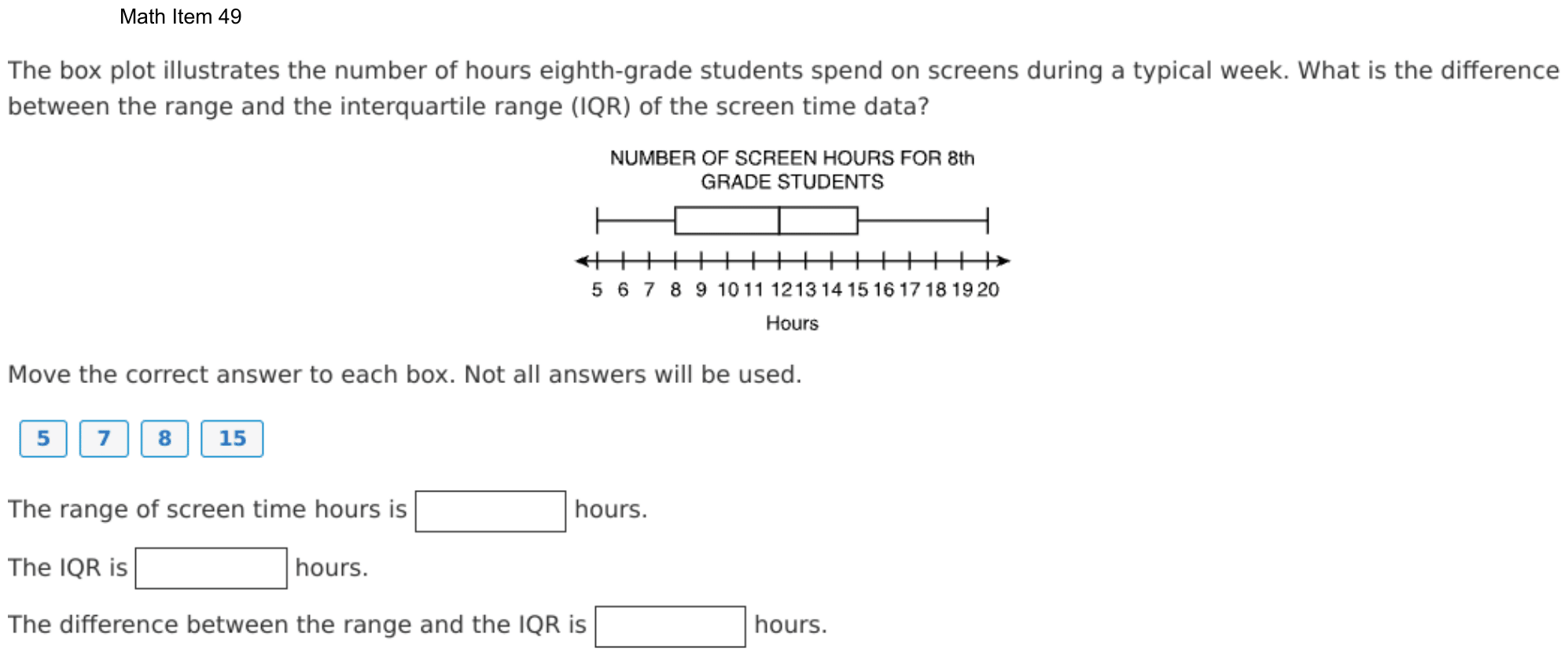
Question 30 of 120
2026 Practice Test C Math, question 50Question
Terry wants to pour cement around the edge of the circular patio in her backyard. The patio has a radius of 5 feet. What is the distance, in feet, around the edge of the patio? Use 3.14 for .
- A15.7
- B31.4
- C49.3
- D78.5
Show the answer
Correct answer: B
To find the distance around a circle if the radius is known, use the formula for circumference, .
Question analysis
Terry wants to pour cement around the edge of a circular patio with a radius of 5 feet. Students find the distance around the edge, using 3.14 for π. It tests the circumference of a circle, and because the formulas for a circle's area and circumference both use the radius, they are easy to mix up.
- NYS standards
- 7.G.4 circle area and circumference
- Grade level
- Grade 7 content, by NYS standard
- Compared with grade 7
- At grade 7 Applying a circle formula is a grade 7 standard, and this is a one-formula problem with a given value for π. The only demand beyond routine is recalling the right formula, which the test does not print.
- Estimated difficulty
- Straightforward: two steps or one careful reading.
- Thinking it demands
- Depth of knowledge 1, recall and reproduction · mainly apply
- What makes it hard
- Something you must already know moderate
- Turning words into math minor
- Solution
- 2 steps
- Reading level
- Question and choices: about grade 4, 37 words.
- Students, last 30 days
- Not enough answers yet to show (it takes 10).
Why it is hard, traps and wrong answers (shows the answer)
Why it is hard
One formula and one multiplication finish the problem once the right formula is chosen. The cement in the story pulls toward area, and the area, 78.5, is listed, as is half the circumference, from multiplying 3.14 by the radius alone. Remembering that the circumference is π times the diameter, here 10 feet, and that the answer is in feet, not square feet, settles it.
Something you must already know moderate Working it out
The circumference formula is not printed, and the area formula uses the same radius and π, so recalling the wrong one gives a number that looks just as finished. (Anderson & Krathwohl, 2001)
Turning words into math minor Understanding the question
Pouring cement suggests covering a surface, but the question asks for “the distance, in feet, around the edge”, which is the circumference, not the area. (Hegarty, Mayer & Monk, 1995; Koedinger & Nathan, 2004)
Strategy: Decide which circle measurement the distance around the edge is, recall its formula, and substitute the radius and 3.14, doubling the radius wherever the formula calls for the diameter.
Traps
- Wrong formula: Uses a related but wrong formula: perimeter for area, diameter for radius, area for volume, or a misremembered one.
- A formula you must know: Needs a formula the test does not give: area, circumference, volume, probability rules.
- A faulty procedure: A systematic but wrong procedure: adding fractions straight across, applying an exponent to each term of a sum, dropping a sign when moving a term.
The wrong answers, classified
A Wrong formula (King et al., 2004)
Multiplies π by the radius, 3.14 × 5 = 15.7, using the radius where C = πd needs the diameter, so it finds half the distance around.
C A faulty procedure (Brown & Burton, 1978; Tatsuoka, 1983)
Starts from the area formula and squares π instead of the radius, 3.14 × 3.14 × 5 ≈ 49.3, mixing the wrong formula with a slip in squaring.
D Wrong formula (King et al., 2004)
Finds the patio’s area, 3.14 × 5² = 78.5 square feet, using the area formula instead of the circumference for the distance around.
Worked solution, step by step
Formulas used
- Circumference of a circle
- C is the circumference, the distance around the circle. r is the radius, the distance from the center to the edge. π (pi) is a fixed number, about 3.14. 2r is the diameter, the distance all the way across. The distance around is always about 3.14 times that.
- Area of a circle
- A is the area, the space inside the circle, in square units. r² means r times r. It is here so you can tell the two formulas apart. This question does not use it.
Sort out the question
The patio is a circle with a radius of 5 feet. The radius is the distance from the center to the edge. Terry wants cement around the edge.
You need the distance around the edge, in feet. The distance around a circle is called its circumference. Use 3.14 for π.
Choose the right formula
The distance around is a length, so use the circumference formula, .
Watch out: pouring cement may make you think of area. The area, square feet, is choice D. That is the space inside the patio, not the distance around it.
Put in the numbers
Put 3.14 in for π and 5 in for r. Multiply 2 by 5 first, because that is easy:
The distance around the patio is 31.4 feet.
Watch out: , choice A, forgets the 2. It goes only halfway around.
Give the answer
The distance around the edge of the patio is 31.4 feet.
So the answer is B, 31.4.
Check your answer
Estimate. The diameter is 10 feet. The distance around a circle is a little more than 3 times its diameter. , so about 31 feet makes sense. Choice D, 78.5, is far too big, and it is in square feet.
More questions like this
The original DOE question
Question 31 of 120
2026 Practice Test D English, question 21Passage Ode to Fireworks
Ode to Fireworks
In autumn my mother drove us to the edge of the field
where the fair was set up year after year:
the carousel, the bumper cars, the long, low sheds
filled with prizewinning animals.
We—my sister, my cousin, and I—were ready for bed,
already in our pajamas. This was a treat we waited
all year for. We waited in the darkness
for the first low, dull thwumps, like someone
beating an old, filthy rug hung on a wash line.
Then we counted the seconds between the lightning
and thunder, as we also used to do, until the sky
lit up: red, blue, green, gold. In my mind’s eye
I can still see the straggly, ancient oak whose branches
reached up past the exhibition halls, silhouetted
against the spectrum of stars that cascaded behind it.
It was one thing to look up into the sky
and imagine yourself in it or to make out pictures
among the clouds, which my sister liked to do.
No, I would tell her, that cloud
does not look like an elephant, a hat, an umbrella.
But it was another thing to see
the sky at night written upon
with those jewels. (We lived in the country:
night was night.) All around us, crickets
stridulated in the stubble of what had been
somebody’s cornfield, their song rising and falling.
You could smell winter on the air’s edge.
Now, in the city, when the sky dips into shadow
at New Year’s or on the Fourth of July, I find myself
craning my neck upward at odd moments.
The city sky is always lit up. This is where we live now,
and it is how we live now, awash in light
of every hue. Everything is a constant celebration:
picking up washing at the cleaner’s or stopping by
the corner market for a loaf of heavy bread.
And the music around me is the music of people,
their voices rising and falling in a hundred languages.
But beneath the yellowish glow deep in the sky
of all our city lights pelting out into the universe,
I remember the feel of the pickup truck bumping
across the ridged field, as I kept waiting for those
childhood bursts, watching as they escorted us home.
Question
The comparison in lines 8–9 of the poem is used to convey
- Athe muffled pounding of explosions in the distance.
- Bthe way lightning streaks through the clouds.
- Cthe echoes of thunder on an autumn night.
- Dthe glow of sparks falling from the sky.
Show the answer
Correct answer: A
The question asks what the comparison in lines 8–9 of the poem is used to convey.
A. CORRECT. In lines 8–9 the speaker compares the deep thumping noises at the start of a fireworks show to the muffled thumping sound made when beating a rug to clean it. The imagery of “low, dull thwumps” (line 8) (onomatopoeia) describes a sound that is not clear or powerful. To the speaker, these low, distant explosions are the signal that the fireworks display is starting and that the loud, cracking sound of fireworks will be heard soon (“Then we counted the seconds between the lightning / and thunder” [lines 10–11]).
B. Incorrect. The comparison in lines 8–9 deals with the low sound of the first fireworks shooting off rather than the streaks of light they emit. To the speaker, the low thwumps (onomatopoeia) are the signal that fireworks are about to explode overhead, much like the way a streak of lightning during a storm indicates that a crash of thunder will follow in a few seconds.
C. Incorrect. The thwump (onomatopoeia) sounds are the start of the fireworks show, not thunder. As a comparison, the speaker says the initial thwumps of the fireworks signal anticipation for the full explosion that will come, much like the way the speaker would watch for lightning and count the seconds before an impending thunderclap (lines 10–11).
D. Incorrect. The muffled thwump (onomatopoeia) sounds occur before the dazzling explosion of lights and before sparks start to fall from the sky. The comparison focuses on the sounds of the experience, not the sight of the experience.
Question analysis
This figurative language question asks what the comparison in lines 8–9 of “Ode to Fireworks” conveys. In the poem an adult speaker remembers waiting with family, already in pajamas, for the fireworks at a country fair. Students must interpret an old-fashioned household image and decide what part of the show it describes, since the nearby lines mention sights as well as sounds.
- Grade level
- Grade 6 reading and task
- Compared with grade 7
- Below grade 7 Interpreting a simile is taught from grade 6, and this one takes up two lines of concrete words. The household chore it pictures may be unfamiliar, but the task is a single step, lighter than typical grade 7 poetry work.
- Estimated difficulty
- Straightforward: two steps or one careful reading.
- Thinking it demands
- Depth of knowledge 2, skills and concepts · mainly understand
- What makes it hard
- Evidence
- Answered from one sentence or line
- Reading level
- Passage: 379 words (a poem; reading level not measured); question and choices: about grade 3, 42 words.
- Students, last 30 days
- Not enough answers yet to show (it takes 10).
Why it is hard, traps and wrong answers (shows the answer)
Why it is hard
The comparison is about sound, and once students notice that, the sight-based choices about lightning and sparks fall away. The pull comes from the next lines, where the children count “the seconds between the lightning / and thunder,” a storm game that makes thunder seem like the thing being described. The question rewards staying inside lines 8–9, where “low, dull” and the beaten rug describe the first faint booms of the show.
Figurative or literary language moderate Understanding the question
Lines 8–9 pair the made-up sound word “thwumps” with a simile, someone beating an old rug on a wash line, so students must hear a dull, distant thud in an image about housework. (Graesser, Singer & Trabasso, 1994; Kintsch, 1998)
Something you must already know minor Working it out
The simile works only for readers who can imagine the flat whack of a rug being beaten clean on a line, a chore many students have never seen or heard. (Anderson & Krathwohl, 2001)
Strategy: Reread lines 8–9 slowly and ask which sense the comparison appeals to, sight, sound or touch, then pick the choice that describes that same experience.
Traps
- Taking figurative language literally: A choice reads a figure of speech or image at face value.
- Wrong part of the text: A choice is true of another paragraph, stanza or speaker than the one asked about.
The wrong answers, classified
B Wrong part of the text (Kirsch & Mosenthal, 1990)
Jumps to the “lightning” of line 10, but lines 8–9 come before the sky lights up and describe something heard in the darkness, not a streak of light.
C Taking figurative language literally (Graesser, Singer & Trabasso, 1994)
Takes the “lightning / and thunder” of lines 10–11 as a real storm and hears the thwumps as thunder, though the counting game only likens the fireworks to one.
D Wrong part of the text (Kirsch & Mosenthal, 1990)
Pictures the colors of lines 12–15, “red, blue, green, gold,” but the rug-beating image describes a dull sound heard before any sparks appear in the sky.
Working it out, step by step
Figure out what the question asks
This asks what a comparison helps you picture. Lines 8–9 compare one thing to another using “like.” That kind of comparison is called a simile. First ask which sense it describes: sight, sound or touch.
Find the comparison
The family waits in the dark. Lines 8–9 say they wait “for the first low, dull thwumps, like someone / beating an old, filthy rug hung on a wash line.” Thwumps is a made-up word that sounds like the noise it names. So the comparison is about a sound. It comes before the sky lights up.
Picture the rug
People used to hang a dusty rug on a line and hit it with a stick. Each hit makes a flat, soft thud, not a sharp bang. The words “low” and “dull” say the same thing. So the first fireworks sound like soft booms far away. Muffled means soft, as if wrapped in cloth.
Check each choice
- A is right. Dull thuds heard in the dark are the muffled pounding of explosions far off.
- B is wrong. Lightning is something you see. Lines 8–9 describe a sound heard before anything lights up.
- C is wrong. The thunder in lines 10–11 is part of a counting game. It compares the show to a storm. The rug image is about the fireworks.
- D is wrong. Sparks are something you see. The colors don’t come until line 12.
Watch out: Lines 10–11 mention “lightning” and “thunder.” That can make C look right. But the rug comparison comes first and is about the fireworks.
Choose the answer
The rug-beating simile makes the first fireworks sound like soft, faraway thuds. So the answer is A, “the muffled pounding of explosions in the distance.”
Why this answer and not the closest wrong one
C is the closest wrong answer, because thunder is a low boom too. But lines 10–11 only compare the show to a storm in a counting game. The rug image in lines 8–9 describes the fireworks themselves: dull, muffled thuds from far away. That is A.
More questions like this
The original DOE question
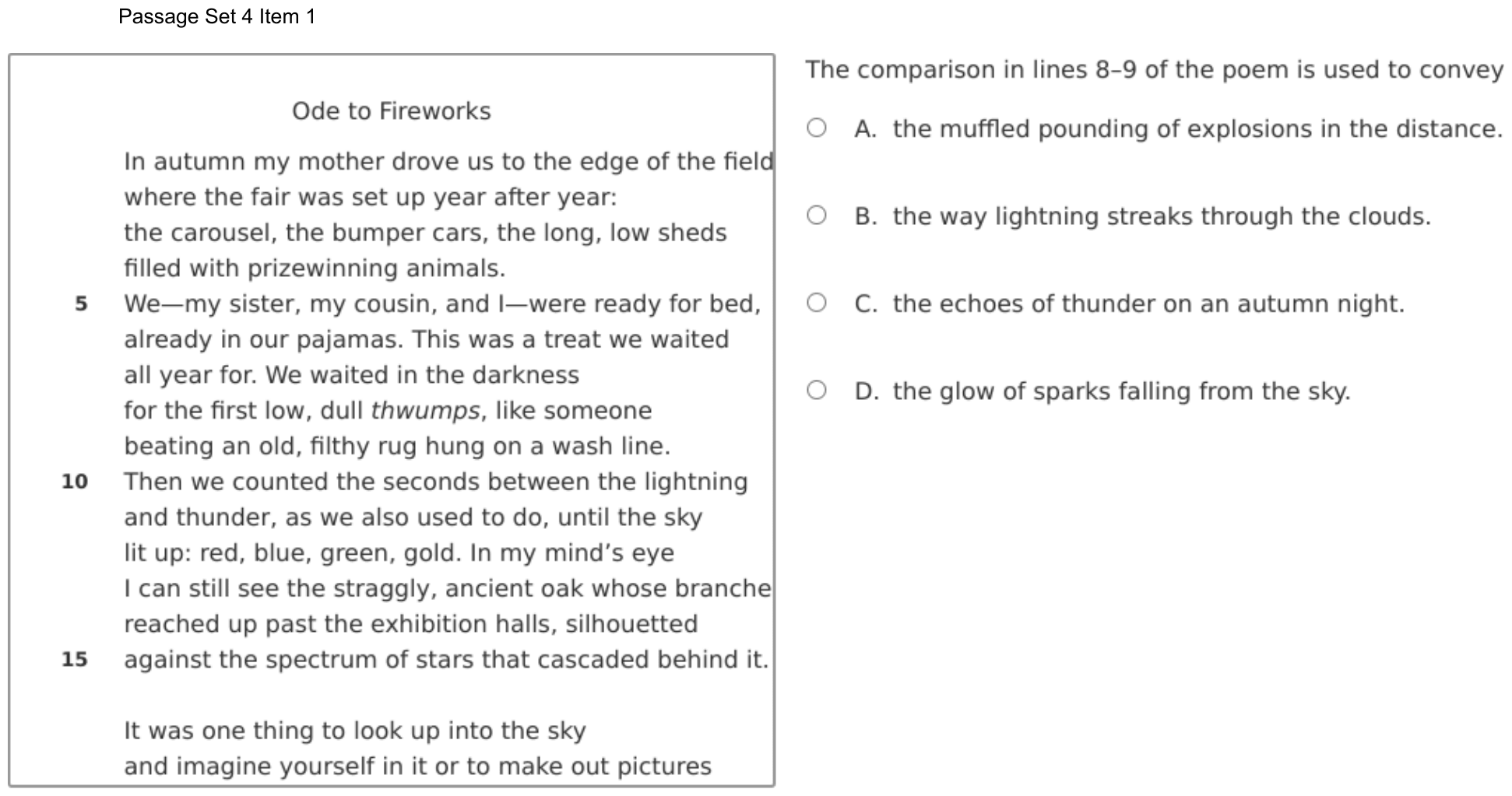
The passage “Ode to Fireworks” as printed (page 32)
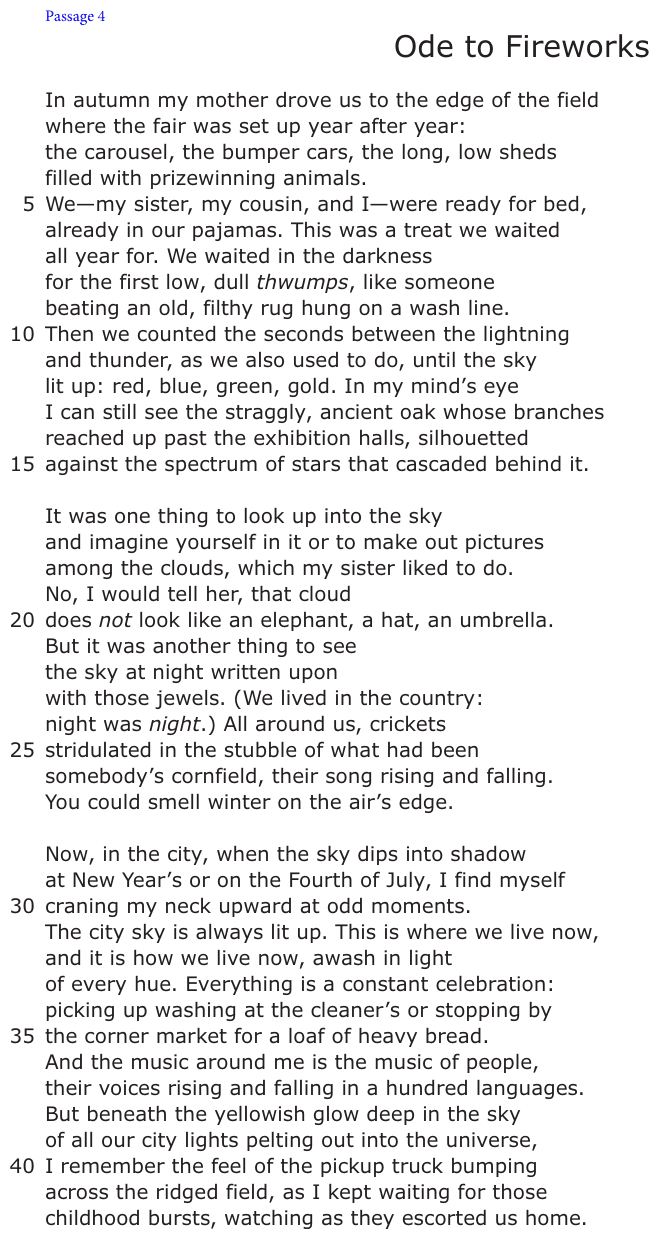
Question 32 of 120
2026 Practice Test D English, question 37Passage Martial Arts for the Mind and Body
Martial Arts for the Mind and Body
(1) The martial arts blend a series of physical movements with strategic mental discipline so that practitioners can defend themselves, physically defeat an opponent, or both. (2) Historians are unsure of exactly when and where martial arts were first used. (3) Martial arts have been practiced by several different societies for many centuries. (4) Martial arts such as karate, kung fu, tae kwon do, and judo are still taught and practiced as methods of self-defense, but they offer students more than that. (5) The study of martial arts can provide students with a way to enhance their mental discipline as well as their physical fitness.
(6) Discipline, focus, and respect are important qualities for everyone to have. (7) However, for most people these qualities are not innate; they must be learned and practiced. (8) The study of martial arts can provide an opportunity to develop these skills. (9) Students are rewarded for their dedication by passing tests and advancing to higher ranks or levels. (10) For example, in a typical tae kwon do class, students learn discipline by diligently practicing moves, improve focus by listening carefully, and demonstrate respect by bowing to the instructor and following directions.
(11) For teenagers, martial arts classes provide a safe and structured environment for gaining physical skills, building confidence, and enjoying a sense of community. (12) A lot of teens go through hard situations as they try to do well in school and in life. (13) A martial arts class can provide teens with a physical outlet for stress while also challenging them mentally. (14) Participating in a martial arts program also helps children and teens focus on self-improvement rather than on competition. (15) Progressing through levels of achievement involves mastering more physically demanding techniques. (16) It requires students to take responsibility and be accountable for achieving set goals. (17) Students gain confidence and experience companionship with other students who are progressing through the ranks.
(18) Adults who practice martial arts can experience many of the same benefits that younger people do, but perhaps the greatest of these is health and fitness. (19) Adult martial arts students often see changes in their body within weeks of beginning a program.
(20) For people interested in studying a martial art, there are many ways to learn and practice. (21) In addition to private studios, community recreation centers often offer low-cost or free martial arts classes. (22) There are even online videos that introduce students to the basic concepts. (23) People should study martial arts.
Question
Which revision of sentence 12 best maintains the formal style established in the passage?
- AA lot of teens have to put up with difficult things while trying to do well in school and in life.
- BMany teenagers deal with tough situations as they try to stay on top of their studies and do well in life.
- CMany teenagers encounter challenges as they work to succeed both academically and personally.
- DA lot of teens face problems as they work to keep up with their schoolwork and find personal success.
Show the answer
Correct answer: C
The question asks for the revision of sentence 12 that best maintains the formal style established in the passage.
A. Incorrect. The phrases “A lot,” “put up with,” “difficult things,” and “do well in school” are worded informally; therefore, this sentence does not consistently maintain the formal style established in the passage.
B. Incorrect. The phrases “deal with,” “tough situations,” “stay on top of,” and “do well in life” are worded informally; therefore, this sentence does not consistently maintain the formal style established in the passage.
C. CORRECT. This option is correct because it uses clear and scholarly wording throughout the whole sentence. The phrases “many teenagers,” “encounter challenges,” and “succeed both academically and personally” make the sentence’s style more consistently formal than the other options.
D. Incorrect. The phrases “A lot,” “face problems,” and “keep up with” are worded informally; therefore, this sentence does not consistently maintain the formal style established in the passage.
Question analysis
This style question asks which revision of sentence 12, “A lot of teens go through hard situations as they try to do well in school and in life,” best keeps the formal style of the martial arts passage. Students compare four rewrites phrase by phrase, listening for casual expressions in each one.
- Grade level
- Grade 6 reading and task
- Compared with grade 7
- Below grade 7 Keeping a formal style is practiced from grade 6, and here it is tested in one sentence with familiar casual phrases. Typical grade 7 style work asks for subtler choices of precise, content-specific words across a passage.
- Estimated difficulty
- Routine: one familiar step, little to misread.
- Thinking it demands
- Depth of knowledge 1, recall and reproduction · mainly evaluate
- What makes it hard
- Evidence
- Answered from one sentence or line
- Reading level
- Passage: about grade 11, 402 words; question and choices: about grade 8, 87 words.
- Students, last 30 days
- Not enough answers yet to show (it takes 10).
Why it is hard, traps and wrong answers (shows the answer)
Why it is hard
Most students hear the casual phrases at once, and only one version avoids all of them, so this is one of the easier revising questions. The risk is stopping at a formal start: one version opens with “Many teenagers” and then slides into “tough situations,” and another sounds serious with “face problems” but begins with “A lot of teens.” Checking every phrase, not the first few words, is all the question asks.
Every choice must be checked minor Choosing the answer
Each rewrite mixes formal and casual wording, “Many teenagers” beside “deal with” and “stay on top of,” so every phrase of every version has to be checked, not just the opening words. (Embretson & Wetzel, 1987)
Something you must already know minor Working it out
Students must recognize idioms such as “put up with” and “keep up with” as spoken English, a sense of register that the question expects them to bring. (Anderson & Krathwohl, 2001)
Strategy: Underline every casual phrase in each rewrite, such as everyday idioms or vague words, and keep only the version with none; one formal phrase is not enough.
Traps
- Wordy, vague or informal: A revision is grammatical but wordy, imprecise or too casual for the passage.
The wrong answers, classified
A Wordy, vague or informal (Connors & Lunsford, 1988)
Trades “go through hard situations” for “put up with difficult things” and keeps “A lot of teens,” swapping one set of casual phrases for another.
B Wordy, vague or informal (Connors & Lunsford, 1988)
Is reassured by the formal opening “Many teenagers,” but the rest, “deal with,” “tough situations” and “stay on top of,” is everyday speech.
D Wordy, vague or informal (Connors & Lunsford, 1988)
Likes the more serious “face problems” and “personal success,” but keeps the casual “A lot of teens” and “keep up with their schoolwork.”
Working it out, step by step
Figure out what the question asks
This asks which rewrite of sentence 12 matches the passage’s formal style. Formal style is the careful, serious way of writing you use in a school report. It skips the casual words you might use with friends.
Spot the casual words
Sentence 12 says, “A lot of teens go through hard situations as they try to do well in school and in life.” “A lot of,” “teens” and “go through” sound like talking with a friend. Compare sentence 11, which speaks of “a safe and structured environment.” The rest of the passage uses careful words like those.
Name the rule
Formal writing uses exact, serious words and skips everyday sayings. For example, Kids have a ton of homework is casual. Students have a large amount of homework is formal. Check every phrase in each choice, not just the first few words.
Check each choice
- A is wrong. “A lot of teens,” “put up with” and “difficult things” are casual.
- B is wrong. It starts well with “Many teenagers.” But “deal with,” “tough situations” and “stay on top of” are casual.
- C is right. Every phrase is formal. To encounter challenges is to meet hard problems. Academically means in school. Personally means in your own life.
- D is wrong. “Face problems” sounds serious. But “A lot of teens” and “keep up with” are casual.
Watch out: B and D each have a formal phrase or two. One formal phrase is not enough.
Choose the answer
Only C is formal from start to finish. So the answer is C, “Many teenagers encounter challenges as they work to succeed both academically and personally.”
Why this answer and not the closest wrong one
B is the closest wrong answer, because it opens with the formal “Many teenagers.” But it then slides into everyday phrases like “deal with” and “stay on top of.” C keeps the same meaning and stays formal from start to end. Words like “encounter challenges” and “academically” match the careful style of the passage.
More questions like this
The original DOE question
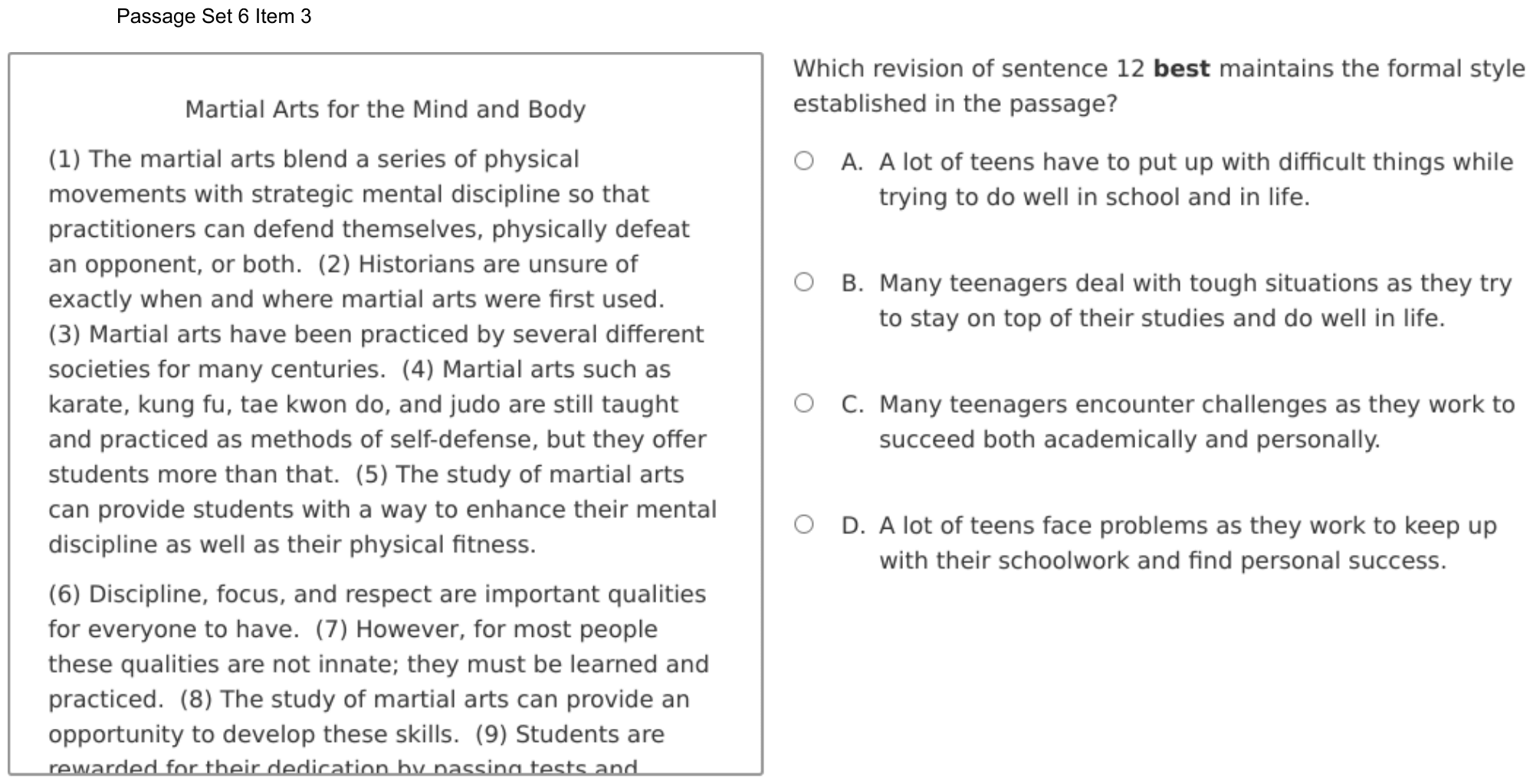
The passage “Martial Arts for the Mind and Body” as printed (page 52)
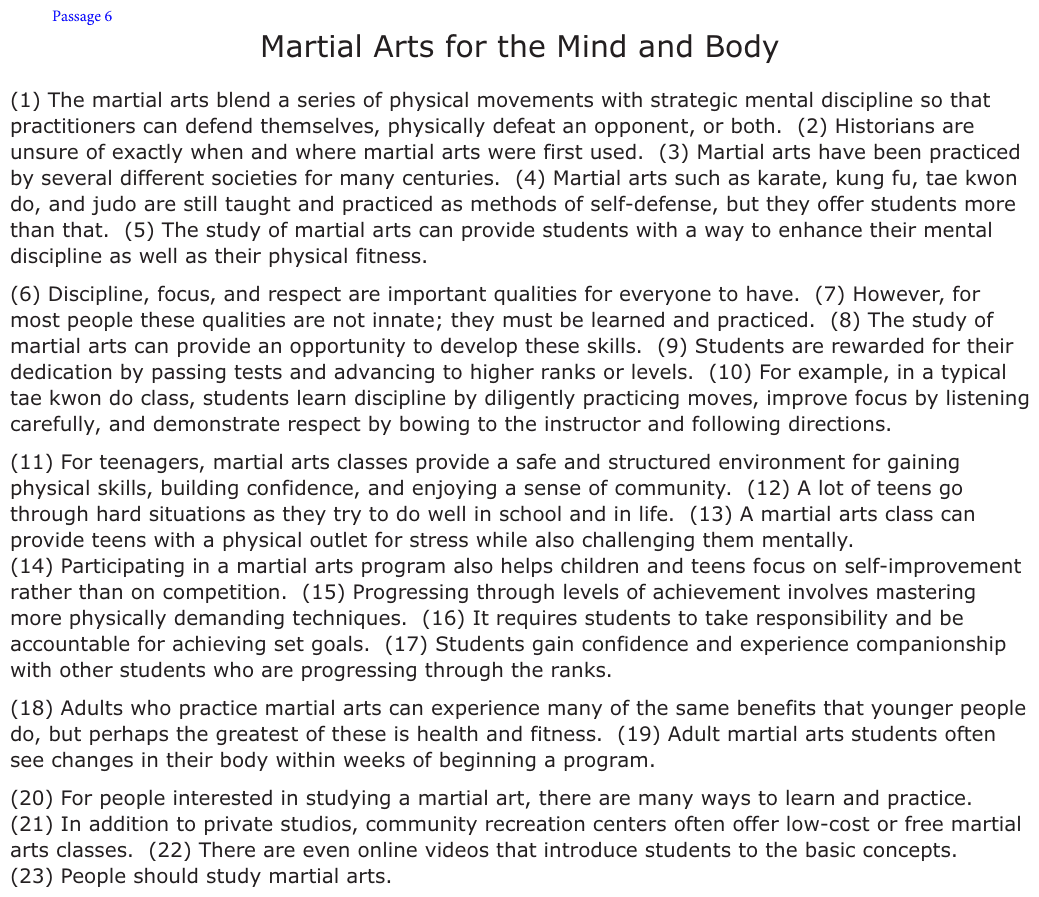
Question 33 of 120
2026 Practice Test D Math, question 1Question
What is the prime factorization of 3,575?
- A
- B
- C
- D
Show the answer
Correct answer: B
By observation, 3,575 ends in 75; therefore, 3,575 is divisible by 25.
Test 143 for factors and eliminate 3, 5, and 7, but 11 is a factor.
; both 11 and 13 are prime numbers.
The first factor, 25, is not prime but is the product of primes, .
The prime factorization of 3,575 is .
Question analysis
This number question asks for the prime factorization of 3,575, chosen from four products of factors. Students divide by primes, using divisibility tests, until only primes remain. The four products look much alike, so the work must be carried all the way through, keeping count of every prime divided out along the way.
- Grade level
- Grade 6 content, by NYS standard
- Compared with grade 7
- Below grade 7 Breaking a number into primes is grade 6 number work that relies on divisibility tests. The number here is larger than in most class examples, but the work is still a few divisions, lighter than typical grade 7 problems.
- Estimated difficulty
- Straightforward: two steps or one careful reading.
- Thinking it demands
- Depth of knowledge 1, recall and reproduction · mainly apply
- What makes it hard
- A very close wrong answer moderate
- Something you must already know minor
- Solution
- 3 steps
- Reading level
- Question and choices: about grade 11, 10 words.
- Students, last 30 days
- Not enough answers yet to show (it takes 10).
Why it is hard, traps and wrong answers (shows the answer)
Why it is hard
Three of the four choices multiply back to 3,575, so checking a product rules out only the one that equals 715. The question turns on whether 143 is prime: it survives the quick tests for 2, 3 and 5, and the factor 11 is easy to miss. Students who keep dividing until every factor is prime, and who write a prime as often as it divides, finish in under a minute.
A very close wrong answer moderate Choosing the answer
5² · 143 matches the right factorization in its first factor and multiplies back to 3,575 just as well, so a product check cannot separate them; only splitting 143 into 11 × 13 does. (Embretson & Wetzel, 1987; Gorin & Embretson, 2006; Ascalon et al., 2007)
Something you must already know minor Working it out
Nothing on the page defines a prime factorization or gives a test for 11, and 143 passes the familiar quick tests for 2, 3 and 5, so it looks prime. (Anderson & Krathwohl, 2001)
Strategy: Divide by the smallest prime that goes in evenly, again and again, writing down every prime you use until the quotient reaches 1, then compare that list with each choice.
Traps
- Stops one step early: A choice is a number from partway through the solution.
- Misunderstands the concept: A wrong belief about a concept: that percents can be added, that area grows like length, that averages can be averaged, that a bigger denominator means a bigger fraction.
The wrong answers, classified
A Misunderstands the concept (Smith, diSessa & Roschelle, 1993; De Bock et al., 1998; Ni & Zhou, 2005)
Lists each prime that divides 3,575 only once, 5, 11 and 13, as if a factorization named which primes divide it, though their product is only 715.
C Stops one step early (King et al., 2004; Gierl et al., 2017)
Divides out one 5 and stops at 5 · 715, a true factorization but not a prime one, though 715 ends in 5 and splits further.
D Stops one step early (King et al., 2004; Gierl et al., 2017)
Divides by 25 and stops at 143, which passes the tests for 2, 3 and 5 and looks prime, though 143 = 11 × 13.
Worked solution, step by step
Formulas used
- Divisibility by 25
- A number is divisible by 25 when 25 goes into it with no remainder. You only need to look at the last two digits. If they are 00, 25, 50 or 75, the number is divisible by 25. This works because 100 is 4 × 25, so the hundreds never leave a remainder.
- Writing a repeated factor with an exponent
- a is any number. The small raised 2 is an exponent. It tells you how many times a is used as a factor, so 5² means 5 × 5 = 25. Use an exponent in a prime factorization when the same prime shows up more than once.
Sort out the question
A prime number is a whole number greater than 1 whose only factors are 1 and itself. Examples are 2, 3, 5, 7, 11 and 13. The prime factorization of 3,575 writes it as a product (the answer to a multiplication) of prime numbers only. So you must break 3,575 down until every factor is prime.
Divide by 25 first
3,575 ends in 75. So it is divisible by 25:
That means 3,575 = 25 × 143. But 25 is not prime. It is 5 × 5, which you can write as 5².
Test 143 for prime factors
Now see if 143 splits. Try the primes in order. 143 is odd, so 2 does not work. Its digits add to 1 + 4 + 3 = 8, which is not a multiple of 3, so 3 does not work. It does not end in 0 or 5, so 5 does not work. Since 7 × 20 = 140, 143 ÷ 7 leaves a remainder of 3, so 7 does not work. Now try 11:
So 143 = 11 × 13, and both 11 and 13 are prime.
Watch out: 143 looks prime, but it is not. Stopping at 5² · 143 leads to choice D.
Put all the primes together
Collect every prime you found. The 5 appears twice, then 11 and 13 once each. The dot · means times, just like ×.
Watch out: write the 5 twice, since it divides 3,575 twice. Writing it once gives 5 · 11 · 13, choice A, which equals only 715. Choice C, 5 · 715, stops too early, because 715 ends in 5 and splits further.
So the answer is B, .
Check your answer
Multiply the primes back together: 25 × 11 = 275, and 275 × 13 = 3,575. That is the number you started with. Also, 5, 11 and 13 are all prime, so nothing can be split further.
More questions like this
The original DOE question
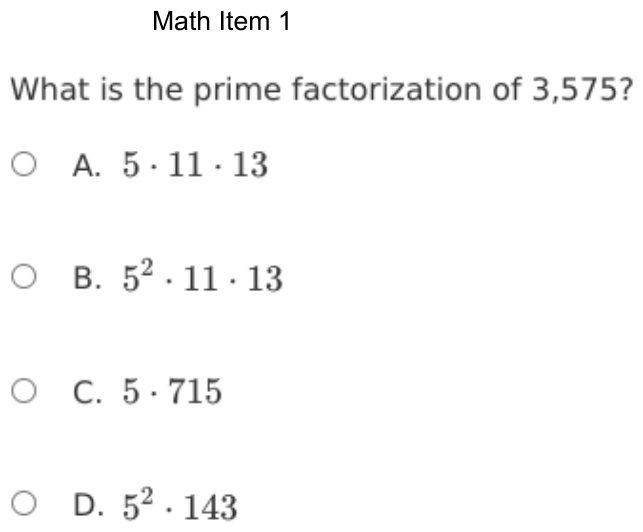
Question 34 of 120
2026 Practice Test D Math, question 5Question
In a school raffle, 1 out of every 25 students wins a prize. Each prize includes a randomly selected trading card from a set of 100 different cards, labeled C1 through C100, with each card equally likely to be chosen. If one student is selected at random, what is the probability that the student both wins a prize and receives Card C17?
Write an expression that represents the probability that a student wins the prize and receives Card C17.
Enter your answer in the space provided. Enter only your answer.
On the test you build the answer on an on-screen keypad; here, type it. Use ^ for a power, sqrt( ) or √ for a root, pi for π, and <= or >= for ≤ and ≥.
Show the answer
Correct answer: 1/25 · 1/100
To calculate the joint probability, first determine the probability of each independent event.
The probability that a randomly selected student wins the prize is .
The probability that a randomly selected student will receive Card C17 is , because Card C17 is 1 card out of 100 labeled cards.
The probability that a student wins the prize and receives Card C17 is the product of those two probabilities, .
Question analysis
In a school raffle, 1 out of every 25 students wins a prize, and each prize includes one of 100 equally likely trading cards. Students type an expression for the probability that a randomly chosen student both wins and gets one particular card. It tests the probability of two independent events, and combining the two chances correctly is the main hurdle.
- Grade level
- Grade 7 content, by NYS standard
- Compared with grade 7
- At grade 7 Grade 7 students find compound probabilities, usually by listing outcomes for coins or number cubes. These two stages have 25 and 100 outcomes, far too many pairs to list, so a rule must be used, and the answer is typed as an expression.
- Estimated difficulty
- Straightforward: two steps or one careful reading.
- Thinking it demands
- Depth of knowledge 2, skills and concepts · mainly apply
- What makes it hard
- Solution
- 2 steps
- Reading level
- Question and choices: about grade 8, 87 words.
- Students, last 30 days
- Not enough answers yet to show (it takes 10).
Why it is hard, traps and wrong answers (shows the answer)
Why it is hard
Each chance is stated almost directly, 1 out of 25 and 1 out of 100, so the question tests one rule: both events must happen, and the chances multiply. The word “and” pulls students toward adding, which gives a result larger than either chance, a sign that something is wrong. Others write only the card's chance and forget that the student must first win a prize.
Something you must already know moderate Working it out
The question never says that the chance of two independent events both happening is the product of their chances, so students must bring that rule to the 1/25 and the 1/100 themselves. (Anderson & Krathwohl, 2001)
An answer in an unexpected form minor Choosing the answer
The answer is typed as an expression with no choices to compare, so a sum of the two chances, which looks just as finished, gets no warning on screen. (Enright, Morley & Sheehan, 2002)
Strategy: Write each event's chance as a fraction, then apply the rule for two independent events that must both happen, and check that the result is smaller than either chance alone.
Traps
- Follows a key word: Picks the operation from a single word rather than the situation: "removed" so subtract, "of" so multiply, "more" so add, when the situation needs something else.
- Stops one step early: A choice is a number from partway through the solution.
- A faulty procedure: A systematic but wrong procedure: adding fractions straight across, applying an exponent to each term of a sum, dropping a sign when moving a term.
The wrong answers, classified
1/25 + 1/100 Follows a key word (Hegarty, Mayer & Monk, 1995)
Reads “both wins a prize and receives Card C17” as a cue to add, so sums the chances, though needing both events must be less likely than either.
1/100 Stops one step early (King et al., 2004; Gierl et al., 2017)
Writes only the chance of receiving Card C17 and leaves out that the student must first be one of the 1 in 25 who win a prize.
1/125 A faulty procedure (Brown & Burton, 1978; Tatsuoka, 1983)
Combines “1 out of 25” and “1 out of 100” by adding the totals, 25 + 100, a faulty rule that gives neither the sum nor the product.
Worked solution, step by step
Formulas used
- Probability of one outcome
- P is the probability, the chance that something happens, from 0 to 1. The top counts the outcomes you want. The bottom counts all the outcomes that could happen. Use it when every outcome is equally likely, like one card picked from 100.
- Probability that two independent events both happen
- A and B are two events. Independent means one does not change the chance of the other. P(A) is the chance of A, and P(B) is the chance of B. Multiply them to get the chance that both happen. The result is smaller than either chance, since both things must happen.
Sort out the question
Two things must both happen. First, the student wins a prize. Second, the card in that prize is Card C17. You need an expression for that chance. An expression is a math phrase made of numbers and signs, with no equal sign. You do not have to work it out to one number.
Find the chance of winning
The question says “1 out of every 25 students wins a prize.” One student is the part that wins, and 25 is the whole group. So:
Find the chance of Card C17
Each prize has one card, picked at random from 100 cards. Every card is equally likely. Card C17 is 1 of those 100 cards:
Multiply the two chances
Winning a prize does not change which card is inside it. So the two events are independent. To find the chance that both happen, multiply:
The dot · means times. Worked out, this is 1/2500.
Watch out: the word and does not mean add here. 1/25 + 1/100 is bigger than either chance, but needing both things must be less likely. Writing only 1/100 forgets that the student must win a prize first.
Enter the expression
On the test, press the fraction key, a small box over a small box. Type 1 on top and 25 on the bottom. Move the cursor out of the fraction with the → key. Press the dot key for times. Then use the fraction key again for 1 over 100. On this site, type 1/25 * 1/100 or 1/25 · 1/100. The value 1/2500 also counts.
So you would enter 1/25 · 1/100.
Check your answer
Picture 2,500 students. 1 in 25 wins, so about 100 students win a prize. Of those 100, about 1 gets Card C17. That is 1 student out of 2,500, which matches 1/25 · 1/100 = 1/2500. It is smaller than 1/25 and 1/100, as it should be.
More questions like this
The original DOE question
Question 35 of 120
2026 Practice Test D Math, question 8Question
A square metal plate has a side length of 3 inches. A circular hole with a diameter of 2 inches is cut out from the center of the plate.
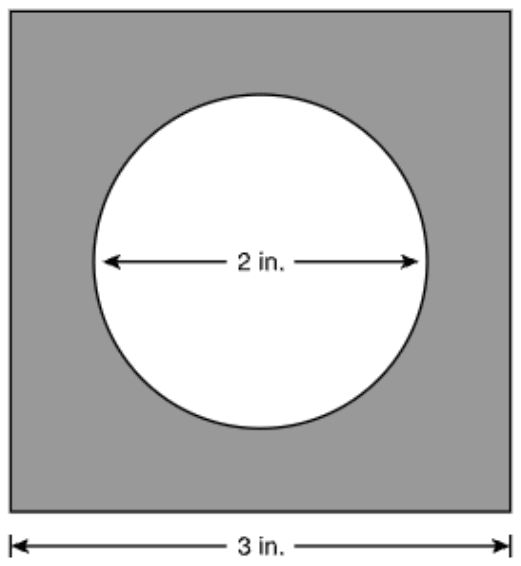
What is the area of the shaded region, to the nearest hundredth of a square inch?
Enter your answer in the space.
Fill-in question: work out the answer and type it as a number.
Show the answer
Correct answer: 5.86
To determine the area of a square, use .
Begin by finding the length of the side of the square, which is 3 inches. The area of the square is .
To determine the area of the circle, use .
The radius of the circle (the hole) is one-half the diameter or , so the area of the entire circle is
To determine the area of the shaded region, subtract the area of the hole in the square from the area of the square:
The shaded area to the nearest hundredth of a square inch sq in.
Question analysis
A 3-inch square metal plate has a circular hole 2 inches across cut from its center, and students find the area of the metal that is left, to the nearest hundredth of a square inch. It tests the areas of a circle and a square. Using the radius, not the diameter, and subtracting the right areas are the keys.
- NYS standards
- 7.G.4 circle area and circumference
- Grade level
- Grade 7 content, by NYS standard
- Compared with grade 7
- At grade 7 Finding a circle's area is a grade 7 standard, and subtracting a hole from a shape is common grade 7 practice. The radius must come from the diameter and the result must be rounded, but the steps are routine.
- Estimated difficulty
- Straightforward: two steps or one careful reading.
- Thinking it demands
- Depth of knowledge 2, skills and concepts · mainly apply
- What makes it hard
- Something you must already know moderate
- Combines ideas minor
- An answer in an unexpected form minor
- Solution
- 3 steps
- Reading level
- Question and choices: about grade 4, 49 words.
- Corrected from the DOE handbook
- A wrong symbol in the explanation was corrected.
- Students, last 30 days
- Not enough answers yet to show (it takes 10).
Why it is hard, traps and wrong answers (shows the answer)
Why it is hard
Every number is small, so the work is choosing the right pieces: the area of the square, the area of the hole, and the difference. A radius of 1 makes the circle's area simply π, which is easy to confuse with the circumference, 2π, when the formulas are half remembered. The region asked for is the gray metal, not the hole, and the final rounding goes up, since the third decimal place is 8.
Something you must already know moderate Working it out
Neither area formula is given, and the hole is labeled by its 2-inch diameter, so students must recall A = πr² and halve the diameter to get the radius 1 first. (Anderson & Krathwohl, 2001)
Combines ideas minor Working it out
The shaded metal is a square with a circle removed, so two area formulas are combined by subtraction rather than either one used alone. (Embretson, 1998; Daniel & Embretson, 2010)
An answer in an unexpected form minor Choosing the answer
The result is typed to the nearest hundredth with no choices to compare, so the long decimal 5.858… must be rounded up, not cut off after two places. (Enright, Morley & Sheehan, 2002)
Strategy: Halve the diameter to get the radius, find the area of the square and of the circle, subtract the circle from the square, and round only at the end.
Traps
- Answers a different question: A choice is right for another quantity: the other unknown, the rest instead of the part, the part instead of the whole.
- Wrong formula: Uses a related but wrong formula: perimeter for area, diameter for radius, area for volume, or a misremembered one.
- A formula you must know: Needs a formula the test does not give: area, circumference, volume, probability rules.
The wrong answers, classified
2.72 Wrong formula (King et al., 2004)
Uses the circumference, 2π × 1 ≈ 6.28, in place of the circle's area and subtracts it from the square's 9 square inches, getting about 2.72.
3.14 Answers a different question (King et al., 2004; Hegarty, Mayer & Monk, 1995)
Finds the area of the circular hole, π × 1² ≈ 3.14 square inches, and enters it instead of the area of the shaded metal left around it.
5.85 Rounds too early (King et al., 2004)
Works the area out correctly as about 5.858 but cuts off the extra digits instead of rounding up to the nearest hundredth.
What was corrected from the DOE handbook, and why
- Explanation: The DOE’s explanation gives the area of the hole as “π(1 in.)² ≅ 3.14 sq in.” The symbol ≅ means “is congruent to”, which an area and a number cannot be; the line means “is approximately equal to”, written ≈. The site now says “π(1 in.)² ≈ 3.14 sq in.”
Worked solution, step by step
Formulas used
- Area of a square
- A is the area, the amount of flat space inside. s is the length of one side. s² means s × s. It works because a square with side s holds s rows of s little unit squares.
- Area of a circle
- A is the area. r is the radius, the distance from the center to the edge. It is half the diameter, the distance straight across through the center. π (pi) is a number a little more than 3, about 3.14. r² means r × r.
Sort out the question
The plate is a square with 3-inch sides. A circle with a 2-inch diameter is cut out of the middle. The diameter is the distance straight across the circle through its center. The shaded region is the metal that is left. You need its area to the nearest hundredth of a square inch.
Find the area of the square
Use the formula for the area of a square, with s = 3 inches:
The whole plate, before the hole is cut, is 9 square inches.
Find the radius of the hole
The circle formula needs the radius, not the diameter. The figure labels the 2 in. distance across the hole. The radius is half of it:
The radius is 1 inch.
Find the area of the hole
Use the formula for the area of a circle, with r = 1 inch:
The sign ≈ means is about equal to. The hole is about 3.14 square inches.
Watch out: 2πr is the circumference, the distance around the circle, not its area. Using it gives 9 − 6.28 = 2.72. And 3.14 is the hole, not the metal, so do not stop there.
Subtract the hole from the square
The shaded metal is the square with the circle taken away:
The shaded region is about 5.86 square inches.
Round and enter the answer
With more digits of π, 3.1416, you get 9 − 3.1416 = 5.8584. The digit after the hundredths place is 8, which is 5 or more, so round up to 5.86. Chopping it to 5.85 is wrong. Type only the number, with no units.
So you would enter 5.86.
Check your answer
The hole is a bit more than a third of the plate, since 3.14 is a bit more than 9 ÷ 3 = 3. So the metal left should be a bit less than two thirds of 9, which is 6. The answer 5.86 is just under 6, so it makes sense.
More questions like this
The original DOE question
Question 36 of 120
2026 Practice Test D Math, question 13Question
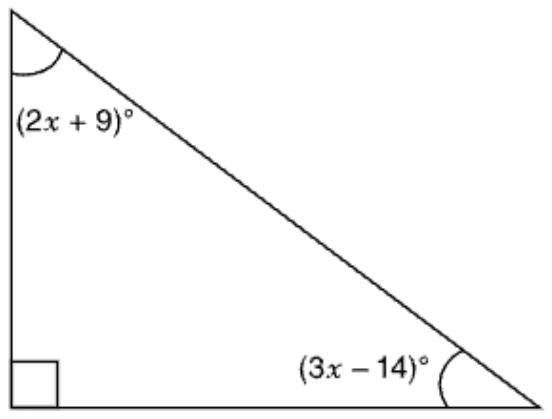
In the right triangle shown above, what is the measure of the smallest angle?
- A43°
- B44°
- C46°
- D47°
Show the answer
Correct answer: A
Since the three angles of a triangle have a sum of 180°, and since one angle is a right angle, the other two angles have a sum of 90°. By writing an equation and using inverse operations, the value of x can be found.
Now, use substitution to find the measure of the two angles to determine the smallest angle of the triangle.
The smallest angle is 43°.
Question analysis
A right triangle has its two other angles labeled (2x + 9)° and (3x − 14)°, and students find the measure of the smallest angle. It tests the angle sum of a triangle and solving a linear equation. Finding x is not the end: both angles must be worked out and compared to see which one is smallest.
- NYS standards
- Grade level
- Grade 8 content, by NYS standard
- Compared with grade 7
- Above grade 7 Grade 7 students write equations for unknown angles using complementary and supplementary angles. This also needs the angle sum of a triangle, which New York places in grade 8, plus substituting back and comparing, though each step is short.
- Estimated difficulty
- Moderate: several steps, or a close reading with one strong distractor.
- Thinking it demands
- Depth of knowledge 2, skills and concepts · mainly apply
- What makes it hard
- Combines ideas moderate
- Many steps minor
- Something you must already know minor
- Solution
- 4 steps
- Reading level
- Question and choices: about grade 6, 14 words.
- Students, last 30 days
- Not enough answers yet to show (it takes 10).
Why it is hard, traps and wrong answers (shows the answer)
Why it is hard
Setting the sum of the two labeled angles to 90° is the decision; the algebra after it is routine. The trap waits at the end: x = 19 is not an angle, and the expression at the top vertex, 2x + 9, gives the larger acute angle, 47°. Evaluating both expressions and checking that they add to 90° takes seconds and shows which one is smaller.
Combines ideas moderate Working it out
The angle facts and the algebra meet in one equation: the right angle means the two labeled angles add to 90°, and only that sum makes (2x + 9) + (3x − 14) solvable. (Embretson, 1998; Daniel & Embretson, 2010)
Many steps minor Working it out
After solving 5x − 5 = 90, both angle expressions must be evaluated and compared, because the question wants an angle, not x, and not the first angle found. (Daniel & Embretson, 2010; Enright, Morley & Sheehan, 2002)
Something you must already know minor Working it out
The 180° angle sum of a triangle is not printed, and only the small square at the bottom left shows that one angle is 90°. (Anderson & Krathwohl, 2001)
Strategy: Use the right angle to see that the other two angles add to 90°, solve that equation for x, then substitute into both expressions and compare them.
Traps
- Answers a different question: A choice is right for another quantity: the other unknown, the rest instead of the part, the part instead of the whole.
- A formula you must know: Needs a formula the test does not give: area, circumference, volume, probability rules.
The wrong answers, classified
B Little reason to choose it (Haladyna & Downing, 1993; Rodriguez, 2005)
No common working gives 44°; it sits one degree from the right measure and fits no consistent value of x, so it mostly draws estimates and guesses.
C Little reason to choose it (Haladyna & Downing, 1993; Rodriguez, 2005)
No common working gives 46°, which would need x = 20 and two angles adding to 95°, so it mostly catches guesses near 45°.
D Answers a different question (King et al., 2004; Hegarty, Mayer & Monk, 1995)
Solves x = 19 correctly but answers with 2x + 9 = 47°, the larger acute angle, instead of evaluating both expressions to find the smaller.
Worked solution, step by step
Formulas used
- Angles in a triangle
- a, b and c are the three angles of any triangle, in degrees. They always add up to 180 degrees. If you tear off the three corners and set them side by side, they make a straight line.
- The two other angles of a right triangle
- a and b are the two angles that are not the right angle. A right angle is 90 degrees, so the other two share what is left of the 180: 180 − 90 = 90.
Sort out the question
The small square at the bottom left corner marks a right angle, which is 90°. The top angle is (2x + 9)°, and the bottom right angle is (3x − 14)°. You need the smallest of the three angles. First find x, then find each angle.
Write an equation
The three angles add to 180°. The right angle uses 90° of that, so the other two angles add to 90°:
Solve for x
Combine the x terms, 2x + 3x = 5x. Combine the numbers, 9 − 14 = −5:
Add 5 to both sides, then divide both sides by 5:
Find both angles
Put x = 19 into each expression:
The three angles are 47°, 43° and 90°.
Watch out: x = 19 is not an angle. And the first angle you find, 47°, is not the smallest one. Stopping there gives choice D.
Pick the smallest angle
Compare 47°, 43° and 90°. The smallest is 43°. The figure is not drawn to scale, so do not judge the angles by how they look. Use the numbers.
So the answer is A, 43°.
Check your answer
Add the three angles: 47 + 43 + 90 = 180. That is the right total for a triangle. Also, 47 + 43 = 90, so the two smaller angles fill exactly what the right angle leaves.
More questions like this
The original DOE question
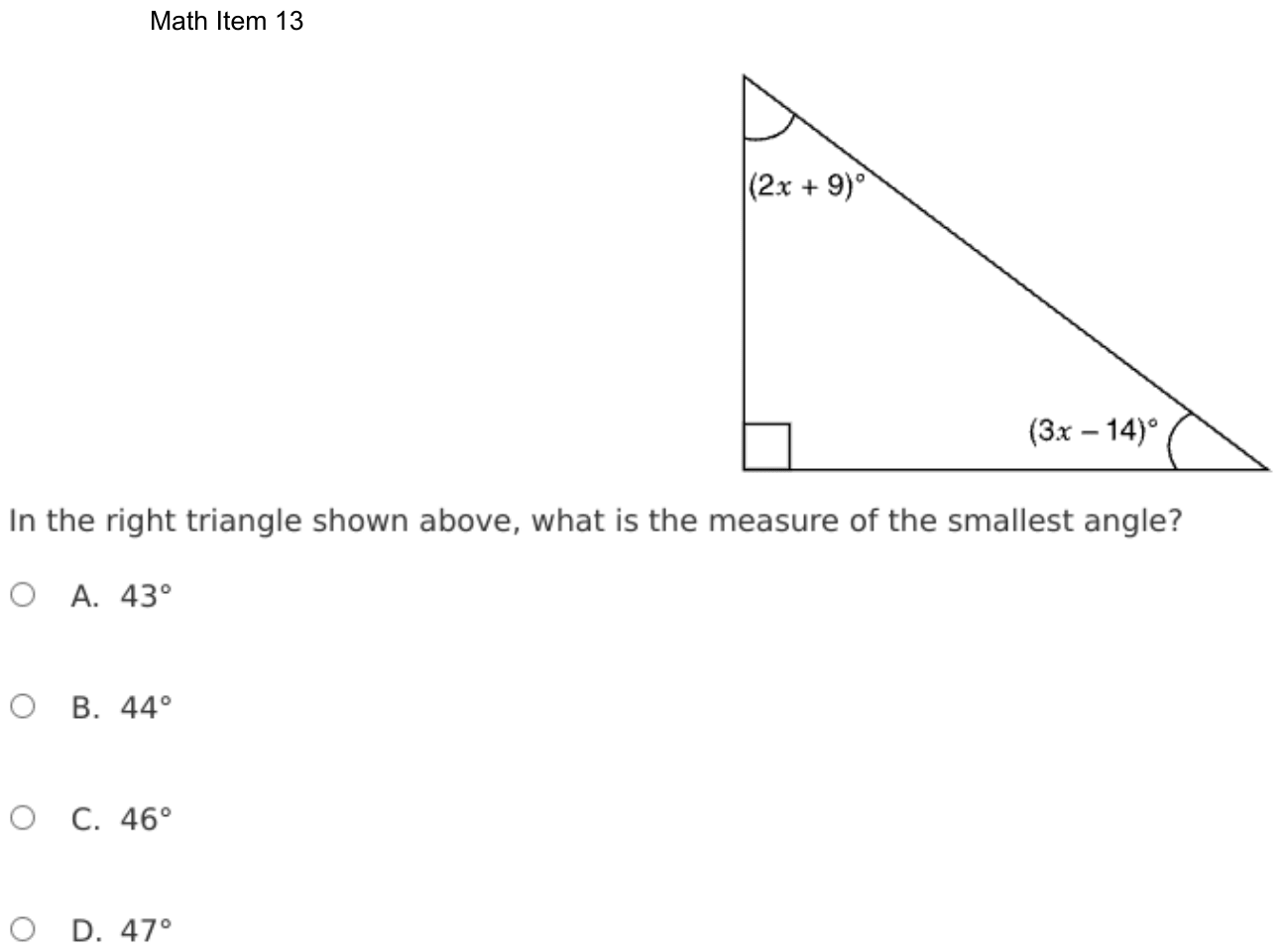
Question 37 of 120
2026 Practice Test D Math, question 25Question
A bus trip takes 9 hours if the mean speed is 50 miles per hour. How many hours would this trip take if the mean speed was 45 miles per hour?
- A8
- B10
- C12
- D14
Show the answer
Correct answer: B
First, find the length of the bus trip in miles by multiplying the time, 9 hours, by the average (mean) speed, 50 miles per hour, to get 450 miles.
Then, divide the total distance, 450 miles, by the average (mean) speed, 45 miles per hour, to get the total time:
Question analysis
A bus trip takes 9 hours at a mean speed of 50 miles per hour, and students find how long the same trip takes at 45 miles per hour. It tests speed, distance and time. Working out the fixed distance first is the key, since guessing how the time should change leads many students astray.
- NYS standards
- 6.RP.3b unit rate problems
- Grade level
- Grade 6 content, by NYS standard
- Compared with grade 7
- Below grade 7 Speed, distance and time problems are grade 6 rate work, and this one uses whole numbers in two steps. Its only twist is how the time responds when the speed changes, which makes it easier than typical grade 7 rate problems.
- Estimated difficulty
- Straightforward: two steps or one careful reading.
- Thinking it demands
- Depth of knowledge 2, skills and concepts · mainly apply
- What makes it hard
- No obvious method moderate
- Something you must already know minor
- Solution
- 2 steps
- Reading level
- Question and choices: about grade 3, 28 words.
- Students, last 30 days
- Not enough answers yet to show (it takes 10).
Why it is hard, traps and wrong answers (shows the answer)
Why it is hard
Two short calculations solve it, but only after noticing that speed and time move in opposite directions: a slower bus takes longer. Students who scale the 9 hours by 45/50, as in a direct proportion, get a little over 8 hours, a result that should feel wrong for a slower trip. Finding the distance first turns the question into one division with no direction to decide.
No obvious method moderate Working it out
The question never mentions the trip's length, yet the 450-mile distance is what stays fixed; setting up a proportion between hours and speeds, the usual reflex, points the wrong way. (Schoenfeld, 1985)
Something you must already know minor Working it out
Students must bring distance = speed × time themselves, to turn 9 hours at 50 miles per hour into miles before dividing by the new speed. (Anderson & Krathwohl, 2001)
Strategy: Find the trip's length in miles from the first speed and time, since that length stays the same, then divide it by the new mean speed.
Traps
- Misunderstands the concept: A wrong belief about a concept: that percents can be added, that area grows like length, that averages can be averaged, that a bigger denominator means a bigger fraction.
- Numbers taken from the question: Combines the numbers in the question without a model of the situation, or is simply a number that appears in the question.
The wrong answers, classified
A Misunderstands the concept (Smith, diSessa & Roschelle, 1993; De Bock et al., 1998; Ni & Zhou, 2005)
Treats time as proportional to speed, scaling 9 hours by 45/50 to 8.1, about 8, though a slower bus needs more time, not less.
C Little reason to choose it (Haladyna & Downing, 1993; Rodriguez, 2005)
No common working gives 12 hours; it needs a slip such as 540 miles for 9 × 50, so it mostly draws guesses.
D Numbers taken from the question (Hegarty, Mayer & Monk, 1995)
Adds the 5-mile-per-hour drop in speed to the 9 hours, 9 + 5 = 14, combining numbers from the question without a model of the trip.
Worked solution, step by step
Formulas used
- Distance, speed and time
- d is the distance traveled. r is the rate, or speed, such as miles per hour. t is the time. It works because at 50 miles each hour, 9 hours covers 9 groups of 50 miles.
- Finding the time
- This is the same rule turned around. d is the distance and r is the speed. Divide the distance by the speed to find t, the number of hours. Use it when you know how far and how fast.
Sort out the question
A bus trip takes 9 hours at a mean speed of 50 miles per hour. The mean speed is the average speed over the whole trip. You need the time for the same trip at 45 miles per hour. The length of the trip does not change, so find it first.
Find the length of the trip
Use distance equals speed times time, with a speed of 50 miles per hour and a time of 9 hours:
The trip is 450 miles long.
Find the new time
Now the bus goes 45 miles per hour over the same 450 miles. Divide the distance by the speed:
The trip takes 10 hours.
Check that it makes sense
A slower bus needs more time for the same trip. 10 hours is more than 9 hours, so it fits.
Watch out: time does not shrink with speed. Scaling 9 hours by 45/50 gives about 8 hours, choice A, which would make the slower bus arrive sooner. Adding the drop of 5 miles per hour to 9 hours gives 14, choice D, which has no reason behind it.
So the answer is B, 10 hours.
Check your answer
Check the distance both ways. At 50 miles per hour for 9 hours, the bus goes 50 × 9 = 450 miles. At 45 miles per hour for 10 hours, it goes 45 × 10 = 450 miles. Same trip, same distance.
More questions like this
The original DOE question
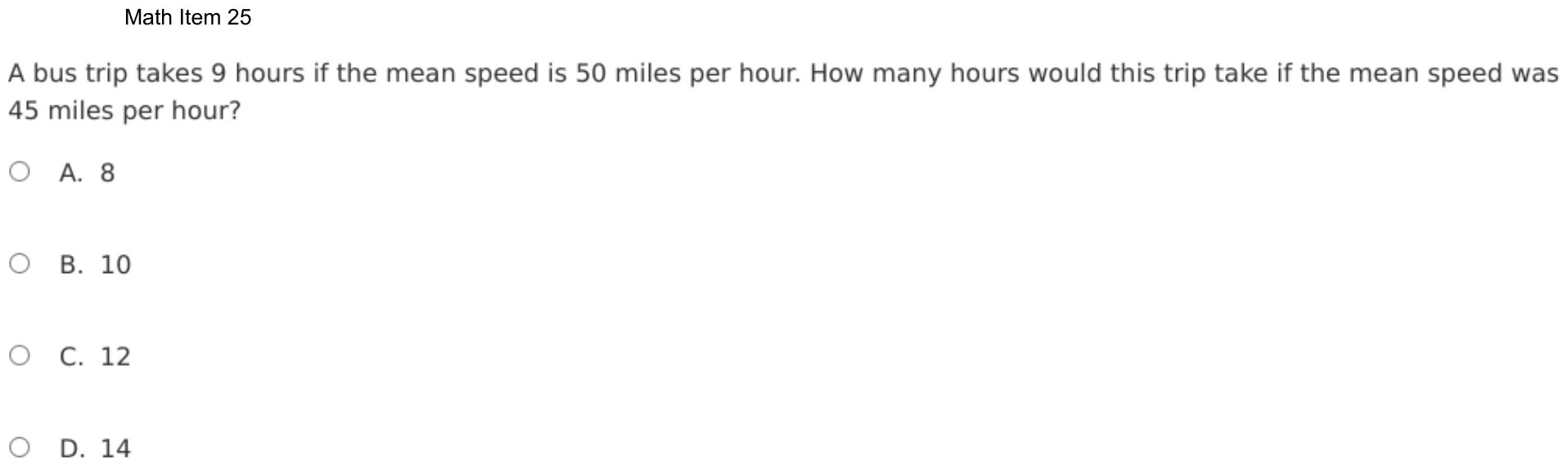
Question 38 of 120
2026 Practice Test D Math, question 29Question
Karl has one red spinner and one blue spinner. Each spinner is divided into 4 equal sections, numbered 1 through 4. He spins each spinner once and writes down the number that each lands on. What is the probability that the two numbers, when multiplied together, will have 4 as a product?
- A
- B
- C
- D
Show the answer
Correct answer: B
There are four possible outcomes for each spin of the spinner:
1, 2, 3, 4
The possible outcomes of two spins are:
Of the 16 possible outcomes, only 3 pairings have a product of 4: 14, 22, and 41.
Therefore, the probability that the two numbers resulting from two consecutive spins have a product of 4 is .
Question analysis
Karl spins a red spinner and a blue spinner, each with four equal sections numbered 1 to 4, and multiplies the two results. This compound probability question asks for the chance that the product is 4. Students build the sample space of outcomes, and listing every pair rather than the ones that come to mind is the safe route.
- NYS standards
- Grade level
- Grade 7 content, by NYS standard
- Compared with grade 7
- At grade 7 Finding a compound probability from a list or table of equally likely outcomes is standard grade 7 work. Two four-section spinners give a small sample space that is quick to write out, and the event needs one careful scan of the products.
- Estimated difficulty
- Moderate: several steps, or a close reading with one strong distractor.
- Thinking it demands
- Depth of knowledge 2, skills and concepts · mainly apply
- What makes it hard
- Something you must already know moderate
- Much to keep track of minor
- Solution
- 3 steps
- Reading level
- Question and choices: about grade 5, 52 words.
- Students, last 30 days
- Not enough answers yet to show (it takes 10).
Why it is hard, traps and wrong answers (shows the answer)
Why it is hard
The question is decided by the count of favorable outcomes, not by any calculation. Students who think of 4 only as 2 × 2 find one outcome, and those who think in factor pairs find two, which is not a listed choice and should send them back to the table. A 4-by-4 grid of products, red down the side and blue across, shows all three cells at once.
Something you must already know moderate Working it out
Nothing in the stem says that red 1 with blue 4 and red 4 with blue 1 are separate outcomes, or that two four-part spinners give 16 equally likely pairs. (Anderson & Krathwohl, 2001)
Much to keep track of minor Working it out
All 16 pairs must be scanned for a product of 4, and the two pairs that use 1 and 4 are easy to miss beside the obvious 2 times 2. (Sweller, 1988; Carpenter, Just & Shell, 1990)
Strategy: Make a 4-by-4 table with the red spinner's numbers down the side and the blue spinner's across the top, write each product in its cell, and count the cells that match.
Traps
- Misreads the question: Misses or misreads a condition or a word in the question: "at least", "each", "remaining", "not".
- Stops one step early: A choice is a number from partway through the solution.
The wrong answers, classified
A Stops one step early (King et al., 2004; Gierl et al., 2017)
Finds only the double, 2 and 2, and stops, missing the two outcomes in which a 1 on one spinner meets a 4 on the other.
C Little reason to choose it (Haladyna & Downing, 1993; Rodriguez, 2005)
No count of the 16 outcomes gives a denominator of 7, so 4/7 has no working behind it and mostly attracts guesses.
D Misreads the question (Hegarty, Mayer & Monk, 1995)
Counts the 7 outcomes in which either spinner shows a 4, reading “4 as a product” as a pair that simply contains a 4.
Worked solution, step by step
Formulas used
- Probability of an event
- P is the probability, the chance that something happens. An outcome is one possible result. This works when every outcome is equally likely, like landing on equal sections of a spinner.
- Counting outcomes of two actions
- a is the number of results for the first action, and b is the number for the second. Each result of the first can go with each result of the second, so you multiply.
Sort out the question
Karl spins two spinners, one red and one blue. Each has 4 equal sections, numbered 1 to 4. He multiplies the two numbers. You need the probability that the product, the answer to a multiplication, is 4.
Count all the outcomes
The red spinner has 4 results, and so does the blue one. Each red result can go with each blue result:
So there are 16 outcomes, all equally likely. Red 1 with blue 4 is not the same as red 4 with blue 1. They come from different spinners.
Make a table of products
Write each product in a table. Red goes down the side and blue goes across the top.
Red × Blue 1 2 3 4 1 1 2 3 4 2 2 4 6 8 3 3 6 9 12 4 4 8 12 16 Three cells show 4: red 1 with blue 4, red 2 with blue 2, and red 4 with blue 1.
Watch out: thinking of 4 only as 2 × 2 finds one outcome. That gives 1/16, choice A.
Find the probability
Use the probability rule. Three outcomes give 4, out of 16 in all:
Watch out: 7 outcomes have a 4 on at least one spinner. But that counts pairs that show a 4, not pairs whose product is 4. That mistake gives 7/16, choice D.
So the answer is B, .
Check your answer
List the ways to multiply two numbers from 1 to 4 and get 4: , and . That is 3 ways. The table has 16 cells, and 13 of them are not 4. So a small chance like 3/16 makes sense.
More questions like this
The original DOE question
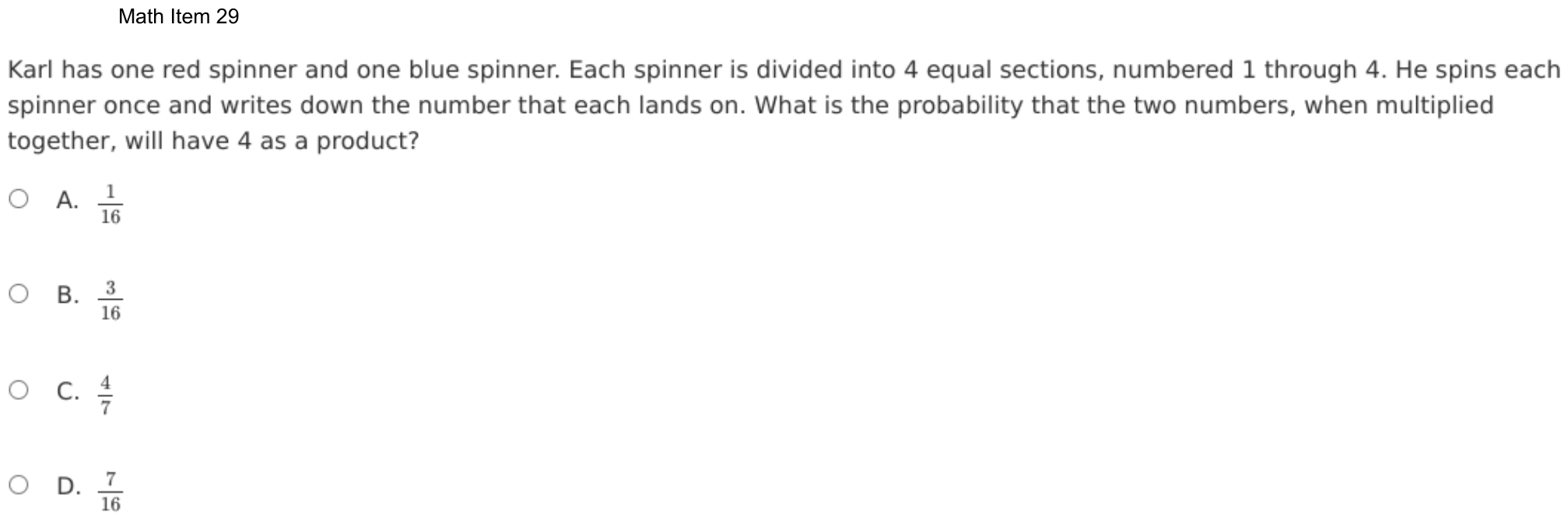
Question 39 of 120
2026 Practice Test D Math, question 34Question
Last week, Emily rode the bus to school on 3 of the 5 mornings and rode the bus home on 4 of the 5 afternoons. Based on last week’s events, what is the probability that Emily will ride the bus in the morning and the afternoon next Monday?
- A
- B
- C
- D
Show the answer
Correct answer: C
Using the joint probability formula, find the product of the two independent events. The probability that Emily will ride the bus to school on any given morning is . The probability that Emily will ride the bus home on any given afternoon is . Therefore, the probability that Emily will ride the bus in the morning and the afternoon is .
Question analysis
Last week Emily rode the bus to school on 3 of 5 mornings and home on 4 of 5 afternoons. This probability question asks how likely she is to ride the bus both ways next Monday, based on those frequencies. Students turn each count into a probability and combine the two, deciding how chances join when both events must happen.
- NYS standards
- Grade level
- Grade 7 content, by NYS standard
- Compared with grade 7
- At grade 7 Compound probability is grade 7 work, often done with a table of outcomes. Each chance here comes from one week's frequencies, and joining the morning and afternoon events in one step is about the usual grade 7 demand.
- Estimated difficulty
- Moderate: several steps, or a close reading with one strong distractor.
- Thinking it demands
- Depth of knowledge 2, skills and concepts · mainly apply
- What makes it hard
- Something you must already know moderate
- Turning words into math minor
- Solution
- 3 steps
- Reading level
- Question and choices: about grade 5, 48 words.
- Corrected from the DOE handbook
- An inaccurate detail in the explanation was corrected.
- Students, last 30 days
- Not enough answers yet to show (it takes 10).
Why it is hard, traps and wrong answers (shows the answer)
Why it is hard
Once the two chances are written, the question is how they combine. Pooling the week into 7 bus rides out of 10 trips, or adding fractions in some way, gives listed choices that look reasonable, since each lies between 0 and 1. Picturing the 25 pairings of a morning with an afternoon, 3 × 4 = 12 of which have both rides, shows why the chances multiply.
Something you must already know moderate Working it out
The rule that two independent events both happen with the product of their chances, 3/5 times 4/5, is not given, and “the morning and the afternoon” is the only signal for it. (Anderson & Krathwohl, 2001)
Turning words into math minor Understanding the question
The counts “3 of the 5 mornings” and “4 of the 5 afternoons” have to become two separate probabilities based on last week, not one pool of 10 trips. (Hegarty, Mayer & Monk, 1995; Koedinger & Nathan, 2004)
Strategy: Turn each count into a probability, then multiply them, since both rides must happen; picturing a table of 5 mornings by 5 afternoons shows why multiplying works.
Traps
- Misunderstands the concept: A wrong belief about a concept: that percents can be added, that area grows like length, that averages can be averaged, that a bigger denominator means a bigger fraction.
- A faulty procedure: A systematic but wrong procedure: adding fractions straight across, applying an exponent to each term of a sum, dropping a sign when moving a term.
- Wrong operation: Adds instead of multiplying, divides the wrong way round, turns a ratio or rate upside down, or undoes a step in the wrong direction (subtracts what should be added back).
The wrong answers, classified
A Wrong operation (Hegarty, Mayer & Monk, 1995; King et al., 2004)
Subtracts the morning chance from the afternoon chance, 4/5 − 3/5 = 1/5, an operation with no meaning for two rides that must both happen.
B A faulty procedure (Brown & Burton, 1978; Tatsuoka, 1983)
Adds the numerators, 3 + 4, but multiplies the denominators, 5 × 5, mixing the rule for adding fractions with the rule for multiplying them.
D Misunderstands the concept (Smith, diSessa & Roschelle, 1993; De Bock et al., 1998; Ni & Zhou, 2005)
Pools the week’s trips into 7 bus rides out of 10, a rate for a single trip, as if riding both ways next Monday were just as likely.
What was corrected from the DOE handbook, and why
- Explanation: The DOE’s explanation says “The probability that Emily will ride the bus to school on any given afternoon is 4/5.” The question says she rode the bus home on 4 of the 5 afternoons; her rides to school are the morning ones. The site now says “ride the bus home on any given afternoon”.
Worked solution, step by step
Formulas used
- Probability from past results
- P is the probability, the chance something happens. You use what happened before to predict the chance it happens again. Emily rode in 3 of 5 mornings, so the chance for one morning is 3/5.
- Both of two independent events
- A and B are two events. Independent means one does not change the chance of the other. To find the chance that both happen, multiply their chances. The result is smaller than either one, since both must happen.
Sort out the question
Last week Emily:
- rode the bus to school on 3 of the 5 mornings;
- rode the bus home on 4 of the 5 afternoons.
You need the chance that she rides the bus in the morning and in the afternoon next Monday. The word and means both rides must happen.
Write each chance
Use last week to find each chance:
- Bus to school on a morning:
- Bus home on an afternoon:
Keep them apart. The morning rides go to school, and the afternoon rides go home.
Multiply the two chances
Both rides must happen, so multiply:
Why multiply? Pair each of the 5 mornings with each of the 5 afternoons. That makes 25 pairs. In of them, she rides both times. So the chance is 12 out of 25.
Avoid the tempting wrong choices
Watch out: pooling the week gives 7 rides out of 10 trips, or 7/10, choice D. That is the chance for one trip, not for two trips on one day.
Adding the tops but multiplying the bottoms gives 7/25, choice B. Subtracting the chances gives 1/5, choice A.
So the answer is C, .
Check your answer
The chance of both rides must be less than the chance of each ride alone. As decimals, 12/25 = 0.48. That is less than 3/5 = 0.6 and 4/5 = 0.8. Choice D, 7/10 = 0.7, is more than 3/5, so it cannot be right.
More questions like this
The original DOE question
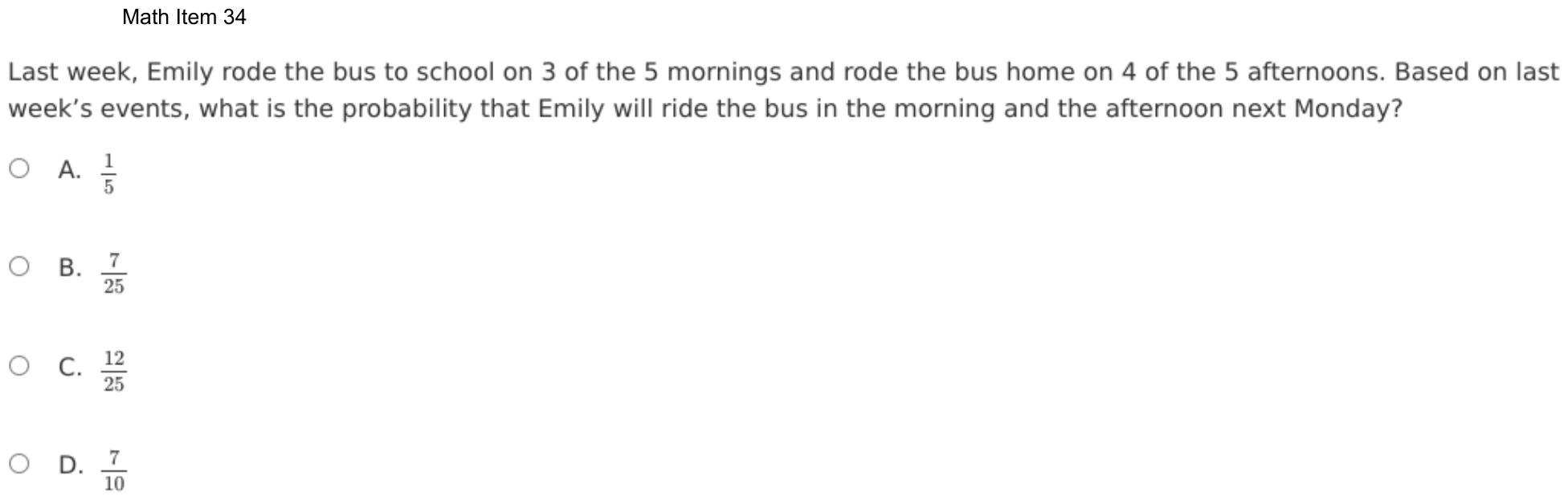
Question 40 of 120
2026 Practice Test D Math, question 35Question
XYZ Corporation hired 6 people as summer workers. Of these 6 people, 3 will be hired as permanent employees in the fall. If 2 of the 6 people are male, how many of the possible groups of 3 people hired in the fall will include only 1 male?
- A4
- B6
- C12
- D24
Show the answer
Correct answer: C
An organized list can be used to determine the number of groups of 3 people that include only 1 male.
Let the letters A, B, C, and D represent the females, and let the numbers 1 and 2 represent the males.
Then, create a list of all possible combinations of 3 people with only 1 male.
AB1, AB2, AC1, AC2, AD1, AD2
BC1, BC2, BD1, BD2
CD1, CD2
There are 12 possible groups with only 1 male.
Question analysis
A company hired 6 summer workers, 2 of them male, and will keep 3 as permanent employees in the fall. This counting question asks how many possible groups of 3 include only 1 male. Students count combinations where order does not matter, and the bold word only, with two kinds of workers to combine, makes careful listing essential.
- NYS standards
- 7.SP.8b sample spaces for compound events
- Grade level
- Grade 7 content, by NYS standard
- Compared with grade 7
- Above grade 7 Grade 7 students list outcomes with organized lists and tree diagrams, usually ordered ones. Counting unordered groups of three under an "only one" condition, built from two kinds of people, goes beyond that typical work.
- Estimated difficulty
- Hard: combines ideas, needs a plan, and has more than one tempting wrong answer.
- Thinking it demands
- Depth of knowledge 2, skills and concepts · mainly apply
- What makes it hard
- Combines ideas moderate
- Something you must already know minor
- Turning words into math minor
- Solution
- 3 steps
- Reading level
- Question and choices: about grade 7, 41 words.
- Students, last 30 days
- Not enough answers yet to show (it takes 10).
Why it is hard, traps and wrong answers (shows the answer)
Why it is hard
The question hides a two-stage count in a hiring story. Students tend to get one stage right and forget the other: they count the pairs of women and stop, or they count ordered picks and so find every group twice. Naming the women A to D and the men 1 and 2, then listing the pairs of women alphabetically with each man attached, makes every group visible and checkable.
Combines ideas moderate Working it out
Two counts are joined: the 6 ways to pick 2 of the 4 women, then the 2 ways to pick the man, and the total is their product. (Embretson, 1998; Daniel & Embretson, 2010)
Something you must already know minor Working it out
Students must already know that a group is the same whichever order its members are named, so picking one woman and then another repeats the reverse pick. (Anderson & Krathwohl, 2001)
Turning words into math minor Understanding the question
The bold word only means exactly one man, so the other two places in each group of 3 must go to two of the 4 women, a step the stem leaves unsaid. (Hegarty, Mayer & Monk, 1995; Koedinger & Nathan, 2004)
Strategy: Name the women A to D and the men 1 and 2, list every pair of women without repeats, then attach each man to each pair and count the groups.
Traps
- Stops one step early: A choice is a number from partway through the solution.
- Overlapping groups: Things in two groups at once are counted twice, or not subtracted.
The wrong answers, classified
A Numbers taken from the question (Hegarty, Mayer & Monk, 1995)
Multiplies the 2 men by the 2 places left for women, 2 × 2 = 4, using numbers from the question without listing a single group.
B Stops one step early (King et al., 2004; Gierl et al., 2017)
Counts the 6 pairs of women correctly but stops before pairing each one with either of the 2 men, which doubles the count.
D Overlapping groups (King et al., 2004)
Counts ordered picks of the two women, 4 × 3 = 12 instead of 6, so each group appears twice, then doubles for the men to reach 24.
Worked solution, step by step
Formulas used
- Counting with two choices
- Each way of picking the man can go with each way of picking the two women. So you multiply the two counts. It is like outfits: 2 shirts with 6 pairs of pants make 12 outfits.
Sort out the question
Six people work for the summer. Two are male, so the other 4 are female. Three will be hired in the fall.
You need the number of groups of 3 with only 1 male. That means exactly 1 man and 2 women. In a group, order does not matter. Ann, Bea and Carl is the same group as Carl, Ann and Bea.
Give each person a name
Call the women A, B, C and D. Call the men 1 and 2. Every group you want has 2 letters and 1 number, like AB1.
List the pairs of women
List each pair once. Start with A, then pair B only with letters after it, and so on:
- AB, AC, AD
- BC, BD
- CD
That is 6 pairs. BA is not new, since it is the same pair as AB.
Watch out: counting the order gives pairs, each one twice. Then doubling for the men gives 24, choice D.
Add a man to each pair
Each pair of women can go with man 1 or man 2. Use the counting rule:
Watch out: stopping at the 6 pairs of women leaves out the men. That gives 6, choice B.
So the answer is C, 12.
Check your answer
Write out every group. With man 1: AB1, AC1, AD1, BC1, BD1, CD1. With man 2: AB2, AC2, AD2, BC2, BD2, CD2. Each list has 6 groups, and . No group repeats, and each has just one man.
More questions like this
The original DOE question
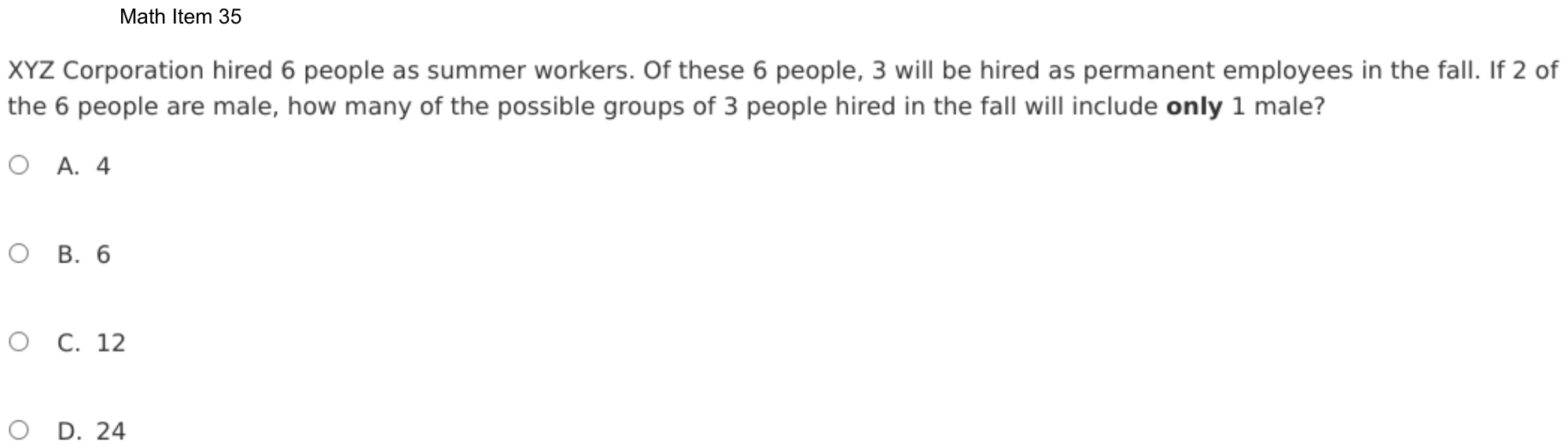
Question 41 of 120
2026 Practice Test D Math, question 36Question
Leah has set a goal to read a total of 500 pages of a textbook. The table shows the book page numbers for the reading she did during three days.
DAILY READING LOG
| Day | Pages Read |
|---|---|
| 1 | pages 45–90, inclusive |
| 2 | pages 100–135, inclusive |
| 3 | pages 145–190, inclusive |
What percentage of her 500-page goal did Leah read on these three days? Round your answer to the nearest tenth.
Enter your answer in the space.
Fill-in question: work out the answer and type it as a number.
Show the answer
Correct answer: 25.6%
First, determine the number of pages read each day. Since the pages per assignment are inclusive, subtract the first page from the last page assigned and then add 1 to determine the pages read for each day.
Day 1: pages
Day 2: pages
Day 3: pages
Leah read a total of 128 pages, since .
To determine the percent, express 128 pages out of 500 pages as a fraction.
Question analysis
Leah's daily reading log lists three ranges of textbook pages, each marked inclusive, and her goal is 500 pages. This percent question asks what percentage of the goal she read over the three days, rounded to the nearest tenth and typed in. Counting the pages in each inclusive range correctly is the tricky step before the percent.
- Grade level
- Grade 7 content, by NYS standard
- Compared with grade 7
- Above grade 7 Finding what percent one number is of another is grade 6 and 7 work. This adds three inclusive page ranges to count, which takes more care than subtracting, then a rounding step, all typed with no choices to check against.
- Estimated difficulty
- Hard: combines ideas, needs a plan, and has more than one tempting wrong answer.
- Thinking it demands
- Depth of knowledge 2, skills and concepts · mainly apply
- What makes it hard
- Something you must already know moderate
- Many steps moderate
- An answer in an unexpected form minor
- Solution
- 4 steps
- Reading level
- Question and choices: about grade 3, 66 words.
- Students, last 30 days
- Not enough answers yet to show (it takes 10).
Why it is hard, traps and wrong answers (shows the answer)
Why it is hard
Counting pages in a range is the whole difficulty; the percent at the end is routine once the total is right. Subtracting first from last feels natural, and here it even rewards the student with a round 25%, so nothing looks wrong. Checking the rule on a tiny range, pages 1 to 3, which is 3 pages and not 2, fixes the count, and the instruction to round to the nearest tenth hints that the answer is not a whole number.
Something you must already know moderate Working it out
Every row says inclusive, but nothing says that pages 45 to 90 hold 90 − 45 + 1 = 46 pages; subtracting alone loses one page on each of the three days. (Anderson & Krathwohl, 2001)
Many steps moderate Working it out
Three page counts, a sum, a division by 500 and a change to a percent come in sequence, and a one-page error in each count carries through to the end. (Daniel & Embretson, 2010; Enright, Morley & Sheehan, 2002)
An answer in an unexpected form minor Choosing the answer
The answer is typed with no choices, and the miscounted total, 125 pages, gives a tidy 25% that looks more finished than the right value with its tenth. (Enright, Morley & Sheehan, 2002)
Strategy: Count each day's pages carefully, testing your method on a short range such as pages 1–3, add the three days, divide by 500, and write the result as a percent to the nearest tenth.
Traps
- Counting the ends: Inclusive or exclusive ends, fence posts, consecutive numbers: an answer that is one too many or too few, or an endpoint drawn open where it belongs closed (or the reverse).
- Stops one step early: A choice is a number from partway through the solution.
- Misreads the question: Misses or misreads a condition or a word in the question: "at least", "each", "remaining", "not".
The wrong answers, classified
25 Counting the ends (Brown & Burton, 1978)
Subtracts the first page from the last for each day, 45 + 35 + 45 = 125 pages, forgetting that an inclusive range counts both end pages, so 125 ÷ 500 = 25%.
0.256 Stops one step early (King et al., 2004; Gierl et al., 2017)
Counts the 128 pages and divides by 500 correctly, then enters the decimal 0.256, one step short of multiplying by 100 to make a percent.
26 Misreads the question (Hegarty, Mayer & Monk, 1995)
Finds 25.6% correctly but rounds it to the nearest whole percent, overlooking the instruction to round to the nearest tenth.
Worked solution, step by step
Formulas used
- Counting pages in an inclusive range
- Inclusive means the first and last pages are both read. Subtracting counts the steps from the first page to the last. That misses one page, so add 1. Test it: pages 1 to 3 are 3 pages, and 3 − 1 + 1 = 3.
- Percent of a total
- The part is the amount you have, here the pages read. The whole is the amount you compare with, here the 500-page goal. Dividing gives a decimal. Multiplying by 100 turns it into a percent, a number out of 100.
Sort out the question
Leah’s goal is 500 pages. The log shows three days:
- Day 1: pages 45 to 90
- Day 2: pages 100 to 135
- Day 3: pages 145 to 190
Each range is inclusive. You need the percent of 500 pages she read, rounded to the nearest tenth.
Count the pages each day
Use the rule for an inclusive range: last page minus first page, plus 1.
Watch out: subtracting alone gives 45, 35 and 45 pages. That is 125 pages, which is exactly 25%. A round answer like that can hide the mistake.
Add the three days
Add the pages from all three days to get her total:
Leah read 128 pages in all. This is the part you compare with the goal.
Change to a percent
Divide the pages read by the goal, then multiply by 100:
Leah read 25.6% of her goal. That already ends in tenths, so no rounding is needed.
Watch out: 0.256 is a decimal, not a percent. And 26 rounds to a whole number, not to the nearest tenth.
Enter the answer
The box has no % sign, but the question asks for a percentage, so the number in the box is the percent. Type it with its decimal point. Typing 25.6% also counts on this site. So you would enter 25.6.
Check your answer
Estimate. 10% of 500 pages is 50 pages. 128 pages is a bit more than 2 × 50 = 100, so the answer is between 20% and 30%. Then check exactly: pages. It matches.
More questions like this
The original DOE question
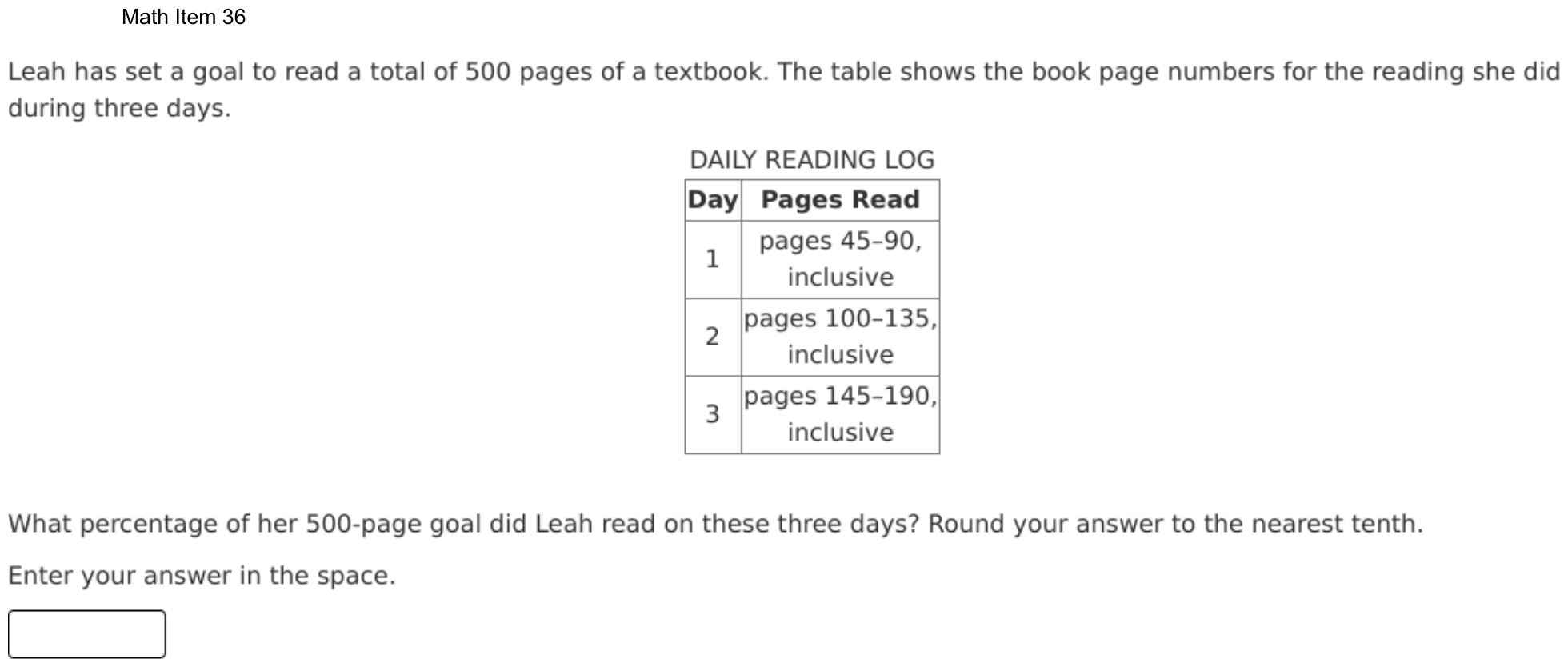
Question 42 of 120
2026 Practice Test D Math, question 37Question
What 3-digit number between 630 and 650 is divisible by both 5 and 8?
Enter your answer in the space.
Fill-in question: work out the answer and type it as a number.
Show the answer
Correct answer: 640
The final digit of the three-digit number is 0. Each of the digits 0 through 9, inclusive, must be considered.
To narrow the choices, first consider that the number between 630 and 650 must be divisible by both 5 and 8.
A number divisible by 5 must end in 0 or 5. Therefore, the only possibilities are 0 and 5.
-
If the number ended in 0, the whole number 640 must also be divisible by 8:
Both result in a remainder of 0.
-
If the number ended in 5, the whole numbers 635 and 645 must also be divisible by 8:
Dividing 635 by 5 results in a remainder of 0, but dividing 635 by 8 results in a remainder of 3.
Dividing 645 by 5 results in a remainder of 0, but dividing 645 by 8 results in a remainder of 5.
Therefore, 640 is the only whole number between 630 and 650 that is divisible by both 5 and 8.
Question analysis
This number question asks for the 3-digit number between 630 and 650 that is divisible by both 5 and 8, typed into a box. Students use divisibility rules or common multiples to find it. The work is short, but the number has to pass both tests, so checking only one divisor is the easy slip.
- NYS standards
- 6.NS.4 common factors and multiples
- Grade level
- Grade 6 content, by NYS standard
- Compared with grade 7
- Below grade 7 Common multiples are grade 6 content. Divisibility by 5 limits the last digit, and only a few numbers lie between 630 and 650, so this is a quick check, shorter than typical grade 7 work.
- Estimated difficulty
- Routine: one familiar step, little to misread.
- Thinking it demands
- Depth of knowledge 1, recall and reproduction · mainly apply
- What makes it hard
- Solution
- 2 steps
- Reading level
- Question and choices: about grade 5, 16 words.
- Students, last 30 days
- Not enough answers yet to show (it takes 10).
Why it is hard, traps and wrong answers (shows the answer)
Why it is hard
Few numbers need checking, so most students succeed; the risk is testing only one divisor. Students who start from multiples of 8 meet 632 first, and those who start from multiples of 5 can slip on 645 ÷ 8. Using the least common multiple, 40, shows at once that the number must be a multiple of 40, which leaves one candidate in the range.
Much to keep track of minor Working it out
Each candidate must pass two tests, divisible by 5 and by 8, and both ends of the range, 630 and 650, pass the first test but fail the second. (Sweller, 1988; Carpenter, Just & Shell, 1990)
Something you must already know minor Working it out
The shortcut that a multiple of 5 ends in 0 or 5 is assumed, and it cuts the search to 635, 640 and 645 before any division by 8. (Anderson & Krathwohl, 2001)
Strategy: Use divisibility by 5 to limit the last digit, then check only those few numbers in the range for divisibility by 8.
Traps
- Misreads the question: Misses or misreads a condition or a word in the question: "at least", "each", "remaining", "not".
- Stops one step early: A choice is a number from partway through the solution.
The wrong answers, classified
632 Misreads the question (Hegarty, Mayer & Monk, 1995)
Takes the first multiple of 8 after 630, 8 × 79 = 632, and stops without checking divisibility by 5, which a number ending in 2 fails.
645 An arithmetic slip (Junker & Sijtsma, 2001)
Picks a number ending in 5 so that 5 divides it, then slips on the check for 8, which leaves a remainder of 5.
40 Stops one step early (King et al., 2004; Gierl et al., 2017)
Finds the least common multiple of 5 and 8, 40, and enters it, one step before finding its multiple between 630 and 650.
Worked solution, step by step
Formulas used
- Divisible by 5
- Divisible means it divides evenly, with no remainder. A whole number is divisible by 5 only when its last digit is 0 or 5. That is because counting by 5s always lands on a number ending in 0 or 5.
- Least common multiple
- The least common multiple, or LCM, is the smallest number that both 5 and 8 divide evenly. 5 and 8 share no factor except 1, so their LCM is their product. Any number divisible by both is a multiple of 40.
Sort out the question
You need a 3-digit number between 630 and 650. It must be divisible by 5 and also by 8. Between means 630 and 650 themselves do not count.
Use the rule for 5
A number divisible by 5 ends in 0 or 5. Between 630 and 650, only three numbers do:
Only these need checking for 8.
Test each number for 8
Divide each one by 8 and look at the remainder, the amount left over:
- 635 ÷ 8 = 79, with 3 left over.
- 640 ÷ 8 = 80, with nothing left over.
- 645 ÷ 8 = 80, with 5 left over.
Only 640 divides evenly by 8.
Watch out: 645 passes the test for 5 but fails for 8. And 632, which is , passes for 8 but ends in 2, so it fails for 5.
Enter the number
640 passes both tests. Type the whole number in the box.
Watch out: 40 is the smallest number divisible by 5 and 8, but it is not between 630 and 650.
So you would enter 640.
Check your answer
Use the LCM. A number divisible by both 5 and 8 must be a multiple of 40. . The multiples next to it are 600 and 680, which are outside the range. So 640 is the only one.
More questions like this
The original DOE question
Question 43 of 120
2026 Practice Test D Math, question 38Question
Melissa has a bag of marbles that are all the same size. The bag contains three red (R) marbles, three green (G) marbles, and two white (W) marbles. For an experiment, she will take two marbles out of the bag without looking. Which list shows the sample space for Melissa’s experiment?
- AR, G, W
- BRG, RW, GW
- CR, R, R, G, G, G, W, W
- DRR, RG, RW, GG, GW, WW
Show the answer
Correct answer: D
The sample space of a random experiment is the collection of all possible outcomes. For this experiment, R represents a red marble, G represents a green marble, and W represents a white marble.
Since two marbles are being drawn, the possible outcomes for the first marble drawn are R, G, W.
List the possible results for each initial outcome combined with the second choice of marble. For example, if the first marble and second marble are both red, the sample space will include RR (red, red).
RR, RG, RW
GR, GG, GW
WR, WG, WW
Since order does not matter in this selection, remove any pairing that presents a duplicate choice, such as RG and GR—only one of the two pairings will be included in the sample space. Those are removed and leave a sample space of:
RR, RG, RW, GG, GW, WW
Question analysis
A bag holds three red, three green and two white marbles, and Melissa will take out two without looking. This probability question asks which list shows the sample space for her experiment. Students must know what a sample space is and what one outcome of drawing two marbles looks like, then decide which color pairs are possible.
- NYS standards
- 7.SP.8b sample spaces for compound events
- Grade level
- Grade 7 content, by NYS standard
- Compared with grade 7
- At grade 7 Representing the sample space of a compound event is a named grade 7 skill. Nothing is computed here; the demand is knowing what one outcome of drawing two marbles looks like and which pairs the bag allows, much as in grade 7 classwork.
- Estimated difficulty
- Moderate: several steps, or a close reading with one strong distractor.
- Thinking it demands
- Depth of knowledge 2, skills and concepts · mainly understand
- What makes it hard
- Something you must already know moderate
- A very close wrong answer moderate
- Solution
- 2 steps
- Reading level
- Question and choices: about grade 3, 71 words.
- Students, last 30 days
- Not enough answers yet to show (it takes 10).
Why it is hard, traps and wrong answers (shows the answer)
Why it is hard
The question tests a definition more than a skill, and three choices describe something real: the colors of one marble, the contents of the bag, and the pairs of different colors. The strongest pull comes from treating the colors as three single objects, which leaves out the pairs of one color although the bag holds three reds, three greens and two whites. Asking what Melissa could be holding after the draw settles it.
Something you must already know moderate Working it out
The term sample space is not defined in the question: students must know it means every possible result of the whole experiment, here a pair of colors drawn together. (Anderson & Krathwohl, 2001)
A very close wrong answer moderate Choosing the answer
The three mixed pairs, RG, RW and GW, form a complete-looking list that is the right list minus RR, GG and WW, so only asking whether two marbles of one color can come out together separates them. (Embretson & Wetzel, 1987; Gorin & Embretson, 2006; Ascalon et al., 2007)
Strategy: Describe one possible result of taking out two marbles, then build the list systematically, starting from each color and pairing it with every color that could come out with it.
Traps
- Misunderstands the concept: A wrong belief about a concept: that percents can be added, that area grows like length, that averages can be averaged, that a bigger denominator means a bigger fraction.
- Without replacement: In a second pick there is one fewer item, which changes the probability.
- Answers a different question: A choice is right for another quantity: the other unknown, the rest instead of the part, the part instead of the whole.
The wrong answers, classified
A Answers a different question (King et al., 2004; Hegarty, Mayer & Monk, 1995)
Lists the colors a single marble can be, the sample space for drawing one marble, though Melissa takes out two.
B Without replacement (Fischbein & Schnarch, 1997)
Leaves out pairs of one color, as if drawing a red marble left no red behind, though the bag holds three reds, three greens and two whites.
C Misunderstands the concept (Smith, diSessa & Roschelle, 1993; De Bock et al., 1998; Ni & Zhou, 2005)
Lists the eight marbles in the bag, describing what the bag holds rather than the possible results of taking two out.
Worked solution, step by step
Formulas used
- Sample space
- An outcome is one possible result of an experiment. The sample space lists every outcome once. For this experiment, one outcome is the pair of colors Melissa holds after she takes out two marbles.
Sort out the question
The bag holds 3 red (R), 3 green (G) and 2 white (W) marbles. Melissa takes out 2 marbles without looking.
You need the sample space: every possible result of taking out 2 marbles. So each outcome must name two colors, like RG for one red and one green.
List pairs by the first color
Start with each color the first marble could be. Then pair it with each color the second could be:
- First red: RR, RG, RW
- First green: GR, GG, GW
- First white: WR, WG, WW
That gives 9 pairs.
Remove pairs that repeat
Melissa ends up holding two marbles. One red and one green is the same result whichever came out first. So GR is the same as RG. Cross out GR, WR and WG. Six pairs are left:
RR, RG, RW, GG, GW, WW
Check the same-color pairs
Can both marbles be the same color? Yes. The bag has 3 reds, 3 greens and 2 whites, so RR, GG and WW can all happen.
Watch out: choice B leaves out RR, GG and WW. That would only be right if the bag had one marble of each color. Choice A is the colors of one marble. Choice C lists the marbles in the bag, not results.
So the answer is D, RR, RG, RW, GG, GW, WW.
Check your answer
Ask what Melissa could be holding. Two reds? Yes, there are 3. Two whites? Yes, there are exactly 2. A green and a white? Yes. Every pair in D can happen, and no possible pair is missing. Choice B misses three pairs that can happen.
More questions like this
The original DOE question
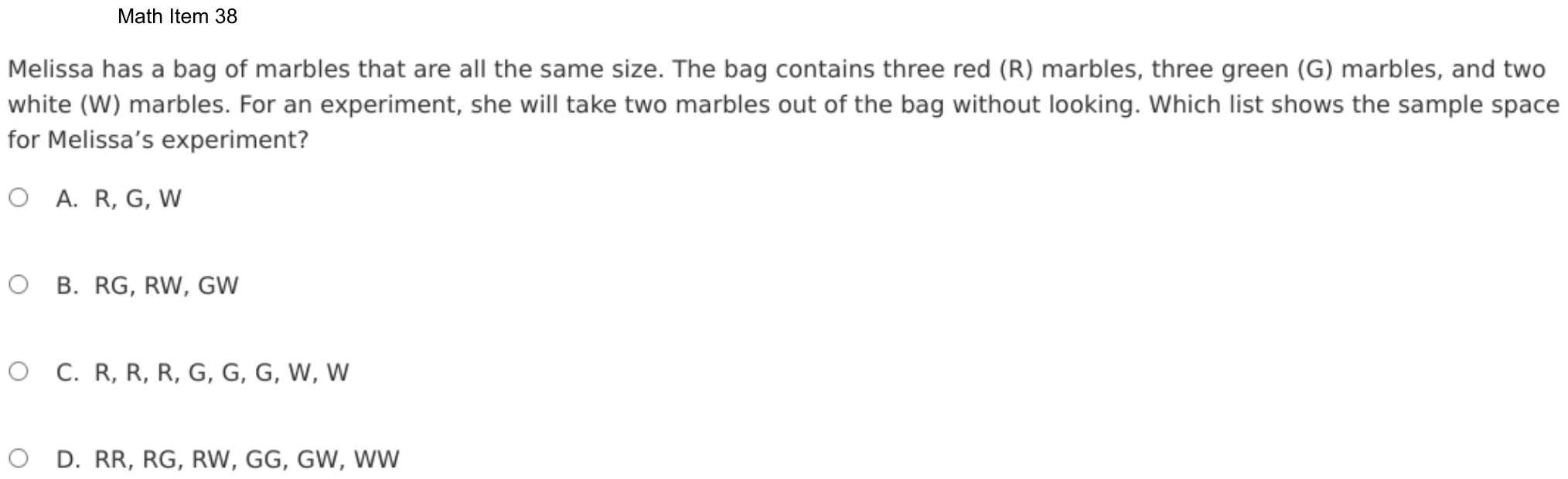
Question 44 of 120
2026 Practice Test D Math, question 41Question
The distance an eagle flies is proportional to the time the eagle spends flying. An eagle flies 90 miles in 3 hours. What is the constant of proportionality for this relationship?
- A3
- B30
- C60
- D90
Show the answer
Correct answer: B
The constant of proportionality is the ratio of y (90) to x (3). . So the constant of proportionality is 30.
Question analysis
An eagle flies 90 miles in 3 hours, and the distance it flies is proportional to its flying time. This proportional relationship question asks for the constant of proportionality. Students need to know that the constant is the unit rate, here miles per hour, and find it from the two values given.
- NYS standards
- 7.RP.2b constant of proportionality
- Grade level
- Grade 7 content, by NYS standard
- Compared with grade 7
- Below grade 7 Grade 7 students find constants of proportionality in tables, graphs and equations. This one is a single division of miles by hours given in a sentence, the same unit rate work students do in grade 6.
- Estimated difficulty
- Routine: one familiar step, little to misread.
- Thinking it demands
- Depth of knowledge 1, recall and reproduction · mainly apply
- What makes it hard
- Solution
- 1 step
- Reading level
- Question and choices: about grade 7, 29 words.
- Students, last 30 days
- Not enough answers yet to show (it takes 10).
Why it is hard, traps and wrong answers (shows the answer)
Why it is hard
One division answers the question, so it is among the easiest on the test. The wrong choices are the two numbers in the stem and one unrelated value, so a student who knows what the constant means is not tempted. Checking that the constant times 3 hours gives back the 90 miles confirms it.
Something you must already know minor Working it out
Students must know that the constant of proportionality is the unit rate, distance over time, here the miles flown in a single hour; the stem gives only the term. (Anderson & Krathwohl, 2001)
Strategy: Divide the distance by the time, because the constant of proportionality is the distance flown in one hour, then check by multiplying it by the 3 hours.
Traps
- Numbers taken from the question: Combines the numbers in the question without a model of the situation, or is simply a number that appears in the question.
The wrong answers, classified
A Numbers taken from the question (Hegarty, Mayer & Monk, 1995)
Gives the 3 hours printed in the stem as the constant, instead of the miles flown in each hour.
C Little reason to choose it (Haladyna & Downing, 1993; Rodriguez, 2005)
No working from 90 miles and 3 hours leads to 60, which may echo the 60 minutes in an hour, so it mostly attracts guesses.
D Numbers taken from the question (Hegarty, Mayer & Monk, 1995)
Gives the 90 miles, the distance for the whole 3-hour flight, as if the eagle covered it in a single hour.
Worked solution, step by step
Formulas used
- Proportional relationship
- x is one amount, here the time in hours, and y is the other, here the distance in miles. k is the constant of proportionality. It is the same for every pair, and it equals y divided by x. Here it is the miles flown in 1 hour.
Sort out the question
The eagle flies 90 miles in 3 hours. Proportional means the distance is always the same number times the time. That number is the constant of proportionality. You need to find it.
Divide the distance by the time
Use the formula. The distance is y and the time is x:
The constant is 30. It means the eagle flies 30 miles in each hour.
Avoid the numbers in the question
Watch out: 3 is the number of hours, choice A. And 90 is the distance for all 3 hours, choice D. Neither is the distance for 1 hour.
So the answer is B, 30.
Check your answer
Multiply back. At 30 miles each hour, the eagle flies miles in 3 hours. That matches the question. Hour by hour, it goes 30, 60, then 90 miles.
More questions like this
The original DOE question
Question 45 of 120
2026 Practice Test D Math, question 47Question
What shape will result from a horizontal slice of the figure above?
- Aa square that has 2-inch sides
- Ba triangle that has 2-inch sides
- Ca rectangle that has a 2-inch side and a 6-inch side
- Da triangle that has one 2-inch side and two 6-inch sides
Show the answer
Correct answer: A
Based on the diagram, the figure shown is a right rectangular prism with a square base. A horizontal slice of the figure will be a plane parallel to the square base, as in this example.
Since the horizontal slice is parallel to the base, it will be congruent to the base, which is a square with 2-inch sides.
Question analysis
A figure shows a right rectangular prism measuring 2 inches by 2 inches by 6 inches, standing on end. This geometry question asks what two-dimensional shape a horizontal slice of the prism makes. It tests visualizing cross-sections of solids, using the labeled lengths to name both the shape and its size.
- NYS standards
- 7.G.3 slicing three-dimensional solids
- Grade level
- Grade 7 content, by NYS standard
- Compared with grade 7
- At grade 7 Describing the shape made by slicing a prism parallel to its base is exactly the grade 7 standard. This is its simplest case, a single slice of a labeled right prism, typical of a classroom example.
- Estimated difficulty
- Routine: one familiar step, little to misread.
- Thinking it demands
- Depth of knowledge 1, recall and reproduction · mainly understand
- What makes it hard
- Solution
- 1 step
- Reading level
- Question and choices: about grade 2, 46 words.
- Students, last 30 days
- Not enough answers yet to show (it takes 10).
Why it is hard, traps and wrong answers (shows the answer)
Why it is hard
A horizontal cut runs parallel to the ground, and this prism stands on a square base, so the slice copies the base. The main danger is picturing the cut along the tall front face, which gives a 2-by-6 rectangle, the shape a vertical slice makes. The two triangles need a slanted cut through a corner and catch only students guessing.
Reading a figure, table or graph minor Understanding the question
The prism is drawn standing on end, 6 inches tall on a 2-by-2 base, so the cut has to be pictured in a flat drawing where the tall front face is the most visible shape. (Lesh, Post & Behr, 1987; Kirsch & Mosenthal, 1990)
Something you must already know minor Working it out
Students must know that a slice parallel to the base of a prism has the same shape and size as the base, which here is the square at the bottom. (Anderson & Krathwohl, 2001)
Strategy: Picture a flat cut across the prism parallel to the ground, ask which face of the prism that cut runs parallel to, and read that face's edge lengths from the labels.
Traps
- Misreads the question: Misses or misreads a condition or a word in the question: "at least", "each", "remaining", "not".
- Misunderstands the concept: A wrong belief about a concept: that percents can be added, that area grows like length, that averages can be averaged, that a bigger denominator means a bigger fraction.
The wrong answers, classified
B Misunderstands the concept (Smith, diSessa & Roschelle, 1993; De Bock et al., 1998; Ni & Zhou, 2005)
Expects a slice to cut off a corner and make a triangle, as a cut through a pyramid might, not a cut parallel to this square base.
C Misreads the question (Hegarty, Mayer & Monk, 1995)
Describes a vertical slice, which runs down the 6-inch height and makes a 2-by-6 rectangle, mixing up horizontal and vertical.
D Numbers taken from the question (Hegarty, Mayer & Monk, 1995)
Builds a triangle from the labels in the figure, one 2-inch and two 6-inch sides, a shape no horizontal cut of this prism can make.
Worked solution, step by step
Formulas used
- A slice parallel to the base
- The sign ≅ means congruent: the same shape and the same size. A prism has the same shape all the way up, like a stack of matching cards. So a cut parallel to its base, at any height, is a copy of the base.
Sort out the question
The figure is a right rectangular prism, a box shape whose faces are all rectangles. It stands on end. The two edges along the bottom are labeled 2 in. The tall edge is labeled 6 in.
You need the shape you get from a horizontal slice. Horizontal means flat, like the floor or a tabletop.
Find the base
The base is the face the prism stands on. The two bottom edges you can see are both labeled 2 in. The right-angle mark on the top face shows its corners are square. The top and the bottom match. So the base is a square with 2-inch sides.
Picture the slice
A horizontal slice cuts straight across the prism, parallel to the base. The walls of the prism go straight up, so the slice is a copy of the base. It is a square with 2-inch sides, at whatever height you cut.
The 6-inch height does not matter. It only tells how tall the stack of squares is.
Rule out the other shapes
Watch out: a 2-inch by 6-inch rectangle, choice C, comes from a vertical slice. That cut goes straight down, through the 6-inch height. A triangle, choice B or D, needs a slanted cut through a corner.
So the answer is A, a square that has 2-inch sides.
Check your answer
Picture the slice sliding up and down. At the bottom, it matches the base, 2 in. by 2 in. At the top, it matches the top face, the same square. In between, the walls are straight, so its size never changes.
More questions like this
The original DOE question
Question 46 of 120
2026 Practice Test D Math, question 49Question
Anise has a piece of cloth measuring 45 inches by 75 inches. She wants to cut it into squares of equal size, without any cloth left over. What is the greatest possible side length, in inches, of one of those squares?
- A3
- B5
- C15
- D45
Show the answer
Correct answer: C
Given that each piece will be a square, the length and width will be the same. The greatest possible length can be determined by finding the greatest common factor of the length and width of the original piece of cloth.
Begin by finding the prime factorization of the length (75 in.) and width (45 in.).
The common factors can be seen as .
The greatest possible side length, in inches, will be .
Question analysis
Anise wants to cut a 45-inch by 75-inch piece of cloth into equal squares with nothing left over. This factors question asks for the greatest possible side length of each square, in inches. Students must see that the side has to divide both lengths evenly, then find the largest number that does.
- NYS standards
- 6.NS.4 common factors and multiples
- Grade level
- Grade 6 content, by NYS standard
- Compared with grade 7
- Below grade 7 Greatest common factors of two numbers up to 100 are grade 6 content. The cloth setting asks students to recognize that this is what is needed, but the work is one short factor search, below typical grade 7 demand.
- Estimated difficulty
- Straightforward: two steps or one careful reading.
- Thinking it demands
- Depth of knowledge 2, skills and concepts · mainly apply
- What makes it hard
- Solution
- 2 steps
- Reading level
- Question and choices: about grade 4, 39 words.
- Students, last 30 days
- Not enough answers yet to show (it takes 10).
Why it is hard, traps and wrong answers (shows the answer)
Why it is hard
Once the side is seen as a common factor, the work is short, since 45 and 75 share both 3 and 5. Students who spot one shared factor and stop reach a listed choice, and those who think only of the largest square that fits use the full 45-inch width. Checking that 45 and 75 both divide by the chosen side, and that no larger number does, closes it.
Turning words into math minor Understanding the question
The words “squares of equal size, without any cloth left over” mean the side must divide both 45 and 75 exactly; nothing names the greatest common factor. (Hegarty, Mayer & Monk, 1995; Koedinger & Nathan, 2004)
Something you must already know minor Working it out
Finding the greatest common factor of 45 and 75 calls for prime factorization or a list of factors, a grade 6 skill the question assumes. (Anderson & Krathwohl, 2001)
Strategy: Write each length as a product of primes, multiply the primes they share, and check that both 45 and 75 divide evenly by the result.
Traps
- Stops one step early: A choice is a number from partway through the solution.
- Misreads the question: Misses or misreads a condition or a word in the question: "at least", "each", "remaining", "not".
The wrong answers, classified
A Stops one step early (King et al., 2004; Gierl et al., 2017)
Finds a factor that 45 and 75 share, 3, and stops without combining it with the 5 they also share.
B Stops one step early (King et al., 2004; Gierl et al., 2017)
Spots the common factor 5, since both lengths end in 5, and stops before multiplying it by the 3 they also share.
D Misreads the question (Hegarty, Mayer & Monk, 1995)
Uses the cloth’s full width, 45 inches, as the side, the largest square that fits, but 45 does not divide 75, leaving a 45-by-30 strip.
Worked solution, step by step
Formulas used
- Greatest common factor
- A factor divides a number evenly. The greatest common factor, or GCF, is the biggest number that divides both. Write each number as a product of primes, numbers whose only factors are 1 and themselves. Then multiply the primes they share.
Sort out the question
The cloth is 45 inches by 75 inches. It is cut into equal squares, with no cloth left over. You need the greatest side the squares can have.
No cloth left over means the side must fit evenly into 45 and into 75. So the side is a common factor of both. The greatest one is the GCF.
Break each number into primes
Write each length as a product of prime numbers:
The two lists share one 3 and one 5.
Multiply the shared primes
Multiply the primes the two numbers share:
The squares can be 15 inches on a side.
Watch out: 3 and 5 are each common factors, choices A and B. But they are not the greatest. Use every prime the numbers share.
Rule out the full width
Watch out: a 45-inch square, choice D, fits the width. But 75 ÷ 45 = 1 with 30 left over. That leaves a strip of cloth 45 inches by 30 inches.
So the answer is C, 15.
Check your answer
Divide each length by 15: and . So the cloth cuts into 3 rows of 5 squares, with nothing left. Both divisions come out even.
More questions like this
The original DOE question
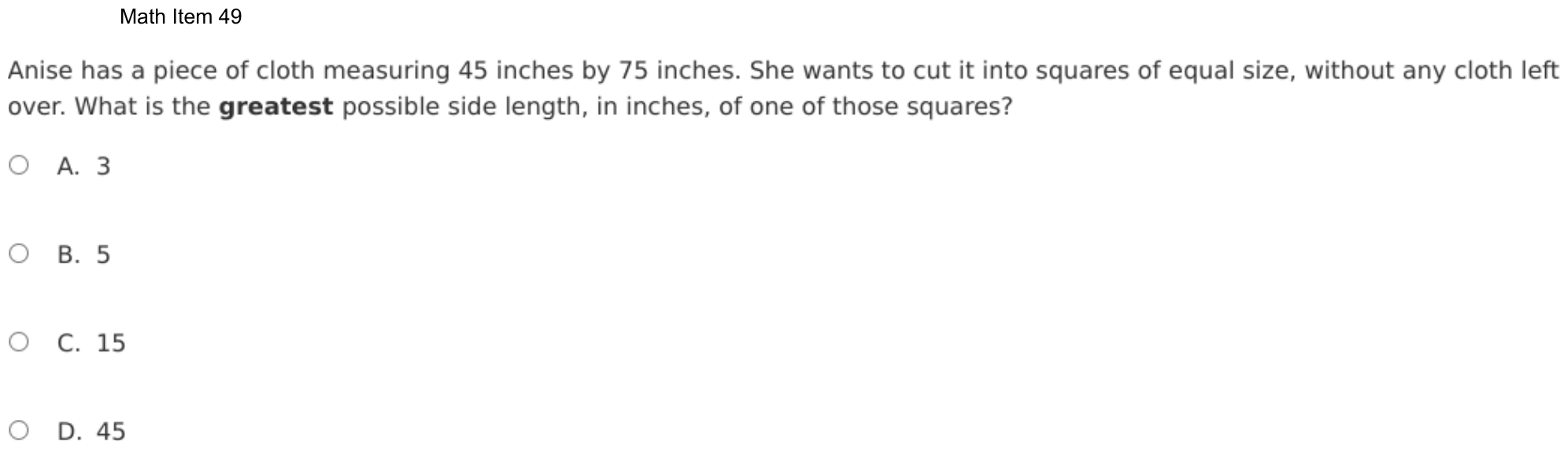
Question 47 of 120
2026 Practice Test D Math, question 50Question
This table shows the number of birds that came to a bird feeder on Monday and Tuesday.
BIRDS AT BIRD FEEDER
| Day | Number of Birds |
|---|---|
| Monday | 30 |
| Tuesday | 24 |
What was the percent decrease in the number of birds from Monday to Tuesday?
- A6%
- B20%
- C24%
- D25%
Show the answer
Correct answer: B
To determine the percent decrease from Monday to Tuesday, first calculate the decrease in the number of birds at the feeder.
The difference in the number of birds at the feeder divided by the number of birds on Monday will yield the percent decrease from Monday to Tuesday.
0.20 represents 20%.
There was a 20% decrease from Monday to Tuesday.
Question analysis
A table shows that 30 birds came to a bird feeder on Monday and 24 on Tuesday. This percent change question asks for the percent decrease from Monday to Tuesday. Students find the change and compare it with one day's count, and choosing the right day as the base decides the result.
- NYS standards
- 7.RP.3 multistep ratio and percent problems
- Grade level
- Grade 7 content, by NYS standard
- Compared with grade 7
- At grade 7 Percent decrease is core grade 7 work, and this is a plain example: one subtraction and one division with friendly numbers. The only real demand is measuring the change against the right day's count.
- Estimated difficulty
- Straightforward: two steps or one careful reading.
- Thinking it demands
- Depth of knowledge 2, skills and concepts · mainly apply
- What makes it hard
- Solution
- 2 steps
- Reading level
- Question and choices: about grade 3, 40 words.
- Students, last 30 days
- Not enough answers yet to show (it takes 10).
Why it is hard, traps and wrong answers (shows the answer)
Why it is hard
The subtraction is trivial, so the question is about the base. Both counts sit in the table, and dividing by the later one gives an equally neat percent that is easy to accept. Saying “a decrease from Monday” and putting Monday’s 30 under the change avoids it, and checking that 20% of 30 is 6 confirms the result.
A very close wrong answer minor Choosing the answer
Dividing the drop of 6 by Monday’s 30 gives 20% and by Tuesday’s 24 gives 25%, two round, listed percents only 5 points apart, so only the choice of base separates them. (Embretson & Wetzel, 1987; Gorin & Embretson, 2006; Ascalon et al., 2007)
Something you must already know minor Working it out
Students must know that a percent decrease is the change divided by the starting amount, here Monday’s count, a rule the question does not state. (Anderson & Krathwohl, 2001)
Strategy: Subtract to find how many fewer birds came on Tuesday, divide by Monday's count, the starting amount, and change the fraction to a percent.
Traps
- Percent of the wrong amount: Finding the whole from a part, or a percent change measured from the wrong starting amount.
- Misunderstands the concept: A wrong belief about a concept: that percents can be added, that area grows like length, that averages can be averaged, that a bigger denominator means a bigger fraction.
- Numbers taken from the question: Combines the numbers in the question without a model of the situation, or is simply a number that appears in the question.
The wrong answers, classified
A Misunderstands the concept (Smith, diSessa & Roschelle, 1993; De Bock et al., 1998; Ni & Zhou, 2005)
Finds the decrease of 6 birds and reads it as 6 percent, as if the count had dropped from 100 rather than from 30.
C Numbers taken from the question (Hegarty, Mayer & Monk, 1995)
Reads Tuesday’s 24 birds as a percent, taking a number straight from the table without working out the change at all.
D Percent of the wrong amount (Parker & Leinhardt, 1995)
Divides the decrease of 6 by Tuesday’s 24 birds instead of Monday’s 30, measuring the change from the later day: 6/24 = 25%.
Worked solution, step by step
Formulas used
- Percent decrease
- Old is the starting amount, here Monday’s count. New is the later amount, Tuesday’s count. The top is how much it dropped. You divide by the starting amount because a change is measured from where you started.
Sort out the question
The table shows 30 birds on Monday and 24 birds on Tuesday. You need the percent decrease from Monday to Tuesday. From Monday means Monday is the starting amount.
Find the drop
Subtract Tuesday’s count from Monday’s:
There were 6 fewer birds.
Watch out: 6 is a number of birds, not a percent. Calling it 6% leads to choice A.
Compare the drop with Monday
Use the formula. Divide the drop by Monday’s count, then multiply by 100:
The number of birds went down by 20%.
Watch out: dividing by Tuesday’s 24 gives , or 25%, choice D. Measure the change from the starting day. Choice C, 24%, just copies a number from the table.
So the answer is B, 20%.
Check your answer
Take 20% of Monday’s count: . Then , which is Tuesday’s count. The answer checks out.
More questions like this
The original DOE question
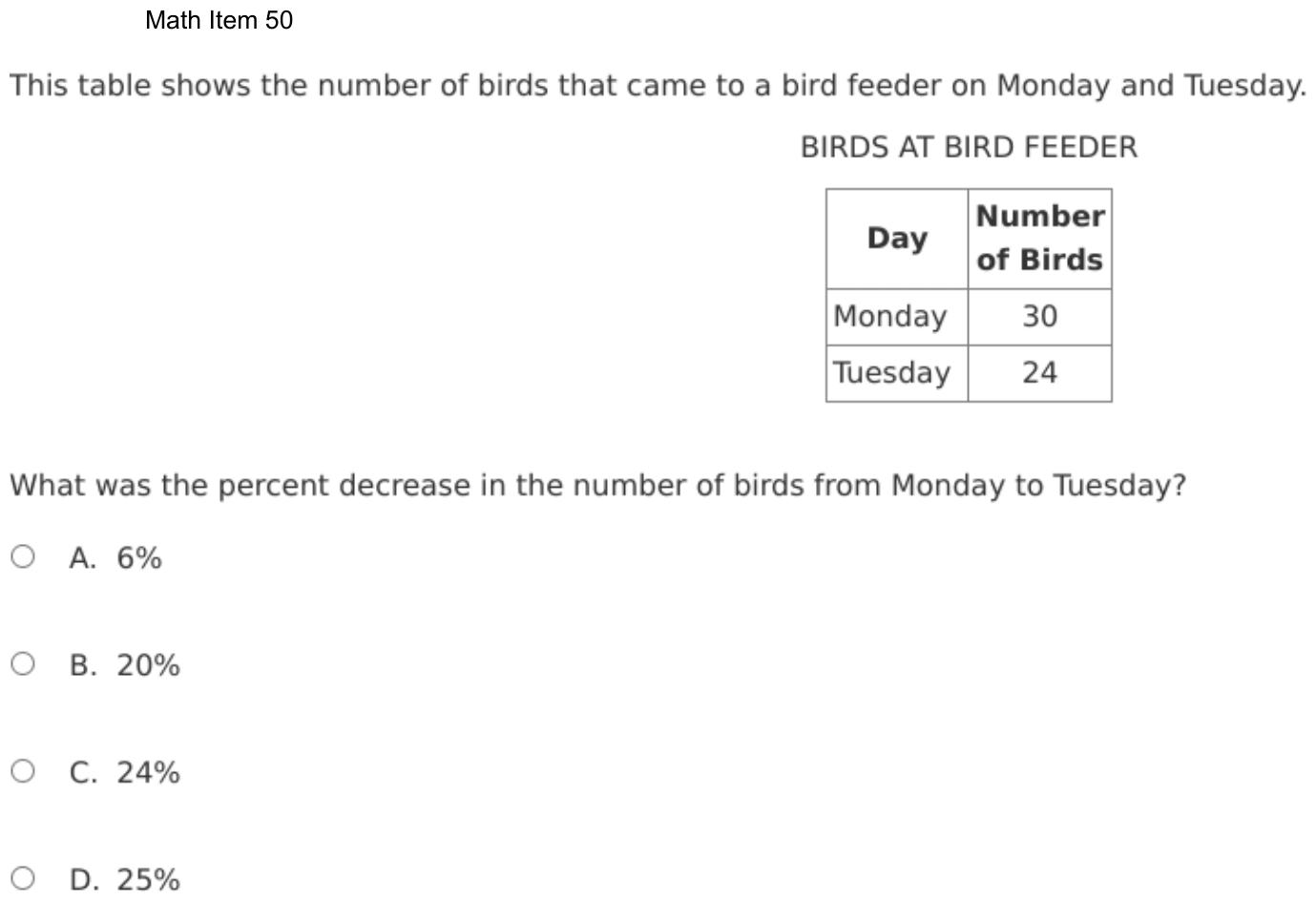
Question 48 of 120
2024 Test A Math, question 2Question
Angle M and angle R are supplementary. The measure of angle R is 5 times the measure of angle M. What is the measure of angle R, in degrees?
Grid-in question: work out the answer and enter it as a number.
Show the answer
Correct answer: 150
Angle M and angle R are supplementary, so the sum of the angles is 180°.
Let m equal the measure of angle M, and let r equal the measure of angle R.
The measure of angle R is 5 times the measure of angle M.
Therefore, the measure of angle R is 150°.
Question analysis
A geometry grid-in about two supplementary angles, where one angle is five times the size of the other. Students must recall what supplementary means, write an equation linking the two angles, and solve it. The question asks for the larger angle, so stopping at the smaller one is the usual slip.
- Grade level
- Grade 7 content, by NYS standard
- Compared with grade 7
- At grade 7 Grade 7 students regularly write and solve simple equations for unknown angles using supplementary and complementary facts. This is a two-step version of exactly that task, with whole numbers and no figure to read.
- Estimated difficulty
- Straightforward: two steps or one careful reading.
- Thinking it demands
- Depth of knowledge 2, skills and concepts · mainly apply
- What makes it hard
- Solution
- 3 steps
- Reading level
- Question and choices: about grade 5, 28 words.
- Students, last 30 days
- Not enough answers yet to show (it takes 10).
Why it is hard, traps and wrong answers (shows the answer)
Why it is hard
Once supplementary is read as a 180° total, the problem is a one-variable equation with whole numbers. Students lose the point in two ways: by stopping at the smaller angle, which the equation produces first, or by using 90° for the total. Checking that the gridded angle is the larger of the pair, and that the two angles add to 180°, catches both.
Something you must already know moderate Working it out
The stem never says what supplementary means; the 180° total has to be recalled, and a student who confuses it with complementary's 90° halves every angle. (Anderson & Krathwohl, 2001)
Turning words into math minor Understanding the question
The sentence "The measure of angle R is 5 times the measure of angle M" has to become R = 5M, so the 180° splits into six equal parts, not five. (Hegarty, Mayer & Monk, 1995; Koedinger & Nathan, 2004)
An answer in an unexpected form minor Choosing the answer
As a grid-in there is nothing to compare against, so gridding angle M's 30°, the first value the equation gives, looks just as finished as angle R. (Enright, Morley & Sheehan, 2002)
Strategy: Call angle M one part and angle R five parts; together the six parts make the supplementary total, so find one part and then multiply for angle R.
Traps
- Answers a different question: A choice is right for another quantity: the other unknown, the rest instead of the part, the part instead of the whole.
- Wrong formula: Uses a related but wrong formula: perimeter for area, diameter for radius, area for volume, or a misremembered one.
The wrong answers, classified
30 Answers a different question (King et al., 2004; Hegarty, Mayer & Monk, 1995)
Solves 6m = 180 correctly for angle M, 30°, and grids it instead of multiplying by 5 to get angle R, the angle the question asks for.
75 Wrong formula (King et al., 2004)
Uses 90° for supplementary, the complementary total, so 6m = 90 gives m = 15 and angle R = 75, half its real size.
36 Numbers taken from the question (Hegarty, Mayer & Monk, 1995)
Divides 180 by the 5 in the stem, combining the two numbers without an equation that gives angle M its own share of the 180°.
Worked solution, step by step
Formulas used
- Supplementary angles
- M and R are the sizes of two angles, in degrees. Supplementary means the two angles add up to 180 degrees. Put side by side, they make a straight line. Do not mix this up with complementary, which means a total of 90 degrees.
Sort out the question
Two angles, M and R, are supplementary. Angle R is 5 times as big as angle M. You need the measure of angle R, in degrees. Measure means its size. Notice that the question asks for R, not M.
Write the facts as equations
Supplementary angles add up to 180°.
The sentence “The measure of angle R is 5 times the measure of angle M” becomes this:
Watch out: supplementary means 180°, not 90°. Using 90° gives R = 75, which is wrong.
Find angle M
Put in place of R. Then the equation has only one unknown, M.
Think of 6 equal parts. M is 1 part and R is 5 parts. So angle M is 30°.
Find angle R
Angle R is 5 times angle M.
Angle R is 150°. Watch out: do not stop at M. Gridding 30 gives the wrong angle. So you would grid 150.
Check your answer
Add the two angles: . So they are supplementary. Also, , so R really is 5 times M. Both facts in the question check out.
More questions like this
The original DOE question
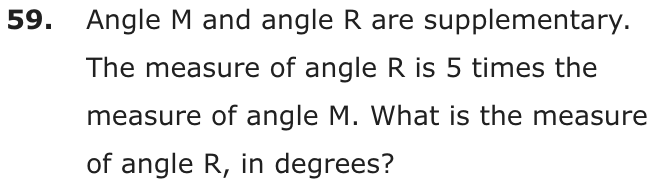
Question 49 of 120
2024 Test A Math, question 8Question
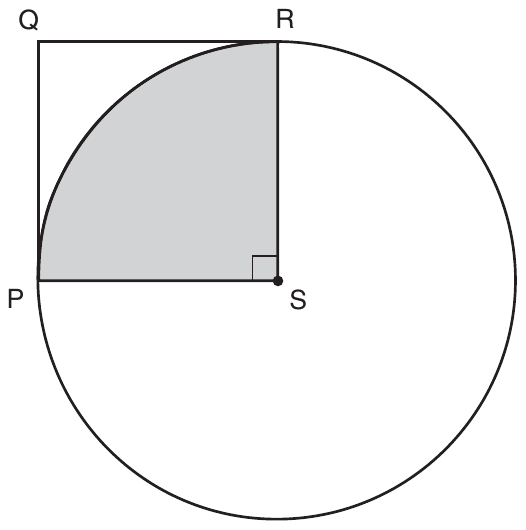
In the figure above, PQRS is a square. Point S is the center of the circle, and points P and R are on the circle. If the area of the square is 4 square centimeters, what is the area, in square centimeters, of the shaded quarter of the circle?
- A
- B
- C
- D
Show the answer
Correct answer: B
The area of square PQRS is 4 square centimeters. So
Sides PS and RS are each a radius of the circle. So the radius of the circle is 2 cm.
The shaded region is of the circle. The area of a circle is . So the area of the shaded region, in square centimeters, is
Question analysis
A geometry question with a figure: square PQRS has one corner at the center of a circle, and the quarter of the circle inside the square is shaded. Given the area of the square, students find the area of the shaded quarter circle. The key is connecting the square's side to the circle's radius.
- Grade level
- Grade 7 content, by NYS standard
- Compared with grade 7
- At grade 7 Circle area is grade 7 content, and this question adds only one linking step from the square's area to the radius. Typical grade 7 circle work gives the radius directly; here it takes one short extra inference.
- Estimated difficulty
- Straightforward: two steps or one careful reading.
- Thinking it demands
- Depth of knowledge 2, skills and concepts · mainly apply
- What makes it hard
- Reading a figure, table or graph moderate
- Something you must already know minor
- Combines ideas minor
- Solution
- 3 steps
- Reading level
- Question and choices: about grade 4, 52 words.
- Students, last 30 days
- Not enough answers yet to show (it takes 10).
Why it is hard, traps and wrong answers (shows the answer)
Why it is hard
The question chains three short facts: from the square's area to its side, from the side to the radius, and from the whole circle to a quarter of it. None is hard, but each wrong choice marks a broken link, most often the whole circle's area, which looks like a finished answer. Pointing to S as the center before computing anything settles the radius.
Reading a figure, table or graph moderate Understanding the question
The radius is never labeled: students must see that S is both a corner of the square and the circle's center, so sides PS and RS are radii. (Lesh, Post & Behr, 1987; Kirsch & Mosenthal, 1990)
Something you must already know minor Working it out
Neither the circle area formula, π times the radius squared, nor the step from a square's area to its side length is given. (Anderson & Krathwohl, 2001)
Combines ideas minor Working it out
Square and circle are linked in one chain: the area 4 gives a side of 2, the side is the radius, and the shaded part is a quarter of π × 2². (Embretson, 1998; Daniel & Embretson, 2010)
Strategy: Take the square root of the square's area to get its side, which is also the radius, then take one quarter of pi times the radius squared.
Traps
- Wrong formula: Uses a related but wrong formula: perimeter for area, diameter for radius, area for volume, or a misremembered one.
- Stops one step early: A choice is a number from partway through the solution.
- A formula you must know: Needs a formula the test does not give: area, circumference, volume, probability rules.
The wrong answers, classified
A Wrong formula (King et al., 2004)
Halves the square's side as if it were a diameter, so it uses a radius of 1, and one quarter of π × 1² gives π/4.
C Wrong formula (King et al., 2004)
Misremembers the circle's area as 2πr², blending it with the circumference 2πr, so one quarter of 2π × 2² gives 2π.
D Stops one step early (King et al., 2004; Gierl et al., 2017)
Finds the whole circle's area, π × 2² = 4π, and stops before taking the quarter that is shaded.
Worked solution, step by step
Formulas used
- Area of a square
- A is the area, the space inside. s is the length of one side, and s² means s × s. All four sides of a square are equal, so its area is side times side.
- Area of a circle
- A is the area of the whole circle. r is the radius: the distance from the center to the edge. π, called pi, is a number a little more than 3, about 3.14. Multiply π by r × r. This works for every circle.
Sort out the figure
PQRS is a square with an area of 4 sq cm. Point S is the center of the circle. Points P and R are on the circle. The shaded part is a quarter of the circle, inside the square. You need the shaded area, in square centimeters. The answer will have π in it.
Find the side of the square
Use the square formula. The area is 4, so find the number that times itself gives 4.
Each side is 2 cm long, because .
See that the side is the radius
Side SP goes from the center, S, to point P on the circle. So SP is a radius. So is side SR. The radius is 2 cm. Watch out: the side is a radius, not a diameter, the full width of the circle. Using a radius of 1 leads to , choice A.
Find the area of the whole circle
The whole circle has an area of 4π sq cm. Watch out: this is the whole circle. Stopping here gives choice D.
Take one quarter
The shaded part is one quarter of the circle, so take one quarter of 4π.
The shaded area is π sq cm. So the answer is B, .
Check your answer
π is about 3.14, so the shaded part is about 3.14 sq cm. The whole square is 4 sq cm. In the figure, the shaded part fills most of the square, but not all. So a bit less than 4 makes sense. The choice 4π is about 12.6, far too big.
More questions like this
The original DOE question
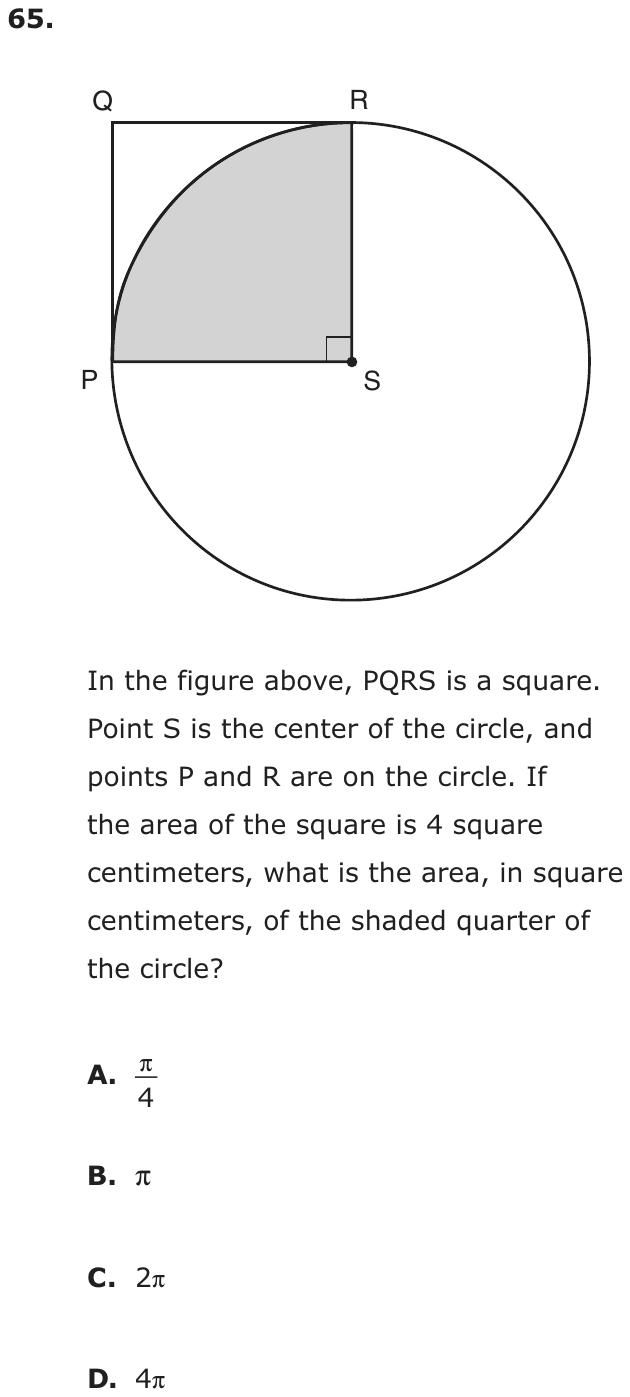
Question 50 of 120
2024 Test A Math, question 12Question
If n is a whole number, and 0.01 is between and , what is the value of n?
- A0
- B1
- C2
- D99
Show the answer
Correct answer: D
, which is between and .
Therefore, and .
Question analysis
A number sense question: 0.01 lies between 1 over n and 1 over n + 2, where n is a whole number, and students find n. It tests comparing a decimal with unit fractions and knowing how a fraction changes as its denominator grows. The unusual form, with n in two denominators, is what slows students down.
- Grade level
- Grade 6 content, by NYS standard
- Compared with grade 7
- At grade 7 Grade 7 students compare fractions and decimals routinely, but not with an unknown in the denominators. The comparison is simple once 0.01 is written as a fraction; the unfamiliar setup is the main demand.
- Estimated difficulty
- Straightforward: two steps or one careful reading.
- Thinking it demands
- Depth of knowledge 2, skills and concepts · mainly apply
- What makes it hard
- Variables instead of numbers moderate
- Something you must already know minor
- Solution
- 2 steps
- Reading level
- Question and choices: about grade 9, 18 words.
- Students, last 30 days
- Not enough answers yet to show (it takes 10).
Why it is hard, traps and wrong answers (shows the answer)
Why it is hard
The setup looks unfamiliar, with n in two denominators, but one rewrite makes it routine: 0.01 is 1/100, so the two denominators must sit on either side of 100. The three small choices fail a quick check, since every fraction from 1/1 to 1/4 is far above 0.01, and 0 cannot be a denominator at all. Students who test the choices instead of rewriting the decimal spend a little longer but reach the same place.
Variables instead of numbers moderate Understanding the question
The unknown sits in two denominators, n and n + 2, so students must reason about which unit fractions lie on either side of 0.01 rather than solve an equation. (Koedinger & Nathan, 2004; Enright, Morley & Sheehan, 2002)
Something you must already know minor Working it out
Two facts are assumed: 0.01 equals 1/100, and a unit fraction shrinks as its denominator grows, so 1/99 is just above 0.01 and 1/101 just below. (Anderson & Krathwohl, 2001)
Strategy: Rewrite 0.01 as a unit fraction, recall that a larger denominator gives a smaller fraction, and test each choice in both 1/n and 1/(n + 2).
Traps
- Misunderstands the concept: A wrong belief about a concept: that percents can be added, that area grows like length, that averages can be averaged, that a bigger denominator means a bigger fraction.
- Numbers taken from the question: Combines the numbers in the question without a model of the situation, or is simply a number that appears in the question.
The wrong answers, classified
A Misunderstands the concept (Smith, diSessa & Roschelle, 1993; De Bock et al., 1998; Ni & Zhou, 2005)
Treats 1/0 as 0, so 0.01 seems to lie between 0 and 1/2; but division by zero is undefined, so n cannot be 0.
B Numbers taken from the question (Hegarty, Mayer & Monk, 1995)
Takes the 1 from 0.01 or from 1/n as the value of n, without checking that 0.01 is far below both 1 and 1/3.
C Numbers taken from the question (Hegarty, Mayer & Monk, 1995)
Takes the 2 from n + 2, or the two decimal places of 0.01, without testing 1/2 and 1/4, which are both far above 0.01.
Worked solution, step by step
Formulas used
- Comparing unit fractions
- A unit fraction has 1 on top, like one fifth. a and b are positive whole numbers on the bottom. A bigger bottom cuts the whole into more pieces, so each piece is smaller. So the fraction with the bigger bottom is the smaller number.
Sort out the question
n is a whole number: 0, 1, 2, 3 and so on. The number 0.01 is between and . Between means one fraction is bigger than 0.01 and the other is smaller. You need the value of n.
Write 0.01 as a fraction
0.01 means one hundredth.
Now all three numbers are fractions with 1 on top. That makes them easy to compare.
Find fractions on each side
With 1 on top, a bigger bottom makes a smaller fraction.
So is a little more than , and is a little less.
The bottoms 99 and 101 are 2 apart, just like n and n + 2.
Match the fractions to n
The smaller bottom is n, and the larger bottom is n + 2.
Both fit. Watch out: small choices do not work. For n = 1, the fractions are 1 and . Both are far bigger than 0.01. For n = 0, is not a number, because you can’t divide by zero. So the answer is D, 99.
Check your answer
Write the fractions as decimals. , a bit more than 0.01. , a bit less. The sign ≈ means about. So 0.01 sits right between them.
More questions like this
The original DOE question
Question 51 of 120
2024 Test A Math, question 15Question
A program on a computer randomly generates a sequence of whole numbers from 1 to 9, inclusive. If the computer generates a sequence of 300 numbers, what is the best prediction of the number of odd numbers in the sequence?
- A120
- B133
- C150
- D167
Show the answer
Correct answer: D
There are five odd numbers in the range 1 through 9: 1, 3, 5, 7, and 9.
So the proportion of odd numbers in the range 1 through 9 is .
The expected number of odd values in the sequence from the computer program is
So the best prediction for the number of odd numbers in the sequence is 167.
Question analysis
A probability question: a computer randomly generates 300 whole numbers from 1 to 9, and students predict how many will be odd. It asks students to find the probability of an odd number and use it to predict a count. Counting carefully which of the nine numbers are odd, and rounding the prediction sensibly, are the points to watch.
- Grade level
- Grade 6 content, by NYS standard
- Compared with grade 7
- At grade 7 Using a probability to predict how often an event happens is grade 6 and 7 work. This takes two short steps plus a rounding decision, about the demand of a typical grade 7 probability task.
- Estimated difficulty
- Straightforward: two steps or one careful reading.
- Thinking it demands
- Depth of knowledge 2, skills and concepts · mainly apply
- What makes it hard
- Solution
- 3 steps
- Reading level
- Question and choices: about grade 11, 37 words.
- Students, last 30 days
- Not enough answers yet to show (it takes 10).
Why it is hard, traps and wrong answers (shows the answer)
Why it is hard
The method is short, a probability times 300, so the question is decided by the probability. Odd and even feel like an even split, and half of 300 is a listed choice, but the numbers 1 to 9 hold five odd and four even. Listing the nine numbers before computing removes the trap, and the result, about 167, then needs only rounding.
Turning words into math minor Understanding the question
The phrase "whole numbers from 1 to 9, inclusive" means nine equally likely values, five of them odd, so the chance of odd is 5/9, not the one half that odd and even suggest. (Hegarty, Mayer & Monk, 1995; Koedinger & Nathan, 2004)
Something you must already know minor Working it out
The stem never says that an expected count is the probability times the number of trials, here 5/9 of the 300 numbers generated. (Anderson & Krathwohl, 2001)
Error-prone arithmetic minor Working it out
The product 300 × 5/9 is 166.67, not a whole number, so the prediction has to be rounded to the nearest whole number. (Brown & Burton, 1978; Junker & Sijtsma, 2001)
Strategy: Count the odd numbers from 1 to 9, write the probability as that count over 9, and multiply by 300, rounding to the nearest whole number.
Traps
- Misunderstands the concept: A wrong belief about a concept: that percents can be added, that area grows like length, that averages can be averaged, that a bigger denominator means a bigger fraction.
- Answers a different question: A choice is right for another quantity: the other unknown, the rest instead of the part, the part instead of the whole.
The wrong answers, classified
A Little reason to choose it (Haladyna & Downing, 1993; Rodriguez, 2005)
No count of the nine numbers gives 120, which is 40% of 300; reaching it takes two errors at once, so it mostly attracts guesses.
B Answers a different question (King et al., 2004; Hegarty, Mayer & Monk, 1995)
Counts the four even numbers instead of the five odd ones and predicts 4/9 of 300, about 133.
C Misunderstands the concept (Smith, diSessa & Roschelle, 1993; De Bock et al., 1998; Ni & Zhou, 2005)
Assumes odd and even numbers are equally likely and takes half of 300, ignoring that 1 to 9 holds one more odd number than even.
Worked solution, step by step
Formulas used
- Probability
- P is the probability, the chance that something happens. Possible results are all the results that are equally likely. Wanted results are the ones you are looking for. The chance is the fraction of the results that you want.
- Expected count
- E is the expected count, your best guess of how many times something will happen. P is its probability, and n is the number of tries. If something happens 5 times out of 9, it should happen about 5 ninths of the time in many tries.
Sort out the question
The computer picks whole numbers from 1 to 9. Inclusive means 1 and 9 count too. Randomly means each number has the same chance. It picks 300 numbers. You need the best guess of how many of them are odd.
Count the odd numbers
An odd number does not split evenly by 2. From 1 to 9, the odd numbers are 1, 3, 5, 7 and 9. That is 5 of the 9 numbers. The even ones, 2, 4, 6 and 8, are only 4. Watch out: odd and even are not equally likely here, since there is one more odd number. Taking half of 300 gives 150, choice C.
Find the chance of odd
Each number the computer picks has a 5 in 9 chance of being odd. Watch out: do not use the 4 even numbers. That gives about 133, choice B.
Multiply by the 300 numbers
The sign ≈ means about. You can’t have part of a number, so round to the nearest whole number. 166.7 is closer to 167 than to 166. So the answer is D, 167.
Check your answer
The odd numbers are a bit more than half of the nine. So the answer should be a bit more than half of 300, which is 150. Only 167 is a bit more than 150. Also, 167 odd plus about 133 even makes 300.
More questions like this
The original DOE question
Question 52 of 120
2024 Test A Math, question 21Question
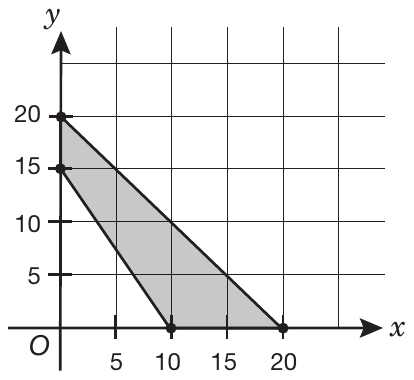
What is the area, in square units, of the shaded region shown in the figure above?
- A75
- B125
- C150
- D200
Show the answer
Correct answer: B
The area of the shaded region, in square units, is the area of the triangle created by the shaded and unshaded regions minus the area of the triangle created by the unshaded region.
The area of the triangle created by the shaded and unshaded regions is 200 square units.
The area of the triangle created by the unshaded region is 75 square units.
Subtract to find the area of the shaded region.
Question analysis
A coordinate geometry question: two line segments cross a grid, one from (0, 20) to (20, 0) and one from (0, 15) to (10, 0), and the region between them is shaded. Students find the shaded area. The shape is not a standard figure, so they need to see it as one triangle with another removed.
- Grade level
- Grade 6 content, by NYS standard
- Compared with grade 7
- At grade 7 Area of triangles is grade 6 content; finding a composite area by subtraction is the kind of task grade 7 students meet regularly. Points on the axes make every length easy to read.
- Estimated difficulty
- Straightforward: two steps or one careful reading.
- Thinking it demands
- Depth of knowledge 2, skills and concepts · mainly apply
- What makes it hard
- Reading a figure, table or graph moderate
- No obvious method minor
- Something you must already know minor
- Solution
- 3 steps
- Reading level
- Question and choices: about grade 6, 16 words.
- Students, last 30 days
- Not enough answers yet to show (it takes 10).
Why it is hard, traps and wrong answers (shows the answer)
Why it is hard
The shaded shape has no name, so the question is about seeing it as a difference of two right triangles whose legs lie on the axes. Once that is seen, both areas are one-line calculations. The wrong choices come from stopping after either triangle or from pairing a base from one segment with a height from the other.
Reading a figure, table or graph moderate Understanding the question
All four lengths come from where the two segments meet the axes, at 20 and 15 on the y-axis and at 10 and 20 on the x-axis, read against grid lines 5 units apart. (Lesh, Post & Behr, 1987; Kirsch & Mosenthal, 1990)
No obvious method minor Working it out
The shaded region is a four-sided shape with no formula of its own; it has to be seen as the large triangle with the small one removed. (Schoenfeld, 1985)
Something you must already know minor Working it out
The area of a triangle, one half of base times height, is assumed and not given. (Anderson & Krathwohl, 2001)
Strategy: Find the area of the large right triangle under the outer segment and subtract the area of the smaller triangle under the inner segment, reading the legs from the axes.
Traps
- Stops one step early: A choice is a number from partway through the solution.
- Answers a different question: A choice is right for another quantity: the other unknown, the rest instead of the part, the part instead of the whole.
- Misreads the figure: Reads a value, label or tick spacing in a figure, table or graph wrongly.
The wrong answers, classified
A Answers a different question (King et al., 2004; Hegarty, Mayer & Monk, 1995)
Finds the area of the small unshaded triangle, 1/2 × 10 × 15 = 75, and gives that region instead of the shaded one.
C Misreads the figure (Lesh, Post & Behr, 1987; Kirsch & Mosenthal, 1990)
Pairs the outer segment's x-intercept, 20, with the inner segment's y-intercept, 15, as if they bounded one triangle: 1/2 × 20 × 15 = 150.
D Stops one step early (King et al., 2004; Gierl et al., 2017)
Finds the area of the large triangle, 1/2 × 20 × 20 = 200, and stops before subtracting the unshaded triangle inside it.
Worked solution, step by step
Formulas used
- Area of a triangle
- A is the area. b is the base, the side the triangle sits on. h is the height: the straight-up distance from the base to the top corner, at a right angle to the base. You take half because a triangle is half of a rectangle with the same base and height.
Sort out the figure
The grid lines are 5 units apart. Two slanted segments run from the y-axis down to the x-axis. The outer one goes from 20 on the y-axis to 20 on the x-axis. The inner one goes from 15 on the y-axis to 10 on the x-axis. The shaded region is the strip between them. You need its area, in square units.
See the shape as two triangles
The shaded region has four sides, and it has no simple formula. But look at the big triangle under the outer segment, with its corner at O. It is the shaded strip plus the small white triangle. So the shaded area is the big triangle minus the small one.
Find the area of the big triangle
The big triangle has a right angle at O. Its base runs along the x-axis from 0 to 20, so it is 20 units. Its height runs up the y-axis from 0 to 20, so it is 20 units.
Watch out: this is the whole big triangle. Stopping here gives 200, choice D.
Find the area of the small triangle
The small triangle also has its right angle at O. Its base is 10 units, from 0 to 10 on the x-axis. Its height is 15 units, from 0 to 15 on the y-axis.
Watch out: 75 is the white triangle, choice A, not the shaded part. Also, pair the base and height of the same triangle. Mixing 20 and 15 gives 150, choice C.
Subtract to find the shaded area
Take the small white triangle away from the big triangle.
The shaded area is 125 square units. So the answer is B, 125.
Check your answer
In the figure, the shaded strip looks bigger than the white triangle. So the shaded area should be more than half of the big triangle, which is . 125 is more than 100. And , the whole big triangle.
More questions like this
The original DOE question
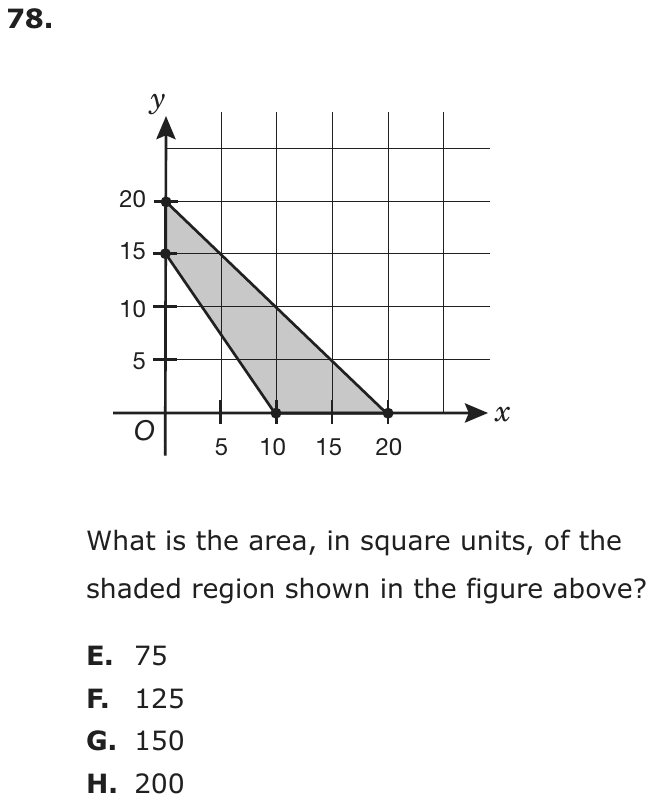
Question 53 of 120
2024 Test A Math, question 26Question
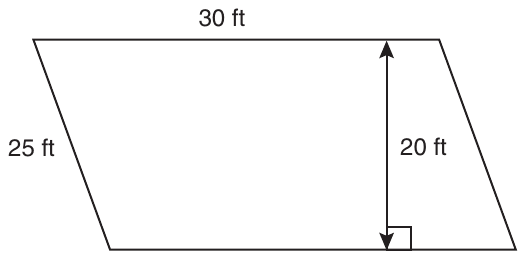
What is the area of the parallelogram shown above?
- A750 sq ft
- B600 sq ft
- C500 sq ft
- D300 sq ft
Show the answer
Correct answer: B
To find the area of a parallelogram, multiply the length of a side by the altitude for that side.
One property of parallelograms is that opposite sides are the same length.
So the bottom side of the parallelogram is 30 feet long and has an altitude of 20 feet.
Therefore, the area of the parallelogram, in square feet, is .
Question analysis
A geometry question with a figure: a parallelogram is labeled with a 30-foot top side, a 25-foot slanted side and a 20-foot height drawn at a right angle. Students find its area. The figure gives one length that is not needed, so students must pick the base and height that belong together.
- NYS standards
- 6.G.1 area of polygons
- Grade level
- Grade 6 content, by NYS standard
- Compared with grade 7
- Below grade 7 Area of a parallelogram is grade 6 content, and this is a one-step use of the formula. It is easier than typical grade 7 area work, which involves composite figures, circles or scale drawings.
- Estimated difficulty
- Routine: one familiar step, little to misread.
- Thinking it demands
- Depth of knowledge 1, recall and reproduction · mainly apply
- What makes it hard
- Solution
- 1 step
- Reading level
- Question and choices: about grade 2, 17 words.
- Students, last 30 days
- Not enough answers yet to show (it takes 10).
Why it is hard, traps and wrong answers (shows the answer)
Why it is hard
This is a one-step formula question with whole numbers, made slightly harder by one length too many. A student who multiplies the two side lengths, as for a rectangle, or brings in a triangle's one half, finds a listed choice. Matching the base to the height marked with a right angle is all it takes.
Reading a figure, table or graph minor Understanding the question
The figure labels three lengths, but only the 30-foot side and the 20-foot height drawn at a right angle to it belong together; the slanted 25-foot side is extra. (Lesh, Post & Behr, 1987; Kirsch & Mosenthal, 1990)
Something you must already know minor Working it out
The parallelogram area formula, base times height, is not given, and its height must be the perpendicular distance, not the slanted side. (Anderson & Krathwohl, 2001)
Strategy: Use base times height, where the height is the perpendicular distance between the two parallel sides chosen as bases.
Traps
- Wrong formula: Uses a related but wrong formula: perimeter for area, diameter for radius, area for volume, or a misremembered one.
- Information you don't need: The question gives numbers or facts that play no part in the answer.
The wrong answers, classified
A Wrong formula (King et al., 2004)
Multiplies the two side lengths, 30 × 25 = 750, as if a parallelogram's area were side times side like a rectangle's.
C Misreads the figure (Lesh, Post & Behr, 1987; Kirsch & Mosenthal, 1990)
Pairs the 20-foot height with the slanted 25-foot side, 25 × 20 = 500, though the height is drawn at a right angle to the 30-foot sides.
D Wrong formula (King et al., 2004)
Uses the triangle formula, 1/2 × 30 × 20 = 300, halving the base times the height.
Worked solution, step by step
Formulas used
- Area of a parallelogram
- A is the area. b is the base, one of the two parallel sides. h is the height: the straight distance between the two parallel sides, at a right angle to the base. It works because you can cut a triangle off one end, move it to the other end and make a rectangle.
Sort out the figure
A parallelogram is a four-sided shape whose opposite sides are parallel. Parallel means they never meet. The figure shows three lengths. The top side is 30 ft. The slanted left side is 25 ft. The arrow from top to bottom is 20 ft, and the small square shows a right angle. You need the area, in square feet.
Choose the base and height
The height must make a right angle with the base. The 20 ft arrow meets the bottom side at a right angle. Opposite sides of a parallelogram are equal, so the bottom side is 30 ft too. So the base is 30 ft and the height is 20 ft. Watch out: the slanted 25 ft side is not needed. Using gives choice C.
Find the area
The area is 600 sq ft. Watch out: do not multiply the two sides, . That is choice A. Do not take half either, which is for triangles and gives 300, choice D. So the answer is B, 600 sq ft.
Check your answer
Picture cutting the triangle off the left end and sliding it to the right end. The shape becomes a rectangle 30 ft long and 20 ft tall, with an area of 600 sq ft. 750 is too big, because the shape is only 20 ft tall, not 25 ft.
More questions like this
The original DOE question
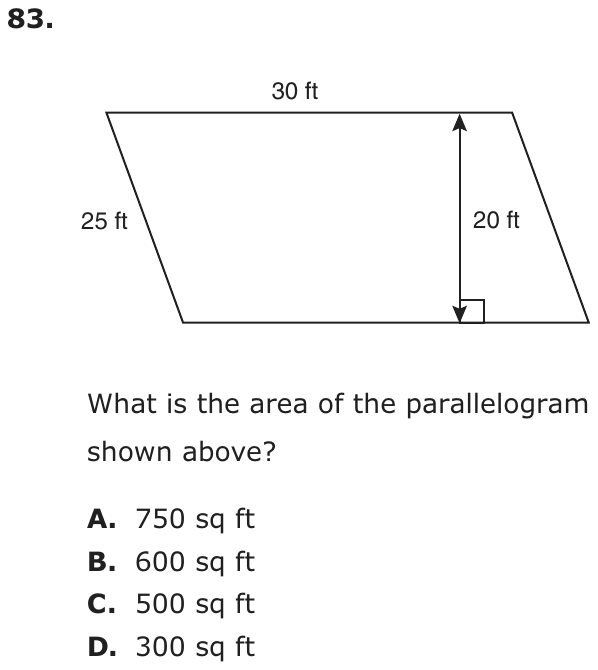
Question 54 of 120
2024 Test A Math, question 31Question
Nura made a square poster with a side length of 13 inches. Latrice made a square poster with a side length of 15 inches. What is the difference, in square inches, between the area of Latrice’s poster and the area of Nura’s poster?
- A56
- B8
- C4
- D2
Show the answer
Correct answer: A
Nura’s poster is square, so all the side lengths are 13 inches. The area, in square inches, is
Latrice’s poster is square, so all the side lengths are 15 inches.
Subtract to determine the difference between the areas.
The difference, in square inches, is 56.
Question analysis
This area word problem compares two square posters, one 13 inches on a side and one 15 inches on a side, and asks for the difference between their areas in square inches. Students square each side length and subtract. Working with the difference in the sides, or with perimeters, instead of the areas is the easy mistake.
- Grade level
- Grade 6 content, by NYS standard
- Compared with grade 7
- Below grade 7 Area of a square is elementary content, and squaring 13 and 15 is grade 6 exponent work. Typical grade 7 area problems involve circles, composite shapes or scale drawings; this one has two familiar areas and a subtraction.
- Estimated difficulty
- Straightforward: two steps or one careful reading.
- Thinking it demands
- Depth of knowledge 2, skills and concepts · mainly apply
- What makes it hard
- Solution
- 3 steps
- Reading level
- Question and choices: about grade 5, 41 words.
- Students, last 30 days
- Not enough answers yet to show (it takes 10).
Why it is hard, traps and wrong answers (shows the answer)
Why it is hard
The method is short, but the question invites a shortcut: the sides differ by 2, so it feels as if the areas should differ by 2 squared. Two choices reward working with the side lengths and one rewards perimeters. Squaring each side before subtracting avoids all three, and a sketch of the 13-inch square inside the 15-inch one shows the gap is an L-shaped strip, far more than 4 square inches.
Something you must already know minor Working it out
The area of a square, side times side, is not given; students must square 13 and 15 themselves rather than work with the side lengths. (Anderson & Krathwohl, 2001)
Error-prone arithmetic minor Working it out
Squaring 13 and 15 by hand gives 169 and 225, and the subtraction 225 − 169 needs a borrow, where an arithmetic slip creeps in. (Brown & Burton, 1978; Junker & Sijtsma, 2001)
Strategy: Find each poster's area by squaring its side length, then subtract the smaller area from the larger; work with the areas, not the side lengths.
Traps
- Wrong formula: Uses a related but wrong formula: perimeter for area, diameter for radius, area for volume, or a misremembered one.
- A faulty procedure: A systematic but wrong procedure: adding fractions straight across, applying an exponent to each term of a sum, dropping a sign when moving a term.
- Answers a different question: A choice is right for another quantity: the other unknown, the rest instead of the part, the part instead of the whole.
The wrong answers, classified
B Wrong formula (King et al., 2004)
Compares perimeters instead of areas, 4 × 15 − 4 × 13 = 60 − 52 = 8, a difference in inches, not square inches.
C A faulty procedure (Brown & Burton, 1978; Tatsuoka, 1983)
Subtracts the sides first and squares the difference, (15 − 13)² = 4, as if 15² − 13² equaled (15 − 13)².
D Answers a different question (King et al., 2004; Hegarty, Mayer & Monk, 1995)
Gives the difference in side lengths, 15 − 13 = 2, a length rather than a difference in area.
Worked solution, step by step
Formulas used
- Area of a square
- A is the area, the flat space inside the shape. s is the length of one side. All four sides of a square are equal, so the area is side times side. The small 2 means squared, or times itself. Area is measured in square units, here square inches.
Write down what you know
Nura’s poster is a square with sides of 13 inches. Latrice’s poster is a square with sides of 15 inches. You need the difference between their areas, in square inches. The difference is how much bigger one area is than the other. So find each area, then subtract.
Find the area of Nura’s poster
Use the area formula with the side of 13 inches.
Nura’s poster has an area of 169 square inches.
Find the area of Latrice’s poster
Use the same formula with the side of 15 inches.
Latrice’s poster has an area of 225 square inches.
Subtract the two areas
Take the smaller area away from the larger one.
The difference is 56 square inches.
Watch out: don’t subtract the sides first and then square. , choice C, is not the same as . The side difference, 2 inches, is choice D, a length. Comparing perimeters, the distance around, gives 8, choice B.So the answer is A, 56 square inches.
Check your answer
Picture Nura’s poster laid in a corner of Latrice’s. The extra part is an L-shaped strip 2 inches wide. One arm is 15 by 2 and the other is 13 by 2. , so the strip is 56 square inches. That matches.
More questions like this
The original DOE question
Question 55 of 120
2024 Test A Math, question 39Question
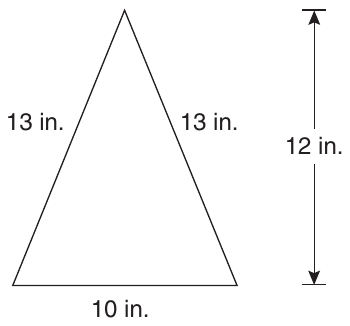
Raquel is cutting out pieces of cardboard to make a pyramid. She will use a square piece for the base and identical triangular pieces for the sides. The figure above shows the dimensions of the triangle for each side. What will be the total surface area, in square inches, of the pyramid, including the square base?
- A280
- B295
- C340
- D360
Show the answer
Correct answer: C
Surface area is found by calculating the area of each side, including the base, and adding them all together.
The base of the pyramid measures 10 inches on each side, so the area of the base is
Each triangular face has a base of 10 inches and a height of 12 inches, so the area of each face is
There are 4 triangular faces (because the square base has 4 edges, each of which will have a triangular face). So the total surface area of the pyramid is the sum of the areas of 4 triangles and 1 square.
So the total surface area is 340 square inches.
Question analysis
This surface area word problem shows one triangular face, with sides of 13 inches, a base of 10 inches and a height of 12 inches, that Raquel will use to build a cardboard pyramid with a square base. Students find the total area of the base and all the triangular sides. Picturing the solid and choosing the right measurements from the figure are the tricky parts.
- Grade level
- Grade 7 content, by NYS standard
- Compared with grade 7
- Above grade 7 Grade 7 students find the surface area of a pyramid from a drawn net or solid. Here only one triangular face is shown, so students must picture the whole pyramid, count its faces, and choose which labeled length belongs in the area formula.
- Estimated difficulty
- Hard: combines ideas, needs a plan, and has more than one tempting wrong answer.
- Thinking it demands
- Depth of knowledge 2, skills and concepts · mainly apply
- What makes it hard
- Reading a figure, table or graph moderate
- Combines ideas moderate
- Something you must already know minor
- Solution
- 4 steps
- Reading level
- Question and choices: about grade 6, 56 words.
- Corrected from the DOE handbook
- A wrong unit in the explanation was corrected.
- Students, last 30 days
- Not enough answers yet to show (it takes 10).
Why it is hard, traps and wrong answers (shows the answer)
Why it is hard
Students have to build the pyramid in their heads from one flat triangle, then choose the right measurement from three labels. The 13-inch sides look like the natural height, and using them gives a listed total; picturing a pyramid with three sloping faces gives another. Sketching the square base with a triangle on each edge, and marking 12 as the height, settles both the face count and the formula.
Reading a figure, table or graph moderate Understanding the question
The figure gives one triangle with three length labels, 13, 13 and 10, and puts its height, 12, on a separate arrow beside it, where it is easy to overlook. (Lesh, Post & Behr, 1987; Kirsch & Mosenthal, 1990)
Combines ideas moderate Working it out
The solid is never drawn: students must see that the square's side equals the triangle's 10-inch base, count four triangles, and add triangle and square areas. (Embretson, 1998; Daniel & Embretson, 2010)
Something you must already know minor Working it out
A triangle's area uses its perpendicular height, not a slanted side, and a pyramid on a square base has four triangular faces; neither fact is given. (Anderson & Krathwohl, 2001)
Strategy: Sketch the pyramid: a square base whose side is the triangle's base, and one triangular face on each side of the square. Find each area with the matching formula, then add them all.
Traps
- Misreads the figure: Reads a value, label or tick spacing in a figure, table or graph wrongly.
- Information you don't need: The question gives numbers or facts that play no part in the answer.
- Misunderstands the concept: A wrong belief about a concept: that percents can be added, that area grows like length, that averages can be averaged, that a bigger denominator means a bigger fraction.
The wrong answers, classified
A Misunderstands the concept (Smith, diSessa & Roschelle, 1993; De Bock et al., 1998; Ni & Zhou, 2005)
Counts only three triangular faces, as if the pyramid had a triangular base, so 3 × 60 + 100 = 280.
B Misunderstands the concept (Smith, diSessa & Roschelle, 1993; De Bock et al., 1998; Ni & Zhou, 2005)
Counts three faces and also uses the 13-inch side as each triangle's height: 3 × 65 + 100 = 295.
D Misreads the figure (Lesh, Post & Behr, 1987; Kirsch & Mosenthal, 1990)
Takes the 13-inch slanted side as each triangle's height instead of the 12-inch arrow beside it, so 4 × 65 + 100 = 360.
What was corrected from the DOE handbook, and why
- Explanation: The handbook ends “So the total surface area is 340 square feet.” The triangle’s dimensions are in inches and the question asks for square inches, so the site now reads “340 square inches.”
Worked solution, step by step
Formulas used
- Area of a triangle
- A is the area. b is the base, the side the triangle sits on. h is the height: the straight-up distance from the base to the top corner, at a right angle to the base. You take half because a triangle is half of a rectangle with the same base and height.
- Area of a square
- A is the area and s is the length of one side. All four sides of a square are equal, so the area is side times side.
- Surface area
- A face is one flat side of a solid shape. The surface area is the total area of the outside. Picture unfolding the solid into flat pieces. Then add up the area of every piece.
Sort out the question
Raquel’s pyramid has a square base. Each side is a triangle like the one in the figure. The triangle’s base is 10 in. Its two slanted sides are 13 in. Its height, the arrow beside it, is 12 in. You need the total surface area, including the square base, in square inches.
Picture the pyramid
Surface area is the total area of all the flat sides, called faces. Each triangle stands on one edge of the square. So each edge of the square is 10 inches, the same as the triangle’s base. A square has 4 edges, so the pyramid has 4 triangles.
Here that is 4 triangles plus 1 square. Watch out: counting only 3 triangles gives 280, choice A.
Find the area of one triangle
Each triangle is 60 square inches. Watch out: the height is 12 in., the straight-up arrow. It is not 13 in., the slanted side. Using 13 gives 65 for each triangle and 360 in all, choice D.
Find the area of the base
The base is a square with sides of 10 inches, the same as each triangle’s base.
The square base is 100 square inches.
Add all five faces
The four triangles and the square together cover 340 square inches.
So the answer is C, 340 square inches.
Check your answer
Each triangle is half of a 10 by 12 rectangle, which has an area of 120. So two triangles make 120, and four make 240. Add the base: . The units fit too: inches times inches gives square inches.
More questions like this
The original DOE question
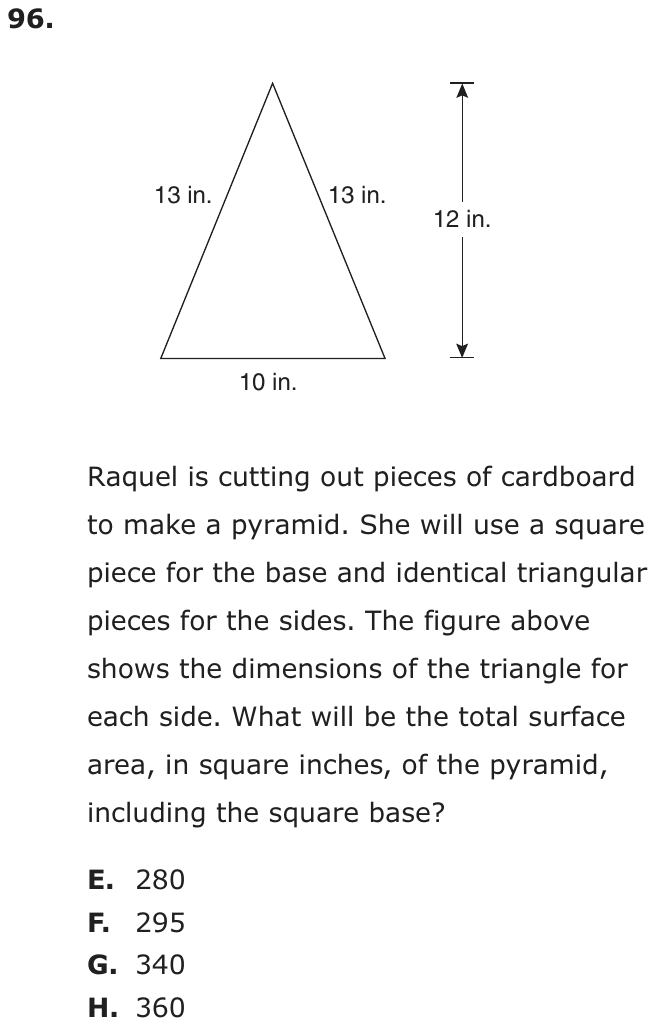
Question 56 of 120
2024 Test A Math, question 41Question
Terrell played 5 computer games and earned a mean score of 8 points per game. If his mean score for the first 4 games was 7 points per game, how many points was his score in the fifth game?
- A9
- B11
- C12
- D14
Show the answer
Correct answer: C
If the mean number of points for the first four games is 7, the total number of points earned in those games is 28.
If the mean number of points for all five games is 8, the total number of points earned is 40.
To find the number of points in the fifth game, find the difference between 40 and 28.
Question analysis
This mean, or average, word problem says Terrell averaged 8 points over 5 computer games and 7 points over the first 4, and asks for his score in the fifth game. Students turn each average into a total and compare the totals. Combining the two averages directly, without going through totals, is the tempting shortcut that fails.
- Grade level
- Grade 6 content, by NYS standard
- Compared with grade 7
- At grade 7 Computing a mean is grade 6 content. Working backward from two means to the totals they stand for, then to one missing score, is a common grade 7 test task, and it comes with a tempting shortcut.
- Estimated difficulty
- Moderate: several steps, or a close reading with one strong distractor.
- Thinking it demands
- Depth of knowledge 2, skills and concepts · mainly apply
- What makes it hard
- Turning words into math moderate
- Something you must already know minor
- Solution
- 3 steps
- Reading level
- Question and choices: about grade 4, 35 words.
- Students, last 30 days
- Not enough answers yet to show (it takes 10).
Why it is hard, traps and wrong answers (shows the answer)
Why it is hard
The question rewards turning both means into totals, 40 points for five games and 28 for four, after which one subtraction finishes it. Averaging 7 with the unknown score is a quick shortcut that gives a listed choice, but it weighs four games as one. Checking that 28 plus the answer, divided by 5, gives 8 catches that error and the near miss next to the answer.
Turning words into math moderate Understanding the question
Each mean has to become a total before the fifth game can be found: "a mean score of 8 points per game" over 5 games means 40 points in all. (Hegarty, Mayer & Monk, 1995; Koedinger & Nathan, 2004)
Something you must already know minor Working it out
Students must know that a total is the mean times the number of games, and that means over different numbers of games cannot simply be averaged. (Anderson & Krathwohl, 2001)
Strategy: Turn each mean into a total by multiplying by its number of games, then subtract the four-game total from the five-game total.
Traps
- Misunderstands the concept: A wrong belief about a concept: that percents can be added, that area grows like length, that averages can be averaged, that a bigger denominator means a bigger fraction.
The wrong answers, classified
A Misunderstands the concept (Smith, diSessa & Roschelle, 1993; De Bock et al., 1998; Ni & Zhou, 2005)
Averages the four-game mean with the fifth score, (7 + x) ÷ 2 = 8, so x = 9, as if the first four games counted once.
B Counting the ends (Brown & Burton, 1978)
Sees the fifth game must lift the mean 1 point above 7 but spreads that over only 4 games, 7 + 4 = 11, instead of all 5.
D Little reason to choose it (Haladyna & Downing, 1993; Rodriguez, 2005)
No common working gives 14, which is twice the four-game mean and matches no total or difference, so it mostly draws guesses.
Worked solution, step by step
Formulas used
- Total from a mean
- The mean, or average, is what each game would score if the total were shared out equally. So the total is the mean times the number of games. Use it to turn each mean back into a total. Totals can be subtracted, but means over different numbers of games can’t.
Sort out the question
Terrell played 5 games. His mean score for all 5 was 8 points per game. His mean for the first 4 games was 7 points per game. The mean, or average, is the total split equally among the games. You need his score in game 5.
Find the total for all 5 games
Turn the mean for all 5 games into a total. Multiply the mean by the number of games.
He scored 40 points in all 5 games together.
Find the total for the first 4 games
Use the same formula with the mean of 7 and 4 games.
He scored 28 points in the first 4 games.
Subtract to find game 5
The 40 points include the first 4 games and game 5. Take away the first 4 games to leave game 5.
He scored 12 points in game 5. Watch out: don’t average 7 and the fifth score as if they were two games. That gives 9, choice A. The 7 stands for 4 games, not 1. Watch out: adding 4 to 7 gives 11, choice B. Each of the first 4 games was 1 point below 8. So game 5 needs 8 plus 4 more points.
So the answer is C, 12 points.
Check your answer
Try scores of 7, 7, 7, 7 and 12. They add up to , and . That is the mean for all 5 games, so 12 is right.
More questions like this
The original DOE question
Question 57 of 120
2024 Test A Math, question 53Question
Carlos has $350 in a savings account that earns 5% simple interest each year. How much will he have in the account after 1 year, if there is no money withdrawn?
- A$17.50
- B$175.00
- C$367.50
- D$525.00
Show the answer
Correct answer: C
Find 5% of 350.
Question analysis
Carlos has $350 in a savings account earning 5% simple interest a year, and this interest question asks how much will be in the account after 1 year with no withdrawals. Students find 5 percent of the balance and use it. Reading whether the question wants the interest or the account's new balance matters most.
- Grade level
- Grade 7 content, by NYS standard
- Compared with grade 7
- Below grade 7 Simple interest is a grade 7 percent topic, but one year of interest is just 5 percent of the balance added on. Typical grade 7 problems run for several years or ask for the rate, so this is lighter.
- Estimated difficulty
- Routine: one familiar step, little to misread.
- Thinking it demands
- Depth of knowledge 2, skills and concepts · mainly apply
- What makes it hard
- Solution
- 2 steps
- Reading level
- Question and choices: about grade 6, 28 words.
- Students, last 30 days
- Not enough answers yet to show (it takes 10).
Why it is hard, traps and wrong answers (shows the answer)
Why it is hard
This is a one-year interest question with friendly numbers, so most students who know what interest is will finish it. The two ways to lose the point are stopping at the interest, which is listed, and writing 5% as 0.5, which gives a listed interest and a listed balance of its own. A sensible balance is only a little more than $350, which rules out every wrong choice.
Something you must already know minor Working it out
Simple interest for one year is the rate times the balance, 5% of $350, added to what is already there; the stem does not spell this out. (Anderson & Krathwohl, 2001)
Error-prone arithmetic minor Working it out
Writing 5% as 0.05, not 0.5, is the one place-value decision, and 0.05 × 350 = 17.5 must then be read as $17.50. (Brown & Burton, 1978; Junker & Sijtsma, 2001)
Strategy: Find 5 percent of $350 by multiplying by 0.05, then decide whether the question wants the interest alone or the amount in the account.
Traps
- Stops one step early: A choice is a number from partway through the solution.
- An arithmetic slip: The right method with a plausible arithmetic error: a digit, a place value or a times-table fact.
The wrong answers, classified
A Stops one step early (King et al., 2004; Gierl et al., 2017)
Finds the interest, 0.05 × $350 = $17.50, and stops without adding it to the $350 already in the account.
B An arithmetic slip (Junker & Sijtsma, 2001)
Writes 5% as 0.5 instead of 0.05, a decimal slip that makes the interest $175.00, and then also stops at the interest.
D An arithmetic slip (Junker & Sijtsma, 2001)
Writes 5% as 0.5, so the interest comes out as $175.00, and adds it to the $350 to reach $525.00.
Worked solution, step by step
Formulas used
- Simple interest
- I is the interest, the extra money the bank pays you. P is the principal, the money you put in. r is the yearly rate as a decimal. t is the time in years. Simple means you earn interest only on the money you started with.
Sort out the question
Carlos starts with $350. The account earns 5% simple interest each year. Interest is extra money the bank adds to your account. You need the total in the account after 1 year. That is the $350 plus the interest.
Change the percent to a decimal
Percent means out of 100, so 5% is 5 out of 100.
Watch out: 5% is 0.05, not 0.5. Using 0.5 makes the interest $175, which leads to B or D.Find the interest
Put in P = 350, r = 0.05 and t = 1 year.
The interest for one year is $17.50. That is the money added to the account.
Add the interest to the savings
After 1 year, Carlos has $367.50. Watch out: $17.50 is only the interest, choice A. The question asks how much is in the account.
So the answer is C, $367.50.
Check your answer
10% of $350 is $35. 5% is half of that, $17.50, so the interest is right. The total should be a little more than $350, since 5% is small. $367.50 fits. $525.00 would mean the account grew by half.
More questions like this
The original DOE question
Question 58 of 120
2024 Test A Math, question 54Question
The probability of an event occurring is 0.05. What is the chance that the event will occur?
- Alikely
- Bunlikely
- Cimpossible
- Dneither likely nor unlikely
Show the answer
Correct answer: B
The probability of the event is 0.05, which equals 5%, which is less than 50%.
Option A:
An event that is likely has a probability over 50%.
Option B:
An event that is unlikely has a probability less than 50% but greater than 0%.
Option C:
An event that is impossible has a 0% probability.
Option D:
An event that is neither likely nor unlikely has a 50% probability.
Question analysis
This probability question gives an event a probability of 0.05 and asks how likely the event is to occur, described in words. Students place the decimal on the scale from 0, impossible, to 1, certain. Reading the place value of the decimal correctly is the only real hurdle.
- NYS standards
- 6.SP.6 probability from 0 to 1
- Grade level
- Grade 6 content, by NYS standard
- Compared with grade 7
- Below grade 7 Describing in words how likely an event is from its probability between 0 and 1 is a grade 6 standard. This is one quick judgment with no computation, well below grade 7 probability work with compound events.
- Estimated difficulty
- Routine: one familiar step, little to misread.
- Thinking it demands
- Depth of knowledge 1, recall and reproduction · mainly understand
- What makes it hard
- Solution
- 1 step
- Reading level
- Question and choices: about grade 10, 23 words.
- Students, last 30 days
- Not enough answers yet to show (it takes 10).
Why it is hard, traps and wrong answers (shows the answer)
Why it is hard
One judgment answers the question: 0.05 is a small probability, but it is not zero. The two tempting errors are treating a small chance as no chance at all and misreading 0.05 as 0.5, an even chance. Writing the probability as 5% or as 1 in 20 makes its size plain.
Something you must already know minor Working it out
The probability scale, 0 for impossible, 1/2 for an even chance and 1 for certain, is assumed, and 0.05 has to be placed near its low end. (Anderson & Krathwohl, 2001)
Strategy: Picture the probability scale from 0 to 1, with 0 for impossible, 1/2 for an even chance and 1 for certain, and see where 0.05 falls.
Traps
- Misunderstands the concept: A wrong belief about a concept: that percents can be added, that area grows like length, that averages can be averaged, that a bigger denominator means a bigger fraction.
- An arithmetic slip: The right method with a plausible arithmetic error: a digit, a place value or a times-table fact.
The wrong answers, classified
A Little reason to choose it (Haladyna & Downing, 1993; Rodriguez, 2005)
No common reading makes 0.05 likely, which would need a probability above one half, so it mostly draws guesses.
C Misunderstands the concept (Smith, diSessa & Roschelle, 1993; De Bock et al., 1998; Ni & Zhou, 2005)
Treats a probability close to 0 as exactly 0, as if an event with a 1 in 20 chance could never happen.
D An arithmetic slip (Junker & Sijtsma, 2001)
Reads 0.05 as 0.5, a place-value slip, which would mean an even chance of happening or not.
Worked solution, step by step
Formulas used
- Probability scale
- P is the probability of an event, a number that tells how likely it is to happen. It is always from 0 to 1. 0 means impossible, and 1 means certain. One half, or 0.5, means an even chance. The closer P is to 0, the less likely the event.
Sort out the question
Probability is a number that tells how likely an event is. An event is something that might happen. Here the probability is 0.05. You need the word that best describes that chance.
Change 0.05 to a percent
So 0.05 is 5 out of 100, or 5%. That is the same as 1 chance in 20. Watch out: 0.05 is not 0.5. A probability of 0.5 would be an even chance, choice D.
Place it on the scale
Probability Chance 0 impossible more than 0, less than 0.5 unlikely 0.5 neither likely nor unlikely more than 0.5, less than 1 likely 1 certain 0.05 is more than 0 but much less than 0.5. So the event is unlikely.
Rule out the other choices
Watch out: a small chance is still a chance. 0.05 is more than 0, so the event can happen. It is not impossible, choice C. Likely, choice A, would need more than 0.5.So the answer is B, unlikely.
Check your answer
Picture 20 tries. With a 5% chance, the event would happen about once, since 5% of 20 is 1. It would not happen about 19 times. That is rare but possible, so unlikely fits.
More questions like this
The original DOE question
Question 59 of 120
2024 Test A Math, question 57Question
An ice cream shop sells 16 cups of ice cream for $48 and 4 cups for $12. There is a proportional relationship between the number of cups of ice cream and the cost. What is the constant of proportionality for this relationship?
- A3 cups per dollar
- B3 dollars per cup
- C4 cups per dollar
- D4 dollars per cup
Show the answer
Correct answer: B
There is a proportional relationship between the cost and the number of cups of ice cream.
Divide the cost by the number of cups of ice cream to find the constant of proportionality.
The constant is the cost per cup, 3 dollars.
Question analysis
An ice cream shop sells 16 cups for $48 and 4 cups for $12, and the cost is proportional to the number of cups. This proportional relationship question asks for the constant of proportionality, with its units. The choices pair two numbers with two kinds of units, so the units of the rate matter as much as the number.
- Grade level
- Grade 7 content, by NYS standard
- Compared with grade 7
- Below grade 7 Grade 7 students find constants of proportionality in tables, graphs and equations. Here one division gives the number, as in grade 6 unit pricing, and the real demand is attaching the right units to it.
- Estimated difficulty
- Straightforward: two steps or one careful reading.
- Thinking it demands
- Depth of knowledge 2, skills and concepts · mainly apply
- What makes it hard
- A very close wrong answer moderate
- Something you must already know minor
- Solution
- 2 steps
- Reading level
- Question and choices: about grade 4, 50 words.
- Students, last 30 days
- Not enough answers yet to show (it takes 10).
Why it is hard, traps and wrong answers (shows the answer)
Why it is hard
One division gives the number, so the question is really about units. The cost depends on the number of cups, and dividing $48 by 16 cups gives the dollars for each cup; reversing the label describes a shop where one dollar buys three cups. The second offer, 4 cups for $12, is a built-in check that the rate stays the same.
A very close wrong answer moderate Choosing the answer
Two choices carry the number 3, "3 cups per dollar" and "3 dollars per cup", so finding 48 ÷ 16 is not enough; the units decide. (Embretson & Wetzel, 1987; Gorin & Embretson, 2006; Ascalon et al., 2007)
Something you must already know minor Working it out
Students must know that dividing dollars by cups gives dollars per cup: a quotient's units read as the top quantity per the bottom one. (Anderson & Krathwohl, 2001)
Strategy: Divide one quantity by the other for one offer, check that the other offer gives the same quotient, and label it with the numerator's units per the denominator's units.
Traps
- Wrong operation: Adds instead of multiplying, divides the wrong way round, turns a ratio or rate upside down, or undoes a step in the wrong direction (subtracts what should be added back).
- Numbers taken from the question: Combines the numbers in the question without a model of the situation, or is simply a number that appears in the question.
The wrong answers, classified
A Wrong operation (Hegarty, Mayer & Monk, 1995; King et al., 2004)
Gets 3 from 48 ÷ 16 but labels it cups per dollar, turning the rate upside down; at these prices a dollar buys only 1/3 of a cup.
C Numbers taken from the question (Hegarty, Mayer & Monk, 1995)
Divides the two cup amounts, 16 ÷ 4 = 4, and attaches cups per dollar, a ratio of like quantities given made-up units.
D Numbers taken from the question (Hegarty, Mayer & Monk, 1995)
Divides the two costs, $48 ÷ $12 = 4, or the two cup counts, and calls the result dollars per cup.
Worked solution, step by step
Formulas used
- Constant of proportionality
- In a proportional relationship, y is always the same number, k, times x. Here x is the number of cups and y is the cost in dollars. So k is y divided by x. Its units are the top’s units per the bottom’s units: dollars per cup.
Sort out the question
16 cups cost $48, and 4 cups cost $12. The cost is proportional to the cups. That means the cost is always the same number times the number of cups. That number is the constant of proportionality. You need it with the right units.
Divide cost by cups
For each offer, divide the cost in dollars by the number of cups.
Both offers give 3. So the constant is 3.
Name the units
Dollars are on top and cups are on the bottom. So the units are dollars per cup. 3 dollars per cup means each cup costs $3. Watch out: two choices use 3. Choice A, 3 cups per dollar, flips the rate. Then 16 cups would cost only about $5, not $48.
Avoid the traps and answer
Watch out: dividing two costs, , or two cup counts, , gives 4. That compares like amounts, so it is not a cost for each cup. It leads to choice C or D.So the answer is B, 3 dollars per cup.
Check your answer
Multiply back. At 3 dollars per cup, 16 cups cost , which is $48. And 4 cups cost , which is $12. Both match the shop’s prices.
More questions like this
The original DOE question
Question 60 of 120
2024 Test B English, question 27Passage Excerpt from Do Them No Harm!
Excerpt from Do Them No Harm!
by Zoa L. Swayne
This narrative is about the Nez Perce, an American Indian tribe, in what is now northern Idaho. The tribe is preparing for a gathering before the coming winter.
In the moon of Ta-Yum, the hottest days of summer, when salmon spawn in the little streams and huckleberries ripen in the high mountains, people from many villages of the Chopunnish Nation gathered in the Oyaip Prairie for the work and festivities of their annual camas1 harvest.
From far and near The People came. . . .
Should a stranger enter their homeland and ask, “Where are you from?” the reply was always, “We are Nee-mee-poo, The People who live here in this place.”
It was a time of Lawtiwa-mah-ton—a time of being friends together—when The People came for this last chance to enjoy being together before the Cold Moons kept them close to their fires. The visiting and trading, the foot racing and horse racing, and the gambling and stick games would be remembered and talked about long after they had forgotten the drudgery of digging and roasting camas, picking berries, or drying meat and fish. Lawtiwa-mah-ton! It was good to be friends together.
As was their custom since wahk-kee-ma, a time far back beyond the memory of man, they set up their camps in the same locations their parents and grandparents had occupied before them. Red Bear’s people, from Kamiah, made their camp near the trail that came out of the mountains. Their neighbors in Kamiah Valley, The People from Tee-e-lap-a-lo, had their camp close by. Across the wide meadow, by the great roasting pits, the camps of the Te-wap-poo and Ask-kah-poo were located. The tepees and ish-nash, brush shelters, of other groups nestled in their accustomed areas in and among the pines in such numbers that they encircled the entire meadow land.
Red Bear’s people had traveled all summer with neighboring bands, gathering and preparing roots, picking and drying berries, drying and smoking meat and fish for their winter food supply. Now they were at the Oyaip camp. The women worked hard to dig and cure as many bags of roots as they could during the warm, sunny days, for the sharp night air brought warnings that WARM was going and COLD was coming.
Everyone helped in some way. Most of the men fished or hunted for meat. While many of the women dug and roasted camas, other women and older children picked and dried berries.
And the younger children played. They played at hunting. They played with the babies. They played with their horses and puppies. They learned how to live through their play.
This sun, happiness, peace, and quiet blessed the Red Bear camp. All were busy with their daily tasks, until sudden cries came from the children playing by the trail.
“People coming! People coming! People coming on the trail from the high mountains!” they called as they ran to their elders, who looked sharply at the figures of approaching horsemen.
Were they friends or enemies? Did they bring good news or bad?
“Who can it be? What brings them here?” were the questions in every mind.
“Could they be the four hunters who had gone to Buffalo Country two summers past? Would they have news of the families who had gone long ago to Buffalo Country and never returned?”
It was customary for a hunting party to be gone for more than one season.
“Looks like hunters,” the older men agreed. “Looks like they had good hunting. Maybe our four hunters. [They have] been gone many moons.”
“Looks like five people—not four,” others observed.
Excitement grew as the riders came close enough to be recognized.
“A-a-a-a-a, they are our four hunters! But who is the fifth person?” they asked.
“Looks like a woman. Who is she?”
The hunters rode up to the welcoming crowd, proud to show off the loads of meat, hides, and other trophies of their hunt. They paraded around the encampment for all to see how strong their Hunting Power had been—what great hunters they, themselves, were.
Red Bear’s people rejoiced at their hunters’ success. Good hunters brought good to everybody. The meat meant plenty of food and the hides meant soft-tanned robes to give comfort through the Cold Moons. But it was the sight of the frail figure of the woman that aroused their curiosity. Who was she? Where had she come from? . . .
“Belongs to Red Bear people. Gone then come back,” the hunters said, as they dismounted and unloaded their packs. . . .
Now they could see! She was the daughter of the family gone so long ago! The girl-child who had left came back now—a grown woman.
“Wat-ku-ese!” the women cried. “Gone-from-Home-then-Come-Back. Wat-ku-ese!” And Wat-ku-ese was her name from that time on.
Gentle arms lifted Wat-ku-ese from her horse. The women brought her food and made a place for her to rest. For many suns they cared for her until she became stronger.
One evening Wat-ku-ese told her story for all to hear.
From DO THEM NO HARM!: Lewis and Clark Among the Nez Perce by Zoa L. Swayne. Published by Caxton Press. Copyright © 1990 by Zoa L. Swayne. Orofino, Idaho and Legacy House, Inc. Orofino, Idaho. All rights reserved.
1camas: a wild, edible plant
Question
How do paragraphs 11–13 affect the plot of the excerpt?
- AThey establish a feeling of mystery by presenting different points of view about the arriving people.
- BThey contribute to the rising action by developing the idea that the arriving people could present a problem.
- CThey lead to a turning point by describing the moment that the crowd realizes why the strangers have come.
- DThey explain the cause of the main conflict by providing background information about the strangers.
Show the answer
Correct answer: B
The question asks how paragraphs 11–13 affect the plot of the excerpt.
A. Incorrect. The paragraphs contain questions about the arriving people. They do not present differing points of view.
B. CORRECT. The paragraphs ask questions in which the characters wonder whether the arriving people are friends or enemies, or whether they might be bringing good news or bad news. By suggesting that the arriving people could present problems such as these, the paragraphs contribute to the rising action.
C. Incorrect. The paragraphs do not lead to a turning point. Instead, they lead to the climax—the moment the characters discover who the visitors are. This means the paragraphs contribute to the rising action.
D. Incorrect. Paragraphs 11–13 ask questions. They do not provide background information about the strangers; instead, they ask for it.
Question analysis
This plot question asks how paragraphs 11–13, a series of questions the villagers ask as riders approach their camp, affect the plot of the Nez Perce narrative. Students must know terms such as rising action and turning point and apply them precisely, since several choices describe these paragraphs in ways that sound right but place them wrongly in the story.
- Grade level
- Grade 8 reading and task
- Compared with grade 7
- Above grade 7 Grade 7 plot questions usually ask what one event causes. Here students apply terms such as rising action and turning point to three short paragraphs of questions, which matches the grade 8 focus on how parts of a story propel the action.
- Estimated difficulty
- Hard: combines ideas, needs a plan, and has more than one tempting wrong answer.
- Thinking it demands
- Depth of knowledge 3, strategic thinking · mainly analyze
- What makes it hard
- A very close wrong answer major
- How, not what moderate
- Something you must already know minor
- Evidence
- Answered from several paragraphs or stanzas
- Reading level
- Passage: about grade 5, 885 words; question and choices: about grade 9, 77 words.
- Students, last 30 days
- Not enough answers yet to show (it takes 10).
Why it is hard, traps and wrong answers (shows the answer)
Why it is hard
Paragraphs 11–13 contain nothing but questions, so the answer depends on what questions do in a plot. Friends or enemies, good news or bad, they raise the chance of trouble and build toward the arrival. The trap is that they also create mystery, and the choice that says so fails only on one phrase about differing viewpoints. A second risk is jumping ahead: at this point no one even knows who the riders are, let alone why they came.
A very close wrong answer major Choosing the answer
The right choice and the one about mystery both see the questions building uncertainty about the riders; only the claim of “different points of view,” when the questions are “in every mind,” separates them. (Embretson & Wetzel, 1987; Gorin & Embretson, 2006; Ascalon et al., 2007)
How, not what moderate Working it out
The stem asks what paragraphs 11–13 do for the plot, so students must place a run of unanswered questions in the story’s shape rather than retell them. (Anderson & Krathwohl, 2001)
Something you must already know minor Working it out
The choices rely on plot terms the excerpt never explains, rising action, turning point and main conflict, and judging them means knowing what each one names. (Anderson & Krathwohl, 2001)
Strategy: Note what the villagers know and do not yet know in paragraphs 11–13, then compare that with what happens later in the excerpt to place these paragraphs in the plot.
Traps
- Half right: One half of a two-part choice is right and the other is not.
- Wrong part of the text: A choice is true of another paragraph, stanza or speaker than the one asked about.
- Wrong purpose or structure: Names a purpose, structure or effect that the part does not serve, or describes what a part says when the question asks what it does.
The wrong answers, classified
A Half right (King et al., 2004; Thissen, Steinberg & Fitzpatrick, 1989)
Rightly feels the mystery in the villagers’ questions but adds “different points of view,” though the whole camp shares the same questions.
C Wrong part of the text (Kirsch & Mosenthal, 1990)
Jumps ahead to the recognition in paragraphs 17–23; in paragraphs 11–13 the crowd does not yet know who the riders are, let alone why they came.
D Wrong purpose or structure (Anderson & Krathwohl, 2001)
Notices the hunters gone two summers and the families who never returned, but those details arrive as questions, and the excerpt has no conflict they explain.
Working it out, step by step
Figure out what the question asks
This asks how paragraphs 11–13 move the story along. You need some plot words. The plot is the order of events in a story. The rising action is the part where tension builds. Tension is the feeling that something big may happen. A turning point is the moment when things change.
Read paragraphs 11 to 13
These paragraphs are all questions. Paragraph 11 asks: “Were they friends or enemies? Did they bring good news or bad?” In paragraph 12, “Who can it be?” is one of “the questions in every mind.” Paragraph 13 asks if the riders are the hunters who left “two summers past.”
Decide what the questions do
The words “enemies” and “bad” news show the camp is worried. The riders might bring trouble. No one knows yet. So the questions build tension as the riders get closer. That is rising action. The answers come later. The crowd knows the hunters in paragraph 18. They learn who the woman is in paragraphs 22 and 23.
Check each choice
- B fits. The questions raise the chance of a problem and build tension.
- A: there is mystery, but not “different points of view.” Everyone asks the same questions.
- C: in these paragraphs, no one knows who the riders are yet, let alone why they came. So nothing here is the moment the crowd realizes anything.
- D: the paragraphs ask about the strangers. They give no background facts about them.
Pick the answer
Watch out: A is very close. The questions do create mystery. But one wrong phrase, “different points of view,” rules it out. So the answer is B.
Why this answer and not the closest wrong one
A is the closest wrong answer, because the questions do make the scene mysterious. But the questions are “in every mind,” so there are no different points of view. B names what the questions do for the plot: they hint that the riders could bring trouble, and they build tension.
More questions like this
The original DOE question
The passage “Excerpt from Do Them No Harm!” as printed (pages 177–178)
Question 61 of 120
2024 Test B Math, question 2Question
Two number cubes have sides labeled 1 through 6. Both number cubes are rolled. How many different outcomes will have a sum of 6?
Grid-in question: work out the answer and enter it as a number.
Show the answer
Correct answer: 5
There will be 5 different outcomes with a sum of 6:
Question analysis
A counting grid-in with two number cubes, each numbered 1 to 6, rolled together. Students count how many different outcomes give a sum of 6. The catch is deciding whether a 2 on the first cube with a 4 on the second counts as a different outcome from the reverse.
- NYS standards
- 7.SP.8b sample spaces for compound events
- Grade level
- Grade 7 content, by NYS standard
- Compared with grade 7
- At grade 7 Grade 7 students list sample spaces for two number cubes when finding compound probabilities. This asks for one count from that list, a short task, though as a grid-in it offers no choices to expose an incomplete list.
- Estimated difficulty
- Moderate: several steps, or a close reading with one strong distractor.
- Thinking it demands
- Depth of knowledge 2, skills and concepts · mainly apply
- What makes it hard
- Solution
- 2 steps
- Reading level
- Question and choices: about grade 3, 21 words.
- Students, last 30 days
- Not enough answers yet to show (it takes 10).
Why it is hard, traps and wrong answers (shows the answer)
Why it is hard
The arithmetic is trivial; the question turns on what counts as a different outcome. Treating the cubes as a first and a second settles it: the first cube runs from 1 to 5 and the second is forced each time. Students who think in pairs of numbers rather than in rolls of two cubes undercount, and those who double every pair overcount by one at the double 3 and 3.
Something you must already know moderate Working it out
Nothing in the stem says that a 2 on the first cube with a 4 on the second differs from the reverse; students must already know that two cubes give 36 ordered outcomes. (Anderson & Krathwohl, 2001)
An answer in an unexpected form minor Choosing the answer
As a grid-in it offers no list of counts to compare, so a student who counts unordered pairs gets no sign that ordered outcomes were wanted. (Enright, Morley & Sheehan, 2002)
Strategy: Treat the cubes as a first and a second cube, run the first cube's value from 1 to 6, and for each value check whether the second cube can complete the sum.
Traps
- Misunderstands the concept: A wrong belief about a concept: that percents can be added, that area grows like length, that averages can be averaged, that a bigger denominator means a bigger fraction.
- Overlapping groups: Things in two groups at once are counted twice, or not subtracted.
The wrong answers, classified
3 Misunderstands the concept (Smith, diSessa & Roschelle, 1993; De Bock et al., 1998; Ni & Zhou, 2005)
Counts unordered pairs, 1 and 5, 2 and 4, 3 and 3, treating a 1 on the first cube with a 5 on the second as the same outcome as the reverse.
6 Overlapping groups (King et al., 2004)
Knows order matters and doubles the 3 pairs to 6, but 3 and 3 reads the same both ways, so that outcome is counted twice.
36 Answers a different question (King et al., 2004; Hegarty, Mayer & Monk, 1995)
Grids the total number of outcomes for two cubes, 6 × 6 = 36, instead of only the outcomes whose sum is 6.
Worked solution, step by step
Formulas used
- Counting principle
- a is the number of ways the first cube can land, and b is the number of ways the second cube can land. Multiply them to count every pair. It works because each face of the first cube can go with each face of the second.
Sort out the question
You roll two number cubes. Each one shows 1, 2, 3, 4, 5 or 6. An outcome is one way the two cubes can land. You need the number of outcomes whose sum (the two numbers added) is 6.
The question does not say if order matters. The answer key counts the cubes as a first cube and a second cube. So 1 on the first and 5 on the second is a different outcome from 5 on the first and 1 on the second.
See why order counts
Picture a red cube and a blue cube. Red 1 with blue 5 is not the same roll as red 5 with blue 1. Both can happen, so both count.
This is how all the outcomes of two cubes are counted. Use the counting principle.
Watch out: 36 is every outcome, not just the ones that add up to 6.List the pairs that make 6
Go through the first cube one number at a time. The second cube has to make up the rest of the 6.
First cube Second cube Sum 1 5 6 2 4 6 3 3 6 4 2 6 5 1 6 The first cube cannot show 6. Then the second cube would need 0, and no face shows 0.
Count the outcomes
The table has 5 rows, so there are 5 outcomes. Watch out: counting 1 and 5 as the same as 5 and 1 gives only 3. Watch out: 3 and 3 is one outcome, not two. Doubling 3 pairs to get 6 counts it twice.
So you would grid 5.
Check your answer
Each number from 1 to 5 on the first cube goes with exactly one number on the second cube. A 6 on the first cube goes with nothing. So there are exactly 5 outcomes. The table shows the same pattern: as the first number goes up by 1, the second goes down by 1.
More questions like this
The original DOE question
Question 62 of 120
2024 Test B Math, question 5Question
The figure below is a triangular prism. The lateral sides are rectangles.
What is the volume of the figure, in cubic inches?
Grid-in question: work out the answer and enter it as a number.
Show the answer
Correct answer: 32
The volume of a triangular prism is found by multiplying the area of the triangular base by the height of the prism.
The area of the triangular base of the prism is square inches.
The height of the triangular prism is 2 inches.
So the volume of the triangular prism, in cubic inches, is .
Question analysis
A geometry grid-in: find the volume, in cubic inches, of a triangular prism drawn with its triangular faces on top and bottom. The drawing gives a 4-inch side of the triangle, a dashed 8-inch height drawn to that side, and a 2-inch edge. Students must recall the volume formula and match each length to its role.
- NYS standards
- 7.G.6 area, surface area, and volume
- Grade level
- Grade 7 content, by NYS standard
- Compared with grade 7
- At grade 7 Finding the volume of a right triangular prism is named in the grade 7 standards, and this is a direct two-step case. The only extra demand is reading a slanted drawing to see which length plays which role.
- Estimated difficulty
- Straightforward: two steps or one careful reading.
- Thinking it demands
- Depth of knowledge 2, skills and concepts · mainly apply
- What makes it hard
- Solution
- 2 steps
- Reading level
- Question and choices: about grade 5, 22 words.
- Students, last 30 days
- Not enough answers yet to show (it takes 10).
Why it is hard, traps and wrong answers (shows the answer)
Why it is hard
The question rewards knowing that a prism's volume is its base area times its height, then matching each length to its job. The drawing lies on its side, with a short 2-inch height and the triangle flat on top, which makes the base harder to spot. Most lost points come from the one half: leaving it out doubles the volume, and stopping at the triangle's area gives half of it.
Something you must already know moderate Working it out
Neither formula is given: the volume is the area of the triangular base times the prism's height, and that area needs the one half in 1/2 × base × height. (Anderson & Krathwohl, 2001)
Reading a figure, table or graph minor Understanding the question
The prism lies with its triangles on top and bottom, so the 2-inch vertical edge is its height, while the dashed 8-inch line is the triangle's height to the 4-inch side. (Lesh, Post & Behr, 1987; Kirsch & Mosenthal, 1990)
An answer in an unexpected form minor Choosing the answer
There are no choices, so a product that forgets the one half, or one that stops at the area of the triangle, gives no warning. (Enright, Morley & Sheehan, 2002)
Strategy: Find the area of the triangular face as one half times base times height, using the 4-inch side and the dashed 8-inch height, then multiply by the 2-inch edge of the prism.
Traps
- Wrong formula: Uses a related but wrong formula: perimeter for area, diameter for radius, area for volume, or a misremembered one.
- Stops one step early: A choice is a number from partway through the solution.
- A formula you must know: Needs a formula the test does not give: area, circumference, volume, probability rules.
The wrong answers, classified
64 Wrong formula (King et al., 2004)
Multiplies 4 × 8 × 2 = 64 as for a rectangular box, leaving out the one half in the area of the triangular base.
16 Stops one step early (King et al., 2004; Gierl et al., 2017)
Finds the triangle's area, 1/2 × 4 × 8 = 16 square inches, and stops before multiplying by the prism's 2-inch height.
Worked solution, step by step
Formulas used
- Area of a triangle
- A is the area. b is the base, one side of the triangle. h is the height, the straight distance from that side to the opposite corner, at a right angle to the side. You take half because a triangle is half of a rectangle with the same base and height.
- Volume of a prism
- V is the volume, the space inside. B is the area of the base, the shape at each end. H is the height of the prism, the distance between the two ends. It works because the prism is like a stack of layers, each the shape of the base.
Sort out the figure
A prism is a solid with two matching ends joined by flat sides. Here the ends are triangles, on the top and bottom. The other sides are rectangles. You need the volume, the space inside, in cubic inches.
The dashed line on the top triangle is 8 in. It meets one side of the triangle at a right angle (the small square). The bottom edge under that side is 4 in. The edge going straight up is 2 in.
Find the triangle’s base and height
The side that the dashed line meets is the top edge of a rectangle face. Opposite sides of a rectangle are equal. So that side is 4 in., the same as the bottom edge under it.
So the triangle has a base of 4 in. Its height is the dashed line, 8 in., because it meets the base at a right angle.
Find the area of the triangle
The triangle’s area is 16 square inches. Watch out: 16 is only the area of one end. Stopping here gives the wrong answer 16.
Multiply by the prism’s height
The height of the prism is the distance between the two triangles. That is the 2 in. edge.
The volume is 32 cubic inches. Watch out: do not forget the one half. is the volume of a box, not of this prism.
So you would grid 32.
Check your answer
Picture a box that is 4 in. by 8 in. by 2 in. Its volume is cubic inches. The triangle has half the area of a 4 by 8 rectangle, so the prism holds half as much as the box. Half of 64 is 32.
More questions like this
The original DOE question
Question 63 of 120
2024 Test B Math, question 6Question
This graph shows y, the weight of a pole of length x.
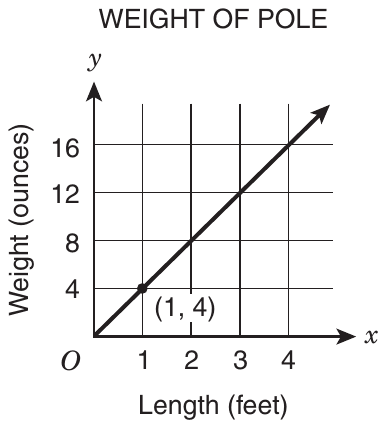
What is represented by the point with coordinates (1, 4)?
- AThe unit rate is 4 ounces per foot.
- BThe y-intercept is 4.
- CA pole 4 feet long weighs 1 ounce.
- DThe length increases 4 feet for each 1 ounce of weight.
Show the answer
Correct answer: A
The x-axis represents the length of the pole, in feet, and the y-axis represents the weight of the pole, in ounces.
The point (1, 4) means that a 1-foot pole would weigh 4 ounces.
Since the graph is linear, the pole weighs 4 ounces for every additional 1 foot of length.
So the unit rate is 4 ounces per foot.
Question analysis
A graph of a pole's weight in ounces against its length in feet is a straight line through the origin, with the point (1, 4) marked. Students decide what that point says about poles, choosing among statements about rates, intercepts and particular poles, so the meaning of each coordinate has to be pinned down.
- Grade level
- Grade 7 content, by NYS standard
- Compared with grade 7
- At grade 7 Explaining what a point on a proportional graph means in the situation is a named grade 7 skill. This is a direct, one-step example with a clear graph, typical of grade 7 classwork.
- Estimated difficulty
- Straightforward: two steps or one careful reading.
- Thinking it demands
- Depth of knowledge 2, skills and concepts · mainly understand
- What makes it hard
- Solution
- 1 step
- Reading level
- Question and choices: about grade 2, 45 words.
- Students, last 30 days
- Not enough answers yet to show (it takes 10).
Why it is hard, traps and wrong answers (shows the answer)
Why it is hard
Nothing needs computing; the question tests whether a point on a graph can be put into words. Each wrong statement misuses the same two numbers, as an intercept, with the coordinates swapped, or as a rate turned upside down. Saying the point aloud with its units, a 1-foot pole weighs 4 ounces, and comparing that sentence with each statement settles it quickly.
Reading a figure, table or graph moderate Understanding the question
The axes carry the meaning: length in feet runs along x and weight in ounces up y, so (1, 4) describes a 1-foot pole, and the line through O makes that a rate. (Lesh, Post & Behr, 1987; Kirsch & Mosenthal, 1990)
A very close wrong answer minor Choosing the answer
Both rate statements pair 4 with 1, one as ounces per foot and the other as feet per ounce; only the axis labels say which way the rate runs. (Embretson & Wetzel, 1987; Gorin & Embretson, 2006; Ascalon et al., 2007)
Something you must already know minor Working it out
The choices use the terms unit rate and y-intercept, which the question does not define, and two statements hang on knowing what each one means. (Anderson & Krathwohl, 2001)
Strategy: Note which quantity each axis measures, say in words what the x-coordinate and the y-coordinate of the marked point stand for, then compare that sentence with each choice.
Traps
- Wrong operation: Adds instead of multiplying, divides the wrong way round, turns a ratio or rate upside down, or undoes a step in the wrong direction (subtracts what should be added back).
- Misreads the figure: Reads a value, label or tick spacing in a figure, table or graph wrongly.
- Misunderstands the concept: A wrong belief about a concept: that percents can be added, that area grows like length, that averages can be averaged, that a bigger denominator means a bigger fraction.
The wrong answers, classified
B Misunderstands the concept (Smith, diSessa & Roschelle, 1993; De Bock et al., 1998; Ni & Zhou, 2005)
Takes the 4 in the point's label for the y-intercept, though the line starts at the origin, where a pole of no length weighs 0 ounces.
C Misreads the figure (Lesh, Post & Behr, 1987; Kirsch & Mosenthal, 1990)
Reads the coordinates the wrong way round, taking 1 as the weight in ounces and 4 as the length in feet.
D Wrong operation (Hegarty, Mayer & Monk, 1995; King et al., 2004)
Turns the rate upside down, describing feet of length per ounce of weight instead of ounces of weight per foot of length.
Worked solution, step by step
Formulas used
- Unit rate
- For a point on the line, y is the weight in ounces and x is the length in feet. The unit rate is the weight of 1 foot of pole. This works for a straight line that starts at the origin, the point (0, 0).
Read the axes
The graph has two axes (number lines). The x-axis, across the bottom, shows length in feet. The y-axis, going up, shows weight in ounces.
A point is written (x, y). The across number comes first, then the up number. So in (1, 4), x is 1 and y is 4.
Say what the point means
x = 1 means a length of 1 foot. y = 4 means a weight of 4 ounces. So a pole 1 foot long weighs 4 ounces.
Watch out: do not swap the numbers. “A pole 4 feet long weighs 1 ounce” reads them the wrong way round. That is choice C.See that this is a unit rate
A unit rate is an amount for 1 unit, here the ounces in 1 foot. The line starts at O, the origin (0, 0), and it is straight. So each extra foot adds the same weight.
The unit rate is 4 ounces per foot. Watch out: choice D turns this upside down. It gives feet for each ounce, not ounces for each foot.
Rule out the y-intercept
The y-intercept is where the line crosses the y-axis. This line crosses it at O, where y is 0. So the y-intercept is 0, not 4, and choice B is wrong.
So the answer is A, the unit rate is 4 ounces per foot.
Check your answer
Try another point on the line, such as (3, 12). A pole 3 feet long weighs 12 ounces. , so it is still 4 ounces per foot. The rate stays the same all along the line.
More questions like this
The original DOE question
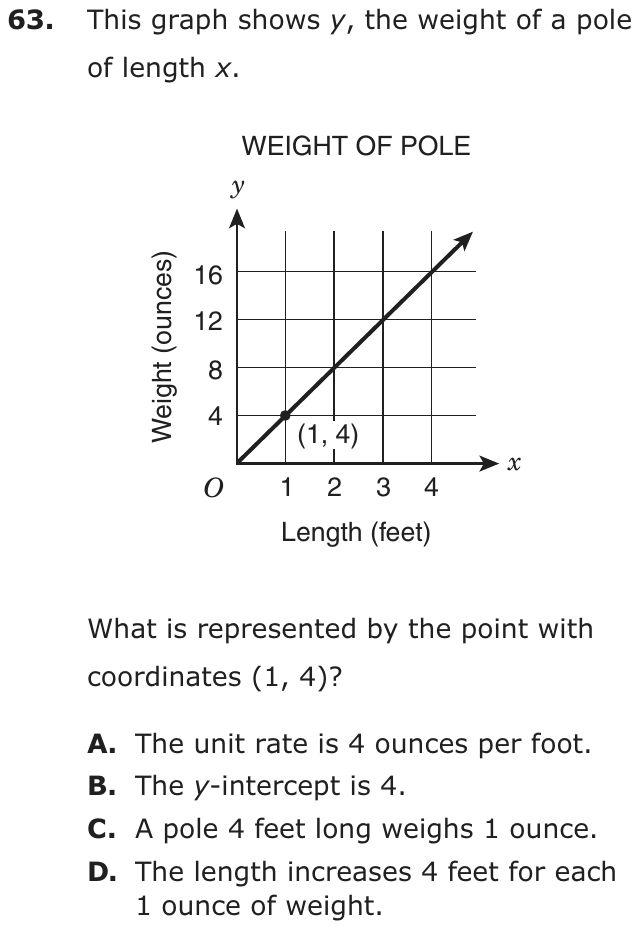
Question 64 of 120
2024 Test B Math, question 18Question
A taxi driver recorded the number of fares each day for one month. The box plot displays the data.
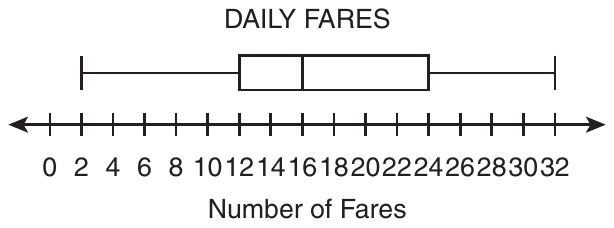
Based on the box plot, which statement is a correct interpretation of the data?
- AThe data point 2 is an outlier.
- BThe mean of the data is 16.
- CThe interquartile range (IQR) of the data is 30.
- DOn about 25% of the days, there were between 12 and 16 fares.
Show the answer
Correct answer: D
The amount of data in a box plot is broken into 4 parts, or quartiles, which each represent 25% of the data. So the amount of data represented between Quartile 1 (12) and the median (16) is about 25% of the data.
Question analysis
A statistics question on a box plot of the number of fares a taxi driver recorded each day for one month. Students decide which of four statements is a correct interpretation of the data, using what a box plot does and does not show. The statements draw on several different box plot ideas, so each one must be checked.
- NYS standards
- 7.SP.1 box plots and interquartile range
- Grade level
- Grade 7 content, by NYS standard
- Compared with grade 7
- At grade 7 Reading box plots, finding the interquartile range and testing for outliers are all grade 7 standards in New York. This item gathers several of them in one question, but each check is short, typical of grade 7 work.
- Estimated difficulty
- Moderate: several steps, or a close reading with one strong distractor.
- Thinking it demands
- Depth of knowledge 2, skills and concepts · mainly understand
- What makes it hard
- Something you must already know moderate
- Every choice must be checked moderate
- Reading a figure, table or graph minor
- Solution
- 3 steps
- Reading level
- Question and choices: about grade 4, 63 words.
- Students, last 30 days
- Not enough answers yet to show (it takes 10).
Why it is hard, traps and wrong answers (shows the answer)
Why it is hard
No calculation here is long; the challenge is knowing what a box plot does and does not show. Two of the wrong statements sound reasonable because they borrow real features of the plot, its long left whisker and its middle line, and give them the wrong meaning. Remembering that the plot splits the days into four groups of about equal size makes the true statement easy to confirm.
Something you must already know moderate Working it out
Each statement draws on a box plot fact the test does not supply: what the middle line marks, how the IQR is found, and when a value counts as an outlier. (Anderson & Krathwohl, 2001)
Every choice must be checked moderate Choosing the answer
The four statements test four separate ideas, an outlier, the mean, the IQR and a quartile's share, so ruling out one says nothing about the next. (Embretson & Wetzel, 1987)
Reading a figure, table or graph minor Understanding the question
The scale is labeled every 2 fares with the numbers crowded together, so the five values 2, 12, 16, 24 and 32 must be read off with care. (Lesh, Post & Behr, 1987; Kirsch & Mosenthal, 1990)
Strategy: Read the minimum, quartiles, median and maximum off the plot, then test each statement in turn, computing the IQR and the outlier cutoffs rather than judging by eye.
Traps
- Misunderstands the concept: A wrong belief about a concept: that percents can be added, that area grows like length, that averages can be averaged, that a bigger denominator means a bigger fraction.
- Wrong formula: Uses a related but wrong formula: perimeter for area, diameter for radius, area for volume, or a misremembered one.
The wrong answers, classified
A Misunderstands the concept (Smith, diSessa & Roschelle, 1993; De Bock et al., 1998; Ni & Zhou, 2005)
Takes the long left whisker as a sign that 2 is an outlier, but that whisker holds a quarter of the days, and 2 is above the cutoff 12 − 1.5 × 12 = −6.
B Misunderstands the concept (Smith, diSessa & Roschelle, 1993; De Bock et al., 1998; Ni & Zhou, 2005)
Takes the median line at 16 for the mean, though a box plot shows the median and quartiles and cannot show the mean.
C Wrong formula (King et al., 2004)
Subtracts the minimum from the maximum, 32 − 2 = 30, which is the range, not the interquartile range of 24 − 12 = 12.
Worked solution, step by step
Formulas used
- Interquartile range (IQR)
- Q1 is the first quartile, the left edge of the box. Q3 is the third quartile, the right edge. The IQR is the length of the box. It tells how spread out the middle half of the data is.
- Low cutoff for an outlier
- Q1 and the IQR are found from the box. An outlier is a value far away from the rest. A value below this cutoff counts as an outlier on the low side. A value at or above it does not.
Read the five numbers
A box plot sums up a set of data with five numbers. Here each piece of data is the number of fares on one day.
- Minimum, the smallest value: 2
- First quartile, Q1, the left edge of the box: 12
- Median, the middle value, the line inside the box: 16
- Third quartile, Q3, the right edge of the box: 24
- Maximum, the largest value: 32
Learn what each part holds
These five numbers split the days into four parts. Each part holds about one fourth of the days, or about 25%. For example, about 25% of the days fall between the minimum and Q1. Another 25% fall between Q1 and the median.
Check choice D
Choice D talks about days with between 12 and 16 fares. 12 is Q1, and 16 is the median. That stretch is one of the four parts. So on about 25% of the days, there were between 12 and 16 fares. Choice D is correct.
Rule out choices B and C
Choice B: a box plot shows the median, 16, not the mean (the average). You cannot find the mean from it. Watch out: do not mix up the median and the mean.
Choice C says the IQR is 30. But 30 is the range, . Watch out: the IQR uses the edges of the box, not the ends of the whiskers.
Rule out choice A and answer
A long whisker does not make 2 an outlier. Use the cutoff rule.
2 is above −6, so 2 is not an outlier. The long whisker just shows that the lowest fourth of the days is spread out.
So the answer is D.
Check your answer
Go back over the four choices. Only D uses what a box plot really shows: four parts of about 25% each. Choice B needs the mean, which the plot does not show. Choice C gives the range, not the IQR. And 2 is not far enough out to be an outlier, so A is wrong.
More questions like this
The original DOE question
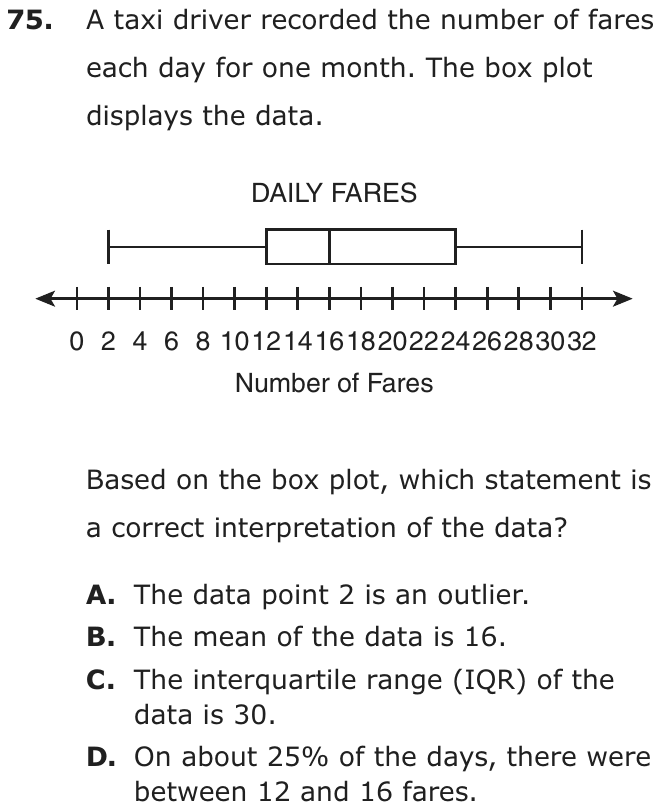
Question 65 of 120
2024 Test B Math, question 21Question
Which number shown above is the greatest?
- A
- B
- C
- D
Show the answer
Correct answer: A
All the numbers are negative, so they are all less than zero. Consider the absolute value of each number and where it falls on a number line. The negative number closest to 0 will be the greatest.
The negative number with the greatest absolute value is −49, so it has the least value.
The negative number with the next greatest absolute value is −1, so it would fall next in order from least to greatest.
Compare the absolute values of and .
Therefore, the numbers listed from least to greatest are:
So the number is the greatest.
Question analysis
Four negative numbers are listed: negative 1/49, negative 49, negative 1/7 and negative 1. Students decide which of them is the greatest. Comparing negative fractions with negative whole numbers tests whether students order numbers by their position on the number line or by their size without the sign.
- Grade level
- Grade 6 content, by NYS standard
- Compared with grade 7
- Below grade 7 Ordering positive and negative rational numbers on a number line is grade 6 content in New York. This is a one-step comparison of four numbers, lighter than typical grade 7 work with signed numbers.
- Estimated difficulty
- Straightforward: two steps or one careful reading.
- Thinking it demands
- Depth of knowledge 1, recall and reproduction · mainly apply
- What makes it hard
- A very close wrong answer moderate
- Something you must already know minor
- Solution
- 2 steps
- Reading level
- Question and choices: about grade 10, 12 words.
- Students, last 30 days
- Not enough answers yet to show (it takes 10).
Why it is hard, traps and wrong answers (shows the answer)
Why it is hard
With no arithmetic to do, the question tests how firmly students picture negative numbers on a line. Comparing sizes without the sign picks the number farthest from 0, and comparing the two fractions by habit picks the wrong one of the pair. Placing all four as points left of 0, with −1 between −49 and the fractions, makes the order plain.
A very close wrong answer moderate Choosing the answer
−1/49 and −1/7 differ only in the denominator, and for negative numbers the larger denominator gives the greater value, the reverse of what their sizes suggest. (Embretson & Wetzel, 1987; Gorin & Embretson, 2006; Ascalon et al., 2007)
Something you must already know minor Working it out
Students must bring the number-line fact that a negative number's value falls as its distance from 0 grows, so −49 is the least of the four, not the greatest. (Anderson & Krathwohl, 2001)
Strategy: Picture each number's place on the number line: among negative numbers, the one closest to 0 is the greatest, so compare their distances from 0.
Traps
- Negatives and direction: Arithmetic with negative numbers, the order of a subtraction, or direction on a number line. (Moving a term across the equals sign without changing its sign is a faulty procedure.)
- Misunderstands the concept: A wrong belief about a concept: that percents can be added, that area grows like length, that averages can be averaged, that a bigger denominator means a bigger fraction.
The wrong answers, classified
B Negatives and direction (Brown & Burton, 1978)
Picks the number with the largest digits, 49, judging its size without the minus sign that puts it farthest below 0.
C Negatives and direction (Brown & Burton, 1978)
Knows 1/7 is greater than 1/49 and keeps that order for the negatives, missing that the order reverses on the left of 0.
D Misunderstands the concept (Smith, diSessa & Roschelle, 1993; De Bock et al., 1998; Ni & Zhou, 2005)
Places −1/7 and −1/49 below −1, as if dividing a negative number made it more negative, so −1 looks like the greatest.
Worked solution, step by step
Formulas used
- Comparing negative numbers
- a and b are positive numbers. Putting a minus sign on both flips their order. The one with the smaller size is closer to 0, so it is greater. For example, 2 is less than 5, but −2 is greater than −5.
Sort out the question
All four numbers are negative, which means less than 0. You need the greatest one, the one with the highest value. On a number line, greater numbers are farther to the right.
Think about distance from 0
For negative numbers, the one closest to 0 is the greatest. The size of a number without its sign is its absolute value. It is the number’s distance from 0. So look for the smallest size.
Compare the sizes
The sizes are 1/49, 49, 1/7 and 1. Both 1/49 and 1/7 have 1 on top. Cutting 1 into 49 pieces gives much smaller pieces than cutting it into 7. So 1/49 is less than 1/7.
So 1/49 is the smallest size. That puts closest to 0.
Put the numbers in order
Flip the order of the sizes to order the negative numbers, from least to greatest.
Watch out: −49 has the biggest digits, but it is the least, so choice B is wrong. Watch out: 1/7 is more than 1/49, but −1/7 is less than −1/49. So choice C is wrong.So the answer is A, .
Check your answer
Change the fractions to decimals: and . Think of money you owe. Owing 2 cents is better than owing 14 cents, $1 or $49. So −1/49 is the greatest.
More questions like this
The original DOE question
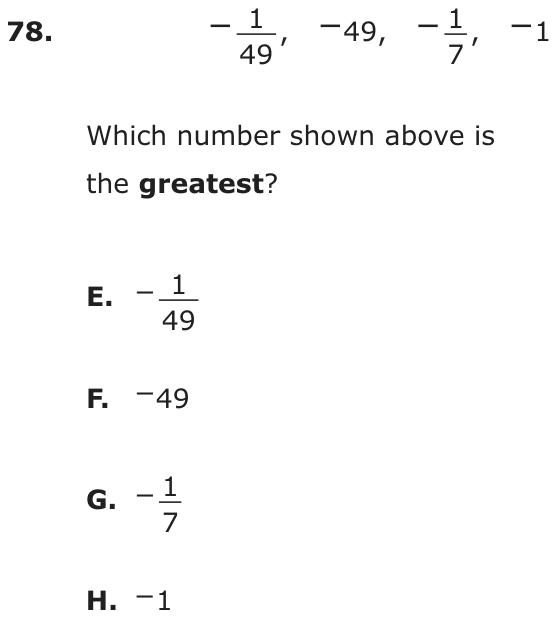
Question 66 of 120
2024 Test B Math, question 22Question
What decimal is equivalent to ?
- A
- B
- C
- D
Show the answer
Correct answer: C
Calculate the decimal equivalent of :
Question analysis
A fractions and decimals question asks which decimal equals negative 13/11. The choices differ in which digits repeat and how the repetition is marked. Students divide 13 by 11, spot the block of digits that repeats, and read the bar notation carefully.
- NYS standards
- 7.NS.2d fractions to decimals by long division
- Grade level
- Grade 7 content, by NYS standard
- Compared with grade 7
- At grade 7 Converting a fraction to a repeating decimal by long division is a named grade 7 skill. This is one short division, typical of grade 7 work, with care needed only in reading the bar notation.
- Estimated difficulty
- Straightforward: two steps or one careful reading.
- Thinking it demands
- Depth of knowledge 1, recall and reproduction · mainly apply
- What makes it hard
- A very close wrong answer moderate
- Something you must already know minor
- Error-prone arithmetic minor
- Solution
- 2 steps
- Reading level
- Question and choices: about grade 15, 10 words.
- Students, last 30 days
- Not enough answers yet to show (it takes 10).
Why it is hard, traps and wrong answers (shows the answer)
Why it is hard
Dividing 13 by 11 is quick; the question is really about reading and writing repeating decimals. Three choices differ only in where the bar goes, so students who know the digits run 1.1818… can still pick the wrong bar. Writing out each barred choice for a few digits and comparing it with the quotient is a fast, sure check.
A very close wrong answer moderate Choosing the answer
The bars over 18 and over 81 cover the same two digits, so only checking which digit comes right after the decimal point, 1 before 8, tells them apart. (Embretson & Wetzel, 1987; Gorin & Embretson, 2006; Ascalon et al., 2007)
Something you must already know minor Working it out
Reading bar notation is assumed: the bar marks exactly the block of digits that repeats, and the whole-number 1 never belongs under it. (Anderson & Krathwohl, 2001)
Error-prone arithmetic minor Working it out
The long division 13 ÷ 11 has to run until the remainder 2 comes back, which is where the repeating pair is confirmed. (Brown & Burton, 1978; Junker & Sijtsma, 2001)
Strategy: Do the long division of 13 by 11 until a remainder comes back, note which digits repeat from that point, and match that block to the bar in each choice.
Traps
- A faulty procedure: A systematic but wrong procedure: adding fractions straight across, applying an exponent to each term of a sum, dropping a sign when moving a term.
- Rounds too early: Rounds a value partway through, or rounds the wrong way, so the final answer drifts from the exact one.
- Answer in another form: The right answer is written differently from the way you worked it out.
The wrong answers, classified
A Rounds too early (King et al., 2004)
Stops the division after two decimal places and treats −1.18 as exact, missing that the digits 1 and 8 go on repeating.
B A faulty procedure (Brown & Burton, 1978; Tatsuoka, 1983)
Counts the whole-number 1 into the block, seeing 1, 18, 18 … as 118 repeating, and bars 118, which means −1.118118… rather than −1.1818….
D A faulty procedure (Brown & Burton, 1978; Tatsuoka, 1983)
Bars 81, the pair in the wrong order, which gives −1.8181…, equal to −1 9/11 rather than the −1 2/11 that −13/11 is.
Worked solution, step by step
Formulas used
- Fraction as division
- a is the top number, the numerator. b is the bottom number, the denominator. A fraction bar means divide. To turn a fraction into a decimal, divide the top by the bottom.
- Bar for repeating digits
- The bar sits over the digits that repeat forever, in the order they repeat. The dots mean the pattern goes on and on. Digits that are not under the bar show up only once.
Sort out the question
You need the decimal equal to . The fraction is negative, so the decimal will be negative too. Work with first. Then put the minus sign back.
Divide 13 by 11
Use long division for .
- 11 goes into 13 once, with 2 left over. Write 1 and a decimal point.
- Bring down a 0 to make 20. 11 goes into 20 once, with 9 left over. Write 1.
- Bring down a 0 to make 90. 11 goes into 90 eight times, with 2 left over. Write 8.
So far you have 1.18.
Spot the repeating pattern
The remainder (the amount left over) is 2 again. That is where you were after the first step. So the same digits come back: 1, 8, 1, 8, and so on forever.
Watch out: −1.18, choice A, stops too soon. The digits never end.Write it with a bar
A bar goes over only the digits that repeat. Here 18 repeats, starting right after the decimal point. The whole number 1 does not repeat, so it is not under the bar. Put the minus sign back.
Watch out: a bar over 81, choice D, means −1.8181…. A bar over 118, choice B, means −1.118118….So the answer is C, .
Check your answer
Multiply back: . That is almost exactly 13, and more 18s bring it even closer. Also, 13/11 is a bit more than 1, so a decimal between 1 and 2 makes sense.
More questions like this
The original DOE question
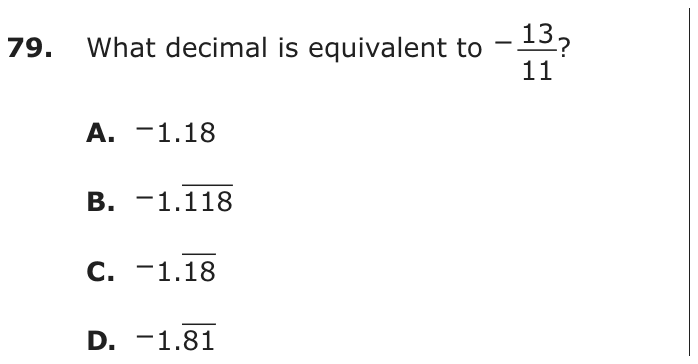
Question 67 of 120
2024 Test B Math, question 28Question
A community center has two 30-member exercise groups. The director recorded the ages of each group’s members in the box plots.
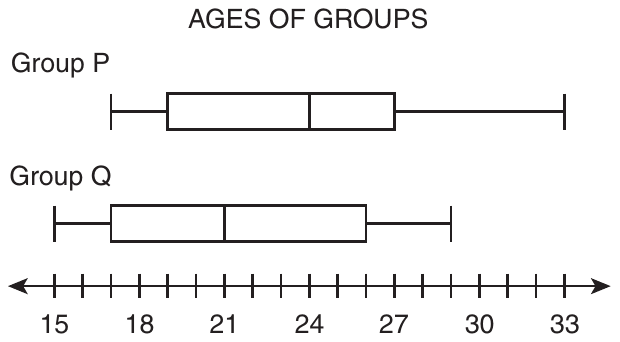
Which statement about the two groups can be verified based on the box plots?
- ABoth groups have at least one member who is exactly 29 years old.
- BGroup P has more members who are at least 17 years old than Group Q has.
- CBoth groups have an equal number of members who are between 21 and 24 years old.
- DGroup Q has fewer members who are between 19 and 27 years old than Group P has.
Show the answer
Correct answer: B
Groups P and Q have an equal number of members. All the members of Group P are 17 or older, but only about of the members of Group Q are 17 or older.
Question analysis
Box plots show the ages of the members of two 30-member exercise groups at a community center, Group P and Group Q. Students decide which statement comparing the groups can be verified from the plots alone. The challenge is knowing what a box plot guarantees about individual ages and counts, and what it leaves unknown.
- NYS standards
- Grade level
- Grade 7 content, by NYS standard
- Compared with grade 7
- Above grade 7 Grade 7 students read box plots and compare medians and spreads. Deciding which claims two box plots can prove, from what the five key values guarantee about counts, is a harder reasoning task than typical grade 7 work.
- Estimated difficulty
- Hard: combines ideas, needs a plan, and has more than one tempting wrong answer.
- Thinking it demands
- Depth of knowledge 3, strategic thinking · mainly evaluate
- What makes it hard
- Every choice must be checked major
- Something you must already know moderate
- Reading a figure, table or graph moderate
- Solution
- 3 steps
- Reading level
- Question and choices: about grade 5, 91 words.
- Students, last 30 days
- Not enough answers yet to show (it takes 10).
Why it is hard, traps and wrong answers (shows the answer)
Why it is hard
This is a question about evidence: the right statement is the only one the box plots guarantee, while the others may or may not be true. Students who treat the plots as pictures of every member, assuming ages fill each whisker or spread evenly through each box, find support for claims that cannot be checked. Asking what must hold for any 30 ages with these summaries separates the verifiable claim from the merely plausible ones.
Every choice must be checked major Choosing the answer
Three of the statements are not false but unverifiable, so each must be tested against what the five-number summaries guarantee, and none can be dismissed at a glance. (Embretson & Wetzel, 1987)
Something you must already know moderate Working it out
Students must know that the minimum and maximum are actual ages, that each quarter of a plot holds about a quarter of the 30 members, and that a whisker shows nothing in between. (Anderson & Krathwohl, 2001)
Reading a figure, table or graph moderate Understanding the question
The scale is labeled only every 3 years, so values such as 17, 19, 26 and 29 have to be read from unlabeled ticks on two separate plots. (Lesh, Post & Behr, 1987; Kirsch & Mosenthal, 1990)
Strategy: List each group's minimum, first quartile, median, third quartile and maximum, then test every statement against only what those five values guarantee about the 30 ages.
Traps
- Misunderstands the concept: A wrong belief about a concept: that percents can be added, that area grows like length, that averages can be averaged, that a bigger denominator means a bigger fraction.
- Numbers taken from the question: Combines the numbers in the question without a model of the situation, or is simply a number that appears in the question.
The wrong answers, classified
A Misunderstands the concept (Smith, diSessa & Roschelle, 1993; De Bock et al., 1998; Ni & Zhou, 2005)
Sees that Group Q's maximum is exactly 29 and that 29 also lies in Group P's upper whisker, assuming someone in Group P is that age.
C Numbers taken from the question (Hegarty, Mayer & Monk, 1995)
Matches the two medians, 21 and 24, and assumes the stretch between them holds the same number of members in both groups.
D Misunderstands the concept (Smith, diSessa & Roschelle, 1993; De Bock et al., 1998; Ni & Zhou, 2005)
Knows Group P's box from 19 to 27 holds half its members, then assumes ages spread evenly so Group Q has fewer there, which its plot cannot show.
Worked solution, step by step
Formulas used
- Members in each part of a box plot
- n is the number of members in a group, here 30. A box plot splits the data into four parts at the minimum, Q1, the median, Q3 and the maximum. Each part holds about one fourth of the data. It does not show how the ages spread out inside a part.
Read the two box plots
A box plot shows five numbers. The minimum is the youngest age, and the maximum is the oldest. Q1 is the left edge of the box, and Q3 is the right edge. The median is the line inside the box.
Group Min Q1 Median Q3 Max P 17 19 24 27 33 Q 15 17 21 26 29 Each group has 30 members.
Know what can be verified
To verify a statement means to know for sure that it is true. A box plot shows only five numbers, not every age. The minimum and maximum are real ages of real members. The other ages are hidden inside the box and whiskers.
Check choice B
In Group P, the youngest member is 17. So all 30 members are at least 17. In Group Q, the youngest member is 15, and 15 is under 17. So at most 29 members of Group Q are at least 17.
Group P has 30 such members, and Group Q has 29 or fewer. So choice B is true for sure.
Rule out choices A and C
A: Group Q’s oldest member is 29, so Group Q has a 29-year-old. But in Group P, 29 is inside the right whisker. A whisker does not show single ages. Watch out: 29 is in Group P’s range, but maybe no one in Group P is exactly 29.
C: The plots do not show how many members are between 21 and 24 in either group.
Rule out choice D and answer
Group P’s box, from 19 to 27, is two of its four parts.
So about 15 members of Group P are between 19 and 27. But 19 and 27 fall in the middle of Group Q’s parts, and ages inside a part can bunch up in any way. Group Q could have more or fewer. Watch out: D assumes the ages are spread out evenly, and a box plot never tells you that.
So the answer is B.
Check your answer
Choice B uses only the two minimums, which are real ages. Group P’s youngest member is 17, and Group Q’s is 15. That alone proves it. Each other choice needs ages inside a box or whisker, which a box plot does not show.
More questions like this
The original DOE question
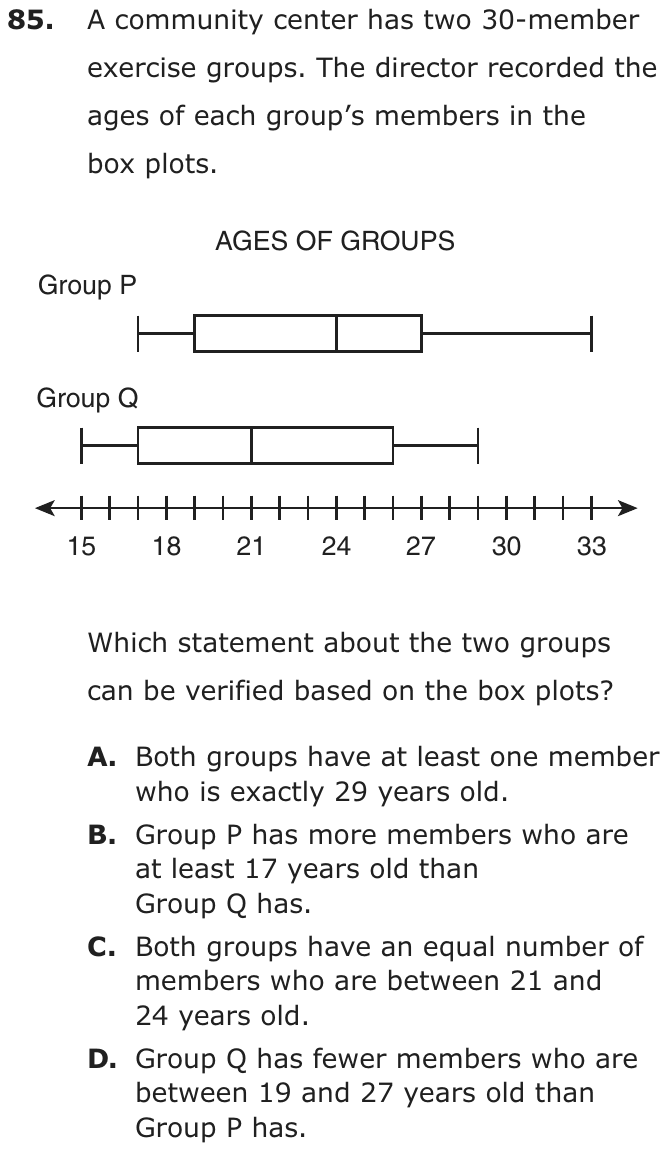
Question 68 of 120
2024 Test B Math, question 32Question
Two circular plates have the dimensions shown.
What is the difference between the areas of the two plates, in square inches?
- A
- B
- C
- D
Show the answer
Correct answer: C
First, determine the area of each circle using the formula :
A circle with a diameter of 18 inches has a radius of 9 inches, so the area is .
A circle with a diameter of 12 inches has a radius of 6 inches, so the area is .
The difference between the two areas is .
Question analysis
Two circular plates are drawn with their diameters marked in inches, and students find the difference between their areas in square inches, in terms of pi. It tests the area of a circle. The diameters, not the radii, are marked, so a step comes before the area formula, which the test does not provide.
- NYS standards
- 7.G.4 circle area and circumference
- Grade level
- Grade 7 content, by NYS standard
- Compared with grade 7
- At grade 7 Finding a circle's area is a grade 7 standard, and this asks for two areas and their difference. It matches typical classwork: the formula must be recalled and each diameter halved first, with no further twist.
- Estimated difficulty
- Straightforward: two steps or one careful reading.
- Thinking it demands
- Depth of knowledge 1, recall and reproduction · mainly apply
- What makes it hard
- Solution
- 3 steps
- Reading level
- Question and choices: about grade 5, 25 words.
- Students, last 30 days
- Not enough answers yet to show (it takes 10).
Why it is hard, traps and wrong answers (shows the answer)
Why it is hard
Two area calculations and a subtraction, kept in terms of π, make this routine for students who know the area formula. Points are lost by using the labeled diameters as radii, by subtracting circumferences, or by subtracting the radii before squaring, and each of these has a listed answer. Writing both areas, 81π and 36π, before subtracting avoids all three.
Something you must already know moderate Working it out
The area formula A = πr² is not given, and the figure labels each plate by its diameter, so 18 and 12 must be halved to radii of 9 and 6 first. (Anderson & Krathwohl, 2001)
Reading a figure, table or graph minor Understanding the question
The dashed lines run all the way across each circle, which marks them as diameters; reading the 18 in. and 12 in. as radii leads to a listed choice. (Lesh, Post & Behr, 1987; Kirsch & Mosenthal, 1990)
Strategy: Halve each diameter to get the radius, find each plate's area as pi times the radius squared, and subtract the smaller area from the larger.
Traps
- Wrong formula: Uses a related but wrong formula: perimeter for area, diameter for radius, area for volume, or a misremembered one.
- A faulty procedure: A systematic but wrong procedure: adding fractions straight across, applying an exponent to each term of a sum, dropping a sign when moving a term.
- A formula you must know: Needs a formula the test does not give: area, circumference, volume, probability rules.
The wrong answers, classified
A Wrong formula (King et al., 2004)
Subtracts the circumferences, 18π − 12π = 6π, using πd, the distance around a circle, in place of the area formula.
B A faulty procedure (Brown & Burton, 1978; Tatsuoka, 1983)
Subtracts the radii first, 9 − 6 = 3, and then squares, π(3)² = 9π, as if the difference of two squares were the square of the difference.
D Wrong formula (King et al., 2004)
Uses the labeled diameters as radii, π(18)² − π(12)² = 324π − 144π = 180π, forgetting to halve them first.
Worked solution, step by step
Formulas used
- Area of a circle
- A is the area, the flat space inside the circle. r is the radius, the distance from the center to the edge. It is half the diameter. π (pi) is a fixed number, about 3.14. r² means r × r. Use it for the space inside any circle.
Sort out the question
Each dashed line goes all the way across its circle, through the center. A line like that is a diameter. The big plate has a diameter of 18 inches. The small plate has a diameter of 12 inches.
You need the difference between the two areas. That means the big area minus the small area, in square inches.
Find each radius
The area formula uses the radius, not the diameter. The radius is half the diameter.
The radii are 9 inches and 6 inches. Watch out: If you use 18 and 12 as the radii, you get , choice D.
Find the big plate’s area
The big plate’s area is square inches. Keep π as a symbol, since all the choices use π.
Find the small plate’s area
The small plate’s area is square inches. Squaring means multiplying a number by itself, so .
Subtract the two areas
Subtract the numbers in front of π, just as 81 apples minus 36 apples is 45 apples. The difference is square inches.
Watch out: Don’t subtract the radii first. Squaring 9 − 6 = 3 gives , choice B. Subtracting the distances around the plates, , gives , choice A. That uses the wrong formula.
So the answer is C, .
Check your answer
Estimate with π about 3. The big plate is about square inches. The small one is about . The difference is about 135, and . It matches.
More questions like this
The original DOE question
Question 69 of 120
2024 Test B Math, question 33Question
If , what is the sum of x and 10% of ?
- A−4.4
- B−3.6
- C0.4
- D4.4
Show the answer
Correct answer: B
First, determine 10% of .
Then determine the sum of x and 10% of .
The sum is −3.6.
Question analysis
With x equal to a negative number, students find the sum of x and 10 percent of the absolute value of x. It tests absolute value, a simple percent and adding numbers with different signs. The tricky part is keeping track of which term is negative and which is not.
- NYS standards
- Grade level
- Grade 7 content, by NYS standard
- Compared with grade 7
- At grade 7 Grade 7 students add positive and negative decimals and find simple percents. This joins those skills with an absolute value in two short steps, so it matches typical practice, with the sign of each term as the main hazard.
- Estimated difficulty
- Straightforward: two steps or one careful reading.
- Thinking it demands
- Depth of knowledge 1, recall and reproduction · mainly apply
- What makes it hard
- Error-prone arithmetic moderate
- Something you must already know minor
- Solution
- 2 steps
- Reading level
- Question and choices: about grade 5, 11 words.
- Students, last 30 days
- Not enough answers yet to show (it takes 10).
Why it is hard, traps and wrong answers (shows the answer)
Why it is hard
The question is short, but it asks students to treat the same number two ways: x keeps its negative sign while |x| drops it. Each wrong choice gets the sign wrong in one place, by taking 10% of −4, by making both terms positive, or by stopping at the positive 0.4. Writing the two terms separately, −4 and +0.4, before adding prevents each slip.
Error-prone arithmetic moderate Working it out
The sum mixes a negative integer with a positive decimal, −4 + 0.4, and the result has to keep the negative sign while moving 0.4 toward zero. (Brown & Burton, 1978; Junker & Sijtsma, 2001)
Something you must already know minor Working it out
Students must know that |−4| = 4, so the 10% is taken of a positive number even though x itself is negative. (Anderson & Krathwohl, 2001)
Strategy: Evaluate the absolute value first, take 10 percent of that positive number, and then add the result to x itself, keeping x's negative sign.
Traps
- Negatives and direction: Arithmetic with negative numbers, the order of a subtraction, or direction on a number line. (Moving a term across the equals sign without changing its sign is a faulty procedure.)
- Stops one step early: A choice is a number from partway through the solution.
The wrong answers, classified
A Negatives and direction (Brown & Burton, 1978)
Takes 10% of x instead of |x|, getting −0.4, and adds it to −4 to reach −4.4, overlooking the absolute value bars.
C Stops one step early (King et al., 2004; Gierl et al., 2017)
Finds 10% of |x| = 0.4 correctly and stops there, without adding x as the word sum requires.
D Negatives and direction (Brown & Burton, 1978)
Uses 4 for x as well as for |x|, so adds 4 + 0.4 = 4.4 and loses the negative sign of x itself.
Worked solution, step by step
Formulas used
- Absolute value
- The two bars mean absolute value. a is any number. Its absolute value is how far it is from 0 on the number line. A distance is never negative, so |−4| = 4.
- Percent of a number
- The whole is the amount the percent is taken of. The percent tells how many out of every 100. The part is the piece you get. Use it to find a percent of any number.
Sort out the question
You know that x = −4. You need the sum of two things: x itself, and 10% of |x|. A sum means you add.
The bars around x mean absolute value. So the 10% is taken of |x|, not of x.
Find the absolute value
−4 is 4 steps from 0 on the number line. So its absolute value is 4. An absolute value is never negative.
Take 10 percent of it
So 10% of |x| is 0.4.
Watch out: If you take 10% of x instead, you get −0.4. Then −4 + (−0.4) = −4.4, choice A. The bars make the number positive first.
Add x and the result
Now add x, which is still −4. Its own minus sign stays.
Start at −4 on the number line. Move 0.4 to the right, toward 0. You land on −3.6.
Watch out: Stopping at 0.4 gives choice C. Using 4 in place of x gives 4.4, choice D.
So the answer is B, −3.6.
Check your answer
Adding a small positive number should move −4 a little toward 0. The answer −3.6 is just to the right of −4, so that fits. Also, , the amount you added.
More questions like this
The original DOE question
Question 70 of 120
2024 Test B Math, question 34Question
The volume of a cube is 512 cubic centimeters. What is the length, in centimeters, of one edge of this cube?
- A8
- B
- C
- D128
Show the answer
Correct answer: A
The volume of a cube is , where s is the length of one edge.
So , and .
If you are not sure how to find the cube root, you can estimate.
We know , so .
Since 512 is less than 1,000, the answer must be less than 10. The only given option less than 10 is 8. Double-check to make sure this is correct: .
Question analysis
A cube has a volume of 512 cubic centimeters, and students work backward to find the length of one edge. It tests the volume formula for a cube and the idea of a cube root. The tricky part is going from a volume to a length, the reverse of the usual volume problem.
- Grade level
- Grade 8 content, by NYS standard
- Compared with grade 7
- Above grade 7 Grade 7 volume work goes from edge lengths to a volume. Going backward needs a cube root, a grade 8 idea, and 512 is beyond the perfect cubes students are expected to know, though checking a guess by multiplying keeps it short.
- Estimated difficulty
- Straightforward: two steps or one careful reading.
- Thinking it demands
- Depth of knowledge 1, recall and reproduction · mainly apply
- What makes it hard
- Something you must already know moderate
- Solution
- 2 steps
- Reading level
- Question and choices: about grade 5, 22 words.
- Students, last 30 days
- Not enough answers yet to show (it takes 10).
Why it is hard, traps and wrong answers (shows the answer)
Why it is hard
This is a one-fact question: a cube's volume is its edge used three times as a factor. Students who remember that need only the number whose cube is 512, and the choices help, because only one is under 10 while 10 × 10 × 10 = 1,000. The wrong choices divide 512 by numbers tied to other measures of a cube or a square, so they catch students who do not recall the formula.
Something you must already know moderate Working it out
Neither V = s³ nor the cube root of 512 is given, so students must recall the formula and know, or find by trial, that 8 × 8 × 8 = 512. (Anderson & Krathwohl, 2001)
Strategy: Write the volume as edge × edge × edge, then find the number that, multiplied by itself three times, gives 512, and confirm it by multiplying.
Traps
- Wrong formula: Uses a related but wrong formula: perimeter for area, diameter for radius, area for volume, or a misremembered one.
- A formula you must know: Needs a formula the test does not give: area, circumference, volume, probability rules.
The wrong answers, classified
B Wrong formula (King et al., 2004)
Divides 512 by 12, the number of edges, as if the volume were the total length of all the edges, giving 42 2/3.
C Wrong formula (King et al., 2004)
Divides 512 by 6, the number of faces, mixing up volume with surface area, giving 85 1/3.
D Wrong formula (King et al., 2004)
Divides 512 by 4, as when a square's side is found from its perimeter, instead of finding the number whose cube is 512.
Worked solution, step by step
Formulas used
- Volume of a cube
- V is the volume, the space inside, in cubic units. s is the length of one edge. s³ means s × s × s. A cube’s length, width and height are all s, so length × width × height becomes s × s × s.
Sort out the question
The cube’s volume is 512 cubic centimeters. Volume is the space inside a solid. You need the length of one edge.
A cube has 12 edges, and they are all the same length. So one edge tells you all of them.
Write the volume formula
You need a number that gives 512 when you multiply it by itself three times. That number is called the cube root of 512.
Try numbers to find the edge
Start with an easy one: . That is too big, so the edge is less than 10. Try 8.
It works. Each edge is 8 centimeters.
Rule out the other choices
Watch out: The volume is not shared out among the faces or the edges. Dividing 512 by the 6 faces gives , choice C. Dividing by the 12 edges gives , choice B. Dividing by 4 gives 128, choice D.
So the answer is A, 8.
Check your answer
Test the biggest choice. is over 2 million, far more than 512. Only an edge less than 10 can work, and 8 is the only choice less than 10. And .
More questions like this
The original DOE question
Question 71 of 120
2024 Test B Math, question 39Question
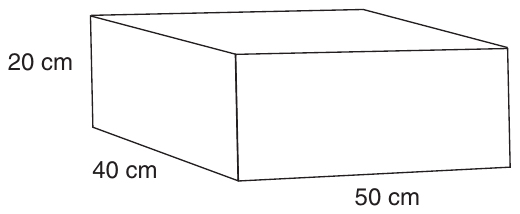
What is the total surface area, in square centimeters, of the closed box shown above?
- A3,800
- B5,600
- C7,600
- D40,000
Show the answer
Correct answer: C
To find surface area, use the formula :
Question analysis
A drawing of a closed box gives its length, width and height in centimeters, and students find its total surface area in square centimeters. It tests surface area of a rectangular prism. The work is short, but every face of the box has to be accounted for, and surface area must be kept apart from volume.
- Grade level
- Grade 7 content, by NYS standard
- Compared with grade 7
- At grade 7 Surface area of a rectangular prism is a grade 7 standard, and this box has whole-number dimensions shown in a drawing. Three face areas, a sum and the opposite faces make it typical practice rather than a stretch.
- Estimated difficulty
- Straightforward: two steps or one careful reading.
- Thinking it demands
- Depth of knowledge 1, recall and reproduction · mainly apply
- What makes it hard
- Solution
- 3 steps
- Reading level
- Question and choices: about grade 8, 15 words.
- Students, last 30 days
- Not enough answers yet to show (it takes 10).
Why it is hard, traps and wrong answers (shows the answer)
Why it is hard
Finding the three face areas, 800, 1,000 and 2,000, is quick; the question tests whether students account for all six faces. The wrong choices are what the box would give with only three faces, with the top left off, or with the dimensions multiplied into a volume. Listing the faces in pairs before adding is the safest route.
Something you must already know minor Working it out
No surface-area formula is given; students must know that a box's six faces come in three matching pairs, 20 × 40, 20 × 50 and 40 × 50. (Anderson & Krathwohl, 2001)
Reading a figure, table or graph minor Understanding the question
The drawing shows only three faces and labels 20, 40 and 50 cm on separate edges, so the hidden faces and their dimensions have to be pictured. (Lesh, Post & Behr, 1987; Kirsch & Mosenthal, 1990)
Strategy: Find the areas of the three different faces from the labeled length, width and height, add them, and double the sum to cover the opposite faces.
Traps
- Stops one step early: A choice is a number from partway through the solution.
- Wrong formula: Uses a related but wrong formula: perimeter for area, diameter for radius, area for volume, or a misremembered one.
- Misreads the question: Misses or misreads a condition or a word in the question: "at least", "each", "remaining", "not".
The wrong answers, classified
A Stops one step early (King et al., 2004; Gierl et al., 2017)
Adds the three different face areas, 800 + 1,000 + 2,000 = 3,800, and stops before doubling for the matching opposite faces.
B Misreads the question (Hegarty, Mayer & Monk, 1995)
Leaves out the 40-by-50 top, as for an open box, 7,600 − 2,000 = 5,600, though the stem says the box is closed.
D Wrong formula (King et al., 2004)
Multiplies the three dimensions, 20 × 40 × 50 = 40,000, which is the box's volume in cubic centimeters, not its surface area.
Worked solution, step by step
Formulas used
- Surface area of a box
- SA is the surface area, the total area of all six faces. l is the length, w is the width and h is the height. lw, lh and wh are the areas of the three different faces. You double because each face has a matching face on the opposite side.
Sort out the question
The box is a rectangular prism, a box shape with six rectangle faces. Its length is 50 cm, its width is 40 cm and its height is 20 cm.
The box is closed, so it has a top. Surface area is the total area of all the outside faces, in square centimeters.
Find the three different faces
The faces come in matching pairs. Find the area of one face from each pair. Multiply its two edges.
Faces Edges Area of one (sq cm) Front and back 50 × 20 1,000 Left and right 40 × 20 800 Top and bottom 50 × 40 2,000 Add the faces and double
Use the formula. Add the three areas. Then double the sum to cover the matching faces you can’t see.
The surface area is 7,600 square centimeters.
Avoid the traps
Watch out: Stopping at 3,800 counts only three faces, choice A. Leaving off the top, as for an open box, gives 5,600, choice B. Multiplying all three edges gives 40,000, choice D. That is the volume, in cubic centimeters.
So the answer is C, 7,600.
Check your answer
Add all six faces one by one: . Also check the units. Area multiplies two lengths, so it is in square centimeters. Multiplying three lengths gives cubic units, which is volume.
More questions like this
The original DOE question
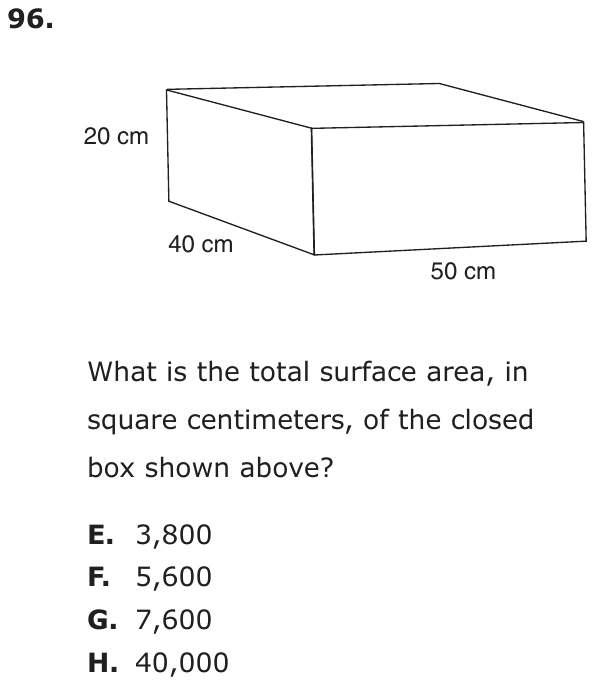
Question 72 of 120
2024 Test B Math, question 41Question
A bag contains 2 green, 4 blue, and 3 yellow disks. Alana selects 4 disks from the bag at random, one at a time, without replacing them. What is the probability that she selects all 4 blue disks?
- A
- B
- C
- D
Show the answer
Correct answer: B
If Alana picks 4 blue disks in a row, the number of blue disks and the total number of disks will both decrease by 1 after each selection.
For the first selection, there are 4 blue disks out of 9 total disks, so the probability of selecting the first blue disk is .
The probabilities of selecting blue for the next three selections are , , and .
Question analysis
A bag holds green, blue and yellow disks, and Alana draws four of them one at a time without putting any back. Students find the probability that all four disks are blue. It tests the probability of dependent events, and the difficulty is keeping track of how the bag changes after each draw.
- NYS standards
- Grade level
- Grade 7 content, by NYS standard
- Compared with grade 7
- Above grade 7 Grade 7 compound probability is usually found with lists or tree diagrams for two stages. Four dependent draws, each changing the counts, are too many to list and need the multiplication rule, which grade 7 does not formally teach.
- Estimated difficulty
- Hard: combines ideas, needs a plan, and has more than one tempting wrong answer.
- Thinking it demands
- Depth of knowledge 2, skills and concepts · mainly apply
- What makes it hard
- Something you must already know moderate
- Error-prone arithmetic moderate
- Solution
- 3 steps
- Reading level
- Question and choices: about grade 5, 37 words.
- Students, last 30 days
- Not enough answers yet to show (it takes 10).
Why it is hard, traps and wrong answers (shows the answer)
Why it is hard
Students who know the multiplication rule for successive draws still have two adjustments to make on every draw, and each wrong choice skips at least one of them. Leaving the bag at 9 disks, or putting each disk back, both produce fractions over 6,561 that look as exact as the right one. Writing the four fractions in a row before multiplying, and cancelling as you go, keeps the arithmetic small.
Something you must already know moderate Working it out
The rule for successive draws without replacement is assumed: each draw's chance is multiplied in, with both the blue count and the total lowered by one. (Anderson & Krathwohl, 2001)
Error-prone arithmetic moderate Working it out
The product 4/9 × 3/8 × 2/7 × 1/6 = 24/3,024 has to be reduced to 1/126, and two wrong choices hide behind 9 to the fourth power, 6,561. (Brown & Burton, 1978; Junker & Sijtsma, 2001)
Strategy: Write the chance of blue for each of the four draws in turn, lowering both the blue count and the total by one each time, and multiply.
Traps
- Without replacement: In a second pick there is one fewer item, which changes the probability.
- Wrong operation: Adds instead of multiplying, divides the wrong way round, turns a ratio or rate upside down, or undoes a step in the wrong direction (subtracts what should be added back).
The wrong answers, classified
A Without replacement (Fischbein & Schnarch, 1997)
Lowers the blue count on each draw but keeps all 9 disks in the bag, 4 × 3 × 2 × 1 over 9 × 9 × 9 × 9, which is 24/6,561 = 8/2,187.
C Without replacement (Fischbein & Schnarch, 1997)
Uses 4/9 for every draw, (4/9) to the fourth power = 256/6,561, as if each disk were put back before the next draw.
D Wrong operation (Hegarty, Mayer & Monk, 1995; King et al., 2004)
Adds the first draw's 4/9 four times, or multiplies it by 4, instead of multiplying the draws' chances, and misses that a probability cannot exceed 1.
Worked solution, step by step
Formulas used
- Probability
- P is the probability, the chance that something happens. It is a number from 0 to 1. The top counts the results you want. The bottom counts all the results that can happen. It works when every result is equally likely.
- Chance of events in a row
- A and B are two events that happen one after the other. P(A) is the chance of the first. P(B after A) is the chance of the second, counting only what is left after the first. You multiply because the second must also happen inside the share of times the first did.
Sort out the question
The bag holds 2 green, 4 blue and 3 yellow disks. That is 9 disks in all. Alana takes 4 disks, one at a time.
“Without replacing them” means a disk she takes does not go back in the bag. You need the chance that all 4 disks are blue.
Find the chance for each pick
For all 4 to be blue, each pick must be blue. After each blue pick, one blue disk is gone. One disk is gone from the total, too. So the top and the bottom each go down by 1.
Pick Blue disks left Disks left Chance of blue 1st 4 9 2nd 3 8 3rd 2 7 4th 1 6 Multiply the four chances
All four picks must go right, one after another. Use the rule for events in a row and multiply.
Simplify the fraction
Divide the top and the bottom by 24. That keeps the value the same.
Watch out: Using for every pick gives , choice C. That is right only if each disk goes back in. Keeping 9 on the bottom each time gives , choice A. Choice D is more than 1, and no chance can be more than 1.
So the answer is B, .
Check your answer
Cancel before you multiply. On top, cancels the 8 on the bottom. That leaves . Divide the top and bottom by 3 to get again.
More questions like this
The original DOE question
Question 73 of 120
2024 Test B Math, question 46Question
The least positive integer evenly divisible by the first 6 positive integers is 60. What is the least positive integer evenly divisible by the first 8 positive integers?
- A1,680
- B840
- C480
- D420
Show the answer
Correct answer: B
Each option is divisible by 1, 2, 3, 4, 5, and 6.
Option A:
1,680 is evenly divisible by the first 8 positive integers.
Option B:
840 is evenly divisible by the first 8 positive integers and is less than 1,680.
Option C:
480 is not evenly divisible by 7.
Option D:
420 is not evenly divisible by 8.
Option B (840) is the correct answer.
Question analysis
Knowing that 60 is the smallest number divisible by each of 1 through 6, students find the smallest positive integer divisible by each of 1 through 8. It tests least common multiples and prime factors. The challenge is adding only the factors that 7 and 8 really need, so the result works for all eight numbers and is still the least.
- NYS standards
- 6.NS.4 common factors and multiples
- Grade level
- Grade 6 content, by NYS standard
- Compared with grade 7
- At grade 7 Least common multiples are grade 6 content, usually for two small numbers. Extending the given result from six numbers to eight means deciding what 7 and 8 add, more reasoning than typical classwork but no new content.
- Estimated difficulty
- Moderate: several steps, or a close reading with one strong distractor.
- Thinking it demands
- Depth of knowledge 2, skills and concepts · mainly apply
- What makes it hard
- Every choice must be checked moderate
- Something you must already know minor
- Solution
- 3 steps
- Reading level
- Question and choices: about grade 13, 25 words.
- Corrected from the DOE handbook
- A rounded decimal in the explanation is now marked as approximate (≈ instead of =).
- Students, last 30 days
- Not enough answers yet to show (it takes 10).
Why it is hard, traps and wrong answers (shows the answer)
Why it is hard
The given fact, 60 for the first six integers, is a head start, but only for students who see what 7 and 8 add. Multiplying 60 by 7 is needed; multiplying by all of 8 is not, since 60 already supplies two of its three factors of 2. Students who multiply by the new numbers whole get answers that are too large or that miss one divisor, so checking the smaller choices first is the efficient route.
Every choice must be checked moderate Choosing the answer
Both 1,680 and 840 are divisible by 7 and by 8, so testing the choices is safe only from the smallest up; 420 fails for 8 and 480 for 7. (Embretson & Wetzel, 1987)
Something you must already know minor Working it out
Building on 60 needs prime factors: 7 adds a new prime, while 8 = 2 × 2 × 2 needs only one more 2, since 60 already holds two. (Anderson & Krathwohl, 2001)
Strategy: Start from 60 and ask which extra prime factors 7 and 8 require, or test the choices from the smallest up for divisibility by both 7 and 8.
Traps
- Stops one step early: A choice is a number from partway through the solution.
- Misreads the question: Misses or misreads a condition or a word in the question: "at least", "each", "remaining", "not".
The wrong answers, classified
A Misreads the question (Hegarty, Mayer & Monk, 1995)
Multiplies 60 by 7 and by 4 to cover 8, getting 1,680, which all of 1 to 8 divide, but overlooks that the question wants the least.
C Misreads the question (Hegarty, Mayer & Monk, 1995)
Multiplies 60 by 8 to bring in the 8 but never checks divisibility by 7, which 480 fails.
D Stops one step early (King et al., 2004; Gierl et al., 2017)
Multiplies 60 by 7 to bring in the 7 and stops, but 420 has only two factors of 2, so 8 does not divide it.
What was corrected from the DOE handbook, and why
- Explanation: To show that 480 is not evenly divisible by 7, the handbook writes 480 ÷ 7 = 68.57. The quotient is really 68.571428…, a decimal that never ends, so 68.57 is only a rounded value. The site writes 480 ÷ 7 ≈ 68.57, as the handbook itself does for other rounded results in this test. The point of the step is unchanged: the quotient is not a whole number, so 480 is not evenly divisible by 7 and is not divisible by all of the first 8 positive integers.
Worked solution, step by step
Formulas used
- Evenly divisible
- a is the number you test, and b is the number you divide by. If the answer is a whole number, with no remainder, a is evenly divisible by b. Then b is a factor of a.
Sort out the question
The first 8 positive integers are 1, 2, 3, 4, 5, 6, 7 and 8. “Evenly divisible” means dividing leaves no remainder.
You need the least, or smallest, number that all 8 of them divide. You are told that 60 is the smallest for 1 to 6. So build on 60.
Bring in the 7
60 is not divisible by 7. And 7 is prime, which means its only factors are 1 and 7. So the new number needs a factor of 7. Multiply 60 by 7.
Bring in the 8
8 is , so the number needs three 2s as factors. But 420 has only two: , and 105 is odd. Multiply by one more 2.
Now and . Both are whole numbers.
Test the choices from smallest up
Choice D: . That is not a whole number, so 420 fails.
Choice C: . The ≈ sign means about, since the decimal never ends. It is not a whole number, so 480 fails.
Choice B: 840 works for 7 and 8. It also works for 1 to 6, since .
Watch out: 1,680, choice A, works too. But it is twice 840, so it is not the least.
So the answer is B, 840.
Check your answer
Divide 840 by each number from 1 to 8. You get 840, 420, 280, 210, 168, 140, 120 and 105. Every answer is a whole number, so 840 works for all eight.
More questions like this
The original DOE question
Question 74 of 120
2024 Test B Math, question 47Question
Three different colors of paint are available to paint the window frame, the door, and the wall of a house. If no two parts of the house may be painted the same color, how many different ways are there to paint the three parts of the house?
- A3
- B6
- C9
- D27
Show the answer
Correct answer: B
One method of solving the problem is to use a table to represent the sample space. Let the three colors be red, blue, and green.
PAINT COLORS
| Window Frame | Door | Wall |
|---|---|---|
| Red | Blue | Green |
| Red | Green | Blue |
| Blue | Red | Green |
| Blue | Green | Red |
| Green | Red | Blue |
| Green | Blue | Red |
There are 6 possible combinations of colors for the window frame, the door, and the wall where no two parts are painted the same color.
Question analysis
Three paint colors are available for a house's window frame, door and wall, and no two of the three parts may be painted the same color. Students count the different ways to paint them. It tests counting arrangements with a sample space, and the rule against repeating a color is what shapes the count.
- NYS standards
- 7.SP.8b sample spaces for compound events
- Grade level
- Grade 7 content, by NYS standard
- Compared with grade 7
- At grade 7 Counting arrangements with an organized list is grade 7 work, and this one has only three parts and three colors. It is typical practice, with the no-repeat rule as the one condition to keep in mind.
- Estimated difficulty
- Straightforward: two steps or one careful reading.
- Thinking it demands
- Depth of knowledge 2, skills and concepts · mainly apply
- What makes it hard
- Solution
- 2 steps
- Reading level
- Question and choices: about grade 8, 47 words.
- Students, last 30 days
- Not enough answers yet to show (it takes 10).
Why it is hard, traps and wrong answers (shows the answer)
Why it is hard
With three colors and three parts, the six arrangements can be listed in well under a minute, so the question rewards either a quick organized list or the counting principle. The main loss comes from ignoring the rule that no two parts match, which turns 3 × 2 × 1 into 3 × 3 × 3. The other wrong choices simply combine the two 3s in the stem.
Something you must already know minor Working it out
The counting principle is assumed: 3 color choices for the window frame, 2 left for the door, then 1 for the wall, multiplied together. (Anderson & Krathwohl, 2001)
Turning words into math minor Understanding the question
The rule that "no two parts of the house may be painted the same color" means each color is used exactly once, which removes one choice at every step. (Hegarty, Mayer & Monk, 1995; Koedinger & Nathan, 2004)
Strategy: Count the color choices for the window frame, then for the door with one color already used, then for the wall, and multiply; or list the arrangements.
Traps
- Without replacement: In a second pick there is one fewer item, which changes the probability.
- Numbers taken from the question: Combines the numbers in the question without a model of the situation, or is simply a number that appears in the question.
The wrong answers, classified
A Numbers taken from the question (Hegarty, Mayer & Monk, 1995)
Gives the number of colors, 3, as the number of ways, without arranging the colors across the three parts.
C Numbers taken from the question (Hegarty, Mayer & Monk, 1995)
Multiplies the 3 colors by the 3 parts, 3 × 3 = 9, a product of the stem's numbers rather than a count of arrangements.
D Without replacement (Fischbein & Schnarch, 1997)
Allows any color on each part, 3 × 3 × 3 = 27, ignoring the rule that a color used once cannot be used again.
Worked solution, step by step
Formulas used
- Counting principle
- a is the number of choices for the first part, b for the second and c for the third. Multiply them to get every possible way. It works because each choice for one part can go with each choice for the next part.
Sort out the question
There are 3 colors and 3 parts to paint: the window frame, the door and the wall. No two parts may be the same color. So each color is used exactly once.
You need the number of different ways to paint the three parts.
Count the choices for each part
Paint the parts in order. Each color you use is gone for the next part.
- Window frame: any of the 3 colors, so 3 choices.
- Door: one color is used, so 2 choices are left.
- Wall: only 1 color is left, so 1 choice.
Multiply the choices
Use the counting principle. Each choice for the window frame goes with each choice for the door, and so on. So you multiply.
Watch out: , choice D, lets a color be used twice. , choice C, just multiplies the numbers in the question.
So the answer is B, 6.
Check your answer
List them. Use R for red, B for blue and G for green, in the order frame, door, wall: RBG, RGB, BRG, BGR, GRB and GBR. That is 6 ways, and each one uses all three colors once.
More questions like this
The original DOE question
Question 75 of 120
2024 Test B Math, question 48Question
Triangle MNP is similar to triangle XYZ, and . What is the perimeter of triangle MNP?
- A25 cm
- B30 cm
- C36 cm
- D40 cm
Show the answer
Correct answer: D
Similar geometric figures have sides that are proportional.
Because , both unknown sides are equal to 15. Therefore, the three sides of MNP are 15, 15, and 10. The perimeter of a triangle is the sum of its three side lengths.
Question analysis
Two isosceles triangles are drawn, one with all its side lengths labeled and the other with only its base labeled, and the triangles are similar. Students find the perimeter of triangle MNP in centimeters. It tests similar figures and proportional sides, and the catch is that two sides must be found from the scale and the equal-sides marks.
- Grade level
- Grade 8 content, by NYS standard
- Compared with grade 7
- Above grade 7 Similar triangles are grade 8 geometry, though grade 7 scale drawings use the same proportional reasoning. Students also need the equal-sides marks to find a missing side, a combined step beyond routine grade 7 scale work.
- Estimated difficulty
- Moderate: several steps, or a close reading with one strong distractor.
- Thinking it demands
- Depth of knowledge 2, skills and concepts · mainly apply
- What makes it hard
- Solution
- 3 steps
- Reading level
- Question and choices: about grade 3, 20 words.
- Students, last 30 days
- Not enough answers yet to show (it takes 10).
Why it is hard, traps and wrong answers (shows the answer)
Why it is hard
The question chains a scale factor to a perimeter, and both links have a trap. Some students scale by adding, since the base grew by 4, and others find the 15 cm leg correctly but then add only some of the sides. Writing all three sides of the large triangle, 15, 15 and 10, before adding is what the question rewards.
Reading a figure, table or graph moderate Understanding the question
The figure carries every number: tick marks show MN = NP, the base MP is 10 cm, and triangle XYZ has 9 cm legs on a 6 cm base. (Lesh, Post & Behr, 1987; Kirsch & Mosenthal, 1990)
Something you must already know minor Working it out
Students must know that corresponding sides of similar triangles share one scale factor, here 10/6 = 5/3, though the stem never says so. (Anderson & Krathwohl, 2001)
Error-prone arithmetic minor Working it out
The scale factor 5/3 is a fraction, and 9 × 5/3 = 15 is easier to get right by dividing 9 by 3 first. (Brown & Burton, 1978; Junker & Sijtsma, 2001)
Strategy: Compare the two bases to get the scale factor, multiply a leg of the small triangle by it, then use the equal sides to add up the perimeter.
Traps
- Stops one step early: A choice is a number from partway through the solution.
- Misunderstands the concept: A wrong belief about a concept: that percents can be added, that area grows like length, that averages can be averaged, that a bigger denominator means a bigger fraction.
The wrong answers, classified
A Stops one step early (King et al., 2004; Gierl et al., 2017)
Finds a scaled leg of 15 cm but adds only it and the 10 cm base, 15 + 10 = 25, leaving out the second 15 cm side.
B Stops one step early (King et al., 2004; Gierl et al., 2017)
Finds both legs, 15 cm each, but adds only 15 + 15 and leaves out the 10 cm base; calling all three sides 10 cm also gives 30.
C Misunderstands the concept (Smith, diSessa & Roschelle, 1993; De Bock et al., 1998; Ni & Zhou, 2005)
Adds 4 cm to each leg because the base grew from 6 to 10, making the legs 13 cm: 13 + 13 + 10 = 36.
Worked solution, step by step
Formulas used
- Similar triangles
- Similar triangles have the same shape but can differ in size. MN matches XY, and MP matches XZ. Each side of the big triangle is the same number of times as long as its matching side. So these two fractions are equal.
- Perimeter of a triangle
- P is the perimeter, the distance all the way around. a, b and c are the lengths of the three sides. Add them to go once around the shape.
Sort out the question
In triangle MNP, the base MP is 10 cm. The tick marks on MN and NP show those two sides are equal. In triangle XYZ, the base XZ is 6 cm, and XY and YZ are each 9 cm.
Similar means the same shape, with every side scaled by the same amount. You need the perimeter of MNP, the sum of its three sides.
Match the sides
The letters line up in order: M with X, N with Y, and P with Z. So the base MP matches the base XZ. The side MN matches XY, and NP matches YZ.
Find the scale factor
The scale factor is how many times bigger MNP is. Compare the two bases.
Every side of MNP is times as long as its matching side in XYZ.
Find the equal sides
Use the similar triangles formula with XY = 9.
Divide 9 by 3 first to keep the numbers small. MN is 15 cm. Since MN = NP, NP is 15 cm too.
Watch out: The base grew by 4 cm, but adding 4 cm to each side is wrong. That gives 13 cm sides and 36, choice C. Similar shapes grow by multiplying.
Add the three sides
The perimeter is 40 cm. Watch out: Leaving out one 15 cm side gives 25, choice A. Leaving out the base gives 30, choice B.
So the answer is D, 40 cm.
Check your answer
The small triangle’s perimeter is 9 + 9 + 6 = 24 cm. Perimeters grow by the same scale factor as the sides. So . It matches.
More questions like this
The original DOE question
Question 76 of 120
2024 Test B Math, question 49Question
Suppose that w, x, y, and z are integers, none of which are zero. Under which set of conditions would the product always be positive?
- Ax is positive and w is positive.
- Bx is negative and w is negative.
- Cy is negative and z is negative.
- Dx and y are negative, and z and w are positive.
Show the answer
Correct answer: C
First, analyze the role of each variable in the expression .
will always be a positive number.
y can be a positive or a negative number.
can be a positive or a negative number.
will always be a positive number.
The expressions and will always be positive. Therefore, making the values of y and z negative would result in the expression being positive, since a negative multiplied by a negative is positive. Thus the given product would always be positive.
Question analysis
Four nonzero integers appear in a product that includes a square, a cube and an absolute value. Students choose the set of conditions that makes the product positive every time. It tests the sign rules for multiplication together with exponents and absolute value, and the trap is judging the sign by counting negative variables without looking at what is done to each.
- NYS standards
- Grade level
- Grade 7 content, by NYS standard
- Compared with grade 7
- Above grade 7 Grade 7 students learn sign rules for products of signed numbers. Here they must reason about four unknown integers under an even power, an odd power and an absolute value, and decide what is always true, which is more abstract than typical grade 7 work.
- Estimated difficulty
- Hard: combines ideas, needs a plan, and has more than one tempting wrong answer.
- Thinking it demands
- Depth of knowledge 2, skills and concepts · mainly analyze
- What makes it hard
- Variables instead of numbers moderate
- Every choice must be checked moderate
- Something you must already know minor
- Solution
- 3 steps
- Reading level
- Question and choices: about grade 6, 58 words.
- Students, last 30 days
- Not enough answers yet to show (it takes 10).
Why it is hard, traps and wrong answers (shows the answer)
Why it is hard
One insight decides the question: x² and |w| are positive whatever x and w are, so only the signs of y and z³ matter. Students who count negative letters instead of negative factors pick conditions that look balanced but leave y as the only negative factor. Students who test a single set of values can be fooled by a choice that leaves y and z unspecified.
Variables instead of numbers moderate Understanding the question
There are four variables and no numbers, and always positive must hold for every allowed value, so one test case can rule a choice out but never confirm it. (Koedinger & Nathan, 2004; Enright, Morley & Sheehan, 2002)
Every choice must be checked moderate Choosing the answer
Each set of conditions has to be checked against all four factors; the first two fix only x and w and leave y and z free to make the product negative. (Embretson & Wetzel, 1987)
Something you must already know minor Working it out
Students must know that a nonzero square and an absolute value are always positive, while an odd power such as z³ keeps the sign of z. (Anderson & Krathwohl, 2001)
Strategy: Work out, factor by factor, which signs each part of the product can take, then test each set of conditions against every factor rather than counting negatives.
Traps
- Negatives and direction: Arithmetic with negative numbers, the order of a subtraction, or direction on a number line. (Moving a term across the equals sign without changing its sign is a faulty procedure.)
- Misunderstands the concept: A wrong belief about a concept: that percents can be added, that area grows like length, that averages can be averaged, that a bigger denominator means a bigger fraction.
The wrong answers, classified
A Checks only one number (Schoenfeld, 1985)
Tests the choice with every variable positive, so the product is positive and it seems to work; y = −1 with z = 1 would make it negative.
B Misunderstands the concept (Smith, diSessa & Roschelle, 1993; De Bock et al., 1998; Ni & Zhou, 2005)
Pairs the negatives x and w as if they must cancel, not seeing that x² and |w| are positive anyway, so y and z still decide.
D Negatives and direction (Brown & Burton, 1978)
Counts two negative letters, x and y, as an even number of negatives, but x² is positive, so y is the only negative factor.
Worked solution, step by step
Formulas used
- Signs in multiplication
- a and b are positive numbers, so −a and −b are negative. A negative times a negative is positive. A negative times a positive is negative. So a product is positive when it has an even number of negative factors.
Sort out the question
w, x, y and z are integers, meaning whole numbers or their negatives. None of them is 0. The product means .
You need the conditions that make the product positive every time, for every number that fits them.
Look at x squared and |w|
means x × x. Two positives or two negatives multiply to a positive. So is always positive.
is the absolute value of w, its distance from 0. It is always positive, since w is not 0.
So x and w never change the sign of the product. Their signs do not matter.
Look at y and z cubed
y can be positive or negative. means z × z × z, and it has the same sign as z. For example, .
So the sign of the whole product is the sign of . It depends only on y and z.
Test each choice
- A and B say nothing about y and z. If y = −1 and z = 1, the product is negative. So they do not always work.
- C: y is negative, and is negative. A negative times a negative is positive. This always works.
- D: y is negative and z is positive. So the product is always negative.
Watch out: D has two negative letters, x and y. But is positive anyway, so y is the only negative factor.
So the answer is C, y is negative and z is negative.
Check your answer
Try numbers for C. Let x = −2, y = −3, z = −1 and w = −5. Then , which is positive. Even with x and w negative, the product stays positive.
More questions like this
The original DOE question
Question 77 of 120
2024 Test B Math, question 50Question
Chris has 1 red shirt, 2 white shirts, and 3 black shirts. Chris picks a shirt at random. Without putting the first shirt back, he picks a second shirt at random. What is the probability that the first shirt is black and the second shirt is red?
- A
- B
- C
- D
Show the answer
Correct answer: B
Use the joint probability formula: P (black shirt first) • P (red shirt second, given black shirt first).
Initially there are 3 black shirts out of 6 total shirts, so the probability of picking a black shirt first is .
Once a black shirt is picked first, there is 1 red shirt out of 5 total shirts remaining.
So the probability of picking a red shirt second, given that a black shirt was picked first, is .
Then P (black shirt first) • P (red shirt second, given black shirt first)
.
Question analysis
Chris has red, white and black shirts and picks two at random, one after the other, without putting the first back. Students find the probability that the first shirt is black and the second is red. It tests the probability of two dependent events, where the second pick has one fewer shirt to choose from.
- NYS standards
- Grade level
- Grade 7 content, by NYS standard
- Compared with grade 7
- Above grade 7 Grade 7 compound probability is usually found with a list or tree of equally likely outcomes. Only two picks are involved, but adjusting the second pick for the shirt already taken goes beyond typical grade 7 work.
- Estimated difficulty
- Moderate: several steps, or a close reading with one strong distractor.
- Thinking it demands
- Depth of knowledge 2, skills and concepts · mainly apply
- What makes it hard
- Something you must already know moderate
- A very close wrong answer moderate
- Turning words into math minor
- Solution
- 3 steps
- Reading level
- Question and choices: about grade 3, 48 words.
- Students, last 30 days
- Not enough answers yet to show (it takes 10).
Why it is hard, traps and wrong answers (shows the answer)
Why it is hard
Two dependent picks with small numbers make this a textbook question, but the choices punish each half-step. Students who leave the first shirt in the drawer get a fraction just below the right one, students who find only the second pick's chance stop at a listed value, and students who add the two chances get a probability far too large. Writing both fractions, 3/6 and 1/5, and multiplying is the whole method.
Something you must already know moderate Working it out
The rule for two dependent picks, the first pick's chance times the second's given the first, is assumed, along with the drop to 5 shirts for the second pick. (Anderson & Krathwohl, 2001)
A very close wrong answer moderate Choosing the answer
1/10 and 1/12 differ only in the second pick's denominator, 5 shirts or 6, so estimating cannot separate them. (Embretson & Wetzel, 1987; Gorin & Embretson, 2006; Ascalon et al., 2007)
Turning words into math minor Understanding the question
"Without putting the first shirt back" sets the second pick's total at 5 shirts, and the order, black first then red, fixes which fraction comes first. (Hegarty, Mayer & Monk, 1995; Koedinger & Nathan, 2004)
Strategy: Find the chance of black on the first pick, then the chance of red on the second pick with one shirt fewer, and multiply the two.
Traps
- Without replacement: In a second pick there is one fewer item, which changes the probability.
- Stops one step early: A choice is a number from partway through the solution.
- Wrong operation: Adds instead of multiplying, divides the wrong way round, turns a ratio or rate upside down, or undoes a step in the wrong direction (subtracts what should be added back).
The wrong answers, classified
A Without replacement (Fischbein & Schnarch, 1997)
Keeps all 6 shirts for the second pick, 3/6 × 1/6 = 1/12, as if the black shirt had been put back.
C Stops one step early (King et al., 2004; Gierl et al., 2017)
Gives only the chance that the second shirt is red once a black one is gone, 1/5, leaving out the first pick's 3/6.
D Wrong operation (Hegarty, Mayer & Monk, 1995; King et al., 2004)
Adds the two chances, 1/2 + 1/5 = 7/10, instead of multiplying them for two events that must both happen.
Worked solution, step by step
Formulas used
- Probability
- P is the probability, the chance that something happens. It is a number from 0 to 1. The top counts the results you want. The bottom counts all the results that can happen. It works when every result is equally likely.
- Chance of events in a row
- A and B are two events that happen one after the other. P(A) is the chance of the first. P(B after A) is the chance of the second, counting only what is left after the first. You multiply because the second must also happen inside the share of times the first did.
Sort out the question
Chris has 1 red, 2 white and 3 black shirts. That is 6 shirts. He picks one and keeps it out. Then he picks a second shirt.
You need the chance that the first shirt is black and the second is red. Both must happen, in that order.
Find the chance of black first
3 of the 6 shirts are black. Each shirt is equally likely to be picked.
That is one half.
Find the chance of red second
A black shirt is now out and not put back. That leaves 5 shirts: 1 red, 2 white and 2 black.
Watch out: The bottom is 5, not 6. Using 6 gives , choice A, as if the shirt went back.
Multiply the two chances
Use the rule for events in a row. The second pick must go right too, inside the half of the time the first one did.
Watch out: Adding the chances gives , choice D. Stopping at gives choice C.
So the answer is B, .
Check your answer
Count every ordered pair of picks. There are 6 choices for the first and 5 for the second, so pairs. Pairs with black then red: 3 black shirts times 1 red shirt is 3. So the chance is .
More questions like this
The original DOE question
Question 78 of 120
2024 Test B Math, question 51Question
Rita used 125 small solid cubes to build a large solid cube. The measure of each edge of the small cubes equals 1 inch. What is the measure of each edge of the large cube, in inches?
- A5
- B25
- C41.33
- D125
Show the answer
Correct answer: A
The volume of a cube with a side length of s is
Since 125 small cubes were used to build the large cube, .
Each side of the large cube is made up of 5 small cubes.
Since 5 small cubes make up each edge of the large cube, and the edge of each small cube measures 1 inch, the measure of each edge of the large cube is .
Question analysis
Rita stacks 125 one-inch cubes into a single large solid cube. Students find the length of each edge of the large cube in inches. It tests volume and perfect cubes with a building-block model, and the care needed is in telling apart the cubes along an edge, across a face and in the whole solid.
- Grade level
- Grade 6 content, by NYS standard
- Compared with grade 7
- Below grade 7 Building a large cube from unit cubes is the model grade 6 uses to introduce perfect cubes. It is a single step with small numbers, easier than typical grade 7 geometry, which works with composite solids and formulas.
- Estimated difficulty
- Routine: one familiar step, little to misread.
- Thinking it demands
- Depth of knowledge 1, recall and reproduction · mainly apply
- What makes it hard
- Solution
- 1 step
- Reading level
- Question and choices: about grade 3, 35 words.
- Students, last 30 days
- Not enough answers yet to show (it takes 10).
Why it is hard, traps and wrong answers (shows the answer)
Why it is hard
This is one of the easiest questions on the test, since 125 is a familiar cube and the small cubes make the large one easy to picture as 5 rows of 5 in 5 layers. The wrong choices name a layer instead of an edge, a division by 3 for three dimensions, or the total count itself, and multiplying 5 × 5 × 5 as a check rules all of them out.
Something you must already know minor Working it out
Students must see that 125 one-inch cubes make a volume of 125 cubic inches, and know or find that 5 × 5 × 5 = 125. (Anderson & Krathwohl, 2001)
Strategy: Think of the large cube as equal rows, columns and layers of small cubes, and find the number that, used three times as a factor, gives 125.
Traps
- Answers a different question: A choice is right for another quantity: the other unknown, the rest instead of the part, the part instead of the whole.
- Wrong operation: Adds instead of multiplying, divides the wrong way round, turns a ratio or rate upside down, or undoes a step in the wrong direction (subtracts what should be added back).
The wrong answers, classified
B Answers a different question (King et al., 2004; Hegarty, Mayer & Monk, 1995)
Gives the number of small cubes in one layer or on one face, 5 × 5 = 25, instead of the number along one edge.
C Wrong operation (Hegarty, Mayer & Monk, 1995; King et al., 2004)
Divides 125 by 3 for the cube's three dimensions instead of taking a cube root; that gives 41.67, and 41.33 is the only choice near it.
D Numbers taken from the question (Hegarty, Mayer & Monk, 1995)
Gives back the 125 from the stem, the count of small cubes and the volume in cubic inches, rather than an edge length.
Worked solution, step by step
Formulas used
- Volume of a cube
- V is the volume, the space inside, in cubic units. s is the length of one edge. s³ means s × s × s. A cube’s length, width and height are all s, so length × width × height becomes s × s × s.
Sort out the question
Rita stacks 125 small cubes into one big solid cube. Each small cube has edges of 1 inch. You need the length of one edge of the big cube, in inches.
Find the big cube’s volume
Each small cube is cubic inch. The big cube is solid, with no gaps. So its volume is 125 cubic inches.
Find the edge length
Find the number that makes 125 when you use it three times. Try 5.
So 5 small cubes sit along each edge. Each one is 1 inch long, so the edge is 5 inches.
Rule out the other choices
Watch out: 25, choice B, is the number of small cubes in one layer, 5 rows of 5. 125, choice D, is the number of cubes, or the volume. Dividing 125 by 3 does not give an edge either. That is about 41.67, near choice C.
So the answer is A, 5.
Check your answer
Picture building it. A row of 5 cubes is 5 inches long. Five rows make a layer of 25 cubes. Five layers make cubes. That matches.
More questions like this
The original DOE question
Question 79 of 120
2024 Test B Math, question 52Question
Five numbered balls are placed in two boxes as shown in the figure above. Davina picks one ball at random from Box B and places it in Box A. Then Yusuf picks one ball from Box A without looking. What is the probability that Yusuf will pick a ball with an odd number?
- A
- B
- C
- D
Show the answer
Correct answer: A
The probability of Davina picking an odd-numbered ball from Box B is . If Davina places an odd-numbered ball in Box A, then the probability of Yusuf picking an odd-numbered ball from Box A is . The probability of both of these events happening is the product of the two probabilities.
Question analysis
Two boxes hold five numbered balls, and Davina moves one ball at random from Box B into Box A before Yusuf draws one from Box A. Students find the probability that Yusuf's ball shows an odd number. It tests two-stage probability, and the tricky part is that the second draw depends on which ball was moved.
- NYS standards
- Grade level
- Grade 7 content, by NYS standard
- Compared with grade 7
- Above grade 7 Grade 7 compound probability lists outcomes for independent stages such as coins or spinners. Here the first random move changes what is in the second box, so students must follow two linked stages, a dependence typical grade 7 work does not include.
- Estimated difficulty
- Among the hardest on the SHSAT: a non-obvious approach, heavy reading, or a well-hidden trap.
- Thinking it demands
- Depth of knowledge 3, strategic thinking · mainly analyze
- What makes it hard
- Solution
- 3 steps
- Reading level
- Question and choices: about grade 4, 57 words.
- Students, last 30 days
- Not enough answers yet to show (it takes 10).
Why it is hard, traps and wrong answers (shows the answer)
Why it is hard
Two chance events are hidden in what reads like a question about a single draw. Every listed wrong answer is a reasonable single-stage answer, either one of the two factors on its own or a count of odd balls across both boxes. Listing the nine equally likely pairs, Davina's ball and then Yusuf's, shows that only two of them end with an odd ball and makes the structure visible without any formula.
No obvious method major Working it out
The stem asks one question about Yusuf's draw, but the answer depends on Davina's earlier random pick; the key is that Box A starts with only even balls, so Yusuf can draw odd only by drawing the ball she moved. (Schoenfeld, 1985)
Something you must already know minor Working it out
Multiplying the chances of the two stages, 2/3 for an odd ball moving and 1/3 for Yusuf then drawing it, is a rule students must bring themselves. (Anderson & Krathwohl, 2001)
Reading a figure, table or graph minor Understanding the question
The numbers appear only in the figure, Box A holding 2 and 6 and Box B holding 3, 4 and 5, so the odd balls have to be spotted there. (Lesh, Post & Behr, 1987; Kirsch & Mosenthal, 1990)
Strategy: List every equally likely pair of a ball moved by Davina and a ball picked by Yusuf, and count the pairs that end with an odd ball.
Traps
- Stops one step early: A choice is a number from partway through the solution.
- Numbers taken from the question: Combines the numbers in the question without a model of the situation, or is simply a number that appears in the question.
The wrong answers, classified
B Stops one step early (King et al., 2004; Gierl et al., 2017)
Finds Yusuf's chance of drawing the odd ball once one is in Box A, 1 out of 3, leaving out the chance that Davina moves an odd ball at all.
C Numbers taken from the question (Hegarty, Mayer & Monk, 1995)
Counts the odd balls in the figure, 3 and 5, over all five balls, 2/5, ignoring that Yusuf draws only from Box A.
D Stops one step early (King et al., 2004; Gierl et al., 2017)
Gives the chance that Davina moves an odd ball, 2 out of 3, the first stage only, without multiplying by Yusuf's 1/3 chance of drawing it.
Worked solution, step by step
Formulas used
- Probability
- P is the probability, the chance that something happens. It is a number from 0 to 1. The top counts the results you want. The bottom counts all the results that can happen. It works when every result is equally likely.
- Chance of events in a row
- A and B are two events that happen one after the other. P(A) is the chance of the first. P(B after A) is the chance of the second, counting only what is left after the first. You multiply because the second must also happen inside the share of times the first did.
Read the figure
Box A holds balls numbered 2 and 6. Box B holds balls numbered 3, 4 and 5.
An odd number does not divide evenly by 2. So the only odd balls are 3 and 5, and both start in Box B. Box A starts with no odd balls at all.
Spot the two chance events
Two things happen by chance, one after the other:
- Davina picks one of the 3 balls in Box B and moves it to Box A.
- Then Yusuf picks one of the 3 balls now in Box A.
Yusuf gets an odd ball only if both go right. Davina must move an odd ball. Then Yusuf must pick that very ball.
The question asks only about Yusuf. But his chance depends on Davina’s pick, which comes first.
Find the chance for Davina’s pick
Box B has 3 balls, and 2 of them, the 3 and the 5, are odd.
If she moves the 4 instead, Box A holds only even balls. Then Yusuf can’t get an odd ball at all.
Find the chance for Yusuf’s pick
Say Davina moved an odd ball. Box A now holds 3 balls: the 2, the 6 and that one odd ball.
Watch out: alone is choice B. It forgets that Davina might move the 4.
Multiply the two chances
Both events must happen, so use the rule for events in a row.
Watch out: alone, choice D, stops after Davina’s pick. , choice C, counts 2 odd balls out of all 5. But Yusuf picks only from Box A.
So the answer is A, .
Check your answer
List all 9 equally likely outcomes. Davina can move 3, 4 or 5. Then Yusuf picks one of 3 balls.
| Ball moved | Box A then | Odd picks |
|---|---|---|
| 3 | 2, 6, 3 | 1 |
| 4 | 2, 6, 4 | 0 |
| 5 | 2, 6, 5 | 1 |
That is 2 odd picks out of 9, or .
More questions like this
The original DOE question
Question 80 of 120
2024 Test B Math, question 53Question
Which graph represents the solution to ?
- A

- B

- C

- D

Show the answer
Correct answer: A
Since , either or .
Solving for x gives .
Solving for x gives .
A filled circle on a number line represents “or equal to.” So the correct number line representation has filled circles at −3 and 1, with the number line filled to the left of −3 for “less than” and to the right of 1 for “greater than.”
Question analysis
Students choose the number line graph that shows every solution of an inequality in which x + 1 sits inside absolute value bars. It tests absolute value as distance and graphing inequalities. The tricky part is turning one absolute value statement into two pieces and placing each boundary point and shaded ray correctly.
- NYS standards
- Grade level
- Grade 7 content, by NYS standard
- Compared with grade 7
- Above grade 7 Grade 7 students solve and graph two-step inequalities and know absolute value as distance. An inequality with an absolute value has to be split into two cases, which is outside the grade 6 to 8 standards and well above typical grade 7 work.
- Estimated difficulty
- Hard: combines ideas, needs a plan, and has more than one tempting wrong answer.
- Thinking it demands
- Depth of knowledge 2, skills and concepts · mainly apply
- What makes it hard
- Something you must already know moderate
- A very close wrong answer moderate
- Reading a figure, table or graph minor
- Solution
- 3 steps
- Reading level
- Question and choices: about grade 9, 7 words.
- Students, last 30 days
- Not enough answers yet to show (it takes 10).
Why it is hard, traps and wrong answers (shows the answer)
Why it is hard
Reading |x + 1| as the distance from x to −1 makes this quick: the points 2 units away are −3 and 1, and greater than or equal means outside them. Students who solve only one case and mirror it across 0 land on graphs centered on 0, and students who find both endpoints may still shade between them. The graphs differ in just one dot or one shading choice, so each must be read carefully.
Something you must already know moderate Working it out
Solving |x + 1| ≥ 2 needs two cases, x + 1 ≤ −2 or x + 1 ≥ 2, joined by or; absolute value inequalities go beyond grade 7, and the stem gives no hint. (Anderson & Krathwohl, 2001)
A very close wrong answer moderate Choosing the answer
The right graph and the segment from −3 to 1 share both filled endpoints, so only deciding between outside and between the boundaries separates them. (Embretson & Wetzel, 1987; Gorin & Embretson, 2006; Ascalon et al., 2007)
Reading a figure, table or graph minor Understanding the question
Four number lines must be read for filled dots and arrow directions, and two of them differ from the right one only in where a single dot sits. (Lesh, Post & Behr, 1987; Kirsch & Mosenthal, 1990)
Strategy: Read the absolute value as distance from −1 on the number line, find the points exactly 2 units away, and decide whether the solutions lie between or outside them.
Traps
- Misunderstands the concept: A wrong belief about a concept: that percents can be added, that area grows like length, that averages can be averaged, that a bigger denominator means a bigger fraction.
- Negatives and direction: Arithmetic with negative numbers, the order of a subtraction, or direction on a number line. (Moving a term across the equals sign without changing its sign is a faulty procedure.)
The wrong answers, classified
B Misunderstands the concept (Smith, diSessa & Roschelle, 1993; De Bock et al., 1998; Ni & Zhou, 2005)
Solves x + 1 ≥ 2 to get x ≥ 1, then mirrors it across 0 to x ≤ −1, as if the solution were centered on 0 rather than on −1.
C Negatives and direction (Brown & Burton, 1978)
Finds −3 and 1 but shades between them, the solution of |x + 1| ≤ 2, reversing which side of the boundaries lies at least 2 units from −1.
D Misunderstands the concept (Smith, diSessa & Roschelle, 1993; De Bock et al., 1998; Ni & Zhou, 2005)
Solves x + 1 ≤ −2 to get x ≤ −3, then mirrors it across 0 to x ≥ 3, assuming the boundaries are symmetric about 0.
Worked solution, step by step
Formulas used
- Absolute value as distance
- x and a are points on the number line. The bars mean absolute value. |x − a| is how far apart the two points are, which is never negative. Since x + 1 = x − (−1), |x + 1| is the distance from x to −1.
Sort out the question
You need the graph of every x that makes true. The sign ≥ means greater than or equal to. The bars mean absolute value.
On a number line, a filled dot means that point counts. A thick line with an arrow means all the numbers that way count too.
Read it as a distance
Adding 1 is the same as subtracting −1, so . By the formula, is the distance from x to −1.
So the inequality says that x is at least 2 units away from −1.
Find the two boundary points
Start at −1 and go 2 units each way.
At −3 and at 1, the distance is exactly 2. The words or equal to let them count, so they get filled dots.
Decide which side to shade
Being at least 2 away means being farther out. Numbers between −3 and 1 are too close to −1. For example, 0 is only 1 unit away. So shade to the left of −3 and to the right of 1.
In algebra, that is or . These give or .
Match the graph
Choice A has filled dots at −3 and 1, with arrows going outward. That matches.
Watch out: Choice C shades between −3 and 1. Those are the points within 2 of −1, the answer to . Choices B and D are centered on 0, but the center here is −1.
So the answer is A, the graph shaded outward from −3 and 1.
Check your answer
Test a point from each part. For x = 2, , and 3 is at least 2. For x = 0, , which is less than 2. For x = −3, , which counts. Graph A agrees with all three.
More questions like this
The original DOE question
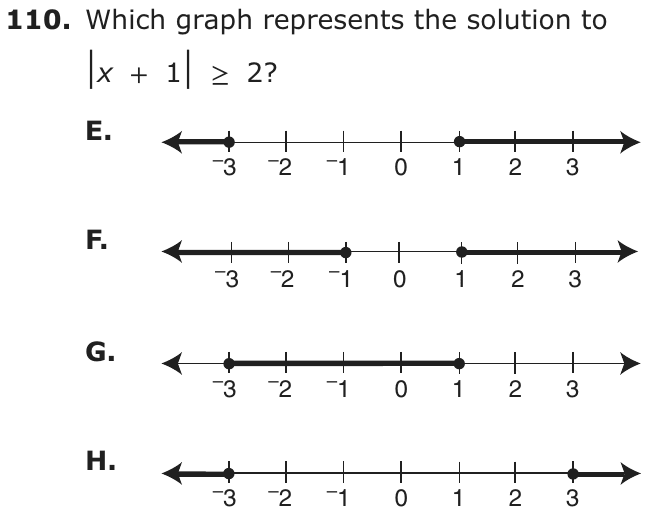
Question 81 of 120
2023 Test A Math, question 1Question
Ms. Li opened a retirement account with a deposit of $2,500. This account earns 4% simple interest annually. How many years will it take her to earn $500 on her $2,500 deposit?
Grid-in question: work out the answer and enter it as a number.
Show the answer
Correct answer: 5
Simple interest (y) is calculated by multiplying the initial deposit (p), the interest rate (r), and time (t):
Question analysis
Ms. Li deposits $2,500 in a retirement account that pays 4% simple interest each year, and this grid-in asks how many years it takes to earn $500 in interest. Students find one year's interest and work out how many years are needed. It turns the usual simple interest question around, asking for the time rather than the interest.
- Grade level
- Grade 7 content, by NYS standard
- Compared with grade 7
- At grade 7 Simple interest is a grade 7 percent application, usually asked as how much interest builds up over a given time. This one gives the interest and asks for the time, a short reverse step with friendly numbers.
- Estimated difficulty
- Straightforward: two steps or one careful reading.
- Thinking it demands
- Depth of knowledge 2, skills and concepts · mainly apply
- What makes it hard
- Solution
- 2 steps
- Reading level
- Question and choices: about grade 6, 28 words.
- Students, last 30 days
- Not enough answers yet to show (it takes 10).
Why it is hard, traps and wrong answers (shows the answer)
Why it is hard
Once one year's interest is known, $100, the rest is counting how many years make $500, so the arithmetic is light. The question turns the usual simple interest problem around, giving the interest and asking for the time, and that reversal is where students stall or grid a percent instead of a number of years. Writing 4% as 0.04, not 0.4, keeps the yearly interest from coming out ten times too big.
Something you must already know minor Working it out
The stem says 4% simple interest annually but never says that each year adds the same 4% of the $2,500 deposit, $100, so the yearly amount has to come from memory. (Anderson & Krathwohl, 2001)
Turning words into math minor Understanding the question
The question gives the interest, $500, and asks for the time, so the familiar formula runs backward: 2,500 × 0.04 × t = 500 has to be solved for t. (Hegarty, Mayer & Monk, 1995; Koedinger & Nathan, 2004)
An answer in an unexpected form minor Choosing the answer
As a grid-in it shows no choices, so 20, the interest as a percent of the deposit, can be gridded with nothing on the page to say it is not a number of years. (Enright, Morley & Sheehan, 2002)
Strategy: Work out one year's interest as 4% of $2,500, then find how many of those yearly amounts add up to the $500 of interest.
Traps
- Stops one step early: A choice is a number from partway through the solution.
- A formula you must know: Needs a formula the test does not give: area, circumference, volume, probability rules.
The wrong answers, classified
20 Stops one step early (King et al., 2004; Gierl et al., 2017)
Finds that the $500 of interest is 20% of the $2,500 deposit and grids 20, stopping before dividing by the 4% earned each year.
0.5 An arithmetic slip (Junker & Sijtsma, 2001)
Writes 4% as 0.4 instead of 0.04, so one year's interest looks like $1,000 and the $500 seems to take only half a year.
125 Numbers taken from the question (Hegarty, Mayer & Monk, 1995)
Divides the $500 of interest by the 4 in 4%, combining two numbers from the stem without first finding 4% of the deposit.
Worked solution, step by step
Formulas used
- Simple interest
- I is the interest, the extra money the account pays you. P is the deposit, the money you put in. r is the yearly rate as a decimal. t is the time in years. Simple means each year’s interest is figured on the deposit only, so every year adds the same amount.
- Percent to decimal
- p is the percent. Percent means out of 100. So divide by 100 to write it as a decimal. For example, 4% is 4 ÷ 100, which is 0.04.
Sort out the question
Ms. Li puts $2,500 into an account. This first amount is called the deposit. Each year the account pays 4% simple interest. Interest is extra money the bank pays you for keeping your money there. You need the number of years it takes to earn $500 of interest. The answer is a number of years, not dollars and not a percent.
Find one year’s interest
First write 4% as a decimal. 4% means 4 out of 100.
Now use the formula for 1 year, so t = 1.
The account earns $100 each year. Watch out: 4% is 0.04, not 0.4. Using 0.4 makes one year’s interest $1,000, and you would grid 0.5 years.
Find how many years make $500
Simple interest adds the same $100 every year. So the time t must make the interest $500.
It takes 5 years. Watch out: $500 is 20% of $2,500. But 20 is a percent, not a number of years. Don’t grid 20. So you would grid 5.
Check your answer
Count up one year at a time: $100, $200, $300, $400, $500. That is 5 years. Or put t = 5 back into the formula: . That matches the $500 in the question.
More questions like this
The original DOE question
Question 82 of 120
2023 Test A Math, question 4Question
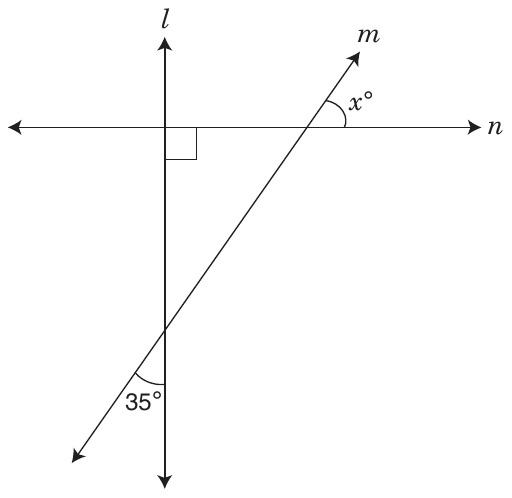
In the figure above, line l is perpendicular to line n. What is the value of x?
Grid-in question: work out the answer and enter it as a number.
Show the answer
Correct answer: 55
Since vertical angles are congruent, the right triangle in the figure has acute angles with measures of 35° and x°. The interior angles of a triangle sum to 180°, so set up an equation to solve for x:
Question analysis
Three lines cross in a figure: line l is perpendicular to line n, and a slanted line m meets them at a marked 35° angle and an unknown angle x. This geometry grid-in asks for the value of x. Students must see the right triangle the lines form and carry the marked angles into it using vertical angles.
- NYS standards
- Grade level
- Grade 8 content, by NYS standard
- Compared with grade 7
- Above grade 7 Grade 7 angle problems use vertical, supplementary and complementary angles. This one also needs the angle sum of a triangle, which New York places in grade 8, and the triangle is not drawn as a separate shape, so students must spot it.
- Estimated difficulty
- Moderate: several steps, or a close reading with one strong distractor.
- Thinking it demands
- Depth of knowledge 2, skills and concepts · mainly apply
- What makes it hard
- Reading a figure, table or graph moderate
- Something you must already know moderate
- An answer in an unexpected form minor
- Solution
- 3 steps
- Reading level
- Question and choices: about grade 4, 17 words.
- Students, last 30 days
- Not enough answers yet to show (it takes 10).
Why it is hard, traps and wrong answers (shows the answer)
Why it is hard
The figure hides a small right triangle between the three lines, and the question is easy once students see it. Its angles are the right angle, the vertical partner of the 35° angle and the vertical partner of x, so x is what the right angle and 35° leave of 180°. Students who never spot the triangle tend to guess a direct relationship between the two marked angles, which no angle fact supports.
Reading a figure, table or graph moderate Understanding the question
Neither marked angle is inside the right triangle that lines l, m and n form: the 35° opens below the point where m crosses l, and x opens above line n, so each must be carried in as a vertical angle. (Lesh, Post & Behr, 1987; Kirsch & Mosenthal, 1990)
Something you must already know moderate Working it out
The stem states only that l is perpendicular to n; students must supply that vertical angles are equal and that the three angles of a triangle add to 180°. (Anderson & Krathwohl, 2001)
An answer in an unexpected form minor Choosing the answer
As a grid-in it offers no choices, so 125, the right angle plus the 35° angle, can be gridded with nothing to signal the missing subtraction. (Enright, Morley & Sheehan, 2002)
Strategy: Find the triangle formed by the three lines, use vertical angles to move the 35° and x° angles inside it, and apply the triangle's angle sum with the right angle.
Traps
- Stops one step early: A choice is a number from partway through the solution.
- A formula you must know: Needs a formula the test does not give: area, circumference, volume, probability rules.
The wrong answers, classified
125 Stops one step early (King et al., 2004; Gierl et al., 2017)
Adds the right angle and the 35° angle, 90 + 35 = 125, and grids that sum without subtracting it from the triangle's 180°.
35 Misunderstands the concept (Smith, diSessa & Roschelle, 1993; De Bock et al., 1998; Ni & Zhou, 2005)
Assumes line m crosses l and n at equal angles, as it would cross two parallel lines, though l and n are perpendicular.
Worked solution, step by step
Formulas used
- Vertical angles
- When two lines cross, they make an X. The angles straight across from each other in the X are called vertical angles. a and b are one such pair. They are always equal, because each one plus the angle between them makes a straight line.
- Angles of a triangle
- A, B and C are the three angles inside any triangle, in degrees. They always add up to 180°. Use it when you know two of the angles and need the third.
Sort out the figure
Line l is perpendicular to line n. Perpendicular means they meet at a right angle, 90°. The small square in the figure marks it. Line m crosses both lines. The three lines make a triangle with a right angle. You need x, the angle marked x° where m crosses n.
Move the 35° angle into the triangle
The 35° angle is below the point where m crosses l. So it is outside the triangle. Lines l and m make an X there. The triangle’s angle is straight across from the 35° angle. They are vertical angles, so they are equal. The triangle’s angle at that corner is 35°.
Move the x° angle into the triangle
The x° angle is above line n, so it is outside the triangle too. Lines m and n make another X. The triangle’s angle at that crossing is straight across from x°. So the third angle of the triangle is also x°. Watch out: line m does not cross l and n at the same angle. Lines l and n are not parallel, so x is not 35.
Use the triangle’s angle sum
The triangle’s three angles are 90°, 35° and x°.
Watch out: 125 is only the two known angles added together. You still subtract it from 180. Gridding 125 is wrong. So you would grid 55.
Check your answer
In a right triangle, the two smaller angles add up to 90°. That is because the right angle uses 90° of the 180°. Check: . Also, in the figure the x° angle looks a bit bigger than the 35° angle, and 55 is.
More questions like this
The original DOE question
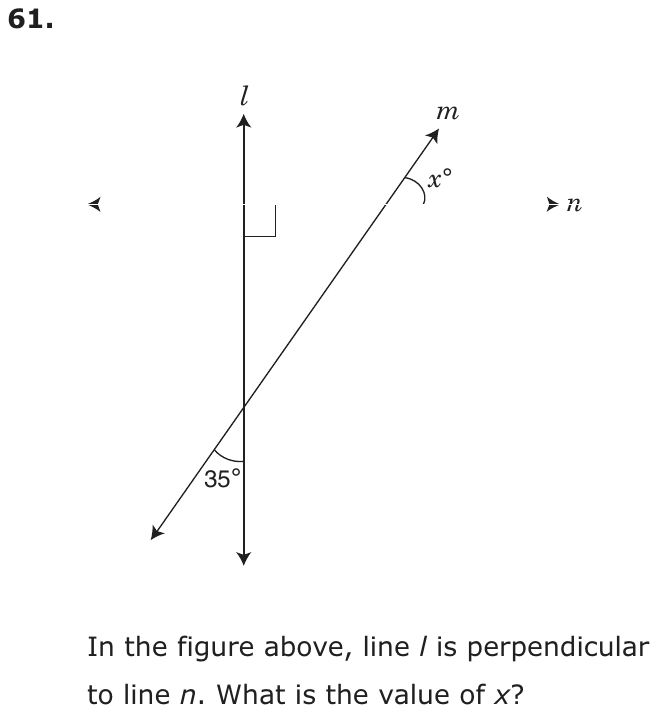
Question 83 of 120
2023 Test A Math, question 6Question
- A40
- B370
- C2,482
- D10,000
Show the answer
Correct answer: C
Question analysis
This exponents question asks for the sum of 3 to the fourth power and 7 to the fourth power. Students evaluate each power separately and then add. The traps are treating an exponent as a multiplier and adding the bases before raising them to a power, and the larger power takes careful multiplication.
- NYS standards
- 6.EE.1 whole-number exponent expressions
- Grade level
- Grade 6 content, by NYS standard
- Compared with grade 7
- Below grade 7 Evaluating whole-number powers is grade 6 work, and this question asks only for two of them and a sum. The one demand beyond routine practice is computing a fourth power of 7 accurately without a calculator.
- Estimated difficulty
- Straightforward: two steps or one careful reading.
- Thinking it demands
- Depth of knowledge 1, recall and reproduction · mainly apply
- What makes it hard
- Error-prone arithmetic moderate
- Something you must already know minor
- Solution
- 3 steps
- Reading level
- Question and choices: about grade 16+, 1 words.
- Students, last 30 days
- Not enough answers yet to show (it takes 10).
Why it is hard, traps and wrong answers (shows the answer)
Why it is hard
The sum is short, but it tests exactly what an exponent means and when to apply it. The wrong choices come from three misreadings of the notation: treating the power as a multiplier, using one factor too few, and adding the bases before raising them. A size check settles it: 7⁴ alone is 49 × 49, a little under 2,500, so 40 and 370 are far too small and 10,000 far too large.
Error-prone arithmetic moderate Working it out
7⁴ means 7 × 7 × 7 × 7 = 2,401, a four-digit product built by hand, most easily as 49 × 49; 3⁴ = 81 is quick by comparison. (Brown & Burton, 1978; Junker & Sijtsma, 2001)
Something you must already know minor Working it out
An exponent counts repeated factors rather than acting as a multiplier, so 3⁴ is 3 × 3 × 3 × 3 = 81, not 3 × 4 = 12; the item assumes that meaning. (Anderson & Krathwohl, 2001)
Strategy: Compute each power on its own, squaring and then squaring again, and add the two results only at the end.
Traps
- A faulty procedure: A systematic but wrong procedure: adding fractions straight across, applying an exponent to each term of a sum, dropping a sign when moving a term.
- Order of operations: Working left to right, or distributing a minus sign wrongly, gives a choice.
The wrong answers, classified
A A faulty procedure (Brown & Burton, 1978; Tatsuoka, 1983)
Multiplies each base by its exponent, 3 × 4 + 7 × 4 = 12 + 28 = 40, instead of using each base as a factor four times.
B A faulty procedure (Brown & Burton, 1978; Tatsuoka, 1983)
Uses each base as a factor three times instead of four, 27 + 343 = 370, so both powers stop one factor short.
D Order of operations (Brown & Burton, 1978)
Adds the bases before applying the exponent, treating 3⁴ + 7⁴ as (3 + 7)⁴ = 10,000, though powers come before addition.
Worked solution, step by step
Formulas used
- A power
- a is the base, the number being multiplied. The small 4 is the exponent. It tells how many times the base is used as a factor, a number being multiplied. So the exponent counts factors. It does not mean multiply by 4.
- Powers come before adding
- a and b are any two positive numbers. The sign ≠ means is not equal to. Powers come before adding. So raise each number to its power first, then add. Adding the bases first gives a much bigger number.
Sort out the question
You need the value of . Each number has a small 4 above it. This 4 is an exponent. Work out each power on its own. Then add the two results.
Find 3 to the fourth power
3⁴ means four 3s multiplied together. Pair them up to make it easier.
Watch out: 3⁴ is not 3 × 4 = 12. Doing that to both powers gives 12 + 28 = 40, choice A.
Find 7 to the fourth power
7⁴ means four 7s multiplied together. Pair them up the same way.
To find 49 × 49, do 49 × 50 = 2,450. Then take away one 49. That gives 2,401. Watch out: count four 7s, not three. Three 7s make 343. Using three factors in both powers gives 370, choice B.
Add the two powers
Watch out: don’t add 3 and 7 first. That gives , choice D. Powers come before adding. So the answer is C, 2,482.
Check your answer
Estimate. 7⁴ is 49 × 49, a little less than 50 × 50 = 2,500. Adding 81 keeps it near 2,500. Only 2,482 is close. 40 and 370 are far too small, and 10,000 is far too big.
More questions like this
The original DOE question
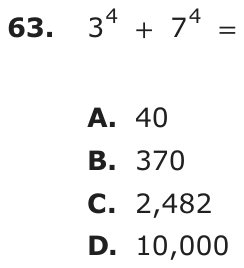
Question 84 of 120
2023 Test A Math, question 9Question
A revolving sign makes 1 complete revolution every 90 minutes. If the sign starts moving at 2:30 p.m., at what time will the sign complete 8 revolutions?
- A1:00 a.m.
- B2:30 a.m.
- C4:00 p.m.
- D12:00 midnight
Show the answer
Correct answer: B
First, use a proportion to find out how many minutes it will take the sign to complete 8 revolutions. Let x equal the total number of minutes:
Next, convert 720 minutes into hours and minutes:
Finally, 12 hours after 2:30 p.m. is 2:30 a.m.
Question analysis
A revolving sign turns once every 90 minutes and starts at 2:30 in the afternoon. Students find the clock time when it finishes 8 full revolutions. The question combines a rate with converting minutes to hours, and then adding the elapsed time to the starting time on a 12-hour clock.
- Grade level
- Grade 6 content, by NYS standard
- Compared with grade 7
- Below grade 7 A constant rate, a multiplication and a conversion from minutes to hours are grade 6 skills. The only step beyond routine work is adding the elapsed time to a starting clock time.
- Estimated difficulty
- Straightforward: two steps or one careful reading.
- Thinking it demands
- Depth of knowledge 2, skills and concepts · mainly apply
- What makes it hard
- Many steps minor
- Something you must already know minor
- Solution
- 3 steps
- Reading level
- Question and choices: about grade 4, 31 words.
- Students, last 30 days
- Not enough answers yet to show (it takes 10).
Why it is hard, traps and wrong answers (shows the answer)
Why it is hard
Each step is routine, so most points are lost in keeping elapsed time and clock time apart. The 12 hours is a duration, and the clock reading that ends it is 12 hours after 2:30 in the afternoon, not 12:00. A sense check helps: 12 hours after any time shows the same digits on the clock with a.m. and p.m. swapped.
Many steps minor Working it out
Three moves: 8 × 90 = 720 minutes, 720 ÷ 60 = 12 hours, then 12 hours counted on from the 2:30 start, which crosses midnight into the morning. (Daniel & Embretson, 2010; Enright, Morley & Sheehan, 2002)
Something you must already know minor Working it out
Counting hours past midnight means switching from p.m. to a.m. on a 12-hour clock, which the stem leaves to the student; the choices mix both halves of the day. (Anderson & Krathwohl, 2001)
Strategy: Multiply 90 minutes by 8 to get the total time, change it to hours, and then count that many hours forward from 2:30 p.m.
Traps
- Stops one step early: A choice is a number from partway through the solution.
- Counting the ends: Inclusive or exclusive ends, fence posts, consecutive numbers: an answer that is one too many or too few, or an endpoint drawn open where it belongs closed (or the reverse).
- Numbers taken from the question: Combines the numbers in the question without a model of the situation, or is simply a number that appears in the question.
The wrong answers, classified
A Counting the ends (Brown & Burton, 1978)
Counts only 7 revolutions, 630 minutes or 10½ hours, as if the first turn were already done at the start, and lands at 1:00 a.m.
C Numbers taken from the question (Hegarty, Mayer & Monk, 1995)
Adds a single revolution's 90 minutes to the 2:30 start, giving 4:00 in the afternoon, without multiplying by the 8 revolutions.
D Stops one step early (King et al., 2004; Gierl et al., 2017)
Finds that 8 revolutions take 12 hours and picks 12:00 midnight, reading the elapsed time as a clock time instead of counting on from 2:30.
Worked solution, step by step
Formulas used
- Total time
- Time for one is how long one revolution takes. How many is the number of revolutions. Each one takes the same time, so multiply to get the total time.
- Minutes to hours
- There are 60 minutes in 1 hour. So to change minutes to hours, divide by 60. Each group of 60 minutes makes 1 hour.
Sort out the question
The sign turns all the way around once every 90 minutes. One full turn is called a revolution. The sign starts at 2:30 p.m. You need the clock time when it finishes 8 revolutions.
Find the total time in minutes
Each revolution takes 90 minutes, and there are 8 of them.
The 8 revolutions take 720 minutes. Watch out: use all 8 revolutions. Counting only 7 gives 630 minutes and 1:00 a.m., choice A. Adding just one 90 minutes gives 4:00 p.m., choice C.
Change the minutes to hours
Clock times are easier to count in hours. There are 60 minutes in an hour.
The sign turns for 12 hours.
Count forward from 2:30 p.m.
Start at 2:30 p.m. and add 12 hours. When you pass midnight, p.m. changes to a.m. So 12 hours after 2:30 p.m. is 2:30 a.m. the next morning. Watch out: 12 hours is an amount of time, not a clock time. Reading it as 12:00 midnight gives choice D. So the answer is B, 2:30 a.m.
Check your answer
From 2:30 p.m. to 2:30 a.m. is one full trip around the clock, 12 hours. 12 hours is minutes. And , the number of revolutions in the question.
More questions like this
The original DOE question
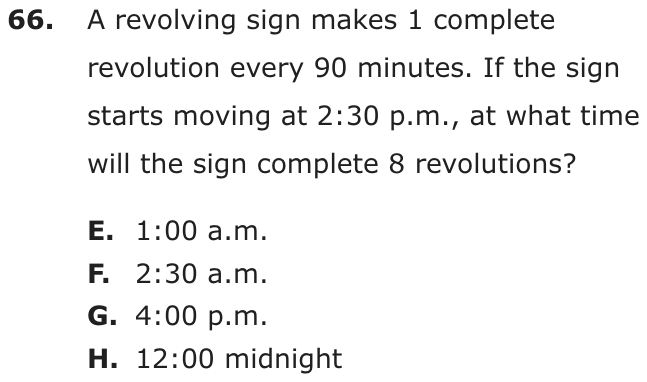
Question 85 of 120
2023 Test A Math, question 12Question
If n is an integer and is an even number, which expression must also represent an even number?
- A
- B
- C
- D
Show the answer
Correct answer: A
The expression is equal to , and it is given that this is an even number. The expression must also represent an even number, because 3 is an odd number: if were odd, would be the product of two odd numbers, which is an odd number. If is an even number, then n must be an odd number. Choose an odd number to substitute for n in the answer options to find which expression represents an even number:
Let .
Option A:
Option B:
Option C:
Option D:
Since 16 is the only even number, the correct answer is option A.
Question analysis
This number properties question says that 3n + 3 is even for an integer n and asks which of four expressions must also be even. Students reason about odd and even numbers written with a variable. The hidden step is deciding what the given fact says about n itself before testing the expressions.
- Grade level
- Grade 7 content, by NYS standard
- Compared with grade 7
- Above grade 7 Grade 7 students rewrite and evaluate expressions, but rarely reason about whether an expression is odd or even for every value of a variable. Here that reasoning comes in two layers: first about n, then about each choice.
- Estimated difficulty
- Moderate: several steps, or a close reading with one strong distractor.
- Thinking it demands
- Depth of knowledge 2, skills and concepts · mainly analyze
- What makes it hard
- Solution
- 3 steps
- Reading level
- Question and choices: about grade 9, 23 words.
- Corrected from the DOE handbook
- The explanation gave the wrong reason why n + 1 must be even; the reason was corrected.
- Students, last 30 days
- Not enough answers yet to show (it takes 10).
Why it is hard, traps and wrong answers (shows the answer)
Why it is hard
The question hides its key step: 3n + 3 = 3(n + 1), and since 3 is odd, n + 1 must be even, so n is odd. A student who skips that step and tests a convenient even value never checks the condition and lands on a wrong expression. Once n is known to be odd, any odd test value, such as 1, picks out 5n + 1 at once.
Variables instead of numbers moderate Understanding the question
No value of n is given; the only fact is that 3n + 3 is even, and it has to be turned into a fact about n itself, that n is odd, before any choice is judged. (Koedinger & Nathan, 2004; Enright, Morley & Sheehan, 2002)
Something you must already know minor Working it out
The parity rules are assumed, not stated: an odd number times an odd number is odd, and an even number plus an odd number is odd. (Anderson & Krathwohl, 2001)
Every choice must be checked minor Choosing the answer
Each expression has to be tested with an odd n or by parity rules; three of the four come out odd whenever n is odd, so none can be dismissed on sight. (Embretson & Wetzel, 1987)
Strategy: First work out what 3n + 3 being even says about n, by factoring out 3 or testing small integers, then check each expression with a value of n that fits.
Traps
- Misreads the question: Misses or misreads a condition or a word in the question: "at least", "each", "remaining", "not".
- Misunderstands the concept: A wrong belief about a concept: that percents can be added, that area grows like length, that averages can be averaged, that a bigger denominator means a bigger fraction.
The wrong answers, classified
B Misunderstands the concept (Smith, diSessa & Roschelle, 1993; De Bock et al., 1998; Ni & Zhou, 2005)
Sees the even term 4n and treats the whole expression as even, overlooking that adding the odd 5 makes 4n + 5 odd for every integer n.
C Misunderstands the concept (Smith, diSessa & Roschelle, 1993; De Bock et al., 1998; Ni & Zhou, 2005)
Assumes an expression that starts with 2n must be even, though 2n + 3 is an even number plus 3 and so is always odd.
D Misreads the question (Hegarty, Mayer & Monk, 1995)
Tests n = 2 without checking the condition, though 3(2) + 3 = 9 is odd; with n = 2, only n + 2 = 4 comes out even.
What was corrected from the DOE handbook, and why
- Explanation: The DOE’s explanation said that n + 1 must be even “because 3 is an odd number and the product of an odd number and an even number is an even number.” That fact does not show that n + 1 is even; the reason is that if n + 1 were odd, 3(n + 1) would be the product of two odd numbers, which is odd, and it is given as even. The site now gives that reason. The answer, A, is unchanged.
Worked solution, step by step
Formulas used
- Pulling out a common factor
- a is a factor, a number being multiplied, that both terms share. b and c are what is left. This is the distributive property run backward. It turns a sum into a product, which is easier to reason about.
- Multiplying odd numbers
- An even number splits into pairs, like 2, 4 or 6. An odd number has one left over, like 1, 3 or 5. An odd number of odd groups always leaves one extra. So the product is odd.
- Adding odd and even numbers
- Two odd numbers each have one left over. Together the two extras make a pair, so the sum is even. An even number plus an odd number still has one left over, so the sum is odd.
Sort out the question
n is an integer, a whole number that can be positive, negative or 0. You are told that is even. You need the expression that must be even too. Must means it is even every time. First find out what the fact tells you about n.
Pull out the 3
Both terms in have a factor of 3. Pull it out.
So 3 times is an even number.
Decide whether n is odd or even
3 is odd. If were odd, would be odd times odd. That is always odd. But we are told it is even. So must be even. One less than an even number is odd. So n is odd. Watch out: don’t test n = 2. Then , which is odd. With n = 2, only comes out even, choice D.
Test each choice with an odd n
Pick an odd number, n = 3. It fits, since is even.
- A: , even
- B: , odd
- C: , odd
- D: , odd
Only A is even.
Make sure A always works
Must means every odd n, not just 3. If n is odd, 5n is odd times odd, so it is odd. Odd plus 1 is even. So is always even. Watch out: 4n is even, but adding the odd 5 makes odd, choice B. In the same way, is always odd, choice C. So the answer is A, .
Check your answer
Try another odd number, n = 1. Then , which is even, so n = 1 fits. And is even too. The other three choices give 9, 5 and 3, all odd. Choice A wins again.
More questions like this
The original DOE question
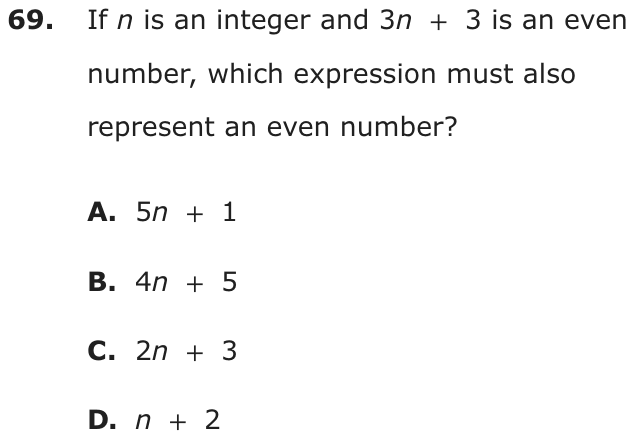
Question 86 of 120
2023 Test A Math, question 13Question
The product of two positive integers is 65. Which number could be the sum of the two integers?
- A5
- B18
- C24
- D52
Show the answer
Correct answer: B
First, find the pairs of positive integers that multiply to 65: and .
The sums of the pairs are 66 and 18. 18 is the option that is provided in the answer choices.
Question analysis
Two positive integers multiply to 65, and this question asks which number in the choices could be their sum. Students list the factor pairs of 65 and add each pair. The words could be signal that more than one pair exists, and only one of the sums appears among the choices.
- NYS standards
- 6.NS.4 common factors and multiples
- Grade level
- Grade 6 content, by NYS standard
- Compared with grade 7
- Below grade 7 Finding factor pairs of a two-digit number is review by grade 7. The question takes two quick steps, listing the pairs and adding each, with nothing to compute beyond small products and sums.
- Estimated difficulty
- Routine: one familiar step, little to misread.
- Thinking it demands
- Depth of knowledge 1, recall and reproduction · mainly apply
- What makes it hard
- Solution
- 2 steps
- Reading level
- Question and choices: about grade 5, 17 words.
- Students, last 30 days
- Not enough answers yet to show (it takes 10).
Why it is hard, traps and wrong answers (shows the answer)
Why it is hard
With only two factor pairs, 1 × 65 and 5 × 13, the work is a short list and two additions. The word could matters: the sum depends on which pair is chosen, and only one of the two sums appears among the choices. The main slip is answering with a factor rather than with the sum the question asks for.
Something you must already know minor Working it out
The pairs come from factoring 65 as 5 × 13, a fact the stem leaves to the student; the pair 1 and 65 also counts, but its sum, 66, is not offered. (Anderson & Krathwohl, 2001)
Strategy: List every pair of positive integers whose product is 65, starting from 1, and add the two numbers in each pair.
Traps
- Answers a different question: A choice is right for another quantity: the other unknown, the rest instead of the part, the part instead of the whole.
The wrong answers, classified
A Answers a different question (King et al., 2004; Hegarty, Mayer & Monk, 1995)
Finds the factor pair 5 and 13 and answers with the factor 5, one of the two integers, instead of their sum.
C Little reason to choose it (Haladyna & Downing, 1993; Rodriguez, 2005)
No pair of positive integers with product 65 adds to 24; reaching it needs a wrong pair such as 3 and 21, whose product is 63, so it mostly catches guesses.
D Little reason to choose it (Haladyna & Downing, 1993; Rodriguez, 2005)
No factor pair of 65 adds to 52, which is 65 − 13 or 4 × 13, and no common working combines them that way, so it mostly draws guesses.
Worked solution, step by step
Formulas used
- Factor pair
- a and b are positive whole numbers that multiply to make 65. Such a pair is called a factor pair of 65. To find them all, try 1, 2, 3 and so on. Stop when the factors start to repeat.
- Dividing by 5
- A whole number splits into groups of 5, with none left over, when its last digit is 0 or 5. So 65 divides by 5, but 64 does not.
Sort out the question
Two positive integers multiply to make 65. Positive integers are the counting numbers 1, 2, 3 and so on. The product is the answer to a multiplication. You need a number that could be their sum, the answer when you add them.
List the factor pairs of 65
Try each small number. See if it divides 65 with nothing left over.
- 1 works: .
- 2 and 4 don’t work, because 65 is odd. 3 doesn’t work either: , with 2 left over.
- 5 works, since 65 ends in 5: .
- 6 and 8 are even, so they don’t work. 7 doesn’t either: .
Since , any factor bigger than 8 pairs with one smaller than 8. You already tried those. So the pairs are 1 and 65, and 5 and 13.
Add each pair
The possible sums are 66 and 18. Only 18 is a choice. Watch out: the question asks for the sum, not one of the numbers. Picking the factor 5 is choice A. So the answer is B, 18.
Check your answer
Work back from 18. Look for two numbers that add to 18 and multiply to 65. and . Both match. For 24 or 52, no pair of whole numbers that multiplies to 65 adds up to them.
More questions like this
The original DOE question
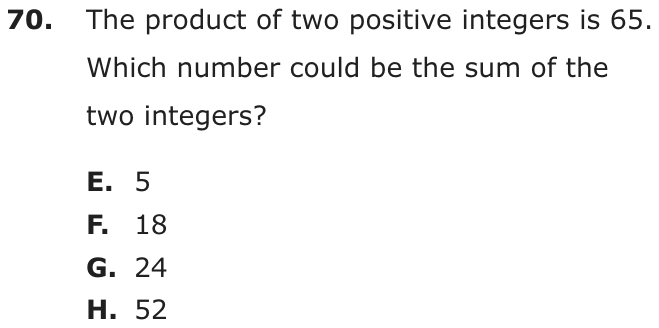
Question 87 of 120
2023 Test A Math, question 15Question
A swim instructor used the box plot below to display the distribution of the ages of students who signed up for swim lessons.
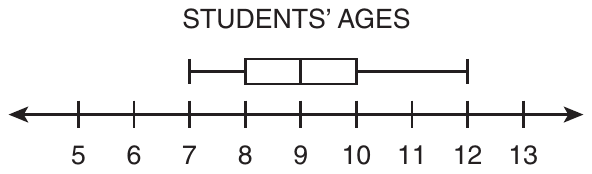
Which statement about the distribution of ages is true?
- AThe data contain an outlier.
- BApproximately half the students are exactly 9 years old.
- CApproximately one-fourth of the students are at least 10 years old.
- DThe interquartile range is 3 greater than the range of the data.
Show the answer
Correct answer: C
The data points in the box plot are as follows:
- minimum: 7
- first quartile: 8
- median: 9
- third quartile: 10
- maximum: 12
Since the value of the third quartile is 10, approximately one-fourth of the students are 10–12 years old.
Question analysis
A swim instructor's box plot shows the ages of students who signed up for lessons. Students decide which of four statements about the distribution is true, using the minimum, quartiles, median and maximum. The statements test different box plot ideas, including outliers, the median, the quartiles and the range, so each needs its own check.
- Grade level
- Grade 7 content, by NYS standard
- Compared with grade 7
- At grade 7 New York places box plots, the interquartile range and outliers in grade 7. Here four statements test those ideas one at a time; each check is short, so the item matches typical grade 7 work.
- Estimated difficulty
- Moderate: several steps, or a close reading with one strong distractor.
- Thinking it demands
- Depth of knowledge 2, skills and concepts · mainly understand
- What makes it hard
- Something you must already know moderate
- Every choice must be checked moderate
- Reading a figure, table or graph minor
- Solution
- 3 steps
- Reading level
- Question and choices: about grade 8, 66 words.
- Students, last 30 days
- Not enough answers yet to show (it takes 10).
Why it is hard, traps and wrong answers (shows the answer)
Why it is hard
Reading the five values off the plot is quick; the work is knowing what a box plot can and cannot say. It shows where quarters of the data begin and end, not how many students share any one age, and a long whisker is not an outlier unless it passes the 1.5 × IQR cutoff, here 13. The true statement uses the third quartile: about a quarter of the students are 10 or older.
Something you must already know moderate Working it out
The statements rely on box plot facts the question does not give: each section holds about a quarter of the data, the middle line is the median, and outliers lie beyond 1.5 IQRs. (Anderson & Krathwohl, 2001)
Every choice must be checked moderate Choosing the answer
Four statements test four separate ideas, an outlier, the share at one age, a quarter of the data and two spreads, so ruling one out says nothing about the rest. (Embretson & Wetzel, 1987)
Reading a figure, table or graph minor Understanding the question
The five values, 7, 8, 9, 10 and 12, are read off a 5-to-13 scale, where the longer right whisker draws the eye more than the box does. (Lesh, Post & Behr, 1987; Kirsch & Mosenthal, 1990)
Strategy: Read the five key values off the plot, then test each statement: compute the range, the interquartile range and the outlier cutoffs, and recall what share of the data each part holds.
Traps
- Misunderstands the concept: A wrong belief about a concept: that percents can be added, that area grows like length, that averages can be averaged, that a bigger denominator means a bigger fraction.
- Wrong formula: Uses a related but wrong formula: perimeter for area, diameter for radius, area for volume, or a misremembered one.
The wrong answers, classified
A Misunderstands the concept (Smith, diSessa & Roschelle, 1993; De Bock et al., 1998; Ni & Zhou, 2005)
Takes the long right whisker, reaching 12, as a sign of an outlier, but 12 is below the cutoff 10 + 1.5 × 2 = 13.
B Misunderstands the concept (Smith, diSessa & Roschelle, 1993; De Bock et al., 1998; Ni & Zhou, 2005)
Reads the median line at 9 as the age of half the students, though a median only splits the ages into a lower and an upper half.
D Wrong formula (King et al., 2004)
Swaps the two measures, taking the box's 2 years as the range and the whiskers' 5 years as the interquartile range, so the IQR seems 3 greater.
Worked solution, step by step
Formulas used
- Range
- The maximum is the largest value, the right end of a box plot. The minimum is the smallest, the left end. The range is how far apart they are. It shows how spread out all the data are.
- Interquartile range
- IQR is short for interquartile range. Q1, the first quartile, is the left edge of the box. Q3, the third quartile, is the right edge. The IQR is the width of the box. It is the spread of the middle half of the data. The four parts of a box plot each hold about one-fourth of the data.
- Outlier test
- An outlier is a value far from the rest of the data. A common rule says a value is an outlier if it lies more than 1.5 IQRs below Q1 or above Q3.
Read the five values off the plot
A box plot shows five numbers. The median is the middle value when the ages are in order.
Part Age Minimum, the left whisker’s end 7 First quartile, Q1, the box’s left edge 8 Median, the line in the box 9 Third quartile, Q3, the box’s right edge 10 Maximum, the right whisker’s end 12 Check choice A, an outlier
An outlier would be above 13 or below 5. The ages only run from 7 to 12. So there is no outlier. Watch out: a long whisker is not an outlier. It just means the top ages are spread out. Choice A is false.
Check choice B, the median
The median, 9, is the middle age. About half the students are 9 or younger. About half are 9 or older. It does not tell how many are exactly 9. Watch out: the median line does not mean half the students are 9. Choice B is false.
Check choice C, the top fourth
The box plot splits the students into four groups of about the same size. Each group holds about one-fourth of them. The last group runs from Q3, 10, to the maximum, 12. At least 10 means 10 or more. So about one-fourth of the students are at least 10 years old. Choice C is true.
Check choice D, the two spreads
The IQR is 3 less than the range, not 3 greater. The box always fits inside the whiskers, so the IQR can never be bigger. Watch out: swapping the two measures gives choice D. So the answer is C: about one-fourth of the students are at least 10 years old.
Check your answer
Picture 20 students. About 5 would be in each fourth of the plot. The top 5 would be ages 10 to 12. That is about one-fourth, just as choice C says. Each other choice fails a fact you can read straight off the plot.
More questions like this
The original DOE question
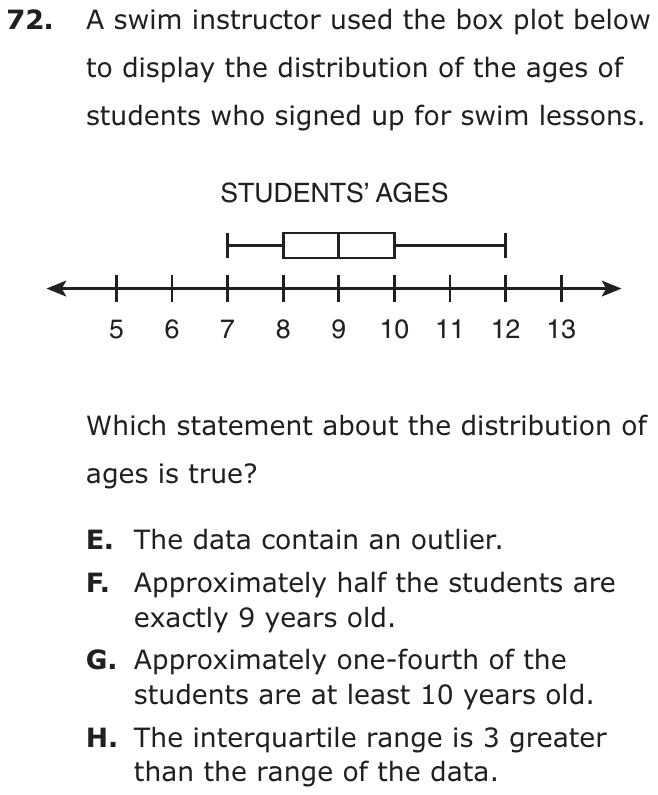
Question 88 of 120
2023 Test A Math, question 23Question
If a person chooses a number at random from the set above, what is the probability that the number is less than 0.005?
- A
- B
- C
- D
Show the answer
Correct answer: C
Three of the five numbers listed (0.001, 0.0001, and 0.00001) are less than 0.005. So, the probability of a person selecting a number less than 0.005 is .
Question analysis
A set holds five decimals, from one tenth down to one hundred-thousandth, and one number is chosen at random. Students find the probability that the number is less than 0.005. Comparing decimals with many zeros is the real task here, along with putting the count over the right total.
- Grade level
- Grade 6 content, by NYS standard
- Compared with grade 7
- Below grade 7 Probability with equally likely outcomes is grade 6 content in New York, and this needs one comparison per number and one fraction. The only real demand is comparing decimals with many zeros correctly.
- Estimated difficulty
- Straightforward: two steps or one careful reading.
- Thinking it demands
- Depth of knowledge 2, skills and concepts · mainly apply
- What makes it hard
- Error-prone arithmetic moderate
- Something you must already know minor
- Solution
- 2 steps
- Reading level
- Question and choices: about grade 6, 27 words.
- Students, last 30 days
- Not enough answers yet to show (it takes 10).
Why it is hard, traps and wrong answers (shows the answer)
Why it is hard
Each number in the set is a tenth of the one before, so only the three smallest fall below 0.005, which lies between 0.01 and 0.001. Students lose the point either by counting the numbers above 0.005 instead of below it or by writing the count over the wrong total. Lining the decimals up with the same number of places makes every comparison easy.
Error-prone arithmetic moderate Working it out
0.005 has to be compared with decimals from 0.1 down to 0.00001; written to five places, 0.00500 against 0.01000 and 0.00100, the order becomes a comparison of whole numbers. (Brown & Burton, 1978; Junker & Sijtsma, 2001)
Something you must already know minor Working it out
The probability is the count of numbers below 0.005 over all 5 numbers in the set; the stem leaves that part-to-whole rule to the student. (Anderson & Krathwohl, 2001)
Strategy: Write each number with five decimal places, compare it with 0.00500, count those that are smaller, and divide by the five numbers in the set.
Traps
- Answers a different question: A choice is right for another quantity: the other unknown, the rest instead of the part, the part instead of the whole.
- Misunderstands the concept: A wrong belief about a concept: that percents can be added, that area grows like length, that averages can be averaged, that a bigger denominator means a bigger fraction.
The wrong answers, classified
A Answers a different question (King et al., 2004; Hegarty, Mayer & Monk, 1995)
Gives 1/5, the chance of picking any one particular number from the set, without counting how many of the five are below 0.005.
B Answers a different question (King et al., 2004; Hegarty, Mayer & Monk, 1995)
Counts the 2 numbers greater than 0.005, 0.1 and 0.01, instead of those less than it, finding the chance of the opposite event.
D Misunderstands the concept (Smith, diSessa & Roschelle, 1993; De Bock et al., 1998; Ni & Zhou, 2005)
Writes a part-to-part ratio, the 2 numbers above 0.005 over the 3 below it, instead of dividing by all 5 numbers in the set.
Worked solution, step by step
Formulas used
- Probability
- P is the probability, the chance that something happens. Possible results are all the results that are equally likely. Wanted results are the ones you are looking for. The chance is the fraction of all the results that you want.
- Adding zeros to a decimal
- Zeros added to the right end of a decimal don’t change its value. One tenth is the same as ten hundredths. Giving every number the same number of decimal places lets you compare them like whole numbers.
Sort out the question
The set has five numbers. A person picks one at random, so each number has the same chance. You need the probability, or chance, that the number picked is less than 0.005.
Give every number five decimal places
Decimals are easier to compare with the same number of places. Add zeros to the end of each.
Number With five places 0.1 0.10000 0.01 0.01000 0.001 0.00100 0.0001 0.00010 0.00001 0.00001 0.005 0.00500 Count the numbers below 0.005
Compare each number with 0.00500 like whole numbers: 10000, 1000, 100, 10 and 1 against 500. Two numbers are bigger: 0.1 and 0.01. Three are smaller: 0.001, 0.0001 and 0.00001. Watch out: 0.01 has fewer digits than 0.005, but it is bigger. Counting the 2 bigger numbers gives , choice B.
Write the probability
Watch out: divide by all 5 numbers in the set. Comparing the 2 bigger numbers with the 3 smaller ones gives , choice D. So the answer is C, .
Check your answer
The numbers below 0.005 and the numbers above it make up the whole set: 3 + 2 = 5. So the two chances, and , add up to 1, as they should.
More questions like this
The original DOE question
Question 89 of 120
2023 Test A Math, question 24Question
A student uses Spinner R and Spinner T to generate a list of two-digit numbers.
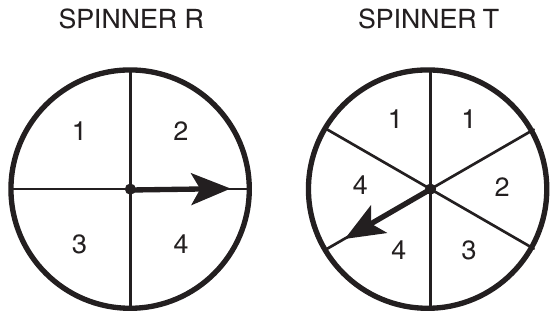
Spinner R determines the digit in the tens place, and Spinner T determines the digit in the ones place. What is the probability that the two-digit number determined by spinning each spinner one time is a prime number?
- A
- B
- C
- D
Show the answer
Correct answer: A
Spinner R has 4 equal sections and Spinner T has 6 equal sections, so the number of possible two-digit numbers that can be created is found by multiplying 4 and 6, which is 24. List the possible outcomes:
| 11 | 11 | 12 | 13 | 14 | 14 |
| 21 | 21 | 22 | 23 | 24 | 24 |
| 31 | 31 | 32 | 33 | 34 | 34 |
| 41 | 41 | 42 | 43 | 44 | 44 |
There are 9 prime numbers out of 24 possible outcomes: 11, 11, 13, 23, 31, 31, 41, 41, and 43.
So the probability that the two-digit number created is a prime number is , which is equivalent to .
Question analysis
Spinner R, with four equal sections, gives the tens digit and Spinner T, with six equal sections and some labels repeated, gives the ones digit of a two-digit number. Students find the probability that the number is prime. Building the full table of outcomes, counting repeated sections separately, and checking whether each number is prime all take care.
- NYS standards
- Grade level
- Grade 7 content, by NYS standard
- Compared with grade 7
- Above grade 7 Listing a sample space for two spinners is grade 7 work, usually with distinct labels and a simple event. Here one spinner repeats two numbers, the space has 24 outcomes, and each two-digit result must be tested for being prime.
- Estimated difficulty
- Hard: combines ideas, needs a plan, and has more than one tempting wrong answer.
- Thinking it demands
- Depth of knowledge 2, skills and concepts · mainly apply
- What makes it hard
- Reading a figure, table or graph moderate
- Much to keep track of moderate
- Something you must already know minor
- Solution
- 4 steps
- Reading level
- Question and choices: about grade 7, 57 words.
- Students, last 30 days
- Not enough answers yet to show (it takes 10).
Why it is hard, traps and wrong answers (shows the answer)
Why it is hard
The question combines a compound sample space with a test for primes, and its figure adds a twist: two labels repeat on Spinner T. Counting the 24 section pairs rather than the 16 different numbers is the careful route, though here both happen to give the same fraction. The points are lost in the prime test, where 33 is easy to count as prime, and in writing the count as a share of all 24 outcomes.
Reading a figure, table or graph moderate Understanding the question
Spinner T has six equal sections but only four labels, with 1 and 4 each appearing twice, so the 24 equally likely outcomes include repeats such as 11 and 11. (Lesh, Post & Behr, 1987; Kirsch & Mosenthal, 1990)
Much to keep track of moderate Working it out
Twenty-four two-digit numbers have to be built and each tested for primality while the repeated sections are kept track of; a 4-by-6 table is the reliable way to hold them. (Sweller, 1988; Carpenter, Just & Shell, 1990)
Something you must already know minor Working it out
Which two-digit numbers are prime is not given; students must test 21, 33, 43 and the rest themselves, and 21 = 3 × 7 and 33 = 3 × 11 look prime at a glance. (Anderson & Krathwohl, 2001)
Strategy: Make a 4-by-6 table with Spinner R's digits as tens and Spinner T's six sections as ones, mark each prime, and count every section, including repeated labels.
Traps
- An arithmetic slip: The right method with a plausible arithmetic error: a digit, a place value or a times-table fact.
- Misunderstands the concept: A wrong belief about a concept: that percents can be added, that area grows like length, that averages can be averaged, that a bigger denominator means a bigger fraction.
- Answers a different question: A choice is right for another quantity: the other unknown, the rest instead of the part, the part instead of the whole.
The wrong answers, classified
B An arithmetic slip (Junker & Sijtsma, 2001)
Counts 33 as prime, missing that 33 = 3 × 11, so 10 of the 24 outcomes look prime and 10/24 reduces to 5/12.
C Misunderstands the concept (Smith, diSessa & Roschelle, 1993; De Bock et al., 1998; Ni & Zhou, 2005)
Finds the 9 prime outcomes but compares them with the 15 that are not prime, a part-to-part ratio, 9/15 = 3/5, instead of dividing by all 24.
D Answers a different question (King et al., 2004; Hegarty, Mayer & Monk, 1995)
Counts the 15 outcomes that are not prime and gives 15/24 = 5/8, the probability of the opposite event.
Worked solution, step by step
Formulas used
- Counting outcomes
- a is the number of equal sections on the first spinner, and b is the number on the second. Each section of the first can go with each section of the second. So the number of pairs is a times b.
- Probability
- P is the probability, the chance that something happens. Possible results are all the results that are equally likely. Wanted results are the ones you are looking for. The chance is the fraction of all the results that you want.
Sort out the question
Spinner R gives the tens digit. Spinner T gives the ones digit. Together they make a two-digit number, like 23. You need the chance that the number is prime. A prime number has exactly two factors, 1 and itself. For example, 13 is prime, but 21 = 3 × 7 is not.
Count all the outcomes
Spinner R has 4 equal sections. Spinner T has 6 equal sections. Look closely: T has two 1s and two 4s. Each section counts as its own outcome.
There are 24 outcomes, all equally likely.
Make a table of the numbers
Each row is a tens digit from R. Each column is a section of T. Prime numbers are in bold.
R 1 1 2 3 4 4 1 11 11 12 13 14 14 2 21 21 22 23 24 24 3 31 31 32 33 34 34 4 41 41 42 43 44 44 Count the prime numbers
Numbers ending in 2 or 4 are even, so 2 divides them. They are not prime. Check the rest. 11, 13, 23, 31, 41 and 43 are prime. But 21 = 3 × 7 and 33 = 3 × 11 are not. Count every section, so 11, 31 and 41 each count twice. That makes 3 + 1 + 2 + 3 = 9 primes. Watch out: counting 33 as prime gives , choice B.
Find the probability
Watch out: divide by all 24 outcomes. Comparing the 9 primes with the 15 others gives , choice C. So the answer is A, .
Check your answer
There are numbers that are not prime. Their chance is . And , as it should be. Notice that , choice D, is the chance of not prime.
More questions like this
The original DOE question
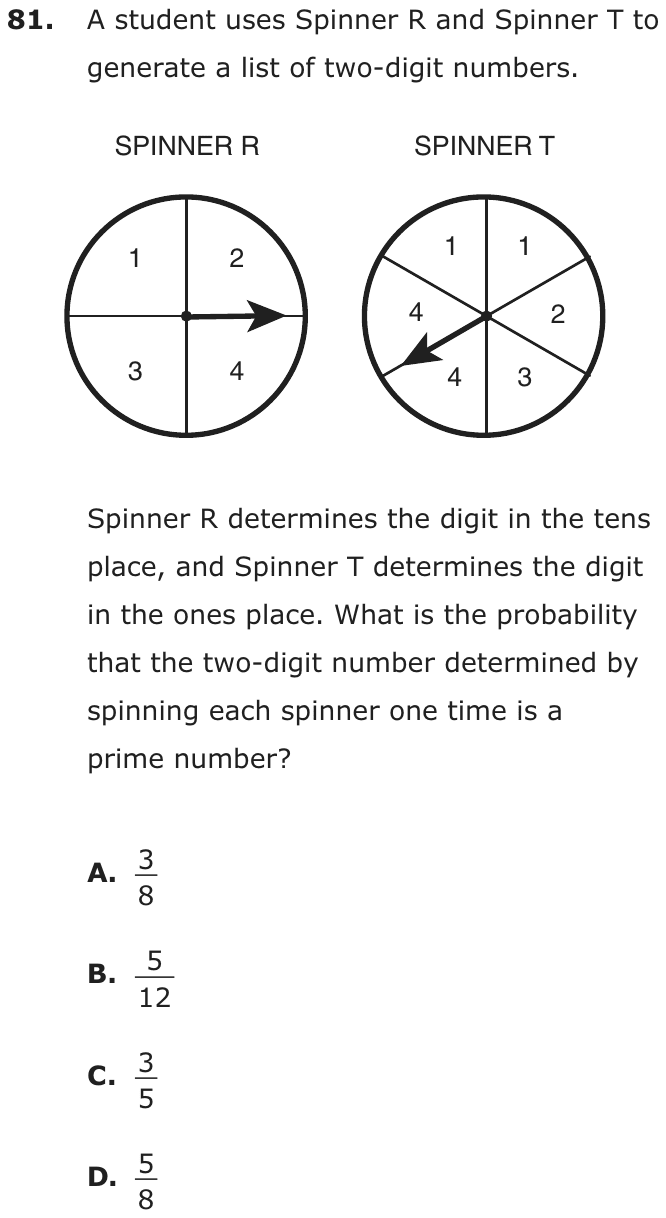
Question 90 of 120
2023 Test A Math, question 25Question
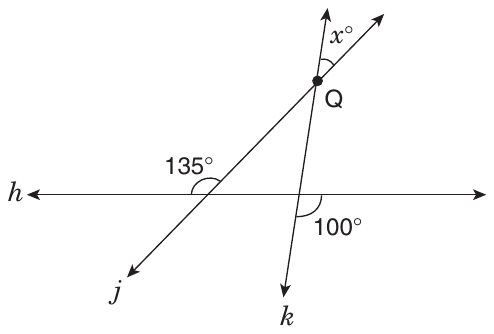
Lines j and k intersect at point Q, and h is a straight line. What is the value of x?
- A55
- B45
- C35
- D30
Show the answer
Correct answer: C
First, find the measures of the three angles inside the triangle. The lower left angle is supplementary to the one marked 135°, so the measure of that angle is . The angle on top is a vertical angle with the one marked x°, so the measure of that angle is also x°. The angle on the lower right is a vertical angle with the one marked 100°, so the measure of that angle is also 100°. Since the measures of the three interior angles of a triangle sum to 180°, set up an equation and solve for x:
Question analysis
Lines j and k cross at point Q above a straight line h, forming a triangle, with a 135° angle marked where j meets h and a 100° angle where k meets h. Students find the angle x at Q. Each marked angle lies outside the triangle, so it has to be turned into an inside angle before the triangle's angle sum can be used.
- NYS standards
- Grade level
- Grade 8 content, by NYS standard
- Compared with grade 7
- Above grade 7 Grade 7 students use supplementary and vertical angles to find unknown angles. This figure needs both, applied at three different vertices, plus the angle sum of a triangle, which New York teaches in grade 8.
- Estimated difficulty
- Hard: combines ideas, needs a plan, and has more than one tempting wrong answer.
- Thinking it demands
- Depth of knowledge 2, skills and concepts · mainly apply
- What makes it hard
- Reading a figure, table or graph major
- Combines ideas moderate
- Something you must already know minor
- Solution
- 4 steps
- Reading level
- Question and choices: about grade 2, 20 words.
- Students, last 30 days
- Not enough answers yet to show (it takes 10).
Why it is hard, traps and wrong answers (shows the answer)
Why it is hard
Every angle the solution needs has to be carried into the triangle from outside, and the two marked angles need different treatment. The 135° is supplementary to the triangle's angle, but the 100° is vertical to it, so subtracting both from 180° out of habit builds the wrong triangle. Checking which side of each line a marked angle sits on, not just how near the triangle it is, separates the two cases.
Reading a figure, table or graph major Understanding the question
None of the three marked angles is inside the triangle formed by h, j and k: the 135° is outside on the left, the 100° is below line h, and x is above Q. (Lesh, Post & Behr, 1987; Kirsch & Mosenthal, 1990)
Combines ideas moderate Working it out
Two different angle facts are needed: the 135° gives a supplementary interior angle of 45°, while the 100° and x carry into the triangle unchanged as vertical angles. (Embretson, 1998; Daniel & Embretson, 2010)
Something you must already know minor Working it out
Supplementary angles, vertical angles and the triangle's 180° sum are all assumed, and the question names none of them. (Anderson & Krathwohl, 2001)
Strategy: Mark the three angles of the triangle formed by lines h, j and k: one is supplementary to 135°, one is vertical to 100°, and the one at Q is vertical to x°.
Traps
- Misreads the figure: Reads a value, label or tick spacing in a figure, table or graph wrongly.
- Stops one step early: A choice is a number from partway through the solution.
The wrong answers, classified
A Misreads the figure (Lesh, Post & Behr, 1987; Kirsch & Mosenthal, 1990)
Takes the triangle's angle at line k as 180 − 100 = 80, the supplement of the marked angle instead of its vertical angle, so x = 180 − 45 − 80 = 55.
B Stops one step early (King et al., 2004; Gierl et al., 2017)
Finds the triangle's angle where line j meets h, 180 − 135 = 45, and gives it instead of going on to the angle at Q.
D Little reason to choose it (Haladyna & Downing, 1993; Rodriguez, 2005)
No angle fact in the figure gives 30, and the angle at Q is drawn close to its true size, so this choice mostly catches guesses.
Worked solution, step by step
Formulas used
- Angles on a straight line
- a and b are two angles side by side on a straight line. Together they make a half turn, a straight angle. So they add up to 180°. Angles like this are called supplementary.
- Vertical angles
- When two lines cross, they make an X. The angles straight across from each other in the X are called vertical angles. a and b are one such pair. They are always equal, because each one plus the angle between them makes a straight line.
- Angles of a triangle
- A, B and C are the three angles inside any triangle, in degrees. They always add up to 180°. Use it when you know two of the angles and need the third.
Sort out the figure
Lines h, j and k make a triangle. Its corners are where j crosses h, where k crosses h, and point Q. The figure marks two angles outside the triangle, 135° and 100°. You need x, the angle marked above Q.
Find the angle where j crosses h
The 135° angle is above h and to the left of j. The triangle’s angle is right next to it, on the other side of j. Together they make the straight line h. Call the triangle’s angle a.
So that corner of the triangle is 45°. Watch out: this is only one corner, not x. Stopping here gives 45, choice B.
Find the angle where k crosses h
The 100° angle is below h and to the right of k. The triangle’s angle is above h and to the left of k. Lines h and k make an X there, and these two angles are straight across from each other. They are vertical angles, so the triangle’s angle is 100°. Watch out: it is not 180 − 100 = 80. That angle is beside the 100°, not across from it. Using 80 gives 55, choice A.
Find the angle at Q
The x° angle is above Q, between the top parts of lines j and k. The triangle’s angle at Q is between the parts of j and k below Q. These two angles are straight across from each other. So they are vertical angles, and the triangle’s angle at Q is also x°.
Use the triangle’s angle sum
The three angles of the triangle must add up to 180°. Only x is unknown. So the answer is C, 35.
Check your answer
Add the triangle’s three angles: . Also, the angle at Q looks narrow in the figure, much less than a right angle of 90°. 35° fits that.
More questions like this
The original DOE question
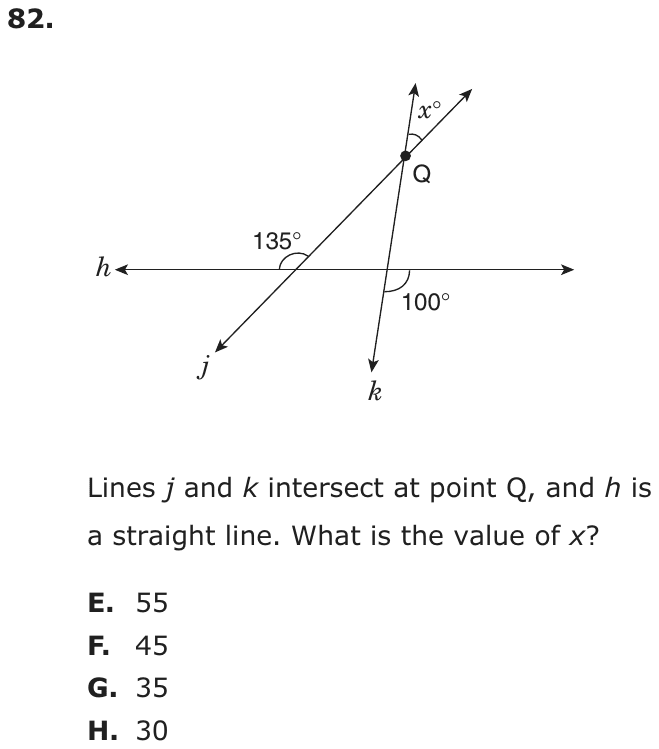
Question 91 of 120
2023 Test A Math, question 34Question
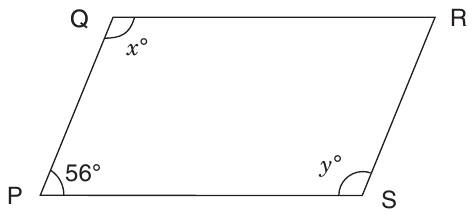
In the parallelogram above, what is the value of ?
- A112
- B124
- C148
- D248
Show the answer
Correct answer: D
In a parallelogram, opposite angles are congruent, so the measure of the unmarked angle is 56°. The sum of the interior angles of a parallelogram is equal to 360°. Use that information to solve the problem:
Question analysis
This geometry question shows parallelogram PQRS with a 56° angle at P and unknown angles x and y at Q and S, and asks for the sum x + y. Students need angle facts about parallelograms: opposite angles match, and the four angles total 360°. Stopping after finding only one angle, or adding the wrong pair, are the common mistakes.
- NYS standards
- Grade level
- Grade 8 content, by NYS standard
- Compared with grade 7
- At grade 7 The parallelogram facts needed, equal opposite angles and a 360° angle sum, rest on grade 8 reasoning about parallel lines and triangles. Once they are known, the arithmetic is short, about the size of a typical grade 7 angle problem.
- Estimated difficulty
- Straightforward: two steps or one careful reading.
- Thinking it demands
- Depth of knowledge 2, skills and concepts · mainly apply
- What makes it hard
- Solution
- 2 steps
- Reading level
- Question and choices: about grade 10, 10 words.
- Students, last 30 days
- Not enough answers yet to show (it takes 10).
Why it is hard, traps and wrong answers (shows the answer)
Why it is hard
Two short angle facts finish the question, but the figure marks three of the four corners, and the unmarked one at R is easy to forget. Students who find one obtuse angle stop with half the total, and those who add the two 56° angles give the part already known. Checking that the four angles, 56, 124, 56 and 124, add to 360 confirms the sum.
Something you must already know moderate Working it out
The figure gives one angle and no rules: students must bring both that opposite angles of a parallelogram are equal and that a quadrilateral's angles total 360°, or that neighboring angles add to 180°. (Anderson & Krathwohl, 2001)
Reading a figure, table or graph minor Understanding the question
The labels x and y sit at Q and S, opposite corners, while the corner R across from the 56° angle at P carries no label at all. (Lesh, Post & Behr, 1987; Kirsch & Mosenthal, 1990)
Strategy: Mark the angle at R equal to the angle at P, since opposite angles of a parallelogram are equal, then take both away from the total of a quadrilateral's four angles.
Traps
- Stops one step early: A choice is a number from partway through the solution.
- Answers a different question: A choice is right for another quantity: the other unknown, the rest instead of the part, the part instead of the whole.
The wrong answers, classified
A Answers a different question (King et al., 2004; Hegarty, Mayer & Monk, 1995)
Adds the two 56° angles at P and R, 56 + 56 = 112, giving the part of the 360° already known instead of the two angles that remain.
B Stops one step early (King et al., 2004; Gierl et al., 2017)
Finds one unmarked angle, 180 − 56 = 124, and stops before adding the equal angle at the opposite corner.
C Little reason to choose it (Haladyna & Downing, 1993; Rodriguez, 2005)
No angle fact in the parallelogram gives 148, which is exactly 100 less than the right total, so it mostly catches guesses or a stray subtraction slip.
Worked solution, step by step
Formulas used
- Opposite angles of a parallelogram
- A parallelogram is a four-sided shape whose opposite sides are parallel. P and R are opposite corners: they don’t share a side. Opposite angles of a parallelogram are always equal.
- Angles of a four-sided shape
- P, Q, R and S are the four corners. Their angles always add up to 360 degrees. A line from one corner to the opposite corner cuts the shape into two triangles, and each triangle’s angles add up to 180 degrees.
- Neighboring angles of a parallelogram
- P and Q are corners next to each other, joined by one side. In a parallelogram, their angles add up to 180 degrees. The same is true of any two neighboring corners.
Sort out the figure
PQRS is a parallelogram. The angle at corner P is 56°. The angle at Q is x°, and the angle at S is y°. The angle at R has no label. You need x + y, the angles at Q and S added together.
Find the angle at R
R is across from P, so they are opposite corners.
So the angle at R is 56°, the same as at P.
Use the 360° total
Watch out: 112 is the two angles you already know, not x + y. Answering 112 is choice A.
Find x and y one at a time
Q is next to P, so use the neighbor rule.
S is also next to P, so y = 124 too. Then , the same total. Watch out: stopping at one angle, 124, gives choice B. The question asks for both added together.
So the answer is D, 248.
Check your answer
Add all four angles: . That is the right total for a four-sided shape. Also, the angles at Q and S look wider than a right angle in the figure, and 124° is wider than 90°.
More questions like this
The original DOE question
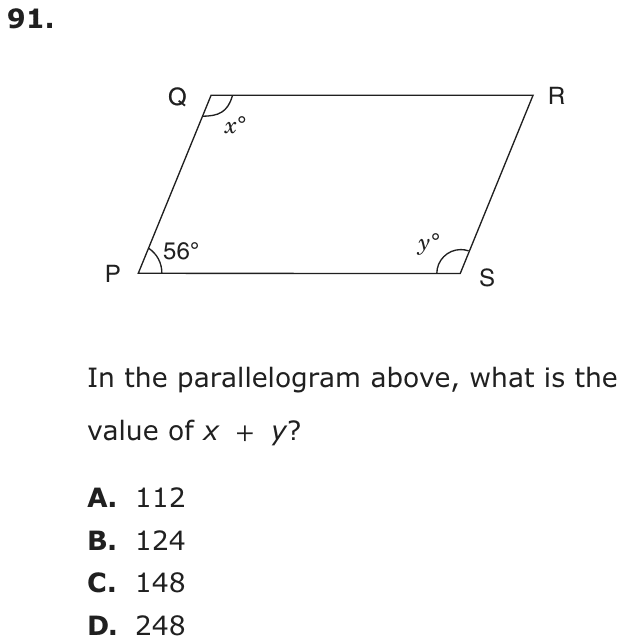
Question 92 of 120
2023 Test A Math, question 37Question
The shaded sector of the circle shown above has an area of square feet. What is the circumference of the circle?
- A ft
- B ft
- C ft
- D ft
Show the answer
Correct answer: B
The area of the entire circle is .
The fraction of the circle that is shaded is . So, the area of the sector is . Use that information to find r:
Use r to calculate the circumference of the circle:
The circumference is feet.
Question analysis
This circle question shows a shaded 45° sector with an area of 18π square feet and asks for the circumference of the whole circle. Students work backward: from the sector to the full area, from the area to the radius, and from the radius to the circumference. Mixing up area and circumference, or stopping partway, gives wrong choices.
- Grade level
- Grade 7 content, by NYS standard
- Compared with grade 7
- Above grade 7 Grade 7 circle problems usually give the radius and ask for area or circumference. This one runs backward from the area of a 45° sector, needing the sector's share of the circle, a square root and a switch to circumference: four linked steps.
- Estimated difficulty
- Hard: combines ideas, needs a plan, and has more than one tempting wrong answer.
- Thinking it demands
- Depth of knowledge 2, skills and concepts · mainly apply
- What makes it hard
- Combines ideas moderate
- Something you must already know moderate
- Reading a figure, table or graph minor
- Solution
- 4 steps
- Reading level
- Question and choices: about grade 5, 30 words.
- Students, last 30 days
- Not enough answers yet to show (it takes 10).
Why it is hard, traps and wrong answers (shows the answer)
Why it is hard
The question moves from a part of the circle's area to the whole circle's length, so area and circumference both appear and are easy to swap. Many students scale the sector up to 144π and stop, giving an area when a length was asked. Solving r² = 144 also needs a square root, after which 2πr is routine. Asking at the end whether the result is a length, measured in feet rather than square feet, catches the main trap.
Combines ideas moderate Working it out
Three ideas chain together: the 45° sector is 1/8 of the circle, so the whole area is 8 × 18π = 144π, then the radius comes from the area, and the circumference from the radius. (Embretson, 1998; Daniel & Embretson, 2010)
Something you must already know moderate Working it out
Neither πr² nor 2πr is given, nor that a full turn is 360°, so every link of the chain rests on formulas students must already know. (Anderson & Krathwohl, 2001)
Reading a figure, table or graph minor Understanding the question
The stem says only “shaded sector”; its 45° angle is marked at the center in the figure, the one place the fraction of the circle comes from. (Lesh, Post & Behr, 1987; Kirsch & Mosenthal, 1990)
Strategy: Work out what fraction of the circle a 45° sector is, scale its area up to the whole circle, solve for the radius, and only then use the circumference formula.
Traps
- Answers a different question: A choice is right for another quantity: the other unknown, the rest instead of the part, the part instead of the whole.
- A formula you must know: Needs a formula the test does not give: area, circumference, volume, probability rules.
- Numbers taken from the question: Combines the numbers in the question without a model of the situation, or is simply a number that appears in the question.
The wrong answers, classified
A Answers a different question (King et al., 2004; Hegarty, Mayer & Monk, 1995)
Scales the sector up to the whole circle, 8 × 18π = 144π, and gives that area, though the question asks for the circumference.
C Numbers taken from the question (Hegarty, Mayer & Monk, 1995)
Repeats the sector's area from the stem, 18π, as if the shaded part's area were the circle's circumference.
D Little reason to choose it (Haladyna & Downing, 1993; Rodriguez, 2005)
No step with the 45° angle or the circle formulas gives 9π, which is half the sector's area, so it mostly attracts guesses.
Worked solution, step by step
Formulas used
- Fraction of a circle in a sector
- A sector is a slice of a circle, like a slice of pizza. Its angle is the angle at the center, in degrees. A full turn around the center is 360 degrees. So the slice is that fraction of the whole circle.
- Area of a circle
- A is the area, the space inside the circle. r is the radius, the distance from the center to the edge. π, called pi, is a number a little more than 3. r² means r times r.
- Circumference of a circle
- C is the circumference, the distance around the circle. r is the radius and π is pi. Two radii make the diameter, the distance across, so this is the same as π times the diameter.
Sort out the question
The shaded slice has a 45° angle at the center. Its area is square feet. You need the circumference, the distance around the whole circle. For that you need the radius, so work back to it.
Find what fraction is shaded
The shaded slice is one eighth of the circle. Eight slices like it would fill the circle.
Find the area of the whole circle
The whole circle has an area of square feet. Watch out: this is an area, not the circumference. Stopping here gives choice A.
Find the radius
Divide both sides by π. Then ask what number times itself makes 144. It is 12, so the radius is 12 feet.
Find the circumference
Leave π as it is, because the choices are written with π. The circumference is feet. So the answer is B, ft.
Check your answer
Work forward. A radius of 12 feet gives an area of square feet. One eighth of that is square feet, the shaded area in the question.
More questions like this
The original DOE question
Question 93 of 120
2023 Test A Math, question 38Question
Which graph represents the solution to ?
- A

- B

- C

- D

Show the answer
Correct answer: A
| Apply the additive inverse property; add 7 to both sides of the inequality. | |
| Apply the multiplicative inverse property; divide both sides of the inequality by −3. Note: when dividing an inequality by a negative number, the inequality sign is reversed. | |
The solution is that x is less than −1, so choose the graph that starts at −1 and continues to the left.
Question analysis
This inequality question asks which number line graph shows the solution of −3x − 7 > −4. Students solve a two-step inequality whose x term has a negative coefficient, then match the boundary point and the direction of the shading. Handling the inequality symbol at the division step is where most mistakes happen, and each slip has a matching graph.
- Grade level
- Grade 7 content, by NYS standard
- Compared with grade 7
- At grade 7 Solving and graphing a two-step inequality is a core grade 7 standard. This one has a negative coefficient on x, the classic grade 7 inequality trap, and four similar graphs test whether the sign and the direction were both handled.
- Estimated difficulty
- Moderate: several steps, or a close reading with one strong distractor.
- Thinking it demands
- Depth of knowledge 1, recall and reproduction · mainly apply
- What makes it hard
- Something you must already know moderate
- A very close wrong answer moderate
- Reading a figure, table or graph minor
- Solution
- 3 steps
- Reading level
- Question and choices: about grade 9, 7 words.
- Corrected from the DOE handbook
- A wrong term in the explanation was corrected.
- Students, last 30 days
- Not enough answers yet to show (it takes 10).
Why it is hard, traps and wrong answers (shows the answer)
Why it is hard
The solving takes two moves, but the second carries the rule the question tests: dividing an inequality by a negative number flips its direction. The four graphs cross two features, boundary at −1 or 1 and shading left or right, so forgetting the flip, dropping a sign, or both each land on a graph. Testing a shaded value such as x = −2 in the original inequality, where 6 − 7 = −1 is greater than −4, confirms the choice.
Something you must already know moderate Working it out
The step that decides the question, reversing the symbol when dividing both sides by −3, is a rule students must bring themselves; −3x > 3 becomes x < −1, not x > −1. (Anderson & Krathwohl, 2001)
A very close wrong answer moderate Choosing the answer
The graph shaded to the right from an open circle at −1 matches the right graph's boundary exactly and differs only in direction, the result of skipping the reversal. (Embretson & Wetzel, 1987; Gorin & Embretson, 2006; Ascalon et al., 2007)
Reading a figure, table or graph minor Understanding the question
Each graph must be read for two things, where its open circle sits, at −1 or 1, and which way the arrow runs, so a boundary alone does not identify the answer. (Lesh, Post & Behr, 1987; Kirsch & Mosenthal, 1990)
Strategy: Add 7 to both sides, divide by −3 and reverse the inequality symbol, then match both the boundary point and the shading direction; test one shaded value in the original.
Traps
- Negatives and direction: Arithmetic with negative numbers, the order of a subtraction, or direction on a number line. (Moving a term across the equals sign without changing its sign is a faulty procedure.)
The wrong answers, classified
B Negatives and direction (Brown & Burton, 1978)
Reverses the symbol correctly but drops the negative in 3 ÷ (−3), so the boundary lands at 1 with the shading to its left.
C Negatives and direction (Brown & Burton, 1978)
Divides both sides by −3 without reversing the symbol, solving the inequality as if it were an equation, so x > −1 and the shading runs right.
D Negatives and direction (Brown & Burton, 1978)
Treats −3x as 3x, so it solves 3x > 3 to get x > 1 with no reversal, which puts both the boundary and the direction wrong.
What was corrected from the DOE handbook, and why
- Explanation: The handbook’s steps say “add 7 to both sides of the equation” and “divide both sides of the equation by −3” (p. 142, question 95). But −3x − 7 > −4 is an inequality, not an equation, and the step’s own note is the point of the question: dividing an inequality by a negative number reverses the sign. The site now says “both sides of the inequality” in both steps, as the DOE’s later guides word this step (“Subtract 4 from both sides of the inequality” in the 2024–2025 guide). The working and the answer are unchanged.
Worked solution, step by step
Formulas used
- Adding to both sides of an inequality
- a and b are the two sides, and c is any number. Adding the same amount to both sides keeps the comparison true, like adding the same weight to both pans of a scale.
- Dividing an inequality by a negative number
- a and b are the two sides, and c is a negative number. When you divide both sides by a negative number, the greater-than sign flips to less-than. That is because negatives reverse order: 2 is more than 1, but −2 is less than −1.
Sort out the question
An inequality compares two amounts. The sign > means is greater than. You need the graph of every x that makes true. The graphs differ in two ways: where the open circle sits, at −1 or 1, and which way the shading goes.
Add 7 to both sides
Adding 7 undoes the −7, so the x term is alone on the left.
Divide by −3 and flip the sign
So x is any number less than −1. Watch out: if you forget to flip the sign, you get x > −1, and that graph is choice C. Also, 3 ÷ (−3) is −1, not 1. Dropping that minus sign leads to B or D.
Match the solution to a graph
Less than −1 means to the left of −1 on the number line. The circle at −1 is open, or empty, because −1 itself does not work. The sign means greater than, not greater than or equal to.
Graph A has an open circle at −1 and is shaded to the left. So the answer is A, the graph shaded left from an open circle at −1.
Check your answer
Test a number on each side of −1. For x = −2: , and −1 is greater than −4, so −2 works. For x = 0: , and −7 is less than −4, so 0 does not work. The shading must go left.
More questions like this
The original DOE question
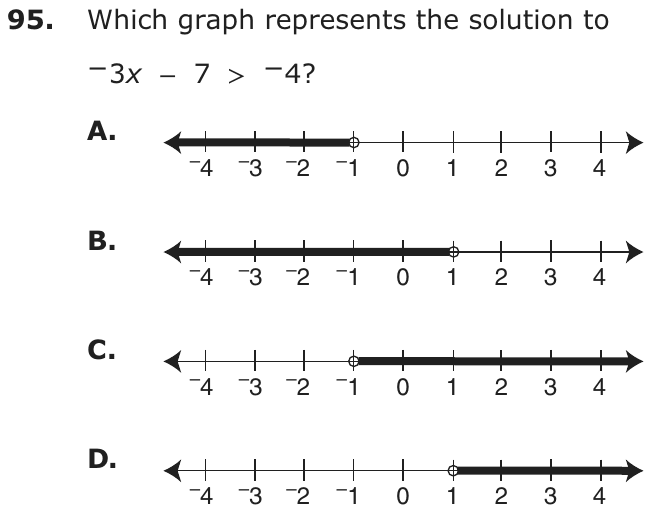
Question 94 of 120
2023 Test A Math, question 43Question
Kim jogs 8 kilometers in 1 hour 40 minutes. At that rate, how many meters does she jog per minute?
- A0.08
- B80
- C800
- D8,000
Show the answer
Correct answer: B
First, calculate Kim’s jogging time in minutes:
1 hour 40 minutes = 100 minutes
Then, convert kilometers to meters:
8 kilometers = 8,000 meters
Now simplify the ratio to find the answer:
Question analysis
This rate question says Kim jogs 8 kilometers in 1 hour 40 minutes and asks how many meters she jogs per minute. Students convert a mixed time to minutes and kilometers to meters before finding a unit rate. Skipping a conversion, or stopping before dividing, gives answers that are off by factors of ten or more.
- Grade level
- Grade 6 content, by NYS standard
- Compared with grade 7
- Below grade 7 Unit rates and metric conversions are grade 6 topics. This needs two conversions, hours and minutes to minutes and kilometers to meters, then one division with whole numbers, simpler than grade 7 rate problems built on fractions.
- Estimated difficulty
- Straightforward: two steps or one careful reading.
- Thinking it demands
- Depth of knowledge 2, skills and concepts · mainly apply
- What makes it hard
- Something you must already know minor
- Many steps minor
- Solution
- 3 steps
- Reading level
- Question and choices: about grade 4, 17 words.
- Students, last 30 days
- Not enough answers yet to show (it takes 10).
Why it is hard, traps and wrong answers (shows the answer)
Why it is hard
The rate itself is one division; what makes the question work is that the distance and the time both arrive in the wrong units. Converting only the time gives a speed in kilometers per minute, and converting only the distance and stopping gives the whole trip in meters. Writing the units beside every number, meters over minutes, shows when the answer is ready.
Something you must already know minor Working it out
The conversions are not given: 1 kilometer is 1,000 meters and 1 hour is 60 minutes, so 8 kilometers becomes 8,000 meters and 1 hour 40 minutes becomes 100 minutes. (Anderson & Krathwohl, 2001)
Many steps minor Working it out
Two conversions, one for distance and one for time, come before the single division, and skipping the distance conversion leaves an answer a thousand times too small. (Daniel & Embretson, 2010; Enright, Morley & Sheehan, 2002)
Strategy: Rewrite the time entirely in minutes and the distance entirely in meters, then divide distance by time; check that the answer's units are meters per minute.
Traps
- Units or scale: The answer is wanted in other units, or a rate or scale must be converted first.
- Stops one step early: A choice is a number from partway through the solution.
- An arithmetic slip: The right method with a plausible arithmetic error: a digit, a place value or a times-table fact.
The wrong answers, classified
A Units or scale (King et al., 2004)
Divides the 8 kilometers by the 100 minutes but never changes kilometers to meters, giving a speed of 0.08 kilometer per minute.
C An arithmetic slip (Junker & Sijtsma, 2001)
Converts both units correctly but cancels only one zero when dividing 8,000 by 100, getting a rate ten times too large.
D Stops one step early (King et al., 2004; Gierl et al., 2017)
Converts 8 kilometers to 8,000 meters and stops, giving the whole distance before dividing by the 100 minutes it took.
Worked solution, step by step
Formulas used
- Kilometers to meters
- Each kilometer is 1,000 meters, so multiply the number of kilometers by 1,000 to get meters. The word part kilo means a thousand.
- Rate
- The rate, or speed, is how far you go in one unit of time. Distance is how far, and time is how long. Dividing shares the distance equally among the minutes, so you get the distance for one minute.
Sort out the question
Kim jogs 8 kilometers in 1 hour 40 minutes. You need her speed in meters per minute: how many meters she jogs in one minute. The question gives kilometers and hours, so change both units first.
Change the time to minutes
One hour is 60 minutes. Add the extra 40 minutes.
Kim jogs for 100 minutes.
Change the distance to meters
Kim jogs 8,000 meters. Watch out: 8,000 is the whole distance, not meters per minute. Stopping here gives choice D.
Divide the distance by the time
She jogs 80 meters each minute. Watch out: if you skip the change to meters, you get 8 ÷ 100 = 0.08 kilometer per minute, choice A. So the answer is B, 80 meters per minute.
Check your answer
Work backward. At 80 meters a minute, 100 minutes gives meters. That is 8 kilometers, just as the question says.
More questions like this
The original DOE question
Question 95 of 120
2023 Test A Math, question 45Question
The diagram above shows line segment RS intersecting a rectangle. What is the measure of angle y?
- A140°
- B130°
- C50°
- D40°
Show the answer
Correct answer: A
First, find the measures of the interior angles of the triangle formed by the line segment and the rectangle. The top angle on the right is a vertex of the rectangle, so the measure of that angle is 90°. The top angle on the left is supplementary to the given angle of 130°. So, the measure of that angle is . The measure of the lower angle is 40°, since . Angle y is supplementary to the lower angle of 40°, so the measure of angle y is .
Question analysis
This geometry question shows line segment RS cutting across a corner of a rectangle, with a 130° angle marked where RS meets the top side, and asks for angle y where it crosses the right side. Students combine supplementary angles, the right angle of a rectangle and the angle sum of a triangle. Stopping at an angle inside the triangle is the main trap.
- NYS standards
- Grade level
- Grade 8 content, by NYS standard
- Compared with grade 7
- Above grade 7 Grade 7 angle problems use supplementary, vertical and adjacent angles. This one adds the angle sum of a triangle, which New York places in grade 8, and chains three facts around a small triangle that students must first spot in the figure.
- Estimated difficulty
- Moderate: several steps, or a close reading with one strong distractor.
- Thinking it demands
- Depth of knowledge 2, skills and concepts · mainly apply
- What makes it hard
- Reading a figure, table or graph moderate
- Many steps minor
- Something you must already know minor
- Solution
- 3 steps
- Reading level
- Question and choices: about grade 7, 17 words.
- Students, last 30 days
- Not enough answers yet to show (it takes 10).
Why it is hard, traps and wrong answers (shows the answer)
Why it is hard
The angle facts are basic, but the route runs through a triangle the figure does not point out, and the answer lies outside it. Students who stop inside the triangle give its 40° angle or its 50° angle, and those who assume y matches the marked 130° skip the work entirely. Checking that y and the triangle's angle beside it form a straight line, 140 + 40 = 180, confirms the result.
Reading a figure, table or graph moderate Understanding the question
The small triangle cut off at the rectangle's top right corner is never outlined or labeled, its 90° corner is unmarked, and y sits outside it, between RS and the rectangle's right side. (Lesh, Post & Behr, 1987; Kirsch & Mosenthal, 1990)
Many steps minor Working it out
Three steps follow in order, a straight angle at R, the triangle's angle sum, and a straight angle at the right side, and the first two results are both listed choices. (Daniel & Embretson, 2010; Enright, Morley & Sheehan, 2002)
Something you must already know minor Working it out
The rectangle's corner must be taken as 90° although no right-angle mark is drawn, and the 180° totals for a straight line and a triangle are assumed. (Anderson & Krathwohl, 2001)
Strategy: Look at the small triangle cut off at the rectangle's corner: get its angle at R from the straight top side, use the 90° corner and the triangle's angle sum, then use the straight right side.
Traps
- Stops one step early: A choice is a number from partway through the solution.
- Misunderstands the concept: A wrong belief about a concept: that percents can be added, that area grows like length, that averages can be averaged, that a bigger denominator means a bigger fraction.
The wrong answers, classified
B Misunderstands the concept (Smith, diSessa & Roschelle, 1993; De Bock et al., 1998; Ni & Zhou, 2005)
Takes y to equal the marked 130° angle, as if RS crossed two parallel sides, though the rectangle's top and right sides meet at a right angle.
C Stops one step early (King et al., 2004; Gierl et al., 2017)
Finds the triangle's angle at R, 180 − 130 = 50, and stops after the first of the three steps.
D Stops one step early (King et al., 2004; Gierl et al., 2017)
Finds the triangle's third angle, 180 − 90 − 50 = 40, but y lies outside the triangle, beside that angle on the straight right side.
Worked solution, step by step
Formulas used
- Angles on a straight line
- a and b are two angles side by side that together make a straight line. A straight line makes an angle of 180 degrees. So if you know one of them, subtract it from 180 to get the other.
- Angles in a triangle
- a, b and c are the three angles inside any triangle. They always add up to 180 degrees. If you know two of them, subtract both from 180 to find the third.
- Outside angle of a triangle
- An outside angle sits next to a triangle’s angle, along a straight line. a and b are the two inside angles at the other corners. The outside angle equals their sum.
Sort out the figure
Segment RS starts at R on the top side of the rectangle. It goes down to the right, crosses the right side, and ends at S. Call the rectangle’s top right corner P. Call the point where RS crosses the right side Q. Then R, P and Q make a small triangle. Angle y is at Q, outside the rectangle.
Find the triangle’s angle at R
The 130° angle and the triangle’s angle at R sit side by side along the top side, a straight line.
Watch out: 50° is only the first step. Stopping here gives choice C.
Find the triangle’s angle at Q
P is a corner of the rectangle, so its angle is 90°.
Watch out: y is outside the triangle, so this 40° angle, choice D, is not y.
Find angle y
Angle y and the triangle’s 40° angle at Q sit side by side along RS, a straight line.
So the answer is A, 140°.
Check your answer
Use the outside angle rule. Angle y is outside the triangle at Q. The two inside angles at the other corners are 50° and 90°, so . Also, y looks wider than a right angle in the figure, so it must be more than 90°.
More questions like this
The original DOE question
Question 96 of 120
2023 Test A Math, question 47Question
Which percentage is closest in value to 0.0099?
- A0%
- B0.1%
- C1%
- D100%
Show the answer
Correct answer: C
Since 0.0099 is equal to 0.99%, the answer option closest to that value is 1%.
Question analysis
This percent question asks which of four percentages is closest in value to the decimal 0.0099. Students convert a small decimal to a percent by multiplying by 100, then compare it with choices that differ by factors of ten. Moving the decimal point the wrong number of places, or reading the digits 99 as a percent, leads to wrong answers.
- NYS standards
- 6.RP.3c percent as a rate per 100
- Grade level
- Grade 6 content, by NYS standard
- Compared with grade 7
- Below grade 7 Converting a decimal to a percent is grade 6 work. This decimal has two zeros before its first digit, so the point must move carefully, but it is a single conversion followed by picking the nearest choice, below typical grade 7 demand.
- Estimated difficulty
- Straightforward: two steps or one careful reading.
- Thinking it demands
- Depth of knowledge 1, recall and reproduction · mainly apply
- What makes it hard
- Solution
- 2 steps
- Reading level
- Question and choices: about grade 6, 7 words.
- Students, last 30 days
- Not enough answers yet to show (it takes 10).
Why it is hard, traps and wrong answers (shows the answer)
Why it is hard
One conversion answers the question, and the choices are spaced by powers of ten, so the work is all in the decimal places. A decimal this small looks like nothing, and students who forget to multiply by 100 see it as nearly 0%. Others move the point the wrong number of places or read the digits 99 as a percent. Seeing that 0.01 is exactly 1% puts 0.0099 just below it.
Error-prone arithmetic minor Working it out
The decimal 0.0099 has two zeros before its digits, so moving the point two places gives 0.99, and miscounting the places lands on 0.1% or 99%. (Brown & Burton, 1978; Junker & Sijtsma, 2001)
Something you must already know minor Working it out
Students must know that a percent is a number of hundredths, so 0.0099 is multiplied by 100 to become 0.99%, a rule the question takes for granted. (Anderson & Krathwohl, 2001)
Strategy: Multiply the decimal by 100 to write it as a percent, moving the point two places to the right, then choose the percent nearest to that value.
Traps
- Misunderstands the concept: A wrong belief about a concept: that percents can be added, that area grows like length, that averages can be averaged, that a bigger denominator means a bigger fraction.
- An arithmetic slip: The right method with a plausible arithmetic error: a digit, a place value or a times-table fact.
- Numbers taken from the question: Combines the numbers in the question without a model of the situation, or is simply a number that appears in the question.
The wrong answers, classified
A Misunderstands the concept (Smith, diSessa & Roschelle, 1993; De Bock et al., 1998; Ni & Zhou, 2005)
Reads 0.0099 as if it were already a percent, 0.0099%, which is nearest 0%, never multiplying by 100 to change the decimal into a percent.
B An arithmetic slip (Junker & Sijtsma, 2001)
Moves the decimal point one place instead of two, turning 0.0099 into about 0.1, and writes that as 0.1%, ten times too small.
D Numbers taken from the question (Hegarty, Mayer & Monk, 1995)
Sees the digits 99, thinks of 99 percent, and picks the nearest choice, ignoring the zeros that make 0.0099 less than one hundredth.
Worked solution, step by step
Formulas used
- Decimal to percent
- A percent is a number of hundredths. To change a decimal into a percent, multiply by 100. That moves the decimal point two places to the right. For example, 0.25 × 100 = 25, so 0.25 is 25%.
Sort out the question
The number 0.0099 is a decimal, but the choices are percents. To compare them, change 0.0099 into a percent first. Then find the choice nearest to it.
Change the decimal to a percent
So 0.0099 is 0.99%. The decimal point moved two places to the right. Watch out: 0.0099 is not already a percent. Reading it as 0.0099% points to 0%, choice A.
Find the nearest choice
Find how far 0.99% is from each choice.
Choice Distance from 0.99% A, 0% 0.99 B, 0.1% 0.89 C, 1% 0.01 D, 100% 99.01 Watch out: moving the point only one place gives about 0.1, choice B. So the answer is C, 1%.
Check your answer
Work the other way. 1% is 1 out of 100, or 0.01. And 0.0099 is just a tiny bit less than 0.0100. So 0.0099 is very close to 1%, just a little less.
More questions like this
The original DOE question
Question 97 of 120
2023 Test A Math, question 48Question
The manager of a shipping company recorded the weights, in pounds, of the last 9 packages the company shipped. The manager displayed the distribution of the weights in a box plot with the five-number summary shown below:
- minimum: 29
- first quartile: 31
- median: 42
- third quartile: 73
- maximum: 98
Which statement about the distribution of weights is supported by the box plot the manager created?
- AThe minimum, 29, is an outlier.
- BThe maximum, 98, is an outlier.
- CThe interquartile range of the data is 11.
- DThe interquartile range and the median are equal.
Show the answer
Correct answer: D
First, identify the first quartile and the third quartile:
- first quartile: 31
- third quartile: 73
Then, find the difference between the first quartile and the third quartile:
The median is given: 42.
So, the interquartile range and the median are equal.
Question analysis
This statistics question gives the five-number summary of nine package weights shown in a box plot and asks which statement about the distribution is supported. Students compute the interquartile range and decide whether the minimum or the maximum is an outlier. Judging outliers by eye, or subtracting the wrong pair of values for the IQR, makes wrong statements look true.
- NYS standards
- 7.SP.1 box plots and interquartile range
- Grade level
- Grade 7 content, by NYS standard
- Compared with grade 7
- At grade 7 Finding the interquartile range and testing for outliers are grade 7 standards in New York. There is no plot to read here, only five numbers, but every statement has to be checked by calculation, which makes it a careful grade 7 task.
- Estimated difficulty
- Moderate: several steps, or a close reading with one strong distractor.
- Thinking it demands
- Depth of knowledge 2, skills and concepts · mainly apply
- What makes it hard
- Something you must already know moderate
- Every choice must be checked moderate
- Solution
- 3 steps
- Reading level
- Question and choices: about grade 7, 84 words.
- Students, last 30 days
- Not enough answers yet to show (it takes 10).
Why it is hard, traps and wrong answers (shows the answer)
Why it is hard
The numbers are given outright, so the work is knowing what each statement claims and testing it. The outlier statements sound right because 98 looks far from 73 and 29 is the smallest value, but the 1.5 × IQR rule clears both. The true statement needs only one subtraction, 73 − 31, and a look at the median, which happens to have the same value.
Something you must already know moderate Working it out
Neither the interquartile range, the third quartile minus the first, nor the outlier rule, more than 1.5 × IQR beyond a quartile, is defined on the page. (Anderson & Krathwohl, 2001)
Every choice must be checked moderate Choosing the answer
The four statements test different ideas, two possible outliers, a value for the IQR and a comparison of the IQR with the median, so ruling out one says nothing about the next. (Embretson & Wetzel, 1987)
Strategy: Compute the interquartile range from the two quartiles, use it to set the outlier cutoffs 1.5 IQR beyond each quartile, and test every statement against those numbers.
Traps
- Misunderstands the concept: A wrong belief about a concept: that percents can be added, that area grows like length, that averages can be averaged, that a bigger denominator means a bigger fraction.
- Wrong formula: Uses a related but wrong formula: perimeter for area, diameter for radius, area for volume, or a misremembered one.
The wrong answers, classified
A Misunderstands the concept (Smith, diSessa & Roschelle, 1993; De Bock et al., 1998; Ni & Zhou, 2005)
Calls 29 an outlier just because it is the minimum, though it sits only 2 below the first quartile and far inside the cutoff 31 − 63 = −32.
B Misunderstands the concept (Smith, diSessa & Roschelle, 1993; De Bock et al., 1998; Ni & Zhou, 2005)
Judges 98 an outlier because it lies 25 above the third quartile, without testing it against the cutoff 73 + 1.5 × 42 = 136.
C Wrong formula (King et al., 2004)
Subtracts the first quartile from the median, 42 − 31 = 11, instead of from the third quartile, measuring only the lower half of the box.
Worked solution, step by step
Formulas used
- Interquartile range
- Q1, the first quartile, is the middle of the lower half of the data. Q3, the third quartile, is the middle of the upper half. The interquartile range, or IQR, is the distance between them. It is the width of the box in a box plot. It shows how spread out the middle half of the data is.
- Outlier rule
- An outlier is a value far away from the rest of the data. Q1 and Q3 are the quartiles, and IQR is the interquartile range. A value is an outlier if it lies more than 1.5 times the IQR below Q1 or above Q3.
Sort out the question
The manager’s box plot is drawn from the five numbers in the list, so you can work from the list. The weights, in pounds, are: minimum 29, first quartile 31, median 42, third quartile 73, maximum 98. You need the one statement that is true. So check each choice.
Find the interquartile range
The interquartile range is 42 pounds. That makes choice C, which says 11, false.
Compare the IQR with the median
The median is 42 pounds. The interquartile range is also 42 pounds. They are equal, so statement D is true.
Watch out: 42 − 31 = 11 subtracts Q1 from the median, not from Q3. That mistake makes choice C look right.
Test the ends for outliers
An outlier would be below −32 or above 136. The minimum, 29, is not below −32. The maximum, 98, is not above 136. So A and B are false. Watch out: 98 looks far away, but not far enough to be an outlier.
Choose the answer
Only statement D is supported by the five numbers. So the answer is D, the interquartile range and the median are equal.
Check your answer
Check the subtraction by adding back: , which is Q3. The median, 42, sits inside the box, between 31 and 73, as it must. The two measures mean different things, but here they happen to be the same number.
More questions like this
The original DOE question
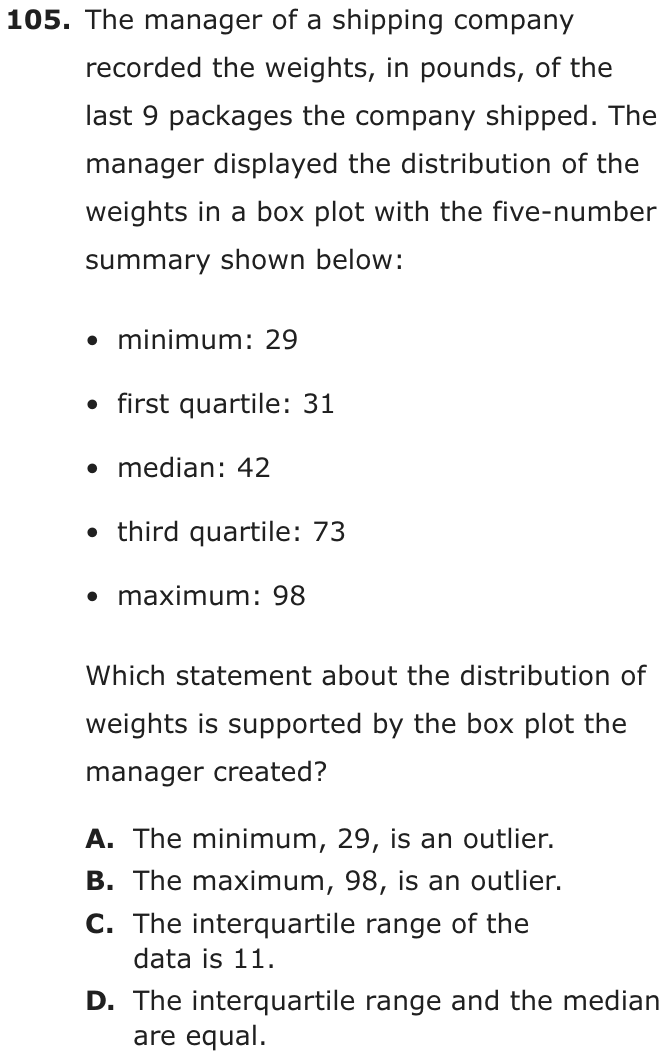
Question 98 of 120
2023 Test A Math, question 50Question
A rectangular concrete driveway is 30 feet long, 8 feet wide, and 6 inches thick. What is the volume of the concrete?
- A44 cu ft
- B48 cu ft
- C120 cu ft
- D240 cu ft
Show the answer
Correct answer: C
First convert 6 inches to 0.5 foot. Then, calculate the volume, in cubic feet:
Question analysis
This volume word problem describes a concrete driveway 30 feet long, 8 feet wide and 6 inches thick, and asks for the volume of the concrete in cubic feet. Students convert inches to feet and multiply three dimensions. Mixing units, or stopping at the area of the driveway's surface, is the main way to go wrong.
- Grade level
- Grade 6 content, by NYS standard
- Compared with grade 7
- Below grade 7 Volume of a rectangular prism with a fractional edge is grade 6 content. The only extra step is changing inches to feet before multiplying, so it is lighter than grade 7 volume work with composite or triangular prisms.
- Estimated difficulty
- Straightforward: two steps or one careful reading.
- Thinking it demands
- Depth of knowledge 2, skills and concepts · mainly apply
- What makes it hard
- Solution
- 2 steps
- Reading level
- Question and choices: about grade 2, 27 words.
- Students, last 30 days
- Not enough answers yet to show (it takes 10).
Why it is hard, traps and wrong answers (shows the answer)
Why it is hard
Volume of a box is familiar, so the question is decided by the mix of units: two dimensions in feet and one in inches. Multiplying the three numbers as printed gives 1,440, which is not a choice, and that should send students back to convert. The listed wrong answers instead come from leaving out the thickness or combining the numbers without the volume rule.
Something you must already know minor Working it out
The stem gives no formula and no conversion, so students must bring both the volume rule, length times width times height, and the 12 inches in a foot. (Anderson & Krathwohl, 2001)
Error-prone arithmetic minor Working it out
The thickness becomes the fraction 1/2 foot, so the product is 30 × 8 × 1/2, or, if the inches are kept, 1,440 divided by 12. (Brown & Burton, 1978; Junker & Sijtsma, 2001)
Strategy: Change 6 inches to a fraction of a foot first so that all three measurements share a unit, then multiply length, width and thickness.
Traps
- Stops one step early: A choice is a number from partway through the solution.
- Numbers taken from the question: Combines the numbers in the question without a model of the situation, or is simply a number that appears in the question.
The wrong answers, classified
A Numbers taken from the question (Hegarty, Mayer & Monk, 1995)
Adds the three numbers in the stem, 30 + 8 + 6 = 44, instead of multiplying the dimensions.
B Numbers taken from the question (Hegarty, Mayer & Monk, 1995)
Multiplies only the width and the thickness, 8 × 6 = 48, combining two of the stem's numbers and leaving out the 30-foot length.
D Stops one step early (King et al., 2004; Gierl et al., 2017)
Finds the area of the driveway's surface, 30 × 8 = 240, and stops before multiplying by the half-foot thickness.
Worked solution, step by step
Formulas used
- Inches to feet
- There are 12 inches in 1 foot. So to change inches into feet, divide the number of inches by 12.
- Volume of a rectangular box
- V is the volume, the space inside a box shape. l is the length, w is the width and h is the height, here the thickness. All three must use the same unit. The answer is in cubic units, such as cubic feet.
Sort out the question
The driveway is a flat box of concrete. It is 30 feet long, 8 feet wide and 6 inches thick. You need its volume, the space the concrete fills, in cubic feet. The thickness is in inches, so change it to feet first.
Change the thickness to feet
So 6 inches is half a foot. Now all three measures are in feet.
Multiply the three measures
The volume is 120 cubic feet. Watch out: 30 × 8 = 240 is only the area of the top surface, in square feet. Stopping there gives choice D. Adding 30 + 8 + 6 = 44 gives choice A.
So the answer is C, 120 cu ft.
Check your answer
Think of it another way. A slab 30 feet by 8 feet and a full foot thick would hold 240 cubic feet. This one is only half a foot thick, so it holds half as much, 120 cubic feet. Using 6 instead of one half would give 1,440, far too big.
More questions like this
The original DOE question
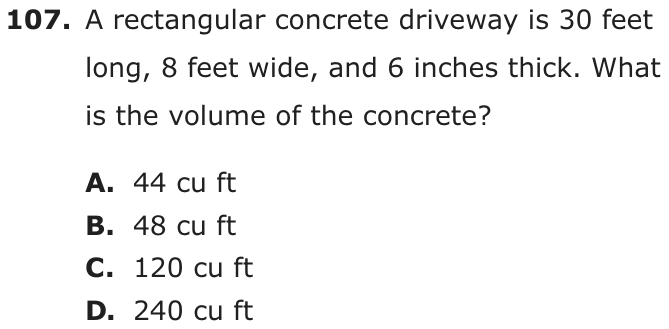
Question 99 of 120
2023 Test A Math, question 51Question
At a carnival, visitors can win a prize if an employee cannot correctly guess their age. The employee records the first 15 ages that he guesses one Saturday. The box plot shown below displays data about the ages he recorded.

What is the interquartile range of the box plot?
- A7
- B9
- C10
- D11
Show the answer
Correct answer: B
Quartile 1 is the median of the lower half of the data, 8.
Quartile 3 is the median of the upper half of the data, 17.
The interquartile range is 9.
Question analysis
This statistics question shows a box plot of 15 ages that a carnival employee guessed and asks for its interquartile range. Students read the quartiles from the edges of the box and subtract. Confusing the interquartile range with the full range, or using the median line in place of a quartile, gives the wrong choices.
- NYS standards
- 7.SP.1 box plots and interquartile range
- Grade level
- Grade 7 content, by NYS standard
- Compared with grade 7
- At grade 7 Reading a box plot and finding its interquartile range is a grade 7 standard in New York. The values sit on labeled whole-number ticks and one subtraction is needed, a routine grade 7 task once the box's edges are known as the quartiles.
- Estimated difficulty
- Straightforward: two steps or one careful reading.
- Thinking it demands
- Depth of knowledge 2, skills and concepts · mainly apply
- What makes it hard
- Solution
- 2 steps
- Reading level
- Question and choices: about grade 6, 48 words.
- Students, last 30 days
- Not enough answers yet to show (it takes 10).
Why it is hard, traps and wrong answers (shows the answer)
Why it is hard
The arithmetic is one subtraction, so the question tests whether students know which parts of a box plot to use. The whiskers' ends give the range, the line inside the box gives the median, and both are easy to grab in place of the quartiles. The story about the carnival and the 15 ages plays no part in the answer.
Something you must already know minor Working it out
The plot shows five values with no labels, so students must know that the box's ends mark the quartiles and that the interquartile range is the box's width, not the whiskers'. (Anderson & Krathwohl, 2001)
Reading a figure, table or graph minor Understanding the question
The values 7, 8, 10, 17 and 18 are read off a scale ticked at every whole number, with the box's ends at 8 and 17 and the median line at 10. (Lesh, Post & Behr, 1987; Kirsch & Mosenthal, 1990)
Strategy: Find the first and third quartiles on the plot by recalling which parts of a box plot mark them, then subtract the smaller quartile from the larger.
Traps
- Wrong formula: Uses a related but wrong formula: perimeter for area, diameter for radius, area for volume, or a misremembered one.
- Misunderstands the concept: A wrong belief about a concept: that percents can be added, that area grows like length, that averages can be averaged, that a bigger denominator means a bigger fraction.
- Information you don't need: The question gives numbers or facts that play no part in the answer.
The wrong answers, classified
A Wrong formula (King et al., 2004)
Subtracts the median from the third quartile, 17 − 10 = 7, measuring only the part of the box right of the middle line.
C Misunderstands the concept (Smith, diSessa & Roschelle, 1993; De Bock et al., 1998; Ni & Zhou, 2005)
Gives the median, 10, read off the line inside the box, taking a single value on the plot for the spread between the quartiles.
D Wrong formula (King et al., 2004)
Subtracts the minimum from the maximum, 18 − 7 = 11, which is the range shown by the whiskers, not the width of the box.
Worked solution, step by step
Formulas used
- Interquartile range
- Q1, the first quartile, is the middle of the lower half of the data. Q3, the third quartile, is the middle of the upper half. In a box plot, Q1 is the left end of the box and Q3 is the right end. So the IQR is the width of the box.
Sort out the question
A box plot shows five numbers. The whiskers, the lines sticking out, end at the smallest and largest values. The box covers the middle half of the data. The line inside the box is the median, the middle value. You need the interquartile range of the ages.
Read the five numbers
Read each one off the number line below the plot.
- Smallest age, the left whisker: 7
- Q1, the left end of the box: 8
- Median, the line inside the box: 10
- Q3, the right end of the box: 17
- Largest age, the right whisker: 18
Find the interquartile range
The interquartile range is 9 years. Watch out: 18 − 7 = 11 is the range, the whole spread from whisker to whisker. That is choice D. The median, 10, is choice C.
So the answer is B, 9.
Check your answer
Count the spaces across the box. From 8 to 17 there are 9 spaces of 1 year each, so the box is 9 years wide. The answer is also less than the whole range, 11, as it must be.
More questions like this
The original DOE question
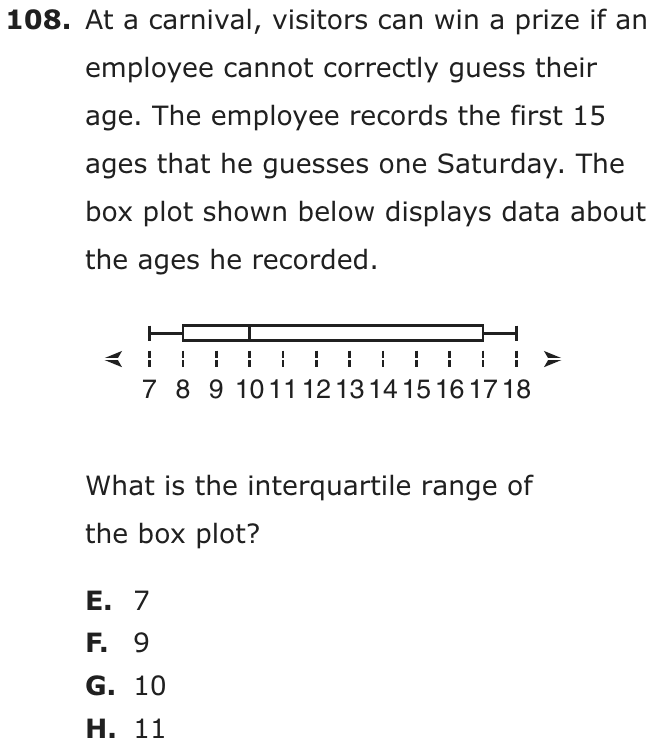
Question 100 of 120
2023 Test A Math, question 53Question
At West College, students are randomly assigned to one of 20 dormitories and one of 6 dining rooms. Kharleen likes 6 of the dormitories and 2 of the dining rooms. What is the probability that she is assigned to both a dormitory and a dining room that she likes?
- A10%
- B12%
- C19%
- D38%
Show the answer
Correct answer: A
Kharleen likes of the dormitories. She likes of the dining rooms. Multiply those fractions together to calculate the probability of Kharleen being assigned to both a dormitory and a dining room that she likes: .
Question analysis
This probability word problem says students at West College are randomly assigned one of 20 dormitories and one of 6 dining rooms, and Kharleen likes 6 dormitories and 2 dining rooms. It asks for the chance that she gets both a dormitory and a dining room she likes. Students combine two independent events and write the result as a percent.
- Grade level
- Grade 7 content, by NYS standard
- Compared with grade 7
- At grade 7 Finding the chance that two independent events both happen is grade 7 compound probability. Each event's chance comes straight from the counts given, and joining them and writing the result as a percent is a typical grade 7 task.
- Estimated difficulty
- Moderate: several steps, or a close reading with one strong distractor.
- Thinking it demands
- Depth of knowledge 2, skills and concepts · mainly apply
- What makes it hard
- Something you must already know moderate
- Turning words into math minor
- A very close wrong answer minor
- Solution
- 3 steps
- Reading level
- Question and choices: about grade 8, 45 words.
- Students, last 30 days
- Not enough answers yet to show (it takes 10).
Why it is hard, traps and wrong answers (shows the answer)
Why it is hard
The question turns on one rule, multiplying the chances of two independent events. Students who know it reduce the fractions first and finish in seconds; students who don't tend to combine the counts, and 6 × 2 = 12 reads naturally as 12%. The other two choices match no common working, so the real contest is between the product of the counts and the product of the chances.
Something you must already know moderate Working it out
The rule that the chance of two independent events both happening is the product of their chances, 3/10 × 1/3, is assumed; nothing in the stem says to multiply. (Anderson & Krathwohl, 2001)
Turning words into math minor Understanding the question
The phrase “both a dormitory and a dining room that she likes” describes two separate random assignments that must both go her way, so the two chances are combined, not compared. (Hegarty, Mayer & Monk, 1995; Koedinger & Nathan, 2004)
A very close wrong answer minor Choosing the answer
The choice 12% sits only 2 points above 10%, so a rough sense that the answer is small cannot separate them; only computing 3/10 × 1/3 does. (Embretson & Wetzel, 1987; Gorin & Embretson, 2006; Ascalon et al., 2007)
Strategy: Write the chance of a liked dormitory and the chance of a liked dining room as fractions, multiply them because both must happen, and convert the product to a percent.
Traps
- Numbers taken from the question: Combines the numbers in the question without a model of the situation, or is simply a number that appears in the question.
- A formula you must know: Needs a formula the test does not give: area, circumference, volume, probability rules.
The wrong answers, classified
B Numbers taken from the question (Hegarty, Mayer & Monk, 1995)
Multiplies the numbers of liked options, 6 × 2 = 12, and reads that product as 12%, without dividing by the 20 × 6 possible assignments.
C Little reason to choose it (Haladyna & Downing, 1993; Rodriguez, 2005)
No combination of 6/20 and 2/6 gives 19%, a value between the right answer and either single chance, so it mostly draws estimates and guesses.
D Little reason to choose it (Haladyna & Downing, 1993; Rodriguez, 2005)
No common working gives 38%, which is larger than either single chance, 30% or about 33%, so it mostly catches guesses.
Worked solution, step by step
Formulas used
- Probability
- P is the probability, the chance that something happens. The top counts the outcomes you want. The bottom counts every outcome that could happen. Each outcome must be equally likely.
- Probability of two separate events
- A and B are two events that don’t affect each other, like two separate random picks. P(A) is the chance of A, and P(B) is the chance of B. The chance that both happen is the two chances multiplied.
Sort out the question
Kharleen gets one of 20 dorms, or dormitories, where students live. She also gets one of 6 dining rooms. Each is picked at random. She likes 6 dorms and 2 dining rooms. You need the chance that she gets a dorm she likes and a dining room she likes.
Find the chance of a liked dorm
She likes 6 of the 20 dorms. Divide the top and bottom by 2 to simplify.
Find the chance of a liked dining room
Use the same formula for the dining rooms.
She likes 2 of the 6 dining rooms. Divide the top and bottom by 2.
Multiply the two chances
The two picks are separate. One doesn’t change the other.
Both must happen, so the chance is smaller than either one alone.
Change to a percent
Watch out: multiplying 6 × 2 = 12 and calling it 12% skips dividing by all the possible assignments. That is choice B. So the answer is A, 10%.
Check your answer
Count every possible assignment. There are dorm and dining room pairs, all equally likely. She likes of them. Then , which is 10%, the same answer.
More questions like this
The original DOE question
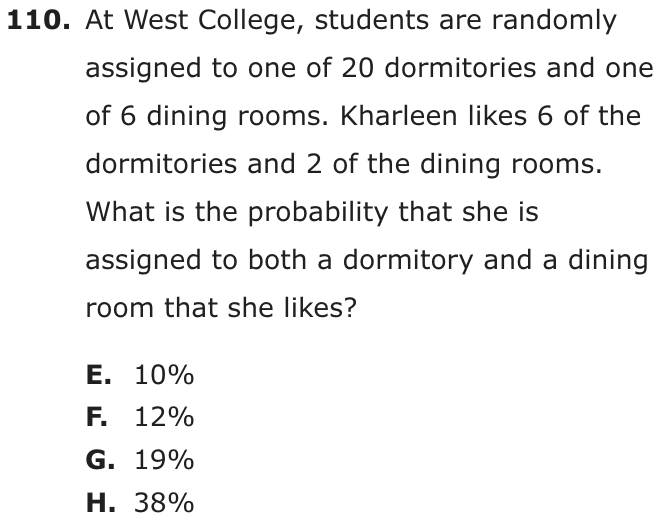
Question 101 of 120
2023 Test A Math, question 57Question
Chanelle selects a marble from a container and then returns it to the container. When she does this 3 times, the probability of choosing a red marble all 3 times is . Based on this information, what is the probability of Chanelle choosing a red marble the first time she selects a marble?
- A
- B
- C
- D
Show the answer
Correct answer: D
Let be the probability of Chanelle selecting a red marble the first time. The probability of selecting a red marble three times is , which is given as . Since , the value of x is 6, and the probability of Chanelle selecting a red marble the first time is .
Question analysis
This probability question says Chanelle draws a marble and puts it back, three times, and the chance of red all three times is 1/216. It asks for the chance of red on her first draw. Students reverse the multiplication rule for repeated independent draws, which means finding a cube root, and dividing by 3 is the tempting shortcut.
- Grade level
- Grade 8 content, by NYS standard
- Compared with grade 7
- Above grade 7 Multiplying probabilities for repeated draws with replacement is grade 7 compound probability. Running it backward, from three draws to one, needs a cube root, a grade 8 idea, though the numbers are friendly and the work is short once set up.
- Estimated difficulty
- Moderate: several steps, or a close reading with one strong distractor.
- Thinking it demands
- Depth of knowledge 2, skills and concepts · mainly apply
- What makes it hard
- Something you must already know moderate
- No obvious method minor
- Solution
- 2 steps
- Reading level
- Question and choices: about grade 7, 55 words.
- Students, last 30 days
- Not enough answers yet to show (it takes 10).
Why it is hard, traps and wrong answers (shows the answer)
Why it is hard
Once the three draws are seen as one chance cubed, the question is a cube root, and 216 is a perfect cube many students know. The risk lies in undoing the cube the wrong way: dividing by 3 because there are three draws, or stopping at 36 after one division by 6. A quick check, 1/6 × 1/6 × 1/6 = 1/216, confirms the answer.
Something you must already know moderate Working it out
Students must know that three draws with the marble returned each time multiply, p × p × p, and must recognize 216 as 6 × 6 × 6; the stem states neither. (Anderson & Krathwohl, 2001)
No obvious method minor Working it out
The usual direction runs from one draw to three; here the three-draw chance is given and the bold first asks for one draw, so students work backward and undo a cube. (Schoenfeld, 1985)
Strategy: Call the chance of red on one draw p, so three draws with replacement give p × p × p; then find the number whose cube equals the given probability.
Traps
- Wrong operation: Adds instead of multiplying, divides the wrong way round, turns a ratio or rate upside down, or undoes a step in the wrong direction (subtracts what should be added back).
- Stops one step early: A choice is a number from partway through the solution.
The wrong answers, classified
A Wrong operation (Hegarty, Mayer & Monk, 1995; King et al., 2004)
Divides 216 by 3 because there are three draws, instead of finding the number that multiplied by itself three times makes 216.
B Stops one step early (King et al., 2004; Gierl et al., 2017)
Divides 216 by 6 to get 36 and stops one division short, keeping 1/36, which is the chance of two reds in a row, not one.
C Little reason to choose it (Haladyna & Downing, 1993; Rodriguez, 2005)
No working with 1/216 gives 1/8, the chance of three heads in three coin tosses, so it mostly attracts guesses at a familiar fraction.
Worked solution, step by step
Formulas used
- Probability of repeated picks
- p is the chance of red on one pick. Chanelle puts the marble back each time, so every pick has the same chance p, and one pick doesn’t change the next. The chance of red on all three picks is the three chances multiplied.
Sort out the question
Chanelle picks a marble and puts it back, 3 times. The chance of red all 3 times is . You need the chance of red on just the first pick. Call that chance p.
Write the three picks as a product
She puts each marble back, so the container is the same every time. Each pick has the same chance, p.
Find the number that fits
You need a fraction that, multiplied by itself three times, makes . Its top is 1, since 1 × 1 × 1 = 1. For the bottom, find a number that times itself three times makes 216.
So the bottom is 6, and p is .
Avoid the tempting shortcuts
Watch out: dividing 216 by 3 gives 72, choice A. Three picks means multiplying three times, not dividing by 3. Also, is the chance of red twice in a row, choice B.
So the answer is D, .
Check your answer
Multiply it out: . That matches the question. Choice A fails fast: is already far smaller than .
More questions like this
The original DOE question
Question 102 of 120
2023 Test B English, question 42Passage Cross-Purposes
Cross-Purposes
What I am is built: concrete and steel.
I defy gravity. I am what every athlete
wants: to remain at the apex of the leap,
up in the air. And yet I am useful, too:
cars, trucks, people, even trains
make their way across my broad back.
Swallows and ospreys nest in my trusses.
What I am is motion. I am water, and I am older
than anything else you know. No human
built me. I am gravity’s best friend; I pool
and flow wherever gravity takes me.
I am the blood flowing in the runner’s chest,
and I catch everything: from the hills,
the mountains. It all washes down through me.
What you are is an accident,
what happens to rain when rain gives in
to Earth’s gravitational pull.
You are some tears dribbling from a mountain’s
eye, running down the pavements
of small towns, into the cities, to the sea.
You are the path of least resistance.
What I am is power. You, of course,
have none: you are a static lump, an artifact
slowly decaying. But my regal flow
nourishes grasses, permits empires to rise.
Those who made you will break you,
in time, replacing you with yet another
clumsy structure. I have seen. I know.
“Clumsy”? Being rebuilt makes me
a friend of time, does it not? And it means
that I have siblings—those “clumsy” structures,
my sisters and brothers.
We stitch across the rip you make.
We are steel thread to the human needle.
We bind you up. We sew you.
And I sow into you; in every cranny
of your superstructure my vapors cling.
They bring out your softness, your rust.
Boast your best, and boast better yet.
I am listening to the bright hum
of the wind in your wires. Because I am,
above all else, patient. I will wait for you.
ospreys: large birds
Question
How does the poet develop the points of view of the structure and the water?
- Aby giving an account of a discussion between them about the future of human civilization
- Bby narrating a debate they have over their impact on the environment
- Cby illustrating the unique power they each possess over nature
- Dby using personification to allow them to debate who is more important
Show the answer
Correct answer: D
The question asks how the poet develops the two points of view.
A. Incorrect. While the poem relates how the water views the structure as “an artifact / slowly decaying” (lines 23–24) and the structure refers to itself as “a friend of time” (line 30), the poet does not give an account of a discussion about the future of human civilization.
B. Incorrect. While the speakers do discuss their impact on the environment, there is no narrator speaking for them.
C. Incorrect. Although the structure states it is made of “concrete and steel” (line 1) and is a “steel thread to the human needle” (line 34), only the water claims to possess power over nature, stating that “all washes down through me” (line 14) and “what I am is power” (line 22).
D. CORRECT. The poet develops the speakers’ points of view by personifying (giving human characteristics to something nonhuman such as an object or animal) the structure and the water, allowing them to debate by criticizing each other and declaring their own importance.
Question analysis
This point-of-view question asks how the poet of “Cross-Purposes” develops the viewpoints of its two speakers, a human-made structure and a body of water, across six alternating stanzas. Each answer pairs a way of presenting the voices with a subject for their exchange, so students must check both halves against the poem, since a choice can be right about one and wrong about the other.
- Grade level
- Grade 7 reading and task
- Compared with grade 7
- At grade 7 This is exactly the grade 7 standard on how a writer develops and contrasts the points of view of different speakers. The choices are short, but each joins a way of presenting the voices to a subject, so two things must be checked at once.
- Estimated difficulty
- Moderate: several steps, or a close reading with one strong distractor.
- Thinking it demands
- Depth of knowledge 3, strategic thinking · mainly analyze
- What makes it hard
- How, not what moderate
- Something you must already know minor
- Every choice must be checked minor
- Evidence
- Answered from the whole text
- Reading level
- Passage: 316 words (a poem; reading level not measured); question and choices: about grade 9, 64 words.
- Students, last 30 days
- Not enough answers yet to show (it takes 10).
Why it is hard, traps and wrong answers (shows the answer)
Why it is hard
The poem is a direct exchange: stanzas alternate between two speakers who address each other as “you,” with no voice outside them. Most students sense the argument, which makes the narrated-debate choice the strongest pull, since its subject, the speakers’ effects on the land, does come up in the poem. The question is decided by the method half of each choice, and only one names a device the poet actually uses, letting the two speak for themselves about which matters more.
How, not what moderate Working it out
The stem asks how the poet develops the two viewpoints, so the right choice must name a method, speakers given voices to argue for themselves, and a choice that only reports what they say falls short. (Anderson & Krathwohl, 2001)
Something you must already know minor Working it out
The right choice relies on the term “personification,” which the poem never names, so students must recognize concrete and water that speak and boast as that device. (Anderson & Krathwohl, 2001)
Every choice must be checked minor Choosing the answer
Each choice pairs a way of presenting the voices, an account, narration, illustration or personification, with a subject, so both halves must be tested against all six stanzas. (Embretson & Wetzel, 1987)
Strategy: Go through the six stanzas noting who is speaking and what each speaker claims, then judge each choice twice: once for how it says the voices are presented, once for what it says they discuss.
Traps
- Half right: One half of a two-part choice is right and the other is not.
- Wrong purpose or structure: Names a purpose, structure or effect that the part does not serve, or describes what a part says when the question asks what it does.
The wrong answers, classified
A Too narrow (King et al., 2004)
Builds the whole exchange on passing references such as “permits empires to rise” and “the human needle,” though the speakers argue about themselves and never discuss where civilization is headed.
B Half right (King et al., 2004; Thissen, Steinberg & Fitzpatrick, 1989)
Rightly sees a debate, and the speakers do touch on their effects on the land and on each other, but “narrating” adds a narrator, while each speaker talks in its own voice.
C Wrong purpose or structure (Anderson & Krathwohl, 2001)
Lists the powers the speakers boast of, which is what the poem says rather than how the poet builds the viewpoints, and only the water claims power over nature.
Working it out, step by step
Figure out what the question asks
This asks about the poet’s method: how the poet shows what each speaker thinks. Each choice names a method and a topic. The right choice must get both parts right.
Notice who is speaking
The poem has six stanzas, or groups of lines. The structure speaks in stanzas 1, 3 and 5. The water speaks in stanzas 2, 4 and 6. Each one says “I” about itself and “you” to the other. No outside voice tells the story. A voice like that is called a narrator, and this poem has none.
Name the poet’s method
In real life, concrete and water have no voices. The poet lets them speak like people anyway. This is called personification: treating a thing as if it were a person. Then the two argue. The structure calls the water “an accident” (line 15). The water answers, “What I am is power. You, of course, / have none” (lines 22–23).
See what they argue about
Each speaker brags about itself and puts the other down. The structure says it is useful, carrying “cars, trucks, people, even trains” (line 5). The water says it is older and stronger. It ends by saying it will outlast the structure: “I will wait for you” (line 42). Their real fight is over which of them matters more.
Check each choice
- A is wrong. Empires come up only once, in line 25. The speakers argue about themselves, not the future of civilization.
- B is wrong. The speakers do mention their effects on the land. The water says it “nourishes grasses” (line 25). But “narrating” means a narrator tells the debate, and no one does. The two speak for themselves.
- C is wrong. It names what the speakers brag about, not how the poet presents them. Also, only the water claims power over nature: “It all washes down through me” (line 14).
- D is right. Personification lets the two argue about who is more important.
Choose the answer
The poet uses personification so the structure and the water can argue over who matters more. So the answer is D.
Why this answer and not the closest wrong one
B is the closest wrong answer. It is right that there is a debate, and the speakers do talk about their effects on the world around them. But B says the debate is narrated. In the poem, the structure and the water speak in their own voices. D names that method.
More questions like this
The original DOE question

The passage “Cross-Purposes” as printed (pages 72–73)
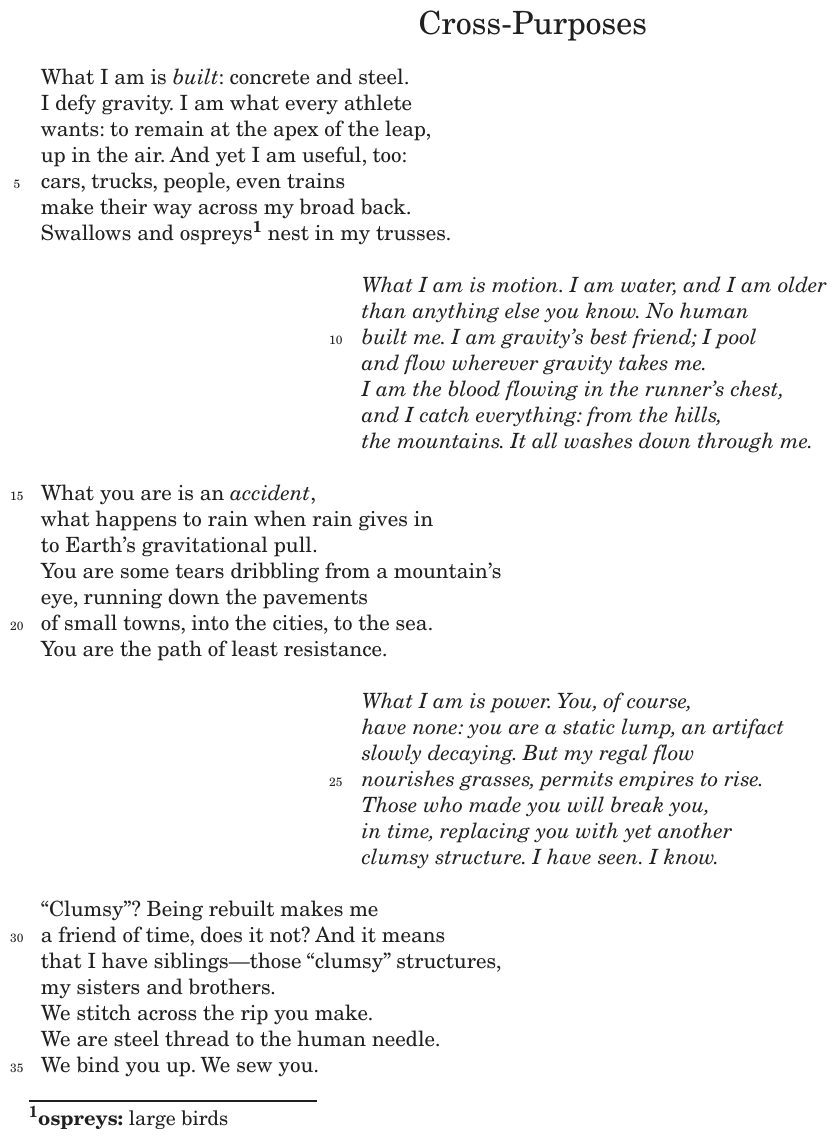
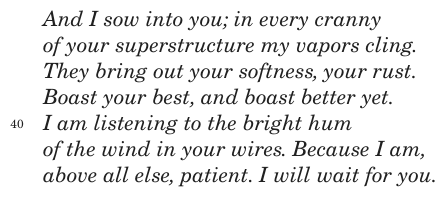
Question 103 of 120
2023 Test B Math, question 3Question
A kindergarten teacher has 72 crayons, 60 pencils, and 84 sheets of paper to distribute to the children in her class. If each child receives an equal number of each item and there are no items remaining, what is the greatest possible number of children in the class?
Grid-in question: work out the answer and enter it as a number.
Show the answer
Correct answer: 12
The greatest possible number of children in the class is the greatest common factor of 72, 60, and 84. Write the prime factorization of each number:
Then, find the factors that all three have in common, which is .
Question analysis
A kindergarten teacher shares 72 crayons, 60 pencils and 84 sheets of paper so that every child gets the same number of each item, with nothing left over. This grid-in asks for the greatest possible number of children in the class. Students must recognize a greatest common factor problem and not confuse it with a least common multiple.
- NYS standards
- 6.NS.4 common factors and multiples
- Grade level
- Grade 6 content, by NYS standard
- Compared with grade 7
- Below grade 7 Greatest common factors are grade 6 content, normally of two numbers. This one uses three numbers and a word setting that must be translated, but the factoring is short, so the demand stays below typical grade 7 work.
- Estimated difficulty
- Straightforward: two steps or one careful reading.
- Thinking it demands
- Depth of knowledge 2, skills and concepts · mainly apply
- What makes it hard
- Turning words into math moderate
- Something you must already know minor
- Solution
- 2 steps
- Reading level
- Question and choices: about grade 11, 45 words.
- Students, last 30 days
- Not enough answers yet to show (it takes 10).
Why it is hard, traps and wrong answers (shows the answer)
Why it is hard
The story has to be recognized as a sharing problem before any arithmetic starts, and the word greatest points to the largest divisor shared by all three counts. Students who spot a small shared factor can stop too soon, while those who think of a common multiple head the wrong way entirely. Checking that 72, 60 and 84 all divide by the entry, and that no larger number does, settles it.
Turning words into math moderate Understanding the question
Nothing names a greatest common factor; “each child receives an equal number of each item and there are no items remaining” means the class size must divide 72, 60 and 84 exactly. (Hegarty, Mayer & Monk, 1995; Koedinger & Nathan, 2004)
Something you must already know minor Working it out
Finding the greatest common factor of three numbers, by prime factorization or by listing factors, is a grade 6 method the question assumes rather than explains. (Anderson & Krathwohl, 2001)
Strategy: Write 72, 60 and 84 as products of primes, multiply the primes all three share, and check that each amount divides evenly by the result.
Traps
- Misunderstands the concept: A wrong belief about a concept: that percents can be added, that area grows like length, that averages can be averaged, that a bigger denominator means a bigger fraction.
- Stops one step early: A choice is a number from partway through the solution.
The wrong answers, classified
6 Stops one step early (King et al., 2004; Gierl et al., 2017)
Spots that 6 divides 72, 60 and 84 and stops there, a common factor not yet multiplied by the extra 2 that all three share.
2520 Misunderstands the concept (Smith, diSessa & Roschelle, 1993; De Bock et al., 1998; Ni & Zhou, 2005)
Finds the least common multiple of 72, 60 and 84, 2,520, confusing a number all three counts divide into with one that divides all three.
4 Stops one step early (King et al., 2004; Gierl et al., 2017)
Takes only the shared 2 × 2 from the prime factorizations and drops the factor 3 that 72, 60 and 84 also share.
Worked solution, step by step
Formulas used
- Greatest common factor
- A factor of a number divides it with nothing left over. The GCF is the greatest number that is a factor of every number in the group. A prime number has only 1 and itself as factors, like 2, 3, 5 and 7. Multiply the primes that all the numbers share, as many times as each number has them.
Sort out the question
The teacher has 72 crayons, 60 pencils and 84 sheets of paper. Every child gets the same number of each item, with none left over.
So the number of children must divide 72, 60 and 84 with no remainder. A number like that is a common factor. You need the greatest one.
Break each number into primes
Write each number as a product of primes. A product is the answer to a multiplication.
You can check each one by multiplying it back out.
Pick out the shared primes
Look for the primes that appear in all three lists. Each list has at least two 2s and one 3. Only 72 has a third 2 and a second 3. The 5 and the 7 appear in one list each.
Watch out: keep every shared prime. Using only one 2 gives 6. Leaving out the 3 gives 4.
Give the answer
Watch out: 2,520 is the smallest number that all three numbers divide into. That is the least common multiple, a different idea. The class can’t have 2,520 children when there are only 60 pencils. So you would grid 12.
Check your answer
Share the items among 12 children. Each child gets crayons, pencils and sheets. Nothing is left over. The numbers 6, 5 and 7 share no factor but 1, so no bigger class works.
More questions like this
The original DOE question
Question 104 of 120
2023 Test B Math, question 4Question
Mr. Smith opened a retirement account with a deposit of $900. This account earns 5% simple interest annually. How many years will it take for his $900 deposit to earn $360 interest?
Grid-in question: work out the answer and enter it as a number.
Show the answer
Correct answer: 8
Calculate simple interest (y) by multiplying the initial deposit (p) by the interest rate (r) by the number of years (t):
Question analysis
Mr. Smith deposits $900 in a retirement account that earns 5% simple interest each year. This grid-in asks how many years it takes for the deposit to earn $360 in interest. Students find one year's interest and then how many years add up to the total, and the percent must become the right decimal.
- Grade level
- Grade 7 content, by NYS standard
- Compared with grade 7
- At grade 7 Simple interest is grade 7 percent work, and a typical problem asks for the interest earned over a given time. This one runs the formula backward to find the time, one extra step, with friendly numbers.
- Estimated difficulty
- Straightforward: two steps or one careful reading.
- Thinking it demands
- Depth of knowledge 2, skills and concepts · mainly apply
- What makes it hard
- Solution
- 2 steps
- Reading level
- Question and choices: about grade 7, 28 words.
- Students, last 30 days
- Not enough answers yet to show (it takes 10).
Why it is hard, traps and wrong answers (shows the answer)
Why it is hard
The numbers are friendly once one year’s interest is found, so most of the difficulty is setting up the right relationship. Students who divide $360 by 5 treat the rate as a dollar amount, and students who compare $360 with $900 stop at a percent. Multiplying back, eight years of $45, confirms the $360.
Something you must already know minor Working it out
Simple interest is the deposit times the rate times the years; the stem does not give this rule, and it must be known to see that each year adds the same $45. (Anderson & Krathwohl, 2001)
Turning words into math minor Understanding the question
The question gives the total interest, $360, and asks for the time, so the usual interest calculation has to be run backward, as 45t = 360. (Hegarty, Mayer & Monk, 1995; Koedinger & Nathan, 2004)
Error-prone arithmetic minor Working it out
Writing 5% as 0.05, not 0.5 or 0.005, is the one place-value decision, and a slip there changes the yearly interest by a power of ten. (Brown & Burton, 1978; Junker & Sijtsma, 2001)
Strategy: Work out the interest for one year, 5 percent of $900, then divide the $360 target by that yearly amount.
Traps
- Stops one step early: A choice is a number from partway through the solution.
- Misunderstands the concept: A wrong belief about a concept: that percents can be added, that area grows like length, that averages can be averaged, that a bigger denominator means a bigger fraction.
- An arithmetic slip: The right method with a plausible arithmetic error: a digit, a place value or a times-table fact.
The wrong answers, classified
40 Stops one step early (King et al., 2004; Gierl et al., 2017)
Finds that $360 is 40 percent of the $900 deposit and enters 40, stopping before dividing by the 5 percent earned each year.
72 Misunderstands the concept (Smith, diSessa & Roschelle, 1993; De Bock et al., 1998; Ni & Zhou, 2005)
Reads 5% as $5 a year, a fixed amount instead of a share of the $900, and divides 360 by 5.
80 An arithmetic slip (Junker & Sijtsma, 2001)
Writes 5% as 0.005, so a year’s interest seems to be $4.50, and 360 ÷ 4.5 = 80 years.
Worked solution, step by step
Formulas used
- Simple interest
- I is the interest, the money the account earns. P is the deposit you start with. r is the yearly rate, written as a decimal. t is the number of years. With simple interest, every year earns the same amount, because it is always based on the first deposit.
Sort out the question
Mr. Smith puts $900 into an account. It earns 5% simple interest each year. Interest is extra money the bank pays you for keeping your money there. You need the number of years until the interest adds up to $360.
Write 5% as a decimal
Percent means “out of 100.” So 5% is 5 out of 100.
Watch out: 5% is not 0.5 or 0.005. Using 0.005 makes a year’s interest $4.50, and that leads to 80 years.
Find the interest for one year
Each year the account earns 5% of $900.
So it earns $45 every year. Watch out: 5% is not $5 a year. Dividing 360 by 5 gives 72, which is wrong.
Use the formula to find the years
Put the numbers into the formula. I is 360, P is 900 and r is 0.05.
To undo “times 45,” divide both sides by 45.
Give the answer
It takes 8 years. Watch out: $360 is 40% of $900. Gridding 40 stops too soon, because each year adds only 5%. So you would grid 8.
Check your answer
Add up the interest year by year. $45 a year for 8 years is dollars. Also, 8 years at 5% a year is 40%, and 40% of $900 is $360.
More questions like this
The original DOE question
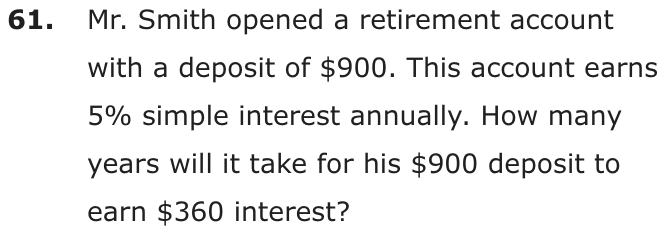
Question 105 of 120
2023 Test B Math, question 9Question
Bryan completed a 100-meter race in 11.74 seconds. Luis completed the same race in 11.69 seconds. What was the difference between their times, expressed as a fraction of a second?
- A
- B
- C
- D
Show the answer
Correct answer: A
First, subtract Luis’s time from Bryan’s time: .
Then, convert to a fraction:
.
Question analysis
Bryan ran a 100-meter race in 11.74 seconds and Luis ran the same race in 11.69 seconds. Students find the difference between their times and express it as a fraction of a second. It tests subtracting decimals and rewriting a decimal as a fraction in lowest terms.
- NYS standards
- 6.NS.3 multi-digit decimal operations
- Grade level
- Grade 6 content, by NYS standard
- Compared with grade 7
- Below grade 7 Subtracting decimals and writing a decimal as a fraction are skills from before grade 7. The two times are close, so the subtraction is quick, and the only care needed is with place value and simplifying.
- Estimated difficulty
- Routine: one familiar step, little to misread.
- Thinking it demands
- Depth of knowledge 2, skills and concepts · mainly apply
- What makes it hard
- Solution
- 2 steps
- Reading level
- Question and choices: about grade 5, 32 words.
- Students, last 30 days
- Not enough answers yet to show (it takes 10).
Why it is hard, traps and wrong answers (shows the answer)
Why it is hard
Two quick skills settle this question: lining up the decimals to subtract, and naming the result as a fraction in lowest terms. The two times differ only in their last two digits, so the subtraction is short, but it needs a borrow that some students skip. The fraction step is where a decimal’s digit gets mistaken for a denominator.
Error-prone arithmetic minor Working it out
Subtracting 11.69 from 11.74 needs a borrow in the hundredths, 14 − 9, after which the tenths cancel to 0, the step where place value goes wrong. (Brown & Burton, 1978; Junker & Sijtsma, 2001)
Something you must already know minor Working it out
The difference, 0.05, must be read as five hundredths and reduced as a fraction; the question gives no help with converting a decimal. (Anderson & Krathwohl, 2001)
Strategy: Line up the decimal points, subtract, write the difference as a number of hundredths over 100, and reduce the fraction.
Traps
- A faulty procedure: A systematic but wrong procedure: adding fractions straight across, applying an exponent to each term of a sum, dropping a sign when moving a term.
- Misunderstands the concept: A wrong belief about a concept: that percents can be added, that area grows like length, that averages can be averaged, that a bigger denominator means a bigger fraction.
The wrong answers, classified
B An arithmetic slip (Junker & Sijtsma, 2001)
Looks only at the tenths, 11.7 − 11.6 = 0.1, dropping the hundredths, a place-value slip that doubles the true gap.
C A faulty procedure (Brown & Burton, 1978; Tatsuoka, 1983)
Subtracts the smaller digit from the larger in each place, 9 − 4 = 5 and 7 − 6 = 1, getting 0.15, which is 3/20.
D Misunderstands the concept (Smith, diSessa & Roschelle, 1993; De Bock et al., 1998; Ni & Zhou, 2005)
Gets 0.05 but reads its digit 5 as a denominator, writing 1/5, instead of five hundredths, 5/100.
Worked solution, step by step
Formulas used
- Decimals as hundredths
- The second place after the decimal point is the hundredths place. So a decimal with two places counts hundredths, and you can write its digits over 100. For example, 0.37 is 37/100. Then simplify by dividing the top and bottom by the same number.
Sort out the question
Bryan ran the race in 11.74 seconds. Luis ran it in 11.69 seconds. The difference is how much longer one time is than the other. You need it as a fraction of a second.
Subtract the two times
Subtract the smaller time from the larger one. Line up the decimal points.
In the hundredths place, 4 is less than 9. So regroup: trade 1 tenth for 10 hundredths. Then 14 − 9 = 5 hundredths. The tenths are now 6 − 6 = 0.
Watch out: don’t just take the smaller digit from the larger one in each place. That gives 0.15, which is , choice C.
Write the difference as a fraction
The 5 is in the hundredths place, so 0.05 is 5 hundredths.
Now simplify. Divide the top and bottom by 5.
Give the answer
Watch out: 0.05 is not . One fifth is 0.2, which is four times as big. So the answer is A, .
Check your answer
Turn back into a decimal: . Then add it to Luis’s time: . That is Bryan’s time, so the difference is right.
More questions like this
The original DOE question
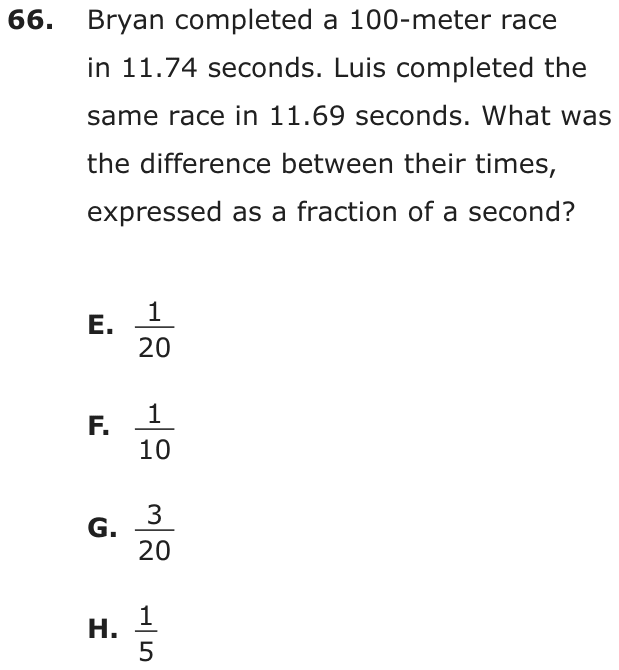
Question 106 of 120
2023 Test B Math, question 10Question
A total of 24 students in a math class took a 100-point test:
- None of the students scored 100 points.
- 75% of the students scored less than 82 points.
- The lowest score in the class was 54 points.
Which box plot best represents the test scores from this math class?
- A
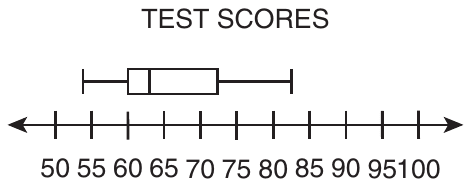
- B
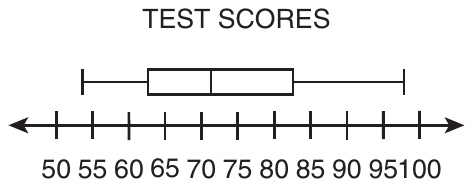
- C
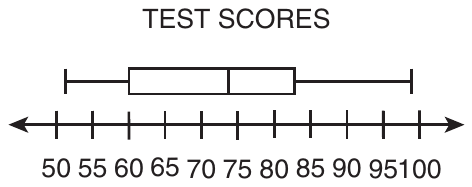
- D
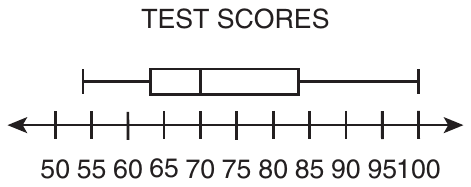
Show the answer
Correct answer: B
Use the information in the bullet points to reason which box plot could represent the data set of test scores.
Since none of the students scored 100, the maximum value on the box plot must be less than 100.
If 75% of the students scored less than 82, then 25% scored 82 points or more. Since the third quartile (Q3) indicates (75%) of the data is to the left and (25%) of the data is to the right, it is reasonable that Q3 would be at or about 82.
Given that the lowest score in the class was 54, the minimum point on the box plot must be 54.
The box plot graph in option B is the only one that meets all three criteria.
Question analysis
Twenty-four students took a 100-point test: nobody scored 100, 75% scored below 82, and the lowest score was 54. Students choose the box plot that fits all three facts. The skill is linking each statement to a part of the plot, the whiskers, the box and the quartiles, and checking every plot closely.
- NYS standards
- 7.SP.1 box plots and interquartile range
- Grade level
- Grade 7 content, by NYS standard
- Compared with grade 7
- At grade 7 Grade 7 students usually read values off a box plot. This item runs the other way, turning a percent statement into a quartile and checking the whiskers against two more facts, but the content stays at grade 7.
- Estimated difficulty
- Moderate: several steps, or a close reading with one strong distractor.
- Thinking it demands
- Depth of knowledge 2, skills and concepts · mainly analyze
- What makes it hard
- Every choice must be checked moderate
- Reading a figure, table or graph moderate
- Something you must already know minor
- Solution
- 3 steps
- Reading level
- Question and choices: about grade 2, 45 words.
- Students, last 30 days
- Not enough answers yet to show (it takes 10).
Why it is hard, traps and wrong answers (shows the answer)
Why it is hard
The question turns three sentences into three features of a box plot, and a plot that matches two of them is easy to accept. The upper-quartile fact is the conceptual one: students who do not know that the box’s right edge marks 75 percent put 82 at the end of the whisker. The other two facts are quick visual checks, but only if every plot is actually checked.
Every choice must be checked moderate Choosing the answer
Each wrong plot fails a different fact, so all four must be tested against all three bullets: the left whisker against 54, the right whisker against 100, and the box’s right edge against 82. (Embretson & Wetzel, 1987)
Reading a figure, table or graph moderate Understanding the question
The axis is labeled every 5 points, and the deciding features fall between labels: one left whisker starts near 51 instead of 54, and box edges sit near 82.5. (Lesh, Post & Behr, 1987; Kirsch & Mosenthal, 1990)
Something you must already know minor Working it out
Nothing explains that “75% of the students scored less than 82” locates the upper quartile, the right edge of the box, rather than the highest score. (Anderson & Krathwohl, 2001)
Strategy: Turn each fact into a feature to check: where the left whisker starts, where the right whisker ends, and where the box ends. Rule out any plot that breaks one.
Traps
- Misreads the question: Misses or misreads a condition or a word in the question: "at least", "each", "remaining", "not".
- Misunderstands the concept: A wrong belief about a concept: that percents can be added, that area grows like length, that averages can be averaged, that a bigger denominator means a bigger fraction.
- Misreads the figure: Reads a value, label or tick spacing in a figure, table or graph wrongly.
The wrong answers, classified
A Misunderstands the concept (Smith, diSessa & Roschelle, 1993; De Bock et al., 1998; Ni & Zhou, 2005)
Puts 82 at the end of the right whisker, as if it were the highest score, when 75 percent below 82 marks the box’s right edge.
C Misreads the figure (Lesh, Post & Behr, 1987; Kirsch & Mosenthal, 1990)
Accepts the left whisker as starting at the lowest score, 54, when it begins near 51, just past the 50 tick.
D Misreads the question (Hegarty, Mayer & Monk, 1995)
Matches the lowest score and the box’s right edge near 82 but overlooks that a whisker reaching 100 means someone scored 100.
Worked solution, step by step
Formulas used
- Parts of a box plot
- A box plot shows five numbers. The left whisker starts at the minimum, the lowest value. The box starts at Q1, the first quartile, and ends at Q3, the third quartile. The line inside is the median, the middle value. The right whisker ends at the maximum. About a quarter of the data falls in each of the four sections.
Sort out the question
24 students took a test. You know three facts. Nobody scored 100. 75% scored less than 82. The lowest score was 54. You need the box plot that fits all three facts.
Turn each fact into a feature
Match each fact to a part of the box plot.
- The lowest score is 54, so the left whisker starts at 54.
- Nobody scored 100, so the right whisker ends before 100.
- 75% is three quarters. Three quarters of the scores are below Q3. So the box should end at about 82.
Read the number line
The ticks are 5 points apart: 50, 55, 60 and so on. A score of 54 sits just left of the 55 tick. A score of 82 sits a little less than halfway from 80 to 85. Look closely, because these points fall between labels.
Check plot A
In plot A, the right whisker ends near 82, and the box ends near 72. That would make 82 the highest score. Watch out: 75% below 82 does not make 82 the top score. It tells you where the box ends. So A is out.
Check plot C
In plot C, the left whisker starts near 51, just right of the 50 tick. But the lowest score was 54. So C is out.
Check plot D
Plot D starts at 54, and its box ends near 82. But its right whisker reaches 100. That means someone scored 100, and nobody did. Watch out: D fits two facts, so it is easy to stop early. Check all three. So D is out.
Check plot B and answer
Plot B starts at 54. Its box ends near 82. Its right whisker stops near 98, below 100. It fits all three facts. So the answer is B.
Check your answer
Go over B once more with all three facts. Its lowest point is 54. Its box ends near 82. Its highest point is under 100. Each other plot breaks one fact: A’s box, C’s left whisker and D’s right whisker.
More questions like this
The original DOE question
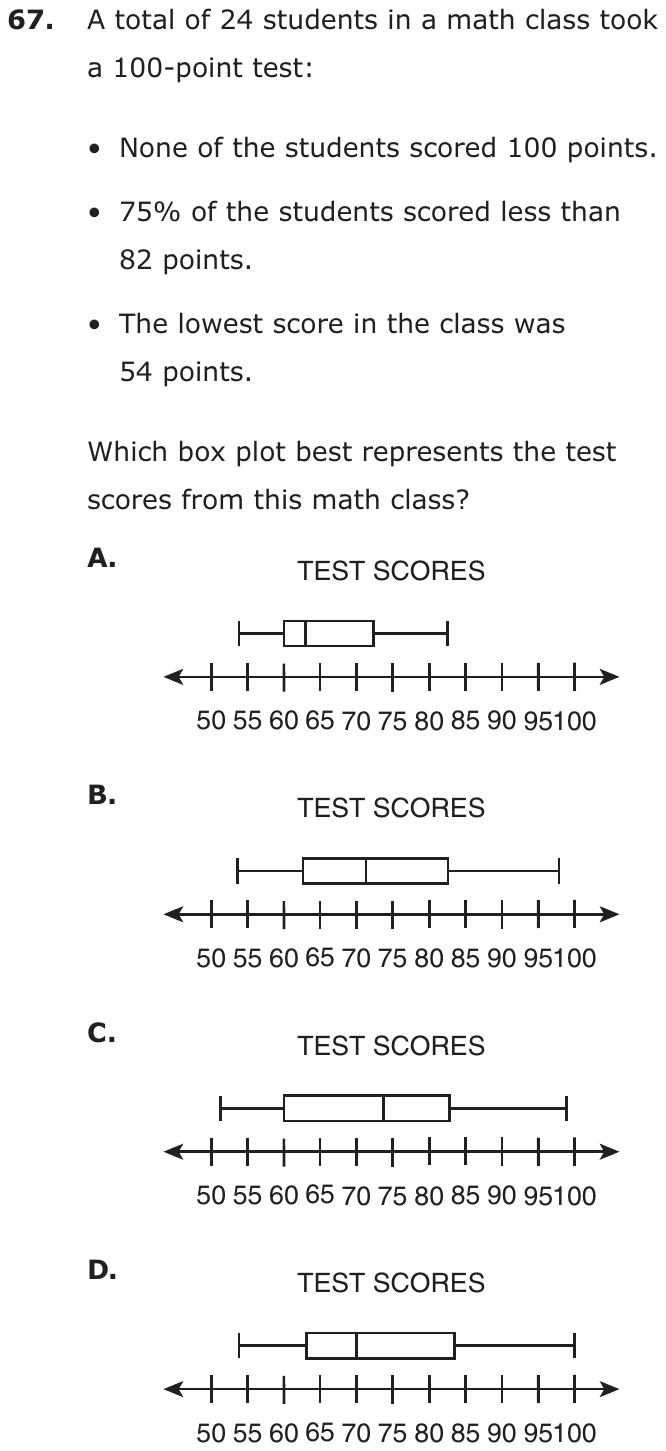
Question 107 of 120
2023 Test B Math, question 16Question
This wheel has 15 spokes, equally spaced. What is the measure of the angle between adjacent spokes?
- A30°
- B24°
- C15°
- D12°
Show the answer
Correct answer: B
The total number of degrees in a circle is 360. The measure of the angle between adjacent spokes is .
Question analysis
A wheel has 15 spokes, equally spaced around its hub, as the figure shows. Students find the measure of the angle between two neighboring spokes. The question tests knowing how many degrees make a full turn around a point and sharing them equally among the spokes.
- NYS standards
- 7.G.5 angle relationships and equations
- Grade level
- Grade 7 content, by NYS standard
- Compared with grade 7
- Below grade 7 Finding an angle by dividing a full turn into equal parts is early angle measurement. It takes one division, and the only fact needed is the number of degrees in a circle, so it sits below grade 7.
- Estimated difficulty
- Routine: one familiar step, little to misread.
- Thinking it demands
- Depth of knowledge 1, recall and reproduction · mainly apply
- What makes it hard
- Solution
- 1 step
- Reading level
- Question and choices: about grade 5, 16 words.
- Students, last 30 days
- Not enough answers yet to show (it takes 10).
Why it is hard, traps and wrong answers (shows the answer)
Why it is hard
One fact and one division answer this question, so it is among the easiest on the test. The wrong choices catch students who use a straight angle’s 180° for the full turn, who take the number of spokes as the angle, or who guess a familiar angle. Multiplying the answer by 15 to get back to 360° is a quick check.
Something you must already know minor Working it out
The question never says that a full turn is 360°; knowing it, and that the 15 spokes split it into 15 equal angles, is the whole method. (Anderson & Krathwohl, 2001)
Strategy: The spokes split the full turn around the hub into 15 equal angles, so divide the number of degrees in a circle by 15.
Traps
- Wrong formula: Uses a related but wrong formula: perimeter for area, diameter for radius, area for volume, or a misremembered one.
- Numbers taken from the question: Combines the numbers in the question without a model of the situation, or is simply a number that appears in the question.
The wrong answers, classified
A Little reason to choose it (Haladyna & Downing, 1993; Rodriguez, 2005)
No working with 15 spokes gives 30°, which is 360 ÷ 12, the angle between hours on a clock, so it mostly draws guesses at a familiar angle.
C Numbers taken from the question (Hegarty, Mayer & Monk, 1995)
Takes the number of spokes, 15, as the angle in degrees, matching a number in the question without any calculation.
D Wrong formula (King et al., 2004)
Divides 180 by 15, using a straight angle’s 180° as the full turn around the hub instead of 360°.
Worked solution, step by step
Formulas used
- Equal angles around a point
- One full turn around a point is 360 degrees. If lines from the point split that turn into equal angles, each angle gets the same share. So divide 360 by how many angles there are.
Sort out the question
The wheel has 15 spokes. They all start at the hub, the center of the wheel, and they are equally spaced. Adjacent spokes are spokes right next to each other. You need the angle between two adjacent spokes.
Count the angles around the hub
Go once around the hub. Between each spoke and the next is one angle. So 15 spokes make 15 angles, all the same size. Together they make one full turn, which is 360 degrees.
Watch out: a full turn is 360 degrees, not 180. Using 180 gives 12 degrees, choice D.
Share the full turn
Use the formula for equal angles.
Each angle is 24 degrees. Watch out: 15 is the number of spokes, not the size of the angle, so choice C is wrong. So the answer is B, 24°.
Check your answer
Multiply back: 15 angles of 24 degrees make degrees, a full turn. Also, a clock’s 12 hour marks are 30 degrees apart. This wheel has more spokes than that, so each angle must be smaller than 30 degrees.
More questions like this
The original DOE question
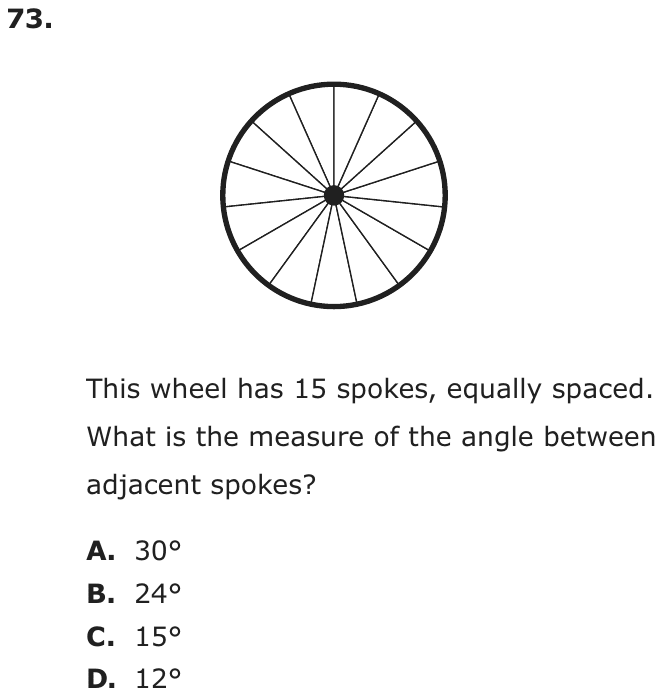
Question 108 of 120
2023 Test B Math, question 21Question
If m and n are positive integers, how many of the five expressions above are equivalent to ?
- A1
- B2
- C3
- D4
Show the answer
Correct answer: D
Since m and n are positive, the value of is also positive. Of the five options given:
is negative.
is positive.
is positive.
is positive.
is positive.
There are 4 expressions that are positive, and each one is equal to .
Question analysis
Five expressions are listed: −mn, (−m)(−n), |mn|, |−mn| and |(−m)(−n)|. If m and n are positive integers, students count how many are equivalent to mn. It tests the sign rules for multiplying negatives together with what absolute value does, and each expression has to be judged on its own.
- Grade level
- Grade 7 content, by NYS standard
- Compared with grade 7
- At grade 7 Multiplying signed numbers and absolute value are grade 6 and 7 content. Checking five expressions one by one takes longer than a typical single computation, but each check uses a familiar rule.
- Estimated difficulty
- Moderate: several steps, or a close reading with one strong distractor.
- Thinking it demands
- Depth of knowledge 2, skills and concepts · mainly analyze
- What makes it hard
- Variables instead of numbers moderate
- Much to keep track of minor
- Something you must already know minor
- Solution
- 5 steps
- Reading level
- Question and choices: about grade 10, 23 words.
- Students, last 30 days
- Not enough answers yet to show (it takes 10).
Why it is hard, traps and wrong answers (shows the answer)
Why it is hard
Each expression takes only a moment, but the answer is a count, so one misjudged expression changes it. The minus signs are designed to unsettle: four of the five expressions show at least one, and only one of those actually stays negative. Substituting small positive numbers and comparing each value with mn turns the question into arithmetic.
Variables instead of numbers moderate Understanding the question
The five expressions use only m and n, so each sign rule has to be applied in general unless the student substitutes values such as m = 2 and n = 3. (Koedinger & Nathan, 2004; Enright, Morley & Sheehan, 2002)
Much to keep track of minor Working it out
Five expressions are judged one at a time and a count kept, and two of them combine the product rule for negatives with absolute value bars. (Sweller, 1988; Carpenter, Just & Shell, 1990)
Something you must already know minor Working it out
The rules that two negative factors give a positive product and that absolute value removes a minus sign are assumed, not stated. (Anderson & Krathwohl, 2001)
Strategy: Pick small values such as m = 2 and n = 3, evaluate each of the five expressions, and count the ones equal to 6.
Traps
- Negatives and direction: Arithmetic with negative numbers, the order of a subtraction, or direction on a number line. (Moving a term across the equals sign without changing its sign is a faulty procedure.)
- Misunderstands the concept: A wrong belief about a concept: that percents can be added, that area grows like length, that averages can be averaged, that a bigger denominator means a bigger fraction.
The wrong answers, classified
A Negatives and direction (Brown & Burton, 1978)
Treats any minus sign as making the value negative, even inside bars or in a product of two negatives, so counts only |mn|.
B Misunderstands the concept (Smith, diSessa & Roschelle, 1993; De Bock et al., 1998; Ni & Zhou, 2005)
Accepts |mn| and (−m)(−n) but believes bars cannot cancel a minus sign written inside them, rejecting |−mn| and |(−m)(−n)|.
C Negatives and direction (Brown & Burton, 1978)
Thinks a negative times a negative stays negative, so rejects (−m)(−n) along with −mn and counts only the three absolute values.
Worked solution, step by step
Formulas used
- Multiplying two negatives
- a and b are positive numbers. A negative number times a negative number gives a positive number. The two minus signs cancel out. One negative and one positive give a negative.
- Absolute value
- The bars around a number mean absolute value. It is how far the number is from 0 on a number line. A distance is never negative, so |−6| = 6 and |6| = 6. The bars remove any minus sign.
Sort out the question
m and n are positive integers. That means whole numbers greater than 0. Writing mn means m times n, so mn is positive. You need to count how many of the five expressions always equal mn.
Pick numbers to test
Pick easy values: and . Then . Any expression that equals mn must come out to 6.
Test the first two expressions
This is negative, so it does not equal 6.
A negative times a negative is positive, so this one equals 6. Watch out: if you think a negative times a negative stays negative, you reject this one and get 3, choice C.
Test the three absolute values
All three equal 6, because absolute value bars remove a minus sign. Watch out: the bars work even when the minus sign is inside them. Rejecting the last two gives 2, choice B.
Count the matches
Four expressions equal mn: , , and . Only does not. The sign rules work the same for any positive m and n, not just 2 and 3. So the answer is D, 4.
Check your answer
Try other numbers, such as and . Then . The five expressions give −5, 5, 5, 5 and 5. Again, four of them match mn.
More questions like this
The original DOE question
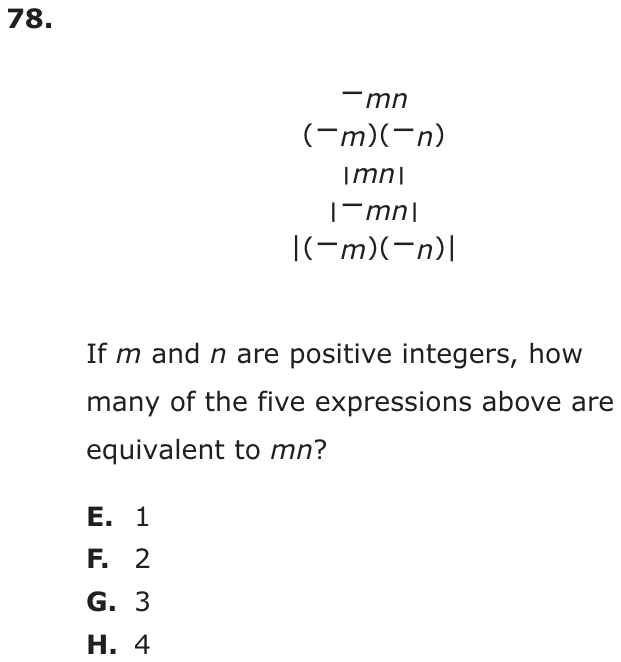
Question 109 of 120
2023 Test B Math, question 24Question
A prism is made up of 9 congruent cubes. Each of the cubes has side lengths measuring 4 units. What is the volume, in cubic units, of the prism?
- A108
- B144
- C480
- D576
Show the answer
Correct answer: D
First, determine the volume of each congruent cube. All the side lengths of the cubes are equal, so the length, width, and height of each cube is 4 units. To determine the volume of each cube, multiply :
So, the volume of each cube is 64 cubic units.
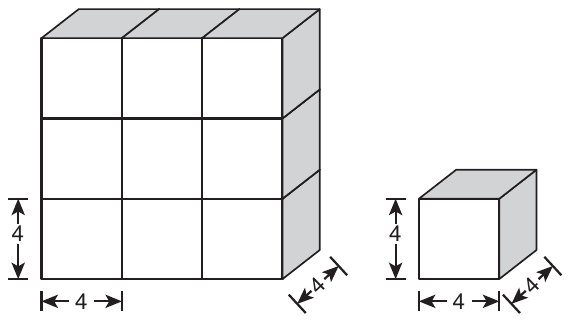
The prism is comprised of 9 of these cubes, so multiply the volume of each cube (64) by the total number of cubes (9) to determine the volume, in cubic units, of the prism:
Question analysis
A prism is built from 9 identical cubes, and each cube has edges 4 units long. Students find the volume of the prism in cubic units. It tests the volume of a cube and how volumes add when solids are put together, and it rewards keeping area, surface area and volume apart.
- Grade level
- Grade 6 content, by NYS standard
- Compared with grade 7
- Below grade 7 Volume of cubes and rectangular prisms is grade 5 and 6 content. This item needs one cube's volume and a multiplication by 9, two short steps, so it is below typical grade 7 work.
- Estimated difficulty
- Routine: one familiar step, little to misread.
- Thinking it demands
- Depth of knowledge 1, recall and reproduction · mainly apply
- What makes it hard
- Solution
- 2 steps
- Reading level
- Question and choices: about grade 3, 27 words.
- Corrected from the DOE handbook
- A letter x printed in place of a multiplication sign in the explanation was corrected.
- Students, last 30 days
- Not enough answers yet to show (it takes 10).
Why it is hard, traps and wrong answers (shows the answer)
Why it is hard
The question needs one formula and one multiplication, and the stem does not even say how the cubes are arranged, because the volume does not depend on it. The wrong choices come from mishandling the cube’s volume: the exponent multiplied instead of applied, the area of one face, or a surface area. Writing the volume out as edge times edge times edge, in cubic units, rules all three out.
Something you must already know minor Working it out
A cube’s volume, edge × edge × edge, is not given; with it, each 4-unit cube holds 64 cubic units, and the arrangement of the 9 cubes does not matter. (Anderson & Krathwohl, 2001)
Strategy: Find the volume of one cube by multiplying its three edges, then multiply by the number of cubes; how the cubes are arranged does not matter.
Traps
- Wrong formula: Uses a related but wrong formula: perimeter for area, diameter for radius, area for volume, or a misremembered one.
- A faulty procedure: A systematic but wrong procedure: adding fractions straight across, applying an exponent to each term of a sum, dropping a sign when moving a term.
The wrong answers, classified
A A faulty procedure (Brown & Burton, 1978; Tatsuoka, 1983)
Takes 4³ as 4 × 3 = 12, multiplying the edge by the exponent, so each cube seems to hold 12 cubic units and 9 × 12 = 108.
B Wrong formula (King et al., 2004)
Uses the area of one face, 4 × 4 = 16 square units, as each cube’s volume, so 9 × 16 = 144.
C Wrong formula (King et al., 2004)
Pictures the 9 cubes as a 3-by-3 slab, 12 by 12 by 4 units, and finds its surface area, 480 square units, instead of its volume.
What was corrected from the DOE handbook, and why
- Explanation: The handbook gives the volume of a cube as “length x width x height”, with the letter x where it means “times”. In a math explanation the letter x reads as a variable, so the site writes length × width × height, the sign the handbook itself uses on the next line (4 × 4 × 4 = 64). Nothing else changes: each cube is 64 cubic units, and the 9 cubes make 64 × 9 = 576.
Worked solution, step by step
Formulas used
- Volume of a cube
- V is the volume, the space inside a solid, in cubic units. s is the length of one edge. All the edges of a cube are equal, so its length, width and height are all s. Multiplying them counts how many unit cubes fit inside.
Sort out the question
A prism, a solid with flat faces, is made of 9 congruent cubes. Congruent means exactly the same size and shape. Each cube has sides of 4 units. You need the volume of the whole prism, in cubic units.
The question doesn’t say how the cubes are stacked. You don’t need to know. Volume is the space inside, and 9 cubes fill the same space however they are arranged.
Find the volume of one cube
Each cube has a volume of 64 cubic units. Watch out: means , not . That slip leads to 108, choice A. Also, is only the area of one face. It leads to 144, choice B.
Multiply by the number of cubes
The prism is 9 of these cubes, so its volume is 9 times as big.
The prism’s volume is 576 cubic units.
Give the answer
Watch out: volume counts the space inside, not the outside faces. Suppose the cubes formed one flat 3-by-3 layer. Adding up the areas of its outside faces gives 480, choice C. That is surface area, not volume. So the answer is D, 576.
Check your answer
Estimate: , and one cube fewer is . You can also test one arrangement. A flat 3-by-3 layer is 12 by 12 by 4 units, and . Same answer.
More questions like this
The original DOE question
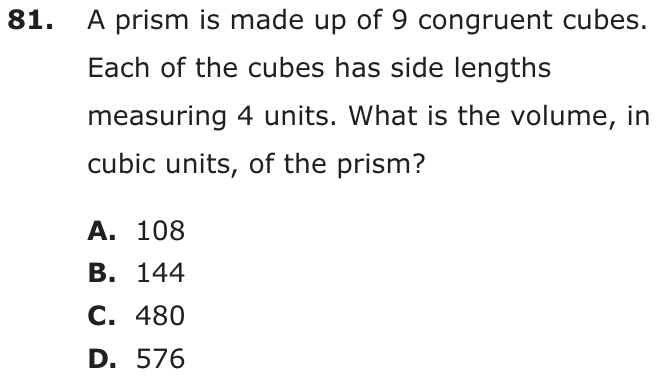
Question 110 of 120
2023 Test B Math, question 26Question
The box plot below represents a set of data.

What is the interquartile range of the set of data?
- A9
- B12
- C21
- D27
Show the answer
Correct answer: C
First, determine the values of the upper and lower quartiles of the set of data:
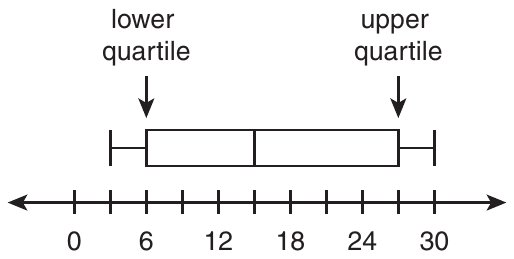
- The upper quartile value is indicated by the vertical line segment at the far right edge of the box plot above the hash mark representing 27.
- The lower quartile value is indicated by the vertical line segment at the far left edge of the box plot above the hash mark representing 6.
To determine the interquartile range, subtract the lower quartile value (6) from the upper quartile value (27):
Question analysis
A box plot on a number line marked every 3 units, with labels every 6, represents a set of data. Students find the interquartile range. They have to read the two ends of the box, one of which falls on an unlabeled tick, and remember exactly which part of the plot the interquartile range measures.
- NYS standards
- 7.SP.1 box plots and interquartile range
- Grade level
- Grade 7 content, by NYS standard
- Compared with grade 7
- At grade 7 Finding the interquartile range from a box plot is a grade 7 skill, and this is a typical example. Read two values and subtract; the only extra care is a box edge that falls on a tick with no label.
- Estimated difficulty
- Straightforward: two steps or one careful reading.
- Thinking it demands
- Depth of knowledge 1, recall and reproduction · mainly apply
- What makes it hard
- Solution
- 2 steps
- Reading level
- Question and choices: about grade 6, 19 words.
- Students, last 30 days
- Not enough answers yet to show (it takes 10).
Why it is hard, traps and wrong answers (shows the answer)
Why it is hard
Once the two edges of the box are read, one subtraction finishes the question, so the work is reading the scale and knowing which part of the plot is meant. The upper quartile falls on an unlabeled tick, which costs care. The wrong answers measure the whole spread or only half of the box, all common mix-ups of what the interquartile range covers.
Reading a figure, table or graph moderate Understanding the question
The axis is labeled only every 6 units but ticked every 3, and the box’s right edge sits on the unlabeled tick for 27, so it has to be counted from 24. (Lesh, Post & Behr, 1987; Kirsch & Mosenthal, 1990)
Something you must already know minor Working it out
Nothing defines the interquartile range; it is the width of the box, the upper quartile minus the lower, not the span of the whiskers. (Anderson & Krathwohl, 2001)
Strategy: Find the values at the left and right edges of the box, counting tick marks in steps of 3 where there is no label, and subtract the smaller from the larger.
Traps
- Wrong formula: Uses a related but wrong formula: perimeter for area, diameter for radius, area for volume, or a misremembered one.
The wrong answers, classified
A Wrong formula (King et al., 2004)
Gives the median minus the lower quartile, 15 − 6 = 9, as the interquartile range, measuring only the left part of the box.
B Wrong formula (King et al., 2004)
Gives the upper quartile minus the median, 27 − 15 = 12, as the interquartile range, measuring only the right part of the box.
D Wrong formula (King et al., 2004)
Subtracts the ends of the whiskers, 30 − 3 = 27, giving the range of the data instead of the interquartile range.
Worked solution, step by step
Formulas used
- Interquartile range
- IQR stands for interquartile range. Q3, the third quartile, is the right edge of a box plot’s box. Q1, the first quartile, is the left edge. Subtracting gives the width of the box, where the middle half of the data lies.
Sort out the question
You see a box plot and need the interquartile range, or IQR. That is the width of the box: the upper quartile minus the lower quartile. The whiskers don’t matter here.
Read the number line
The labels are 0, 6, 12, 18, 24 and 30. But there is a tick mark halfway between each pair of labels. So the ticks go up by 3: 0, 3, 6, 9 and so on. The tick between 24 and 30 stands for 27.
Find the edges of the box
The left edge of the box is at 6. That is the lower quartile, Q1. The right edge is at the unlabeled tick after 24, which is 27. That is the upper quartile, Q3.
Subtract to find the IQR
Watch out: uses the ends of the whiskers. That is the range, choice D. Also, the median line at 15 splits the box. and are each only part of the box. So the answer is C, 21.
Check your answer
Count the tick spaces across the box, from 6 to 27. There are 7 spaces, and each is worth 3. So the box is units wide. That matches.
More questions like this
The original DOE question
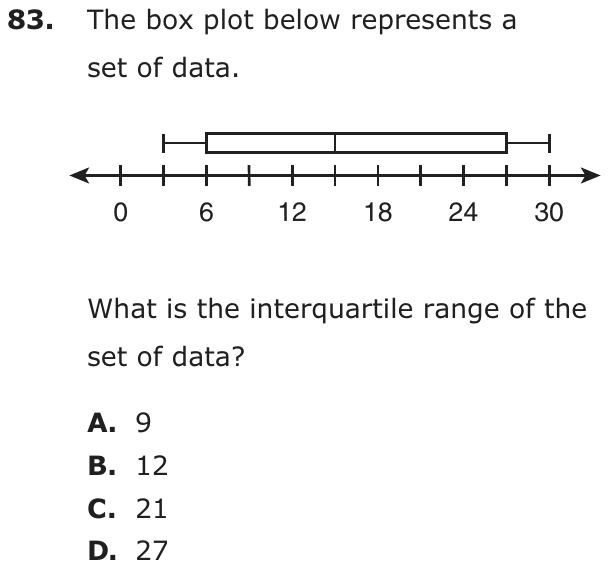
Question 111 of 120
2023 Test B Math, question 30Question
PRICE OF A USED VIDEO GAME AT VARIOUS STORES
| Price of Used Video Game | Number of Stores |
|---|---|
| $10.99 | 5 |
| $11.99 | 2 |
| $12.99 | 1 |
| $13.99 | 4 |
The table above shows the price of a certain used video game at 12 different stores. What is the median price of this video game?
- A$10.99
- B$11.49
- C$11.99
- D$12.32
Show the answer
Correct answer: C
There are 5 stores where the video game is priced at $10.99 and a total of 5 stores where it is priced at either $12.99 or $13.99, so the median price must be $11.99.
Question analysis
A statistics question with a table showing the price of a used video game at 12 stores, grouped by price, and asking for the median price. Students put the prices in order using the number of stores at each price and find the middle. The table gives counts rather than a list, so the position of the middle value has to be worked out from the running totals.
- Grade level
- Grade 6 content, by NYS standard
- Compared with grade 7
- At grade 7 Finding a median is grade 6 work that grade 7 students meet often. The twist is the frequency table: the 12 prices are not listed one by one, so students count positions instead of reading down a list.
- Estimated difficulty
- Straightforward: two steps or one careful reading.
- Thinking it demands
- Depth of knowledge 2, skills and concepts · mainly apply
- What makes it hard
- Solution
- 2 steps
- Reading level
- Question and choices: about grade 4, 40 words.
- Students, last 30 days
- Not enough answers yet to show (it takes 10).
Why it is hard, traps and wrong answers (shows the answer)
Why it is hard
The arithmetic is trivial once the positions are found: counting down 5 stores at $10.99 and then 2 at $11.99 puts both the 6th and 7th prices at $11.99. The wrong choices reward three different misreadings of a frequency table: the most common price, a middle pair one place too early, and the mean, which takes a long computation to reach. A student who writes the running totals 5, 7, 8 and 12 beside the table avoids all three.
Reading a figure, table or graph moderate Understanding the question
The 12 prices are never listed; the table gives four prices with store counts of 5, 2, 1 and 4, so the 6th and 7th prices must be found by a running count. (Lesh, Post & Behr, 1987; Kirsch & Mosenthal, 1990)
Something you must already know minor Working it out
With 12 values the median is the mean of the 6th and 7th in order, a rule the question assumes; here both fall in the $11.99 row, so no averaging is needed. (Anderson & Krathwohl, 2001)
Strategy: Keep a running total of the store counts down the table; with 12 prices in order, the median is the average of the 6th and 7th, so find the rows where they fall.
Traps
- Answers a different question: A choice is right for another quantity: the other unknown, the rest instead of the part, the part instead of the whole.
- Counting the ends: Inclusive or exclusive ends, fence posts, consecutive numbers: an answer that is one too many or too few, or an endpoint drawn open where it belongs closed (or the reverse).
The wrong answers, classified
A Answers a different question (King et al., 2004; Hegarty, Mayer & Monk, 1995)
Gives the mode, $10.99, the price that 5 stores charge, more than any other, instead of the middle price of the 12.
B Counting the ends (Brown & Burton, 1978)
Knows to average two middle prices but takes the 5th and 6th instead of the 6th and 7th, averaging $10.99 and $11.99 to get $11.49.
D Answers a different question (King et al., 2004; Hegarty, Mayer & Monk, 1995)
Computes the mean instead, $147.88 for all 12 prices divided by 12, about $12.32, a different measure of center from the median asked for.
Worked solution, step by step
Formulas used
- Median of an even number of values
- The median is the middle value when all the values are listed from least to greatest. With an even number of values, no single value sits in the middle. So take the two middle values and find their average: add them and divide by 2.
Sort out the table
Each row gives a price and how many stores charge it. For example, 5 stores charge $10.99. So $10.99 shows up 5 times in the list of prices. Add the stores to check the count.
There are 12 prices. You need the median. That is the middle price when the prices are in order from least to greatest.
Find the middle places
12 is an even number, so no single price sits in the middle. The two middle prices are the 6th and the 7th. Five prices come before the 6th one. Five prices come after the 7th one.
Count down the table
The table already lists the prices from least to greatest. Keep a running total of the stores. It shows which places in the list each price fills.
Price Stores Places in the list $10.99 5 1st to 5th $11.99 2 6th and 7th $12.99 1 8th $13.99 4 9th to 12th The 6th and 7th prices are both $11.99.
Find the median
Use the formula with the 6th and 7th prices.
The median price is $11.99.
Watch out: $10.99 is the mode, the price that shows up most often. That is choice A, not the median. Averaging the 5th and 6th prices gives $11.49, choice B. Adding all 12 prices and dividing by 12 gives the mean, about $12.32. That is choice D.
So the answer is C, $11.99.
Check your answer
Count the prices on each side of $11.99. Five stores charge less: the five at $10.99. Five stores charge more: one at $12.99 and four at $13.99. The two sides match, so $11.99 is in the middle.
More questions like this
The original DOE question
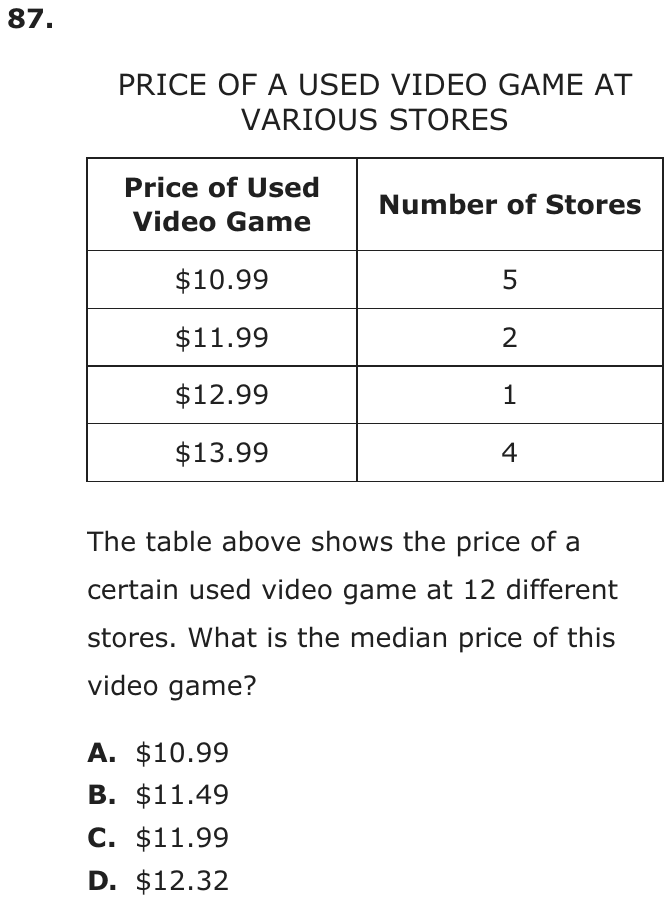
Question 112 of 120
2023 Test B Math, question 34Question
There are 3 different highways from City W to City X, 4 different highways from City X to City Y, and 3 different highways from City Y to City Z. How many different routes are there for a trip from City W to City X to City Y to City Z?
- A10
- B12
- C24
- D36
Show the answer
Correct answer: D
Multiply the numbers of highways between each pair of cities:
Question analysis
A counting question about highways: there are 3 highways from City W to City X, 4 from X to Y and 3 from Y to Z. Students count the different routes from W to Z through X and Y. It tests the counting principle, and deciding whether to add or multiply the numbers of highways is the key.
- NYS standards
- 7.SP.8b sample spaces for compound events
- Grade level
- Grade 7 content, by NYS standard
- Compared with grade 7
- Below grade 7 Grade 7 students build tree diagrams and lists for compound events. This item needs only the counting principle across three stages, with no restriction on the choices, which makes it shorter than typical grade 7 work.
- Estimated difficulty
- Routine: one familiar step, little to misread.
- Thinking it demands
- Depth of knowledge 2, skills and concepts · mainly apply
- What makes it hard
- Solution
- 1 step
- Reading level
- Question and choices: about grade 11, 48 words.
- Students, last 30 days
- Not enough answers yet to show (it takes 10).
Why it is hard, traps and wrong answers (shows the answer)
Why it is hard
Once a route is seen as one highway on each of three stretches, the count is a single product, 3 × 4 × 3. The wrong choices come from adding the counts, from stopping after two stretches, and from adding two-stretch products. A small tree for the first two stretches shows why the numbers multiply: each of the 3 highways to City X branches into 4.
Something you must already know minor Working it out
The counting principle, multiplying the 3, 4 and 3 highway choices because each route uses one highway on every stretch, is assumed; the stem never says to multiply. (Anderson & Krathwohl, 2001)
Strategy: A route uses one highway on each of the three stretches, so count the choices for each stretch and multiply; a small tree for two stretches shows why.
Traps
- Wrong operation: Adds instead of multiplying, divides the wrong way round, turns a ratio or rate upside down, or undoes a step in the wrong direction (subtracts what should be added back).
- Stops one step early: A choice is a number from partway through the solution.
The wrong answers, classified
A Wrong operation (Hegarty, Mayer & Monk, 1995; King et al., 2004)
Adds the highways, 3 + 4 + 3 = 10, counting the roads available rather than the ways to choose one road on each stretch.
B Stops one step early (King et al., 2004; Gierl et al., 2017)
Multiplies the first two stretches, 3 × 4 = 12 routes from City W to City Y, and stops before the 3 highways on to City Z.
C Wrong operation (Hegarty, Mayer & Monk, 1995; King et al., 2004)
Counts routes two stretches at a time, 3 × 4 = 12 for W to Y and 4 × 3 = 12 for X to Z, and adds them instead of multiplying all three.
Worked solution, step by step
Formulas used
- Counting principle
- a, b and c are the numbers of choices for the first, second and third parts of a task. Every choice for one part can go with every choice for the others. So you multiply. Use it when you make one choice at each stage and want to count all the ways.
Sort out the trip
A route goes from City W to X, then to Y, then to Z. It uses exactly one highway on each of three stretches:
- W to X: 3 highways
- X to Y: 4 highways
- Y to Z: 3 highways
You need to count all the different routes.
Count routes from W to Y
Start small. Pick any of the 3 highways to City X. From there, you can take any of the 4 highways to City Y. So each first highway leads to 4 routes.
There are 12 routes from City W to City Y.
Add the last stretch
Each of those 12 routes can end with any of the 3 highways to City Z. So multiply again. This is the counting principle with all three stretches.
There are 36 routes in all.
Avoid the common traps
Watch out: Adding 3 + 4 + 3 = 10 counts highways, not routes. That gives choice A. Stopping at 12 forgets the last stretch, choice B. Adding 12 + 12 = 24 mixes two partial counts, choice C. A route is built by choosing one highway after another, so you multiply.
So the answer is D, 36.
Check your answer
Picture one highway from W to X. After it, there are 4 × 3 = 12 ways to finish the trip. Each of the 3 highways from W to X gives 12 ways. That makes 12 + 12 + 12 = 36 routes.
More questions like this
The original DOE question
Question 113 of 120
2023 Test B Math, question 40Question
Angle A and angle B are complementary. If the measure of angle B is three times as great as the measure of angle A, what is the measure of angle B?
- A45°
- B67.5°
- C75°
- D135°
Show the answer
Correct answer: B
Let A represent the measure of angle A, and let B represent the measure of angle B, in degrees. Since the angles are complementary, . The question states that , or . Substitute that expression for A in the first equation and solve for B:
Question analysis
A geometry question about two complementary angles, where angle B is three times as large as angle A. Students find the measure of angle B. They must recall what complementary means, since the question does not say, and set up an equation that splits the total in the right proportion.
- Grade level
- Grade 7 content, by NYS standard
- Compared with grade 7
- At grade 7 Writing and solving an equation from complementary angles is a grade 7 standard. This is the familiar version without a figure: one equation from the definition, then a division and a multiplication, typical of grade 7 classwork.
- Estimated difficulty
- Straightforward: two steps or one careful reading.
- Thinking it demands
- Depth of knowledge 2, skills and concepts · mainly apply
- What makes it hard
- Something you must already know moderate
- Turning words into math minor
- Solution
- 3 steps
- Reading level
- Question and choices: about grade 7, 31 words.
- Students, last 30 days
- Not enough answers yet to show (it takes 10).
Why it is hard, traps and wrong answers (shows the answer)
Why it is hard
Once complementary is read as a 90° total, the problem is one equation with a decimal answer, 4A = 90. The 22.5° for angle A is not listed, so stopping at the smaller angle is not rewarded here, but using 180° is: it gives 45° and 135°, and both appear among the choices. Checking that the chosen angle and one third of it add to 90° settles it.
Something you must already know moderate Working it out
The stem never says what complementary means; the 90° total has to be recalled, and a student who confuses it with the supplementary 180° doubles both angles. (Anderson & Krathwohl, 2001)
Turning words into math minor Understanding the question
The clause “the measure of angle B is three times as great as the measure of angle A” has to become B = 3A, so the 90° splits into four equal parts, not three. (Hegarty, Mayer & Monk, 1995; Koedinger & Nathan, 2004)
Strategy: Recall the total that complementary angles share, think of angle A as one part and angle B as three parts, find one part, then multiply for angle B.
Traps
- Wrong formula: Uses a related but wrong formula: perimeter for area, diameter for radius, area for volume, or a misremembered one.
- Misreads the question: Misses or misreads a condition or a word in the question: "at least", "each", "remaining", "not".
The wrong answers, classified
A Misreads the question (Hegarty, Mayer & Monk, 1995)
Splits the 90° evenly, 90 ÷ 2 = 45, using the complementary total but ignoring that angle B is three times angle A.
C Little reason to choose it (Haladyna & Downing, 1993; Rodriguez, 2005)
No common working gives 75°, which would need angle A to be 25° and the pair to add to 100°; it mostly draws guesses.
D Wrong formula (King et al., 2004)
Uses 180°, the supplementary total, so 4A = 180 gives angle A = 45° and angle B = 135°, a pair that is not complementary.
Worked solution, step by step
Formulas used
- Complementary angles
- A and B are the measures of the two angles, in degrees. Complementary angles are two angles that add up to 90 degrees, the size of a square corner. Use this whenever a problem says two angles are complementary.
Sort out the question
Complementary angles are two angles that add up to 90 degrees. Angle B is three times as big as angle A. You need the measure of angle B, in degrees.
Write the facts as equations
Let A and B stand for the two measures. The angles are complementary, so use the formula.
Angle B is three times angle A, so:
Put 3A in place of B
Replace B in the sum with 3A. Then there is only one letter to find.
Think of it as 4 equal parts. Angle A is 1 part, and angle B is 3 parts.
Find angle A
Divide both sides by 4.
Angle A measures 22.5 degrees. That is not the answer yet, because the question asks for angle B.
Find angle B
Angle B is three times angle A.
Angle B measures 67.5 degrees.
Watch out: Angles that add to 180 degrees are called supplementary. Using 180 by mistake gives 45 and 135, choice D. Splitting 90 in half gives 45, choice A. That ignores the fact that B is three times A.
So the answer is B, 67.5°.
Check your answer
Add the two angles: 22.5 + 67.5 = 90. So they are complementary. Now divide: 67.5 ÷ 22.5 = 3. So angle B is three times angle A. Both facts check out.
More questions like this
The original DOE question
Question 114 of 120
2023 Test B Math, question 41Question
The height of a tree in 2013 is 300% of the height it was in 2003. By what percentage did its height increase over this ten-year period?
- A
- B100%
- C200%
- D300%
Show the answer
Correct answer: C
Let h represent the height of the tree in 2003. Then the height of the tree in 2013 is . Calculate the percent increase:
Question analysis
A percent question about a tree whose height in 2013 is 300% of its height in 2003. Students find the percent increase over the ten years. No heights are given, so the key is telling the difference between a percent of an amount and a percent change.
- Grade level
- Grade 7 content, by NYS standard
- Compared with grade 7
- Above grade 7 Grade 7 percent-increase problems give two amounts to compare. This gives only a percent of the earlier height and no heights at all, so students must work out what that percent means for the change with nothing concrete to calculate with.
- Estimated difficulty
- Hard: combines ideas, needs a plan, and has more than one tempting wrong answer.
- Thinking it demands
- Depth of knowledge 2, skills and concepts · mainly apply
- What makes it hard
- Turning words into math moderate
- Variables instead of numbers moderate
- Something you must already know minor
- Solution
- 2 steps
- Reading level
- Question and choices: about grade 3, 25 words.
- Students, last 30 days
- Not enough answers yet to show (it takes 10).
Why it is hard, traps and wrong answers (shows the answer)
Why it is hard
The stem hands students a percent and asks for a different percent, and the given 300% looks like a finished answer. The real step is separating “300% of” from “increased by”: a height that triples has grown by twice its original size. Picking a 2003 height of 100 units makes it concrete, since 300 − 100 = 200 units of growth on a base of 100.
Turning words into math moderate Understanding the question
“300% of the height it was in 2003” describes the new height, three times the old, not the increase; the question then asks for the change, which is a different percent. (Hegarty, Mayer & Monk, 1995; Koedinger & Nathan, 2004)
Variables instead of numbers moderate Understanding the question
No heights are given, only a percent, so students must invent a height such as 100 units or work with h and 3h to measure the change. (Koedinger & Nathan, 2004; Enright, Morley & Sheehan, 2002)
Something you must already know minor Working it out
A percent increase divides the change by the starting amount, (3h − h) ÷ h, a rule the question assumes without stating. (Anderson & Krathwohl, 2001)
Strategy: Call the 2003 height 100 units, find the 2013 height from the percent given, then divide the change by the 2003 height and write the result as a percent.
Traps
- Answers a different question: A choice is right for another quantity: the other unknown, the rest instead of the part, the part instead of the whole.
- Wrong operation: Adds instead of multiplying, divides the wrong way round, turns a ratio or rate upside down, or undoes a step in the wrong direction (subtracts what should be added back).
The wrong answers, classified
A Wrong operation (Hegarty, Mayer & Monk, 1995; King et al., 2004)
Divides the 2003 height by the 2013 height, h ÷ 3h = 1/3, turning the comparison upside down and reporting 33 1/3%.
B Little reason to choose it (Haladyna & Downing, 1993; Rodriguez, 2005)
No common working gives 100%, which would mean the height only doubled; it echoes the 100% that the 2003 height stands for, so it mostly draws guesses.
D Answers a different question (King et al., 2004; Hegarty, Mayer & Monk, 1995)
Reads “300% of” as an increase of 300%, giving the 2013 height as a percent of the 2003 height instead of the percent increase.
Worked solution, step by step
Formulas used
- Percent increase
- Original is the starting amount. New is the amount after the change. New minus original is how much it grew. Dividing by the original compares the growth with the start. Multiplying by 100 turns that into a percent.
Sort out the wording
The 2013 height is 300% of the 2003 height. That means it is 3 times the 2003 height. You need the percent increase. That is how much the tree grew, compared with its 2003 height.
Pick an easy height
The question gives no real height, so choose one. Say the tree was 100 feet tall in 2003. Then the 2013 height is 300% of 100 feet.
In 2013, the tree was 300 feet tall.
Find how much it grew
The growth is how much taller the tree got. Subtract the old height from the new one.
The tree grew 200 feet in ten years.
Find the percent increase
Use the formula. The original height is the 2003 height.
The height went up by 200%.
Watch out: 300% compares the new height with the old one. It is not the increase. That trap is choice D. Dividing the old height by the new one gives , choice A.
So the answer is C, 200%.
Check your answer
Think about doubling. A tree that doubles adds 100% of its height. A tree that triples adds 200% of its height. So 100 feet plus 200% of 100 feet is 100 + 200 = 300 feet. That is 300% of 100 feet.
More questions like this
The original DOE question
Question 115 of 120
2023 Test B Math, question 42Question
1 gallon = 16 cups
1 cup = 8 fluid ounces
If 1 gallon = fluid ounces, what is the value of x?
- A4
- B7
- C8
- D64
Show the answer
Correct answer: B
If 1 gallon is equal to 16 cups, and 1 cup is equal to 8 fluid ounces, then
So, .
Question analysis
This question gives two facts, 16 cups in a gallon and 8 fluid ounces in a cup, and says a gallon equals 2 to the power x fluid ounces. Students find the exponent x. It combines a unit conversion with writing a number as a power of 2, and the exponent is easy to confuse with a multiplier.
- Grade level
- Grade 6 content, by NYS standard
- Compared with grade 7
- At grade 7 Converting units with given facts is grade 6 work, and this conversion is a single multiplication. The twist is writing the result as a power of 2, which calls for fluency with powers that grade 7 work rarely asks for.
- Estimated difficulty
- Straightforward: two steps or one careful reading.
- Thinking it demands
- Depth of knowledge 2, skills and concepts · mainly apply
- What makes it hard
- Combines ideas minor
- Something you must already know minor
- Solution
- 3 steps
- Reading level
- Question and choices: about grade 2, 16 words.
- Students, last 30 days
- Not enough answers yet to show (it takes 10).
Why it is hard, traps and wrong answers (shows the answer)
Why it is hard
The conversion is one multiplication, so the question really tests whether students can name the exponent for 128. Stopping at the cups, where 16 = 2⁴, or treating 2 to the power x as 2 times x gives a listed choice. Writing 16 as 2⁴ and 8 as 2³ and adding the exponents is the quickest route, and doubling from 1 seven times is a sure check.
Combines ideas minor Working it out
A unit conversion, 16 cups × 8 fluid ounces = 128 fluid ounces, has to be joined to exponents by recognizing 128 as a power of 2. (Embretson, 1998; Daniel & Embretson, 2010)
Something you must already know minor Working it out
Students must know or build the powers of 2 up to 128, and see that the exponent counts factors of 2, not the number of terms in a list starting at 1. (Anderson & Krathwohl, 2001)
Strategy: Convert 1 gallon to fluid ounces by multiplying the two facts, then keep halving the result, or keep doubling from 2, counting how many factors of 2 it takes.
Traps
- Stops one step early: A choice is a number from partway through the solution.
- A faulty procedure: A systematic but wrong procedure: adding fractions straight across, applying an exponent to each term of a sum, dropping a sign when moving a term.
- Counting the ends: Inclusive or exclusive ends, fence posts, consecutive numbers: an answer that is one too many or too few, or an endpoint drawn open where it belongs closed (or the reverse).
The wrong answers, classified
A Stops one step early (King et al., 2004; Gierl et al., 2017)
Writes the 16 cups in a gallon as 2⁴ and stops before multiplying by the 8 fluid ounces in each cup, which adds 3 to the exponent.
C Counting the ends (Brown & Burton, 1978)
Lists the powers of 2 starting at 1, so counts 1, 2, 4, …, 128 as eight numbers and takes 8 as the exponent, though 1 is 2⁰.
D A faulty procedure (Brown & Burton, 1978; Tatsuoka, 1983)
Treats 2 to the power x as 2 times x, so 2x = 128 gives 64, confusing an exponent with a multiplier.
Worked solution, step by step
Formulas used
- Meaning of an exponent
- The 2 is the base, the number being multiplied. x is the exponent, the small raised number. It tells how many 2s are multiplied together. For example, 2 to the third power means 2 × 2 × 2, which is 8.
- Multiplying powers of the same base
- a and b are exponents. The first power has a twos multiplied together. The second has b more twos. Multiplying puts all the twos together, so you add the exponents.
Sort out the question
A gallon is 16 cups. A cup is 8 fluid ounces. A gallon is also fluid ounces. You need x, the exponent. It tells how many 2s are multiplied together.
Change a gallon to fluid ounces
Each of the 16 cups holds 8 fluid ounces. So multiply.
One gallon is 128 fluid ounces.
Write 128 as a power of 2
Now you need . Keep multiplying by 2, and count the 2s.
Number of 2s 1 2 3 4 5 6 7 Product 2 4 8 16 32 64 128 It takes seven 2s to make 128.
So x = 7.
Give the answer
Watch out: A gallon is 16 cups, and . Stopping there gives 4, choice A. And does not mean 2 times x. Solving 2 × x = 128 gives 64, choice D.
So the answer is B, 7.
Check your answer
Use the exponent rule. 16 is and 8 is . So . The exponent is 7 again.
More questions like this
The original DOE question
Question 116 of 120
2023 Test B Math, question 43Question
A certain square puzzle has an area of 64 square inches, and a cubic block has a volume of 64 cubic inches. What is the ratio of the length of a side of the puzzle to the length of a side of the block?
- A
- B
- C
- D
Show the answer
Correct answer: D
The length of one side of the puzzle is inches. The length of one side of the block is inches.
The ratio of the side of the puzzle to the side of the block is , which reduces to .
Question analysis
A square puzzle has an area of 64 square inches, and a cube-shaped block has a volume of 64 cubic inches. Students find the ratio of a side of the puzzle to a side of the block. Both figures are described by the number 64, but turning an area and a volume back into lengths takes different steps, and the order of the ratio matters.
- NYS standards
- Grade level
- Grade 8 content, by NYS standard
- Compared with grade 7
- Above grade 7 Grade 7 area and volume problems go from side lengths to an area or a volume. Going backward needs a square root and a cube root, and cube roots are grade 8 content, although 64 is both a perfect square and a perfect cube.
- Estimated difficulty
- Moderate: several steps, or a close reading with one strong distractor.
- Thinking it demands
- Depth of knowledge 2, skills and concepts · mainly apply
- What makes it hard
- Something you must already know moderate
- Combines ideas minor
- Solution
- 3 steps
- Reading level
- Question and choices: about grade 3, 46 words.
- Students, last 30 days
- Not enough answers yet to show (it takes 10).
Why it is hard, traps and wrong answers (shows the answer)
Why it is hard
Because 64 is both a perfect square and a perfect cube, the computation is easy once students know to undo squaring and cubing. The risk is at the end: with sides of 8 and 4 inches in hand, writing the block first turns the ratio upside down. Students who never find the side lengths are left with ideas such as two dimensions against three.
Something you must already know moderate Working it out
Neither formula is given: the puzzle’s side is the number whose square is 64 and the block’s edge the number whose cube is 64, and cube roots are grade 8 work. (Anderson & Krathwohl, 2001)
Combines ideas minor Working it out
A square and a cube share the number 64 in different units, so two different inverse operations feed one ratio, which must list the puzzle’s side first. (Embretson, 1998; Daniel & Embretson, 2010)
Strategy: Find the side of the square from its area and the edge of the cube from its volume by testing small whole numbers, then write the puzzle's side first and simplify.
Traps
- Wrong operation: Adds instead of multiplying, divides the wrong way round, turns a ratio or rate upside down, or undoes a step in the wrong direction (subtracts what should be added back).
- Numbers taken from the question: Combines the numbers in the question without a model of the situation, or is simply a number that appears in the question.
The wrong answers, classified
A Little reason to choose it (Haladyna & Downing, 1993; Rodriguez, 2005)
No common working gives 1 : 3; it makes the puzzle’s side the shorter one, the reverse of 8 and 4 inches, so it mostly draws guesses.
B Wrong operation (Hegarty, Mayer & Monk, 1995; King et al., 2004)
Finds both lengths correctly, 8 and 4 inches, but writes the block’s side first, turning the ratio upside down to 1 : 2.
C Numbers taken from the question (Hegarty, Mayer & Monk, 1995)
Matches the square to 2 and the cube to 3, the powers behind square inches and cubic inches, and writes 2 : 3 without finding any length.
Worked solution, step by step
Formulas used
- Area of a square
- A is the area, in square units. s is the length of one side. All sides of a square are equal, so the area is the side times itself. To find the side from the area, ask which number times itself gives the area.
- Volume of a cube
- V is the volume, the space inside, in cubic units. s is the length of one edge. A cube’s length, width and height are all equal, so the volume is the edge used three times. To go backward, ask which number used three times gives the volume.
Sort out the shapes
The puzzle is a square with an area of 64 square inches. The block is a cube with a volume of 64 cubic inches. A cube is a box with every edge the same length. You need the ratio of the puzzle’s side to the block’s side, with the puzzle first.
Find the puzzle’s side
Use the area formula backward. Which number times itself makes 64?
The puzzle’s side is 8 inches. This number is the square root of 64.
Find the block’s side
Use the volume formula backward. Which number used three times makes 64? Try small numbers. 3 × 3 × 3 = 27 is too small.
The block’s side is 4 inches. This number is the cube root of 64.
Write and simplify the ratio
Put the puzzle first, as the question asks. Then divide both parts by 4.
Watch out: Writing the block’s side first gives 1 : 2, choice B. The order in a ratio matters.
So the answer is D, 2 : 1.
Check your answer
Check both sides. 8 × 8 = 64 square inches, and 4 × 4 × 4 = 64 cubic inches. The puzzle’s side is longer, so its number in the ratio must be bigger. Only choice D puts the bigger number first.
More questions like this
The original DOE question
Question 117 of 120
2023 Test B Math, question 46Question
What is the value of the expression above, in decimal form?
- A0
- B0.5
- C1.5
- D2.5
Show the answer
Correct answer: D
Question analysis
An exponents question: students find the decimal value of a sum of four powers, zero cubed, four to the zero power, two to the negative first power and negative one squared. Each of the four terms follows a different rule, and a slip on any one of them changes the total.
- Grade level
- Grade 8 content, by NYS standard
- Compared with grade 7
- Above grade 7 Grade 7 work uses whole-number exponents and signed numbers. Zero and negative exponents are grade 8 content, and this expression tests both alongside a negative base, each with its own common misconception.
- Estimated difficulty
- Hard: combines ideas, needs a plan, and has more than one tempting wrong answer.
- Thinking it demands
- Depth of knowledge 1, recall and reproduction · mainly apply
- What makes it hard
- Solution
- 4 steps
- Reading level
- Question and choices: about grade 6, 12 words.
- Students, last 30 days
- Not enough answers yet to show (it takes 10).
Why it is hard, traps and wrong answers (shows the answer)
Why it is hard
Every term tests a different exponent rule, and each wrong choice comes from breaking exactly one of them. The zero exponent is the most common casualty, since 4⁰ looks as if it should be 0 like 0³; a negative exponent read as a negative number is close behind. Writing each term’s value above it before adding, 0, 1, 1/2 and 1, keeps the four rules separate.
Something you must already know major Working it out
Three rules the test does not give decide the sum: any nonzero number to the 0 power is 1, 2 to the −1 power is 1/2, and (−1)² is positive 1. (Anderson & Krathwohl, 2001)
Error-prone arithmetic minor Working it out
The four terms carry a zero base, a zero exponent, a negative exponent and a negative base, so a sign or a stray 0 can slip in at each one. (Brown & Burton, 1978; Junker & Sijtsma, 2001)
Strategy: Evaluate each power on its own, using the rules for a zero exponent and a negative exponent and the sign of a squared negative number, then add the four values.
Traps
- A faulty procedure: A systematic but wrong procedure: adding fractions straight across, applying an exponent to each term of a sum, dropping a sign when moving a term.
- Order of operations: Working left to right, or distributing a minus sign wrongly, gives a choice.
The wrong answers, classified
A A faulty procedure (Brown & Burton, 1978; Tatsuoka, 1983)
Treats 2 to the power −1 as −2 instead of one half, so the four terms 0 + 1 − 2 + 1 add to 0.
B Order of operations (Brown & Burton, 1978)
Squares as if the minus sat outside the parentheses, taking (−1)² as −1, so the terms add to 0 + 1 + 0.5 − 1 = 0.5.
C A faulty procedure (Brown & Burton, 1978; Tatsuoka, 1983)
Takes 4 to the power 0 as 0 rather than 1, so the expression becomes 0 + 0 + 0.5 + 1 = 1.5.
Worked solution, step by step
Formulas used
- Zero exponent
- a is any number except 0. An exponent of 0 always gives 1. It works because each step down in the exponent divides by a. For example, 4 to the first power is 4, and 4 ÷ 4 = 1.
- Negative exponent
- a is the base, and n is a positive whole number. A negative exponent does not make the number negative. It means 1 divided by the base to the positive power. For example, 2 to the −1 power is one half.
Sort out the question
The expression adds four powers. A power is a base with an exponent, a small raised number. The exponent tells how many times to use the base as a factor, a number you multiply. Find each power, then add.
Find the first two powers
Zero times itself is still zero.
Next, use the zero exponent rule.
Watch out: is 1, not 0. Taking it as 0 gives choice C.
Find the negative power
Use the negative exponent rule.
Watch out: is not −2. That mistake gives choice A.
Find the last power
The base is −1, inside the parentheses. Multiply it by itself. A negative times a negative is positive.
Watch out: The answer is not −1. That mistake gives choice B.
Add the four values
Now add them. The question wants a decimal, so write one half as 0.5.
So the answer is D, 2.5.
Check your answer
See why with a pattern. and . Each step down divides by 4, so . In the same way, and .
More questions like this
The original DOE question
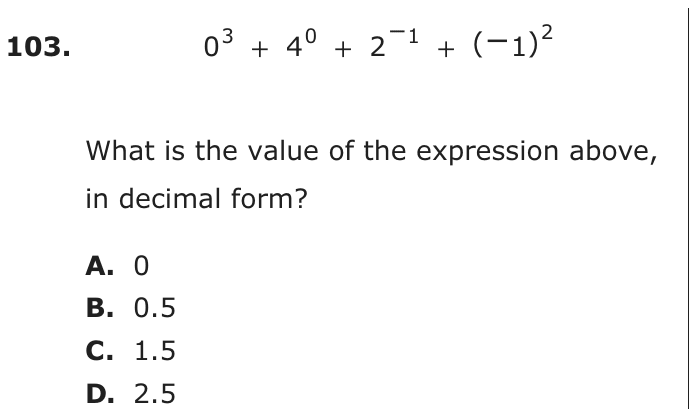
Question 118 of 120
2023 Test B Math, question 49Question
A rectangular swimming pool of uniform depth is 20 yards long and 14 yards wide. If the water is 6 feet deep, what is the volume of water in the pool, in cubic yards?
- A40
- B286
- C560
- D1,680
Show the answer
Correct answer: C
First, change 6 feet to yards:
Then, multiply the dimensions of the pool to find the volume, in cubic yards:
Question analysis
A rectangular swimming pool is 20 yards long and 14 yards wide, and the water is 6 feet deep. Students find the volume of water in cubic yards. It tests the volume of a rectangular prism, and the depth is in a different unit from the other measurements, so it has to be converted first.
- Grade level
- Grade 6 content, by NYS standard
- Compared with grade 7
- Below grade 7 The volume of a rectangular prism is grade 5 and 6 content, and the conversion here gives a whole number. Grade 7 volume work is usually longer, with composite or triangular prisms; here the only extra step is one unit conversion.
- Estimated difficulty
- Straightforward: two steps or one careful reading.
- Thinking it demands
- Depth of knowledge 2, skills and concepts · mainly apply
- What makes it hard
- Combines ideas minor
- Something you must already know minor
- Solution
- 2 steps
- Reading level
- Question and choices: about grade 6, 31 words.
- Students, last 30 days
- Not enough answers yet to show (it takes 10).
Why it is hard, traps and wrong answers (shows the answer)
Why it is hard
The only real trap is the mixed units: 20 and 14 are yards, 6 is feet, and the answer is wanted in cubic yards. Multiplying the three numbers as printed gives a listed choice three times too large. Underlining the unit of each measurement before multiplying, and converting the odd one out, takes seconds.
Combines ideas minor Working it out
The length and width are in yards but the depth is in feet, so a conversion, 6 feet = 2 yards, must come before the volume formula is used. (Embretson, 1998; Daniel & Embretson, 2010)
Something you must already know minor Working it out
Neither 3 feet = 1 yard nor volume = length × width × depth is given; both are assumed in a stem that asks for cubic yards. (Anderson & Krathwohl, 2001)
Strategy: Change the depth from feet to yards first, so that all three measurements are in yards, then multiply the length, width and depth.
Traps
- Units or scale: The answer is wanted in other units, or a rate or scale must be converted first.
- Wrong formula: Uses a related but wrong formula: perimeter for area, diameter for radius, area for volume, or a misremembered one.
- Numbers taken from the question: Combines the numbers in the question without a model of the situation, or is simply a number that appears in the question.
The wrong answers, classified
A Numbers taken from the question (Hegarty, Mayer & Monk, 1995)
Adds the three measurements, 20 + 14 + 6 = 40, with no conversion and no volume formula, combining the stem’s numbers.
B Wrong formula (King et al., 2004)
Finds the area of the water’s surface, 20 × 14 = 280, then adds the depth of 6 instead of multiplying by it.
D Units or scale (King et al., 2004)
Multiplies 20 × 14 × 6 without changing 6 feet to 2 yards, mixing yards with feet and getting a volume three times too large.
Worked solution, step by step
Formulas used
- Volume of a rectangular box
- V is the volume, the space inside, in cubic units. l is the length, w is the width, and h is the height or depth. All three must be in the same unit. Multiplying them counts the unit cubes that fill the box.
- Feet to yards
- There are 3 feet in 1 yard. So to change feet to yards, divide the number of feet by 3. A yard is longer than a foot, so you get a smaller number.
Sort out the measurements
The pool is shaped like a box. Uniform depth means the water is equally deep everywhere. The pool is 20 yards long and 14 yards wide. The water is 6 feet deep. You need the volume, the space the water fills, in cubic yards.
Change the depth to yards
Two sides are in yards, but the depth is in feet. All three must use the same unit before you multiply. The answer is in cubic yards, so change feet to yards.
The water is 2 yards deep.
Find the volume
Use the volume formula with all three measurements in yards.
The pool holds 560 cubic yards of water.
Give the answer
Watch out: Multiplying 20 × 14 × 6 mixes yards with feet. It gives 1,680, choice D, which is three times too big.
So the answer is C, 560 cubic yards.
Check your answer
Check the units. Yards times yards times yards gives cubic yards, just what the question asks for. Also, 1,680 ÷ 3 = 560. So using 6 feet unchanged makes the answer exactly three times too big.
More questions like this
The original DOE question
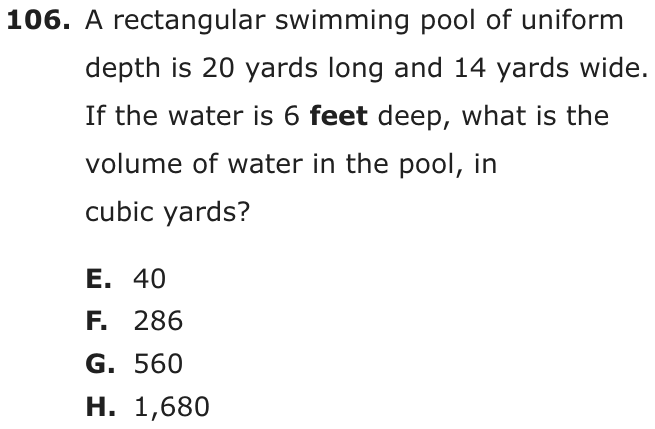
Question 119 of 120
2023 Test B Math, question 50Question
A student made a list of all possible products of 2 different numbers in the set above. What fraction of the products are odd?
- A
- B
- C
- D
Show the answer
Correct answer: B
First, list the products:
Of the 10 products, 3 are odd. The fraction is .
Question analysis
A student lists every product of two different numbers from the set 3, 4, 5, 6, 7. Students find what fraction of those products are odd. It tests listing outcomes systematically without counting a pair twice, and reasoning about odd and even numbers.
- NYS standards
- Grade level
- Grade 7 content, by NYS standard
- Compared with grade 7
- At grade 7 Organized lists of outcomes are grade 7 work. Here students list the products of pairs from five numbers, without repeating a pair or pairing a number with itself, then count the ones that fit.
- Estimated difficulty
- Moderate: several steps, or a close reading with one strong distractor.
- Thinking it demands
- Depth of knowledge 2, skills and concepts · mainly apply
- What makes it hard
- Much to keep track of moderate
- Something you must already know minor
- Solution
- 3 steps
- Reading level
- Question and choices: about grade 6, 28 words.
- Students, last 30 days
- Not enough answers yet to show (it takes 10).
Why it is hard, traps and wrong answers (shows the answer)
Why it is hard
The count of odd products is easy, since only 3, 5 and 7 can make one; the total is where students go wrong. Counting ordered pairs, 5 × 4 = 20, while listing odd products once mixes two kinds of counting. Writing the 10 pairs in order, 3 with each larger number, then 4, and so on, keeps the total honest.
Much to keep track of moderate Working it out
Listing the products of 2 different numbers from five means tracking 10 pairs, with no pair repeated in reverse order and no number paired with itself. (Sweller, 1988; Carpenter, Just & Shell, 1990)
Something you must already know minor Working it out
The shortcut, that a product is odd only when both factors are odd, cuts the work to counting pairs from 3, 5 and 7, but it must be known. (Anderson & Krathwohl, 2001)
Strategy: List each pair of different numbers once, then find each product, or use the fact that a product is odd only when both factors are odd, and count.
Traps
- Overlapping groups: Things in two groups at once are counted twice, or not subtracted.
- Misunderstands the concept: A wrong belief about a concept: that percents can be added, that area grows like length, that averages can be averaged, that a bigger denominator means a bigger fraction.
- Answers a different question: A choice is right for another quantity: the other unknown, the rest instead of the part, the part instead of the whole.
The wrong answers, classified
A Overlapping groups (King et al., 2004)
Counts ordered pairs for the total, 5 × 4 = 20, so each pair appears twice, but counts the odd products once, 3, giving 3/20.
C Misunderstands the concept (Smith, diSessa & Roschelle, 1993; De Bock et al., 1998; Ni & Zhou, 2005)
Assumes about half of all products are odd, as odd and even numbers come equally often, without listing the products or checking any.
D Answers a different question (King et al., 2004; Hegarty, Mayer & Monk, 1995)
Gives the share of the numbers in the set that are odd, 3 of 5, instead of the share of the products, never forming any products.
Worked solution, step by step
Formulas used
- Fraction of a list
- The top counts the products that are odd. The bottom counts all the products in the list. A product is the answer when you multiply. The fraction tells what share of the list is odd.
- Odd times odd
- An odd number can’t be split into pairs, like 3 or 7. An even number can, like 4. A product is odd only when both numbers are odd. If either number is even, the product is even, because it splits into pairs.
Sort out the question
The set has 3, 4, 5, 6 and 7. The student multiplies 2 different numbers, every possible way. A product is the answer to a multiplication. Each pair counts once, since 3 × 4 and 4 × 3 give the same product. You need the fraction of the products that are odd.
List every pair once
Pair 3 with each bigger number. Then pair 4 with each bigger number, and so on. This way no pair is counted twice.
3 × 4 = 12 3 × 5 = 15 3 × 6 = 18 3 × 7 = 21 4 × 5 = 20 4 × 6 = 24 4 × 7 = 28 5 × 6 = 30 5 × 7 = 35 6 × 7 = 42 There are 10 products.
Count the odd products
The odd products are 15, 21 and 35. That makes 3. They come from the only pairs where both numbers are odd: 3 and 5, 3 and 7, and 5 and 7.
Write the fraction
Use the fraction formula.
Watch out: Counting 4 × 3 as well as 3 × 4 makes 20 pairs. Then , choice A, mixes two ways of counting. And , choice D, is the share of the numbers that are odd, not the products.
So the answer is B, .
Check your answer
Count without listing. Each of the 5 numbers can pair with 4 others, which makes 20. But that counts every pair twice, so there are 20 ÷ 2 = 10 pairs. Only the odd numbers 3, 5 and 7 make odd products, and they form 3 pairs.
More questions like this
The original DOE question
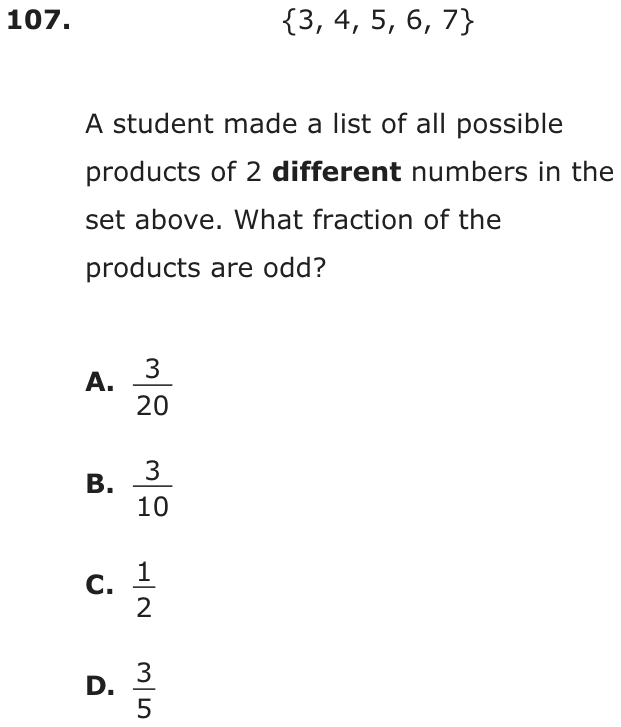
Question 120 of 120
2023 Test B Math, question 51Question
A number, n, is divided by 25. If the quotient is 10 with a remainder of 5, what is the quotient expressed as a decimal?
- A10.20
- B10.25
- C10.50
- D10.75
Show the answer
Correct answer: A
A quotient of 10 with a remainder of 5 means the quotient is
Question analysis
A number is divided by 25, giving a quotient of 10 with a remainder of 5, and students write the quotient as a decimal. It tests what a remainder means and how it becomes part of a decimal quotient. Connecting the remainder to the decimal part of the answer is the key idea.
- Grade level
- Grade 6 content, by NYS standard
- Compared with grade 7
- Below grade 7 Division with remainders and decimal quotients are grade 6 skills. This takes two short steps, with no word problem to translate, though students must know what a remainder means once a quotient is written as a decimal.
- Estimated difficulty
- Straightforward: two steps or one careful reading.
- Thinking it demands
- Depth of knowledge 1, recall and reproduction · mainly apply
- What makes it hard
- Something you must already know moderate
- Solution
- 2 steps
- Reading level
- Question and choices: about grade 5, 22 words.
- Students, last 30 days
- Not enough answers yet to show (it takes 10).
Why it is hard, traps and wrong answers (shows the answer)
Why it is hard
The question checks one idea: a remainder is a fraction of the divisor, not a string of digits to place after the point. Students who write the remainder 5 as tenths, or set the divisor 25 after the point, land on listed choices. Rebuilding n = 25 × 10 + 5 = 255 and dividing by 25 confirms the decimal.
Something you must already know moderate Working it out
A remainder of 5 means 5 out of the 25 needed for another whole, so it becomes 5/25 = 0.2, a link between remainders and decimals the question assumes. (Anderson & Krathwohl, 2001)
Strategy: Rebuild n from the quotient and the remainder, then divide it by 25 to a decimal; or write the remainder as a fraction of the divisor.
Traps
- Misunderstands the concept: A wrong belief about a concept: that percents can be added, that area grows like length, that averages can be averaged, that a bigger denominator means a bigger fraction.
- Numbers taken from the question: Combines the numbers in the question without a model of the situation, or is simply a number that appears in the question.
The wrong answers, classified
B Numbers taken from the question (Hegarty, Mayer & Monk, 1995)
Writes the divisor, 25, after the decimal point, setting the stem’s numbers 10 and 25 side by side instead of turning the remainder into a fraction.
C Misunderstands the concept (Smith, diSessa & Roschelle, 1993; De Bock et al., 1998; Ni & Zhou, 2005)
Writes the remainder 5 as the tenths digit, 10.5, believing a remainder becomes the digits after the decimal point.
D Little reason to choose it (Haladyna & Downing, 1993; Rodriguez, 2005)
No common working gives 10.75; it treats the remainder as three quarters of the divisor, which nothing in the stem suggests, so it mostly draws guesses.
Worked solution, step by step
Formulas used
- Quotient with a remainder
- d is the divisor, the number you divide by. q is the whole-number part of the quotient, the answer to the division. r is the remainder, what is left over. The leftover still has to be divided by d, so it becomes the fraction r over d.
Sort out the words
n is divided by 25. So 25 is the divisor, the number you divide by. The quotient is the answer to a division. Here it is 10 with a remainder of 5. The remainder is the amount left over. You need the exact quotient as a decimal.
Turn the remainder into a fraction
The 5 left over still has to be divided by 25. So it becomes the fraction . Use the formula.
Change the fraction to a decimal
Simplify first. Divide the top and bottom by 5. Then write the fraction in hundredths.
So the quotient is 10 + 0.20 = 10.20.
Give the answer
Watch out: A remainder is not the digits after the decimal point. Writing the 5 after the point gives 10.50, choice C. Writing the 25 after it gives 10.25, choice B.
So the answer is A, 10.20.
Check your answer
Rebuild n. Ten 25s plus the 5 left over is . Now divide: . That matches 10.20.
More questions like this
The original DOE question