Question
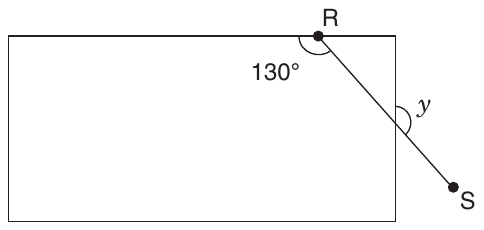
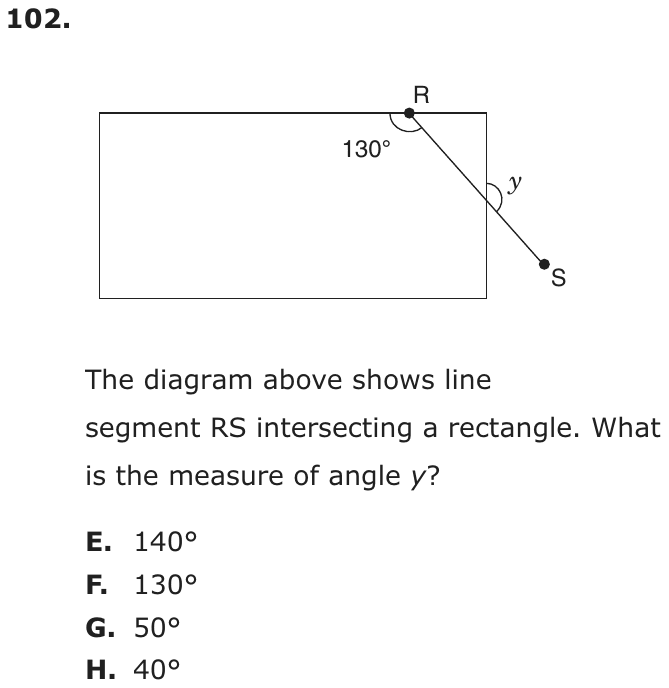
The diagram above shows line segment RS intersecting a rectangle. What is the measure of angle y?
- A140°
- B130°
- C50°
- D40°
Show the answer
Correct answer: A
First, find the measures of the interior angles of the triangle formed by the line segment and the rectangle. The top angle on the right is a vertex of the rectangle, so the measure of that angle is 90°. The top angle on the left is supplementary to the given angle of 130°. So, the measure of that angle is . The measure of the lower angle is 40°, since . Angle y is supplementary to the lower angle of 40°, so the measure of angle y is .
Question analysis
This geometry question shows line segment RS cutting across a corner of a rectangle, with a 130° angle marked where RS meets the top side, and asks for angle y where it crosses the right side. Students combine supplementary angles, the right angle of a rectangle and the angle sum of a triangle. Stopping at an angle inside the triangle is the main trap.
- NYS standards
- Grade level
- Grade 8 content, by NYS standard
- Compared with grade 7
- Above grade 7 Grade 7 angle problems use supplementary, vertical and adjacent angles. This one adds the angle sum of a triangle, which New York places in grade 8, and chains three facts around a small triangle that students must first spot in the figure.
- Estimated difficulty
- Moderate: several steps, or a close reading with one strong distractor.
- Thinking it demands
- Depth of knowledge 2, skills and concepts · mainly apply
- What makes it hard
- Reading a figure, table or graph moderate
- Many steps minor
- Something you must already know minor
- Solution
- 3 steps
- Reading level
- Question and choices: about grade 7, 17 words.
- Students, last 30 days
- Not enough answers yet to show (it takes 10).
Why it is hard, traps and wrong answers (shows the answer)
Why it is hard
The angle facts are basic, but the route runs through a triangle the figure does not point out, and the answer lies outside it. Students who stop inside the triangle give its 40° angle or its 50° angle, and those who assume y matches the marked 130° skip the work entirely. Checking that y and the triangle's angle beside it form a straight line, 140 + 40 = 180, confirms the result.
Reading a figure, table or graph moderate Understanding the question
The small triangle cut off at the rectangle's top right corner is never outlined or labeled, its 90° corner is unmarked, and y sits outside it, between RS and the rectangle's right side. (Lesh, Post & Behr, 1987; Kirsch & Mosenthal, 1990)
Many steps minor Working it out
Three steps follow in order, a straight angle at R, the triangle's angle sum, and a straight angle at the right side, and the first two results are both listed choices. (Daniel & Embretson, 2010; Enright, Morley & Sheehan, 2002)
Something you must already know minor Working it out
The rectangle's corner must be taken as 90° although no right-angle mark is drawn, and the 180° totals for a straight line and a triangle are assumed. (Anderson & Krathwohl, 2001)
Strategy: Look at the small triangle cut off at the rectangle's corner: get its angle at R from the straight top side, use the 90° corner and the triangle's angle sum, then use the straight right side.
Traps
- Stops one step early: A choice is a number from partway through the solution.
- Misunderstands the concept: A wrong belief about a concept: that percents can be added, that area grows like length, that averages can be averaged, that a bigger denominator means a bigger fraction.
The wrong answers, classified
B Misunderstands the concept (Smith, diSessa & Roschelle, 1993; De Bock et al., 1998; Ni & Zhou, 2005)
Takes y to equal the marked 130° angle, as if RS crossed two parallel sides, though the rectangle's top and right sides meet at a right angle.
C Stops one step early (King et al., 2004; Gierl et al., 2017)
Finds the triangle's angle at R, 180 − 130 = 50, and stops after the first of the three steps.
D Stops one step early (King et al., 2004; Gierl et al., 2017)
Finds the triangle's third angle, 180 − 90 − 50 = 40, but y lies outside the triangle, beside that angle on the straight right side.
Worked solution, step by step
Formulas used
- Angles on a straight line
- a and b are two angles side by side that together make a straight line. A straight line makes an angle of 180 degrees. So if you know one of them, subtract it from 180 to get the other.
- Angles in a triangle
- a, b and c are the three angles inside any triangle. They always add up to 180 degrees. If you know two of them, subtract both from 180 to find the third.
- Outside angle of a triangle
- An outside angle sits next to a triangle’s angle, along a straight line. a and b are the two inside angles at the other corners. The outside angle equals their sum.
Sort out the figure
Segment RS starts at R on the top side of the rectangle. It goes down to the right, crosses the right side, and ends at S. Call the rectangle’s top right corner P. Call the point where RS crosses the right side Q. Then R, P and Q make a small triangle. Angle y is at Q, outside the rectangle.
Find the triangle’s angle at R
The 130° angle and the triangle’s angle at R sit side by side along the top side, a straight line.
Watch out: 50° is only the first step. Stopping here gives choice C.
Find the triangle’s angle at Q
P is a corner of the rectangle, so its angle is 90°.
Watch out: y is outside the triangle, so this 40° angle, choice D, is not y.
Find angle y
Angle y and the triangle’s 40° angle at Q sit side by side along RS, a straight line.
So the answer is A, 140°.
Check your answer
Use the outside angle rule. Angle y is outside the triangle at Q. The two inside angles at the other corners are 50° and 90°, so . Also, y looks wider than a right angle in the figure, so it must be more than 90°.
More questions like this
The original DOE question