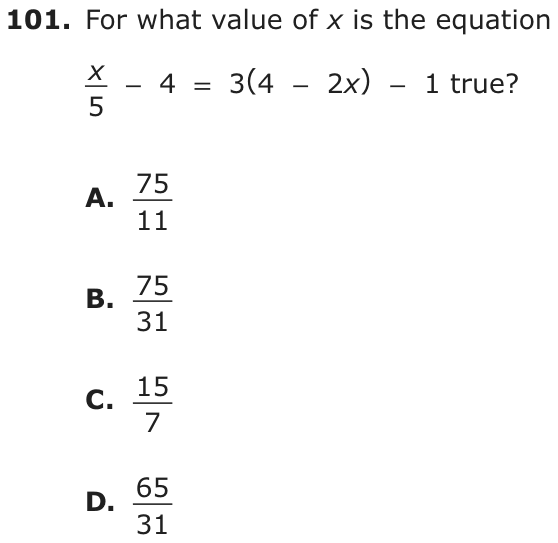
Question
For what value of x is the equation true?
- A
- B
- C
- D
Show the answer
Correct answer: B
| Apply the distributive property; multiply the 3 by 4 and . | |
| Combine like terms. | |
| Apply the additive inverse property; add and 4 to both sides of the equation. | |
| Get a common denominator. | |
| Apply the multiplicative inverse property; multiply both sides of the equation by 5. | |
| Apply the multiplicative inverse property; divide both sides of the equation by 31. | |
Question analysis
This equation question asks for the value of x that makes x/5 − 4 = 3(4 − 2x) − 1 true. Students use the distributive property, collect variable terms on one side, and clear a fraction before solving. Each wrong choice matches a common slip with the parentheses or with the fraction, so careful bookkeeping matters more than speed.
- NYS standards
- Grade level
- Grade 8 content, by NYS standard
- Compared with grade 7
- Above grade 7 Grade 7 equations have the form px + q = r. This one has x on both sides, a fractional coefficient and a product to expand, which are grade 8 equation skills, and every wrong choice matches a plausible slip along the way.
- Estimated difficulty
- Hard: combines ideas, needs a plan, and has more than one tempting wrong answer.
- Thinking it demands
- Depth of knowledge 1, recall and reproduction · mainly apply
- What makes it hard
- Error-prone arithmetic moderate
- Many steps moderate
- A very close wrong answer minor
- Solution
- 5 steps
- Reading level
- Question and choices: about grade 8, 14 words.
- Students, last 30 days
- Not enough answers yet to show (it takes 10).
Why it is hard, traps and wrong answers (shows the answer)
Why it is hard
Every step is a routine move in solving a linear equation, but there are five of them and the fraction raises the cost of each. The listed wrong answers come from distributing the 3 to only one term, clearing the fraction from one term only, and stretching the parentheses over the −1. Substituting the result back is slow with a denominator of 31, so careful step-by-step work matters more than checking.
Error-prone arithmetic moderate Working it out
The term x/5 sits beside whole-number terms and a negative −6x, so clearing the fraction means multiplying every term by 5, and the answer is the unfriendly 75/31. (Brown & Burton, 1978; Junker & Sijtsma, 2001)
Many steps moderate Working it out
Five moves in a row, distributing the 3, combining 12 and −1, collecting the x terms, clearing the fifth and dividing by 31, each give a slip a place to enter. (Daniel & Embretson, 2010; Enright, Morley & Sheehan, 2002)
A very close wrong answer minor Choosing the answer
The fraction 75/11 shares its numerator with 75/31 and differs by one digit of the denominator, so only the coefficient of x, 6 1/5 rather than 2 1/5, separates them. (Embretson & Wetzel, 1987; Gorin & Embretson, 2006; Ascalon et al., 2007)
Strategy: Distribute the 3 to both terms in the parentheses, combine constants, collect the x terms on one side, then multiply every term by 5 to clear the fraction; check by substituting.
Traps
- A faulty procedure: A systematic but wrong procedure: adding fractions straight across, applying an exponent to each term of a sum, dropping a sign when moving a term.
- Order of operations: Working left to right, or distributing a minus sign wrongly, gives a choice.
The wrong answers, classified
A A faulty procedure (Brown & Burton, 1978; Tatsuoka, 1983)
Distributes the 3 only to the 4, writing 12 − 2x, so the equation becomes x/5 + 2x = 15 and then 11x = 75.
C A faulty procedure (Brown & Burton, 1978; Tatsuoka, 1983)
Multiplies only x/5 by 5 to clear the fraction, leaving 6x and 15 unchanged, so it solves x + 6x = 15 and gets 7x = 15.
D Order of operations (Brown & Burton, 1978)
Applies the 3 to the −1 as well, as if it sat inside the parentheses, so the right side becomes 9 − 6x and the constant 13 instead of 15.
Worked solution, step by step
Formulas used
- The distributive property
- a, b and c are numbers or terms. Multiplying a by a difference means multiplying a by each part. The number outside must reach every term inside the parentheses.
- Doing the same to both sides
- a and b are the two sides of an equation, and c is any number. An equation is like a balanced scale. Adding the same amount to both sides, or multiplying both sides by the same number, keeps it balanced.
Sort out the question
You need the value of x that makes both sides of the equation equal. The plan: clear the parentheses, gather the x terms on one side, and get rid of the fraction. Then divide.
Clear the parentheses
Watch out: the 3 multiplies both 4 and 2x. Writing 12 − 2x leads to , choice A. The −1 is outside the parentheses, so the 3 does not touch it.
Gather the x terms
Add 6x to both sides to move the x terms to the left. Add 4 to both sides to move the plain numbers to the right.
Clear the fraction
Multiply both sides by 5. Every term gets multiplied, not only the fraction.
Watch out: multiplying only the fraction by 5 gives x + 6x = 15. That leads to , choice C.
Divide by 31
75 and 31 share no factor except 1, so the fraction is already simplified. So the answer is B, .
Check your answer
Put back in. Then and . Write 4 as . The left side is . On the right, , and . Both sides match.
More questions like this
The original DOE question