Question
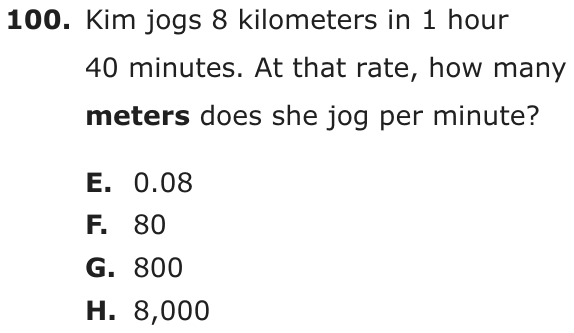
Kim jogs 8 kilometers in 1 hour 40 minutes. At that rate, how many meters does she jog per minute?
- A0.08
- B80
- C800
- D8,000
Show the answer
Correct answer: B
First, calculate Kim’s jogging time in minutes:
1 hour 40 minutes = 100 minutes
Then, convert kilometers to meters:
8 kilometers = 8,000 meters
Now simplify the ratio to find the answer:
Question analysis
This rate question says Kim jogs 8 kilometers in 1 hour 40 minutes and asks how many meters she jogs per minute. Students convert a mixed time to minutes and kilometers to meters before finding a unit rate. Skipping a conversion, or stopping before dividing, gives answers that are off by factors of ten or more.
- Grade level
- Grade 6 content, by NYS standard
- Compared with grade 7
- Below grade 7 Unit rates and metric conversions are grade 6 topics. This needs two conversions, hours and minutes to minutes and kilometers to meters, then one division with whole numbers, simpler than grade 7 rate problems built on fractions.
- Estimated difficulty
- Straightforward: two steps or one careful reading.
- Thinking it demands
- Depth of knowledge 2, skills and concepts · mainly apply
- What makes it hard
- Something you must already know minor
- Many steps minor
- Solution
- 3 steps
- Reading level
- Question and choices: about grade 4, 17 words.
- Students, last 30 days
- Not enough answers yet to show (it takes 10).
Why it is hard, traps and wrong answers (shows the answer)
Why it is hard
The rate itself is one division; what makes the question work is that the distance and the time both arrive in the wrong units. Converting only the time gives a speed in kilometers per minute, and converting only the distance and stopping gives the whole trip in meters. Writing the units beside every number, meters over minutes, shows when the answer is ready.
Something you must already know minor Working it out
The conversions are not given: 1 kilometer is 1,000 meters and 1 hour is 60 minutes, so 8 kilometers becomes 8,000 meters and 1 hour 40 minutes becomes 100 minutes. (Anderson & Krathwohl, 2001)
Many steps minor Working it out
Two conversions, one for distance and one for time, come before the single division, and skipping the distance conversion leaves an answer a thousand times too small. (Daniel & Embretson, 2010; Enright, Morley & Sheehan, 2002)
Strategy: Rewrite the time entirely in minutes and the distance entirely in meters, then divide distance by time; check that the answer's units are meters per minute.
Traps
- Units or scale: The answer is wanted in other units, or a rate or scale must be converted first.
- Stops one step early: A choice is a number from partway through the solution.
- An arithmetic slip: The right method with a plausible arithmetic error: a digit, a place value or a times-table fact.
The wrong answers, classified
A Units or scale (King et al., 2004)
Divides the 8 kilometers by the 100 minutes but never changes kilometers to meters, giving a speed of 0.08 kilometer per minute.
C An arithmetic slip (Junker & Sijtsma, 2001)
Converts both units correctly but cancels only one zero when dividing 8,000 by 100, getting a rate ten times too large.
D Stops one step early (King et al., 2004; Gierl et al., 2017)
Converts 8 kilometers to 8,000 meters and stops, giving the whole distance before dividing by the 100 minutes it took.
Worked solution, step by step
Formulas used
- Kilometers to meters
- Each kilometer is 1,000 meters, so multiply the number of kilometers by 1,000 to get meters. The word part kilo means a thousand.
- Rate
- The rate, or speed, is how far you go in one unit of time. Distance is how far, and time is how long. Dividing shares the distance equally among the minutes, so you get the distance for one minute.
Sort out the question
Kim jogs 8 kilometers in 1 hour 40 minutes. You need her speed in meters per minute: how many meters she jogs in one minute. The question gives kilometers and hours, so change both units first.
Change the time to minutes
One hour is 60 minutes. Add the extra 40 minutes.
Kim jogs for 100 minutes.
Change the distance to meters
Kim jogs 8,000 meters. Watch out: 8,000 is the whole distance, not meters per minute. Stopping here gives choice D.
Divide the distance by the time
She jogs 80 meters each minute. Watch out: if you skip the change to meters, you get 8 ÷ 100 = 0.08 kilometer per minute, choice A. So the answer is B, 80 meters per minute.
Check your answer
Work backward. At 80 meters a minute, 100 minutes gives meters. That is 8 kilometers, just as the question says.
More questions like this
The original DOE question