Question
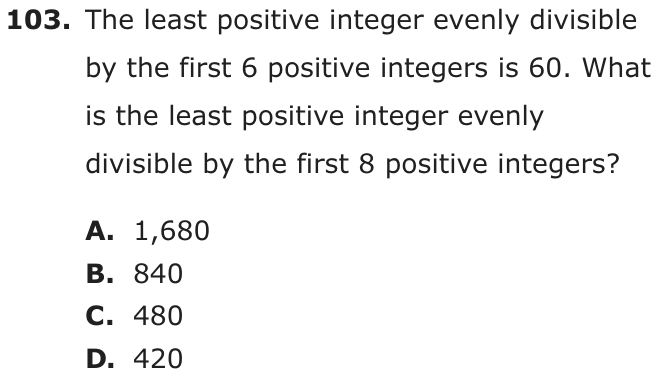
The least positive integer evenly divisible by the first 6 positive integers is 60. What is the least positive integer evenly divisible by the first 8 positive integers?
- A1,680
- B840
- C480
- D420
Show the answer
Correct answer: B
Each option is divisible by 1, 2, 3, 4, 5, and 6.
Option A:
1,680 is evenly divisible by the first 8 positive integers.
Option B:
840 is evenly divisible by the first 8 positive integers and is less than 1,680.
Option C:
480 is not evenly divisible by 7.
Option D:
420 is not evenly divisible by 8.
Option B (840) is the correct answer.
Question analysis
Knowing that 60 is the smallest number divisible by each of 1 through 6, students find the smallest positive integer divisible by each of 1 through 8. It tests least common multiples and prime factors. The challenge is adding only the factors that 7 and 8 really need, so the result works for all eight numbers and is still the least.
- NYS standards
- 6.NS.4 common factors and multiples
- Grade level
- Grade 6 content, by NYS standard
- Compared with grade 7
- At grade 7 Least common multiples are grade 6 content, usually for two small numbers. Extending the given result from six numbers to eight means deciding what 7 and 8 add, more reasoning than typical classwork but no new content.
- Estimated difficulty
- Moderate: several steps, or a close reading with one strong distractor.
- Thinking it demands
- Depth of knowledge 2, skills and concepts · mainly apply
- What makes it hard
- Every choice must be checked moderate
- Something you must already know minor
- Solution
- 3 steps
- Reading level
- Question and choices: about grade 13, 25 words.
- Corrected from the DOE handbook
- A rounded decimal in the explanation is now marked as approximate (≈ instead of =).
- Students, last 30 days
- Not enough answers yet to show (it takes 10).
Why it is hard, traps and wrong answers (shows the answer)
Why it is hard
The given fact, 60 for the first six integers, is a head start, but only for students who see what 7 and 8 add. Multiplying 60 by 7 is needed; multiplying by all of 8 is not, since 60 already supplies two of its three factors of 2. Students who multiply by the new numbers whole get answers that are too large or that miss one divisor, so checking the smaller choices first is the efficient route.
Every choice must be checked moderate Choosing the answer
Both 1,680 and 840 are divisible by 7 and by 8, so testing the choices is safe only from the smallest up; 420 fails for 8 and 480 for 7. (Embretson & Wetzel, 1987)
Something you must already know minor Working it out
Building on 60 needs prime factors: 7 adds a new prime, while 8 = 2 × 2 × 2 needs only one more 2, since 60 already holds two. (Anderson & Krathwohl, 2001)
Strategy: Start from 60 and ask which extra prime factors 7 and 8 require, or test the choices from the smallest up for divisibility by both 7 and 8.
Traps
- Stops one step early: A choice is a number from partway through the solution.
- Misreads the question: Misses or misreads a condition or a word in the question: "at least", "each", "remaining", "not".
The wrong answers, classified
A Misreads the question (Hegarty, Mayer & Monk, 1995)
Multiplies 60 by 7 and by 4 to cover 8, getting 1,680, which all of 1 to 8 divide, but overlooks that the question wants the least.
C Misreads the question (Hegarty, Mayer & Monk, 1995)
Multiplies 60 by 8 to bring in the 8 but never checks divisibility by 7, which 480 fails.
D Stops one step early (King et al., 2004; Gierl et al., 2017)
Multiplies 60 by 7 to bring in the 7 and stops, but 420 has only two factors of 2, so 8 does not divide it.
What was corrected from the DOE handbook, and why
- Explanation: To show that 480 is not evenly divisible by 7, the handbook writes 480 ÷ 7 = 68.57. The quotient is really 68.571428…, a decimal that never ends, so 68.57 is only a rounded value. The site writes 480 ÷ 7 ≈ 68.57, as the handbook itself does for other rounded results in this test. The point of the step is unchanged: the quotient is not a whole number, so 480 is not evenly divisible by 7 and is not divisible by all of the first 8 positive integers.
Worked solution, step by step
Formulas used
- Evenly divisible
- a is the number you test, and b is the number you divide by. If the answer is a whole number, with no remainder, a is evenly divisible by b. Then b is a factor of a.
Sort out the question
The first 8 positive integers are 1, 2, 3, 4, 5, 6, 7 and 8. “Evenly divisible” means dividing leaves no remainder.
You need the least, or smallest, number that all 8 of them divide. You are told that 60 is the smallest for 1 to 6. So build on 60.
Bring in the 7
60 is not divisible by 7. And 7 is prime, which means its only factors are 1 and 7. So the new number needs a factor of 7. Multiply 60 by 7.
Bring in the 8
8 is , so the number needs three 2s as factors. But 420 has only two: , and 105 is odd. Multiply by one more 2.
Now and . Both are whole numbers.
Test the choices from smallest up
Choice D: . That is not a whole number, so 420 fails.
Choice C: . The ≈ sign means about, since the decimal never ends. It is not a whole number, so 480 fails.
Choice B: 840 works for 7 and 8. It also works for 1 to 6, since .
Watch out: 1,680, choice A, works too. But it is twice 840, so it is not the least.
So the answer is B, 840.
Check your answer
Divide 840 by each number from 1 to 8. You get 840, 420, 280, 210, 168, 140, 120 and 105. Every answer is a whole number, so 840 works for all eight.
More questions like this
The original DOE question