Question
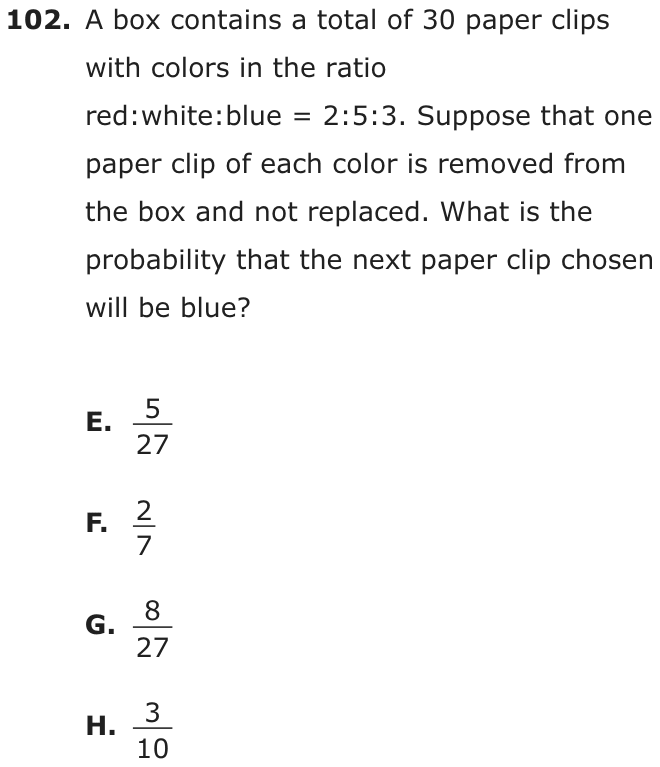
A box contains a total of 30 paper clips with colors in the ratio . Suppose that one paper clip of each color is removed from the box and not replaced. What is the probability that the next paper clip chosen will be blue?
- A
- B
- C
- D
Show the answer
Correct answer: C
The ratio is . Find the number of each color in a box of 30 paper clips.
If one paper clip of each color is removed (3 total), there will be 8 blue paper clips out of 27 in the box. The probability that the next paper clip chosen will be blue is .
Question analysis
A box of 30 paper clips has red, white and blue clips in the ratio 2 to 5 to 3, and one clip of each color is taken out. Students find the probability that the next clip drawn is blue. It tests ratios and simple probability; the ratio gives shares rather than counts, and the removals change both the blue count and the total.
- Grade level
- Grade 6 content, by NYS standard
- Compared with grade 7
- At grade 7 Splitting a total by a three-part ratio and finding a simple probability are both familiar skills. Combining them, then adjusting the counts after the removals, adds steps but stays within typical grade 7 multi-step work.
- Estimated difficulty
- Moderate: several steps, or a close reading with one strong distractor.
- Thinking it demands
- Depth of knowledge 2, skills and concepts · mainly apply
- What makes it hard
- Many steps moderate
- A very close wrong answer moderate
- Turning words into math minor
- Solution
- 4 steps
- Reading level
- Question and choices: about grade 5, 47 words.
- Students, last 30 days
- Not enough answers yet to show (it takes 10).
Why it is hard, traps and wrong answers (shows the answer)
Why it is hard
The question chains a ratio problem into a probability problem, with a small change in between. Students who skip the removal get 3/10, a choice that is almost the right value and looks natural because it matches the ratio. The cleanest route lists the actual counts, 6, 15 and 9, takes one from each, and writes blue's 8 over the remaining 27.
Many steps moderate Working it out
The ratio 2:5:3 must become counts of 6, 15 and 9 clips, one clip of each color must come out, and only then can blue's 8 be put over 27. (Daniel & Embretson, 2010; Enright, Morley & Sheehan, 2002)
A very close wrong answer moderate Choosing the answer
3/10 = 0.3 and 8/27, about 0.296, are almost equal, so an estimate cannot separate them; only subtracting the three removed clips does. (Embretson & Wetzel, 1987; Gorin & Embretson, 2006; Ascalon et al., 2007)
Turning words into math minor Understanding the question
The removal of one clip of each color, not replaced, happens before the draw, so it changes both the blue count and the total in the box. (Hegarty, Mayer & Monk, 1995; Koedinger & Nathan, 2004)
Strategy: Divide 30 by the sum of the ratio parts to find each color's count, take one clip away from each color, then put the blue count over the new total.
Traps
- Without replacement: In a second pick there is one fewer item, which changes the probability.
- Misunderstands the concept: A wrong belief about a concept: that percents can be added, that area grows like length, that averages can be averaged, that a bigger denominator means a bigger fraction.
- Answers a different question: A choice is right for another quantity: the other unknown, the rest instead of the part, the part instead of the whole.
The wrong answers, classified
A Answers a different question (King et al., 2004; Hegarty, Mayer & Monk, 1995)
Works out the counts correctly but puts red's remaining 5 clips over the 27 left, answering for the wrong color.
B Misunderstands the concept (Smith, diSessa & Roschelle, 1993; De Bock et al., 1998; Ni & Zhou, 2005)
Treats the ratio terms as actual counts and removes one from each, so blue is 3 − 1 = 2 of 10 − 3 = 7 clips.
D Without replacement (Fischbein & Schnarch, 1997)
Gives blue's share of the full box, 9 of 30 or 3 of 10 ratio parts, ignoring the three clips removed before the draw.
Worked solution, step by step
Formulas used
- Size of one ratio part
- The ratio numbers tell how many parts each color gets. Their sum is the number of parts in all. total is the number of clips. Dividing gives the size of one part. Each color is then its ratio number times one part.
- Probability
- P(blue) is the chance of picking a blue clip. The top counts the blue clips in the box. The bottom counts all the clips in the box. It works because each clip is equally likely to be picked.
Sort out the question
The box has 30 clips. The ratio red : white : blue = 2 : 5 : 3 means that for every 2 red clips, there are 5 white clips and 3 blue clips.
Then one clip of each color is taken out and not put back. You need the chance that the next clip picked is blue.
Find the size of one part
The ratio has parts in all. The 30 clips are shared among those 10 parts.
Each part is 3 clips.
Count the clips of each color
Multiply each ratio number by the size of one part.
Check: 6 + 15 + 9 = 30 clips. That matches the total.
Take out one of each color
One red, one white and one blue clip come out. Each color drops by 1, and the total drops by 3.
Color Before After Red 6 5 White 15 14 Blue 9 8 All 30 27 Find the chance of blue
Watch out: , choice D, ignores the 3 clips taken out. , choice A, is the chance of red. Taking 1 from each ratio number, as if the box held only 10 clips, gives , choice B.
So the answer is C, .
Check your answer
Add the clips left: 5 + 14 + 8 = 27. That matches. Also, is about 0.296, a bit less than blue’s share of the full box, 0.3. That makes sense, since one blue clip came out.
More questions like this
The original DOE question