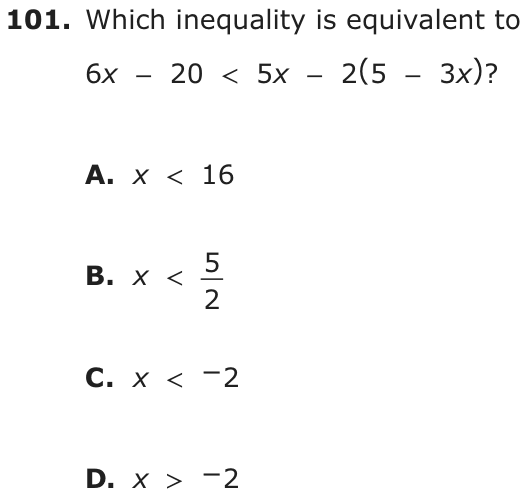
Question
Which inequality is equivalent to ?
- A
- B
- C
- D
Show the answer
Correct answer: D
Distribute the coefficient −2 on the right-hand side:
Subtract from both sides:
Add 10 to both sides:
Divide both sides by 5:
This is equivalent to
Question analysis
Students choose the simplest equivalent form of a linear inequality that has x on both sides and a negative number multiplied into parentheses. It tests distributing, combining like terms and solving inequalities. Sign errors in the distribution, and reading the direction of the final inequality, are where most mistakes happen.
- NYS standards
- Grade level
- Grade 8 content, by NYS standard
- Compared with grade 7
- Above grade 7 Grade 7 inequalities have the form px + q < r. This one has x on both sides and a negative factor to distribute across a subtraction, steps that belong to grade 8 equation work, so it is harder than typical grade 7 practice.
- Estimated difficulty
- Hard: combines ideas, needs a plan, and has more than one tempting wrong answer.
- Thinking it demands
- Depth of knowledge 1, recall and reproduction · mainly apply
- What makes it hard
- Error-prone arithmetic moderate
- A very close wrong answer moderate
- Many steps minor
- Solution
- 4 steps
- Reading level
- Question and choices: about grade 16+, 10 words.
- Students, last 30 days
- Not enough answers yet to show (it takes 10).
Why it is hard, traps and wrong answers (shows the answer)
Why it is hard
Every move is standard algebra, but the inequality is built so that small slips change the answer completely. The −2 has to reach both terms in the parentheses, and once the boundary −2 is found its direction still has to be read correctly, since the variable ends up on the right as −2 < x. Rewriting that as x > −2, or substituting x = 0 into the original, catches the trap.
Error-prone arithmetic moderate Working it out
Distributing −2 over (5 − 3x) gives −10 + 6x, two sign decisions in one move, and the x terms then sit on both sides of the inequality. (Brown & Burton, 1978; Junker & Sijtsma, 2001)
A very close wrong answer moderate Choosing the answer
x < −2 and x > −2 share the boundary and differ only in direction, which depends on reading −2 < x correctly or flipping the sign when dividing by a negative. (Embretson & Wetzel, 1987; Gorin & Embretson, 2006; Ascalon et al., 2007)
Many steps minor Working it out
Four moves follow one another, distributing, collecting 5x + 6x, moving the x terms and dividing by 5, and a slip at any of them changes the result. (Daniel & Embretson, 2010; Enright, Morley & Sheehan, 2002)
Strategy: Distribute the −2 to both terms in the parentheses, combine the x terms on the right, then gather the x terms on the side that keeps their coefficient positive.
Traps
- Order of operations: Working left to right, or distributing a minus sign wrongly, gives a choice.
- Negatives and direction: Arithmetic with negative numbers, the order of a subtraction, or direction on a number line. (Moving a term across the equals sign without changing its sign is a faulty procedure.)
- A faulty procedure: A systematic but wrong procedure: adding fractions straight across, applying an exponent to each term of a sum, dropping a sign when moving a term.
The wrong answers, classified
A A faulty procedure (Brown & Burton, 1978; Tatsuoka, 1983)
Treats 5 − 3x as 2, combining a number with an x term, so the right side becomes 5x − 4 and the solution x < 16.
B Order of operations (Brown & Burton, 1978)
Multiplies the −2 by the 5 but not by the −3x, writing 5x − 10 − 3x, which leads to 4x < 10 and x < 5/2.
C Negatives and direction (Brown & Burton, 1978)
Finds the boundary −2 but points the inequality the wrong way, by misreading −2 < x or by not flipping the sign after dividing by −5.
Worked solution, step by step
Formulas used
- Distributive property
- a is the number outside the parentheses. b and c are the terms inside. Multiply a by each one. A minus sign inside counts as a negative term, so 5 − 3x is 5 + (−3x). A negative times a negative is positive.
- Keeping an inequality true
- a and b are the two sides, and c is any number. Adding or subtracting the same number on both sides keeps the inequality true. Dividing both sides by a positive number also keeps it true. Only multiplying or dividing by a negative number flips the sign.
Sort out the question
An inequality compares two sides with a sign like <, which means is less than. To solve it, you get x alone on one side.
You need the short inequality that has the same answers as the long one.
Distribute the −2
Multiply −2 by both terms inside the parentheses, 5 and −3x.
A negative times a negative is positive, so the second part is +6x. Watch out: If the −2 multiplies only the 5, you end up with , choice B.
Combine the x terms
The right side is now 5x − 10 + 6x. Put the x terms together: 5x + 6x = 11x.
Gather the x terms on one side
Subtract 6x from both sides. That leaves the x terms on the right, where they stay positive.
Get x by itself
Add 10 to both sides. Then divide both sides by 5.
You divided by a positive 5, so the sign does not flip.
Read it with x first
says −2 is less than x. That is the same as saying x is greater than −2, just as 3 < 5 means 5 > 3.
Watch out: , choice C, has the same number but points the wrong way.
So the answer is D, .
Check your answer
Test x = 0, which is greater than −2. The left side is . The right side is . And −20 < −10 is true. Now test x = −3. The left side is −38 and the right side is −43. That is false, as it should be.
More questions like this
The original DOE question