Question
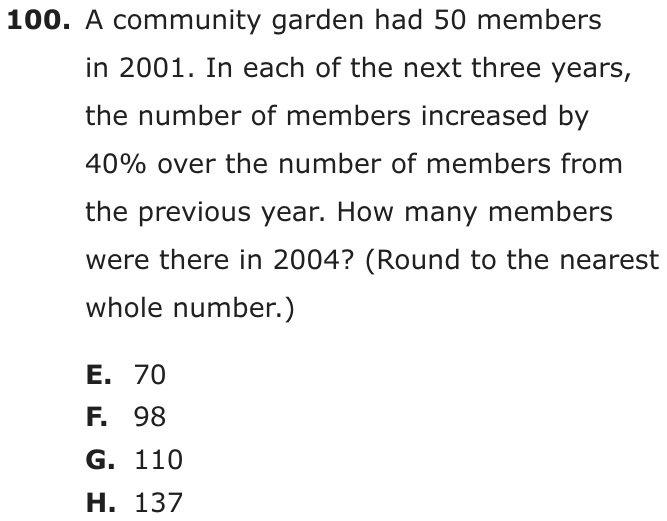
A community garden had 50 members in 2001. In each of the next three years, the number of members increased by 40% over the number of members from the previous year. How many members were there in 2004? (Round to the nearest whole number.)
- A70
- B98
- C110
- D137
Show the answer
Correct answer: D
To find out how many members there were in 2002, calculate 40% of 50 and then add it to 50.
To find out how many members there were in 2003, calculate 40% of 70 and then add it to 70.
To find out how many members there were in 2004, calculate 40% of 98 and then add it to 98.
The result is 39.2, which is rounded to 39 to keep members to the nearest whole number.
Question analysis
A community garden has 50 members in 2001, and membership grows by 40 percent each year over the year before. Students find the number of members in 2004, rounded to a whole number. It tests repeated percent increase, where each of the three rounds of growth must start from the previous year's total.
- NYS standards
- 7.RP.3 multistep ratio and percent problems
- Grade level
- Grade 7 content, by NYS standard
- Compared with grade 7
- At grade 7 Percent increase is grade 7 content, and each step here is a routine one. Repeating it three times, each time on the new total, adds length and bookkeeping but no new idea, so it matches grade 7 demand.
- Estimated difficulty
- Moderate: several steps, or a close reading with one strong distractor.
- Thinking it demands
- Depth of knowledge 2, skills and concepts · mainly apply
- What makes it hard
- Many steps moderate
- Turning words into math minor
- Error-prone arithmetic minor
- Solution
- 3 steps
- Reading level
- Question and choices: about grade 5, 40 words.
- Students, last 30 days
- Not enough answers yet to show (it takes 10).
Why it is hard, traps and wrong answers (shows the answer)
Why it is hard
Compound growth is the whole question: each year's 40% is taken of a larger number, so the increases grow from 20 to 28 to about 39. Students who add 20 three times treat the growth as simple, and those who lose count of the years stop at an earlier total that is also listed. Multiplying by 1.4 three times, or checking that the third increase is the largest, separates the right count from the rest.
Many steps moderate Working it out
Three yearly increases have to be applied in turn, 50 to 70 to 98 to 137.2, each taking 40% of the new total rather than of the original 50. (Daniel & Embretson, 2010; Enright, Morley & Sheehan, 2002)
Turning words into math minor Understanding the question
The phrase "increased by 40% over the number of members from the previous year" sets a new base each year, the wording that separates compound from simple growth. (Hegarty, Mayer & Monk, 1995; Koedinger & Nathan, 2004)
Error-prone arithmetic minor Working it out
The third year's 40% of 98 is 39.2, the first decimal in the chain, and the rounding instruction applies only to the final count. (Brown & Burton, 1978; Junker & Sijtsma, 2001)
Strategy: Multiply the membership by 1.4 once for each year from 2002 through 2004, carrying the unrounded value forward, and round only at the end.
Traps
- Stops one step early: A choice is a number from partway through the solution.
- Misunderstands the concept: A wrong belief about a concept: that percents can be added, that area grows like length, that averages can be averaged, that a bigger denominator means a bigger fraction.
The wrong answers, classified
A Stops one step early (King et al., 2004; Gierl et al., 2017)
Applies the 40% increase once, 50 + 20 = 70, which is the 2002 membership, and stops two years short of 2004.
B Stops one step early (King et al., 2004; Gierl et al., 2017)
Applies two increases, reaching 98 members in 2003, and stops one year short of the 2004 total the question asks for.
C Misunderstands the concept (Smith, diSessa & Roschelle, 1993; De Bock et al., 1998; Ni & Zhou, 2005)
Adds 40% of the original 50, that is 20, in each of the three years, 50 + 60 = 110, instead of 40% of the previous year's total.
Worked solution, step by step
Formulas used
- Percent increase
- old is last year’s number of members. p is the percent increase, here 40. new is this year’s number. You add p percent of the old amount to the old amount. Each year, the new number becomes next year’s old number.
Sort out the question
In 2001 the garden had 50 members. In each of the next three years, 2002, 2003 and 2004, the members grew by 40%.
The 40% is of last year’s members, so the base changes every year. You need the number for 2004, rounded to the nearest whole number.
Find the members in 2002
40% of 50 is 20. Add it to 50.
There were 70 members in 2002.
Find the members in 2003
Now 70 is the old number. Take 40% of 70, not of 50.
There were 98 members in 2003.
Find the members in 2004
Now 98 is the old number.
Round to the nearest whole number. 137.2 is closer to 137 than to 138, so there were 137 members.
Watch out: Adding 20 members every year uses 40% of 50 each time. That gives 110, choice C. Stopping after one or two years gives 70 or 98, choices A and B.
So the answer is D, 137.
Check your answer
A 40% rise is the same as multiplying by 1.4. So , which rounds to 137. It matches.
More questions like this
The original DOE question