Question
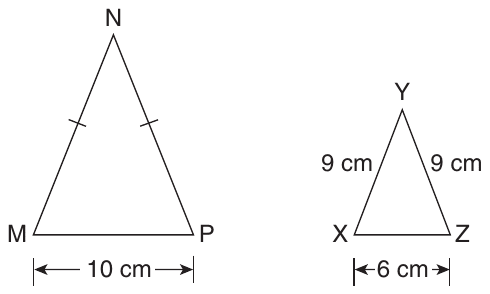
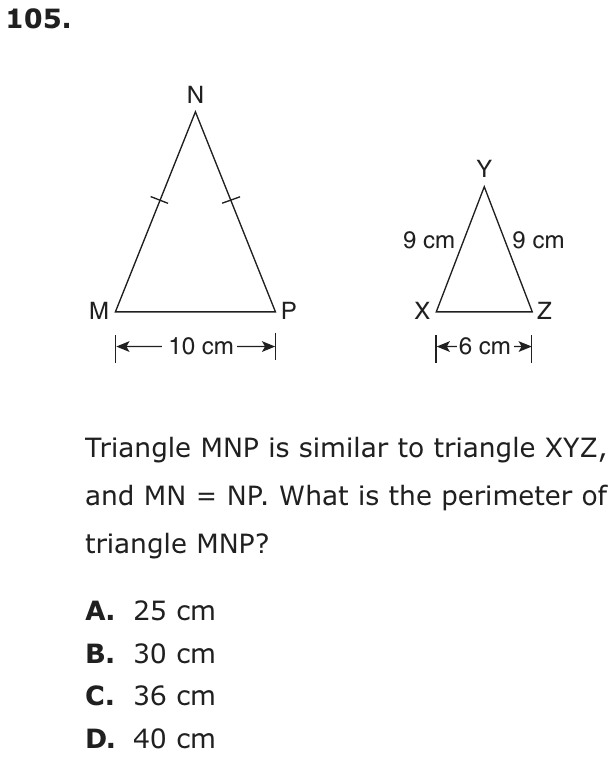
Triangle MNP is similar to triangle XYZ, and . What is the perimeter of triangle MNP?
- A25 cm
- B30 cm
- C36 cm
- D40 cm
Show the answer
Correct answer: D
Similar geometric figures have sides that are proportional.
Because , both unknown sides are equal to 15. Therefore, the three sides of MNP are 15, 15, and 10. The perimeter of a triangle is the sum of its three side lengths.
Question analysis
Two isosceles triangles are drawn, one with all its side lengths labeled and the other with only its base labeled, and the triangles are similar. Students find the perimeter of triangle MNP in centimeters. It tests similar figures and proportional sides, and the catch is that two sides must be found from the scale and the equal-sides marks.
- Grade level
- Grade 8 content, by NYS standard
- Compared with grade 7
- Above grade 7 Similar triangles are grade 8 geometry, though grade 7 scale drawings use the same proportional reasoning. Students also need the equal-sides marks to find a missing side, a combined step beyond routine grade 7 scale work.
- Estimated difficulty
- Moderate: several steps, or a close reading with one strong distractor.
- Thinking it demands
- Depth of knowledge 2, skills and concepts · mainly apply
- What makes it hard
- Solution
- 3 steps
- Reading level
- Question and choices: about grade 3, 20 words.
- Students, last 30 days
- Not enough answers yet to show (it takes 10).
Why it is hard, traps and wrong answers (shows the answer)
Why it is hard
The question chains a scale factor to a perimeter, and both links have a trap. Some students scale by adding, since the base grew by 4, and others find the 15 cm leg correctly but then add only some of the sides. Writing all three sides of the large triangle, 15, 15 and 10, before adding is what the question rewards.
Reading a figure, table or graph moderate Understanding the question
The figure carries every number: tick marks show MN = NP, the base MP is 10 cm, and triangle XYZ has 9 cm legs on a 6 cm base. (Lesh, Post & Behr, 1987; Kirsch & Mosenthal, 1990)
Something you must already know minor Working it out
Students must know that corresponding sides of similar triangles share one scale factor, here 10/6 = 5/3, though the stem never says so. (Anderson & Krathwohl, 2001)
Error-prone arithmetic minor Working it out
The scale factor 5/3 is a fraction, and 9 × 5/3 = 15 is easier to get right by dividing 9 by 3 first. (Brown & Burton, 1978; Junker & Sijtsma, 2001)
Strategy: Compare the two bases to get the scale factor, multiply a leg of the small triangle by it, then use the equal sides to add up the perimeter.
Traps
- Stops one step early: A choice is a number from partway through the solution.
- Misunderstands the concept: A wrong belief about a concept: that percents can be added, that area grows like length, that averages can be averaged, that a bigger denominator means a bigger fraction.
The wrong answers, classified
A Stops one step early (King et al., 2004; Gierl et al., 2017)
Finds a scaled leg of 15 cm but adds only it and the 10 cm base, 15 + 10 = 25, leaving out the second 15 cm side.
B Stops one step early (King et al., 2004; Gierl et al., 2017)
Finds both legs, 15 cm each, but adds only 15 + 15 and leaves out the 10 cm base; calling all three sides 10 cm also gives 30.
C Misunderstands the concept (Smith, diSessa & Roschelle, 1993; De Bock et al., 1998; Ni & Zhou, 2005)
Adds 4 cm to each leg because the base grew from 6 to 10, making the legs 13 cm: 13 + 13 + 10 = 36.
Worked solution, step by step
Formulas used
- Similar triangles
- Similar triangles have the same shape but can differ in size. MN matches XY, and MP matches XZ. Each side of the big triangle is the same number of times as long as its matching side. So these two fractions are equal.
- Perimeter of a triangle
- P is the perimeter, the distance all the way around. a, b and c are the lengths of the three sides. Add them to go once around the shape.
Sort out the question
In triangle MNP, the base MP is 10 cm. The tick marks on MN and NP show those two sides are equal. In triangle XYZ, the base XZ is 6 cm, and XY and YZ are each 9 cm.
Similar means the same shape, with every side scaled by the same amount. You need the perimeter of MNP, the sum of its three sides.
Match the sides
The letters line up in order: M with X, N with Y, and P with Z. So the base MP matches the base XZ. The side MN matches XY, and NP matches YZ.
Find the scale factor
The scale factor is how many times bigger MNP is. Compare the two bases.
Every side of MNP is times as long as its matching side in XYZ.
Find the equal sides
Use the similar triangles formula with XY = 9.
Divide 9 by 3 first to keep the numbers small. MN is 15 cm. Since MN = NP, NP is 15 cm too.
Watch out: The base grew by 4 cm, but adding 4 cm to each side is wrong. That gives 13 cm sides and 36, choice C. Similar shapes grow by multiplying.
Add the three sides
The perimeter is 40 cm. Watch out: Leaving out one 15 cm side gives 25, choice A. Leaving out the base gives 30, choice B.
So the answer is D, 40 cm.
Check your answer
The small triangle’s perimeter is 9 + 9 + 6 = 24 cm. Perimeters grow by the same scale factor as the sides. So . It matches.
More questions like this
The original DOE question