Question
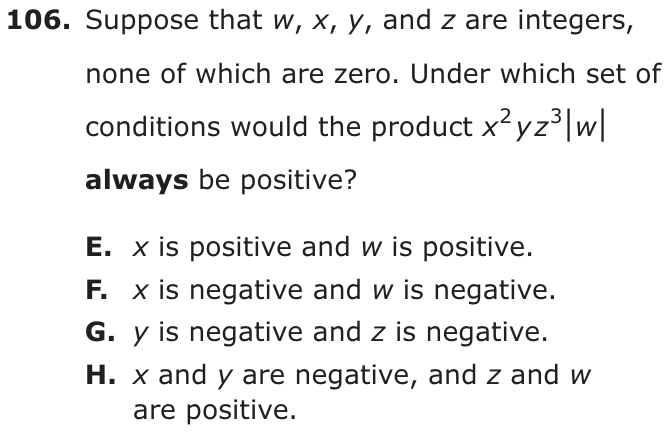
Suppose that w, x, y, and z are integers, none of which are zero. Under which set of conditions would the product always be positive?
- Ax is positive and w is positive.
- Bx is negative and w is negative.
- Cy is negative and z is negative.
- Dx and y are negative, and z and w are positive.
Show the answer
Correct answer: C
First, analyze the role of each variable in the expression .
will always be a positive number.
y can be a positive or a negative number.
can be a positive or a negative number.
will always be a positive number.
The expressions and will always be positive. Therefore, making the values of y and z negative would result in the expression being positive, since a negative multiplied by a negative is positive. Thus the given product would always be positive.
Question analysis
Four nonzero integers appear in a product that includes a square, a cube and an absolute value. Students choose the set of conditions that makes the product positive every time. It tests the sign rules for multiplication together with exponents and absolute value, and the trap is judging the sign by counting negative variables without looking at what is done to each.
- NYS standards
- Grade level
- Grade 7 content, by NYS standard
- Compared with grade 7
- Above grade 7 Grade 7 students learn sign rules for products of signed numbers. Here they must reason about four unknown integers under an even power, an odd power and an absolute value, and decide what is always true, which is more abstract than typical grade 7 work.
- Estimated difficulty
- Hard: combines ideas, needs a plan, and has more than one tempting wrong answer.
- Thinking it demands
- Depth of knowledge 2, skills and concepts · mainly analyze
- What makes it hard
- Variables instead of numbers moderate
- Every choice must be checked moderate
- Something you must already know minor
- Solution
- 3 steps
- Reading level
- Question and choices: about grade 6, 58 words.
- Students, last 30 days
- Not enough answers yet to show (it takes 10).
Why it is hard, traps and wrong answers (shows the answer)
Why it is hard
One insight decides the question: x² and |w| are positive whatever x and w are, so only the signs of y and z³ matter. Students who count negative letters instead of negative factors pick conditions that look balanced but leave y as the only negative factor. Students who test a single set of values can be fooled by a choice that leaves y and z unspecified.
Variables instead of numbers moderate Understanding the question
There are four variables and no numbers, and always positive must hold for every allowed value, so one test case can rule a choice out but never confirm it. (Koedinger & Nathan, 2004; Enright, Morley & Sheehan, 2002)
Every choice must be checked moderate Choosing the answer
Each set of conditions has to be checked against all four factors; the first two fix only x and w and leave y and z free to make the product negative. (Embretson & Wetzel, 1987)
Something you must already know minor Working it out
Students must know that a nonzero square and an absolute value are always positive, while an odd power such as z³ keeps the sign of z. (Anderson & Krathwohl, 2001)
Strategy: Work out, factor by factor, which signs each part of the product can take, then test each set of conditions against every factor rather than counting negatives.
Traps
- Negatives and direction: Arithmetic with negative numbers, the order of a subtraction, or direction on a number line. (Moving a term across the equals sign without changing its sign is a faulty procedure.)
- Misunderstands the concept: A wrong belief about a concept: that percents can be added, that area grows like length, that averages can be averaged, that a bigger denominator means a bigger fraction.
The wrong answers, classified
A Checks only one number (Schoenfeld, 1985)
Tests the choice with every variable positive, so the product is positive and it seems to work; y = −1 with z = 1 would make it negative.
B Misunderstands the concept (Smith, diSessa & Roschelle, 1993; De Bock et al., 1998; Ni & Zhou, 2005)
Pairs the negatives x and w as if they must cancel, not seeing that x² and |w| are positive anyway, so y and z still decide.
D Negatives and direction (Brown & Burton, 1978)
Counts two negative letters, x and y, as an even number of negatives, but x² is positive, so y is the only negative factor.
Worked solution, step by step
Formulas used
- Signs in multiplication
- a and b are positive numbers, so −a and −b are negative. A negative times a negative is positive. A negative times a positive is negative. So a product is positive when it has an even number of negative factors.
Sort out the question
w, x, y and z are integers, meaning whole numbers or their negatives. None of them is 0. The product means .
You need the conditions that make the product positive every time, for every number that fits them.
Look at x squared and |w|
means x × x. Two positives or two negatives multiply to a positive. So is always positive.
is the absolute value of w, its distance from 0. It is always positive, since w is not 0.
So x and w never change the sign of the product. Their signs do not matter.
Look at y and z cubed
y can be positive or negative. means z × z × z, and it has the same sign as z. For example, .
So the sign of the whole product is the sign of . It depends only on y and z.
Test each choice
- A and B say nothing about y and z. If y = −1 and z = 1, the product is negative. So they do not always work.
- C: y is negative, and is negative. A negative times a negative is positive. This always works.
- D: y is negative and z is positive. So the product is always negative.
Watch out: D has two negative letters, x and y. But is positive anyway, so y is the only negative factor.
So the answer is C, y is negative and z is negative.
Check your answer
Try numbers for C. Let x = −2, y = −3, z = −1 and w = −5. Then , which is positive. Even with x and w negative, the product stays positive.
More questions like this
The original DOE question