Question
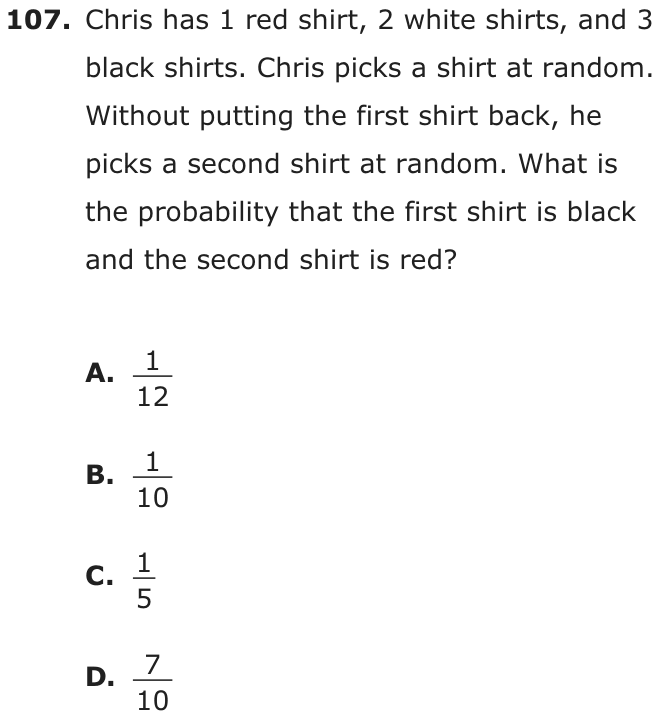
Chris has 1 red shirt, 2 white shirts, and 3 black shirts. Chris picks a shirt at random. Without putting the first shirt back, he picks a second shirt at random. What is the probability that the first shirt is black and the second shirt is red?
- A
- B
- C
- D
Show the answer
Correct answer: B
Use the joint probability formula: P (black shirt first) • P (red shirt second, given black shirt first).
Initially there are 3 black shirts out of 6 total shirts, so the probability of picking a black shirt first is .
Once a black shirt is picked first, there is 1 red shirt out of 5 total shirts remaining.
So the probability of picking a red shirt second, given that a black shirt was picked first, is .
Then P (black shirt first) • P (red shirt second, given black shirt first)
.
Question analysis
Chris has red, white and black shirts and picks two at random, one after the other, without putting the first back. Students find the probability that the first shirt is black and the second is red. It tests the probability of two dependent events, where the second pick has one fewer shirt to choose from.
- NYS standards
- Grade level
- Grade 7 content, by NYS standard
- Compared with grade 7
- Above grade 7 Grade 7 compound probability is usually found with a list or tree of equally likely outcomes. Only two picks are involved, but adjusting the second pick for the shirt already taken goes beyond typical grade 7 work.
- Estimated difficulty
- Moderate: several steps, or a close reading with one strong distractor.
- Thinking it demands
- Depth of knowledge 2, skills and concepts · mainly apply
- What makes it hard
- Something you must already know moderate
- A very close wrong answer moderate
- Turning words into math minor
- Solution
- 3 steps
- Reading level
- Question and choices: about grade 3, 48 words.
- Students, last 30 days
- Not enough answers yet to show (it takes 10).
Why it is hard, traps and wrong answers (shows the answer)
Why it is hard
Two dependent picks with small numbers make this a textbook question, but the choices punish each half-step. Students who leave the first shirt in the drawer get a fraction just below the right one, students who find only the second pick's chance stop at a listed value, and students who add the two chances get a probability far too large. Writing both fractions, 3/6 and 1/5, and multiplying is the whole method.
Something you must already know moderate Working it out
The rule for two dependent picks, the first pick's chance times the second's given the first, is assumed, along with the drop to 5 shirts for the second pick. (Anderson & Krathwohl, 2001)
A very close wrong answer moderate Choosing the answer
1/10 and 1/12 differ only in the second pick's denominator, 5 shirts or 6, so estimating cannot separate them. (Embretson & Wetzel, 1987; Gorin & Embretson, 2006; Ascalon et al., 2007)
Turning words into math minor Understanding the question
"Without putting the first shirt back" sets the second pick's total at 5 shirts, and the order, black first then red, fixes which fraction comes first. (Hegarty, Mayer & Monk, 1995; Koedinger & Nathan, 2004)
Strategy: Find the chance of black on the first pick, then the chance of red on the second pick with one shirt fewer, and multiply the two.
Traps
- Without replacement: In a second pick there is one fewer item, which changes the probability.
- Stops one step early: A choice is a number from partway through the solution.
- Wrong operation: Adds instead of multiplying, divides the wrong way round, turns a ratio or rate upside down, or undoes a step in the wrong direction (subtracts what should be added back).
The wrong answers, classified
A Without replacement (Fischbein & Schnarch, 1997)
Keeps all 6 shirts for the second pick, 3/6 × 1/6 = 1/12, as if the black shirt had been put back.
C Stops one step early (King et al., 2004; Gierl et al., 2017)
Gives only the chance that the second shirt is red once a black one is gone, 1/5, leaving out the first pick's 3/6.
D Wrong operation (Hegarty, Mayer & Monk, 1995; King et al., 2004)
Adds the two chances, 1/2 + 1/5 = 7/10, instead of multiplying them for two events that must both happen.
Worked solution, step by step
Formulas used
- Probability
- P is the probability, the chance that something happens. It is a number from 0 to 1. The top counts the results you want. The bottom counts all the results that can happen. It works when every result is equally likely.
- Chance of events in a row
- A and B are two events that happen one after the other. P(A) is the chance of the first. P(B after A) is the chance of the second, counting only what is left after the first. You multiply because the second must also happen inside the share of times the first did.
Sort out the question
Chris has 1 red, 2 white and 3 black shirts. That is 6 shirts. He picks one and keeps it out. Then he picks a second shirt.
You need the chance that the first shirt is black and the second is red. Both must happen, in that order.
Find the chance of black first
3 of the 6 shirts are black. Each shirt is equally likely to be picked.
That is one half.
Find the chance of red second
A black shirt is now out and not put back. That leaves 5 shirts: 1 red, 2 white and 2 black.
Watch out: The bottom is 5, not 6. Using 6 gives , choice A, as if the shirt went back.
Multiply the two chances
Use the rule for events in a row. The second pick must go right too, inside the half of the time the first one did.
Watch out: Adding the chances gives , choice D. Stopping at gives choice C.
So the answer is B, .
Check your answer
Count every ordered pair of picks. There are 6 choices for the first and 5 for the second, so pairs. Pairs with black then red: 3 black shirts times 1 red shirt is 3. So the chance is .
More questions like this
The original DOE question