Question
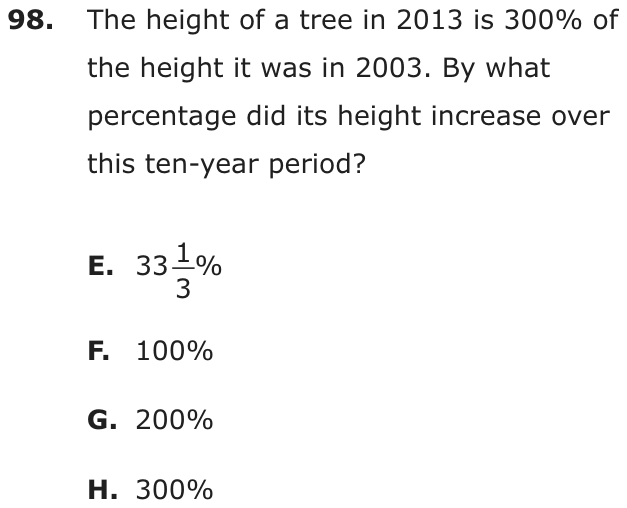
The height of a tree in 2013 is 300% of the height it was in 2003. By what percentage did its height increase over this ten-year period?
- A
- B100%
- C200%
- D300%
Show the answer
Correct answer: C
Let h represent the height of the tree in 2003. Then the height of the tree in 2013 is . Calculate the percent increase:
Question analysis
A percent question about a tree whose height in 2013 is 300% of its height in 2003. Students find the percent increase over the ten years. No heights are given, so the key is telling the difference between a percent of an amount and a percent change.
- Grade level
- Grade 7 content, by NYS standard
- Compared with grade 7
- Above grade 7 Grade 7 percent-increase problems give two amounts to compare. This gives only a percent of the earlier height and no heights at all, so students must work out what that percent means for the change with nothing concrete to calculate with.
- Estimated difficulty
- Hard: combines ideas, needs a plan, and has more than one tempting wrong answer.
- Thinking it demands
- Depth of knowledge 2, skills and concepts · mainly apply
- What makes it hard
- Turning words into math moderate
- Variables instead of numbers moderate
- Something you must already know minor
- Solution
- 2 steps
- Reading level
- Question and choices: about grade 3, 25 words.
- Students, last 30 days
- Not enough answers yet to show (it takes 10).
Why it is hard, traps and wrong answers (shows the answer)
Why it is hard
The stem hands students a percent and asks for a different percent, and the given 300% looks like a finished answer. The real step is separating “300% of” from “increased by”: a height that triples has grown by twice its original size. Picking a 2003 height of 100 units makes it concrete, since 300 − 100 = 200 units of growth on a base of 100.
Turning words into math moderate Understanding the question
“300% of the height it was in 2003” describes the new height, three times the old, not the increase; the question then asks for the change, which is a different percent. (Hegarty, Mayer & Monk, 1995; Koedinger & Nathan, 2004)
Variables instead of numbers moderate Understanding the question
No heights are given, only a percent, so students must invent a height such as 100 units or work with h and 3h to measure the change. (Koedinger & Nathan, 2004; Enright, Morley & Sheehan, 2002)
Something you must already know minor Working it out
A percent increase divides the change by the starting amount, (3h − h) ÷ h, a rule the question assumes without stating. (Anderson & Krathwohl, 2001)
Strategy: Call the 2003 height 100 units, find the 2013 height from the percent given, then divide the change by the 2003 height and write the result as a percent.
Traps
- Answers a different question: A choice is right for another quantity: the other unknown, the rest instead of the part, the part instead of the whole.
- Wrong operation: Adds instead of multiplying, divides the wrong way round, turns a ratio or rate upside down, or undoes a step in the wrong direction (subtracts what should be added back).
The wrong answers, classified
A Wrong operation (Hegarty, Mayer & Monk, 1995; King et al., 2004)
Divides the 2003 height by the 2013 height, h ÷ 3h = 1/3, turning the comparison upside down and reporting 33 1/3%.
B Little reason to choose it (Haladyna & Downing, 1993; Rodriguez, 2005)
No common working gives 100%, which would mean the height only doubled; it echoes the 100% that the 2003 height stands for, so it mostly draws guesses.
D Answers a different question (King et al., 2004; Hegarty, Mayer & Monk, 1995)
Reads “300% of” as an increase of 300%, giving the 2013 height as a percent of the 2003 height instead of the percent increase.
Worked solution, step by step
Formulas used
- Percent increase
- Original is the starting amount. New is the amount after the change. New minus original is how much it grew. Dividing by the original compares the growth with the start. Multiplying by 100 turns that into a percent.
Sort out the wording
The 2013 height is 300% of the 2003 height. That means it is 3 times the 2003 height. You need the percent increase. That is how much the tree grew, compared with its 2003 height.
Pick an easy height
The question gives no real height, so choose one. Say the tree was 100 feet tall in 2003. Then the 2013 height is 300% of 100 feet.
In 2013, the tree was 300 feet tall.
Find how much it grew
The growth is how much taller the tree got. Subtract the old height from the new one.
The tree grew 200 feet in ten years.
Find the percent increase
Use the formula. The original height is the 2003 height.
The height went up by 200%.
Watch out: 300% compares the new height with the old one. It is not the increase. That trap is choice D. Dividing the old height by the new one gives , choice A.
So the answer is C, 200%.
Check your answer
Think about doubling. A tree that doubles adds 100% of its height. A tree that triples adds 200% of its height. So 100 feet plus 200% of 100 feet is 100 + 200 = 300 feet. That is 300% of 100 feet.
More questions like this
The original DOE question