Question
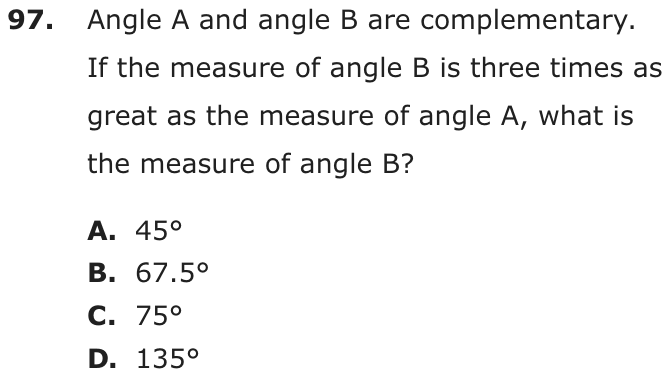
Angle A and angle B are complementary. If the measure of angle B is three times as great as the measure of angle A, what is the measure of angle B?
- A45°
- B67.5°
- C75°
- D135°
Show the answer
Correct answer: B
Let A represent the measure of angle A, and let B represent the measure of angle B, in degrees. Since the angles are complementary, . The question states that , or . Substitute that expression for A in the first equation and solve for B:
Question analysis
A geometry question about two complementary angles, where angle B is three times as large as angle A. Students find the measure of angle B. They must recall what complementary means, since the question does not say, and set up an equation that splits the total in the right proportion.
- Grade level
- Grade 7 content, by NYS standard
- Compared with grade 7
- At grade 7 Writing and solving an equation from complementary angles is a grade 7 standard. This is the familiar version without a figure: one equation from the definition, then a division and a multiplication, typical of grade 7 classwork.
- Estimated difficulty
- Straightforward: two steps or one careful reading.
- Thinking it demands
- Depth of knowledge 2, skills and concepts · mainly apply
- What makes it hard
- Something you must already know moderate
- Turning words into math minor
- Solution
- 3 steps
- Reading level
- Question and choices: about grade 7, 31 words.
- Students, last 30 days
- Not enough answers yet to show (it takes 10).
Why it is hard, traps and wrong answers (shows the answer)
Why it is hard
Once complementary is read as a 90° total, the problem is one equation with a decimal answer, 4A = 90. The 22.5° for angle A is not listed, so stopping at the smaller angle is not rewarded here, but using 180° is: it gives 45° and 135°, and both appear among the choices. Checking that the chosen angle and one third of it add to 90° settles it.
Something you must already know moderate Working it out
The stem never says what complementary means; the 90° total has to be recalled, and a student who confuses it with the supplementary 180° doubles both angles. (Anderson & Krathwohl, 2001)
Turning words into math minor Understanding the question
The clause “the measure of angle B is three times as great as the measure of angle A” has to become B = 3A, so the 90° splits into four equal parts, not three. (Hegarty, Mayer & Monk, 1995; Koedinger & Nathan, 2004)
Strategy: Recall the total that complementary angles share, think of angle A as one part and angle B as three parts, find one part, then multiply for angle B.
Traps
- Wrong formula: Uses a related but wrong formula: perimeter for area, diameter for radius, area for volume, or a misremembered one.
- Misreads the question: Misses or misreads a condition or a word in the question: "at least", "each", "remaining", "not".
The wrong answers, classified
A Misreads the question (Hegarty, Mayer & Monk, 1995)
Splits the 90° evenly, 90 ÷ 2 = 45, using the complementary total but ignoring that angle B is three times angle A.
C Little reason to choose it (Haladyna & Downing, 1993; Rodriguez, 2005)
No common working gives 75°, which would need angle A to be 25° and the pair to add to 100°; it mostly draws guesses.
D Wrong formula (King et al., 2004)
Uses 180°, the supplementary total, so 4A = 180 gives angle A = 45° and angle B = 135°, a pair that is not complementary.
Worked solution, step by step
Formulas used
- Complementary angles
- A and B are the measures of the two angles, in degrees. Complementary angles are two angles that add up to 90 degrees, the size of a square corner. Use this whenever a problem says two angles are complementary.
Sort out the question
Complementary angles are two angles that add up to 90 degrees. Angle B is three times as big as angle A. You need the measure of angle B, in degrees.
Write the facts as equations
Let A and B stand for the two measures. The angles are complementary, so use the formula.
Angle B is three times angle A, so:
Put 3A in place of B
Replace B in the sum with 3A. Then there is only one letter to find.
Think of it as 4 equal parts. Angle A is 1 part, and angle B is 3 parts.
Find angle A
Divide both sides by 4.
Angle A measures 22.5 degrees. That is not the answer yet, because the question asks for angle B.
Find angle B
Angle B is three times angle A.
Angle B measures 67.5 degrees.
Watch out: Angles that add to 180 degrees are called supplementary. Using 180 by mistake gives 45 and 135, choice D. Splitting 90 in half gives 45, choice A. That ignores the fact that B is three times A.
So the answer is B, 67.5°.
Check your answer
Add the two angles: 22.5 + 67.5 = 90. So they are complementary. Now divide: 67.5 ÷ 22.5 = 3. So angle B is three times angle A. Both facts check out.
More questions like this
The original DOE question