Question
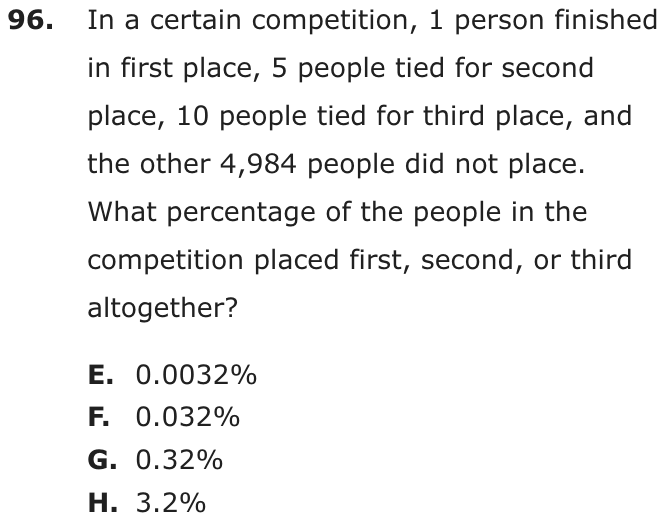
In a certain competition, 1 person finished in first place, 5 people tied for second place, 10 people tied for third place, and the other 4,984 people did not place. What percentage of the people in the competition placed first, second, or third altogether?
- A0.0032%
- B0.032%
- C0.32%
- D3.2%
Show the answer
Correct answer: C
The total number of people who participated in the competition was . The total number who placed first, second, or third was .
Question analysis
A percent question about a competition with 1 first-place finisher, 5 tied for second, 10 tied for third and 4,984 who did not place. Students find what percentage of everyone placed. All four choices use the same digits, so the challenge is placing the decimal point when a decimal becomes a percent.
- Grade level
- Grade 6 content, by NYS standard
- Compared with grade 7
- At grade 7 Writing part of a whole as a percent is grade 6 content. This one first totals four groups, then turns a fraction of a large total into a percent, where a slip of one place value is easy to make.
- Estimated difficulty
- Moderate: several steps, or a close reading with one strong distractor.
- Thinking it demands
- Depth of knowledge 2, skills and concepts · mainly apply
- What makes it hard
- Error-prone arithmetic moderate
- Many steps minor
- Solution
- 3 steps
- Reading level
- Question and choices: about grade 10, 40 words.
- Students, last 30 days
- Not enough answers yet to show (it takes 10).
Why it is hard, traps and wrong answers (shows the answer)
Why it is hard
The method is short, so the question tests decimal places. All four choices share the digits 32 and differ only in where the point falls, so a slip of one place, or forgetting to multiply by 100, still finds a choice waiting. A rough check helps: 16 is a bit more than 15, and 15 of 5,000 is 0.3%, so the answer must sit just above 0.3%.
Error-prone arithmetic moderate Working it out
16 ÷ 5,000 = 0.0032 has two zeros after the decimal point, and writing it as a percent moves the point two more places; each move can land one place off. (Brown & Burton, 1978; Junker & Sijtsma, 2001)
Many steps minor Working it out
The total of 5,000 is not given; it has to be built from 1 + 5 + 10 + 4,984 before the 16 people who placed can be compared with it. (Daniel & Embretson, 2010; Enright, Morley & Sheehan, 2002)
Strategy: Add the people who placed and the people who did not to get the total, write the placers as a fraction of it, then change that fraction to a decimal and multiply by 100.
Traps
- Misunderstands the concept: A wrong belief about a concept: that percents can be added, that area grows like length, that averages can be averaged, that a bigger denominator means a bigger fraction.
- An arithmetic slip: The right method with a plausible arithmetic error: a digit, a place value or a times-table fact.
The wrong answers, classified
A Misunderstands the concept (Smith, diSessa & Roschelle, 1993; De Bock et al., 1998; Ni & Zhou, 2005)
Finds 16 ÷ 5,000 = 0.0032 and adds a percent sign without multiplying by 100, as if a decimal were already a percent.
B An arithmetic slip (Junker & Sijtsma, 2001)
Finds 0.0032 but moves the decimal point only one place when writing the percent, giving 0.032%, ten times too small.
D An arithmetic slip (Junker & Sijtsma, 2001)
Divides 16 by 500 instead of 5,000, dropping a zero, or moves the point three places, giving 3.2%, ten times too large.
Worked solution, step by step
Formulas used
- Percent of a whole
- The part is the group you care about. The whole is everyone. The fraction tells what share of the whole the part is. Multiplying by 100 turns that share into a percent, which means out of 100.
Sort out the groups
Some people placed: 1 in first, 5 in second and 10 in third. The other 4,984 people did not place. You need the percent of all the people who placed.
Count the people who placed
These are the people who finished first, second or third. Add them.
So 16 people placed.
Count everyone
The whole is everyone in the competition: the people who placed plus the people who did not.
So 5,000 people took part. Notice that 4,984 is not the whole. It leaves out the 16 who placed.
Turn the share into a percent
Use the percent formula.
First divide: . Then multiply by 100. That moves the decimal point two places to the right.
So 0.32% of the people placed.
Avoid the decimal traps
Watch out: 0.0032 is not a percent yet. Putting a % sign on it gives choice A, which is 100 times too small. Moving the point only one place gives choice B. Moving it three places gives choice D.
So the answer is C, 0.32%.
Check your answer
Estimate. 1% of 5,000 is 50. The 16 people are about a third of 50. So the answer should be about a third of 1%, or about 0.3%. Choice C, 0.32%, fits.
More questions like this
The original DOE question