Question
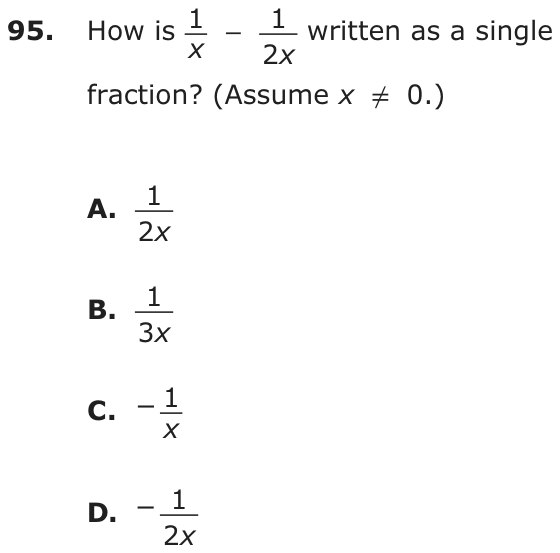
How is written as a single fraction? (Assume .)
- A
- B
- C
- D
Show the answer
Correct answer: A
Question analysis
This algebra question asks students to write 1/x minus 1/(2x) as a single fraction, assuming x is not zero. It tests finding a common denominator when the denominators contain a variable. Getting both fractions over the same denominator before subtracting, and keeping track of the sign, are what matter.
- NYS standards
- Grade level
- Grade 7 content, by NYS standard
- Compared with grade 7
- At grade 7 Grade 7 students subtract fractions with unlike denominators and work with linear expressions, but seldom see a variable in a denominator. The steps match those for numerical fractions, so it is a short task once the common denominator is found.
- Estimated difficulty
- Straightforward: two steps or one careful reading.
- Thinking it demands
- Depth of knowledge 1, recall and reproduction · mainly apply
- What makes it hard
- Variables instead of numbers moderate
- Error-prone arithmetic minor
- Solution
- 2 steps
- Reading level
- Question and choices: about grade 11, 14 words.
- Students, last 30 days
- Not enough answers yet to show (it takes 10).
Why it is hard, traps and wrong answers (shows the answer)
Why it is hard
This is subtraction of unlike fractions with a letter in the bottom, and every wrong choice is a familiar fraction error: combining the denominators straight across by adding or subtracting, or subtracting the numerators the wrong way round. Substituting x = 1 makes it 1 − 1/2 = 1/2, which rules out the negative choices and 1/3 at once.
Variables instead of numbers moderate Understanding the question
The denominators are x and 2x, so the common denominator is built with a letter, and no number checks the result unless students substitute a value such as x = 1. (Koedinger & Nathan, 2004; Enright, Morley & Sheehan, 2002)
Error-prone arithmetic minor Working it out
Only the first fraction changes: 1/x becomes 2/2x, and then the subtraction 2 − 1 must be done in the order written, first numerator minus second. (Brown & Burton, 1978; Junker & Sijtsma, 2001)
Strategy: Rewrite 1/x with the denominator 2x by multiplying its top and bottom by 2, then subtract the numerators and keep the common denominator.
Traps
- A faulty procedure: A systematic but wrong procedure: adding fractions straight across, applying an exponent to each term of a sum, dropping a sign when moving a term.
- Negatives and direction: Arithmetic with negative numbers, the order of a subtraction, or direction on a number line. (Moving a term across the equals sign without changing its sign is a faulty procedure.)
The wrong answers, classified
B A faulty procedure (Brown & Burton, 1978; Tatsuoka, 1983)
Adds the denominators, x + 2x = 3x, and keeps a numerator of 1, as if two unit fractions combined by adding their bottoms.
C A faulty procedure (Brown & Burton, 1978; Tatsuoka, 1983)
Subtracts the denominators straight across, x − 2x = −x, and keeps 1 on top, so the result 1/(−x) is written −1/x.
D Negatives and direction (Brown & Burton, 1978)
Rewrites 1/x as 2/2x correctly but subtracts the numerators in reverse order, 1 − 2 = −1, giving a negative result.
Worked solution, step by step
Formulas used
- Equivalent fractions
- a is the top, or numerator. b is the bottom, or denominator. k is any number except 0. Multiplying the top and bottom by the same number gives an equal fraction, because k over k is 1.
- Subtracting fractions with the same bottom
- a and b are the tops. c is the shared bottom. When the bottoms match, the pieces are the same size. So subtract the tops and keep the bottom.
Sort out the question
You need to write as one fraction. The problem says x is not 0. That matters because you can’t divide by 0.
Find a common bottom
To subtract fractions, their bottoms must match. 2x is 2 times x. So multiply the top and bottom of by 2.
Now both fractions have the bottom 2x.
Subtract the tops
Subtract the tops in order. Keep the bottom.
Watch out: Never add or subtract the bottoms. Adding them gives , choice B. Subtracting them gives , choice C. And keep the order: 2 − 1, not 1 − 2. The wrong order gives choice D.
So the answer is A, .
Check your answer
Try x = 1. The problem becomes . Choice A gives . It matches. Choices B, C and D give , −1 and .
More questions like this
The original DOE question