Question
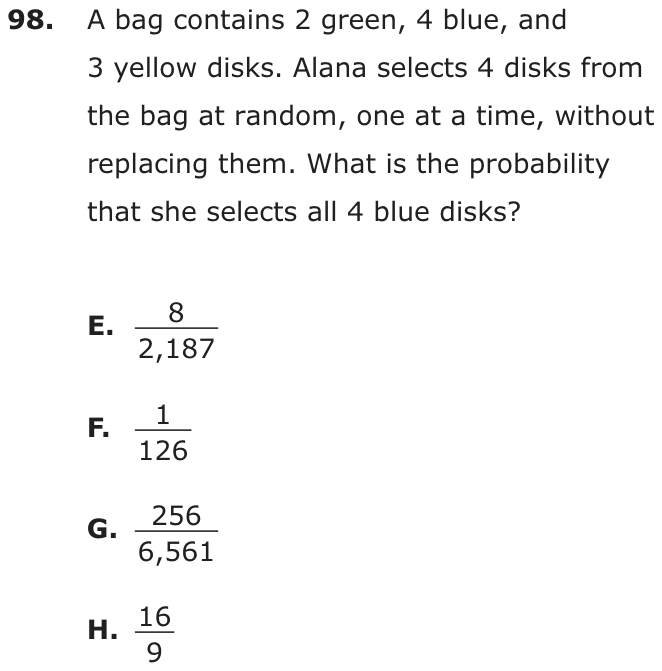
A bag contains 2 green, 4 blue, and 3 yellow disks. Alana selects 4 disks from the bag at random, one at a time, without replacing them. What is the probability that she selects all 4 blue disks?
- A
- B
- C
- D
Show the answer
Correct answer: B
If Alana picks 4 blue disks in a row, the number of blue disks and the total number of disks will both decrease by 1 after each selection.
For the first selection, there are 4 blue disks out of 9 total disks, so the probability of selecting the first blue disk is .
The probabilities of selecting blue for the next three selections are , , and .
Question analysis
A bag holds green, blue and yellow disks, and Alana draws four of them one at a time without putting any back. Students find the probability that all four disks are blue. It tests the probability of dependent events, and the difficulty is keeping track of how the bag changes after each draw.
- NYS standards
- Grade level
- Grade 7 content, by NYS standard
- Compared with grade 7
- Above grade 7 Grade 7 compound probability is usually found with lists or tree diagrams for two stages. Four dependent draws, each changing the counts, are too many to list and need the multiplication rule, which grade 7 does not formally teach.
- Estimated difficulty
- Hard: combines ideas, needs a plan, and has more than one tempting wrong answer.
- Thinking it demands
- Depth of knowledge 2, skills and concepts · mainly apply
- What makes it hard
- Something you must already know moderate
- Error-prone arithmetic moderate
- Solution
- 3 steps
- Reading level
- Question and choices: about grade 5, 37 words.
- Students, last 30 days
- Not enough answers yet to show (it takes 10).
Why it is hard, traps and wrong answers (shows the answer)
Why it is hard
Students who know the multiplication rule for successive draws still have two adjustments to make on every draw, and each wrong choice skips at least one of them. Leaving the bag at 9 disks, or putting each disk back, both produce fractions over 6,561 that look as exact as the right one. Writing the four fractions in a row before multiplying, and cancelling as you go, keeps the arithmetic small.
Something you must already know moderate Working it out
The rule for successive draws without replacement is assumed: each draw's chance is multiplied in, with both the blue count and the total lowered by one. (Anderson & Krathwohl, 2001)
Error-prone arithmetic moderate Working it out
The product 4/9 × 3/8 × 2/7 × 1/6 = 24/3,024 has to be reduced to 1/126, and two wrong choices hide behind 9 to the fourth power, 6,561. (Brown & Burton, 1978; Junker & Sijtsma, 2001)
Strategy: Write the chance of blue for each of the four draws in turn, lowering both the blue count and the total by one each time, and multiply.
Traps
- Without replacement: In a second pick there is one fewer item, which changes the probability.
- Wrong operation: Adds instead of multiplying, divides the wrong way round, turns a ratio or rate upside down, or undoes a step in the wrong direction (subtracts what should be added back).
The wrong answers, classified
A Without replacement (Fischbein & Schnarch, 1997)
Lowers the blue count on each draw but keeps all 9 disks in the bag, 4 × 3 × 2 × 1 over 9 × 9 × 9 × 9, which is 24/6,561 = 8/2,187.
C Without replacement (Fischbein & Schnarch, 1997)
Uses 4/9 for every draw, (4/9) to the fourth power = 256/6,561, as if each disk were put back before the next draw.
D Wrong operation (Hegarty, Mayer & Monk, 1995; King et al., 2004)
Adds the first draw's 4/9 four times, or multiplies it by 4, instead of multiplying the draws' chances, and misses that a probability cannot exceed 1.
Worked solution, step by step
Formulas used
- Probability
- P is the probability, the chance that something happens. It is a number from 0 to 1. The top counts the results you want. The bottom counts all the results that can happen. It works when every result is equally likely.
- Chance of events in a row
- A and B are two events that happen one after the other. P(A) is the chance of the first. P(B after A) is the chance of the second, counting only what is left after the first. You multiply because the second must also happen inside the share of times the first did.
Sort out the question
The bag holds 2 green, 4 blue and 3 yellow disks. That is 9 disks in all. Alana takes 4 disks, one at a time.
“Without replacing them” means a disk she takes does not go back in the bag. You need the chance that all 4 disks are blue.
Find the chance for each pick
For all 4 to be blue, each pick must be blue. After each blue pick, one blue disk is gone. One disk is gone from the total, too. So the top and the bottom each go down by 1.
Pick Blue disks left Disks left Chance of blue 1st 4 9 2nd 3 8 3rd 2 7 4th 1 6 Multiply the four chances
All four picks must go right, one after another. Use the rule for events in a row and multiply.
Simplify the fraction
Divide the top and the bottom by 24. That keeps the value the same.
Watch out: Using for every pick gives , choice C. That is right only if each disk goes back in. Keeping 9 on the bottom each time gives , choice A. Choice D is more than 1, and no chance can be more than 1.
So the answer is B, .
Check your answer
Cancel before you multiply. On top, cancels the 8 on the bottom. That leaves . Divide the top and bottom by 3 to get again.
More questions like this
The original DOE question