Question
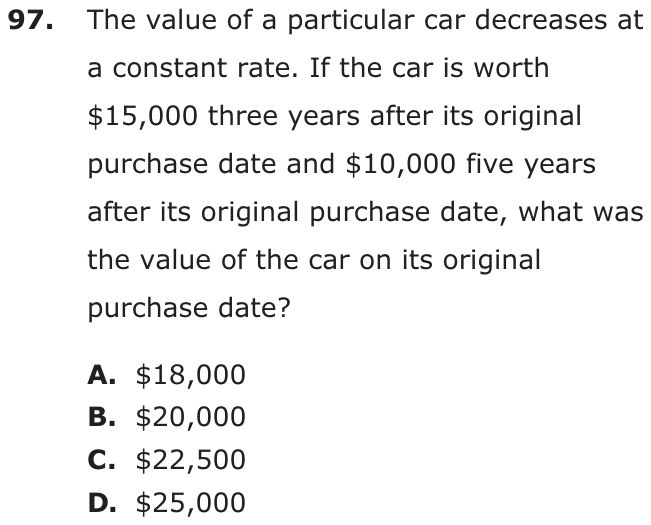
The value of a particular car decreases at a constant rate. If the car is worth $15,000 three years after its original purchase date and $10,000 five years after its original purchase date, what was the value of the car on its original purchase date?
- A$18,000
- B$20,000
- C$22,500
- D$25,000
Show the answer
Correct answer: C
The value of the car decreased $5,000 in two years: $15,000 to $10,000.
Therefore, the value of the car decreases $2,500 each year. After the first 3 years, the car’s value had decreased $7,500.
So .
Question analysis
A car loses value at a constant rate, and its worth three years and five years after purchase is given. Students find what the car was worth on the day it was bought. It tests rate of change and initial value in a linear relationship, and the tricky part is counting the right number of years when working back.
- NYS standards
- 8.F.4 modeling with linear functions
- Grade level
- Grade 8 content, by NYS standard
- Compared with grade 7
- Above grade 7 Finding a starting value from two later values of a steady change is grade 8 linear-function work. A grade 7 student can reason with a yearly rate, but extending it back to the purchase date goes beyond typical grade 7 problems.
- Estimated difficulty
- Moderate: several steps, or a close reading with one strong distractor.
- Thinking it demands
- Depth of knowledge 2, skills and concepts · mainly apply
- What makes it hard
- Turning words into math moderate
- Many steps minor
- Solution
- 3 steps
- Reading level
- Question and choices: about grade 10, 43 words.
- Students, last 30 days
- Not enough answers yet to show (it takes 10).
Why it is hard, traps and wrong answers (shows the answer)
Why it is hard
The question is a straight-line pattern read backward, and its numbers are friendly; the difficulty is counting years correctly. The $5,000 drop happens over 2 years, not 5, and the purchase lies 3 years before the $15,000 value, not 2. Each miscount gives a listed answer, so sketching a timeline from year 0 to year 5 before computing pays off.
Turning words into math moderate Understanding the question
The phrases "three years after its original purchase date" and "five years after" must become points at year 3 and year 5 on a timeline whose start, year 0, holds the unknown value. (Hegarty, Mayer & Monk, 1995; Koedinger & Nathan, 2004)
Many steps minor Working it out
Three moves are chained: the $5,000 drop over 2 years, the $2,500 yearly rate, and three years of that rate added back to $15,000. (Daniel & Embretson, 2010; Enright, Morley & Sheehan, 2002)
Strategy: Find the yearly drop from the change between the two given years, then add that drop back once for each year between the purchase and year 3.
Traps
- Counting the ends: Inclusive or exclusive ends, fence posts, consecutive numbers: an answer that is one too many or too few, or an endpoint drawn open where it belongs closed (or the reverse).
- Misreads the question: Misses or misreads a condition or a word in the question: "at least", "each", "remaining", "not".
- Numbers taken from the question: Combines the numbers in the question without a model of the situation, or is simply a number that appears in the question.
The wrong answers, classified
A Misreads the question (Hegarty, Mayer & Monk, 1995)
Divides the $5,000 drop by 5, the year of the second value, instead of the 2 years between year 3 and year 5, then adds back 3 × $1,000.
B Counting the ends (Brown & Burton, 1978)
Adds back the $5,000 two-year drop once, which gives the value at year 1, one year short of the 3 years back to the purchase.
D Numbers taken from the question (Hegarty, Mayer & Monk, 1995)
Adds the two given values, $15,000 + $10,000, combining numbers from the question without a model of the steady decrease.
Worked solution, step by step
Formulas used
- Rate of change
- change in value is how many dollars the value went up or down. change in time is how many years passed. rate is the change for one year. A constant rate means the change is the same every year.
Sort out the question
The car’s value “decreases at a constant rate.” That means the car loses the same number of dollars each year. Year 0 is the day it was bought.
Year Value 0 ? 3 $15,000 5 $10,000 You need the value at year 0.
Find the drop for one year
From year 3 to year 5 is 2 years. In that time, the value fell by dollars.
The car loses $2,500 each year. Watch out: Divide by the 2 years between the values, not by 5. Dividing by 5 leads to $18,000, choice A.
Go back to year 0
From year 0 to year 3 is 3 years. The car lost $2,500 in each of them. So add that amount back 3 times.
Watch out: Adding back only one $5,000 gives $20,000, choice B. That is the value at year 1, not year 0.
So the answer is C, $22,500.
Check your answer
Count forward from $22,500, taking off $2,500 each year. Year 1 is $20,000. Year 2 is $17,500. Year 3 is $15,000. Year 4 is $12,500. Year 5 is $10,000. Both given values match.
More questions like this
The original DOE question