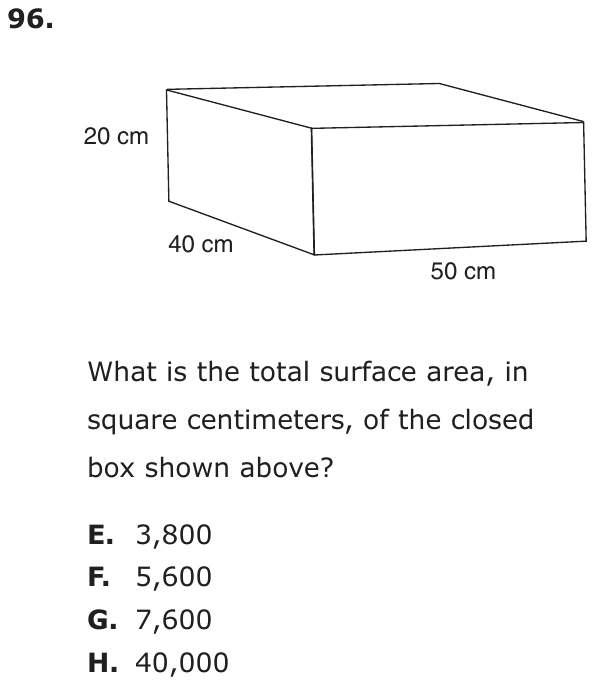
Question
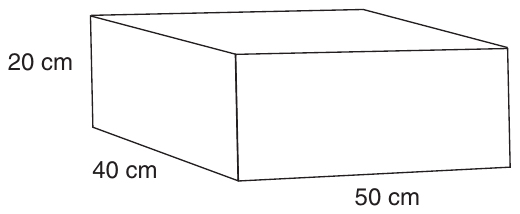
What is the total surface area, in square centimeters, of the closed box shown above?
- A3,800
- B5,600
- C7,600
- D40,000
Show the answer
Correct answer: C
To find surface area, use the formula :
Question analysis
A drawing of a closed box gives its length, width and height in centimeters, and students find its total surface area in square centimeters. It tests surface area of a rectangular prism. The work is short, but every face of the box has to be accounted for, and surface area must be kept apart from volume.
- Grade level
- Grade 7 content, by NYS standard
- Compared with grade 7
- At grade 7 Surface area of a rectangular prism is a grade 7 standard, and this box has whole-number dimensions shown in a drawing. Three face areas, a sum and the opposite faces make it typical practice rather than a stretch.
- Estimated difficulty
- Straightforward: two steps or one careful reading.
- Thinking it demands
- Depth of knowledge 1, recall and reproduction · mainly apply
- What makes it hard
- Solution
- 3 steps
- Reading level
- Question and choices: about grade 8, 15 words.
- Students, last 30 days
- Not enough answers yet to show (it takes 10).
Why it is hard, traps and wrong answers (shows the answer)
Why it is hard
Finding the three face areas, 800, 1,000 and 2,000, is quick; the question tests whether students account for all six faces. The wrong choices are what the box would give with only three faces, with the top left off, or with the dimensions multiplied into a volume. Listing the faces in pairs before adding is the safest route.
Something you must already know minor Working it out
No surface-area formula is given; students must know that a box's six faces come in three matching pairs, 20 × 40, 20 × 50 and 40 × 50. (Anderson & Krathwohl, 2001)
Reading a figure, table or graph minor Understanding the question
The drawing shows only three faces and labels 20, 40 and 50 cm on separate edges, so the hidden faces and their dimensions have to be pictured. (Lesh, Post & Behr, 1987; Kirsch & Mosenthal, 1990)
Strategy: Find the areas of the three different faces from the labeled length, width and height, add them, and double the sum to cover the opposite faces.
Traps
- Stops one step early: A choice is a number from partway through the solution.
- Wrong formula: Uses a related but wrong formula: perimeter for area, diameter for radius, area for volume, or a misremembered one.
- Misreads the question: Misses or misreads a condition or a word in the question: "at least", "each", "remaining", "not".
The wrong answers, classified
A Stops one step early (King et al., 2004; Gierl et al., 2017)
Adds the three different face areas, 800 + 1,000 + 2,000 = 3,800, and stops before doubling for the matching opposite faces.
B Misreads the question (Hegarty, Mayer & Monk, 1995)
Leaves out the 40-by-50 top, as for an open box, 7,600 − 2,000 = 5,600, though the stem says the box is closed.
D Wrong formula (King et al., 2004)
Multiplies the three dimensions, 20 × 40 × 50 = 40,000, which is the box's volume in cubic centimeters, not its surface area.
Worked solution, step by step
Formulas used
- Surface area of a box
- SA is the surface area, the total area of all six faces. l is the length, w is the width and h is the height. lw, lh and wh are the areas of the three different faces. You double because each face has a matching face on the opposite side.
Sort out the question
The box is a rectangular prism, a box shape with six rectangle faces. Its length is 50 cm, its width is 40 cm and its height is 20 cm.
The box is closed, so it has a top. Surface area is the total area of all the outside faces, in square centimeters.
Find the three different faces
The faces come in matching pairs. Find the area of one face from each pair. Multiply its two edges.
Faces Edges Area of one (sq cm) Front and back 50 × 20 1,000 Left and right 40 × 20 800 Top and bottom 50 × 40 2,000 Add the faces and double
Use the formula. Add the three areas. Then double the sum to cover the matching faces you can’t see.
The surface area is 7,600 square centimeters.
Avoid the traps
Watch out: Stopping at 3,800 counts only three faces, choice A. Leaving off the top, as for an open box, gives 5,600, choice B. Multiplying all three edges gives 40,000, choice D. That is the volume, in cubic centimeters.
So the answer is C, 7,600.
Check your answer
Add all six faces one by one: . Also check the units. Area multiplies two lengths, so it is in square centimeters. Multiplying three lengths gives cubic units, which is volume.
More questions like this
The original DOE question